 Colorado Criminal Lawyer Blog
How to Challenge aThe Good-Faith ExceptionAfter a Home Raid


Quick Answer
To challenge a search warrant in Colorado after a home raid, your attorney first obtains the warrant, the sworn affidavit, and the return, then files a motion to suppress and for return of property under Crim. P. 41(e). The motion can attack probable cause, particularity, the way the warrant was executed, or false statements in the affidavit. If the court agrees, the evidence and its fruits are excluded unless the prosecution proves the good-faith exception applies. The sooner a defense lawyer reviews the paperwork, the more options you keep.
Officers arrive early in the morning. Someone hands you a stack of papers, and for the next several hours strangers go through your bedroom, your closets, your phone, and your files. Whether the raid involved drugs, a fraud investigation, a sex-crime allegation, or something else, the warrant is the government’s permission slip. If that permission slip was defective, the evidence officers carried out of your home may never reach a jury.
This guide explains how Colorado criminal defense lawyers attack search warrants, what the law actually requires, and what to do (and avoid) in the first hours. It is general information, not advice about your particular case.
What to Do in the First Hours After a Home Raid
The first hours shape the rest of the case. Your goal is to protect your rights without giving prosecutors anything extra and without creating a new problem for yourself.

- Do not consent to anything beyond the warrant. Consent can erase a warrant defect. If an officer asks whether they can also look in the garage or your car, the safe answer is a polite, clear no. Our article on police contact and advisements before a search explains why.
- Do not try to explain. Statements made during a raid are used at trial. Say you want a lawyer and stop talking. Whether a statement can be suppressed is a separate question from whether the search was lawful, as discussed in our piece on Miranda warnings and suppression of statements.
- Do not touch, move, or delete anything. Wiping a phone or hiding items once officers have announced a search can invite a separate charge under the tampering statute, C.R.S. 18-8-610.
- Stay off social media and away from phone calls about the case. See how social media posts become evidence in Colorado criminal cases.
- Write down what happened, for your lawyer only. Note the time officers arrived, who was present, which rooms they searched, whether they knocked, what was damaged, and what they took.
Step One: Get the Warrant, the Affidavit, and the Return
A warrant challenge is built on paper. Three documents matter most:
- The warrant says what officers may search for and where. Its text sets the outer limit of their authority.
- The affidavit is the sworn statement that persuaded the judge. Under C.R.S. 16-3-303(1), a warrant issues only on an affidavit sworn or affirmed before the judge that relates facts sufficient to describe the place and property, and to establish the grounds for the warrant or probable cause to believe they exist. Colorado practice also calls for a district attorney to review the affidavit for legal sufficiency (Crim. P. 41(c)).
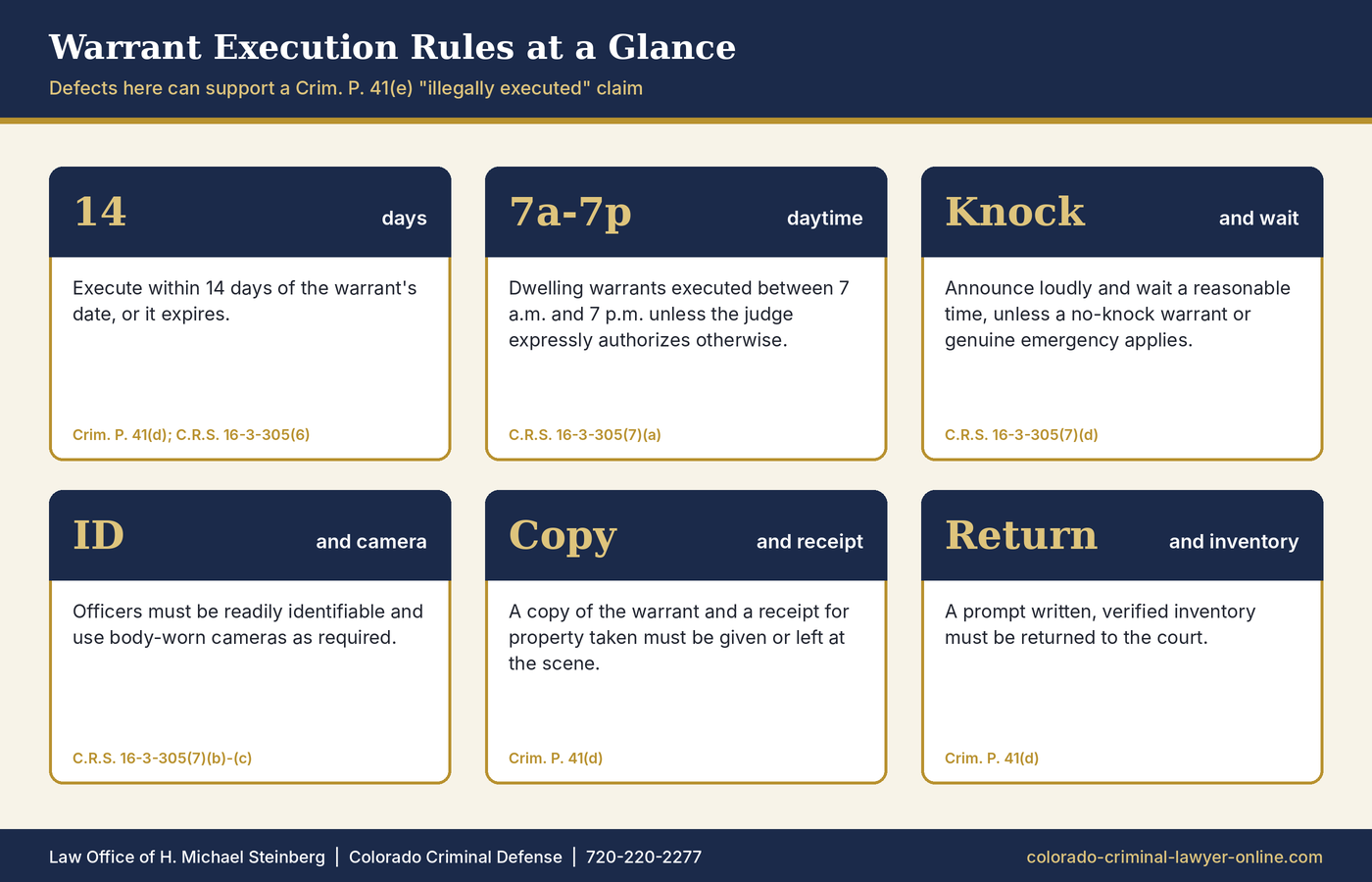
- The return and inventory show what was actually seized, by whom, and when. Under Crim. P. 41(d), officers must give you a copy of the warrant and a receipt for the property taken (or leave them at the scene), and the return must be made promptly with a verified written inventory.
Sometimes the affidavit is sealed or redacted early in a case. Your attorney can ask the court for access and can request related discovery, including body-worn camera footage, dispatch logs, photographs, and forensic reports.
Colorado’s Search Warrant Framework
- Fourth Amendment and Colo. Const. art. II, § 7: probable cause supported by oath or affirmation, with a particular description of the place to be searched and the things to be seized.
- C.R.S. 16-3-301 through 16-3-308: who may issue warrants, what the application and warrant must contain, how warrants are executed, and when unlawfully obtained evidence is admissible.
- Colo. R. Crim. P. 41: application, issuance, execution, and return of warrants, and the motion to suppress in Rule 41(e).
Step Two: Confirm You Have Standing
To contest a search, you must have a legitimate expectation of privacy in the place searched or the things seized. The United States Supreme Court framed that test in Rakas v. Illinois, 439 U.S. 128 (1978). Your own home is the clearest case. Overnight guests, tenants, and others can also qualify depending on the facts, which is why your lawyer will ask who lived where, who had keys, and where each device and item was found.
Colorado’s rule is also broad. Crim. P. 41(e) allows “a person aggrieved by an unlawful search and seizure” to seek return of property. A Colorado appellate court held in Boudette, 425 P.3d 1228 that a person whose property was seized, and who had not been charged, could still bring a Rule 41(e) motion for its return.
The Five Grounds Under Crim. P. 41(e)
Rule 41(e) lists exactly five grounds for a motion for return of property and to suppress evidence. Nearly every warrant challenge fits one or more of them.
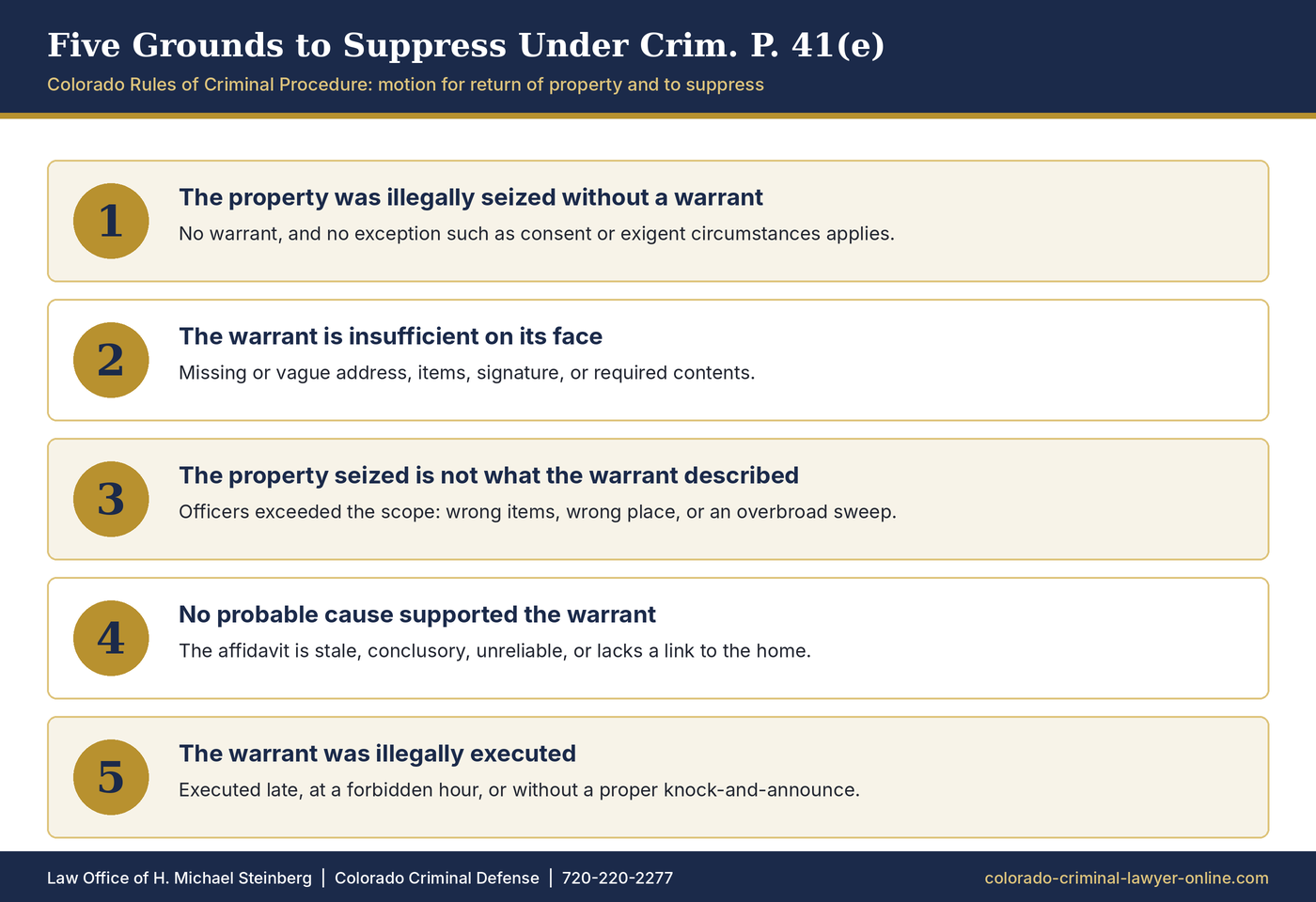

| Ground | What it can look like after a home raid | Evidence a defense lawyer uses |
|---|---|---|
| 1. Seized without a warrant | Officers search a room, unit, or vehicle the warrant never covered, or return for a second search. | Warrant text, body-camera video, floor plans, witness testimony |
| 2. Warrant insufficient on its face | Wrong address, no description of the items, or missing required contents. | The warrant itself, compared against C.R.S. 16-3-304 |
| 3. Property seized is not what was described | Officers take phones, documents, or cash the warrant never listed. | Inventory compared with the warrant’s item list, photographs |
| 4. No probable cause for the warrant | The affidavit is stale, conclusory, relies on an unreliable source, or never ties the home to a crime. | The affidavit’s four corners, informant history, public records |
| 5. Warrant illegally executed | Executed late, at night without authorization, or without a proper knock and announcement. | Return, timestamps, dispatch logs, body-camera video |
Attacking Probable Cause Inside the Four Corners
Colorado courts decide probable cause from within the four corners of the affidavit. As the Colorado Supreme Court put it in People v. Randolph, 4 P.3d 477 (Colo. 2000), the question is whether the affidavit contains enough facts to warrant a person of reasonable caution to believe evidence of a crime is at the place to be searched. Colorado applies the totality-of-the-circumstances test from Illinois v. Gates, 462 U.S. 213 (1983). Facts an officer knew but never wrote down cannot rescue a thin affidavit.
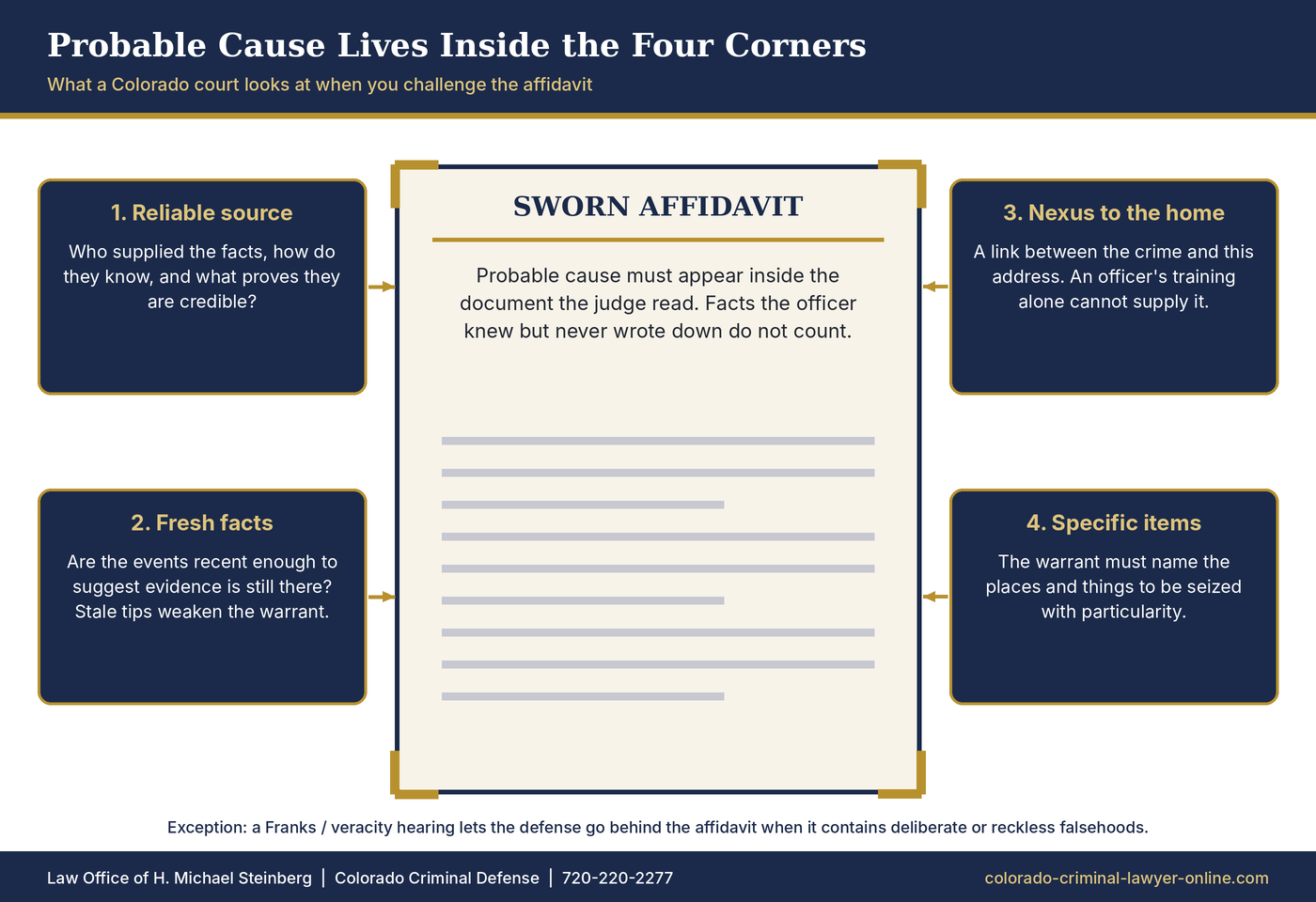
Defense lawyers typically press four questions:
- Is the source reliable? An affidavit that relies on an informant must explain how the informant knows what they claim and why they should be believed. In People v. Pacheco, No. 06SA132 (Colo. Oct. 10, 2006), the Colorado Supreme Court affirmed suppression where the affidavit leaned on old anonymous tips and a conclusory informant account, and it held the good-faith exception did not apply.
- Are the facts fresh? Old information weakens the inference that evidence is still in the home. In People v. Miller, No. 03SA107 (Colo. Sept. 8, 2003), the court affirmed suppression of evidence from a home search and held the good-faith exception inapplicable. Staleness is fact-specific, though. In People v. Cooper, 2016 CO 73, the court reversed a suppression order because the affidavit described an ongoing drug-trafficking pattern, so an officer could reasonably rely on the warrant.
- Is there a nexus to the home? The affidavit must connect the suspected crime to this address. Annotations to C.R.S. 16-3-303 collect Colorado decisions holding that an officer’s training and experience cannot substitute for an evidentiary link between the place and the criminal activity. See also People v. Kazmierski, No. 00SA395 (Colo. June 25, 2001), which addressed the residence nexus and declined to apply good faith.
- Does the affidavit say more than it proves? Boilerplate, conclusions, and opinions are not facts. Our earlier article on the changing face of probable cause for search warrants in Colorado walks through how courts have treated thin affidavits.
Particularity and Scope: Phones, Computers, and Cloud Accounts
Both the Fourth Amendment and C.R.S. 16-3-303(1) require a warrant to identify the place and the property to be searched for and seized. That requirement has grown in importance because a home raid almost always includes digital devices. The United States Supreme Court recognized in Riley v. California that a phone holds the privacies of a person’s life, and Colorado courts have followed with real limits.
- In People v. Coke, 2020 CO 28, the Colorado Supreme Court held that a warrant authorizing a search of everything on a cellphone, with no limit tied to the alleged victim or the time of the offense, violated the particularity requirement. The trial court’s exclusion of the evidence stood.
- In People v. Thompson, 2021 CO 15, the court affirmed suppression and held that the prosecution could not cure a defective first warrant simply by obtaining a second warrant for data it already held. The People had to prove the later search was genuinely independent of the first, and they did not. The trial court had also rejected good faith because Coke had already put officers on notice.
If officers took your devices, your lawyer will look at whether the warrant limited the search by date range, subject matter, and account, and whether the search of the device’s contents went beyond those limits. For more, see our article on cell phone searches and seizures under Colorado law.
Execution Defects: Time, Knock, Cameras, and Paperwork
A warrant that was valid when signed can still be executed unlawfully. Colorado’s execution rules are found in C.R.S. 16-3-305 and Crim. P. 41(d).
- Timing. A warrant must be executed within 14 days of its date. Dwelling warrants are executed between 7 a.m. and 7 p.m. unless the judge expressly authorizes another time for good cause.
- Knock and announce. For a dwelling, officers must announce their presence loudly enough that they reasonably believe occupants can hear, then wait a reasonable time based on the size of the home. Exceptions apply when a court has authorized a no-knock warrant or when objective circumstances show an emergency threatening life or risking grave injury that law enforcement did not create.
- No-knock warrants. Colorado tightened these in 2023 (2023 Colo. Sess. Laws ch. 395), and a 2025 amendment to Crim. P. 41(c) requires an affidavit seeking a no-knock warrant to specifically request one and to establish that no-knock entry is necessary because of a credible threat to the life of any person, including the officers.
- Identification and cameras. Officers executing a dwelling warrant must be readily identifiable as law enforcement and must wear and activate body-worn cameras as required by statute. That footage is often the best evidence of what actually happened.
- Paperwork. You are entitled to a copy of the warrant and a receipt for what was taken, and the return and inventory must be filed promptly.
One honest caution: in Hudson v. Michigan, 547 U.S. 586 (2006), the United States Supreme Court held that the federal exclusionary rule does not apply to knock-and-announce violations. Whether and how a Colorado court will suppress evidence for a violation of Colorado’s own statute depends on the facts and the claims raised. A knock-and-announce failure may still matter to the credibility of the officers who testify and to other grounds on the same motion.
When the Affidavit Contains Lies or Omissions
Sometimes the problem is not what the affidavit leaves out of the four corners, but what it puts inside them. In Franks v. Delaware, 438 U.S. 154 (1978), the Supreme Court held that a defendant who makes a substantial preliminary showing that the affiant included a knowingly or recklessly false statement, and that the statement was necessary to probable cause, is entitled to a hearing. If the defense proves the falsehood and the corrected affidavit no longer establishes probable cause, the warrant is void and the fruits of the search are excluded.
Colorado recognized veracity challenges even before Franks, and Colorado decisions allow attacks on material omissions as well as affirmative misstatements. A helpful overview is Veracity Challenges in Colorado: A Primer, The Colorado Lawyer (Feb. 1985). The practical challenge is that you need specifics: records that contradict the affidavit, an informant’s actual history, or body-camera video showing the facts were different. A misrepresentation also defeats the good-faith presumption discussed below.
A warrant is only as strong as the sworn facts behind it. If the facts were thin, stale, or wrong, the warrant falls, and what officers found under it may fall with it.
The Good-Faith Exception: The Prosecution’s Best Response
Even a defective warrant does not always mean suppression. Colorado codified a good-faith exception in C.R.S. 16-3-308 in 1981, three years before the United States Supreme Court announced a similar rule in United States v. Leon, 468 U.S. 897 (1984). Under the statute, otherwise admissible evidence is not suppressed if an officer obtained it through a good-faith mistake or a technical violation. A “good faith mistake” is a reasonable error in judgment about facts or law, and a “technical violation” includes reasonable, good-faith reliance on a warrant later invalidated because of such a mistake. Evidence obtained under a warrant and within its scope is presumed to be in good faith, unless the warrant was obtained through intentional and material misrepresentation.
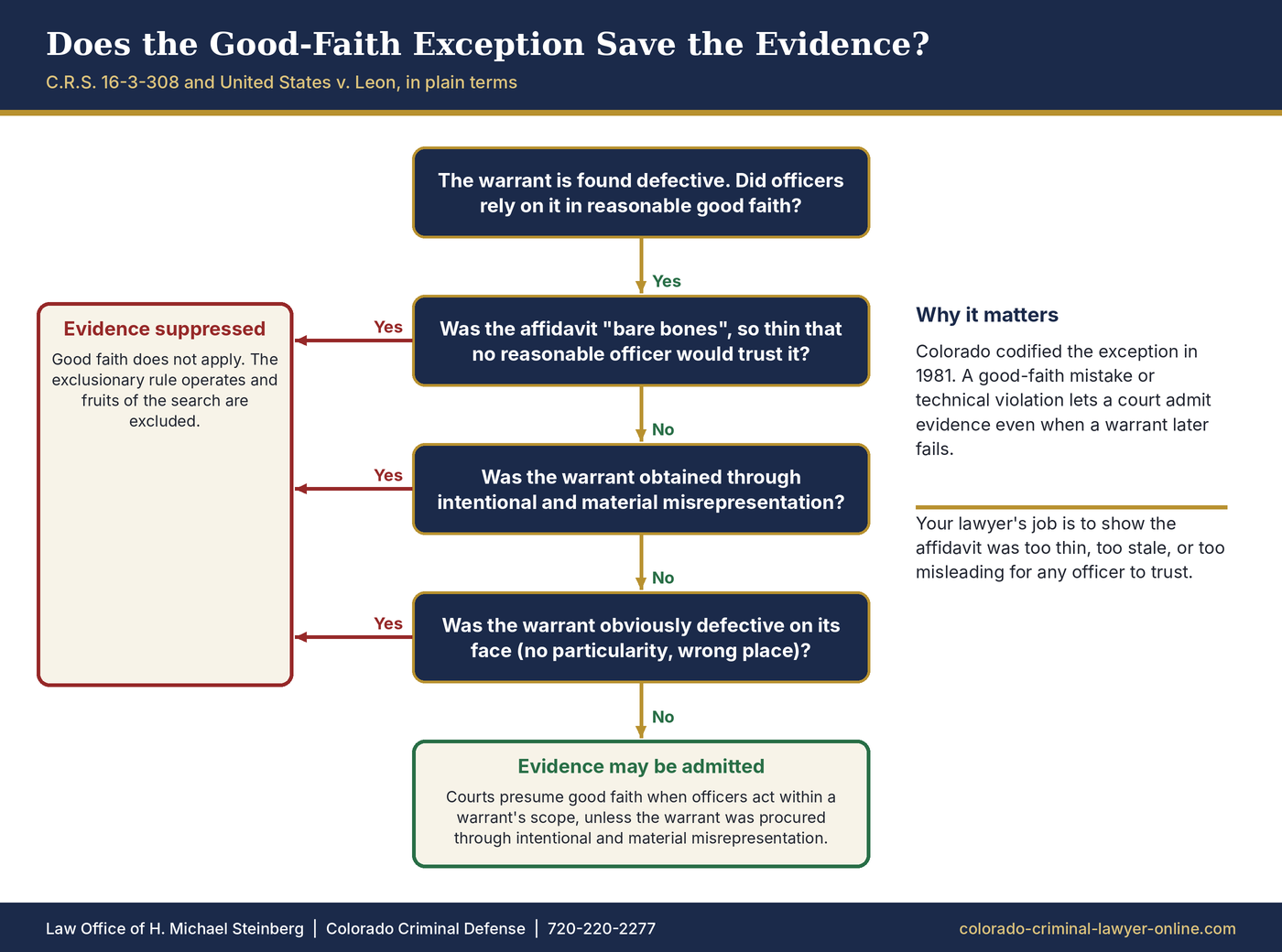
The exception has limits, and that is where a skilled defense is built. Colorado courts have refused to apply it when the affidavit was “bare bones,” meaning it offered conclusions rather than facts a reasonable officer could trust, as in Pacheco, Miller, and Kazmierski above. Your lawyer will also look at who wrote the affidavit and who executed the warrant, whether the defect was obvious on its face, and whether earlier appellate decisions already warned officers about the problem.
Filing the Motion and Winning the Hearing
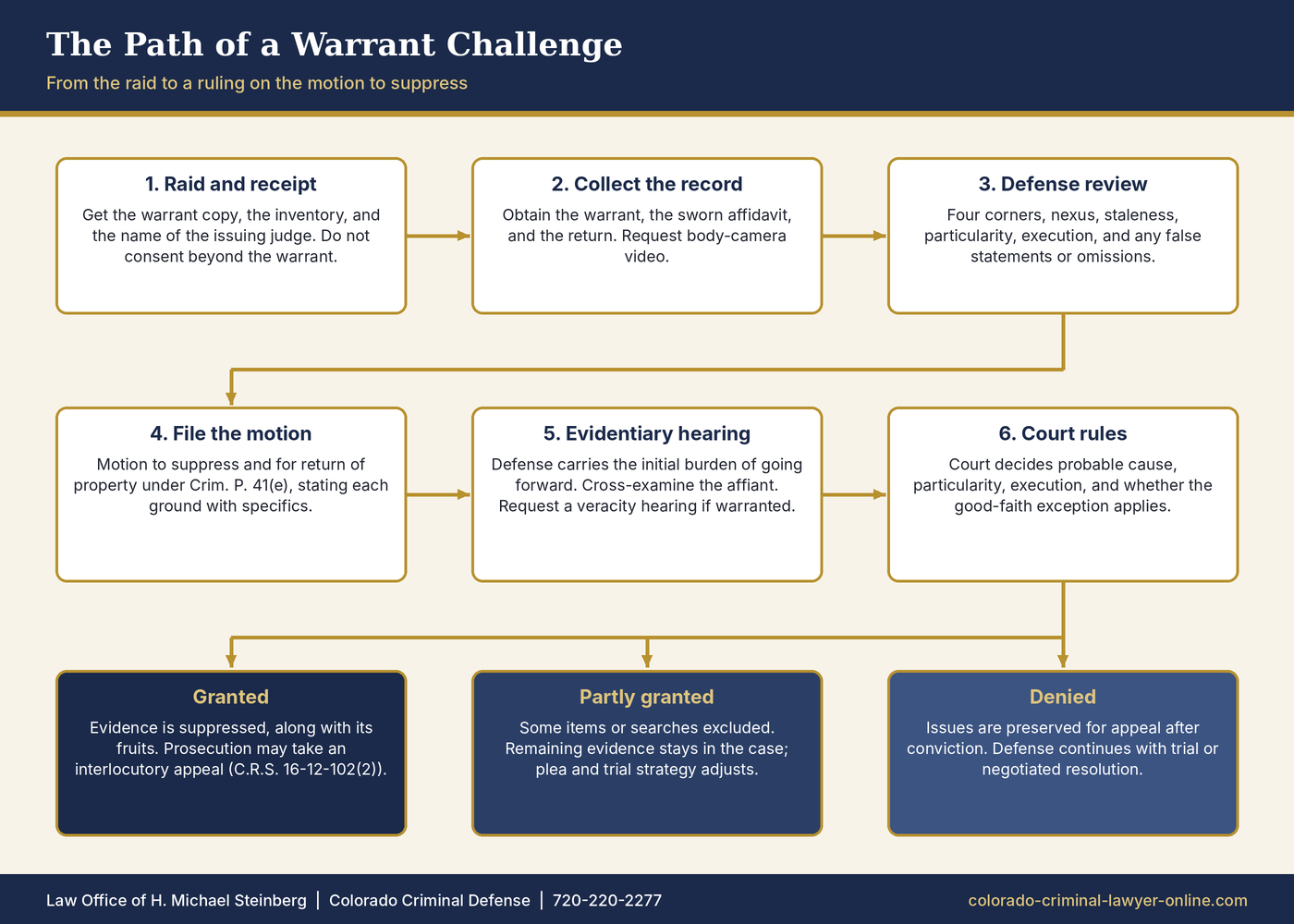
- File a specific motion. The motion is brought under Crim. P. 41(e) in the district court for the county where the property was seized. In People v. Cunningham, 2013 CO 71, the Colorado Supreme Court held that, whether a search was warrantless or under a warrant, the defendant has the initial burden of going forward by showing one of the Rule 41(e) grounds. A vague motion invites denial. Deadlines are set by the court and local practice, so waiting can cost you the issue. Our article on the burden of proof on a Colorado motion to suppress covers this in more detail.
- Use the hearing to build the record. Cross-examine the officer who wrote the affidavit, challenge the informant’s reliability, play the body-camera video, and tie each defect to a specific Rule 41(e) ground and to the Colorado and federal constitutions. This record also decides whether good faith applies and what an appeals court will see.
- Follow the fruits. Under the Wong Sun v. United States, 371 U.S. 471 (1963) doctrine, evidence derived from an unlawful search can also be excluded. The prosecution may respond with exceptions such as independent source. In Thompson, the People carried the burden on that doctrine and failed to meet it. The Supreme Court applied the exclusionary rule to the states in Mapp v. Ohio, 367 U.S. 643 (1961).
- Expect an appeal fight if you win. The prosecution can take an interlocutory appeal of a pretrial suppression order directly to the Colorado Supreme Court under C.R.S. 16-12-102(2), after certifying that the appeal is not for delay and that the evidence is a substantial part of its proof.
- If the motion is denied, the issues are preserved for appeal after conviction, and your defense continues. A separate request for the return of property can also proceed under Rule 41(e).
What happens after evidence is suppressed depends on how central it was. Prosecutors may reassess the charges, negotiate, or in some cases dismiss. No lawyer can promise an outcome, but a successful motion often changes the leverage in the entire case.
Mistakes That Can Sink a Warrant Challenge
- Consenting to extra searching. Consent is one of the most common ways prosecutors avoid a warrant problem.
- Assuming a Miranda problem is a search problem. Miranda governs statements. The lawfulness of a search is decided under the Fourth Amendment, Colorado’s constitution, and the warrant rules above.
- Talking to officers or posting online. Anything you say can be used, and it can also undercut the facts your lawyer needs to prove.
- Destroying or hiding items. It can turn a search-and-seizure defense into a second criminal case.
- Waiting to hire counsel. Evidence goes stale, video gets overwritten, and motion deadlines pass.
Frequently Asked Questions
Can I challenge a search warrant if police found evidence?
Yes. The point of a motion to suppress is to exclude evidence that was found. Under Crim. P. 41(e), you can challenge the warrant’s validity, its probable cause, its scope, and how it was executed.
How long do Colorado police have to execute a search warrant?
A search warrant must be executed within 14 days after its date, under Crim. P. 41(d) and C.R.S. 16-3-305. A search after that window can support an illegal-execution claim.
Can police search my home at night in Colorado?
A warrant for a dwelling is generally executed between 7 a.m. and 7 p.m., unless the judge expressly authorizes another time for good cause under C.R.S. 16-3-305(7). Execution outside those hours without authorization is a defect your lawyer can raise.
What is a no-knock warrant in Colorado?
A no-knock warrant lets officers enter without the usual announcement and waiting period. Colorado limits them under C.R.S. 16-3-303 and the 2025 amendment to Crim. P. 41(c): the affidavit must specifically request one and show that no-knock entry is necessary because of a credible threat to life. Separate emergency exceptions can also apply.
Does a defective warrant mean my case will be dismissed?
Not automatically. The court may find the good-faith exception applies, and the prosecution may have other evidence untouched by the search. A successful motion can still weaken the case significantly, depending on what was suppressed.
Do I have to be charged before I can ask for my property back?
No. Crim. P. 41(e) allows a person aggrieved by an unlawful search and seizure to move for return of property, and a Colorado appellate court has confirmed in Boudette that a person who was not charged can bring that motion.
Was Your Home Searched? Talk to a Colorado Criminal Defense Attorney.
The Law Office of H. Michael Steinberg has defended Colorado criminal cases for over forty years, including serious drug, sex crime, and felony cases that begin with a search warrant. If officers searched your home, call 720-220-2277 or contact the firm online for a confidential consultation. Learn more about our practice areas, including drug crimes and sex crimes.
Related Reading
- Colorado Criminal Law: Motion to Suppress Evidence and the Burden of Proof
- The Changing Face of Probable Cause for Search Warrants in Colorado
- Cell Phone Searches and Seizures Under Colorado Law
- Colorado Citizen Police Contact: Advisement Before Search
- Search and Seizure Law: Have You Been “Seized” by a Police Officer?
- Preliminary Hearings in Colorado: The Probable Cause Standard
- More articles in Search and Seizure Laws
Authorities Cited
- U.S. Const. amend. IV; Colo. Const. art. II, § 7
- C.R.S. 16-3-301; 16-3-303; 16-3-304; 16-3-305; 16-3-308; 16-12-102(2); 18-8-610
- Colo. R. Crim. P. 41; Rule Change 2025(16); 2023 Colo. Sess. Laws ch. 395
- People v. Cunningham, 2013 CO 71; People v. Cooper, 2016 CO 73; People v. Coke, 2020 CO 28; People v. Thompson, 2021 CO 15
- People v. Miller, No. 03SA107 (Colo. 2003); People v. Pacheco, No. 06SA132 (Colo. 2006); People v. Kazmierski, No. 00SA395 (Colo. 2001); People v. Randolph, 4 P.3d 477 (Colo. 2000); Boudette, 425 P.3d 1228
- Franks v. Delaware, 438 U.S. 154 (1978); Illinois v. Gates, 462 U.S. 213 (1983); United States v. Leon, 468 U.S. 897 (1984); Hudson v. Michigan, 547 U.S. 586 (2006); Riley v. California, 573 U.S. 373 (2014); Rakas v. Illinois, 439 U.S. 128 (1978); Wong Sun v. United States, 371 U.S. 471 (1963); Mapp v. Ohio, 367 U.S. 643 (1961)
- Veracity Challenges in Colorado: A Primer, The Colorado Lawyer (Feb. 1985)
This article is general legal information current as of October 24, 2026. It is not legal advice, and reading it does not create an attorney-client relationship with the Law Office of H. Michael Steinberg. Laws and court decisions change, and every case turns on its own facts. Attorney advertising. Prior results do not guarantee a similar outcome.