 Colorado Criminal Lawyer Blog
Colorado Marijuana vs. Alcohol DUI: Testing and Evidence


Colorado Marijuana vs. Alcohol DUIs
A Colorado DUI is a DUI whether the allegation involves a beer, a “joint,” a prescription pill or a mix. But the proof looks very different. An alcohol case usually turns on a breath or blood number measured against a bright-line 0.08 limit. A marijuana case has no bright line at all: prosecutors lean on a blood THC level, an officer’s observations and, often, a Drug Recognition Expert’s opinion, and each of those can be questioned in ways an alcohol case cannot.
I am H. Michael Steinberg, a Denver criminal defense attorney with more than 40 years of experience. This guide walks through how Colorado law treats alcohol and marijuana DUIs, how the testing works, what the evidence really shows, and where a defense typically begins. It reflects Colorado law and agency sources as of October 27, 2026.
KEY TAKEAWAYS
- Alcohol: a BAC of 0.08 or higher within two hours of driving is DUI per se under C.R.S. § 42-4-1301(2)(a).
- Marijuana: Colorado has no per se THC limit. Five nanograms per milliliter (5 ng/mL) of delta-9 THC in whole blood only permits a jury to infer impairment (§ 42-4-1301(6)(a)(IV)).
- A breath machine measures alcohol, not THC, so marijuana cases usually rest on blood evidence and officer opinion.
- Refusing a test is not a safe harbor. It is admissible at trial and carries a longer license revocation than a failed test (§ 42-2-126).
- A medical marijuana card is not a defense to DUI.
One DUI law, two very different kinds of proof
Colorado’s DUI statute covers driving under the influence of alcohol, one or more drugs, or any combination. Under C.R.S. § 42-4-1301, DUI requires proof that the driver was “substantially incapable” of safely operating a vehicle, while DWAI (driving while ability impaired) requires only that the driver was affected “to the slightest degree” and so less able than normal. DUI is a strict-liability offense, and a medical marijuana entitlement is not a defense (§ 42-4-1301(1)(e)).
The difference is in how the State gets from “the driver used a substance” to “the driver was impaired.” Alcohol has a statutory number. Marijuana does not. The graphic below summarizes the contrast.
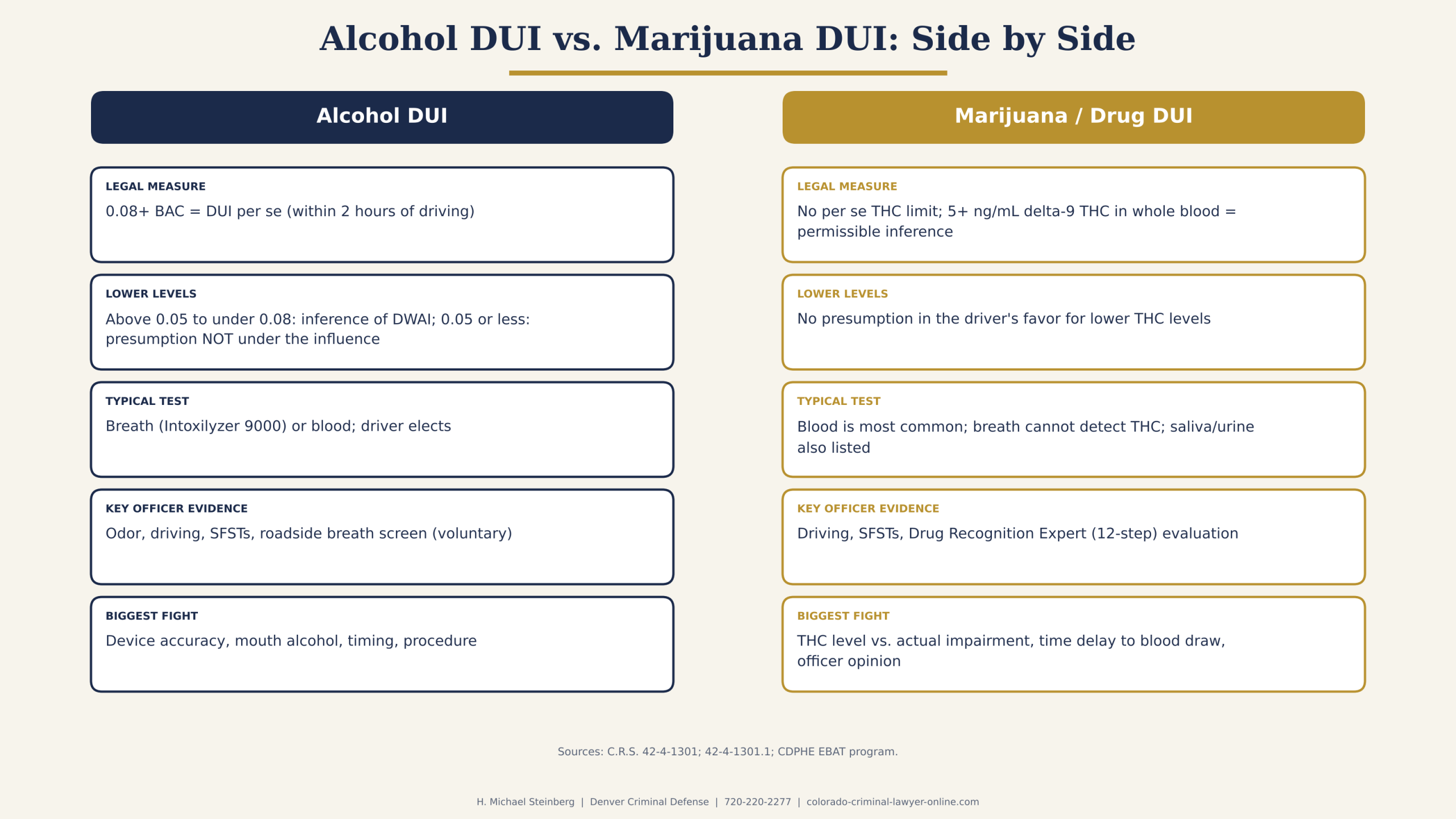
Alcohol DUI vs. marijuana DUI in Colorado: the legal measure,
the testing and where the fight usually is.
How Colorado proves an alcohol DUI
The BAC thresholds
Alcohol is the only substance for which Colorado writes numbers into the statute. A blood or breath alcohol content (BAC) of 0.08 or more at the time of driving or within two hours afterward is DUI per se, and a driver who drank after driving has an affirmative defense (§ 42-4-1301(2)(a)). The statute also sets graduated inferences under § 42-4-1301(6)(a):
- 0.05 or less: a presumption that the driver was not under the influence.
- More than 0.05 but less than 0.08: a permissible inference that the driver’s ability was impaired (DWAI).
- 0.08 or more: a permissible inference that the driver was under the influence (DUI).
Even with a per se number, the statute lets a defendant show a disparity between the test result and the other facts of the case (§ 42-4-1301(2)(b)). A number is evidence, not the end of the analysis.
Breath tests
Colorado law enforcement uses the Intoxilyzer 9000, operated by certified operators under Board of Health rules (5 CCR 1005-2) administered through the CDPHE Evidential Breath Alcohol Testing (EBAT) program. The instrument reports grams of alcohol per 210 liters of breath, and CDPHE’s own Intoxilyzer resources acknowledge residual mouth alcohol as a known interferent.
Courts may take judicial notice of CDPHE-certified devices, but the State must still show a particular device was working properly, and noncompliance with CDPHE rules generally goes to the weight of the result unless it undermines validity (§ 42-4-1301(6)(c), (6)(f)).
The program has had controversy. In 2017, a former CDPHE employee alleged improper signatures on instrument certifications, an episode covered by 9News that led defense lawyers to scrutinize certification records more closely.
Blood tests
A driver may choose a blood test instead of a breath test for alcohol, and the election generally cannot be changed afterward (§ 42-4-1301.1(2)(a)). Only a physician, registered nurse, EMS provider or appropriately trained person under supervision may draw the blood (§ 42-4-1301.1(6)(a)). Blood results raise their own questions: the draw, storage, chain of custody and lab methods.
The roadside breath screen
The handheld preliminary breath test at the roadside is voluntary in Colorado (§ 42-4-1301(6)(i)) and does not satisfy the chemical test requirement (§ 42-4-1301.1(7)). Declining it is different from refusing the post-arrest test.
How Colorado proves a marijuana DUI
No per se limit: the 5 ng/mL inference
For marijuana, the statute offers only a permissible inference: if a driver’s whole blood contained 5 ng/mL or more of delta-9 THC, the jury may (but need not) infer the driver was under the influence of drugs (§ 42-4-1301(6)(a)(IV)). Unlike alcohol, there is no matching presumption in the driver’s favor for lower THC levels, and the inference is tied to DUI rather than DWAI. In plain terms, a high THC number helps the prosecution, but a low number does not end the case, and a high number does not compel a conviction.
Why a THC number is weak evidence of impairment
The science is the reason Colorado stopped short of a per se limit. NHTSA’s Report to Congress on marijuana-impaired driving (DOT HS 812 440, 2017) found that THC blood levels correlate poorly with impairment, so per se levels are not meaningful, and that THC drops rapidly after smoking.
The AAA Foundation’s analysis of drivers arrested for DUI (Logan, Kacinko and Beirness, 2016) found that no THC threshold from 1 to 10 ng/mL agreed adequately with field-sobriety-test impairment, that about 70% of cannabis-positive arrestees were below 5 ng/mL, and concluded that a quantitative per se threshold for THC “cannot be scientifically supported.”
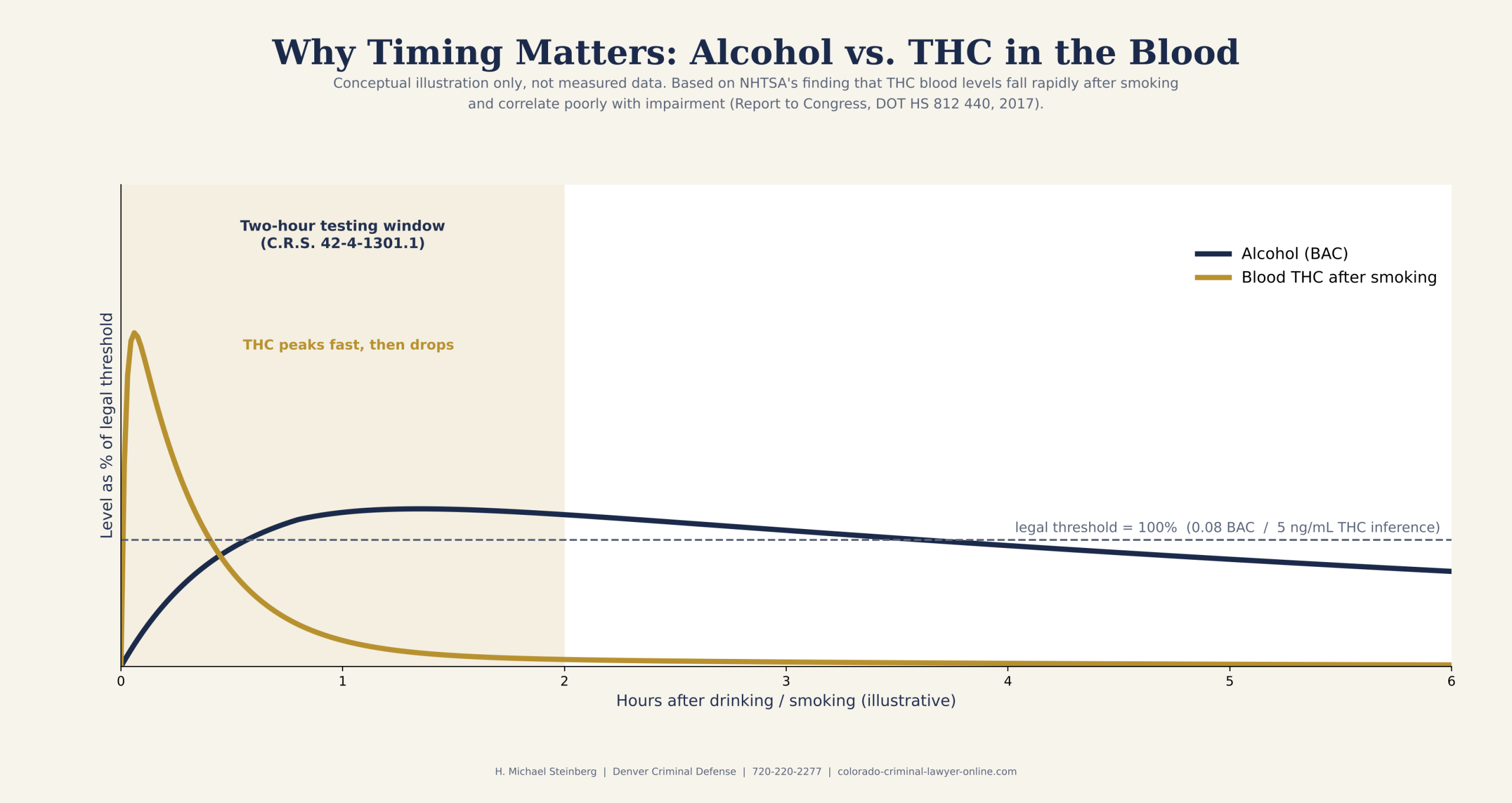
Conceptual illustration (not measured data) of why timing matters. Based on NHTSA’s finding that THC falls rapidly after smoking.
Timing makes this worse. Colorado’s statute expects a sample within two hours, but THC can fall quickly while officers arrange a warrant, a nurse and a transport. A blood level measured late may say little about the driver’s condition at the wheel.
Breath tests do not measure THC
The Intoxilyzer measures alcohol. It cannot detect THC, which is why CDOT notes that blood is commonly used for cannabis and other drugs while breath is used for alcohol (CDOT). Colorado’s drug-testing provision lists blood, saliva and urine, all within two hours (§ 42-4-1301.1(2)(b)).
Field sobriety tests and the Drug Recognition Expert
With no controlling number, marijuana cases lean on human observation. Officers use the NHTSA Standardized Field Sobriety Tests (SFST), and some departments call in a trained Drug Recognition Expert (DRE) through the Colorado DRE program.
The DRE protocol has twelve steps:
- Breath alcohol test
- Interview of the arresting officer
- Preliminary examination and first pulse
- Eye examinations
- Divided-attention psychophysical tests
- Vital signs and second pulse
- Dark-room examination
- Muscle tone
- Examination for injection sites and third pulse
- Suspect’s statements and other observations
- Evaluator’s opinion
- Toxicological examination
The DRE’s opinion is exactly that, an opinion, and the quality of the work behind it (skipped steps, rushed exams, medical conditions that mimic impairment, nervousness) is fertile ground for cross-examination.
The medical marijuana card
A medical card does not make driving high lawful. But the statute also says a card may not be used in the prosecution’s case in chief (§ 42-4-1301(6)(j)) and a card alone is not probable cause for a blood analysis (§ 42-4-1301(6)(k)).
Expressed consent: the testing process step by step
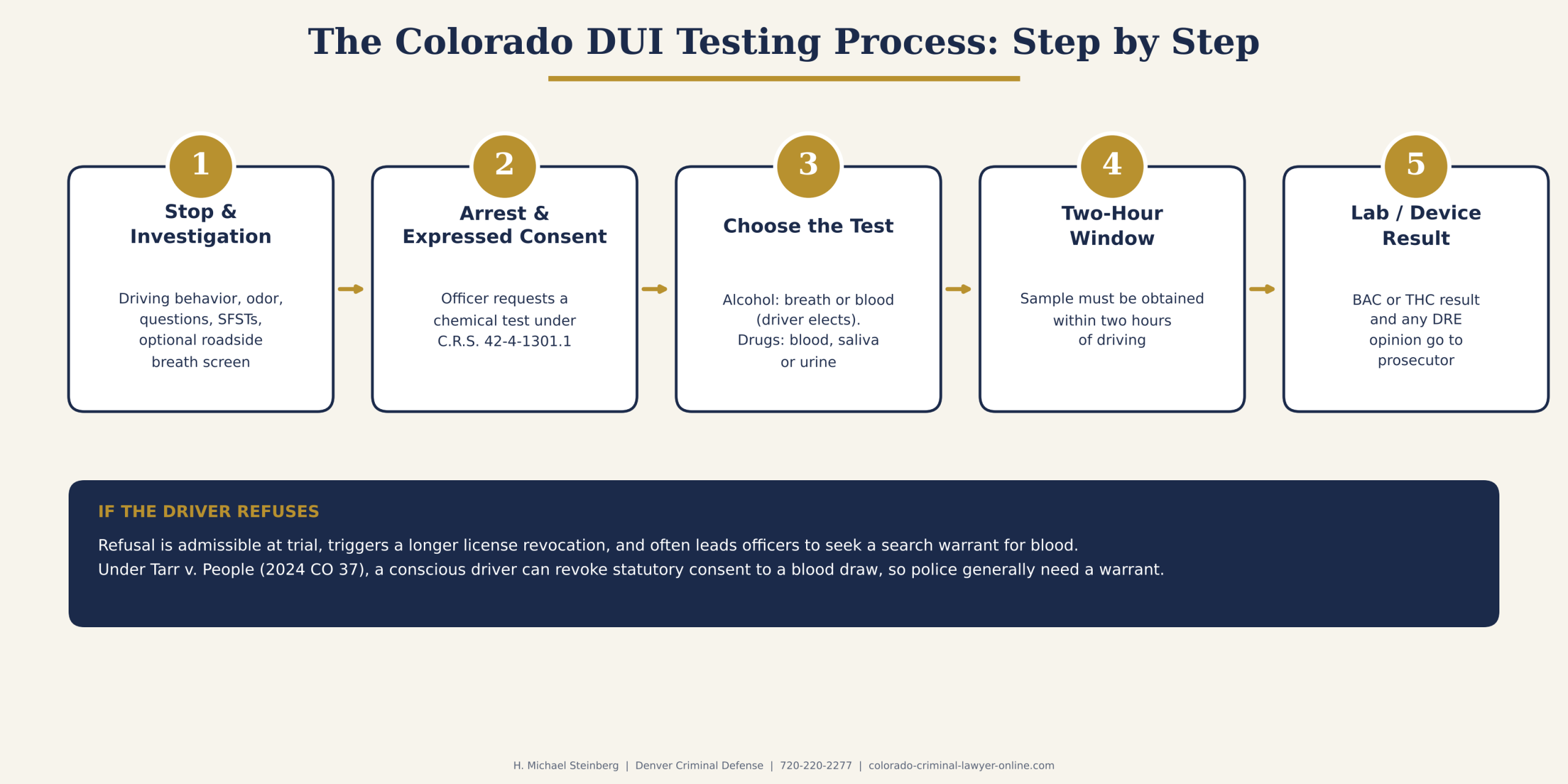
Anyone who drives in Colorado is deemed to have consented to a chemical test, within limits set by C.R.S. § 42-4-1301.1. For alcohol the driver chooses breath or blood. If a breath test is not possible, blood is required. Everyone must cooperate so a sample is obtained within two hours of driving, and the statute provides for testing of unconscious or deceased drivers. The flowchart summarizes the sequence.
Blood draws, warrants and what the courts have said
Blood evidence is the heart of most drug cases, so the law on how police get blood matters. Some of the leading authorities:
- Missouri v. McNeely, 569 U.S. 141 (2013): the natural dissipation of alcohol does not, by itself, create a per se exigency allowing a warrantless blood draw.
- Birchfield v. North Dakota, 579 U.S. 438 (2016): a warrantless breath test may be taken incident to a DUI arrest, but a warrantless blood test generally may not.
- Tarr v. People, 2024 CO 37: a conscious driver may revoke statutory consent to a blood draw, so police generally need a warrant to obtain it.
- People v. Raider, 2022 CO 40: the expressed consent statute’s bar on forced collection does not apply when a warrant authorizes the blood draw.
- People v. White, 2023 CO 43: consent to a blood draw at a crash scene was valid and suppression was reversed. The blood showed active THC about seven times the 5 ng/mL inference level.
- People v. Hyde, 2017 CO 24: addressed blood draws from an unconscious driver under the expressed consent statute.
- People v. Montoya, 2024 CO 20: refusal evidence is governed by ordinary rules of evidence, and a jury may consider a driver’s later recantation of a refusal.
The practical takeaway: whether a blood result can be used often depends on whether there was a valid warrant or valid consent, and a motion to suppress can decide the case.
Refusing the test: what actually happens
Many drivers refuse. In 2022, CDOT reports, 54.25% of 12,994 impaired-driving law enforcement contacts ended in a toxicology refusal (CDOT, May 2025). Drivers often believe a refusal avoids evidence. It does not:
- A refusal is admissible at trial (§ 42-4-1301(6)(d)).
- Police may seek a warrant and take blood anyway, and an involuntary blood test is admissible (§ 42-4-1301(6)(e)).
- The DMV revocation is longer: one year for a first refusal, two for a second, three for a third or later, versus nine months for a first test failure (§ 42-2-126).
- CDOT also lists a two-year interlock requirement, Persistent Drunk Driver designation, SR-22 insurance and Level II education after a refusal.
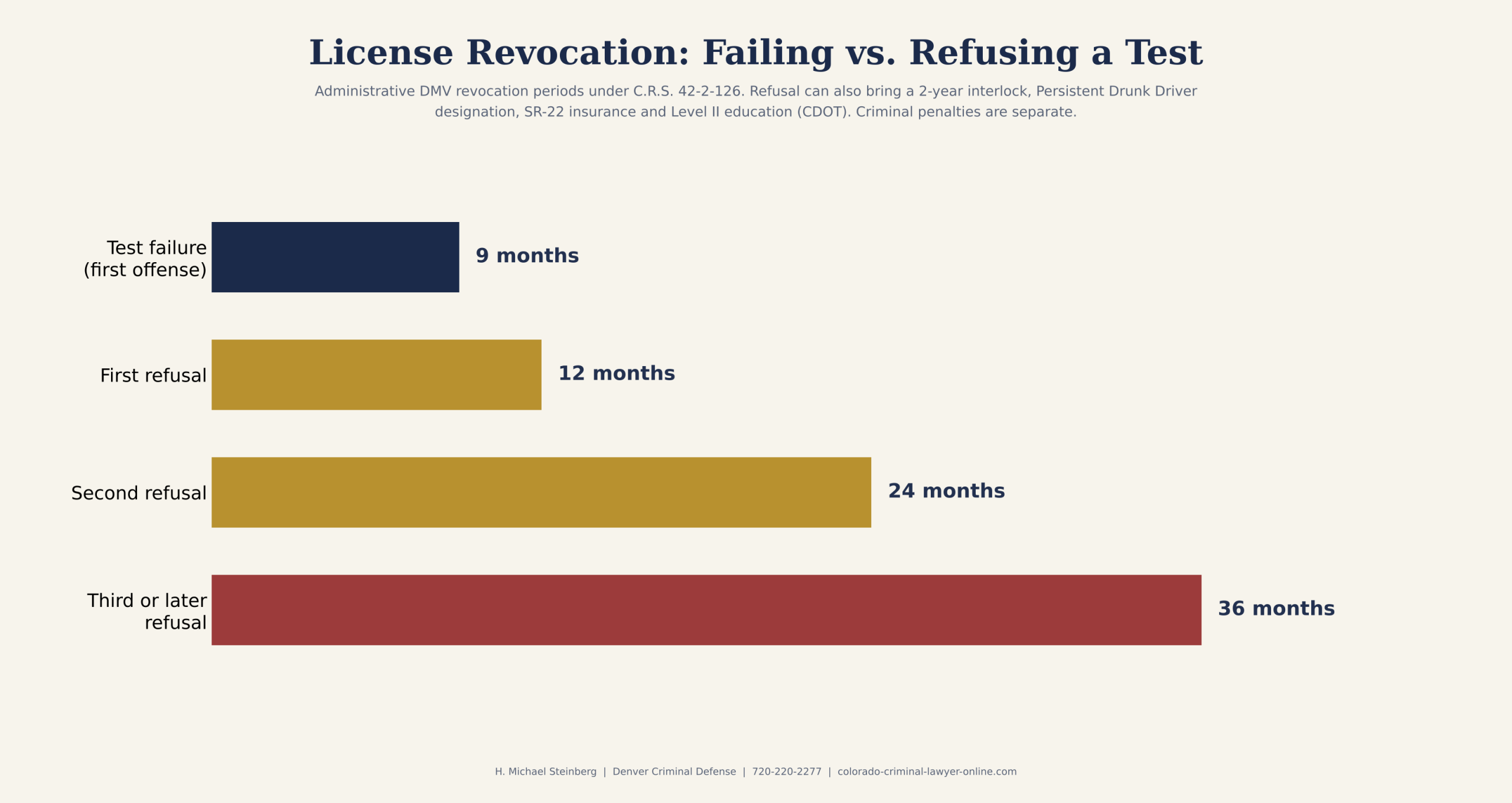 Administrative revocation periods under C.R.S. § 42-2-126 (separate from criminal penalties).
What counts as a refusal is judged objectively by the driver’s words and conduct (Gallion v. Colorado Department of Revenue, 171 P.3d 217 (Colo. 2007)). Recent Court of Appeals decisions show that revocation hearings can turn on the record: compare Jansma v. Colorado Department of Revenue, 2023 COA 59 with Moore v. Colorado Department of Revenue, 2026 COA 2, which found the refusal evidence sufficient.
Where a defense usually begins
Every case is different, but the lines of inquiry differ by substance. The chart lists common starting points.
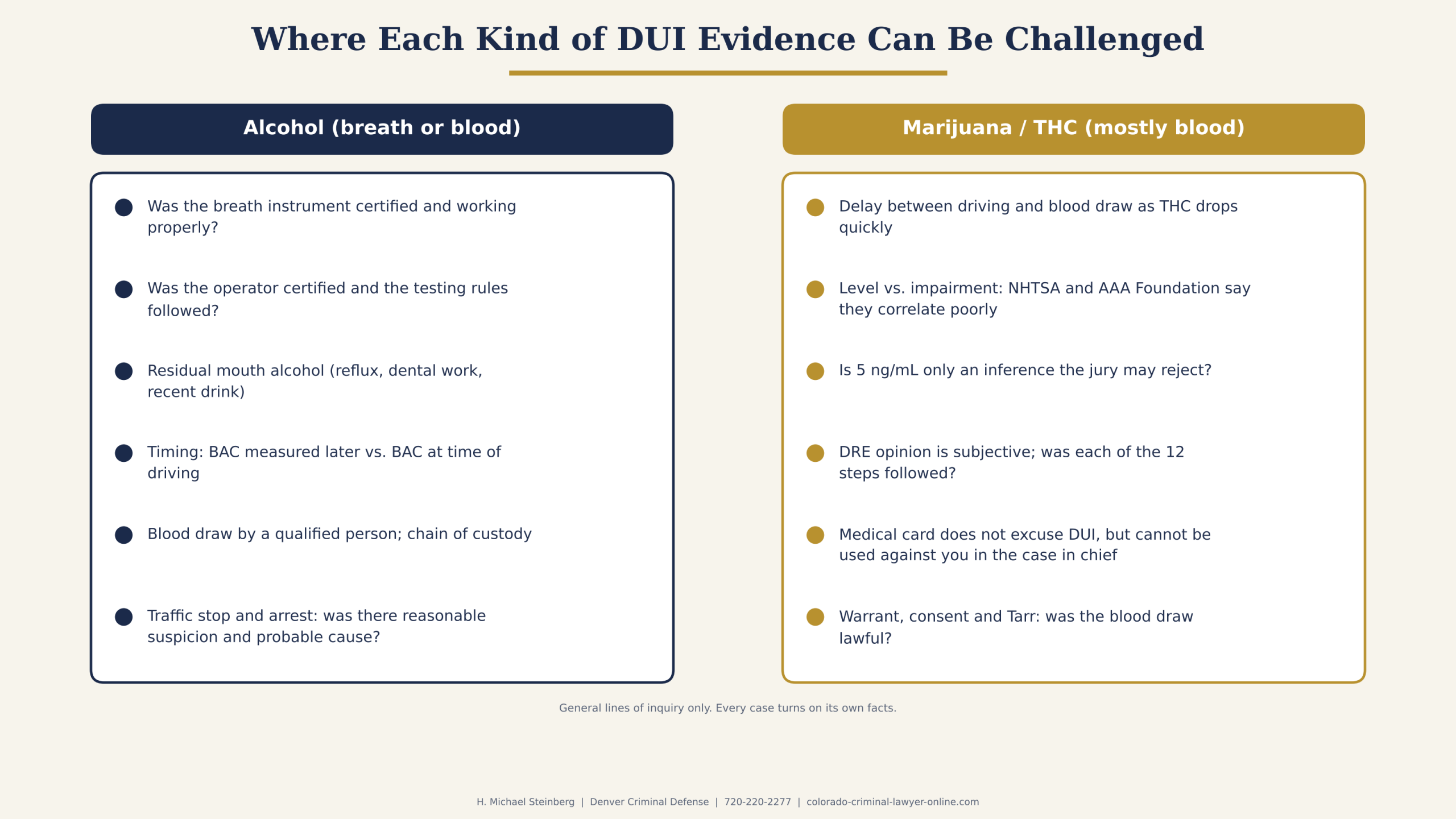 Common lines of inquiry in alcohol and marijuana DUI cases.
- The stop and the arrest. Was there reasonable suspicion for the stop and probable cause for the arrest? Everything else follows from that.
- The test itself. Instrument certification, operator training, mouth alcohol, rising BAC, blood draw qualifications and chain of custody.
- The warrant or consent. After Tarr, how blood was obtained is a major issue.
- Timing. Especially for THC, when the sample was taken relative to driving.
- The opinion evidence. SFST administration and DRE protocol compliance.
Penalties for a Colorado DUI conviction
Penalties are the same statutory scheme regardless of whether the substance is alcohol or marijuana. Under C.R.S. § 42-4-1307, a first-offense DUI or DUI per se carries 5 days to 1 year in jail (the minimum may be suspended only with evaluation and treatment), a $600 to $1,000 fine and 48 to 96 hours of useful public service, with optional probation up to two years. A BAC of 0.20 or higher carries a 10-day minimum. Higher offense levels carry increasing minimums, and a fourth DUI can be a class 4 felony.
| Offense | Jail | Fine | Public service |
|---|---|---|---|
| First DUI / DUI per se | 5 days to 1 year | $600 to $1,000 | 48 to 96 hours |
| First DWAI | 2 to 180 days | $200 to $500 | 24 to 48 hours |
| Second offense | 10-day minimum | $600 to $1,500 | 48 to 120 hours |
| Third or later | 60-day minimum | See statute | See statute |
Summary of C.R.S. § 42-4-1307. Confirm current figures in the statute and consider enhancements.
Recent and upcoming changes (2026)
- HB26-1242 (signed May 28, 2026) requires an ignition interlock-restricted license for nine months after reinstatement for certain first-time DUI/DWAI convictions and allows early reinstatement with an interlock. KDVR reports a June 1, 2027 start; confirm the effective date before relying on it.
- SB26-132, “Magnus’ Law” (effective August 12, 2026) requires officers investigating crashes involving death or suspected serious bodily injury to offer drivers a voluntary preliminary breath test, which the driver may refuse (CBS Colorado).
Enforcement remains a priority: CDOT reports cannabis impairment was suspected in 1,058 crashes in 2025 (CDOT, May 2026), and its impaired-driving data shows thousands of DUI cases filed each year.
Frequently asked questions
Is there a legal THC limit for driving in Colorado?
No. Colorado has a permissible inference at 5 ng/mL of delta-9 THC in whole blood, but it is not a per se limit, and a jury may accept or reject it (C.R.S. § 42-4-1301(6)(a)(IV)).
Can a breathalyzer detect marijuana?
No. Colorado’s breath instrument measures alcohol. Marijuana testing is usually done by blood, and the statute also lists saliva and urine.
Can I be charged with DUI if I have a medical marijuana card?
Yes. A medical marijuana entitlement is not a defense, though a card cannot be used in the prosecution’s case in chief and is not alone probable cause for a blood analysis.
Should I refuse the test in a Colorado DUI stop?
I cannot give advice on a specific stop in an article, but a refusal is admissible at trial, brings a longer license revocation than a failed test, and may lead to a warrant for blood. Speak with a DUI lawyer as soon as possible.
How long do I have to get a DUI test in Colorado?
The statute requires a sample within two hours of driving.
Do police need a warrant for a blood draw?
Often, yes. Under Tarr v. People (2024 CO 37), a conscious driver may revoke statutory consent to a blood draw, so police generally need a warrant. Exceptions such as valid consent can apply.
Charged with a marijuana or alcohol DUI in Denver or Colorado?
The first days after an arrest matter: deadlines for the DMV hearing request are short, and evidence such as video, instrument records and blood-draw documentation should be preserved quickly. I have defended DUI cases in Colorado for more than 40 years. Call 720-220-2277 for a confidential consultation, or visit www.hmichaelsteinberg.com or www.colorado-criminal-lawyer-online.com.
FREE, CONFIDENTIAL CONSULTATION
H. Michael Steinberg, Denver Criminal Defense
Over 40 years of experience defending Colorado DUI cases
www.hmichaelsteinberg.com | www.colorado-criminal-lawyer-online.com
Disclaimer: This article is general information about Colorado law, not legal advice, and does not create an attorney-client relationship. Laws and agency sources change, and the outcome of any case depends on its facts. Statute and case links point to third-party sources that may not reflect the most recent amendments.
Sources and Further Reading
- C.R.S. § 42-4-1301 (Colorado Public Law)
- C.R.S. § 42-4-1301.1 (expressed consent)
- C.R.S. § 42-4-1307 (penalties)
- C.R.S. § 42-2-126 (revocation, 2022 code via Justia)
- Tarr v. People, 2024 CO 37
- People v. Montoya, 2024 CO 20
- People v. Raider, 2022 CO 40
- People v. White, 2023 CO 43
- People v. Hyde, 2017 CO 24
- Moore v. Colorado Dept. of Revenue, 2026 COA 2
- Jansma v. Colorado Dept. of Revenue, 2023 COA 59 (CBA summary)
- Gallion v. Colorado Dept. of Revenue (Colo. 2007)
- Missouri v. McNeely
- Birchfield v. North Dakota
- AAA Foundation: drivers arrested for DUI and per se limits for cannabis
- NHTSA Report to Congress: Marijuana-Impaired Driving (2017)
- NHTSA SFST manual
- CDOT: over half of drivers refuse DUI testing (2025)
- CDOT impaired driving
- CDOT Drug Recognition Expert program
- CDOT cannabis impairment facts (May 2026)
- CDPHE EBAT program
- CDPHE Intoxilyzer resources
- 5 CCR 1005-2 (testing rules)
- 9News on the 2017 breath-program controversy
- HB26-1242 (bill page)
- KDVR on HB26-1242
- SB26-132 (bill page)
- CBS Colorado on Magnus’ Law