 Colorado Criminal Lawyer Blog
Can a Colorado Felony Be Dismissed at the Preliminary Hearing? What Hawkins Shows About Weak Identification Evidence


Can a Colorado Felony Be Dismissed at the Preliminary Hearing? What Hawkins Shows About Weak Identification Evidence
Many people charged with a felony in Colorado are told the preliminary hearing is a formality: the judge will find probable cause, the case will be bound over, and the real fight comes later.
Usually that prediction is right. But on October 1, 2026, the Colorado Court of Appeals decided People v. Hawkins, No. 25CA1585, and upheld the dismissal of two felony motor vehicle theft counts because the prosecution never presented evidence that the man sitting at the defense table was the person who took the vehicles.
So the answer to the question in the title is yes. A Colorado felony can be dismissed at the preliminary hearing, and one of the ways it happens is a failure of identification evidence.
- Probable cause has two parts: that a crime was committed, and that this defendant committed it.
- In Hawkins, a witness said he saw the defendant in the courtroom but never indicated which man he meant. That was not enough.
- The trial judge refused to let the prosecution reopen its evidence after closing argument, and the Court of Appeals found no abuse of discretion.
- The decision is unpublished and is not binding precedent, and a dismissal at this stage does not always end a prosecution.
- The identity link deserves close attention in stolen-car, surveillance-video, eyewitness, and accomplice cases.
What Happened in People v. Hawkins
Robert Hawkins was charged in Mesa County with two counts of second degree motor vehicle theft, a class 4 felony under C.R.S. § 18-4-409. He asked for a preliminary hearing on both counts.
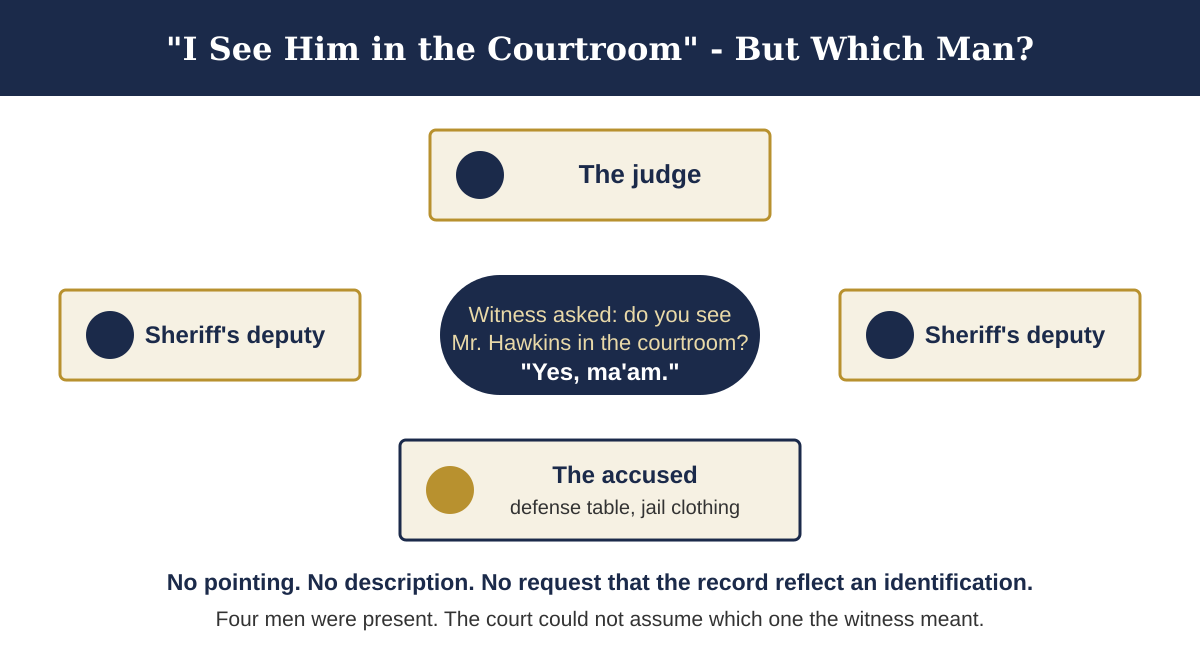
The prosecution called two witnesses. The first was the alleged victim, who described the thefts. The prosecutor then asked him whether he knew Mr. Hawkins and whether he saw Mr. Hawkins in the courtroom. He answered yes to both and added that he had met Hawkins several years earlier.
He did not point, gesture, or describe what the person he was talking about looked like or was wearing, and the prosecutor did not ask the court to have the record reflect an identification. The second witness, a police service technician, did not identify Hawkins at all. Both witnesses were excused, and the prosecution rested.
After argument, the judge asked a simple question: had the defendant been identified? The prosecutor pointed to the victim’s testimony that Hawkins was in the courtroom. The judge observed that three other men had been in the room during that testimony: the judge himself and two sheriff’s deputies. The prosecution asked to reopen the evidence and recall the victim. The judge said no and dismissed both counts for lack of probable cause.
Why “I See Him in the Courtroom” Was Not Enough
On appeal, the People argued that the judge should have drawn the obvious inference. Hawkins was the one charged. He was sitting at the defense table next to a lawyer. He was wearing jail clothing. Who else could the witness have meant?
A unanimous division of the Court of Appeals (Judge Lum writing, Judges Freyre and Grove concurring) rejected each step of that argument:
- The charges are not evidence. A court cannot treat the fact that someone has been accused as proof that he is the person a witness is describing.
- Sitting at the defense table is not evidence. The division drew on Martinez v. People, 244 P.3d 135 (Colo. 2010), where the Colorado Supreme Court held that a prosecutor may not ask jurors to infer guilt from a defendant’s mere presence at trial.
- Jail clothing is not evidence. Being in custody does not make it more likely that a person committed the crime charged.
The division agreed that a preliminary hearing judge must view the evidence in the light most favorable to the prosecution. But favorable inferences have to be drawn from evidence, and here there was none connecting Hawkins to the thefts beyond the fact that he was present. The court reached that result even under the de novo standard of review the prosecution asked for, leaving open whether the more deferential abuse of discretion standard applies.
Favorable inferences have to come from evidence. The prosecutor’s own assumption about who the witness meant is not evidence.
No Do-Over: The Request to Reopen the Evidence
The second issue matters just as much in practice. Colorado trial courts have discretion to reopen a case and take more evidence when doing so serves the ends of justice, a principle the Supreme Court restated in People v. Hall, 2021 CO 71M. The prosecution argued the judge should have used that discretion.
The Court of Appeals disagreed. The prosecution had argued at the close of the hearing that its burden was met and asked to reopen only after the judge raised the identification problem. It pointed to nothing that had prevented it from identifying Hawkins while its witnesses were on the stand, and those witnesses had already been released. The judge could have reopened the evidence, the division said, but he was not required to give the prosecution a second chance.
For the defense, the lesson is about timing. A defense lawyer has no duty to point out a hole in the prosecution’s case while the prosecution can still fill it. The time to raise it is in argument, after the evidence has closed.
Identification Is Half of Probable Cause
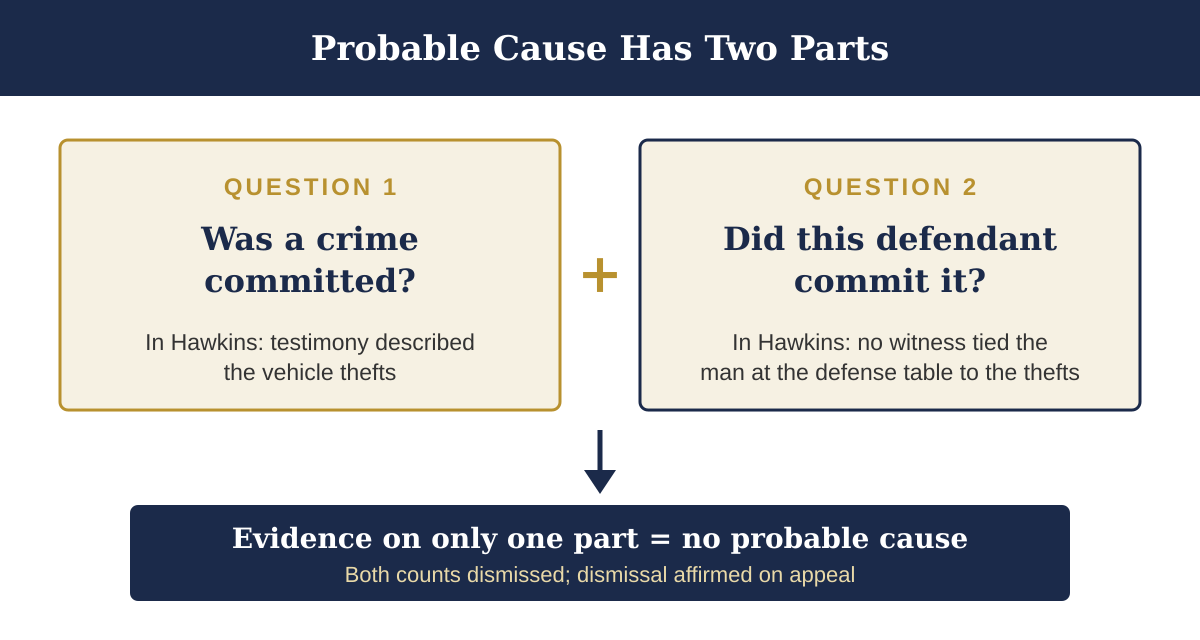
- C.R.S. § 16-5-301 and Crim. P. 5(a)(4) and 7(h): the hearing decides whether there is probable cause to believe an offense was committed and that the person charged committed it.
- People v. Collins, 32 P.3d 636 (Colo. App. 2001): the prosecution need not show evidence sufficient to convict, only enough to lead a reasonably careful person to believe the defendant committed the crime. The Court of Appeals affirmed a no-probable-cause dismissal there as well.
It is important to be candid about how low this bar is. Hearsay is allowed at a preliminary hearing, the judge generally does not weigh credibility, and conflicts in the evidence are resolved for the prosecution. In most cases a single detective can supply the identification by relaying what witnesses said. Hawkins does not change any of that. What it confirms is that the bar is low but real: someone has to offer evidence that connects the accused to the crime.
Where the Identity Link Tends to Be Weakest
The gap in Hawkins was an oversight in the courtroom. In other cases the gap is in the investigation itself, and the preliminary hearing is the first chance to expose it under oath.
| Type of case | Questions worth asking at the preliminary hearing |
|---|---|
| Stolen vehicle | Who saw the car taken? Is the accused tied to the theft, or only to the car days later? Who else had access to it? |
| Surveillance video | Who says the person on the video is the accused, and on what basis? Did that witness know the accused before? How clear is the footage? |
| Eyewitness | Was there a lineup or photo array? How was it run? How long did the witness see the person, and under what conditions? |
| Accomplice or informant | Is anything other than the cooperating witness’s word linking the accused to the crime? What was the witness promised? |
Even when the judge finds probable cause, these answers are now sworn testimony. They can shape plea negotiations, motions to suppress an identification, and cross-examination at trial. I discuss those tactical uses in more depth in Preliminary Hearings in Colorado: the Probable Cause Standard and Why Prelims May Be Underused.
The Limits of Hawkins
- It is unpublished. The opinion was not selected for official publication, so it is not binding precedent. Its reasoning rests on settled authority that is.
- Not everyone gets a preliminary hearing. Under § 16-5-301, the right belongs to people charged with class 1, 2, or 3 felonies (and level 1 or 2 drug felonies), and to those charged with class 4, 5, or 6 felonies that carry mandatory sentencing, are crimes of violence, or are sex offenses. Others charged with class 4 through 6 felonies qualify only while in custody on that charge; see People v. Subjack, 2021 CO 10. Everyone else receives a dispositional hearing instead.
- Dismissal is not always final. The prosecution can appeal, as it did here. And when a county court dismisses after a preliminary hearing, the prosecution may ask the district court for permission to refile by direct information under Crim. P. 5 and 7(c); see Holmes v. District Court, 668 P.2d 11 (Colo. 1983).
- The right can be lost. The demand for a preliminary hearing must be made within a short window after the first appearance on the charges, and waiving the hearing is sometimes the price of a plea offer. That decision should be made with a lawyer who has read the discovery.
Frequently Asked Questions
Can felony charges be dismissed in Colorado when identification evidence is too weak?
Yes. If the prosecution does not present evidence at the preliminary hearing that would lead a reasonably careful person to believe the accused is the one who committed the crime, the judge must dismiss the charge. Hawkins is a recent example.
Does a witness have to point at the defendant in court?
No particular gesture is required, and identification can be shown in other ways, including through an officer’s hearsay testimony. But there must be some evidence in the record connecting the person charged to the crime. A bare statement that the person is somewhere in the courtroom did not do that in Hawkins.
Can the prosecutor fix the problem after the evidence closes?
Only if the judge allows it. Reopening the evidence is discretionary. In Hawkins the judge declined, and the Court of Appeals upheld that choice.
If my case is dismissed at the preliminary hearing, is it over?
Not necessarily. The prosecution may appeal or, in some circumstances, seek permission to refile. A dismissal is still a significant result that changes the leverage in the case.
Should I waive my preliminary hearing?
Sometimes waiver is the right call, for example to preserve a favorable plea offer. But it should be a decision, not a default. Where identification is the weak point of the case, the hearing may be the best opportunity to test it.
Talk to a Colorado Criminal Defense Lawyer Before You Waive
If you or someone you care about is facing a felony charge in the Denver metro area, the preliminary hearing deadline arrives quickly. H. Michael Steinberg has practiced Colorado criminal law for over forty years. Call 720-220-2277 or visit www.hmichaelsteinberg.com to discuss your case. More on this stage of a case is available on the firm’s Preliminary Hearings in Colorado page and on the Colorado Criminal Lawyer Blog.
Sources
- People v. Hawkins, No. 25CA1585 (Colo. App. Oct. 1, 2026) (unpublished)
- Colorado Politics, “No do-over after Mesa County prosecutor forgot to ID defendant: court” (Oct. 1, 2026)
- C.R.S. § 16-5-301; C.R.S. § 18-4-409; Colo. Crim. P. 5; Colo. Crim. P. 7
- People v. Collins, 32 P.3d 636 (Colo. App. 2001); Martinez v. People, 244 P.3d 135 (Colo. 2010); People v. Hall, 2021 CO 71M; People v. Subjack, 2021 CO 10; Holmes v. District Court, 668 P.2d 11 (Colo. 1983)
Disclaimer: This article is provided for general informational purposes and is not legal advice. Reading it does not create an attorney-client relationship. Criminal procedure, deadlines, and case law change, and every case turns on its own facts. Consult a licensed Colorado attorney about your situation. Past results do not guarantee a similar outcome.