 Colorado Criminal Lawyer Blog
If I Contact a Witness or Victim, Is That Witness Tampering in Colorado? (C.R.S. 18-8-707)


Quick Answer
No, not automatically. Contacting a witness or victim is not, by itself, witness tampering. Under C.R.S. § 18-8-707, the prosecution must prove that you intentionally attempted to induce the person to testify falsely, withhold testimony, skip a proceeding they were legally summoned to, or avoid a summons, and that you did it without a bribe or threat. The crime is a class 4 felony.
But the contact can still be a serious problem. A mandatory protection order or a bond condition may forbid all contact, so a harmless text can be charged as a separate crime. And what you say matters. Asking a witness to “drop the charges” or “not show up” is exactly the conduct prosecutors charge.
If you have been charged with a crime in Colorado, or you know someone who has, the urge to reach out to the other side is natural. You may want to apologize, explain, check in on a partner, or ask what happened. That urge is also one of the most common ways people turn a manageable case into a much more dangerous one.
This article explains what C.R.S. § 18-8-707 actually prohibits, what the Colorado Supreme Court has said about it, how it differs from bribery and intimidation, how protection orders change the analysis, and what you should do if contact has already happened. If you need to talk through a specific situation, call the Law Office of H. Michael Steinberg before you reach out to anyone else.
What Does C.R.S. 18-8-707 Say?
Colorado’s witness tampering statute sits in Article 8 of Title 18, the part of the criminal code that deals with offenses against the administration of justice. The General Assembly explained its purpose in the legislative declaration at § 18-8-701: witnesses and victims must be free to come forward and testify without improper influence. You can read the full text on the Colorado Revised Statutes site or in the official Title 18 PDF.
C.R.S. § 18-8-707 (Tampering with a witness or victim)
(1) A person commits tampering with a witness or victim if he intentionally attempts without bribery or threats to induce a witness or victim or a person he believes is to be called to testify as a witness or victim in any official proceeding or who may be called to testify as a witness to or victim of any crime to:
(a) Testify falsely or unlawfully withhold any testimony; or
(b) Absent himself from any official proceeding to which he has been legally summoned; or
(c) Avoid legal process summoning him to testify.
(2) Tampering with a witness or victim is a class 4 felony.
Notice what the statute does not say. It does not say “contacts a witness.” It does not say “communicates with a victim.” The verb that matters is attempts to induce, and the object of the attempt is one of three specific results.
The Three Ways to Violate the Statute
The three prohibitions in § 18-8-707(1). Each requires an intentional attempt, with no bribe or threat.
1. Testify falsely or unlawfully withhold testimony — § 18-8-707(1)(a)
This is the most commonly charged subsection. It covers attempts to get a witness or victim to change their story, recant something true, or stay silent when they would otherwise be obligated to speak. In People v. Cunefare, 102 P.3d 302 (Colo. 2004), the Colorado Supreme Court held that a conviction under subsection (1)(a) requires evidence that the defendant induced or attempted to induce the victim to testify falsely or unlawfully withhold testimony. It does not require that a subpoena had been issued or that any testimony was ever given.
The facts in Cunefare are a useful warning. After a domestic assault charge, the alleged victim asked that the charges be dropped, and a letter to the prosecutor urging dismissal was signed by the defendant in the victim’s name without her knowledge or consent. The court addressed both the tampering conviction and a forgery conviction, and it stressed that the General Assembly intended § 18-8-707 to reach a wide range of activity that interferes with a witness or victim.
2. Absent himself from an official proceeding — § 18-8-707(1)(b)
This subsection covers attempts to get someone to skip a hearing or trial. It has a built-in limit: the person must have been “legally summoned.” In People v. Yascavage, 101 P.3d 1090 (Colo. 2004), decided the same day as Cunefare, the court held that when the charge is under (1)(b), the prosecution must prove the witness or victim was legally summoned, meaning they had some legal obligation to appear, though not necessarily a formal subpoena. Without that proof, the conviction could not stand.
3. Avoid legal process summoning him to testify —
§ 18-8-707(1)(c)
The third prohibition targets attempts to help a witness dodge a subpoena or other legal process, for example by encouraging them to leave town or avoid being served.
The crime is the attempt. The witness does not have to be persuaded, and the case does not have to go to trial.
That point matters. Cunefare discusses earlier decisions such as People v. Moyer, 670 P.2d 785 (Colo. 1983), People v. Scialabba, 55 P.3d 207 (Colo. App. 2002), and People v. Francois, 198 Colo. 249, 598 P.2d 144 (1979) in explaining how the statute works, and it reads the statute broadly. The fact that a witness refused to go along, or told the police right away, is not a defense to the attempt.
The Elements Prosecutors Must Prove
Breaking the statute into parts shows where cases are won and lost. The prosecution generally has to prove each of these beyond a reasonable doubt:
- A witness or victim. The person is, or you believed they would be, a witness or victim in an official proceeding, or a witness to or victim of any crime. The definitions in C.R.S. § 18-8-702 are broad, and they include people who have not yet been called to testify.
- An attempt to induce. You tried to persuade, pressure, or push the person toward one of the three results. Mere communication is not enough.
- Intent. You acted intentionally. Carelessness, a clumsy apology, or a conversation about something else does not satisfy this element.
- No bribe or threat. If the attempt involved a benefit or a threat, the case belongs under § 18-8-703 (bribery) or § 18-8-704 (intimidation) instead, discussed below.
- A prohibited objective. The goal was false or withheld testimony, absence from a proceeding the person was legally summoned to, or avoidance of legal process.
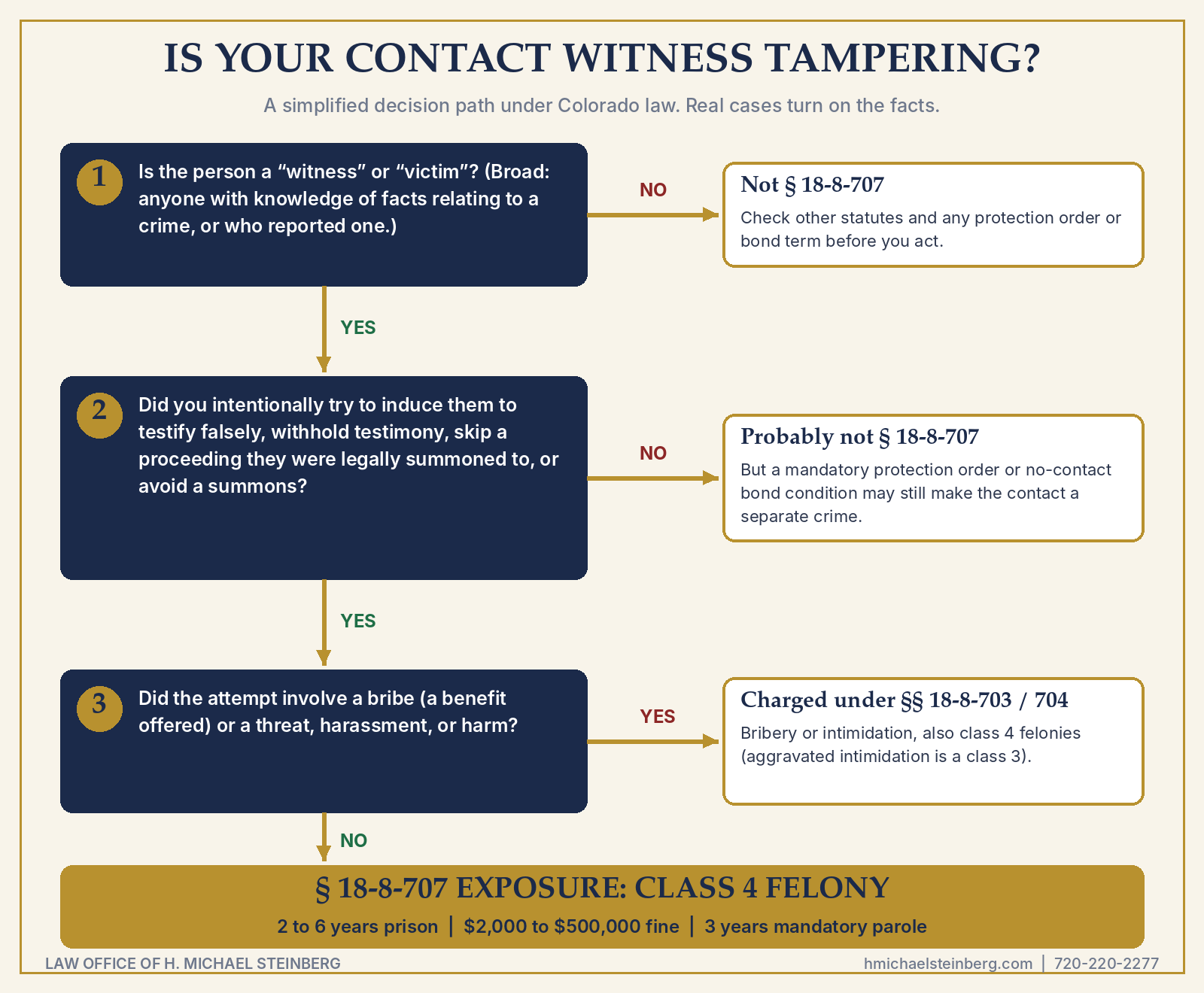
So Is Any Contact With a Witness or Victim a Crime?
Not under § 18-8-707 on its own. People contact witnesses lawfully every day. Defense lawyers and investigators interview them. Neighbors, co-workers, and family members talk to them. Victims and defendants who are spouses or partners often share a household, children, and bills. The statute is aimed at interference with testimony, not at every communication.
That said, here are the situations where contact gets people into trouble:
- “Please drop the charges.” Only the district attorney decides whether to proceed. A victim cannot drop a case, and a request to do so can look like an attempt to induce withheld testimony. See our article on what happens when a domestic violence victim refuses to cooperate.
- “You don’t have to come to court.” Telling a witness they can ignore a subpoena is a textbook (1)(b) or (1)(c) problem. For more, read can you refuse to testify in a Colorado criminal trial.
- “Just tell them it didn’t happen that way.” Any suggestion about what to say, especially a request to change a prior statement, risks (1)(a).
- Contact through friends, family, or social media. Using a go-between does not insulate you. Messages, posts, and call logs are often the prosecution’s best evidence. Learn how social media evidence is used in Colorado criminal cases.
- Jail calls. Recorded calls are routinely reviewed. A call to a family member who then contacts the witness can be used to show your intent.
Intent is the dividing line. A text saying “I’m sorry, I hope you are OK” is very different from “if you tell them it was an accident we can both move on.” The first may violate a protection order. The second is the sort of message that can support a felony.
The Protection Order Trap
For many people, the real risk is not § 18-8-707 at all. When someone is charged with certain offenses in Colorado, particularly offenses involving alleged violence, the court issues a protection order at the first appearance under C.R.S. § 18-1-1001. These orders commonly bar any direct or indirect contact with the alleged victim, and sometimes with named witnesses. Bond conditions under C.R.S. § 16-4-103 frequently contain the same restriction.
Violating a protection order is its own offense under C.R.S. § 18-6-803.5, and a violation can also lead to a bond revocation, a new arrest, and a prosecutor who is far less willing to negotiate. The alleged victim’s consent is not a defense. Only the court can modify the order. We explain the consequences in detail in What Happens If You Violate a Colorado Criminal Protection Order.
Practical point
If you are under a no-contact order, a witness or victim who reaches out to you first does not change your obligation. Do not respond. Save the message and give it to your lawyer, who can raise the issue with the court if the order needs to be changed.
Witness Tampering vs. Bribery, Intimidation, and Retaliation
Colorado separates witness interference into several offenses. Which one applies depends on how the person tried to influence the witness. Section 18-8-707 is the catch-all for non-coercive attempts. The others cover bribes, threats, and punishment.
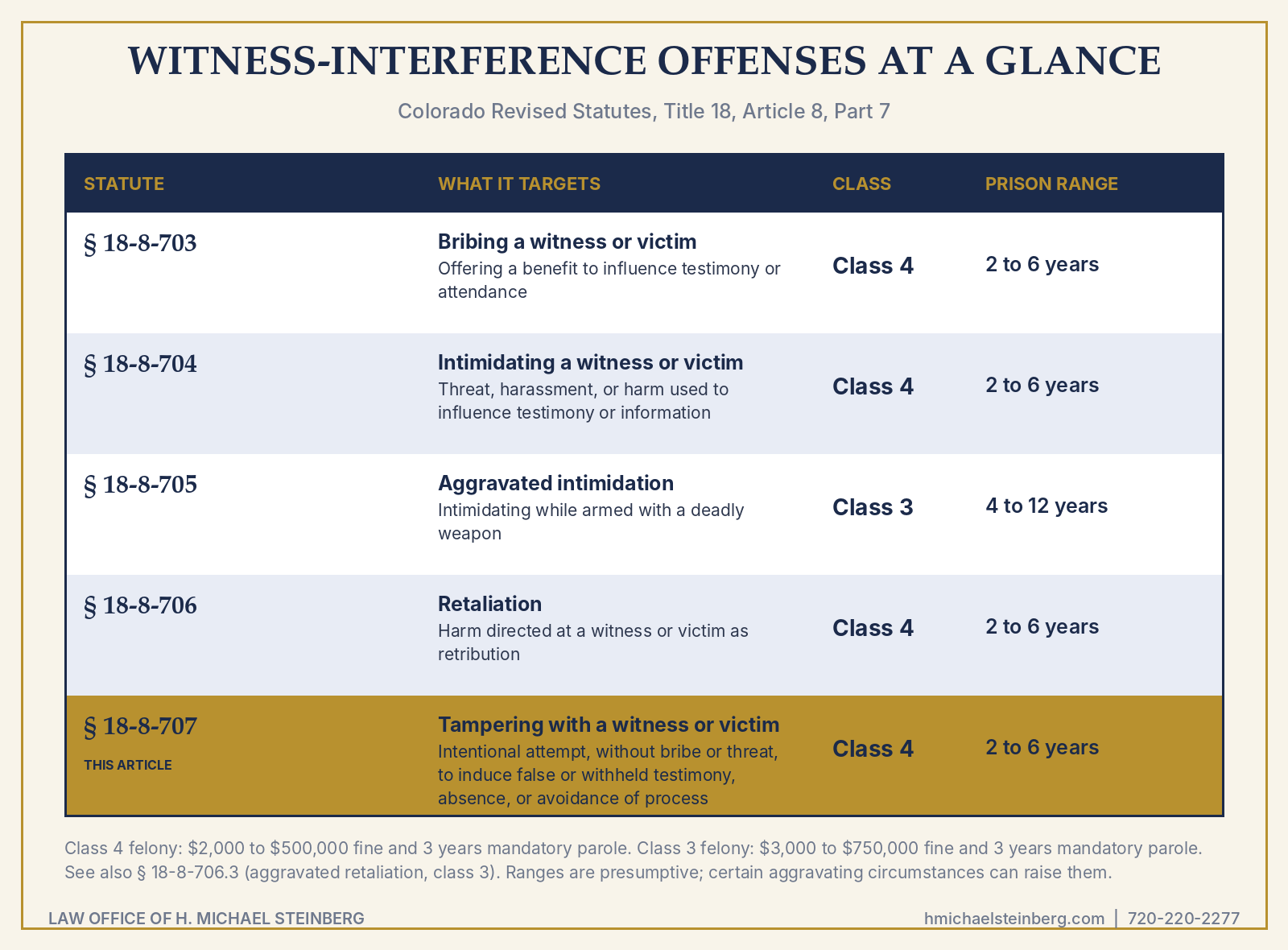
C.R.S. § 18-8-703 — Bribing a witness or victim
Offering or giving a benefit to influence testimony or attendance. Class 4 felony.
C.R.S. § 18-8-704 — Intimidating a witness or victim
Using threats, harassment, or harm to influence testimony or information. Class 4 felony. The statute was amended in 2022, so confirm which version applies to the date of the alleged offense.
C.R.S. § 18-8-705 — Aggravated intimidation
Intimidation while armed with a deadly weapon. Class 3 felony.
C.R.S. § 18-8-706 — Retaliation against a witness or victim
Harm directed at a person because of their role as a witness or victim. Class 4 felony. See also § 18-8-706.3 (aggravated retaliation).
Prosecutors sometimes charge several of these together, and they may add related counts such as harassment, stalking, or violation of a protection order. If the evidence of a threat is thin, a case initially charged as intimidation may be negotiated down or reframed. If you suspect you have been overcharged, a careful review of the actual words and context is the first step.
Penalties for Witness Tampering in Colorado
Tampering with a witness or victim is a class 4 felony. For offenses committed on or after July 1, 2020, the presumptive sentencing range under C.R.S. § 18-1.3-401 is:
| Penalty | Class 4 felony (presumptive range) |
|---|---|
| Prison | 2 to 6 years in the Department of Corrections |
| Fine | $2,000 to $500,000 |
| Mandatory parole | 3 years |
Probation can be possible in some cases, and aggravating circumstances can change the range, so the actual exposure depends on the facts and the record. Beyond the sentence itself, a felony conviction can affect employment, housing, firearm rights, and professional licensing. A tampering charge also tends to hurt the underlying case. Prosecutors may argue that contact with a witness shows consciousness of guilt, and judges are often less willing to set a reasonable bond.
Common Defenses to a Witness Tampering Charge
Every case is different, but these are the issues a defense lawyer will examine first:
- No intent to induce. The communication was personal, logistical, or an apology, not an attempt to change testimony.
- No “attempt.” The words, in context, did not ask the person to do anything covered by the statute.
- Not “legally summoned.” For (1)(b) charges, the prosecution must prove the person had a legal obligation to appear. See Yascavage, discussed above.
- Wrong statute. If the allegation is really a threat or an offer of a benefit, the charge may not fit § 18-8-707, and the elements and exposure change.
- Lawful communication. Interviews by defense counsel or investigators, and honest conversations that do not seek false or withheld testimony, are not tampering. Read about the line between coaching and coercing in witness preparation.
- Identity and authenticity. Screenshots can be altered, accounts can be spoofed, and the person who sent a message may not be the defendant.
- Weak or ambiguous proof. A case built on a single disputed conversation, or on a complainant whose account has shifted, may not survive a preliminary hearing or trial.
Sometimes the underlying allegation is itself disputed. If so, a thorough defense looks at both cases at once. See false, exaggerated, or mistaken domestic violence allegations for how those cases are approached.
What to Do If You Have Already Contacted a Witness or Victim
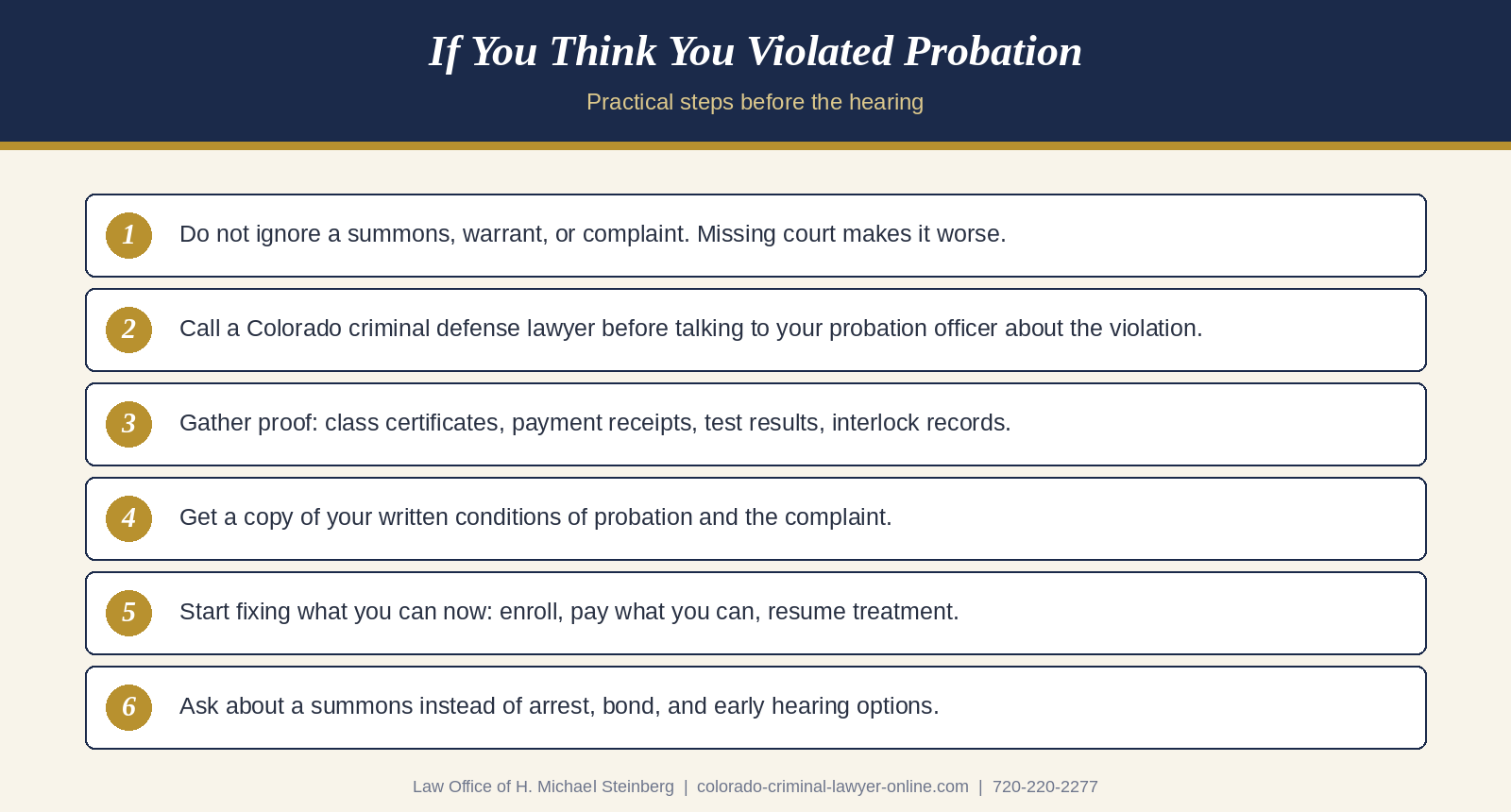
If you are charged, accused, or under a protection order, follow this checklist.
- Stop all contact right now. That means calls, texts, social media, letters, and messages passed through other people.
- Do not delete anything. Deleting messages, posts, or call logs can create a new problem under the physical evidence tampering statute, § 18-8-610. See our overview of tampering with physical evidence.
- Do not explain yourself to police. Even a friendly conversation can become an admission. Ask for a lawyer.
- Tell your lawyer everything. Include every message and every contact, even the ones you think are harmless. Your lawyer can only manage what they know about.
- Let your lawyer handle any needed communication. If something genuinely has to be communicated, such as property or child exchange, it should go through counsel or a court-approved arrangement.
- Do not respond if the witness contacts you. Save the message and report it to your lawyer.
Frequently Asked Questions
Talk to a Denver Criminal Defense Lawyer
A witness tampering allegation, or even the fear of one, is serious and time-sensitive. What you say and do in the next few days can shape your case for years. H. Michael Steinberg is a Denver criminal defense lawyer who handles felony and misdemeanor cases, including domestic violence cases where protection orders and witness issues arise. You can see the full list of practice areas and read client reviews on the firm’s website.
Questions about witness contact in your case?
Call the Law Office of H. Michael Steinberg at 720-220-2277 or send a message through the contact page. Consultations are confidential.
This article is general information, not legal advice, and it does not create an attorney-client relationship. Laws change, and outcomes depend on the facts. See the firm’s disclaimer. Browse more on our blog: Colorado Criminal Lawyer Blog and articles about witnesses.
Sources and Authority
- C.R.S. § 18-8-707, Tampering with a witness or victim
- C.R.S. §§ 18-8-701 to 18-8-706.3 (witness and victim protection statutes)
- Colorado Revised Statutes, Title 18 (official PDF, 2024)
- C.R.S. § 18-1-1001, Protection orders
- C.R.S. § 16-4-103, Bond conditions
- C.R.S. § 18-1.3-401, Felony sentencing
- C.R.S. § 18-6-803.5, Violation of a protection order
- People v. Cunefare, 102 P.3d 302 (Colo. 2004)
- People v. Yascavage, 101 P.3d 1090 (Colo. 2004)
About the author. H. Michael Steinberg is a Denver criminal defense lawyer and the founder of the Law Office of H. Michael Steinberg. Call 720-220-2277 for a confidential consultation.