 Colorado Criminal Lawyer Blog
Colorado Police Gave You an Inadequate Miranda Warning—Is Your Statement Automatically Suppressed?


By H. Michael Steinberg · Published October 17, 2026 · Filed under Search and Seizure Laws, Criminal Process
In People v. Vanpelt, 2026 CO 66 (decided October 12, 2026), the Colorado Supreme Court held that a defendant’s statements and handwritten apology letter from a 75-minute jailhouse interrogation were voluntary under the due process clause, even though the prosecution conceded he never received a proper Miranda advisement. Because the detectives’ conduct did not overbear his will, the statements are not barred for every purpose. They remain off-limits in the prosecution’s case-in-chief because of the Miranda violation, but the voluntariness ruling keeps open the possibility that prosecutors use them to impeach him if he testifies.
Justice Brian D. Boatright wrote the opinion, and all six of his colleagues joined it.
- What Happened: The Facts Behind the Case
- People v. Vanpelt at a Glance
- The 75-Minute Interrogation
- How the Colorado Supreme Court Analyzed the Statements
- The Gun Seizure and Identification Rulings
- What Vanpelt Means for Colorado Defendants
- If Police Want to Question You: Practical Steps
- Frequently Asked Questions
Most people have heard that police must read you your Miranda rights, and many assume that if officers skip or fumble the warnings, everything you said simply disappears.
On October 12, 2026, the Colorado Supreme Court showed why that assumption is dangerous. In People v. Vanpelt, 2026 CO 66, the prosecution conceded that a man was questioned in custody for about 75 minutes without a proper Miranda advisement. The justices still held that his statements, including a written apology, were voluntary, because the detectives’ conduct did not overbear his will.
The distinction between a Miranda violation and an involuntary confession is one of the most important and least understood ideas in Colorado criminal defense. It decides whether a statement is kept out of the prosecution’s main case only, or kept out of the courtroom entirely. The opinion also follows People v. Torres, 2026 CO 15, decided in March, in which a divided court likewise reversed an order suppressing a suspect’s statements.
This guide explains what the court decided, how it applied Colorado’s seven-factor voluntariness test, what the ruling means for people facing charges, and what to do if police want to talk to you. I have defended Colorado criminal cases for more than forty years, including thirteen years as a career prosecutor in Arapahoe and Douglas counties, and I studied many decisions like this for their critical importance to the rule of law..
What Happened: The Facts Behind the Case
The facts below come from the Colorado Supreme Court’s opinion, which relied on the district court’s order and the suppression hearing record. They are allegations. Mr. Vanpelt pleaded not guilty, the case has not gone to trial, and nothing here is a finding of guilt.
On the afternoon of July 21, 2024, Loveland officers tried to pull over a Toyota Sequoia with no license plates. It drove off. The driver of a Jeep Wrangler followed and photographed the Sequoia’s driver, who then fired a handgun at the Jeep; the bullet struck its front bumper. Less than an hour later, someone fired at a Ford Explorer driven by Lance Black, hitting a rear tire, and Black reported it to Dacono police.
Loveland police identified Justin Winter Vanpelt as the suspect in the first incident, and a warrant issued for his arrest. Black picked Vanpelt out of a photo array three days later and again in a second array two days after that. That same day, officers responding to a welfare check found Vanpelt unconscious on his motorcycle with a firearm holstered on his leg. They removed the gun, which woke him, and took him to the Las Animas County Jail, where they discovered the active warrant.
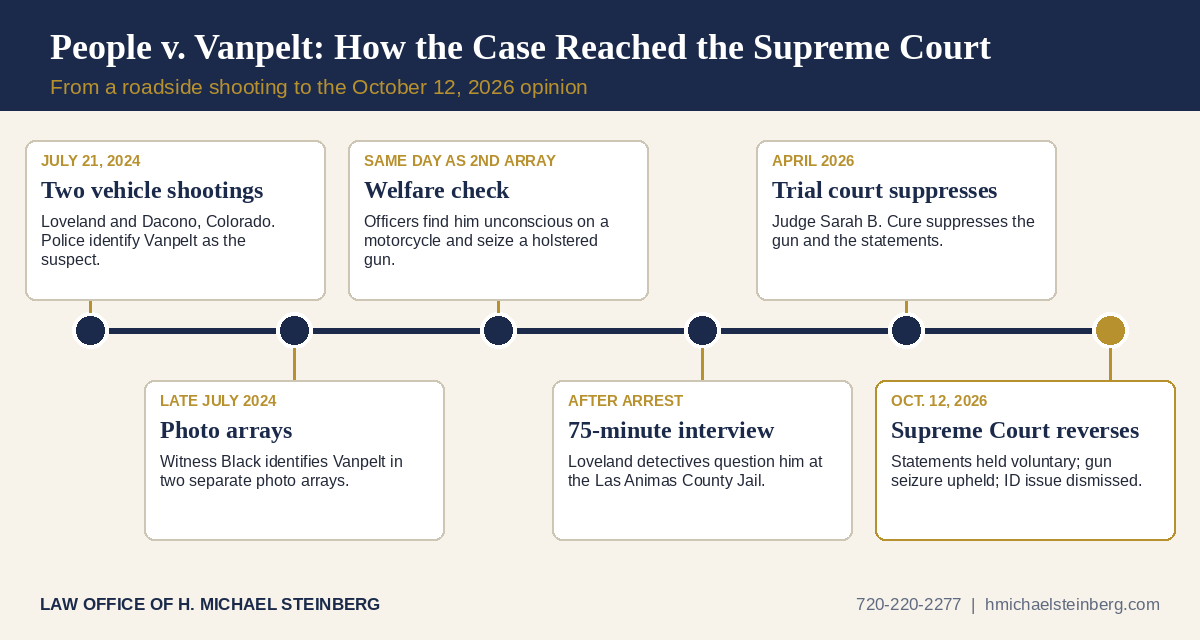
Prosecutors in Larimer County charged him with attempted first degree murder, vehicular eluding, two counts of illegal discharge of a firearm, possession of a weapon by a previous offender, and three crime of violence sentence enhancers. The defense moved to suppress the seized gun, the witness identifications, and everything Vanpelt said during his jailhouse interview.
People v. Vanpelt at a Glance
| Item | Detail |
|---|---|
| Citation | People v. Vanpelt, 2026 CO 66, No. 26SA142 |
| Court | Colorado Supreme Court, en banc |
| Decided | October 12, 2026 |
| Author | Justice Boatright; Chief Justice Márquez and Justices Hood, Gabriel, Samour, Berkenkotter, and Blanco joined |
| Trial court | Larimer County District Court, No. 24CR1075 (Judge Sarah B. Cure) |
| Posture | Pretrial (interlocutory) appeal by the People under C.A.R. 4.1 and C.R.S. § 16-12-102 |
| Holding on statements | Statements and apology letter were voluntary because officers’ conduct did not overbear the defendant’s will |
| Holding on the gun | Officers lawfully seized the holstered firearm for officer safety; no Fourth Amendment or Colo. Const. art. II, § 7 violation |
| Holding on identification | Appeal dismissed on this issue; it was not reviewable under C.A.R. 4.1 |
Read the full opinion on the Colorado Judicial Department website or on Justia. The Colorado Bar Association’s summary and Colorado Politics’ coverage are helpful companions.
The 75-Minute Interrogation
Sergeant Cortina and Detective Mu of the Loveland Police Department interviewed Vanpelt in an interrogation room at the jail. Cortina opened with a Miranda advisement. The district court later found it incomplete in four ways: it did not tell Vanpelt he could invoke his right to silence at any time, that he could ask for an attorney at any time, that an attorney could be present during questioning, or that he could stop the interview whenever he wished. On appeal, the People conceded he was not properly advised.
About ten minutes in, Cortina began asking about the Loveland shooting. He told Vanpelt that no one had been hurt. Vanpelt asked whether the attempted murder charge could change, and Cortina answered that it depended on his story. Vanpelt said he wanted to tell everything but did not want to incriminate himself. Cortina responded that a judge looks differently at a person who takes responsibility, and Vanpelt then admitted firing at the car, explaining that he wanted to be left alone.
Later, Cortina suggested that Vanpelt write an apology to the victims and said he would make sure they received it. Vanpelt observed that the letter was also a confession. He asked whether Cortina would come to court or talk to the judge, and Cortina said he would be in court. Cortina also said he would pass his observations to the district attorney. Vanpelt wrote a letter calling himself apologetic and remorseful. As he finished, he reminded the sergeant that he had made him a promise, and Cortina answered that his honesty would be duly noted.
A Miranda violation decides whether the prosecution can use your words in its main case. Voluntariness decides whether it can use them for any purpose.
Judge Cure suppressed the statements and the letter on two independent grounds. First, the advisement was inadequate. Second, she found the statements involuntary, concluding that Cortina made coercive misrepresentations, namely promises to talk to the judge, to give a recommendation to the district attorney, and to get the letter to the judge, and that these combined with Vanpelt’s apparent cognitive difficulties to undermine his ability to choose silence. She also suppressed the gun and barred an in-court identification by Black. The People appealed.
How the Colorado Supreme Court Analyzed the Statements
Jurisdiction and standard of review
Under C.A.R. 4.1 and C.R.S. § 16-12-102, the People may appeal pretrial orders that suppress evidence from an unlawful search or that suppress an involuntary confession or admission. The court reviewed the gun and statements rulings but dismissed the identification issue because it did not fall within that narrow authorization. Because the interview was recorded and the facts outside the recording were undisputed, the justices independently reviewed the recording rather than simply deferring to the trial judge.
Miranda compliance and voluntariness are different questions
The prosecution conceded that the statements were taken in violation of Miranda v. Arizona, 384 U.S. 436 (1966) and are therefore inadmissible in its case-in-chief. Colorado’s General Assembly addressed custodial interrogation in C.R.S. § 16-3-406, which also provides that nothing in the statute precludes the admission of a voluntary statement to impeach the defendant as a witness. That mirrors the federal rule of Harris v. New York, 401 U.S. 222 (1971).
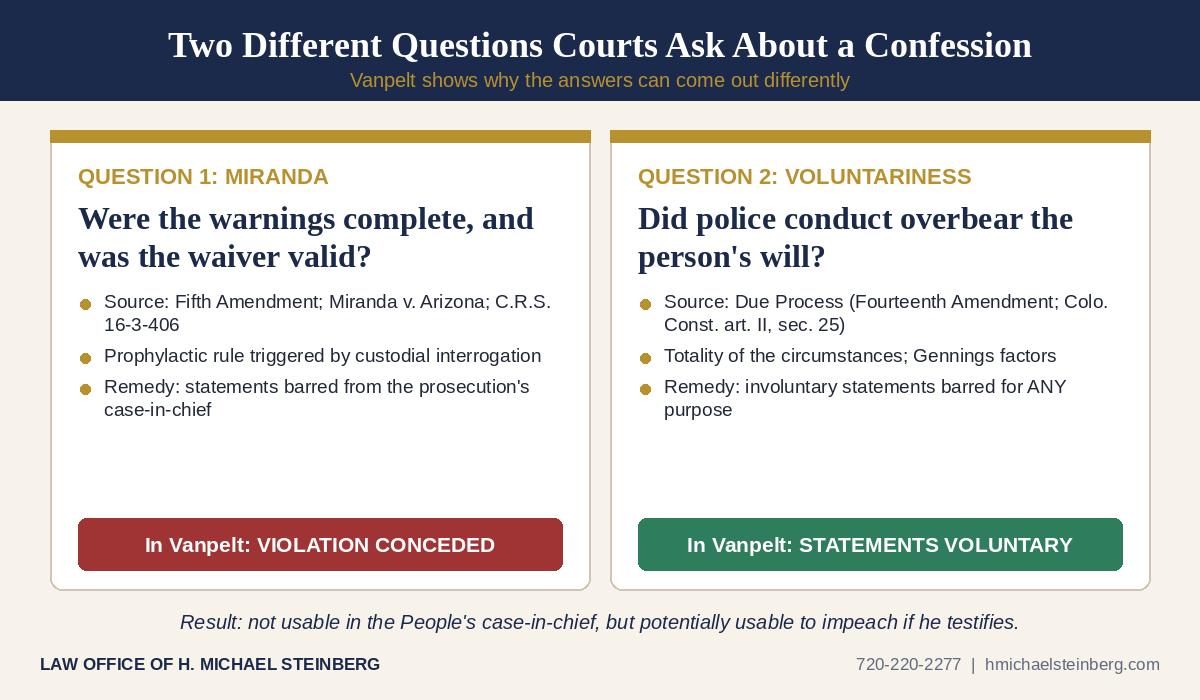
Voluntariness comes from a different source: the Due Process Clause of the Fourteenth Amendment and Colo. Const. art. II, § 25. A statement that is involuntary is inadmissible for any purpose, including impeachment. That is why the People pressed the voluntariness question even after conceding the Miranda error, and why the court treated the trial judge’s blending of the two issues as a mistake.
In a footnote, the justices noted that the district court conflated the voluntariness of the statements with the voluntariness of the Miranda waiver, which are analytically distinct under People v. Smiley, 2023 CO 36.
Burden and test. When a defendant makes a prima facie showing of involuntariness, the People must prove voluntariness by a preponderance of the evidence (People v. McIntyre, 2014 CO 39; People v. Raffaelli, 647 P.2d 230 (Colo. 1982)).
The central question is whether police behavior overbore the defendant’s will, which has two steps: was the police conduct coercive, and did that conduct play a significant role in inducing the statements (People v. Ramadon, 2013 CO 68)?
Under Colorado v. Connelly, 479 U.S. 157 (1986), coercive police activity is a necessary predicate to a finding of involuntariness under the Due Process Clause.
The seven Gennings factors
Colorado courts weigh the totality of the circumstances using the nonexhaustive factors from People v. Gennings, 808 P.2d 839 (Colo. 1991). The court found the first four undisputed and favorable to Vanpelt, but the remaining three decisively favored voluntariness.
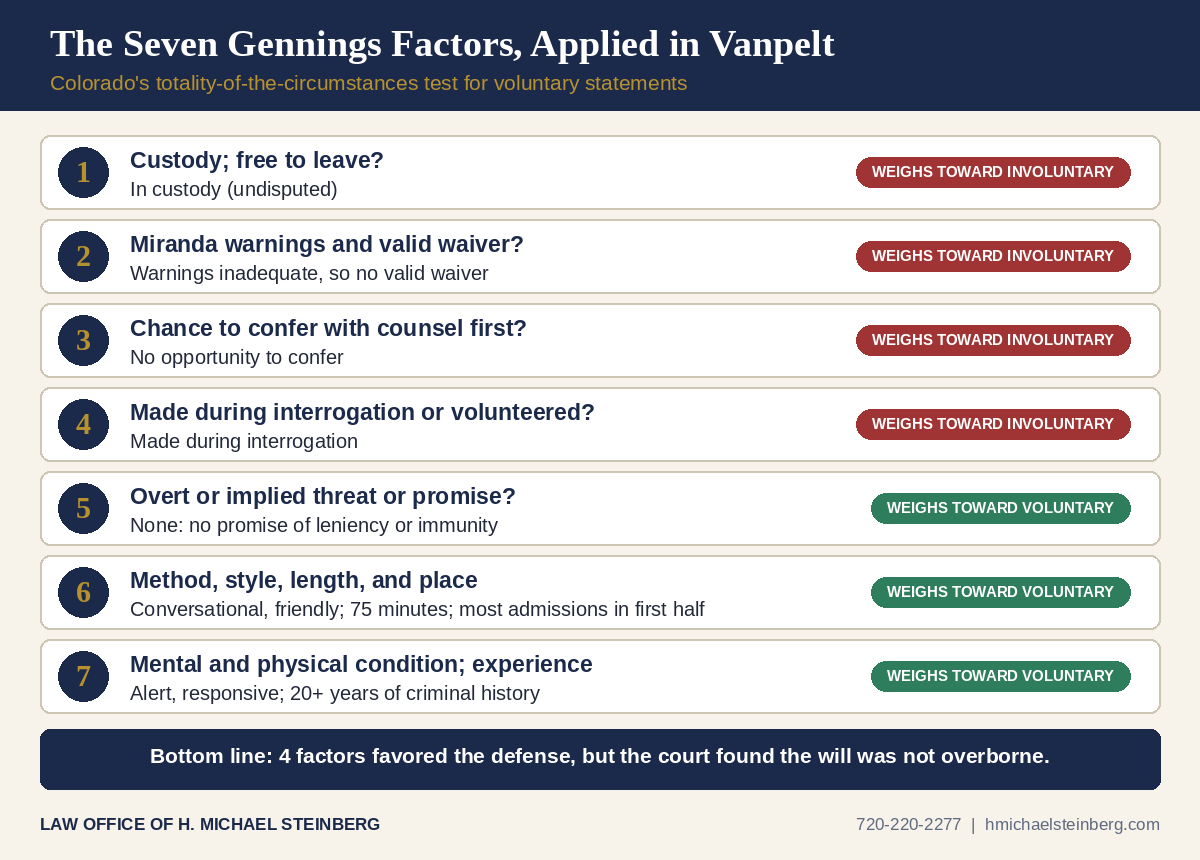
- Threats or promises (factor 5). The court disagreed with the district court’s characterization. Cortina did not promise to speak to the judge; he confirmed he would be in court. He said he would deliver the letter to the victims, not the judge. And his statement that he would give his observations to the district attorney did not impliedly promise leniency or immunity, citing People v. Torres, 2026 CO 15 and People v. McIntyre, 2014 CO 39.
- Method, style, length, and place (factor 6). Cortina did not badger Vanpelt. The district court itself observed a conversational tone and friendly demeanor. Suggesting that accountability would look favorable is within the bounds of proper police conduct, as in People v. Torres, 2026 CO 15 and People v. Zadran, 2013 CO 69M. The 75-minute length was not enough, particularly since most of the inculpatory statements came in the first half. The court contrasted People v. Liggett, 2014 CO 72, where statements after a five-and-a-half-hour interview were voluntary, with People v. Ramadon, 2013 CO 68, where statements after 54 minutes were coerced because of invocations of violence and deportation.
- Mental and physical condition and experience (factor 7). The record did not support the district court’s inference of cognitive delay. Vanpelt was responsive and wary of the sergeant’s attempts to get a confession. And his criminal history of more than twenty years cut toward voluntariness, because it showed experience resisting pressure; he even voiced a reluctance to incriminate himself during the interview.
The court added a timing point in a footnote: even if some remark had been coercive, a promise must actually induce the statement, and most of Vanpelt’s inculpatory statements came before the sergeant’s alleged promises.
Weighing everything, the justices concluded that although Vanpelt was in custody, lacked proper warnings, and had no chance to consult counsel, the police did not threaten him, their method was proper, he was mentally alert, and he had extensive experience with the criminal justice system. The statements and the apology letter were voluntary.
The Gun Seizure and Identification Rulings
Although the voluntariness holding drew the most attention, the court resolved two other issues. On the gun, it held that officers did not violate the Fourth Amendment or Colo. Const. art. II, § 7. Under Terry v. Ohio, 392 U.S. 1 (1968), officers with reasonable suspicion of a crime may take protective measures, including removing weapons, when they reasonably fear for their safety.
Here, a man slumped over a motorcycle suggested driving under the influence, and the officers faced an armed, unconscious, and therefore unpredictable person who might wake in a startled state. The court noted that reasonable suspicion can exist even when an innocent explanation, such as sleep, is possible, and it did not rely on a community caretaking theory, which Caniglia v. Strom, 593 U.S. 194 (2021) sharply limited.
On the identification, the court declined to reach whether Black could identify Vanpelt in court because C.A.R. 4.1 does not cover that type of order. Because this was a pretrial appeal, the criminal case itself has not yet gone to trial.
What Vanpelt Means for Colorado Defendants
- A Miranda violation helps, but it is not a magic eraser. It keeps the statements out of the prosecution’s case-in-chief. It does not stop prosecutors from arguing the statements were voluntary and from trying to use them to impeach a defendant who testifies. That can effectively pressure a defendant not to take the stand.
- Friendly, cooperative-sounding interrogation is generally lawful. The court repeatedly characterized a conversational tone, the suggestion that accountability looks good, and an offer to relay remorse to the victim as ordinary tactics. The same approach was endorsed in People v. Torres, 2026 CO 15.
- The exact words on the recording decide the case. The district court read the sergeant’s responses as promises. The Supreme Court read the same recording more literally and found no promise about the judge. Defense lawyers must parse every sentence, request the full video, and frame suppression arguments around specific, provable misrepresentations.
- Mental-state arguments need record support and a link to coercion. Alleged cognitive limitations did not carry the day without evidence, and under Colorado v. Connelly, 479 U.S. 157 (1986) a person’s mental condition alone does not make a statement involuntary absent police coercion.
- Timing matters. If the statements came before the alleged promise, the promise cannot have induced them. Build a timeline of the interview minute by minute.
- Prior experience cuts both ways. Extensive criminal history can be used to show the suspect understood and could resist pressure.
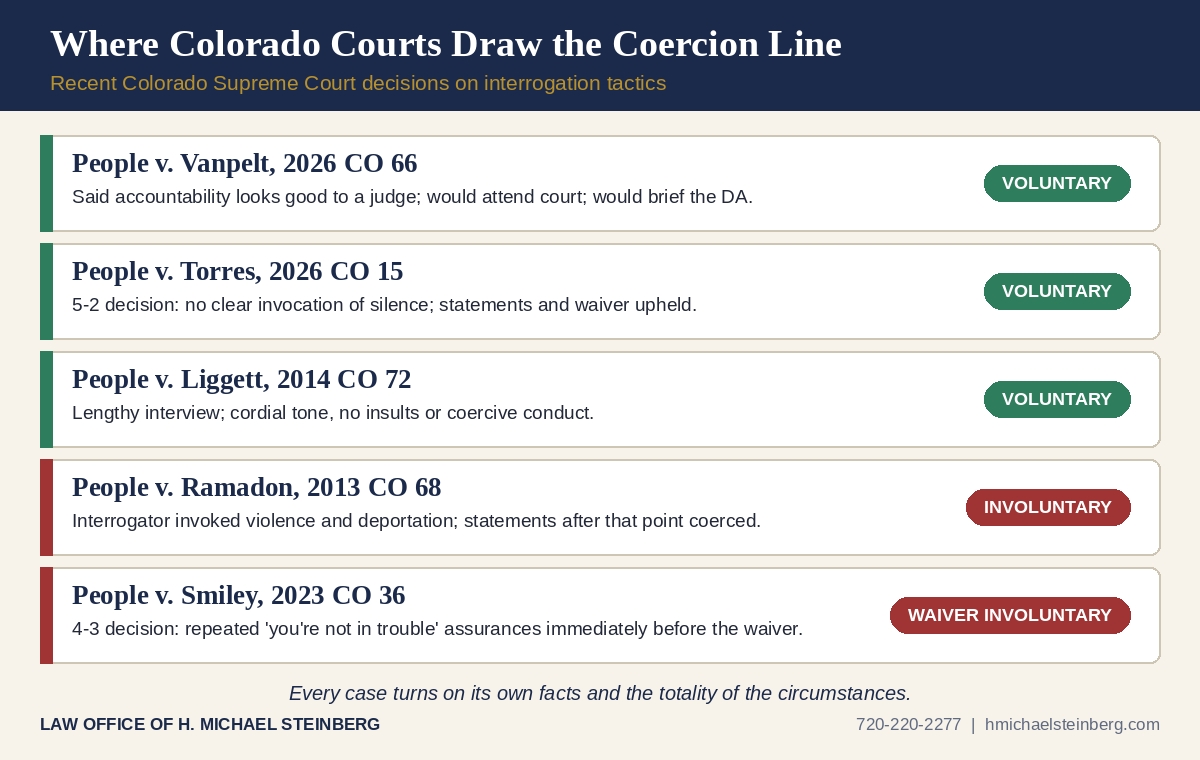
Compare People v. Vanpelt, 2026 CO 66 and People v. Torres, 2026 CO 15 with People v. Smiley, 2023 CO 36, where a four-justice majority found a Miranda waiver involuntary because detectives repeatedly assured the suspect he was “not in trouble” and downplayed the warnings just before he waived them, and with People v. Ramadon, 2013 CO 68, where an interrogator’s references to violence and deportation produced coerced statements. The pattern is consistent: tone and encouragement are tolerated, while threats, specific promises, and misleading assurances that undercut a person’s choice are where suppression succeeds.
A motion to suppress in Colorado is won or lost on the record. Preserve the full interview video, identify the exact words that function as a threat or promise, show how they induced specific statements, and be ready to address every Gennings factor. When the prosecution appeals under C.A.R. 4.1, the Supreme Court will independently review the recording.
If Police Want to Question You: Practical Steps
Vanpelt is a reminder that what you say in an interrogation room can follow you into court even when the police make mistakes. This is general information, not legal advice for your situation, but these principles protect people in Colorado every day:
- Clearly invoke your rights. Say, “I am invoking my right to remain silent and I want a lawyer.” Courts require a clear invocation; a hesitant or ambiguous statement may not stop questioning, as the court held in People v. Torres, 2026 CO 15.
- Do not count on a Miranda mistake to rescue you. Even if warnings are flawed, the statements may be used to impeach you if they are found voluntary.
- Treat a detective’s assurances with caution. Officers can promise to relay information, but prosecutors and judges decide charges and sentences. A comforting word in the room may not mean what you think it does.
- Do not write letters or statements for police or an alleged victim. An apology or explanation can be used as evidence, as the letter in this case shows.
- Call a Colorado criminal defense lawyer before any interview. The earlier counsel is involved, the more options exist to protect your rights and to preserve the evidence needed to challenge what police did.
For more on why even innocent people hurt their cases by talking to police, read my article, Why Innocent People Sometimes Hurt Their Cases by Talking to Colorado Police.
Frequently Asked Questions
What did the Colorado Supreme Court decide in People v. Vanpelt?
On October 12, 2026, the court held that Justin Vanpelt’s statements and written apology letter during a 75-minute custodial interrogation were voluntary under the Due Process Clause, even though the prosecution conceded he did not receive a proper Miranda advisement. It also held that officers lawfully seized his holstered firearm for safety, and it dismissed the prosecution’s appeal on the in-court identification issue because C.A.R. 4.1 did not authorize review of it.
If police do not give a proper Miranda warning in Colorado, can my statements still be used against me?
Possibly, in a limited way. Statements taken in a custodial interrogation without a proper Miranda advisement cannot be used in the prosecution’s case-in-chief. But if the statements were voluntary, Colorado law allows them to be used to impeach the defendant’s credibility if he or she testifies (C.R.S. § 16-3-406(5)). If the statements were involuntary, they cannot be used for any purpose.
What makes a confession involuntary in Colorado?
Courts ask whether police conduct was coercive and whether that coercion played a significant role in inducing the statements, so that the person’s will was overborne. They weigh the totality of the circumstances, including the seven Gennings factors: custody, Miranda warnings, access to counsel, whether the statement came during interrogation, threats or promises, the method, style, length, and place of questioning, and the person’s mental and physical condition and experience with the justice system.
Can a detective tell me that cooperating will look good to a judge?
In Vanpelt, the Colorado Supreme Court treated an officer’s suggestion that taking accountability would look favorable to a judge as permissible, noncoercive police conduct. The line is crossed by threats, by specific promises of leniency or immunity, or by misrepresentations that overbear a person’s will, and every case turns on its own facts and the recording of the interview.
Does People v. Vanpelt mean Miranda warnings no longer matter?
No. The prosecution conceded the Miranda violation, so the statements remain inadmissible in its case-in-chief. The decision addresses a different question, whether the statements were voluntary under the Due Process Clause, which controls whether they may be used for other purposes such as impeachment.
What should I do if police want to question me about a crime in Colorado?
Do not answer substantive questions, do not write statements or letters for police, and clearly say that you are invoking your right to remain silent and your right to an attorney. Then contact an experienced Colorado criminal defense lawyer before any interview. Even a friendly conversation can produce evidence that is later used against you.
Do not try to talk your way out of it. Attorney H. Michael Steinberg has defended Colorado criminal cases for more than forty years, including thirteen years as a career prosecutor. Call before you give a statement.
720-220-2277 (urgent / cell)
303-627-7777 (main office)
The Edwards Building, 8400 E. Prentice Ave., Penthouse 1500, Greenwood Village, CO 80111 · hmichaelsteinberg.com
Related Reading from the Colorado Criminal Lawyer Blog
- Why Innocent People Sometimes Hurt Their Cases by Talking to Colorado Police
- Tenth Circuit Upholds Drug-Dog Sniff Outside a Car: What U.S. v. Ostertag Means for Colorado Defendants
- More articles on Colorado search and seizure law
- More articles on the Colorado criminal process
Learn about our practice areas, including DUI and DWAI defense, drug crimes, assault, domestic violence, sex crimes, and firearms and weapons offenses, or read about the attorney profile of H. Michael Steinberg.
Sources and Authorities
The decision
- People v. Vanpelt, 2026 CO 66 (official opinion, Colorado Judicial Department)
- Justia copy of the opinion
- Colorado Lawyer opinion summary (Colorado Bar Association)
- Colorado justices reverse Larimer County decision barring evidence (Colorado Politics, Oct. 12, 2026)
Colorado cases
- People v. Torres, 2026 CO 15
- People v. Smiley, 2023 CO 36
- People v. McIntyre, 2014 CO 39
- People v. Liggett, 2014 CO 72
- People v. Zadran, 2013 CO 69M
- People v. Ramadon, 2013 CO 68
- People v. Gennings, 808 P.2d 839 (Colo. 1991)
- People v. Raffaelli, 647 P.2d 230 (Colo. 1982)
United States Supreme Court cases
- Miranda v. Arizona, 384 U.S. 436 (1966)
- Colorado v. Connelly, 479 U.S. 157 (1986)
- Harris v. New York, 401 U.S. 222 (1971)
- Terry v. Ohio, 392 U.S. 1 (1968)
- Caniglia v. Strom, 593 U.S. 194 (2021)
Statutes, rules, and constitutional provisions
- C.R.S. § 16-3-406 (custodial interrogation; admissibility)
- C.R.S. § 16-12-102 (appeals by the prosecution)
- C.A.R. 4.1 (interlocutory appeals in criminal cases)
- Colo. Const. art. II, § 7, Colo. Const. art. II, § 18, and Colo. Const. art. II, § 25
- U.S. Const. Fourth Amendment, Fifth Amendment, and Fourteenth Amendment
This article is for general information only. It is not legal advice and does not create an attorney-client relationship. Facts are drawn from the published Colorado Supreme Court opinion and press coverage; the defendant is presumed innocent and the criminal case remains pending. Every case is different. Consult a Colorado criminal defense attorney about your situation.