H. Michael Steinberg has 42+ years of experience practicing Colorado criminal law. Mr. Steinberg strives to stay current with the ever changing aspects of criminal law issues and updates resulting in his extensive knowledge of successful criminal defense as well as appellate work. He is also an active member of the National Association of Criminal Defense Lawyers, the Colorado Criminal Defense Bar Association, the Colorado Trial Lawyer's Association, and the Colorado and Arapahoe Bar Associations.
Published on:
How Social Media Posts Become Evidence in Colorado Criminal Cases
A single post can change the course of a criminal case. A late-night rant, a photo with the wrong people, a message that was meant to be private: prosecutors in Colorado treat all of it as potential evidence, and they are getting better at using it. But a screenshot is not automatically an exhibit. Before a jury ever sees your post, the State has to clear a series of legal hurdles, and each one is an opportunity for the defense.
This guide explains, in plain English, how social media content moves from your phone to a Colorado courtroom, which rules decide whether it comes in, and what you should do (and avoid) if you are under investigation. It is written from the defense side of the courtroom by a Denver criminal defense lawyer.
Quick answer
Public posts need no warrant. Police and prosecutors can screenshot them freely.
Private content usually requires a warrant or other legal process, and Colorado courts review the scope of digital warrants closely.
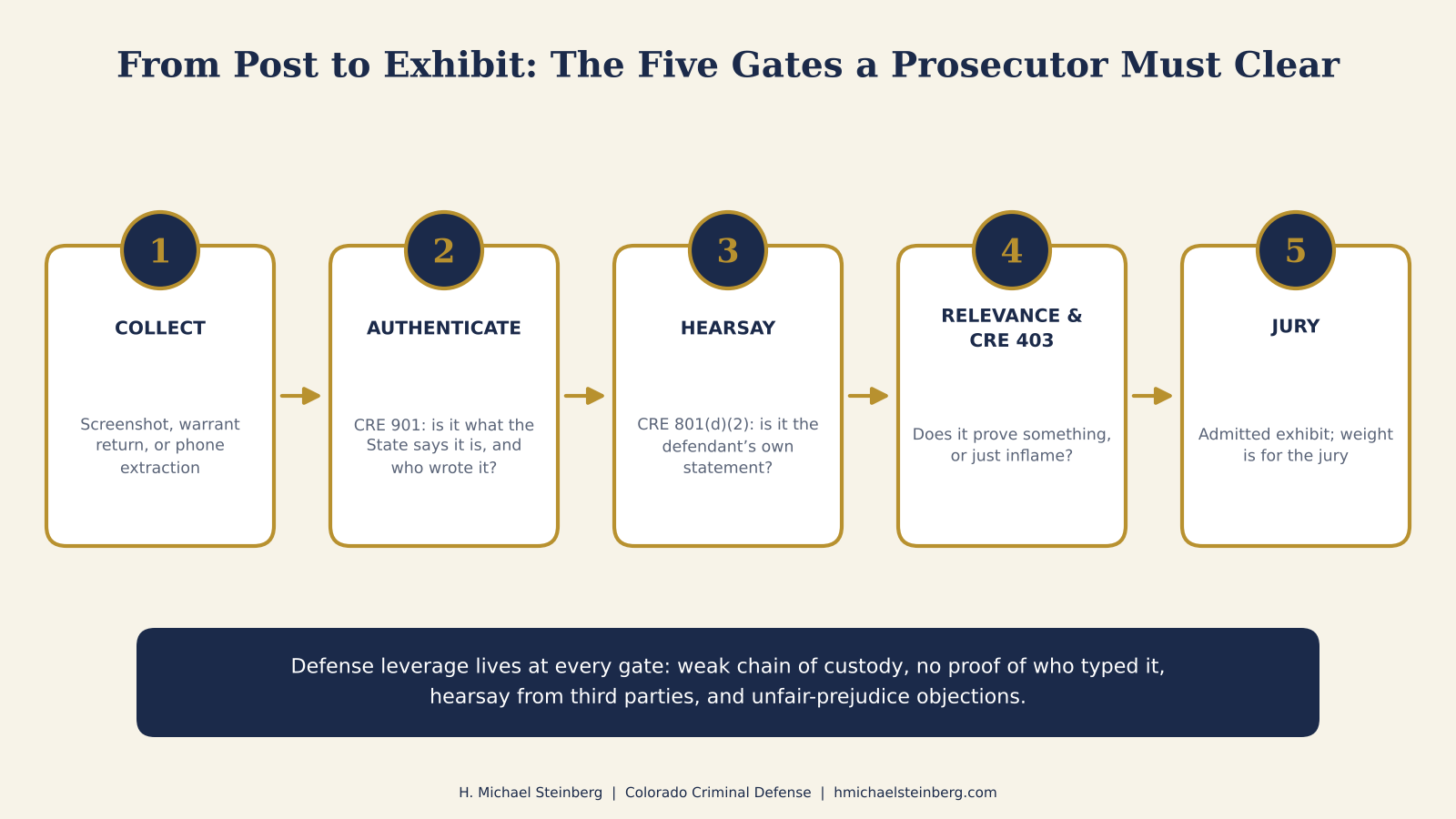
To admit a post, the prosecution must authenticate it under CRE 901 (is it what they say it is, and did the defendant write it?), then clear hearsay and fairness objections.
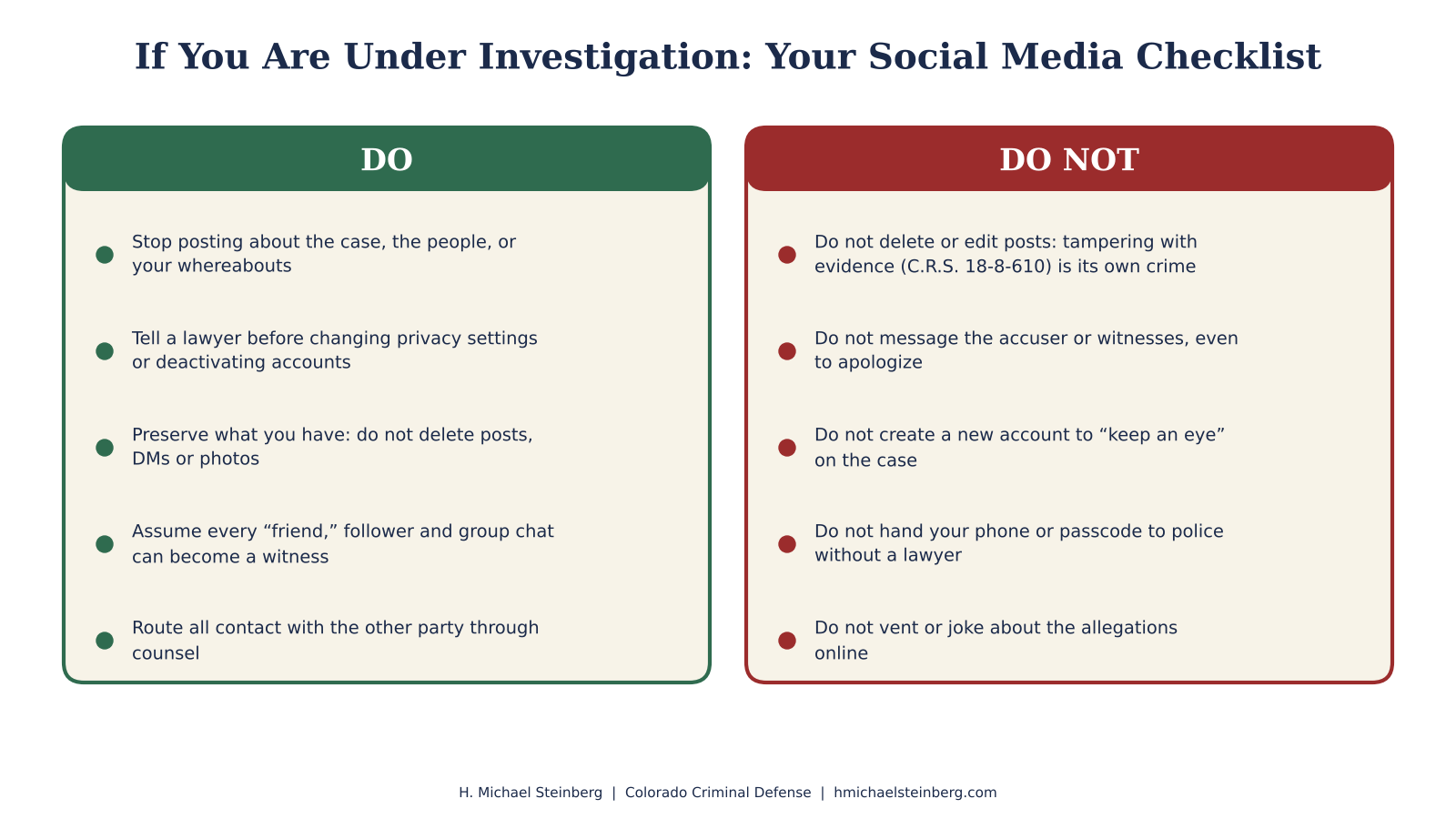
Deleting posts after you learn of an investigation can itself be charged as tampering with physical evidence.
Your own posts are usually admissible against you as a party admission.
Why prosecutors want your posts
Social media is a running diary. It records where people were, who they were with, what they said, and how they felt, all with timestamps. For a prosecutor, that is a gift: it can supply motive, identity, intent, and an alibi-buster in one exhibit. For a defendant, the same posts can look damning even when, in full context, they are harmless.
That is why our firm tells every client the same thing in the first meeting: stop posting about the case. We cover the practical rules in our article, Don’t Talk About Your Criminal Case on Social Media. This article goes deeper into the legal mechanics.
How investigators get social media evidence
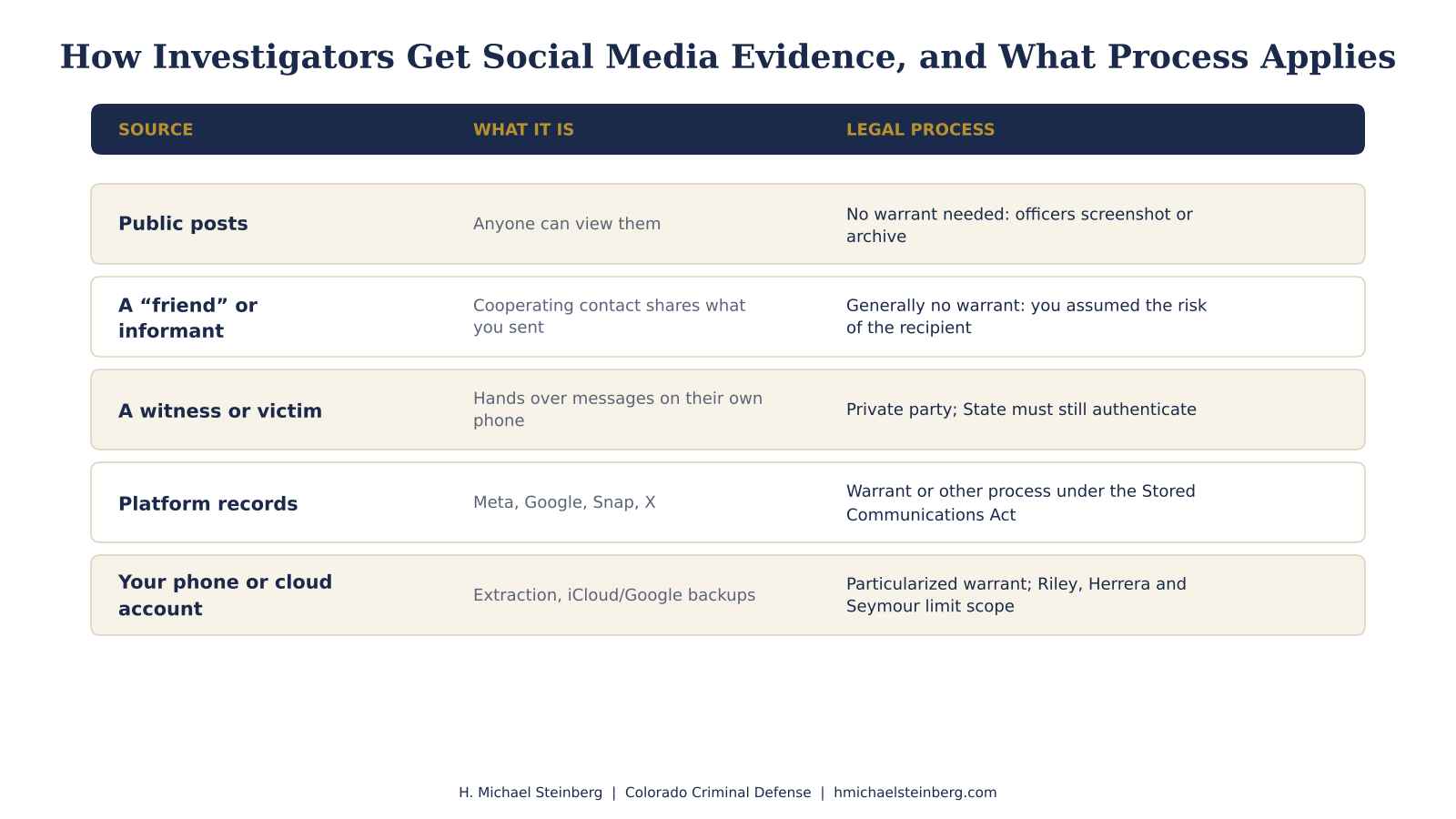
There are five common routes, and the legal rules differ for each.
Public posts. If anyone can see it, so can a detective. No warrant is required, and agents sometimes use undercover or “decoy” accounts to view more.
A friend, follower, or informant. Under the long-standing “false friend” principle, the Fourth Amendment does not protect what you voluntarily share with someone who then hands it to police. See Hoffa v. United States, 385 U.S. 293 (1966). If you send a message to someone, you assume the risk that they will show it to the government.
A witness or complainant. In many cases, the alleged victim simply screenshots the messages and gives them to police. That is a private party, not a government search, though the State must still authenticate the screenshots.
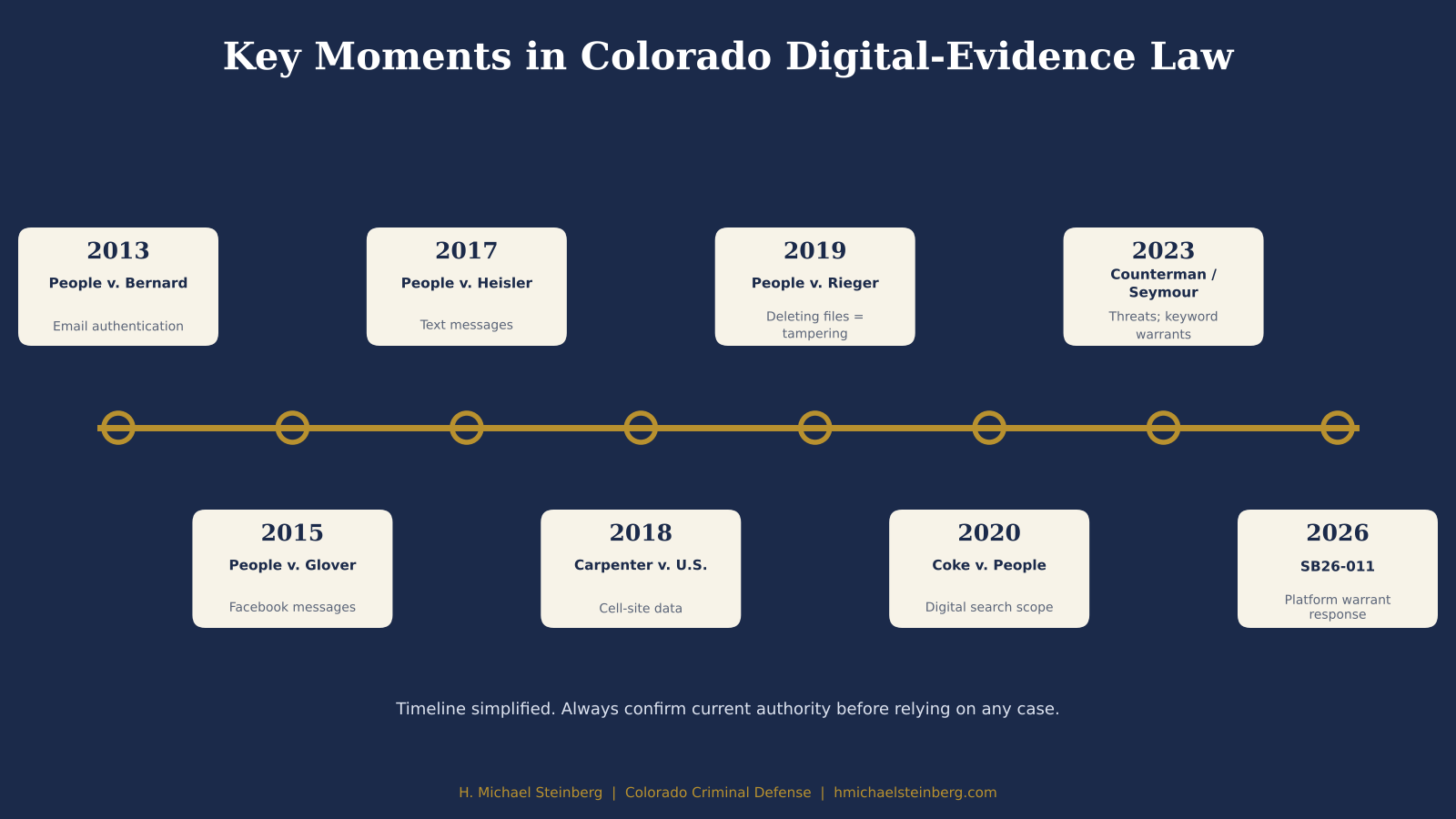
Colorado lawmakers have also pursued SB26-011, which addresses how quickly covered platforms must respond to Colorado search warrants; check the bill page for its current status.
A warrant to search a phone for ownership information did not permit opening every folder. The court refused to treat the warrant as a general warrant and affirmed suppression.
Colorado recognized a constitutionally protected privacy interest in Google search history under art. II, § 7, though the evidence was admitted on good-faith grounds.
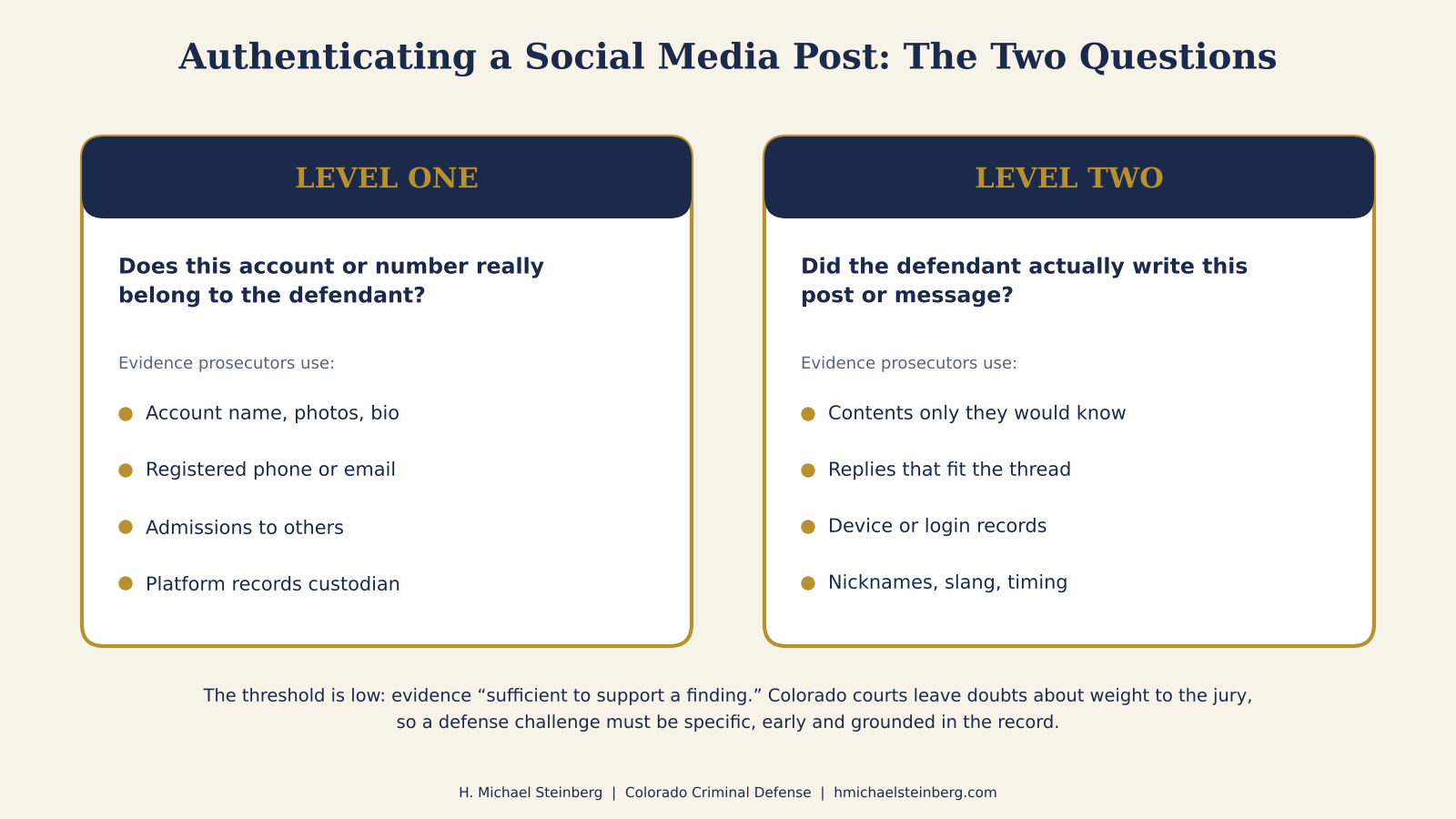
Even when a post was lawfully obtained, the prosecutor must first authenticate it.CRE 901 requires evidence “sufficient to support a finding that the matter in question is what its proponent claims.”For social media, that raises two distinct questions, and Colorado courts have addressed them in a short line of cases.
People v. Bernard, 2013 COA 79 emails may be authenticated through a witness with personal knowledge or through distinctive characteristics in the contents and surrounding circumstances.
People v. Glover, 2015 COA 16: Colorado’s first appellate decision on Facebook communications. The court treated authentication of social media as a two-level inquiry, and held the messages were properly authenticated and not inadmissible hearsay, even though the trial court was wrong to call them business records.
People v. Heisler, 2017 COA 58: applied the same reasoning to text messages in a harassment prosecution and confirmed that the proponent may authenticate with circumstantial evidence such as content, context, and replies.
The bar for authentication is low, which is exactly why the defense must act early and specifically. A general objection at trial rarely wins. A targeted motion that points to who else had access to the account often does.
Practical weaknesses defense counsel look for include: accounts that were shared or hacked, fake or spoofed profiles, a phone passed between people, screenshots with no URL, date, or username, edited or cropped images, and messages that the State cannot tie to a specific device or login. Our deleted-message article, Can Police Recover Your Deleted Text Messages?, explains how forensic recovery works and where it fails.
Gate two: hearsay, context and fairness
Hearsay is an out-of-court statement offered for its truth. Your own posts, offered by the State against you, are generally not hearsay at all: under CRE 801(d)(2) they are statements of a party opponent. That is the rule that makes your venting so dangerous.
Third-party posts are different. Comments from friends, replies, or a witness’s own posts are often hearsay when offered to prove their truth, and the defense can object unless an exception applies. Glover shows that a prosecutor’s chosen label (such as “business record”) is not controlling: the court looks at what the evidence actually is.
Two more doctrines protect context. The rule of completeness, CRE 106, lets the defense insist that the rest of a conversation come in when the State plays only the worst messages. And CRE 403 allows exclusion when unfair prejudice substantially outweighs probative value, which can matter for violent memes, song lyrics, jokes, and photographs that tell the jury little about the charge.
When the post is the crime
Sometimes the content is not just proof; it is the offense. Colorado prosecutes online conduct under several statutes, all collected in Title 18 of the Colorado Revised Statutes:
Harassment, C.R.S. 18-9-111. Threatening or abusive messages are a common basis for misdemeanor harassment charges.
Violation of a protection order, C.R.S. 18-6-803.5. A “like,” tag, or direct message to a protected person can be charged as a violation. Read what happens if you violate a protection order before you touch your phone.
Threat cases and the First Amendment. In Counterman v. Colorado, 600 U.S. 66 (2023), the Supreme Court vacated a Colorado stalking conviction built on Facebook messages and held that the State must prove the speaker acted at least recklessly, meaning he consciously disregarded a substantial risk that the words would be viewed as threatening.
These cases frequently arise in domestic violence and assault prosecutions, where an angry exchange of messages becomes the centerpiece of the State’s case.
Deleting posts can create a new charge
The instinct to clean up your profile is understandable and dangerous. Under C.R.S. 18-8-610, tampering with physical evidence includes destroying or concealing evidence when you believe an official proceeding is pending or about to begin. In People v. Rieger, 2019 COA 14, the Court of Appeals held that an electronically stored photograph qualifies as “physical evidence” under that statute.
Asking a friend to delete posts or change a story can raise witness-tampering exposure under C.R.S. 18-8-707.And deletion rarely works: copies often survive on the other person’s phone, in backups, or with the platform.
The right move is to preserve everything and call a lawyer before touching privacy settings.
Defense strategies that work
Challenge authorship. Make the State prove who typed the post, not just whose name appears on it.
Move to suppress. Attack warrants for lack of probable cause or particularity, and challenge warrantless phone and account searches under Riley, Herrera and Seymour.
Demand the whole conversation. Invoke completeness and context so a single message is not read in a vacuum.
Object to hearsay and prejudice. Exclude third-party commentary, speculation and inflammatory content under CRE 802 and 403.
Preserve your own evidence. Messages can help the defense too, proving self-defense, consent, alibi or a motive to fabricate.
Bring in a digital forensic examiner. Metadata, device logs and platform records can undercut a screenshot.
Every case turns on its facts. If your case involves digital evidence, we encourage you to review our representative case history and contact the firm for a confidential consultation.
What to do right now
If you think you are being investigated, or you have been charged: stop posting, preserve everything, stay off the other party’s accounts, and do not discuss the case with anyone but your lawyer. Our and our post on why you should never talk to the police explain the offline side. The same caution applies to AI chatbots: see Anything You Ask ChatGPT May Be Used Against You in Court.
How Colorado law got here
Colorado’s rules of evidence were written long before Facebook, so the law has developed on a case-by-case basis. The timeline above shows how courts moved from authenticating emails to wrestling with keyword warrants and platform response deadlines. Expect more change, and always confirm current authority before relying on any case.
Frequently asked questions
Can police use my social media posts against me in Colorado?
Yes. Public posts require no warrant, and your own statements are generally admissible against you as party admissions. Private content usually requires a warrant or another form of legal process.
Do police need a warrant to see my Facebook or Instagram account?
Not for public content. For private messages and account data held by the platform, they generally use a warrant or other process under the Stored Communications Act. Searching your phone usually requires a warrant under Riley v. California.
What does it mean to authenticate a social media post?
The prosecution must offer evidence sufficient to support a finding that the post is what they claim, and in practice that the defendant actually wrote it. Colorado courts allow circumstantial proof such as content, context and replies (CRE 901; Glover; Heisler).
Is a screenshot enough to get a post admitted?
Not by itself. A witness must be able to say the screenshot fairly and accurately shows the post, and the State must still tie the post to the defendant and clear hearsay and fairness objections.
Can I delete my posts if I am being investigated?
Do not delete anything until you speak with a lawyer. Destroying evidence after you know about an investigation can be charged as tampering with physical evidence under C.R.S. 18-8-610, and Colorado courts treat electronic files as physical evidence.
Can a post be a crime even if I did not mean it as a threat?
The First Amendment requires more than a negligent reading. Under Counterman v. Colorado, the State must prove at least recklessness for a true-threat prosecution, though other charges such as harassment or protection order violations have their own elements.
Facing charges involving texts, posts, or phone evidence?
Attorney H. Michael Steinberg has defended Colorado criminal cases for decades. Call for a confidential consultation, or review the firm’s practice areas and attorney profile.
Disclaimer. This article is for general information only and is not legal advice. Reading it does not create an attorney-client relationship. Laws change and every case is different; consult a licensed Colorado attorney about your situation. Past results do not guarantee a similar outcome. hmichaelsteinberg.com
 Colorado Criminal Lawyer Blog