 Colorado Criminal Lawyer Blog
Preliminary Hearings in Colorado: the Probable Cause Standard – Why “Prelims” May Be Underused


By Colorado Criminal Defense Lawyer H. Michael Steinberg | October 20, 2026
When a felony charge lands, the first instinct for many defendants is to get it over with. In Colorado, one of the earliest decisions in a felony case is whether to demand a preliminary hearing, a short courtroom proceeding where a judge decides whether the prosecution has enough evidence to justify moving the case forward. In our experience, roughly nineteen out of twenty are waived. That is often the right call, but it should be a decision, not a default.
This guide explains what a Colorado preliminary hearing is, the probable cause standard judges apply, when a person charged in Colorado is entitled to a preliminary hearing, the short deadline to ask for one, and the practical ways a “prelim” can help a defendant even when the case is not dismissed. This article reflects Colorado’s statutes, court rules, and decisions current as of October 20, 2026.
Key Takeaways
- A preliminary hearing is a limited probable causescreen. It is not a trial, and the judge does not decide guilt.
- Only certain felonies qualify, and the request deadline is short: 7 days after the first appearance (Crim. P. 5(a)(4)(I) and 7(h)(1)).
- The bar or burden of proof is very and evidence is viewed in the prosecution’s favor, but the prosecution must still support not only the element of identificationand every essential element of the crime charged with actual evidence.
- In my experience of some 40 plus years about 95% of preliminary hearings are waived. Waiver can be a smart decision IF it is a part of negotiations with the prosecution, but a reflexive waiver can forfeit information, leverage, and a sworn record that could be useful at trial.
- A “no probable cause” ruling is a great result if you successfully win at hearing but that result is NOT necessarily the end of the case, because the law permits the prosecution to refile the case. The hearings greatest value is frequently strategic.
What Exactly Is a Preliminary Hearing in Colorado?
A preliminary hearing is an early court proceeding in a felony case, usually held in county court after the prosecutor files a felony complaint, or in district court when the prosecutor files a direct information.
The sole purpose of the preliminary hearing is to determine whether there is probable cause to believe that the charged offense was committed and that the defendant committed it.
The governing sources are C.R.S. 16-5-301, Crim. P. 5 for county court, and Crim. P. 7(h) for district court.
The procedure is simple on paper. The defendant is not asked to plead guilty or not guilty. The prosecutor carries the burden of establishing probable cause. The defendant may cross-examine the prosecution’s witnesses and may introduce evidence, however the judge may temper the rules of evidence in the exercise of sound discretion (Crim. P. 5(a)(4)(II); Crim. P. 7(h)(3)). If the judge finds probable cause, the defendant is “bound over”to district court for arraignment. If not, the unsupported counts are dismissed.
For a short overview in our own words, see our firm’s page on preliminary hearings in Colorado. This article goes deeper on the standard and the strategy.
The Probable Cause Standard at a Preliminary Hearing
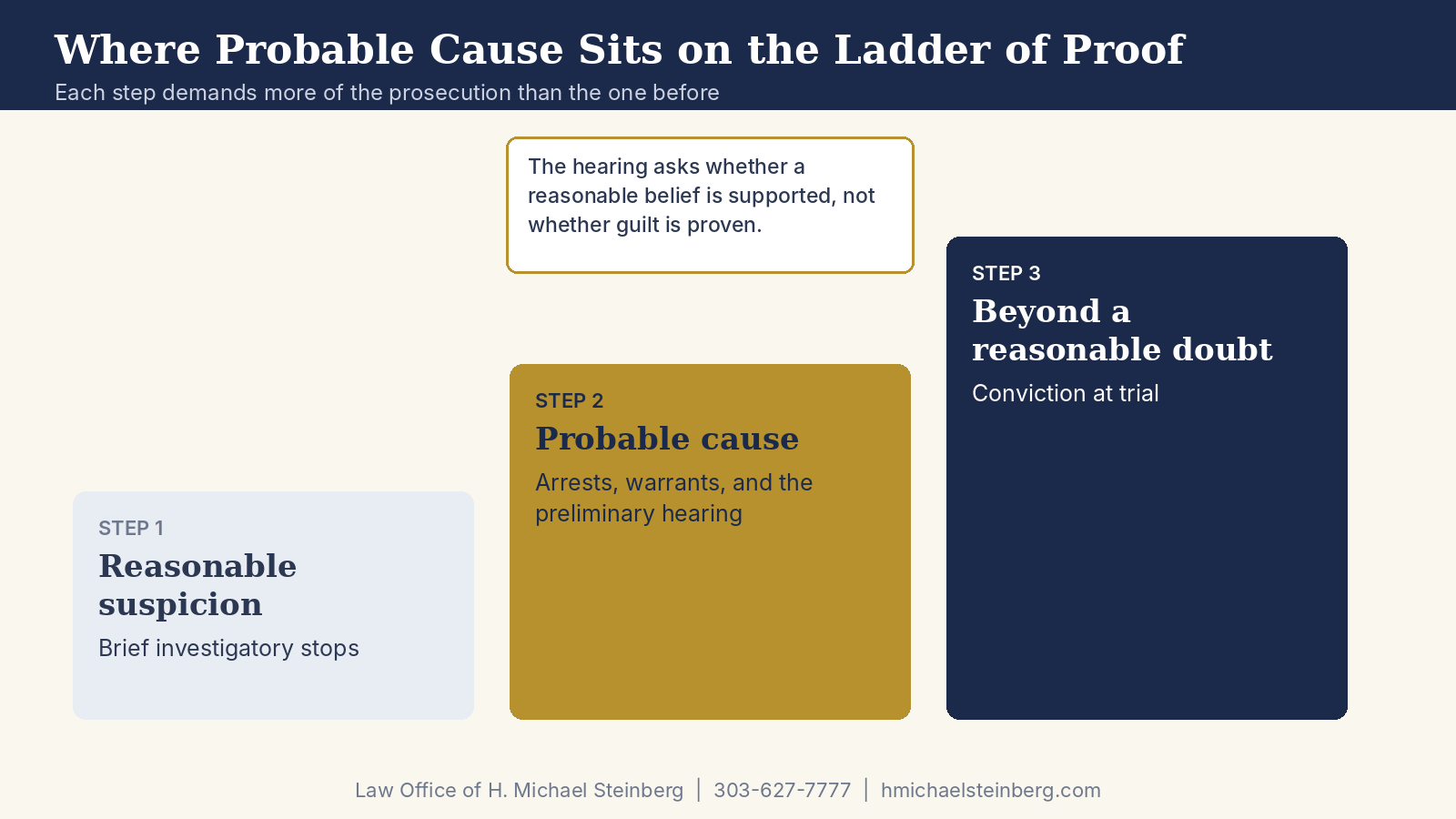
Where probable cause sits among the standards of proof.
Probable cause is the same concept that governs arrests and warrants, a practical, common-sense judgment about the facts. The U.S. Supreme Court describes it as a fair probability based on the totality of the circumstances (Illinois v. Gates, 462 U.S. 213 (1983)). We cover the broader doctrine in our post on probable cause under Colorado law. At a preliminary hearing, the question is narrower and the hearing is more structured.
In a recent Colorado Court of Appeals decision, the court explained that the prosecution must present evidence that would lead a person of “ordinary prudence and caution” to hold a reasonable belief that the defendant committed the crime. The evidentiary threshold is low, the prosecution need not present evidence sufficient to convict, and the judge views the evidence and draws inferences in the prosecution’s favor (People v. Hawkins, No. 25CA1585 (Colo. App. Oct. 1, 2026) (unpublished), citing People v. Collins, 32 P.3d 636 (Colo. App. 2001)).
Relaxed evidence and the hearsay limit
Because the hearing is a screening device and not a trial, the rules of evidence are relaxed, and much of the testimony can be hearsay. But there is a limit.
In Hunter v. District Court, 190 Colo. 48, 543 P.2d 1265 (1975), the Colorado Supreme Court reiterated that the prosecution may not rely totally on hearsay when competent evidence is readily available, a rule it traced to Maestas v. District Court, 189 Colo. 443, 541 P.2d 889 (1975). In practice, that principle can support a demand that the prosecution call the witness who actually perceived the events.
Credibility is largely off the table
A preliminary hearing in Colorado is not a mini-trial. In Hunter, the Court held that a judge may weigh a witness’s credibility only when the testimony is implausible or incredible as a matter of law. A mere conflict in the testimony is a question for the jury, and the judge must draw the inference favorable to the prosecution. The Court reinstated charges that a district judge had dismissed after disbelieving the complaining witness. Cross-examination can still matter, but a judge will rarely let it become a trial on credibility.
Low bar, not no bar
Two points keep the standard honest. First, the bar is genuinely low. In People v. Hall, 999 P.2d 207 (Colo. 2000), a fatal skiing collision at Vail, both the county court and the district court found no probable cause for reckless manslaughter. The Colorado Supreme Court reversed and held that whether Hall was reckless was for the trier of fact. Second, the bar is not zero.
In Hawkins, a district court dismissed two vehicle theft counts because the prosecution offered no substantive evidence identifying the defendant as the perpetrator beyond his presence in the courtroom, and the Court of Appeals affirmed, also upholding the denial of the prosecution’s request to reopen the evidence after closing argument. Identification is part of probable cause, and the prosecution has to prove it with evidence rather than assumptions.
Who Is Entitled to a Preliminary Hearing?
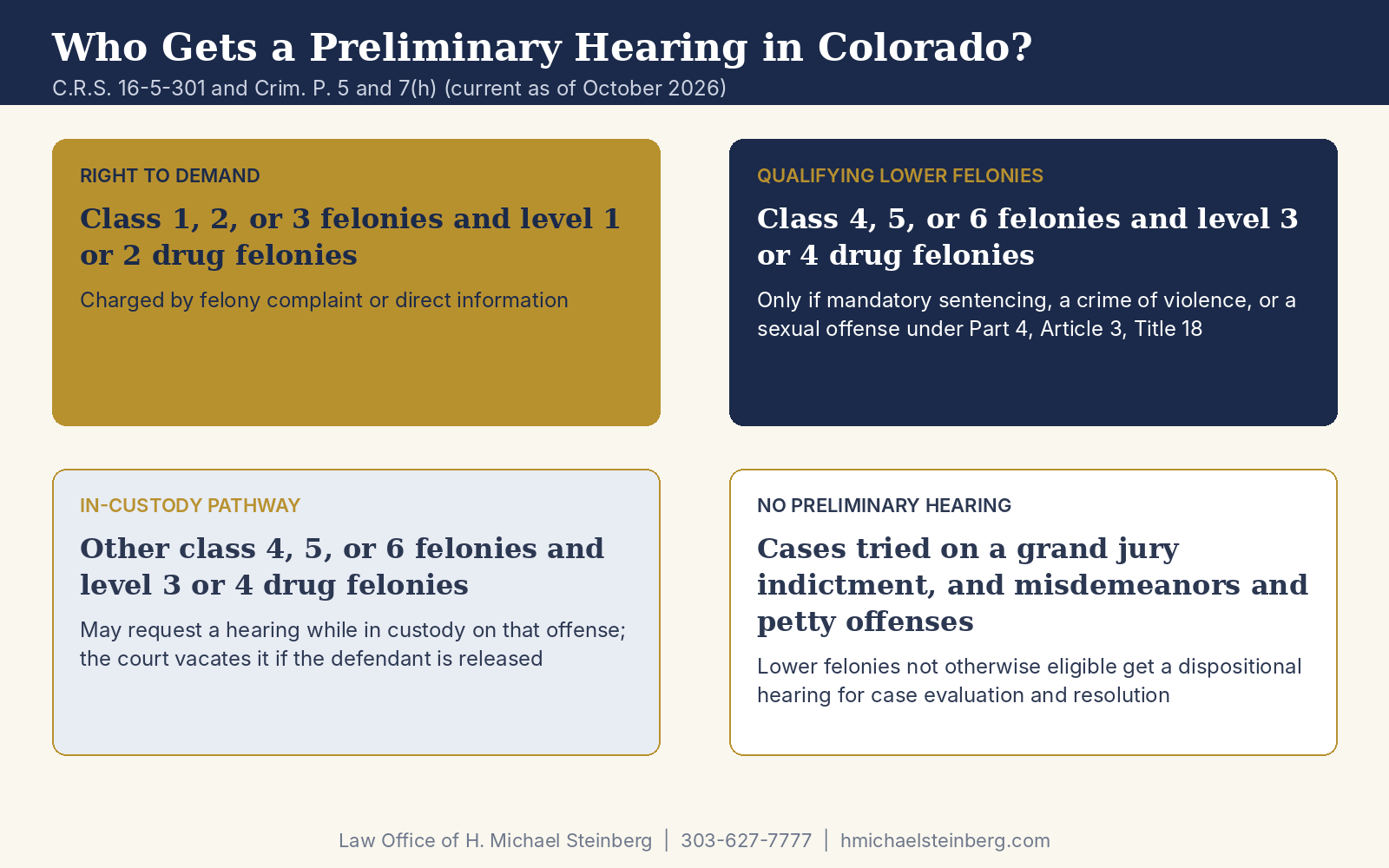
Who may demand a preliminary hearing under C.R.S. 16-5-301 and Crim. P. 5 and 7(h).
Not every case qualifies. Under C.R.S. 16-5-301 and the parallel rules, eligibility depends on the level of the charged offense:
- Right to demand. Persons accused of class 1, 2, or 3 felonies, or level 1 or 2 drug felonies.
- Qualifying lower felonies. Persons accused of class 4, 5, or 6 felonies, or level 3 or 4 drug felonies, if the felony requires mandatory sentencing, is a crime of violence, or is a sexual offense under Part 4 of Article 3 of Title 18.
- The in-custody pathway. Other class 4, 5, or 6 felony and level 3 or 4 drug felony defendants may request a hearing if they are in custody on that offense. If the defendant is released before the hearing, the court vacates it on a party’s motion.
- No hearing. Cases tried on a grand jury indictment do not get one, and the rules provide no preliminary hearing procedure for misdemeanors and petty offenses. Lower felonies that are not otherwise eligible receive a dispositional hearing, a status conference for case evaluation and potential resolution.
Two wrinkles are worth knowing. First, the in-custody pathway means that winning a bond reduction can extinguish a hearing the defense wanted, so the two goals have to be coordinated. We discuss release issues in our article on setting bail bonds in Colorado. Second, entitlement turns on what the defendant is actually accused of.
In People v. Vanness, 2020 CO 18, the Colorado Supreme Court held that a defendant charged with a level 4 drug felony plus a special offender count that together amounted to a level 1 drug felony was entitled to a hearing.
The Court has addressed entitlement repeatedly since 2018, and the question is still evolving: in an original proceeding where the Court issued an order to show cause in June 2026, it is considering whether a juvenile is entitled to a hearing after a related grand jury indictment, and we have not located a decision when this article was prepared (Colorado Politics report; Colorado Supreme Court docket).
The 7-Day Clock: Deadlines That Can Forfeit the Preliminary Hearing
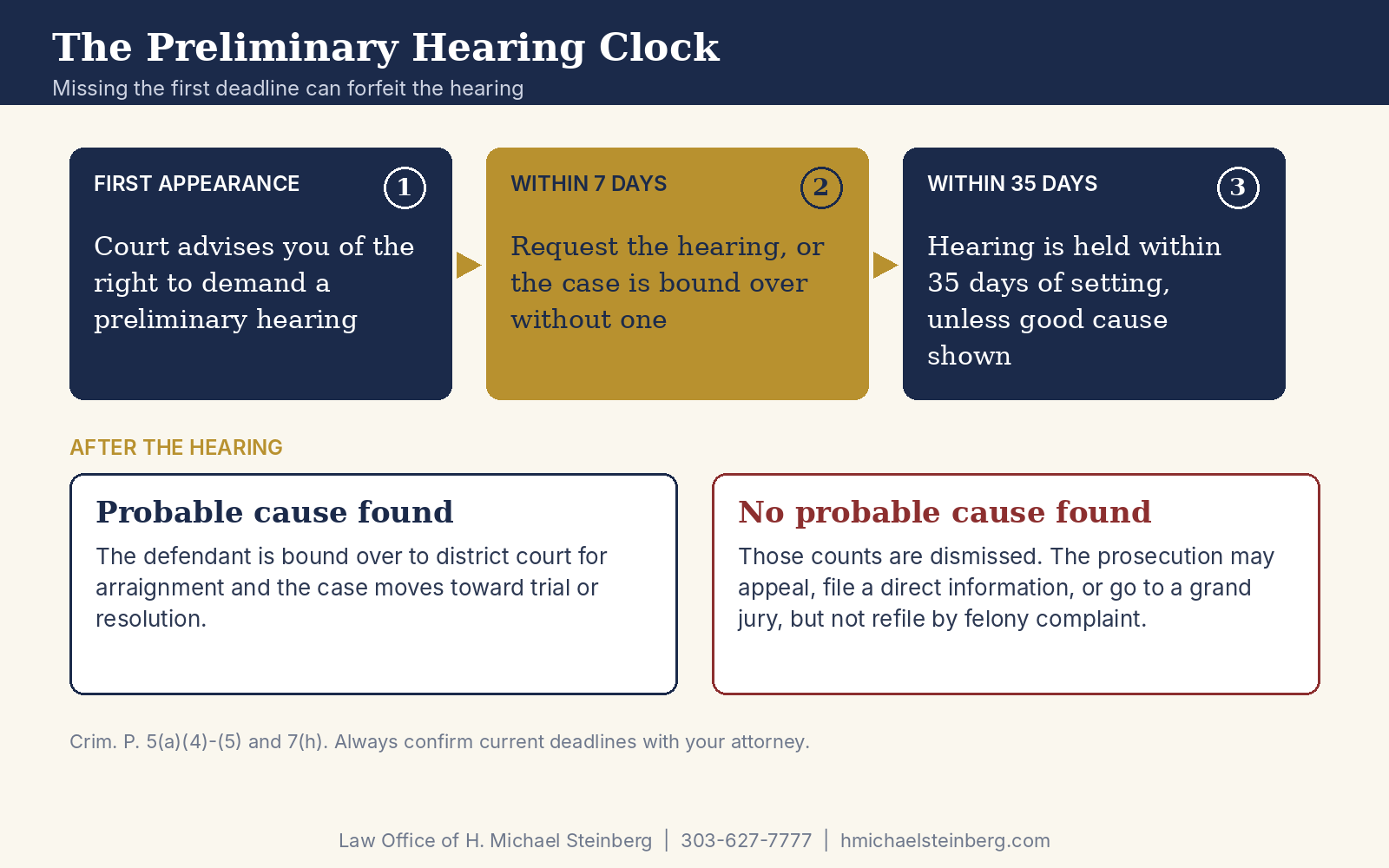
The preliminary hearing clock and what follows the ruling.
The deadline is the single most important practical point. In county court, either the prosecutor or the defendant may request a preliminary hearing within 7 days after the defendant is brought before the court.
The hearing must then be held within 35 days of the setting, unless good cause for a continuance is shown (Crim. P. 5(a)(4)(I)). If no one asks within the 7 days, the court orders the defendant bound over, and no case may be bound over until the hearing is held, the 7 days expire, or the right is waived (Crim. P. 5(a)(5)).
District court practice mirrors this. A request on a direct information must generally be made within 7 days and before a plea, absent good cause. Once the window closes, the request will not be heard, and the court will not entertain successive requests (Crim. P. 7(h)(1), (h)(2), and (h)(5)). Note that the prosecution can ask for a hearing too, which is one reason defense counsel should not assume a quiet 7 days.
Why Preliminary Hearings Are So Often Waived
In our experience, roughly 95% of preliminary hearings are waived and the case is bound over to district court for arraignment, a point we make on our preliminary hearing page. The reasons are understandable:
- The standard is low and credibility challenges are limited, so outright dismissal is uncommon.
- A hearing can give the prosecution a rehearsal, an opportunity to shore up weak spots, and a stronger sense of its witnesses.
- A hearing can be hard on complainants and families, and some clients prefer a faster, quieter path.
- Waiver is often the currency of the first serious plea negotiation. A defense lawyer may trade a waiver for a better offer.
Commentators have long observed that, whatever the rules say about screening charges, the hearings practical role is often negotiation and information-gathering. A well-known Colorado Lawyer article on felony preliminary hearings made this point decades ago. That is exactly why the hearing is underused: when waiver becomes automatic, the defense gives up the leverage that the hearing date creates, often without testing whether a better path exists.
Six Tactical Uses of a Preliminary Hearing
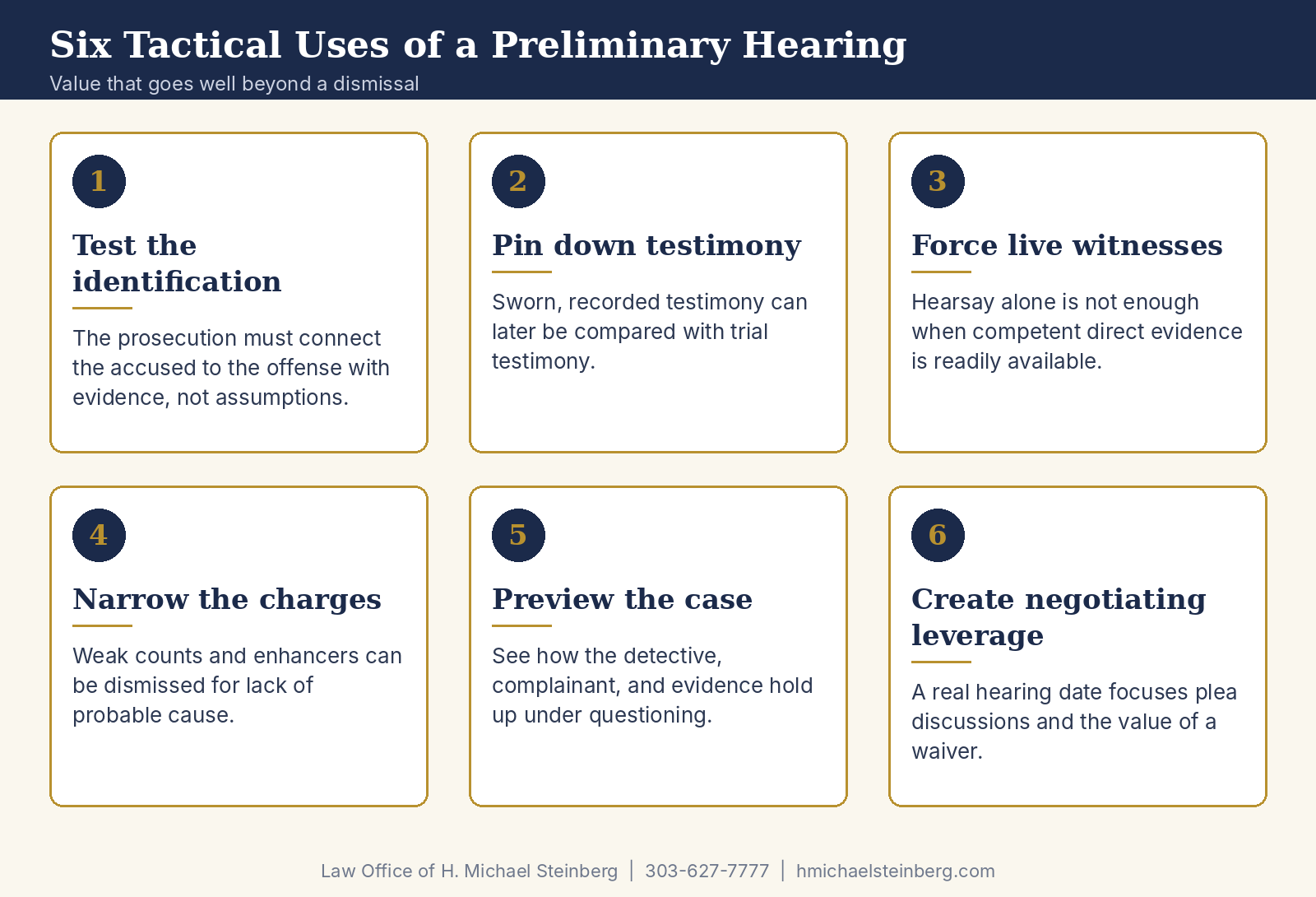
1. Test the identification
Identification is part of probable cause. If the complainant or detective cannot tie the accused to the offense with evidence, that gap belongs on the record and may support dismissal, as Hawkins illustrates. It is an unpublished opinion and not binding precedent, but it shows how courts treat a missing link.
2. Pin down testimony
A preliminary hearing produces sworn, recorded testimony. Years later, that transcript can be compared with what a witness says at trial, which can help expose inconsistency or embellishment.
3. Force live witnesses
If the prosecution plans to rely on a detective’s secondhand account, a hearing lets the defense insist on the Maestas principle that competent direct evidence must be presented when it is readily available. That can bring the key witness into the courtroom, under oath, and subject to cross-examination.
4. Narrow the charges
Counts that lack support can be dismissed, and overcharged cases often look different once the evidence is tested element by element. Even partial success can change how a case is valued and what a reasonable resolution looks like.
5. Preview the case
Courts say discovery is not the purpose of a preliminary hearing, and judges will curtail questioning that looks like a fishing expedition. Still, a properly focused hearing shows how the detective, the complainant, and the evidence perform under questioning, information that informs motions, investigation, and the decision whether to go to trial.
6. Create negotiating leverage
A real hearing date focuses the prosecution’s attention. Early negotiations tend to move when the alternative is a contested hearing with live witnesses, and a waiver then has real value. Read more about how resolutions are built in our overview of plea bargaining in Colorado.
What Happens After a “No Probable Cause” Ruling?
A dismissal at a preliminary hearing feels like a victory, and it is, but it is not always final. If the judge finds no probable cause on any count, those counts are dismissed, and if all counts are dismissed the defendant is discharged.
The prosecution may then appeal to the district court, file a direct information in district court charging the same offenses, or submit the matter to a grand jury, though it may not simply file a new felony complaint (Crim. P. 5(a)(4)(IV)-(VI)). A dismissal also does not bar further prosecution for the same offenses (Crim. P. 7(h)(5)).
The rules do build in a check. When the prosecution proceeds by direct information after a no-probable-cause ruling, it must file a written statement alleging facts showing that evidence exists which, for good cause, was not presented at the hearing, and the defendant may request an evidentiary hearing within 21 days of the first appearance on the new filing (Crim. P. 7(c)(2)).
The prosecution’s belief that the judge erred is not itself good cause for refiling. Review is also available in the other direction: in People v. Maes, 2024 CO 15, the Supreme Court held that a magistrate’s probable cause finding after a preliminary hearing is reviewable by a district court. Hall is the cautionary example on the prosecution’s side of the ledger: two lower courts found no probable cause and the Supreme Court reversed.
The Real Risks, and When Waiver Makes Sense
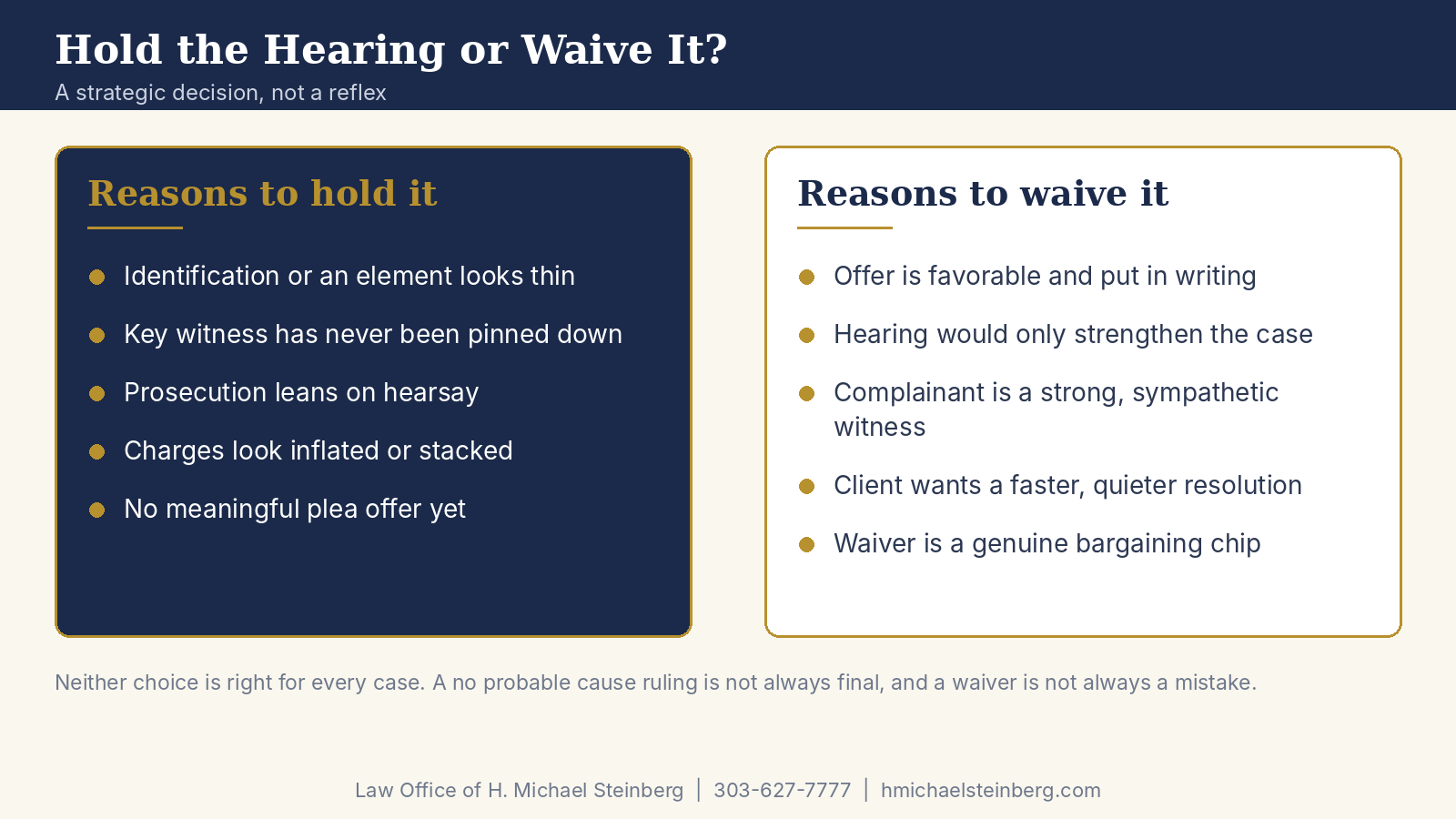
Hold it or waive it: a strategic decision, not a reflex.
A preliminary hearing is not free. A hearing can strengthen the prosecution’s case if the complainant testifies well, can reveal defense theories too early, and can delay a favorable resolution. Waiver is often the right call when a written offer is favorable and a hearing would only educate the other side, when the client wants a prompt resolution, or when the waiver is itself a bargaining chip. The point is not that every case should go to a hearing. It is that the choice should be made deliberately, case by case.
A Practical Checklist Before the Seven Days Run Out
- Confirm eligibility. Identify the felony class or drug felony level, whether a mandatory sentence, crime of violence, or sexual offense applies, and the client’s custody status.
- Calendar the deadline. Count 7 days from the first appearance, and confirm whether the prosecution has already requested a hearing.
- Read the charging documents closely. Look for gaps in identification and in each element of the offense.
- Map the witnesses. Determine who actually perceived the events and whether the prosecution will rely on hearsay.
- Assess the plea posture. Ask whether there is a written offer, and whether it is conditioned on a waiver.
- Prepare the client. The defendant does not testify or plead at the hearing, but should know what to expect.
- Document the decision. Whichever way the choice goes, make sure it reflects a strategy the client understands.
Recent Developments to Watch
- People v. Hawkins (Colo. App. Oct. 1, 2026): dismissal affirmed where the evidence did not identify the defendant as the perpetrator and the court declined to reopen the evidence. Unpublished.
- People v. McGee, 2026 CO 14: in the arrest context, the Colorado Supreme Court held that a vague description failed to supply probable cause that the arrested person was the suspect, reinforcing the need for a nexus between the person and the crime.
- A pending Colorado Supreme Court original proceeding on whether a juvenile is entitled to a preliminary hearing after a related grand jury indictment (details).
Frequently Asked Questions About Colorado Preliminary Hearings
What does probable cause mean at a Colorado preliminary hearing?
It means the prosecution has presented evidence that would lead a person of ordinary prudence and caution to reasonably believe the defendant committed the charged crime. It is a far lower bar than proof beyond a reasonable doubt, and the judge views the evidence in the prosecution’s favor.
Do I have to testify at my preliminary hearing?
No. The defendant is not called upon to plead, the prosecutor carries the burden of establishing probable cause, and the defendant is not required to testify. The defendant may cross-examine prosecution witnesses and may introduce evidence.
How soon must a preliminary hearing be requested in Colorado?
Generally within 7 days after the defendant is brought before the court following the filing of the felony complaint or information. If no one requests a hearing within that time, the case is bound over without one. Once requested, the hearing must be held within 35 days of the setting unless good cause for a continuance is shown.
Is every felony eligible for a preliminary hearing?
No. Class 1, 2, and 3 felonies and level 1 and 2 drug felonies carry a right to a hearing. Class 4, 5, and 6 felonies and level 3 and 4 drug felonies qualify only if they involve mandatory sentencing, a crime of violence, or a sexual offense, or if the defendant is in custody on the offense. Cases tried on indictment do not get one.
Can charges be dismissed at a preliminary hearing?
Yes. If the judge finds no probable cause as to any count, those counts are dismissed. However, the prosecution may be able to appeal, file a direct information, or go to a grand jury, so a dismissal is not always final.
Does hearsay count at a preliminary hearing?
Yes, to a degree. The rules of evidence are relaxed and much of the testimony may be hearsay. But the prosecution may not rely totally on hearsay when competent evidence is readily available.
Should I waive my preliminary hearing?
It depends on the strength of the evidence, the identification, the witnesses, and the status of plea negotiations. Waiver is sometimes part of a favorable resolution, and a hearing is sometimes the best way to test a weak case. The decision should be made with an experienced criminal defense lawyer who can evaluate both paths.
Talk to a Colorado Criminal Defense Lawyer About Your Options
The decision whether to demand a preliminary hearing has to be made quickly, and it can shape the rest of a felony case. Attorney H. Michael Steinberg has defended Colorado criminal cases for more than 42 years, including DUI, drug, sex crime, domestic violence, assault, theft, and homicide matters. To discuss your case, contact the firm for a free consultation.
Free Consultation
Law Office of H. Michael Steinberg · 42+ Years Exclusively Practicing Colorado Criminal Law
Cell: 720-220-2277
The Edwards Building · 8400 E Prentice Ave, Penthouse 1500 · Greenwood Village, CO 80111
Related Reading
- Preliminary Hearings in Colorado (firm overview)
- Probable Cause Under Colorado Law (2026)
- What Does a Prosecutor Look for Before Filing Criminal Charges?
- The Setting of Bail Bonds in Colorado
- Understanding Plea Bargaining in Colorado
- Pre-Charge Investigation Representation
- Jury Trial or Judge “Bench” Trial: A Critical Decision
- All Colorado Criminal Defense Practice Areas
- Representative Case Results
- Colorado Criminal Lawyer Blog
Sources
- C.R.S. 16-5-301, Preliminary hearing or waiver; dispositional hearing
- Colo. R. Crim. P. 5, Preliminary Proceedings
- Colo. R. Crim. P. 7, The Indictment and the Information
- C.R.S. 18-1.3-406, Mandatory sentences for violent crimes
- C.R.S. Title 18, Article 3, Part 4, Unlawful Sexual Behavior
- Hunter v. District Court, 190 Colo. 48, 543 P.2d 1265 (1975)
- Maestas v. District Court, 189 Colo. 443, 541 P.2d 889 (1975)
- People v. Hall, 999 P.2d 207 (Colo. 2000)
- People v. Vanness, 2020 CO 18
- People v. Maes, 2024 CO 15 (Colorado Lawyer summary)
- People v. McGee, 2026 CO 14
- People v. Hawkins, No. 25CA1585 (Colo. App. Oct. 1, 2026) (unpublished)
- Illinois v. Gates, 462 U.S. 213 (1983)
- Colorado Politics, Colorado Supreme Court intervenes in 3 ongoing cases (July 9, 2026)
- Colorado Supreme Court, Original Proceedings
- Felony Preliminary Hearings in Colorado, Colorado Lawyer (1988)
This article is provided for general informational purposes and is not legal advice. Reading it does not create an attorney-client relationship. Criminal procedure, deadlines, and case law change, and every case turns on its own facts, so consult a licensed attorney about your situation. Past results do not guarantee a similar outcome. Please do not send confidential information through the website contact form, text, or voicemail until an attorney-client relationship has been established.