 Colorado Criminal Lawyer Blog
What Counts as a Colorado DUI Probation Violation?


Probation after a Colorado DUI is a deal. You avoid more jail, and in exchange you follow a long list of rules. When a client calls me and says, “I think I may have violated my probation,” the first thing I do is sort what happened into the right category.
Some problems are fixable with a phone call and a receipt. Others put your probation, and your freedom, at real risk.
This article explains what the law treats as a DUI probation violation, how the court handles it, and what is actually on the table if the court finds one. The core rules live in C.R.S. 42-4-1307 for DUI sentencing and in C.R.S. 16-11-205 and 16-11-206 for revocation.
Quick Answer
A Colorado DUI probation violation is any failure to follow a condition of your probation, or committing a new offense while on probation. Common examples are missed probation check-ins, skipped Level II alcohol classes, positive or missed alcohol tests, interlock problems, unpaid costs, and new arrests.
A judge, not a jury, decides, usually by a preponderance of the evidence. Not every violation leads to revocation, and a lawyer can often argue for a lesser response.
In This Article
How DUI Probation Works in Colorado
Under C.R.S. 42-4-1307, probation after a first DUI conviction from one to up to two years. For a second or later DUI, probation is generally mandatory for at least two years, and the court also imposes a suspended 365-day jail sentence that hangs over the case. Judges commonly add Level II alcohol education and treatment, ignition interlock, and sometimes continuous alcohol monitoring.
The Court must give you a written statement of your conditions, as required by C.R.S. 18-1.3-204. That list is the measuring stick. If a condition is on it, breaking it can be a violation. If it is not on it, the argument that you violated probation gets much weaker.
Technical Violations
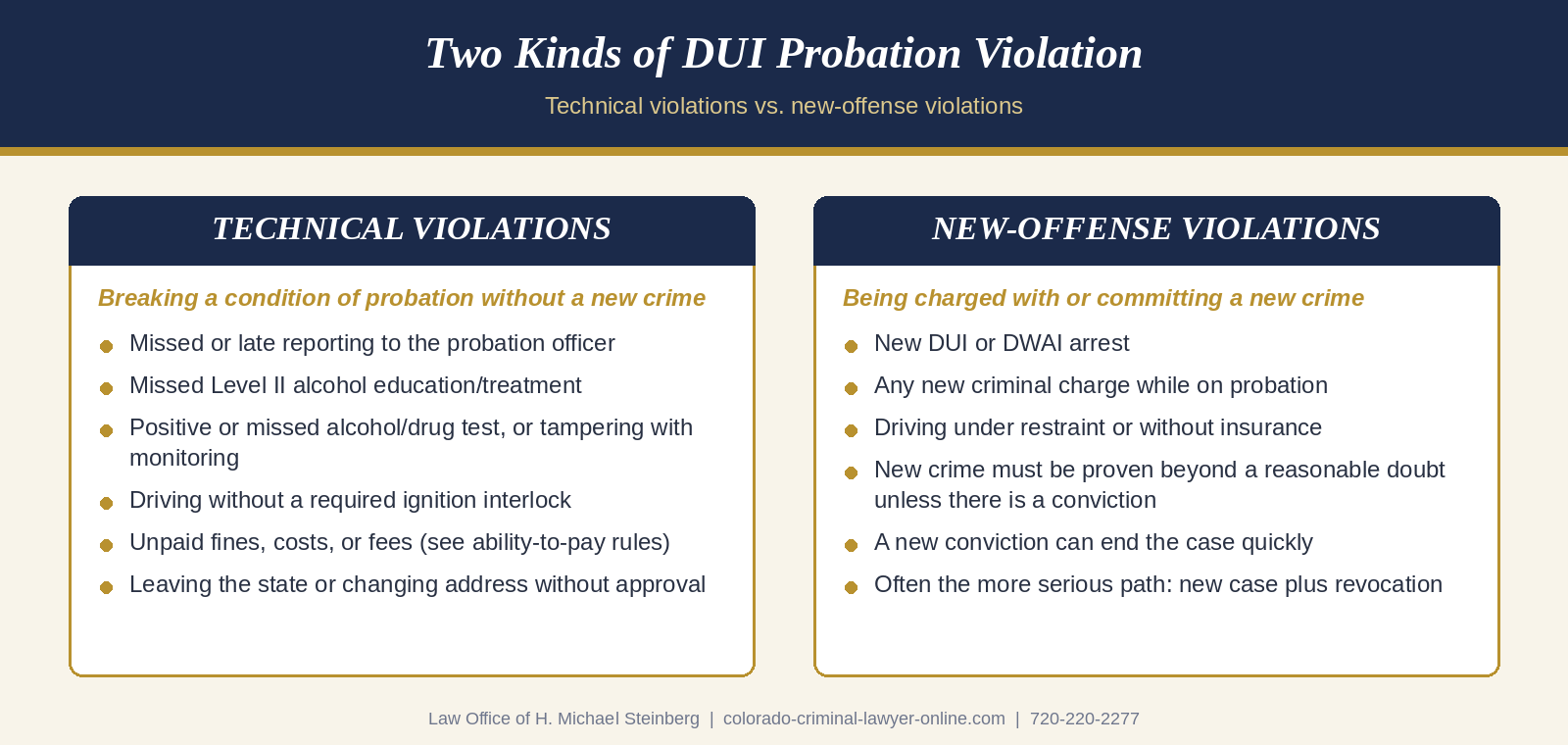
A technical violation means you broke a rule of probation without committing a new crime. In DUI cases the usual suspects are:
- Reporting failures. Missing or arriving late to appointments with your probation officer, or failing to report a change of address or job.
- Education and treatment. Not enrolling in, attending, or finishing Level II alcohol education or therapy.
- Testing and monitoring. Positive or missed alcohol or drug tests, tampering with a monitoring device, or failing to blow into an interlock.
- Interlock rules. Driving a vehicle without a required ignition interlock device.
- Money. Unpaid fines, costs, restitution, or supervision fees.
- Travel and contact rules. Leaving the state or breaking a no-alcohol or no-bar condition.
New-Offense Violations
The second category is picking up a new case. A new DUI or DWAI is the obvious one, but any new criminal charge can trigger a revocation filing. Under C.R.S. 16-11-206, if the allegation is a new crime and there is no conviction yet, the prosecution must prove the new crime beyond a reasonable doubt at the revocation hearing. If you have already been convicted, that conviction can carry the violation.
A new arrest and a probation revocation filing often run side by side. How the new case ends can change the probation case, so the two should be defended together.
This is also why I tell clients not to talk about a new arrest with a probation officer before they have spoken with counsel. See our post on pre-trial conditions in Colorado DUI cases for how bond conditions can overlap with probation.
What Is Not a Violation
Not every bad day on probation is a violation. A condition has to be one the court actually imposed, and the proof has to match it. A few points worth knowing:
- A condition that was never put in writing or never explained to you can be challenged under C.R.S. 18-1.3-204.
- A probation officer’s informal rule is not necessarily a court order.
- Colorado’s statute carves out some medical marijuana and natural medicine situations from probation conditions, so check the exact wording of your conditions before assuming a lawful-use problem is a violation.
- Nonpayment is treated differently when you truly cannot pay. See the ability-to-pay discussion below.
How a Violation Gets Reported
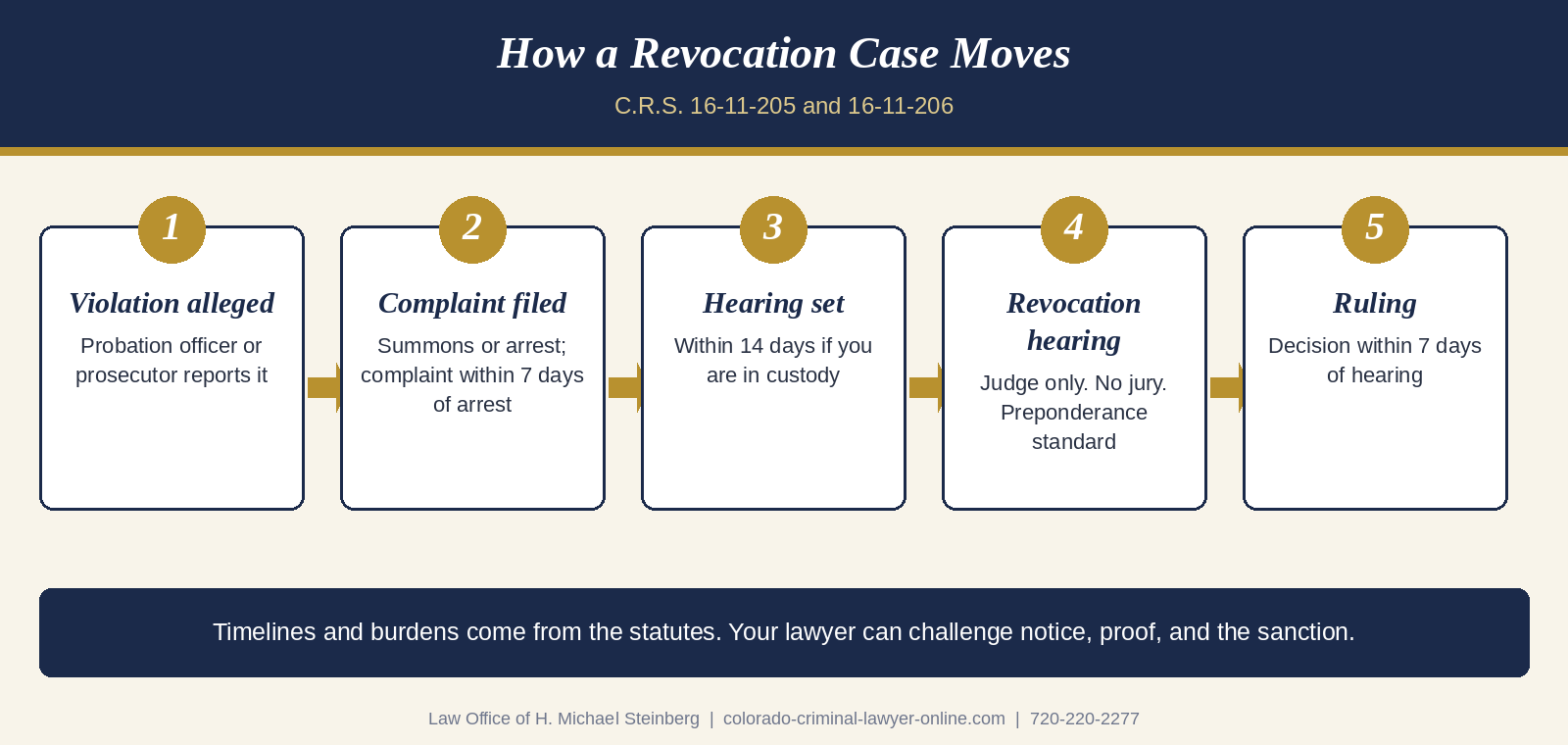
A probation officer or the prosecutor starts the process. Under C.R.S. 16-11-205, the court can issue a summons or a warrant, and a complaint must be filed within seven days if you are arrested.
A summons is generally the preferred first step, which is one reason a prompt call to a lawyer matters. Ignoring a summons turns a fixable problem into a warrant. I covered that risk in A Missed Court Date Can Put Your Freedom at Risk.
Your Rights at a Revocation Hearing
A revocation hearing is not a trial, but you do have protections. The U.S. Supreme Court set the baseline in Morrissey v. Brewer and Gagnon v. Scarpelli: notice of the claimed violations, a hearing before a neutral decision-maker, the chance to be heard and present evidence, and in many cases the assistance of counsel.
- No jury. The judge decides.
- Standard of proof is a preponderance of the evidence for most violations (C.R.S. 16-11-206).
- Hearsay is more relaxed than at trial, which is why cross-examination and objections still matter.
- If you are in custody, the hearing must be set within 14 days, and the judge must rule within seven days of the hearing.
- Failure to pay fees can be treated as prima facie evidence of a violation, but only if the court makes the right findings first (see below).
What the Judge Can Do: The 365-Day Cap
After a violation is found, the judge has a menu: continue probation as is, add conditions, impose short jail, extend probation, or revoke it. Structured, graduated responses under C.R.S. 16-11-215 encourage courts to match the response to the violation instead of reaching for jail every time.
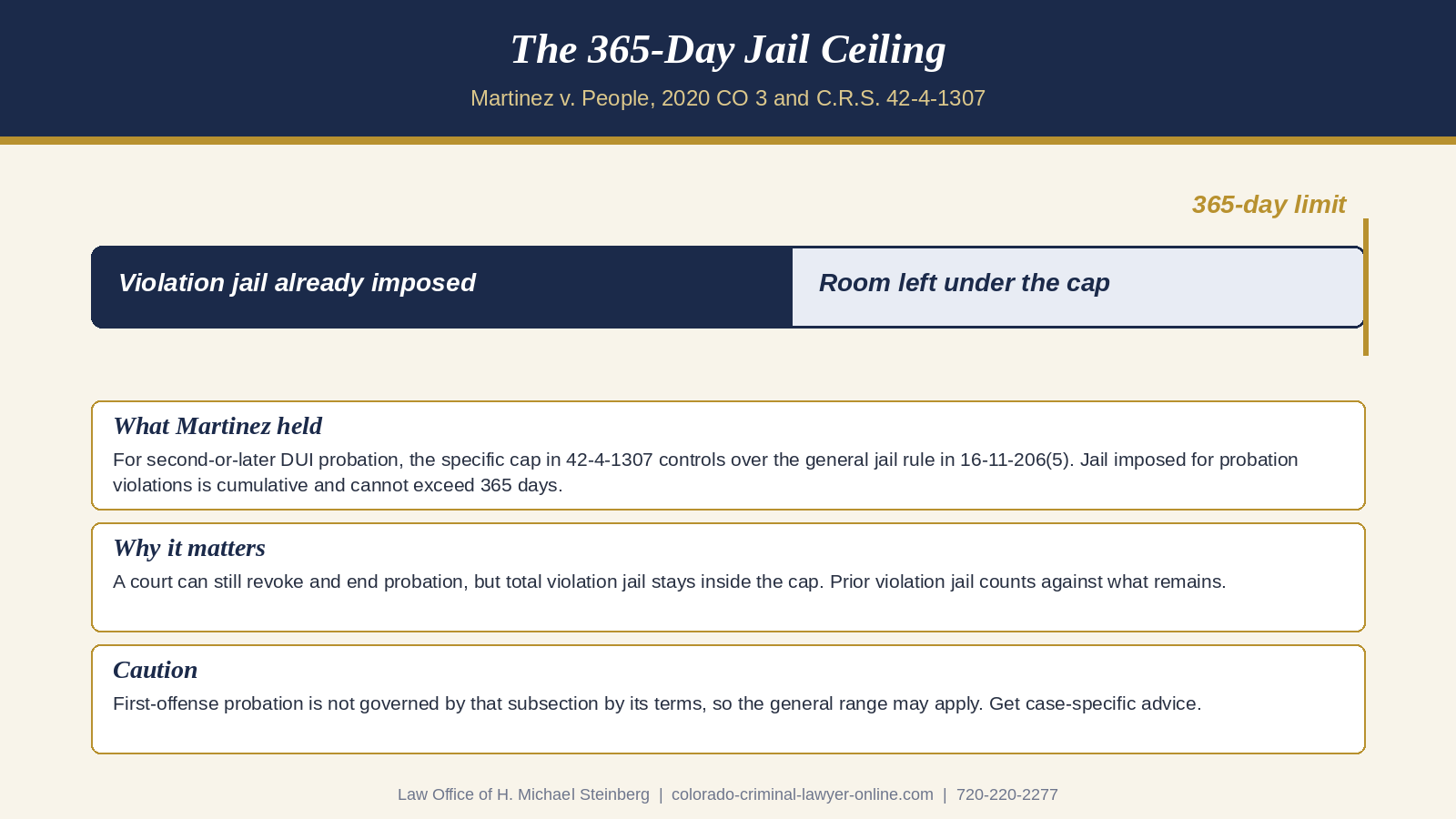
For second-or-later DUI probation, C.R.S. 42-4-1307 says jail imposed for violations is cumulative and capped at one year, and the sanction must promote compliance, not merely punish. In Martinez v. People, 2020 CO 3, the Colorado Supreme Court held that this specific cap controls over the general probation-violation jail rule. A court may still revoke and end probation, but the total violation jail stays within the 365-day limit.
| Situation | What usually happens | Key authority |
|---|---|---|
| Missed class or late check-in | Warning, added conditions, or a short sanction | C.R.S. 16-11-215 |
| Positive alcohol test | Treatment changes, monitoring, possible short jail | C.R.S. 42-4-1307 |
| Unpaid costs or fees | Hearing on ability to pay before revocation | C.R.S. 18-1.3-702 |
| New DUI arrest | Revocation filing plus the new case | C.R.S. 16-11-206 |
| Repeated serious violations | Jail within cap, extension, or revocation | Martinez v. People |
Defenses and Mitigation
Even when the facts are not great, there is usually something to work with:
- Challenge the proof. Was the test reliable? Was the report accurate? Does the evidence prove the exact condition alleged?
- Challenge the notice. Did you receive the condition in writing under C.R.S. 18-1.3-204?
- Inability to pay. Under C.R.S. 18-1.3-702 and Bearden v. Georgia, a court generally should not revoke for nonpayment without considering whether you could pay and whether alternatives exist.
- Mitigation. Proof of enrollment, sobriety, steady work, and treatment progress can turn a revocation request into a modification.
- Early termination. Strong compliance can support a request to end probation early under C.R.S. 42-4-1307.
What to Do Right Now
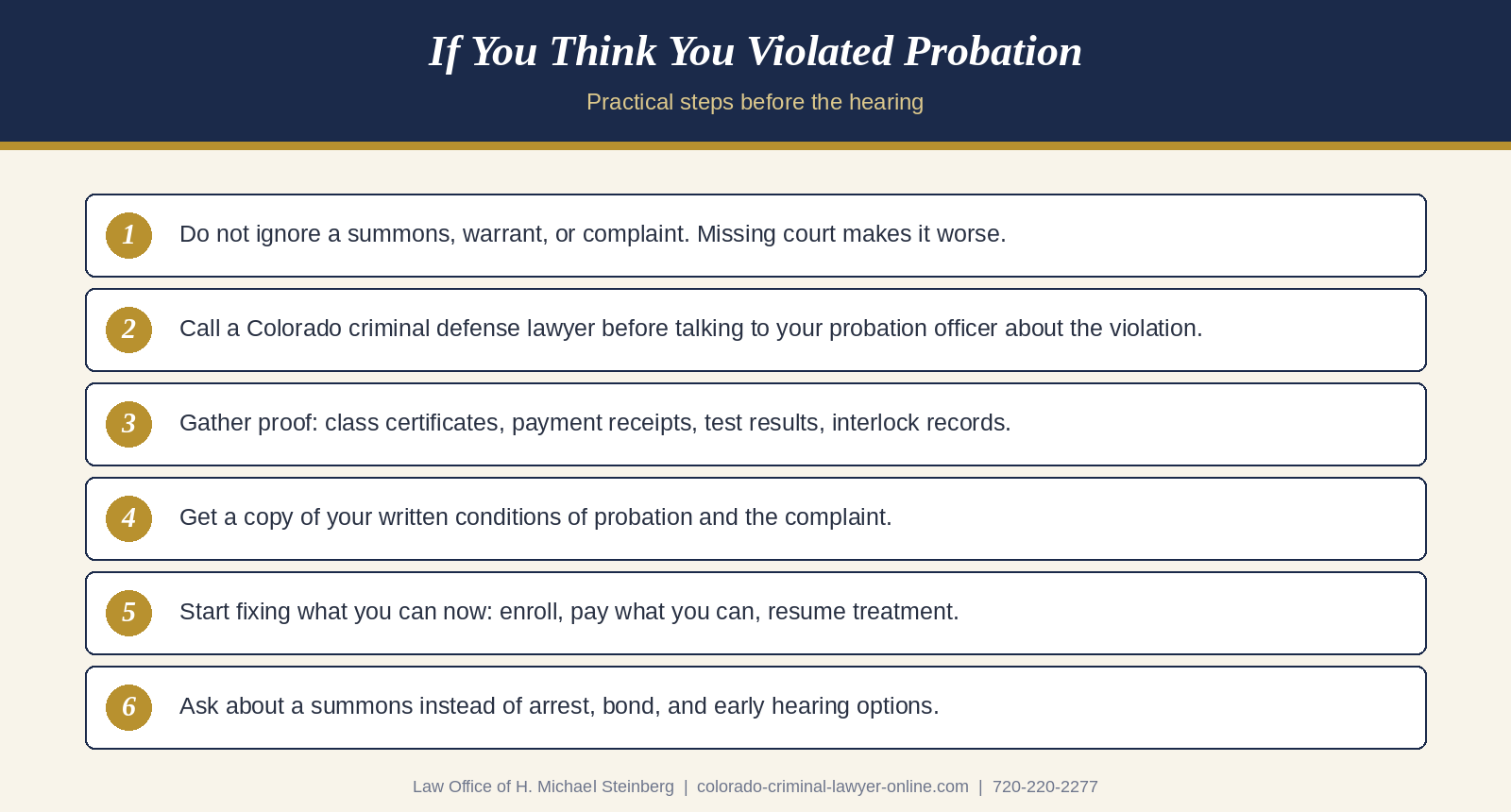
Do not ignore anything with a court’s name on it. Do not make statements to your probation officer about a new arrest or a positive test until you have talked to counsel. Start fixing what you can now, because judges respond to people who are already moving in the right direction.
Frequently Asked Questions
Is a positive alcohol test an automatic revocation?
No. It is a violation if alcohol use is prohibited, but courts often respond with treatment changes, monitoring, or a short sanction rather than revocation, especially for a first slip.
Will I go to jail for a technical violation?
Possibly, but not automatically. Colorado encourages graduated responses, and for second-or-later DUI probation, total violation jail is capped at 365 days under Martinez.
Does a jury decide whether I violated probation?
No. A judge decides, usually by a preponderance of the evidence (C.R.S. 16-11-206).
What if I cannot afford the fees or classes?
Tell your lawyer. Courts are supposed to look at ability to pay before revoking for nonpayment (C.R.S. 18-1.3-702).
Can I get probation ended early?
Sometimes. Strong compliance and a lawyer’s motion can support early termination under C.R.S. 42-4-1307.
Facing a DUI Probation Violation in Colorado?
I have defended DUI and probation cases in Denver and across Colorado for years. Call Law Office of H. Michael Steinberg at 720-220-2277 or 303-627-7777 for a confidential consultation, or contact the office online.
Related Colorado Criminal Defense Resources
- A Missed Court Date Can Put Your Freedom at Risk
- Colorado Pre-Trial Conditions on DUI Cases
- More Colorado DUI Law and Issues
- Colorado DUI and Vehicular Homicide
- Law Office of H. Michael Steinberg Home
Sources and Authority
- C.R.S. 42-4-1307: DUI penalties
- C.R.S. 16-11-205: Arrest and complaint for probation violation
- C.R.S. 16-11-206: Revocation hearing
- C.R.S. 16-11-215: Structured behavioral responses
- C.R.S. 18-1.3-204: Conditions of probation
- C.R.S. 18-1.3-702: Ability to pay
- Martinez v. People, 2020 CO 3
- Morrissey v. Brewer, 408 U.S. 471 (1972)
- Gagnon v. Scarpelli, 411 U.S. 778 (1973)
- Bearden v. Georgia, 461 U.S. 660 (1983)
Law stated as of October 22, 2026. Statutes and case law change, so verify current law before relying on this article.
This article is general information, not legal advice, and reading it does not create an attorney-client relationship. Every case is different. Prior results do not guarantee a similar outcome. Consult a licensed Colorado attorney about your situation.