 Colorado Criminal Lawyer Blog
Colorado Law: When The Domestic Violence Victim Refuses To Cooperate


By H. Michael Steinberg, A Colorado Criminal Defense Lawyer – Practicing Colorado Criminal Law in the courts of Colorado for over 40 years.
 Introduction:
A recent Colorado case, People vs. Honstein, establishes the near-absolute power of a Colorado District Attorney to refuse to dismiss a domestic violence case and the extreme efforts of the defense to call the DA to the stand in an attempt to call that DA to account.
The Facts of Honstein
In June 2024, the Colorado Supreme Court took up a case that captures exactly why recantation is one of the most misunderstood moments in a Colorado criminal case.
Ten months after Harold Honstein was charged with third-degree assault, the alleged victim, V.S., told the prosecutor she had been wrong — Honstein never punched her, she said; what she’d felt was a thrown soda can striking the back of her head. Days later she repeated the correction to an investigator.
The prosecutor didn’t hide the ball: he immediately disclosed the recantation to the defense and assigned an investigator to run it down. But the case didn’t simply go away — it went to the Colorado Supreme Court, on the narrow question of whether the defense could force the prosecutor himself onto the witness stand.
That’s the reality those accused of domestic violence in Colorado need to understand: in Colorado, a recantation is a serious event that no question changes how a case is investigated and argued — but it is not a “button” the alleged victim can press to make the charges disappear.
The Short Answer: Recanting Does Not Automatically End the Case
Colorado law gives the decision to file, pursue, or dismiss a criminal case to the district attorney — never to the alleged victim. That was true the day charges were filed, and it remains true even if the alleged victim later says the accusation was wrong, exaggerated, or fabricated.
Once double jeopardy attaches — (when the first witness is sworn in a bench trial, or the first juror is impaneled) — a court has no authority to dismiss the case over the prosecutor’s objection.
Colorado’s “No-Drop” Rule In Colorado Domestic Violence Cases
- This isn’t just office policy — it has a statutory backbone. Under C.R.S. § 18-6-801, Colorado’s domestic-violence sentencing statute, once the prosecution can make a prima facie case — enough evidence on its face to suggest the offense occurred — the district attorney generally cannot dismiss the case outright or offer a plea that removes the domestic-violence designation, even before trial and even if the proof might fall short of “beyond a reasonable doubt”.
This rule exists because recantation is common, not rare. Defense-side practitioners estimate that false statements or recantations occur in roughly half of Colorado domestic violence cases.
How Prosecutors Decide Whether a Recantation Is Credible
A recantation triggers an investigation of its own.
Colorado prosecutors typically weigh the following kinds of issues:
-
The defendant’s prior criminal history and any pattern of abusive conduct toward this or a former partner.
-
The original police reports and the responding officer’s own observations.
-
Any current or prior protection orders and affidavits the alleged victim previously signed.
-
Medical records and photographs documenting injuries.
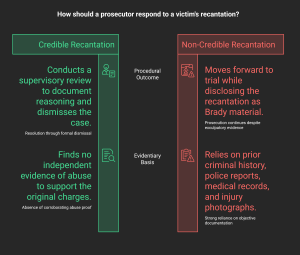
If the DA doesn’t find the recantation credible, the office can move forward to trial — while remaining obligated to disclose the recantation to defense counsel as Brady material, since it is exculpatory evidence that weakens the prosecution’s own case.
If the DA credits the recantation and finds no independent evidence of abuse, the standard practice is to conduct a supervisory review, document the reasoning, and then either dismiss or decline to oppose a defense motion to dismiss.
Quick Reference: Recantation in a Colorado Criminal Case
This table is a general orientation only and is not a substitute for case-specific legal advice.
Building a Case Without the Alleged Victim’s Testimony
Because the State is not required to call the alleged victim, prosecutors often try to prove the case a different way:
-
Excited (spontaneous) utterances — statements made at the scene, close in time to the incident, can sometimes come in under a hearsay exception, subject to the confrontation limits set out in Crawford v. Washington, 541 U.S. 36 (2004), which restricts the use of testimonial statements from a witness who doesn’t appear at trial.
-
Medical records and injury photographs documenting the incident.
-
Other percipient witnesses, including anyone the alleged victim spoke to immediately after the incident or later when recanting.
Without solid corroborating evidence, juries frequently acquit when the alleged victim doesn’t testify — which is exactly why a competent, early defense review of the State’s actual proof (versus what was merely alleged) matters so much.
 The Recanting Witness’s Legal Risk
This is the part clients are often shocked to learn: recanting isn’t risk-free for the person doing it.
-
False reporting to authorities — C.R.S. § 18-8-111: typically a class 3 misdemeanor (up to 6 months in jail and/or a $50–$750 fine) if the person knowingly reported an incident that they knew did not occur.
-
Perjury or false swearing — C.R.S. §§ 18-8-502, 18-8-504, 18-8-505: first-degree perjury is a class 4 felony where a person knowingly makes a materially false statement under oath that they don’t believe to be true.
-
Where the original statement and the recantation are both sworn and inconsistent, § 18-8-505 allows the prosecution to charge in the alternative without proving which statement was false — but the resulting conviction is capped at false swearing, a class 1 petty offense, if that’s all the two inconsistent statements establish. A prompt, same-proceeding retraction is an affirmative defense to first-degree perjury under § 18-8-508
Because of this exposure, it is common — and wise — for a recanting alleged victim to seek independent counsel before giving a new statement or signing anything, separate from the defendant’s own attorney, given the obvious conflict of interest.
When Someone Else Pressures the Recantation: The Felony Crime of Witness Tampering
If the defendant, or someone acting on the defendant’s behalf, pushes the recantation into existence, that person takes on separate — and serious — criminal exposure of their own. The Colorado Supreme Court has read the witness-tampering statute, C.R.S. § 18-8-707, broadly: the prosecution doesn’t need to prove the witness was under subpoena, that the attempt succeeded, or that testimony was actually affected. The crime is complete the moment the attempt is made.
One reported Colorado case involved a defendant who convinced the victim to sign a letter to the DA recanting truthful assault allegations, then later forged a second letter in her name entirely — resulting in convictions for both witness tampering and forgery, on top of the original charge.
Refusing to Testify: Contempt and Use Immunity
Recantation and simple refusal to testify are treated differently. A witness who is merely reluctant — but doesn’t deny the original account — can be compelled to appear by subpoena; failing to appear can lead to indirect contempt proceedings, with full due process protections and up to six months in jail as a sanction
If a witness asserts a Fifth Amendment privilege, only the prosecutor — not the court — can grant use immunity under C.R.S. § 13-90-118, which compels testimony but bars its use against the witness except in a later perjury or false-statement case.
Key Takeaways
-
In Colorado, only the district attorney — never the alleged victim — decides whether a criminal case moves forward, including domestic violence cases governed by the no-drop rule in C.R.S. § 18-6-801.
-
A recantation triggers a credibility investigation; prosecutors weigh prior history, police observations, medical evidence, and protection orders before deciding whether to believe it.
-
Even a credible recantation must be disclosed to the defense as Brady material — and can open the door to dismissal.
-
The alleged victim who recants can face separate charges — false reporting under § 18-8-111 or perjury/false swearing under §§ 18-8-502–505 — which is why independent counsel matters.
-
Anyone who pressures a witness into recanting risks a witness-tampering charge under § 18-8-707, regardless of whether the pressure actually worked.
-
A case can sometimes proceed without the alleged victim’s testimony at all, through excited utterances, medical records, and other witnesses — but the outcome often turns on exactly how strong that substitute evidence really is.
If You’re Facing This Situation in Colorado
Whether you’ve been charged and the accuser has recanted, or you’re the one being asked to change your story, the legal exposure runs in more than one direction — and the standard for what the State can still prove is technical and fact-specific. An early, thorough review by an experienced Colorado criminal defense attorney is the best way to understand where your case actually stands.
Mr. Steinberg writes and publishes The Colorado Criminal Lawyer Blog — a client-education resource that translates Colorado criminal statutes, rules of evidence, and appellate decisions into practical guidance for the people they affect.
Colorado Criminal Law –Colorado Law: When The Domestic Violence Victim Refuses To Cooperate
The reader is alerted that Colorado criminal law, like criminal law in every state and at the Federal level, changes constantly. The article above was accurate when it was drafted, but it cannot account for changes that occurred after it was uploaded.
 ABOUT THE AUTHOR: H. Michael Steinberg – Email the Author at: hmsteinberg@hotmail.com
A Denver, Colorado Criminal Defense Lawyer – call his office at 303-627-7777 during business hours, or call his cell at 720-220-2277 if you cannot wait and need his immediate assistance.
“A good criminal defense lawyer is someone who devotes themselves to their client’s case from beginning to end, always realizing that this case is the most important thing in that client’s life.”
Putting more than 40 years of Colorado criminal defense experience to work for you.
One should be careful when selecting a Colorado criminal defense lawyer. We encourage you to “vet” our firm. Over the last 40 years – by focusing ONLY on Colorado criminal law – H. Michael has had the time to continually update himself in nearly every area of criminal law, including procedure, trial, and courtroom practice.
H. Michael works hard to deliver the best possible results for his clients, both in and out of the courtroom. He has written extensively on Colorado criminal law and continues to do so, and he hopes this article helps you in some small way.