 Colorado Criminal Lawyer Blog
How to Get a Sentence to Unsupervised “Bench” Probation Instead of Supervised Probation Under Colorado Law


If you have been convicted of — or are about to plead guilty to — a Colorado criminal offense, one of the most important questions in your case is not just whether you will be placed on probation, but what kind.
Probation can mean monthly (or more frequent) meetings with a probation officer, home visits, drug and alcohol testing, monthly supervision fees, and a probation officer who can file a complaint if you slip.
Or it can mean unsupervised probation — often called “bench probation” in the hallways of Colorado courthouses — where the judge sets your conditions but you do not report to a probation officer. You prove compliance to the court instead.
For the right client in the right case, that difference is enormous. It can mean fewer missed work shifts, lower costs, less exposure to technical violations, and a sentence that feels like what it should be for a low-level, first-time offense: accountability without constant surveillance.
So how do you actually get it? This guide explains what “unsupervised” or “bench” probation really means in Colorado, what the statutes do and do not say, the factors that persuade a judge, a step-by-step strategy for asking for it, and what to do if you end up on supervised probation anyway. It is written from the perspective of a Denver criminal defense attorney who has spent more than forty years in Colorado’s criminal law courtrooms.
There is no checkbox, form, or statute that creates “unsupervised probation” as a right.
Under C.R.S. § 18-1.3-202, a Colorado judge may grant probation on the terms and conditions the court deems best — and under C.R.S. § 18-1.3-204, reporting to a probation officer is one of the conditions a court may impose, not one it must impose.
Unsupervised probation exists because judges have discretion. You get it by (1) being eligible for probation at all, (2) building a record under the § 18-1.3-203 factors that makes a judge comfortable, (3) ideally getting the prosecutor’s agreement, and (4) asking for it explicitly at sentencing — in writing, with a proposed compliance plan.
- What “Unsupervised” or “Bench” Probation Means in Colorado
- What the Colorado Statutes Actually Say
- Supervised vs. Unsupervised Probation: Side-by-Side
- Who Realistically Qualifies (and Who Usually Doesn’t)
- The Factors That Persuade a Judge
- A Six-Step Strategy to Ask for Unsupervised Probation
- Negotiating Unsupervised Terms in a Plea Agreement
- What to Say and File at the Sentencing Hearing
- Alternatives: Deferred Judgments and Early Termination
- Unsupervised Does Not Mean Unwatched: Violations
- Common Mistakes That Cost People Unsupervised Probation
- Frequently Asked Questions
What “Unsupervised” or “Bench” Probation Means in Colorado
“Bench probation” is a courthouse nickname, not a statutory term. The idea is that you are on probation “with the bench” — meaning with the judge — rather than with a probation officer.
In practice, a person on unsupervised probation:
- is sentenced to probation for a set term, with written conditions the judge orders;
- does not report to a probation officer or receive home and workplace visits from one;
- proves compliance by filing certificates, receipts, and other documentation with the court (or, depending on the courtroom, with the district attorney or the clerk) by deadlines the judge sets; and
- remains fully subject to the court’s orders — if conditions are not met, the case can go back to the judge.
Colorado’s judiciary recognizes this distinction in its own paperwork. For example, a Larimer County administrative order on unsupervised probation explains that at sentencing the court states whether probation is supervised or unsupervised, that the district attorney handles continued victim contact in unsupervised cases that implicate the Victim Rights Act, and that supervised probation is “generally preferred” in those victim-rights cases — which tells you something important: unsupervised probation is the exception, so you have to make the case for it.
Unsupervised probation is not a loophole. It is a judgment call a judge makes when the record shows that a person does not need a probation officer to stay on track. H. Michael Steinberg
What the Colorado Statutes Actually Say
Because so many websites describe unsupervised probation as if it were its own statutory program, it is worth being precise. Colorado’s probation statutes are found in Part 2 of Article 1.3 of Title 18. None of them uses the phrase “unsupervised probation,” and none gives a defendant a right to it. Instead, the pieces fit together like this:
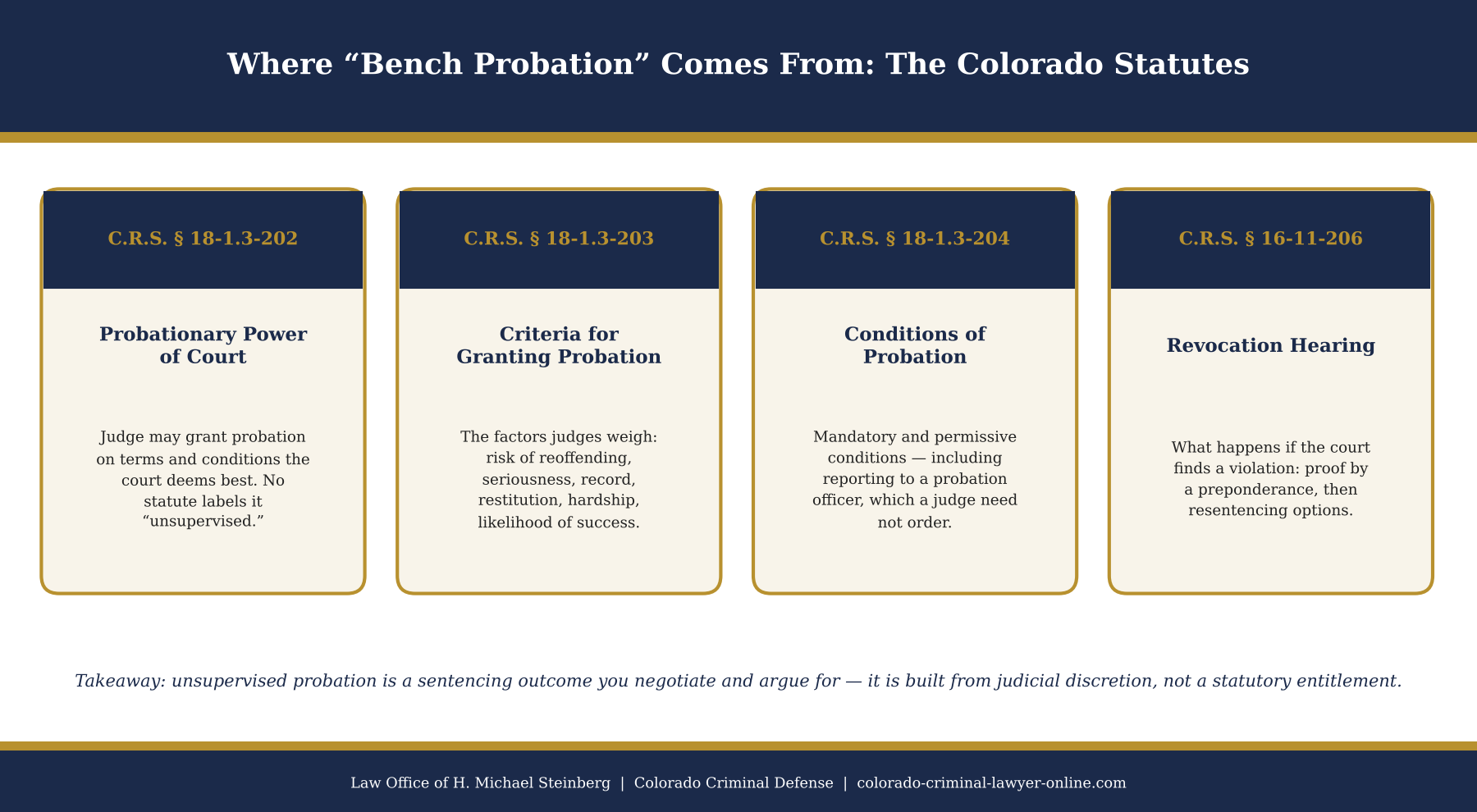
The four statutes that matter most when you are asking a Colorado judge for unsupervised probation.
C.R.S. § 18-1.3-201 — Who may apply for probation
Under § 18-1.3-201, a person convicted of an offense — other than a class 1 felony or a civil infraction — may apply to the court for probation. There are important exceptions for defendants with two or more prior felony convictions (and certain enumerated offenses), and the statute generally calls for the application to be in writing, although for a misdemeanor or petty offense the court may waive the written application. If you are not eligible to apply for probation, the question of supervision never arises.
C.R.S. § 18-1.3-202 — The court’s probationary power
Section 18-1.3-202 is the source of the judge’s discretion.
When it appears that the ends of justice and the best interest of the public, as well as the defendant, will be served, the court may grant probation “upon such terms and conditions as it deems best.” Colorado appellate courts routinely describe this as broad discretion. The statute also:
- allows the court to include county jail time as a condition of probation, subject to statutory caps on the total commitment (90 days for a felony, 60 days for a misdemeanor, and 10 days for a petty offense, with special rules for certain DUI felonies and exceptions for work release);
- limits probation for a misdemeanor or petty offense to five years (case law annotations discuss an older, shorter limit tied to the maximum jail term, so the exact ceiling in a given case should be checked), while leaving the length of felony probation to the court; and
- allows each judicial district’s probation department to contract with public agencies or private providers to supervise probationers — which is why “supervised probation” is sometimes handled by a private company rather than a state probation officer.
Notice what is not in the statute: any rule that says supervision is mandatory. That silence is the doorway through which unsupervised probation walks.
C.R.S. § 18-1.3-203 — The criteria for granting probation
Section 18-1.3-203 tells judges how to think about whether to grant probation at all.
A court may deny probation where, given the offense and the defendant’s history and character, prison better protects the public — for example because there is a serious risk of a new crime, the defendant needs correctional treatment best delivered in custody, probation would unduly depreciate the seriousness of the crime, the record suggests probation will fail, or the case does not fit statewide sentencing practice for similar defendants.
The statute then lists fourteen non-controlling factors that favor probation, including no prior record, no serious harm to a person or property, restitution made, circumstances unlikely to recur, a character and attitude suggesting the defendant is unlikely to reoffend, and the likelihood that the defendant will respond well to probation.
Those same factors are the raw material of your argument for unsupervised probation.
A judge who is already comfortable with probation is one step away from being comfortable with probation without an officer — if the record shows there is nothing for an officer to “fix.”
C.R.S. § 18-1.3-204 — Conditions of probation
Section 18-1.3-204 is where the supervision question lives. Subsection (1) lists conditions that must be part of every probation sentence — among them, no new offense during the revocation period, payment of restitution, compliance with court orders on substance-abuse testing and treatment, and no harassment, intimidation, or tampering with the victim or prosecution witnesses (unless the court makes written findings that the condition is unnecessary).
Subsection (2) then lists conditions the court may impose, and that list includes things like:
- reporting to a probation officer at times set by the court or the officer;
- permitting the officer to visit the defendant’s home and other locations at reasonable times;
- remaining within the court’s jurisdiction unless permission is granted;
- answering the officer’s reasonable inquiries and promptly reporting changes of address or employment;
- home detention or electronic monitoring; and
- paying costs of supervision — historically a monthly supervision fee that the court may reduce to an amount the defendant can afford.
Because the reporting, visit, and supervision-fee conditions are discretionary, a judge who omits them is not violating the statute — the judge is simply choosing a less restrictive set of terms.
In domestic-violence cases, however, subsection (2)(b) adds conditions that the court is directed to impose, and sex-offense cases carry their own treatment and supervision framework — which is why those cases rarely end up unsupervised.
Finally, § 18-1.3-204(4)(a) lets the court change the terms of probation later: for good cause shown, after notice to the defendant, the district attorney, and the probation officer, the judge may shorten or extend the term or change conditions, with a hearing if the defendant or the district attorney asks for one. That provision is the foundation for both modifying supervision and asking the court to end probation early (more on that below).
Eligibility: C.R.S. § 18-1.3-201 | Court’s power and term limits: C.R.S. § 18-1.3-202 | Criteria and factors: C.R.S. § 18-1.3-203 | Conditions and modification: C.R.S. § 18-1.3-204 | Revocation: C.R.S. § 16-11-206 | Prison-plus-probation limit: Allman v. People, 2019 CO 78
Supervised vs. Unsupervised Probation: Side-by-Side
The practical differences between the two are easiest to see in a table. Remember that the specifics vary by judge, county, and plea agreement — what follows is a general comparison, not a promise about any particular courtroom.
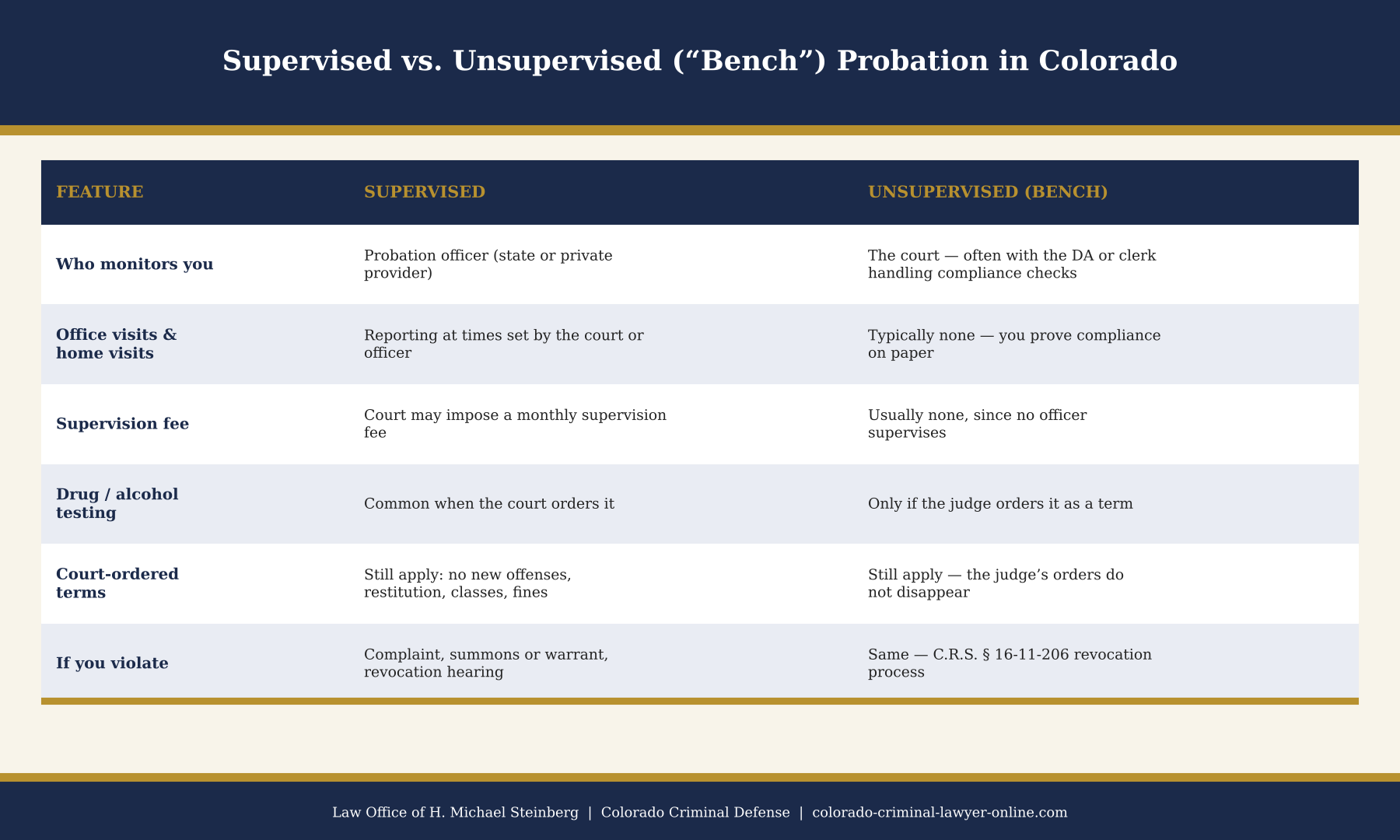
Supervised vs. unsupervised (“bench”) probation in Colorado — the judge’s orders apply either way.
The most common misunderstanding is that “unsupervised” means “no conditions.” It does not. Every term the judge orders still applies. The only thing that changes is who watches — and, often, how much it costs you in time, money, and stress.
Who Realistically Qualifies (and Who Usually Doesn’t)
No lawyer can promise a result, but experience in Colorado courtrooms gives a good sense of where unsupervised probation is realistic and where it is a long shot.
Cases where it is realistic
- Low-level misdemeanors and petty offenses with no victim injury and no safety concern;
- First-time defendants with no criminal history or a long law-abiding period;
- Property and theft-type cases where restitution has been paid or will be paid in full before sentencing;
- Cases where the treatment or classes have already been completed — a judge cannot easily say a person needs an officer to make them do something they have already done;
- Defendants with stable employment, housing, and family support who can credibly document compliance themselves.
Cases where it is a harder sell
- Domestic-violence cases, where § 18-1.3-204(2)(b) directs additional mandatory conditions and treatment requirements that courts generally want monitored — see our practice page on Colorado domestic violence defense;
- DUI and DWAI cases, which carry their own sentencing statute, mandatory alcohol education and treatment, and monitoring — see Colorado DUI defense;
- Sex-offense cases, which involve approved-provider treatment requirements and the supervision framework of the Sex Offender Lifetime Supervision Act — see Colorado sex crimes defense;
- Cases involving an identified victim who has opted into the Victim Rights Act, where, as the Larimer County order notes, supervised probation is generally preferred;
- Substance-driven cases where the court has ordered testing and treatment under the mandatory conditions of § 18-1.3-204(1) and wants a professional verifying compliance — see Colorado drug crimes defense; and
- Defendants with a poor compliance history, prior probation violations, open warrants, or pending cases.
A harder case is not an impossible case. A well-prepared defendant with a strong record of voluntary compliance can sometimes persuade a judge to start supervised and move to unsupervised, or to terminate early. We address those options below.
The Factors That Persuade a Judge
Judges are risk managers. When a judge decides whether to order a probation officer, the unspoken question is: “What is the chance this person will fail, and who will catch it if they do?” Your job is to answer that question before it is asked. The statutory factors in § 18-1.3-203(2) are your roadmap.
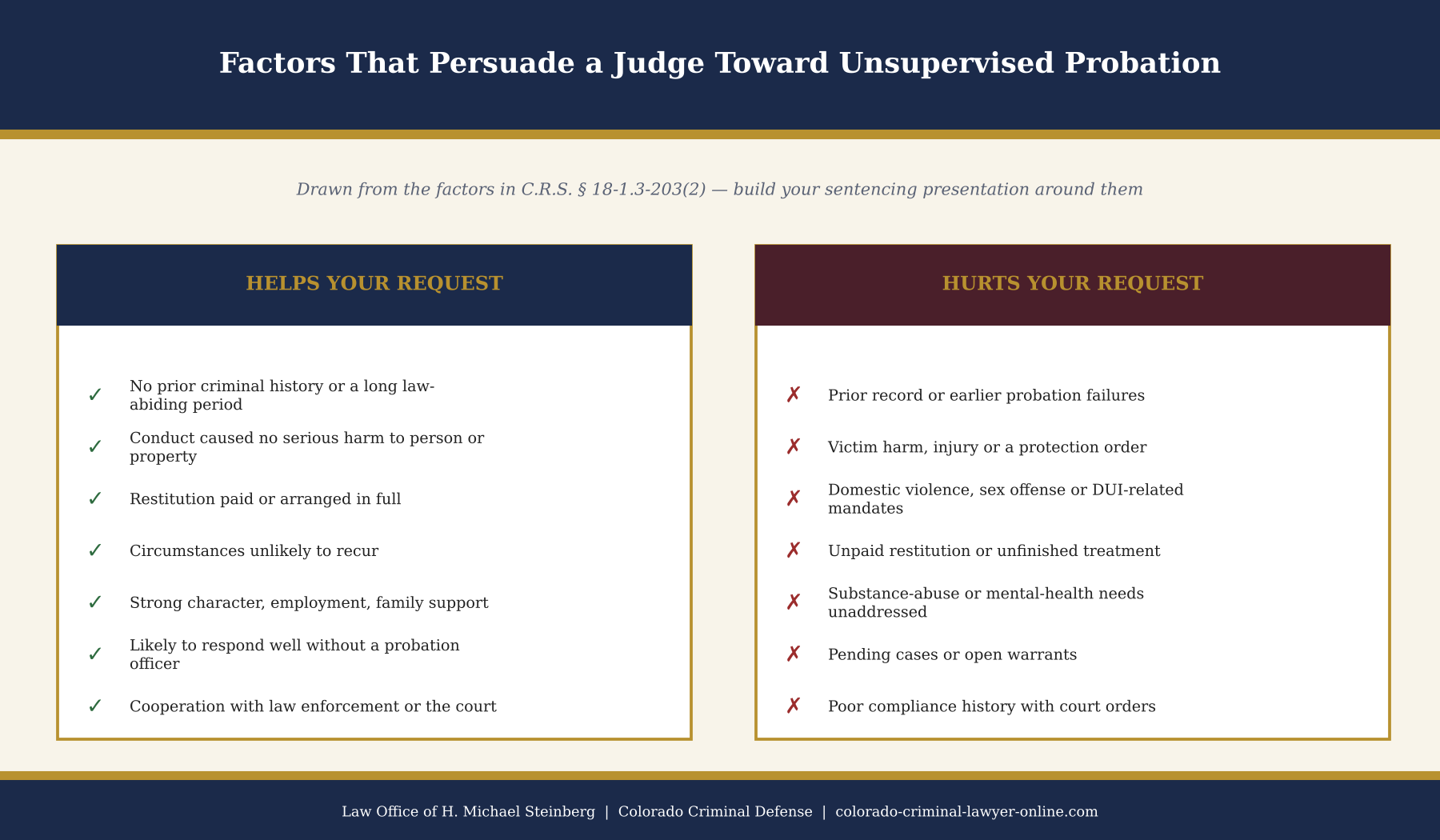
1. A clean or nearly clean record
The single most persuasive fact is the absence of prior convictions, or a long stretch of law-abiding life. It speaks directly to the statutory factors about criminal history and the unlikelihood of re-offending.
2. Restitution and repair before sentencing
Pay it, or have a funded plan in place. Restitution is both a mandatory condition of probation and a statutory factor. A judge who sees restitution already paid has one less reason to want an officer tracking payments.
3. Treatment or classes already completed
If the likely conditions include an alcohol or drug evaluation, anger-management or other counseling, community service, or a theft-awareness class, completing them before sentencing — and arriving with certificates — removes the main practical reason for supervision.
4. Stability and verifiable support
Steady employment, a stable address, family involvement, and letters from employers, counselors, or community members show the court there are real-world supports that stand in for a probation officer.
5. A concrete self-reporting plan
Do not simply ask the court to “trust” you. Offer a mechanism: a list of conditions, a date certain for each, a method of proof (certificate, receipt, affidavit), and a compliance review date — a short hearing or filing deadline at which the court can see that everything is done. A judge is far more likely to say yes to a structure than to a promise.
6. The prosecutor’s position
When the district attorney agrees — or at least does not object — the judge’s comfort level rises dramatically. That is why unsupervised terms are best negotiated, not just argued.
A Six-Step Strategy to Ask for Unsupervised Probation
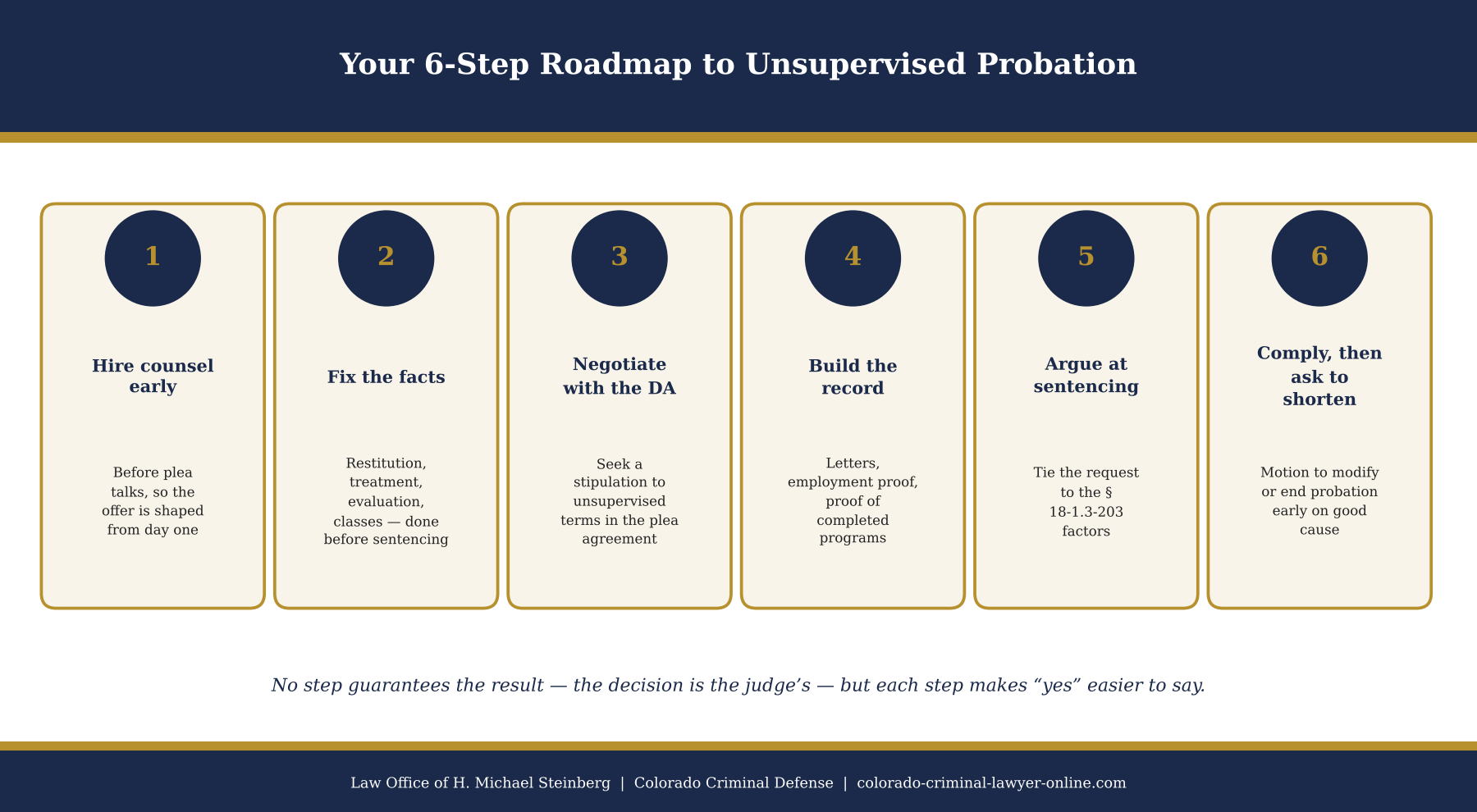
- Hire counsel early. The terms of probation are usually shaped during plea negotiations, long before sentencing. A lawyer who knows the DA’s office and the judge can steer the offer toward unsupervised terms from the start. Waiting until the day of sentencing is often too late.
- Fix the facts. Complete evaluations and classes, pay or arrange restitution, resolve fines where possible, and secure employment and housing documentation. Do not wait for the judge to order it — do it now and prove it.
- Negotiate with the district attorney. Ask for a stipulation that probation will be unsupervised (or that the People will not oppose it), and that supervision fees will be waived. Offer the compliance plan described above.
- Build the sentencing record. Gather letters, proof of completion, employment verification, and a short personal statement. Where a presentence report is prepared, make sure it accurately reflects your efforts and your stability.
- Argue at sentencing. Present a short sentencing memorandum tied to the § 18-1.3-203 factors and a proposed order spelling out the conditions, deadlines, and proof requirements. Ask the court to state on the record that probation is unsupervised.
- Comply — and, if necessary, ask to shorten. If the judge orders supervised probation anyway, document perfect compliance and, at the appropriate point, ask for modification or early termination under § 18-1.3-204(4)(a).
Negotiating Unsupervised Terms in a Plea Agreement
Most Colorado criminal cases resolve by plea agreement, which makes plea negotiation the best moment to shape probation terms. A few points deserve attention:
- Ask for it specifically. Many plea offers say only “probation.” Ask the prosecutor to specify “unsupervised probation” or to agree that the defendant will not be required to report to a probation officer.
- Trade compliance for terms. Offer front-loaded conditions (classes done, restitution paid) in exchange for the unsupervised stipulation.
- Understand that the court is not bound. In many courtrooms a judge may accept or reject a stipulated sentence. Your presentation at sentencing still matters.
- Mind the multi-count rule. In Allman v. People, 2019 CO 78, the Colorado Supreme Court held that when a court sentences a defendant for multiple offenses in the same case, it may not impose imprisonment for some offenses and probation for others. The Court later confirmed in People v. Manaois, 2021 CO 49 that this limit does not apply to sentences under the Sex Offender Lifetime Supervision Act. In a multi-count case, that means the structure of the plea matters — an unsupervised-probation deal has to be built so that all counts in the case receive probation.
- Get it in writing. If the prosecutor agrees to unsupervised terms, make sure the agreement or the proposed order says so explicitly.
If your case has not yet reached the plea stage, the preliminary hearing and other early steps can also create leverage that improves what the prosecution is willing to offer.
What to Say and File at the Sentencing Hearing
If the judge has discretion, the sentencing hearing is your chance to use it. A strong presentation typically includes:
- a short sentencing memorandum that ties the facts to the factors in § 18-1.3-203 and explains why a probation officer would add nothing in this case;
- a binder of proof — completed-program certificates, restitution receipts, employment letters, character letters;
- a proposed order that lists each condition, a deadline, and how compliance will be shown (and, if appropriate, a compliance review date);
- the defendant’s own words — a brief, sincere statement that accepts responsibility and shows insight; and
- an express request that the court order the probation to be unsupervised and waive supervision fees under § 18-1.3-204.
Two cautions. First, do not minimize the offense — judges can tell when a defendant is trying to talk their way out of accountability, and it undermines the very trust unsupervised probation depends on. Second, be prepared for the judge to say, “Let’s start with supervised and revisit.” That is not a loss — it is a path, and it is where the next section picks up.
Alternatives: Deferred Judgments and Early Termination
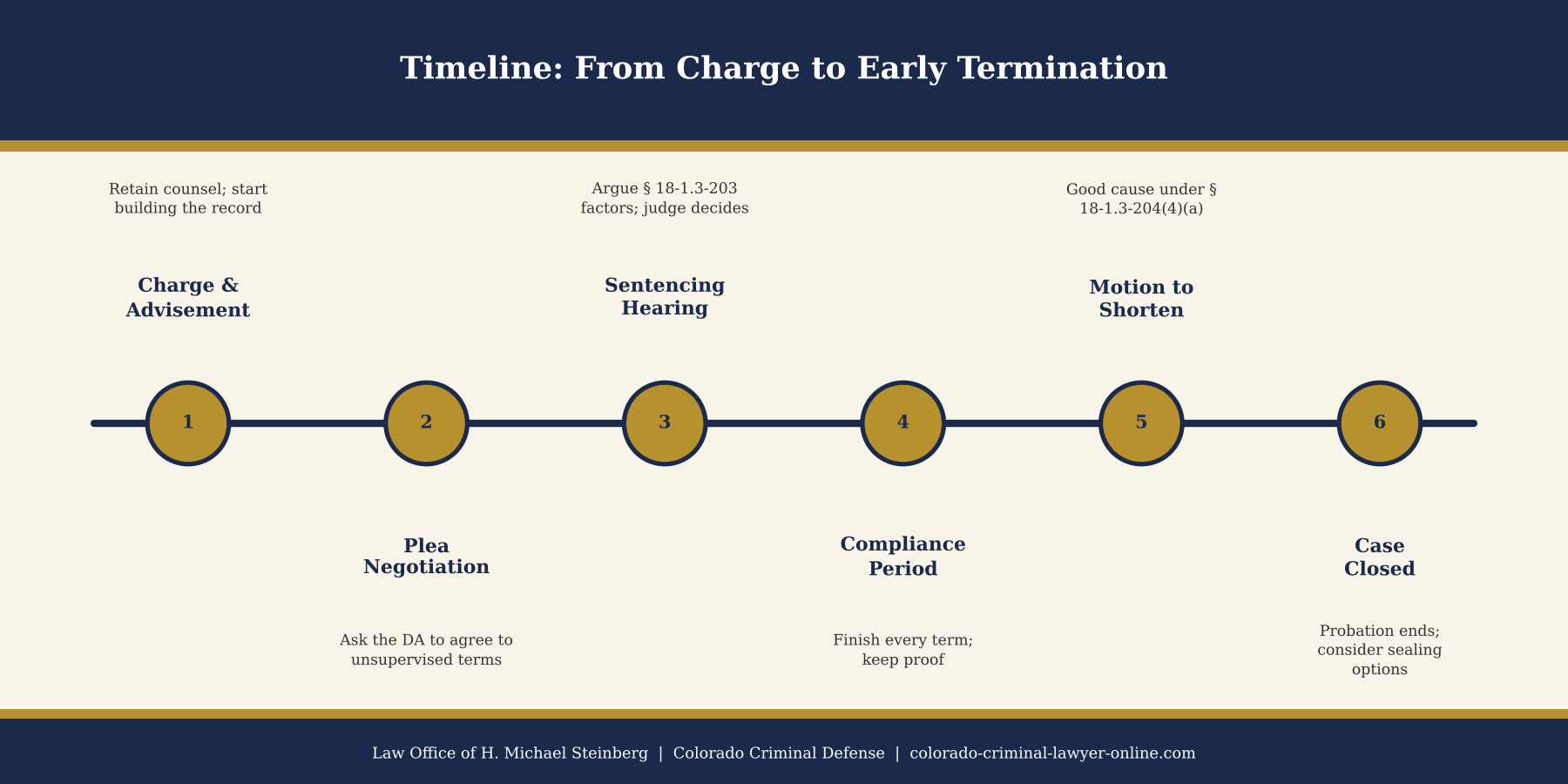
The path from charge to case closure — with opportunities to improve your terms at several points.
Deferred judgment and sentence
In appropriate cases, the better answer is not “unsupervised probation” but a deferred judgment and sentence under C.R.S. § 18-1.3-102. Under a deferred judgment, the defendant pleads guilty but the court postpones entering the conviction for a set period, typically with conditions; if the defendant completes the period successfully, the plea is withdrawn and the case dismissed.
A Colorado Supreme Court opinion on deferred-judgment extensions notes that the statute ordinarily caps the total continuance at four years. Because a successful deferred judgment avoids a conviction altogether, it is often a better result than any form of probation — and the level of supervision during the deferral period depends on the agreement, the judge, and the judicial district.
Starting supervised, then ending early
If the court orders supervised probation, the next goal is to shorten it. Section 18-1.3-204(4)(a) allows the court, for good cause and after notice to the defendant, the district attorney, and the probation officer, to shorten the term. A hearing is required if the defendant or the district attorney requests one. In practice, the strongest early-termination motions show:
- all conditions completed (classes, treatment, community service, fines, and restitution);
- a substantial period of compliance without violations;
- stable employment, housing, and family circumstances; and
- the position of the probation officer, the prosecutor, and — where applicable — the victim.
Colorado’s own policy bodies have recognized the value of this. The Colorado Commission on Criminal and Juvenile Justice approved Recommendation FY23-SR01 in January 2023, which proposed a standardized statewide process for probation to review eligible adult cases for early termination once half of the sentence has been served.
The recommendations status is listed as “no implementation,” and it confirms that the final decision always rests with a judicial officer — so a defense lawyer’s motion remains an important tool. If you are considering this route, see more articles on probation on the Colorado Criminal Lawyer Blog and our probation defense resources.
Unsupervised Does Not Mean Unwatched: Violations
Some people hear “unsupervised” and assume no one is paying attention. That is a dangerous mistake. The conditions of your probation are court orders, and a violation can be brought to the court by the district attorney or a probation officer. Under C.R.S. § 16-11-206, the prosecution must prove a violation of a condition by a preponderance of the evidence — a lower standard than at trial — while a new criminal offense must be established beyond a reasonable doubt unless the probationer has been convicted.
See also People v. Ickler, 877 P.2d 863 (Colo. 1994). If probation is revoked, the court may impose any sentence — or grant any probation — that might originally have been imposed.
Common problems on unsupervised probation include missing a deadline to file proof, forgetting a class, falling behind on restitution, and picking up a new charge. Because no officer is there to remind you, you must be your own probation officer: calendar every deadline, keep copies of everything, and file proof early. If you receive a complaint or a summons, call a lawyer immediately — a probation violation defense is far easier to handle before a warrant issues.
Treat every condition as if a probation officer were reviewing it weekly. Judges who grant unsupervised probation are trusting you; the quickest way to lose that trust — and to be moved to supervised probation or have probation revoked — is to miss a deadline without telling the court.
Common Mistakes That Cost People Unsupervised Probation
- Waiting until sentencing to ask. By then the plea terms are set. Ask during negotiations.
- Showing up with promises instead of proof. Judges respond to certificates and receipts, not intentions.
- Ignoring restitution. Unpaid restitution is the most common reason a judge insists on supervision.
- Failing to address the underlying problem. If alcohol, drugs, or anger played a role, a judge will want to see treatment completed — or monitored.
- Minimizing the offense. Lack of insight is a red flag that suggests a person will need supervision.
- Not reading the written conditions. Under § 18-1.3-204(3) you are entitled to a written statement of conditions. Read it, calendar it, and ask your lawyer about anything unclear.
- Going it alone. Whether to push for unsupervised terms, a deferred judgment, or a different plea is a strategic decision best made with experienced counsel.
Talk to a Denver Criminal Defense Attorney About Your Sentence
The difference between supervised and unsupervised probation can shape the next several years of your life. At the Law Office of H. Michael Steinberg, we have spent more than four decades defending people charged with DUI, domestic violence, drug crimes, sex crimes, and a broad range of felonies and misdemeanors across Denver and the metro area. We know how Colorado judges and prosecutors approach probation, and we know how to build the record that gives you the best chance at the least restrictive sentence available.
If you are facing sentencing — or are already on probation and want to change your terms — call H. Michael Steinberg at 720-220-2277 or visit www.hmichaelsteinberg.com. For more Colorado criminal law articles, browse the Colorado Criminal Lawyer Blog.
Frequently Asked Questions
Is there a statute that creates “unsupervised probation” in Colorado?
No. Colorado’s probation statutes do not use the term. Unsupervised or “bench” probation results from the court’s broad discretion under C.R.S. § 18-1.3-202 to set terms and conditions, together with the fact that reporting to a probation officer is a discretionary condition under C.R.S. § 18-1.3-204(2).
What does “bench probation” mean?
It is a courthouse nickname for probation that is overseen by the judge rather than by a probation officer. You follow the conditions the court orders and show compliance to the court (or, in some courtrooms, the district attorney or clerk) instead of reporting to an officer.
Can I get unsupervised probation for a felony?
It is possible but less common. Felony cases more often involve supervised probation, and certain offenses — such as sex offenses and many domestic-violence cases — carry additional required conditions. A strong record, a stipulation from the prosecutor, and completed treatment improve the odds, but the decision belongs to the judge.
Do I still have to pay fines, restitution, and costs on unsupervised probation?
Yes. Restitution is a mandatory condition of every probation sentence under C.R.S. § 18-1.3-204(1), and fines and court costs still apply. The supervision fee, by contrast, is tied to supervision and can often be avoided or reduced when no officer is assigned.
Can the judge order drug or alcohol testing on unsupervised probation?
Yes. The judge can order testing and treatment as conditions regardless of who supervises. In practice, courts that want testing often prefer supervised probation because someone has to administer and monitor it.
What happens if I violate unsupervised probation?
The district attorney or a probation officer can file a complaint, and the court can issue a summons or a warrant. Under C.R.S. § 16-11-206, a violation of a condition must be proven by a preponderance of the evidence. If probation is revoked, the court may impose any sentence that could originally have been imposed.
If I get supervised probation, can I ask to end it early?
Yes. Under C.R.S. § 18-1.3-204(4)(a), the court may, for good cause shown and after notice to the defendant, the district attorney, and the probation officer, shorten the term of probation. A hearing is required if the defendant or the district attorney asks for one. Completed conditions and a clean compliance record make the strongest motions.
Is a deferred judgment better than unsupervised probation?
Often, yes, because a successfully completed deferred judgment under C.R.S. § 18-1.3-102 avoids a conviction. It is not available or appropriate in every case, so discuss both options with your lawyer before accepting a plea.
Should I hire a lawyer to ask for unsupervised probation?
Because terms are usually shaped during plea negotiations and settled at sentencing, an experienced Colorado criminal defense lawyer can make a meaningful difference. Call H. Michael Steinberg at 720-220-2277 to discuss your case.
- C.R.S. § 18-1.3-201 — Application for probation
- C.R.S. § 18-1.3-202 — Probationary power of court
- C.R.S. § 18-1.3-203 — Criteria for granting probation
- C.R.S. § 18-1.3-204 — Conditions of probation
- C.R.S. § 18-1.3-102 — Deferred sentencing of defendant
- C.R.S. § 16-11-206 — Revocation hearing
- Allman v. People, 2019 CO 78 (Colo. 2019)
- People v. Manaois, 2021 CO 49 (Colo. 2021)
- People v. Ickler, 877 P.2d 863 (Colo. 1994)
- Colorado Supreme Court opinion on deferred-judgment extensions, No. 16SC966
- Larimer County District Court Administrative Order 2019-5 (unsupervised probation)
- Colorado Commission on Criminal and Juvenile Justice, Recommendation FY23-SR01 (early termination review)
www.hmichaelsteinberg.com | Colorado Criminal Lawyer Blog
Disclaimer: This article is for general information only and is not legal advice. Reading it does not create an attorney-client relationship. Colorado law changes, and every case turns on its own facts, the judge, and the prosecutor. Statutory text and case law should be verified against official sources before you rely on them. If you are facing criminal charges or sentencing, consult a licensed Colorado criminal defense attorney. Prior results do not guarantee a similar outcome.