 Colorado Criminal Lawyer Blog
False, Exaggerated, or Mistaken Domestic Violence Allegations: How Are They Defended?


A domestic violence accusation can upend a life in minutes. In Colorado, an officer who has probable cause must make an arrest, a protection order follows almost automatically, and you may be barred from your own home before you have said a word to a lawyer.
Some accusations are true. Others are not: they are invented, inflated, or simply mistaken. If you are facing one of the latter, this guide explains how a Colorado criminal defense lawyer tests the allegation and defends the case.
How are false, exaggerated, or mistaken domestic violence allegations defended in Colorado?
The defense investigates the accuser’s account against the physical evidence, recordings, messages, witnesses, and motive; challenges the arrest and any statements; asserts self-defense where it fits; uses prior inconsistent statements for cross-examination; and, when the accuser does not testify, contests whether their out-of-court statements can be used at all.
The prosecution bears the burden of proving its case beyond a reasonable doubt at every step.
How Colorado Defines Domestic Violence
Colorado does not have a stand-alone crime called “domestic violence.” Under C.R.S. 18-6-800.3, domestic violence is an act, or a threat, against a person with whom the actor has an intimate relationship, used as a method of coercion, control, punishment, intimidation, or revenge. It also covers any other crime, such as harassment, menacing, or criminal mischief, when it is used against an intimate partner. In practice, ordinary charges such as assault carry a domestic violence label.
The label matters. A conviction brings the domestic violence sentencing provisions of C.R.S. 18-6-801, which include mandatory treatment, and it can bring firearms consequences that last long after the case ends. Our review shows this can affect gun ownership. For the full picture of how we handle these cases, see our Colorado domestic violence defense page.
Three Kinds of Problem Allegations
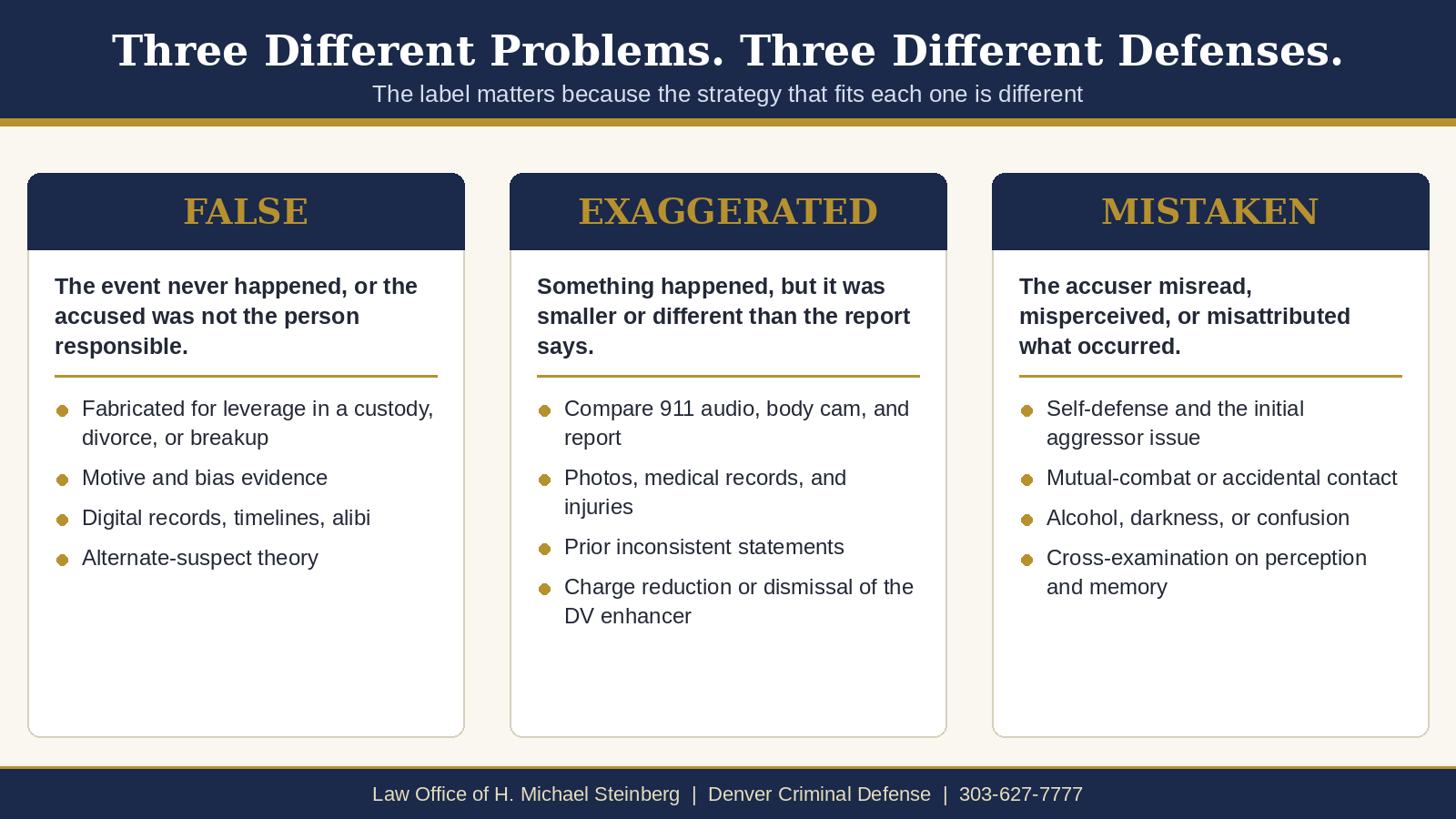
Defense lawyers do not treat every disputed accusation alike. The way a case is defended depends on what actually went wrong, and it usually falls into one of three categories.
1. False allegations
A false allegation is a claim that something happened when it did not. The reasons vary: a custody or divorce dispute, anger after a breakup, a wish for leverage in a property fight, or an attempt to avoid blame for the accuser’s own conduct.
The defense has to prove nothing; the goal is to show the jury that the story does not hold together.
2. Exaggerated allegations
Here, something did happen, perhaps a heated argument or a shove during a struggle, but the account has grown. A push becomes a choking. A broken phone becomes a threat to kill. Exaggeration often arrives after the first report, once a person has talked with family, an advocate, or a divorce lawyer.
The defense goal is to hold the accuser to the evidence and to the first, least-polished version of events.
3. Mistaken allegations
The accuser may sincerely believe what they report. They can often misread who started a fight, mistake an accident for an assault. They may also be intoxicated, frightened, and disoriented, or blame the wrong person.
Here the defense treats the accuser as an honest but mistaken witness, and the strategy centers on objective evidence rather than on attacking character.
Many accusations are true. A good defense does not assume the accuser is lying. It holds the government to its burden of proof and tests whether the evidence supports the claim.
What Happens After the Call
The first hours shape the case. Understanding the sequence explains why early action matters.
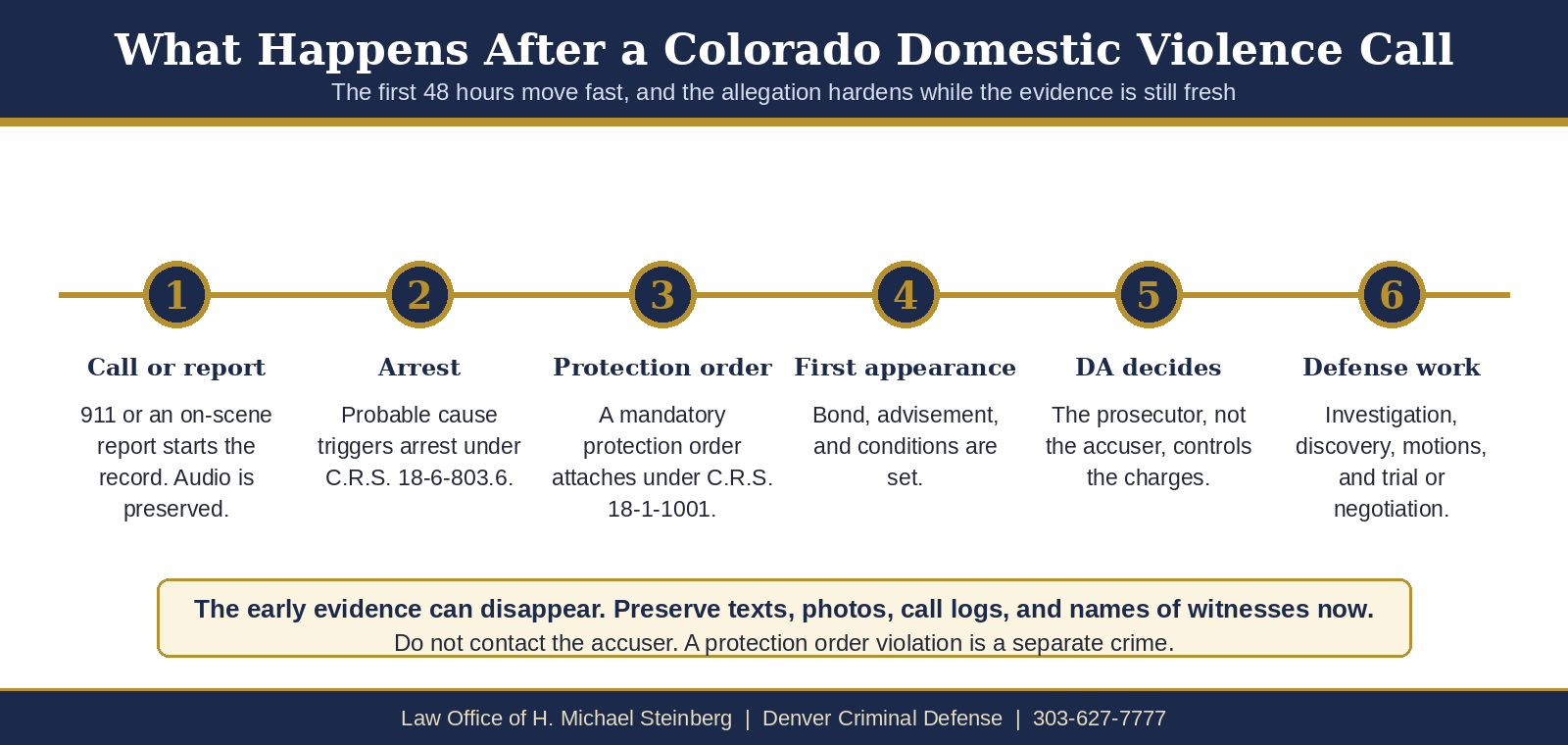
- Mandatory arrest. Under C.R.S. 18-6-803.6, when officers have probable cause that a crime of domestic violence occurred, they must arrest. The statute also directs them to identify the predominant aggressor and to preserve evidence. Probable cause is a far lower standard than proof beyond a reasonable doubt.
- Mandatory protection order. Under C.R.S. 18-1-1001, a protection order is issued at the first court appearance in a domestic violence case. It can bar contact, require you to stay away from your home, and restrict firearms. It stays in place while the case is pending.
- The no-contact trap. Violating the order is its own crime under C.R.S. 18-6-803.5, and the accuser’s consent is not a defense. A friendly text from the accuser can become a new charge against you.
- The DA decides. The district attorney, not the accuser, decides whether to file, amend, or dismiss charges.
The protection order is where many people may get hurt twice. They are told, truthfully, that the accuser wants to talk and may respond. The safest path is to ask your lawyer to seek a modification through the court and NOT respond.
How the Defense Tests the Allegation
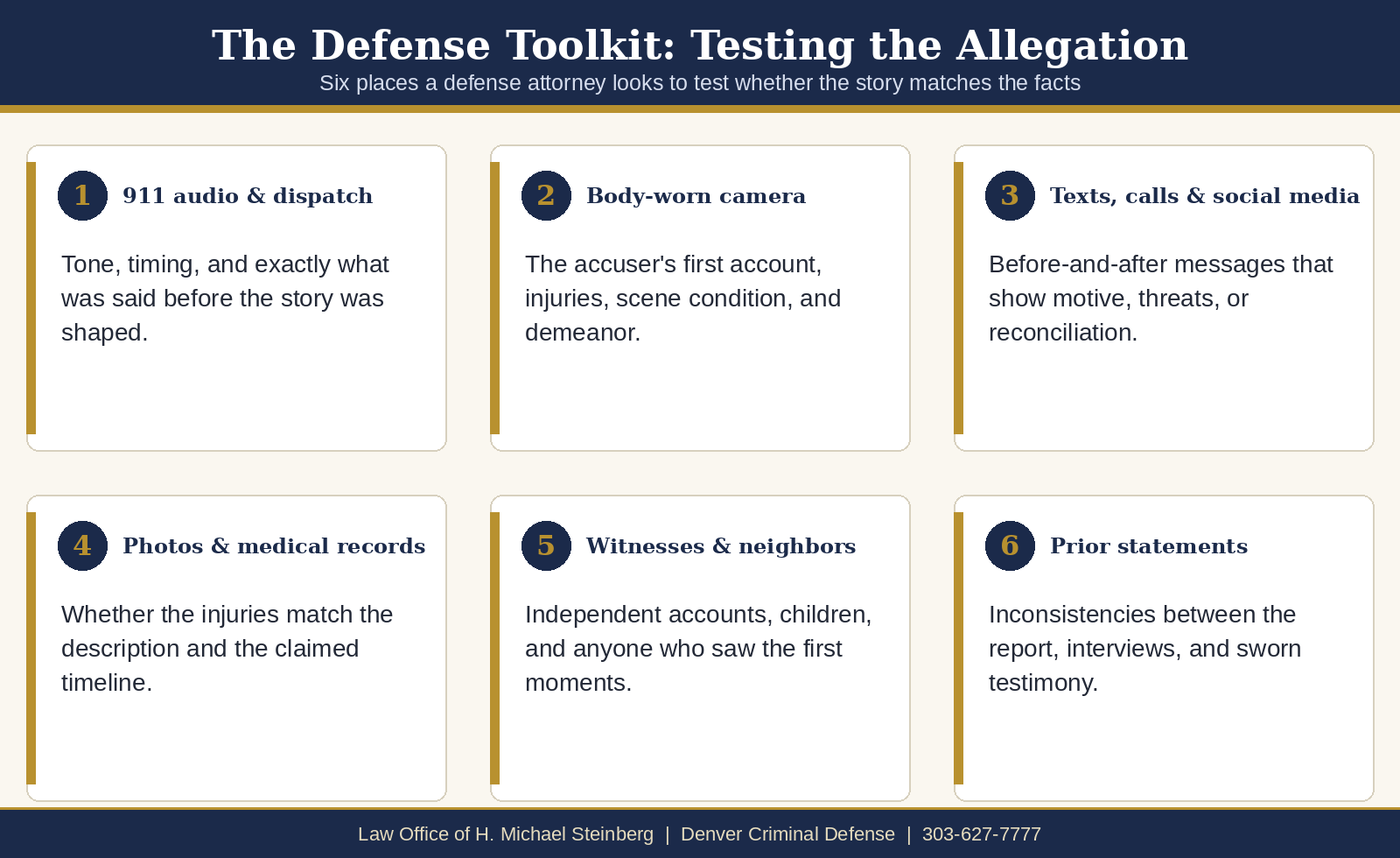
A domestic violence case often looks like one person’s word against another’s. It rarely stays that way once a thorough investigation begins.
The 911 call and body-worn camera
The tone of the call, the order of events described, and what the accuser said on scene to officers are often the most important pieces of evidence. They are also fixed in time. A calm, detached call that later turns into a dramatic report is a major point for cross-examination. The defense will demand the audio, the dispatch log, and the body-camera footage early on.
Physical evidence and injuries
Photographs, medical records, and the location of any injury have to match the claimed event. Defensive wounds on the accused can indicate that they were protecting themselves. Injuries that do not fit the story or were photographed days later can undermine it.
Texts, social media, and call logs
Messages sent before and after the incident show motive, intent, and state of mind. Messages that ask for money or custody terms, or that threaten to “have you arrested,” can be critical. Preserve them now, and do not delete anything: deleting can look like hiding the truth.
Witnesses and motive
Neighbors, children, and friends can confirm or contradict a timeline. Separately, we examine what the accuser stood to gain: a pending custody fight, a divorce, or a property dispute.
Motive to lie is a legitimate basis for cross-examination, but it must be tied to evidence, not speculation.
Prior inconsistent statements
Accounts change. When a person tells police one story, a prosecutor a second, and a jury a third, the differences matter. Under CRE 613, the defense may confront a witness with earlier statements that conflict with trial testimony. Careful, documented comparison of every version is one of the most effective tools in these cases.
Statements the accused made
Many people talk to police because they believe honesty will clear things up. Your words, including apologies, are easily misread.We examine whether any statement was taken out of context or made without proper advisement, and whether it can be challenged.
Self-Defense and the Predominant Aggressor
Sometimes the person arrested is the one who was attacked.
Colorado law allows a person to use reasonable and appropriate force to defend against what they reasonably believe is the imminent use of unlawful force, as set out inC.R.S. 18-1-704.
Self-defense is an affirmative defense: once the defense raises some credible evidence of it, the prosecution must disprove it beyond a reasonable doubt. For how the Colorado Supreme Court has addressed self-defense instructions, see People v. Pickering, No. 10SC446 (Colo. 2011).
The arrest statute is relevant here too.Section 18-6-803.6directs officers to determine the predominant aggressor rather than arrest by default. When officers got that call wrong, because they arrived at the end of a fight or arrested the larger person, the defense can show it with the injury evidence, the 911 call, and witness accounts.
Recantation and Who Controls the Case
Many people believe that if the accuser says “I want to drop the charges,”the case ends.
It does not.
The district attorney controls the prosecution. A recantation is relevant evidence, and prosecutors take it seriously, but they may still proceed on the 911 call, officer observations, photographs, and other proof.
Two cautions apply. First, do not pressure the accuser to recant. Contact can violate a protection order and lead to new, serious charges. Second, a sincere recantation should go through a lawyer so the statement is accurate and documented. An accuser who gave an earlier sworn statement they now say was false may face exposure of their own, which is why they may need independent counsel.
When the Accuser Does Not Testify
Prosecutors sometimes try to proceed without a cooperating accuser, relying on the 911 call and what was said to police. The Sixth Amendment’s Confrontation Clause limits that. In Crawford v. Washington, 541 U.S. 36 (2004), the Supreme Court held that testimonial out-of-court statements are barred unless the witness is unavailable and the defense had a prior chance to cross-examine.
In Davis v. Washington, 547 U.S. 813 (2006), the Court drew the line: statements made to help meet an ongoing emergency are generally not testimonial, while statements describing past events to establish facts for a prosecution are.
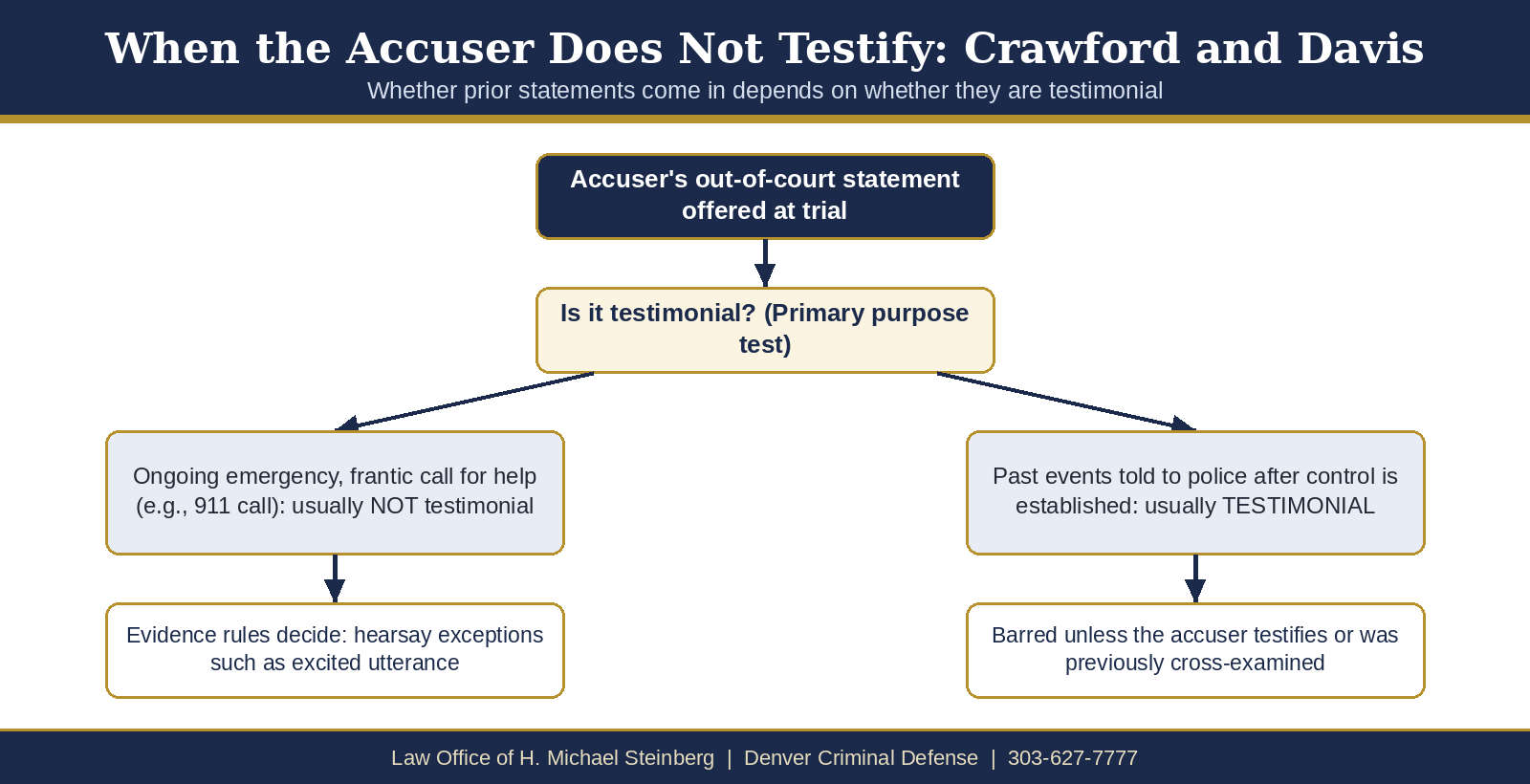
Colorado courts apply these rules in prosecutions that rely on a witness’s out-of-court statements. See Raile v. People, No. 05SC756 (Colo. 2006) and Compan v. People, No. 04SC422 (Colo. 2005). Even when a statement is not testimonial, it must still satisfy the hearsay rules, such as the excited utterance exception under CRE 803(2). A calm report made an hour later may not qualify.
The motion practice in a case can determine whether it can be tried at all.
Knowingly False Reports Are Crimes
Colorado treats deliberately false accusations as crimes. A person who knowingly reports a crime that did not happen can face false reporting to authorities under C.R.S. 18-8-111, and a person who knowingly gives false sworn testimony can face perjury in the second degree under C.R.S. 18-8-503or, in more serious circumstances, perjury in the first degree under C.R.S. 18-8-502.
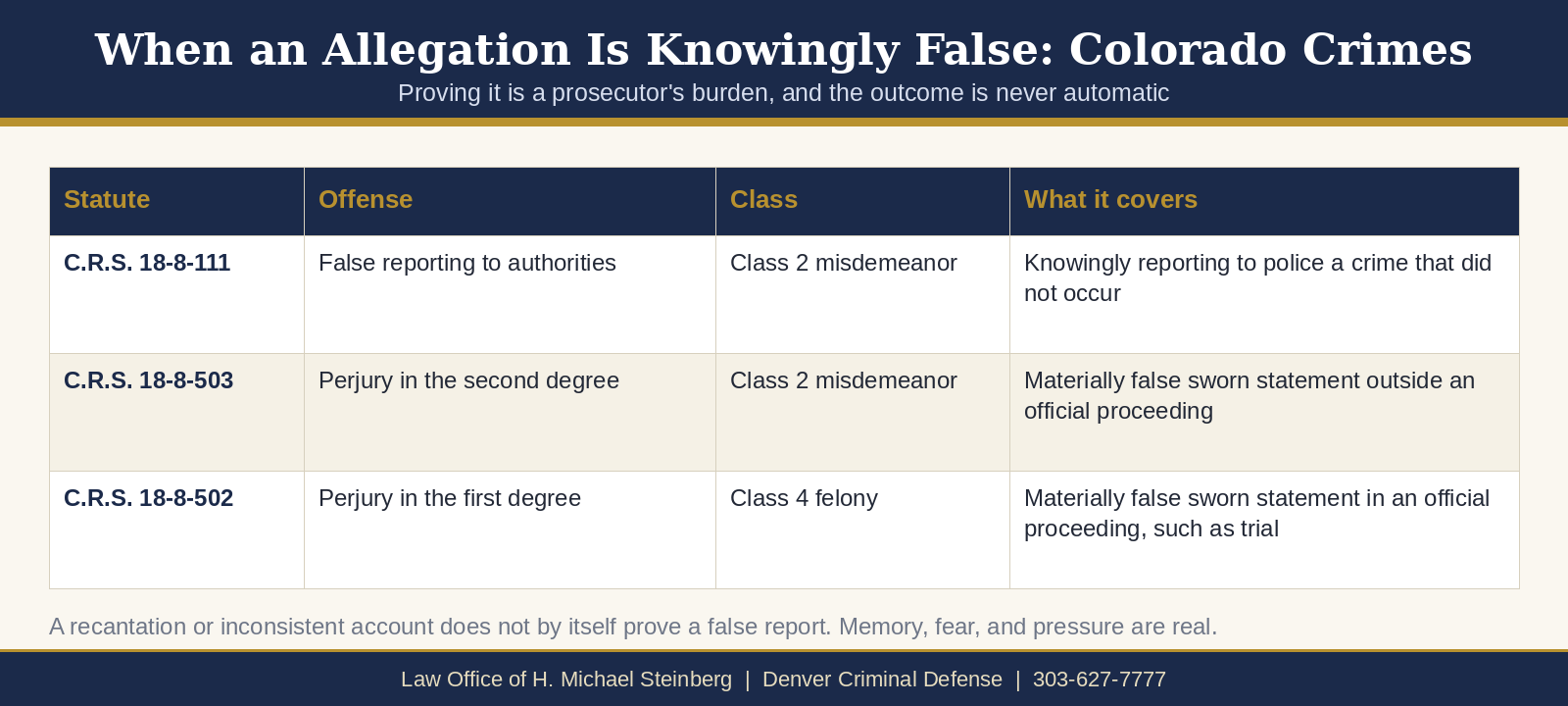
These charges can be hard to prove because they require showing the person knew the statement was false. A mistaken or exaggerated report is not a crime. Still, the possibility is a reason to preserve evidence of who said what, and when.
What to Do If You Are Accused

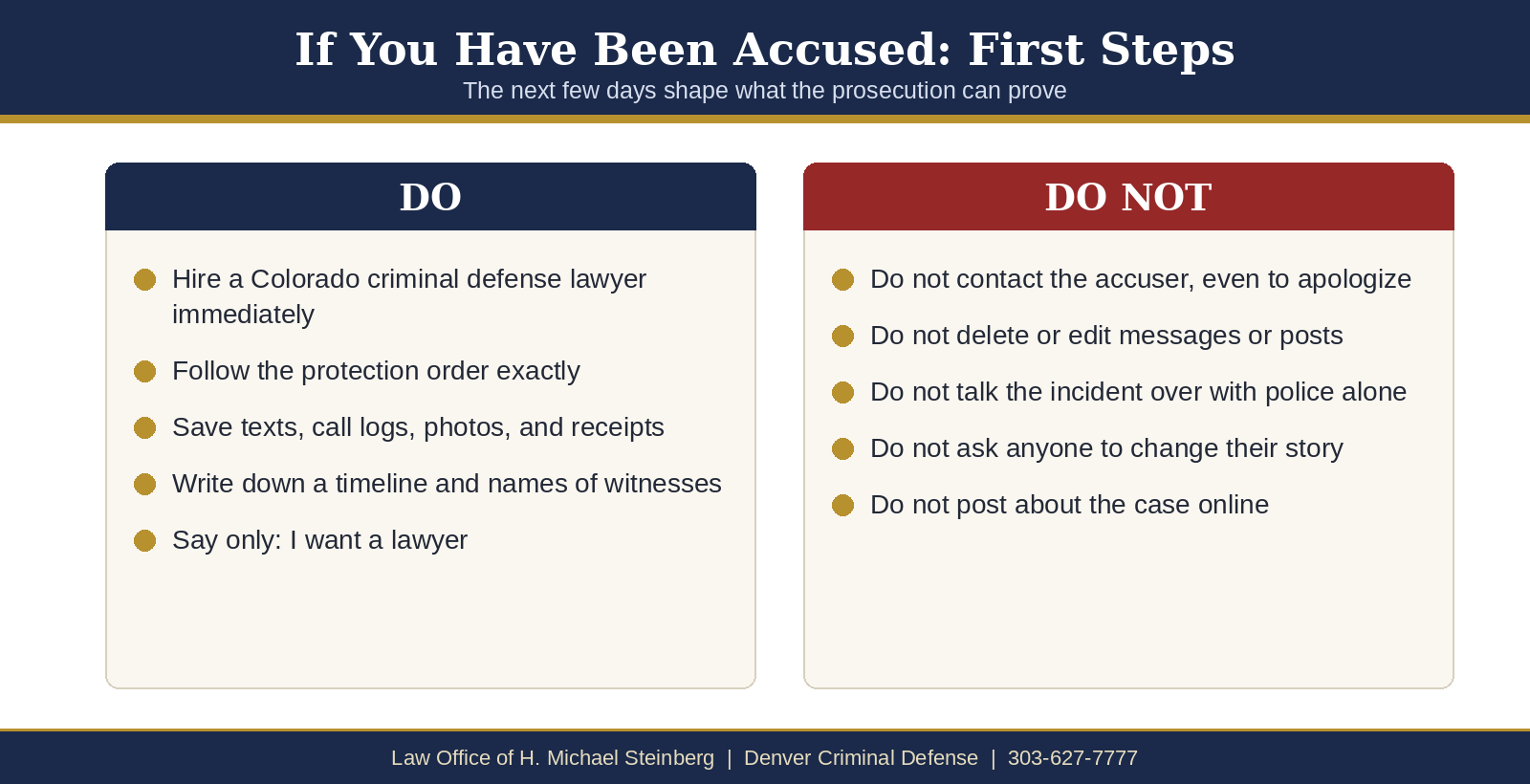
- Say little, and say it only to your lawyer. Politely decline to answer questions and ask for an attorney.
- Follow the protection order exactly. No calls, texts, social media messages, or messages through friends. Do not return to the home without court permission.
- Preserve everything. Screenshot texts and call logs, save photographs and receipts, and write down names and a timeline while memories are fresh.
- Do not delete or edit anything. Deleted messages can look like concealment.
- Identify witnesses. Note who was present, who heard what, and who saw the aftermath.
- Photograph your own injuries. If you were hurt, document it and get medical care promptly.
- Hire a Colorado criminal defense lawyer immediately. The early record matters most.
Frequently Asked Questions
Can a domestic violence charge be dropped if the accuser recants?
Only the district attorney can dismiss charges. A recantation is important evidence and can lead to a dismissal or a reduced charge, but prosecutors may proceed on other evidence, such as the 911 call, photographs, and officer testimony.
Can I be arrested for domestic violence without any evidence of injury?
Yes. Under C.R.S. 18-6-803.6, officers must arrest when they have probable cause that a domestic violence offense occurred, and an accuser’s statement can supply probable cause. Probable cause is a much lower standard than the proof required for a conviction.
What if the accuser contacts me despite the protection order?
Do not respond. The protection order binds you, not the accuser, and the accuser’s consent is not a defense under C.R.S. 18-6-803.5. Save the message and give it to your lawyer, who can ask the court to modify the order.
Is a false domestic violence accusation a crime in Colorado?
It can be. Knowingly false reports to authorities fall under C.R.S. 18-8-111, and knowingly false sworn statements can be perjury under C.R.S. 18-8-502 or 18-8-503. These charges require proof that the person knew the statement was false, so an honest mistake or an exaggeration is not enough.
Can the case go forward if the accuser refuses to testify?
Sometimes. Prosecutors may try to use 911 calls or statements to police, but Crawford v. Washington and Davis v. Washington restrict the use of testimonial statements, and the hearsay rules limit the rest. A defense lawyer can challenge this evidence before trial.
Should I tell the police my side of the story?
Never. At least not without a lawyer. Statements made in the heat of the moment are often incomplete, misunderstood, or used out of context. Your lawyer can decide whether, when, and how to present your account.
How long does a Colorado domestic violence case take?
It varies with the charge, the court, and the evidence. A misdemeanor may resolve in months, while a felony or a case that goes to trial can take longer. Your lawyer can give a realistic estimate after reviewing discovery.
Accused of Domestic Violence in Colorado? Talk to a Defense Lawyer Today.
Attorney H. Michael Steinberg has devoted his career to criminal defense. Learn about our firm or contact us for a confidential consultation.
Call 303-627-7777
The Edwards Building, 8400 E Prentice Ave, Penthouse 1500, Greenwood Village, CO 80111
This article is general information, not legal advice, and it does not create an attorney-client relationship. Laws change and every case is different; results depend on the facts. Contact a qualified Colorado criminal defense lawyer about your situation. Past results do not guarantee a similar outcome.