 Colorado Criminal Lawyer Blog
Intoxilyzer vs. Blood Test: Colorado DUI Guide | Denver DUI Lawyer


Intoxilyzer vs. Blood Test in a Colorado DUI Investigation
- After a lawful DUI arrest, Colorado’s Express Consent law generally lets you choose between a breath test and a blood test, and requires you to cooperate so a sample is obtained within two hours of driving.
- The breath test is run on the Intoxilyzer 9000 by a certified operator, and the sample is consumed in the process. A blood sample is drawn by qualified personnel, analyzed in a certified laboratory, and can be retested.
- Refusing has real costs: a 12-month license revocation for a first refusal, and the refusal itself can be used against you at trial. Officers can also seek a search warrant for blood.
- Both tests can be challenged. Certification, procedure, timing, chain of custody, and constitutional issues all matter.
- For breath tests and refusals, you have only seven days to request a DMV hearing. Do not let that deadline pass.
It is one of the most consequential questions a Colorado driver can face, and it is usually asked at the worst possible moment: you have been arrested on suspicion of DUI, the officer reads you the Express Consent advisement, and you are told you must choose between a breath test and a blood test. You have seconds to decide, no time to research, and the result may become the centerpiece of the prosecution’s case.
With more than forty years of a law practice centered on defending DUI and DWAI cases across the Denver metro area, I have seen how often drivers make that choice without understanding what each test measures, how it is administered, or how it can be challenged later.
This guide explains how the Intoxilyzer 9000 and laboratory blood testing work in Colorado, what the law requires of officers and drivers, how recent appellate decisions have reshaped the landscape, and where defense lawyers look for weaknesses in the evidence.
Everything below is grounded in Colorado’s statutes, administrative rules, and published court decisions, each linked so you can read the source yourself. Start with the controlling statute, C.R.S. § 42-4-1301.1, known as the Express Consent law.
How Colorado’s Express Consent Law Works
Colorado treats every person who drives on its streets and highways as having agreed to chemical testing under certain conditions. That principle, codified in C.R.S. § 42-4-1301.1, is why the law is called Express Consent.
The Colorado Supreme Court has described the statute as deeming every driver to have consented to a breath or blood test simply by getting behind the wheel, and has confirmed that a blood test may be required when a breath test is unavailable.
In practical terms, the statute sets out several rules that come up again and again in DUI cases:
- Probable cause comes first. The officer must have probable cause to believe you drove under the influence before demanding an evidentiary test.
- The choice is yours in alcohol cases. Once you choose breath or blood, the statute generally locks in that choice, subject to limited exceptions under subsection (2)(a.5). Failing to complete or cooperate with the chosen test is treated as a refusal.
- Medical circumstances can override the choice. If injury, illness, or similar conditions prevent a breath test, or you are receiving treatment where a certified breath instrument is not available, the test must be blood.
- The two-hour clock. Under subsection (2)(a)(III), you must cooperate so that a sample can be obtained within two hours of driving.
- Extraordinary circumstances. If circumstances beyond the officer’s or agency’s control prevent the chosen test within two hours, such as a power outage or malfunctioning equipment, the officer must tell you and direct you to take the other test. Inconvenience and heavy workload do not qualify.
- Drug impairment is different. When an officer has probable cause for DUI or DWAI and drug testing is reasonable, the statute under subsection (2)(b) calls for a blood, saliva, or urine test to check for drugs.
- Forms and cooperation. You must cooperate with whoever is collecting the specimen, including signing required release forms. Refusing to sign can itself count as a refusal under subsection (3).
- Who may draw blood. Under subsection (6), only a physician, registered nurse, qualified EMS provider, or a person whose normal duties include drawing blood under medical supervision may draw blood for these purposes.
- Unconscious or deceased drivers. Under subsection (8), a person who is dead or unconscious must be tested, a rule the Colorado Supreme Court examined in People v. Hyde, 2017 CO 24.
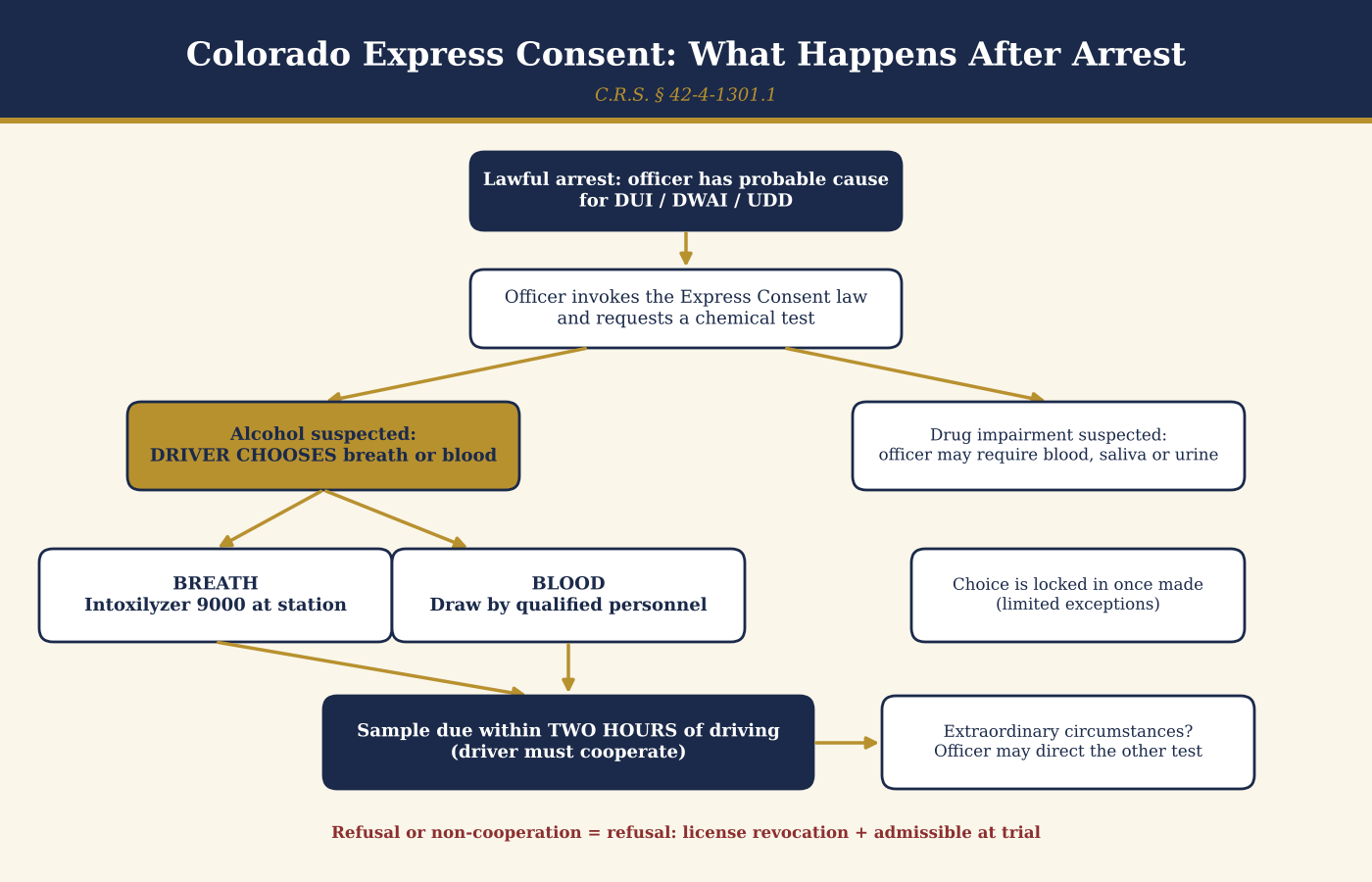 How Colorado’s Express Consent law moves from arrest to a completed chemical test.
Drivers under 21 face special rules when the suspected offense is underage drinking and driving, and commercial drivers are subject to lower limits. If either describes you, the analysis above may change, and an early consultation is especially important.
The Roadside Breath Test Is Not the Evidentiary Test
Many people confuse the handheld device an officer may use at the roadside with the Intoxilyzer machine at the station. They are legally distinct.
Under C.R.S. § 42-4-1301(6)(i), an officer who lawfully contacts a driver and reasonably suspects alcohol impairment may offer a preliminary screening test, but must first tell the driver that he or she may refuse or agree. The results can help establish probable cause, but neither the results nor a refusal may generally be used at trial, except at a hearing held outside the jury’s presence to decide probable cause.
Equally important, subsection (7) of C.R.S. § 42-4-1301.1 provides that a preliminary screening test does not substitute for the evidentiary breath or blood test. Declining the roadside device is a different decision than declining the Express Consent test after arrest, with very different consequences.
The Intoxilyzer 9000: How Colorado’s Breath Test Works
Colorado’s evidentiary breath instrument is the Intoxilyzer 9000. According to the Colorado Department of Public Health and Environment, its Evidential Breath Alcohol Testing (EBAT) program repairs, calibrates, and certifies the instruments used statewide, and trains and certifies the officers who operate them.
CDPHE states that the program is accredited by ANAB and meets ISO/IEC 17025:2017. The Colorado Board of Health’s rules governing breath testing appear in 5 CCR 1005-2, and CDPHE publishes the rules and related EBAT documents as well as Intoxilyzer resources and the operator manual.
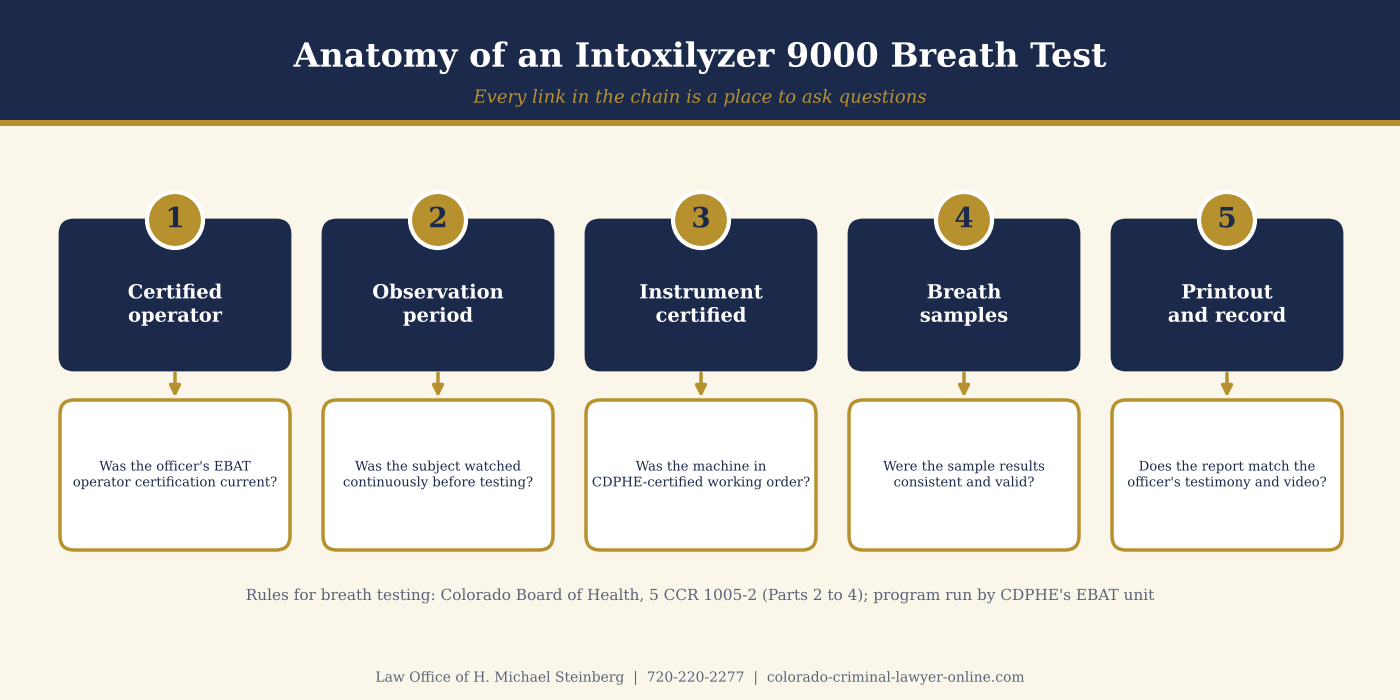
Each step of a breath test is a place where the prosecution must lay a proper foundation.
A breath result is a number on a printout. Whether that number can be trusted depends on the people and procedures behind it.
H. Michael Steinberg
What the prosecution must be able to show
Because a breath result is generated by a machine and a person working together, the prosecution’s case depends on a chain of foundation: a certified operator, a properly maintained and certified instrument, adherence to the testing protocol, and a result that is reported accurately. Each link is a legitimate subject of inquiry.
- Operator certification. The Board of Health rules require breath samples to be collected by certified operators. A lapse in certification has long been a basis for challenging revocations and results.
- The observation period. Operators are trained to watch the subject continuously before the test so that mouth alcohol from belching, regurgitation, or recent drinking does not inflate the reading. The exact protocol is set out in the rules and the operator guide.
- Instrument certification. Each Intoxilyzer 9000 must be certified before use, and the prosecution typically offers a certificate showing the machine was in working order.
- The printout and the video. The report should be consistent with the officer’s testimony and with any body-worn or station camera footage.
The certificate question in Colorado courts
In People v. Ambrose, 2021 COA 62, the Colorado Court of Appeals held that the Intoxilyzer 9000 “working order” certificate is not testimonial and does not trigger the Confrontation Clause.
That ruling means a defendant cannot demand that the certifying analyst appear simply because a certificate was admitted, but it does not make the breath result immune from challenge. It places the burden on the defense to probe the instrument’s foundation through cross-examination, records requests, and, where appropriate, expert testimony.
As Colorado Politics reported, the case also arose against the backdrop of earlier disputes about certification paperwork.
Those disputes were real. In 2017, defense lawyers raised questions about the signatures on Intoxilyzer certification documents, and CDPHE publicly disagreed that the issue undermined certification, as 9NEWS reported. Whatever one makes of that debate, it illustrates why the paperwork behind a breath result deserves scrutiny rather than assumption.
One more point: the breath sample is gone
A breath sample is consumed in the act of testing. Unlike blood, there is no retained specimen that an independent laboratory can analyze later. In a breath case, the defense typically reconstructs reliability from the instrument records, the operator’s conduct, the subject’s circumstances, and the timeline.
The Blood Test: From Needle to Laboratory
A blood test follows a different path. The sample is drawn by qualified personnel under subsection (6) of the Express Consent statute, sealed and transported, and analyzed by a laboratory operating under the Board of Health’s blood-testing rules. Part 5 of 5 CCR 1005-2 addresses certification of forensic toxicology laboratories, and Part 6 addresses collection and testing requirements for blood.
- Retesting is possible. Because blood is a physical specimen, a portion can generally be preserved for retesting. Whether that happens, and under what conditions, depends on how the sample was collected and stored in your specific case.
- Results take longer. Lab results can take weeks. The DMV timeline for blood cases differs from breath cases, because the revocation process generally begins after lab results are returned. See the DMV’s lifespan chart for Express Consent cases.
- Blood can reveal more. Only a blood test can measure THC in whole blood, which is the basis for Colorado’s five-nanogram permissible inference. If drug impairment is suspected, an officer may require blood, saliva, or urine under subsection (2)(b).
- The draw can fail. A chosen blood test is not always completed, and Colorado courts have addressed what happens next.
Courts have also addressed what remedy applies when officers do not follow the statute. The Colorado Supreme Court considered that question in Turbyne v. People, and the cooperation requirement has been examined in Gallion v. Colorado Department of Revenue. Because remedies depend heavily on the facts and the procedural posture, this is an area where case-specific legal analysis is essential.
Breath vs. Blood: Side-by-Side
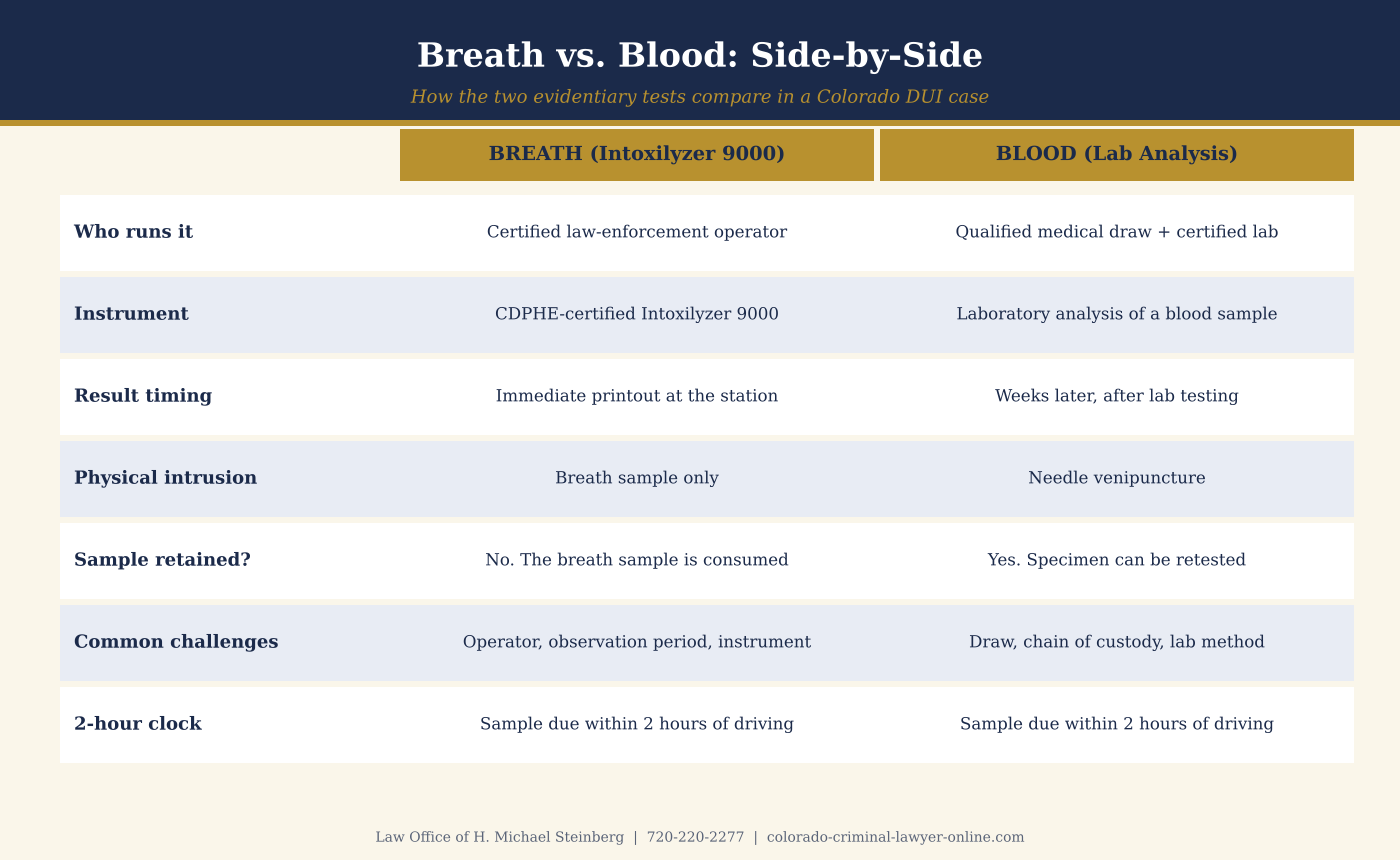
Breath and blood tests differ in who runs them, how fast results arrive, and whether the sample can be retested.
| Breath (Intoxilyzer 9000) | Blood (laboratory) | |
|---|---|---|
| Who performs it | Certified law-enforcement operator | Qualified medical personnel draw; certified laboratory analyzes |
| Where | Police station or approved facility | Hospital, clinic, or mobile collection, then laboratory |
| Result timing | Immediate printout | Often weeks |
| Sample retained? | No, consumed in testing | Yes, can generally be retested |
| Measures drugs such as THC? | No | Yes, in whole blood |
| Typical challenge points | Operator, observation period, instrument certification | Draw, chain of custody, lab method and records |
| Two-hour requirement | Sample due within two hours of driving | Sample due within two hours of driving |
BAC Thresholds and What the Numbers Mean
Whichever test is used, the result is compared to Colorado’s statutory thresholds in C.R.S. § 42-4-1301. The Colorado General Assembly’s own summary of drunk driving laws lays out the framework. A BAC of 0.05 or less creates a presumption that the driver was not under the influence.
A BAC above 0.05 but below 0.08 permits an inference that alcohol impaired the driver’s ability to operate a vehicle. A BAC of 0.08 or more permits an inference that the driver was under the influence, and separately supports a DUI per se charge for driving with a BAC of 0.08 or more at the time of driving or within two hours after.
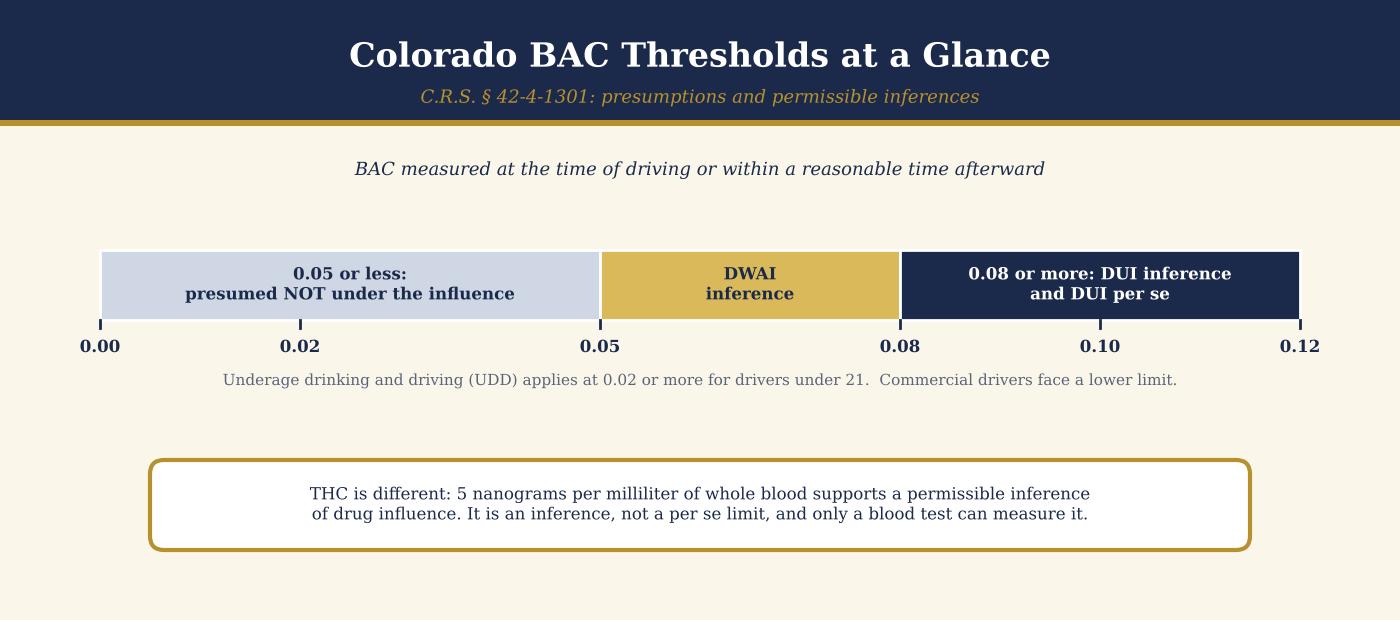
Colorado BAC thresholds create presumptions and permissible inferences, with 0.08 also defining DUI per se.
Two details are easy to miss.
First, the inferences in subsection (6)(a) are permissible inferences, not automatic findings, so a jury may weigh other evidence.
Second, subsection (6)(a) refers to a BAC at the time of the alleged offense or within a reasonable time afterward, while the per se offense uses the two-hour language. The distinction can matter when a test is taken late or when the defense argues BAC was still rising after driving.
For marijuana, Colorado law provides a permissible inference of drug influence when whole blood contains five nanograms or more of delta-9 THC per milliliter. That is also an inference, not a per se limit.
The Two-Hour Window
The two-hour rule in § 42-4-1301.1(2)(a)(III) shapes the entire investigation. Officers know they are racing a clock, and so does the defense. If a test is administered late, one question is whether the statute required suppression. In People v. Burdette, 2024 COA 38, the Court of Appeals held that the Express Consent statute does not mandate suppression of a blood test result at a later DUI trial simply because the sample was not obtained within two hours of driving.
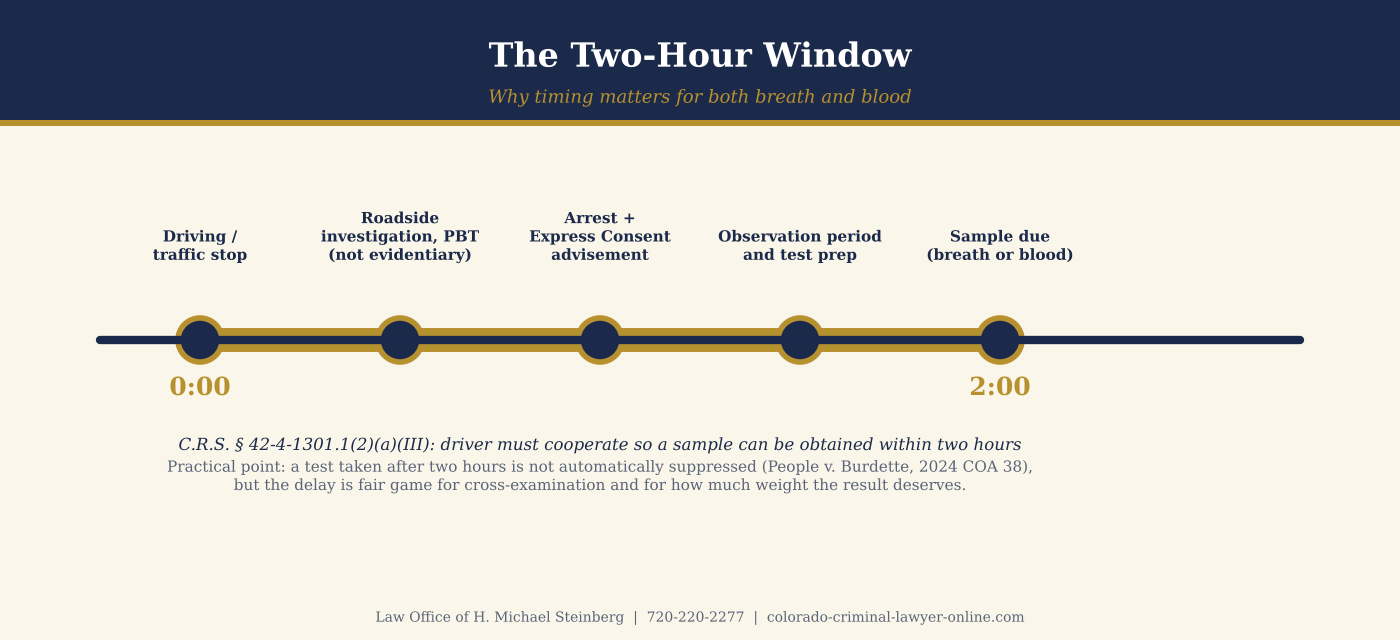
Colorado expects a chemical sample within two hours of driving.
That does not make a late sample irrelevant. Timing remains a powerful issue for cross-examination and for the weight of the evidence. If a sample is collected well after driving, the defense can ask whether the result reflects the driver’s BAC at the time of driving, particularly if the person had recently consumed alcohol and was still absorbing it.
When Police Want Blood: Warrants, Consent, and Recent Colorado Decisions
A blood draw is a search under the Fourth Amendment, which is why the constitutional law of DUI testing has been so active. A handful of decisions form the backbone of the current framework:
- Missouri v. McNeely, 569 U.S. 141 (2013): the natural dissipation of alcohol does not create a per se exigency justifying a warrantless blood draw in every drunk-driving case.
- Birchfield v. North Dakota, 579 U.S. 438 (2016): breath tests may be required as a search incident to a lawful DUI arrest, but warrantless blood tests may not be compelled on that basis.
- Mitchell v. Wisconsin, 588 U.S. 840 (2019): addressed warrantless blood draws from unconscious drivers, generally permitting them where exigent circumstances exist.
- People v. Hyde, 2017 CO 24: the Colorado Supreme Court held that an unconscious driver’s statutory consent satisfied the consent exception to the warrant requirement on the facts presented.
- People v. Raider, 2022 CO 40: the Express Consent statute’s prohibition on forced specimen collection applies to warrantless searches and does not limit blood draws carried out under a valid warrant. Read the Colorado Bar summary or the opinion.
- Tarr v. People, 2024 CO 37: a conscious driver may revoke the statutory consent, and police generally must obtain a warrant before drawing blood once consent is revoked.
The practical lesson is that the Express Consent statute, the Fourth Amendment, and the warrant process all interact. If an officer proceeds with a blood draw after you object, whether the draw was lawful may turn on whether there was a warrant, whether an exception applies, and how the Colorado Supreme Court’s decisions in Tarr and Raider apply to the facts. These issues are fact-intensive and are often decisive.
What Happens If You Refuse
Some drivers decide to refuse testing altogether, believing it denies the prosecution its best evidence. The law anticipates that and attaches consequences, some administrative and some in the criminal case.
- License revocation. The Colorado Department of Revenue’s Express Consent page states that a first test refusal results in 12 months of revocation, with early reinstatement possible after a mandatory two months of no driving, and that a person revoked for refusal is not eligible for a probationary license. By comparison, a first test failure at 0.08 or greater by a driver 21 or older carries a nine-month revocation, with early reinstatement possible after one month.
- The refusal is evidence. Under C.R.S. § 42-4-1301(6)(d), a refusal to take, complete, or cooperate with a test is admissible at a later DUI or DWAI trial.
- A warrant may follow. As Raider explains, refusal does not prevent police from seeking a warrant for blood.
- Other consequences. Refusals can also carry additional administrative consequences, including potential persistent drunk driver classification under C.R.S. § 42-2-126.
The seven-day DMV deadline
A separate administrative case begins immediately. The Department of Revenue’s Express Consent procedures page explains that you will have up to seven days to request a hearing, and the DMV’s case lifespan chart shows a seven-day window to request a hearing in breath and refusal cases. If you do not request a hearing, the revocation takes effect when the time runs out. Blood cases follow a different timeline because the DMV acts after lab results are available, so read the notice you receive carefully. Hearing information is available through the Hearings Division.
Criminal Penalties If Convicted
A first DUI in Colorado is a misdemeanor. Under C.R.S. § 42-4-1307, a first-offense DUI carries a possible jail sentence of five days to one year and a fine of $600 to $1,000, along with other consequences such as useful public service, probation, alcohol education and treatment, and license consequences.
Penalties increase for repeat offenses, and certain aggravating circumstances can change the picture. The Colorado General Assembly’s law summary provides a useful overview, but because sentencing is highly fact-specific, you should discuss your own exposure with a lawyer.
How a DUI Defense Lawyer Challenges Breath and Blood Evidence
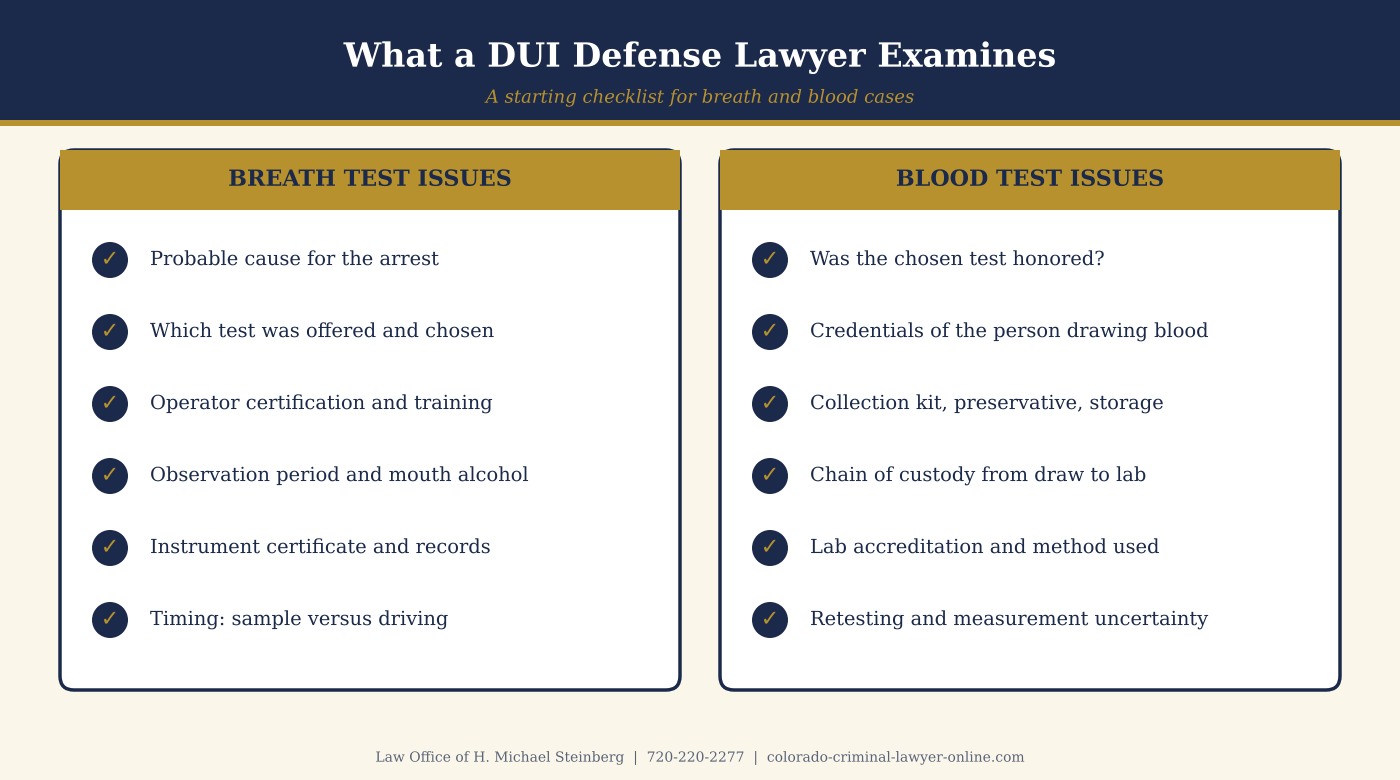
A starting checklist for challenging breath and blood evidence.
Challenging a breath test
- Whether the officer had probable cause for the arrest and for the Express Consent demand.
- Whether the officer offered the choice required by the statute and honored it.
- Whether the operator held a current certification and followed the testing protocol.
- Whether the subject was properly observed beforehand, and whether medical conditions or recent belching or regurgitation could have introduced mouth alcohol.
- Whether the instrument’s certification and maintenance records are complete and reliable.
- Whether the timing supports an accurate inference about BAC at the time of driving.
Challenging a blood test
- Whether the chosen test was honored, or whether a failed draw really qualified as an extraordinary circumstance.
- Whether the person who drew the blood was among those the statute authorizes.
- Whether the collection kit, preservative, labeling, storage, and transport were proper.
- Whether chain of custody is documented from the draw through the laboratory.
- Whether the laboratory was properly certified and followed the applicable method and quality controls.
- Whether independent retesting of a retained portion is possible and appropriate, and what the measurement uncertainty is.
The result on the page is only as reliable as the process that produced it. Our job is to examine every step.
So Which Test Should You Choose?
There is no universal answer, and no responsible lawyer can give one without knowing the facts. What can be said is that the tests involve different trade-offs:
- Breath is fast and noninvasive, and the result is available immediately, but the sample is consumed and cannot be independently retested.
- Blood takes longer and requires a needle draw, but a specimen exists that can be retested, and the chain of custody and laboratory records create additional avenues for challenge. Blood can also reveal drugs, including THC, which matters if drug use is suspected.
- Refusal avoids creating a chemical result but triggers a 12-month revocation for a first refusal, can be used as evidence, and may lead to a warrant.
Because the decision is made in the moment, the best preparation is understanding these trade-offs before you are ever in that situation, and contacting a criminal defense lawyer immediately after an arrest.
What To Do After a Colorado DUI Arrest
- Note the seven-day deadline. For breath tests and refusals, the window to request a DMV hearing is short. Keep the paperwork you were given.
- Write down what you remember as soon as possible: the stop, the roadside tests, what you were asked, which test you chose, how long you waited, and who administered it.
- Do not discuss the case with anyone other than your lawyer, and avoid posting about it on social media.
- Preserve evidence. Body-worn camera, dash camera, and station video may be overwritten. Your lawyer can send preservation requests.
- Contact a DUI defense attorney promptly. Early involvement protects your license, preserves evidence, and allows a lawyer to evaluate the stop, the arrest, and the test.
Frequently Asked Questions
Can I choose between a breath test and a blood test in Colorado?
In alcohol-related cases, generally yes. Under C.R.S. § 42-4-1301.1(2)(a)(I), a driver arrested on probable cause makes the election between breath and blood. Exceptions apply if medical circumstances prevent a breath test, if the officer finds extraordinary circumstances, or if drug impairment is suspected.
How long do police have to obtain a sample?
The statute requires drivers to cooperate so that a sample can be obtained within two hours of driving. Colorado courts have held that a sample obtained after two hours is not automatically suppressed, but timing remains an important issue for the weight of the evidence.
Can I change my mind after choosing breath or blood?
Generally not. The statute treats the choice as locked in once made, subject to the extraordinary-circumstances exception, which allows an officer to direct you to the other test without it counting as a refusal.
Is the Intoxilyzer 9000 reliable?
CDPHE certifies and calibrates the instruments and certifies the operators, and Colorado courts have admitted its results. That does not make every result beyond challenge. Operator certification, the observation period, instrument records, and timing are all legitimate areas for defense inquiry.
What happens if I refuse a chemical test?
A first refusal results in a 12-month license revocation under the Department of Revenue’s published guidance, the refusal can be admitted at trial, and police may seek a warrant for blood. You generally have seven days to request a DMV hearing in refusal cases.
Can police force a blood draw?
Colorado courts have addressed this at length. Under Raider, the Express Consent statute’s ban on forced collection does not limit searches under a valid warrant. Under Tarr, a conscious driver can revoke statutory consent, and police generally need a warrant to draw blood after that.
Is the roadside breath test the same as the Intoxilyzer?
No. A preliminary screening test at the roadside helps determine probable cause but does not substitute for the evidentiary test required after arrest, and its results are generally not admissible at trial.
Can a breath or blood result be challenged in court?
Yes. Breath results can be challenged through operator certification, instrument records, observation procedures, and timing. Blood results can be challenged through the draw, chain of custody, laboratory certification and method, and retesting.
Learn more about the firm at www.hmichaelsteinberg.com, and explore more articles on DUI, DWAI, and Colorado criminal defense on the Colorado Criminal Lawyer Blog.
Sources and Further Reading
Statutes and Regulations
- C.R.S. § 42-4-1301.1 (Express Consent)
- C.R.S. § 42-4-1301 (DUI, DWAI, inferences, refusal evidence)
- C.R.S. § 42-4-1307 (penalties)
- C.R.S. § 42-2-126 (license revocation)
- 5 CCR 1005-2 (Testing for Alcohol and Other Drugs)
Colorado Cases
- Tarr v. People, 2024 CO 37
- People v. Raider, 2022 CO 40
- People v. Hyde, 2017 CO 24
- People v. Spencer, 2024 COA 75
- People v. Null (Colo. 2010)
- People v. Burdette, 2024 COA 38
- People v. Ambrose, 2021 COA 62
- Turbyne v. People (Colo. 2007)
- Gallion v. Colorado Department of Revenue (Colo. 2007)
United States Supreme Court
- Missouri v. McNeely, 569 U.S. 141 (2013)
- Birchfield v. North Dakota, 579 U.S. 438 (2016)
- Mitchell v. Wisconsin, 588 U.S. 840 (2019)
Agency and Government Resources
- CDPHE Evidential Breath Alcohol Testing (EBAT) program
- CDPHE EBAT documents and Board of Health rules
- CDPHE Intoxilyzer resources
- Colorado Department of Revenue: Express Consent
- Colorado Department of Revenue: Express Consent procedures
- Colorado DMV: lifespan of an Express Consent case (PDF)
- Colorado General Assembly: Colorado Drunk Driving Laws (PDF)
News Coverage
Disclaimer. This article is provided for general informational purposes only and is not legal advice. Reading it does not create an attorney-client relationship. Laws and court decisions change, and every case turns on its own facts. If you have been arrested or charged with DUI or any other offense, consult a licensed Colorado criminal defense attorney about your situation. Attorney advertising.