 Colorado Criminal Lawyer Blog
DA Overcharging in Colorado: How Prosecutors “Stack” Charges


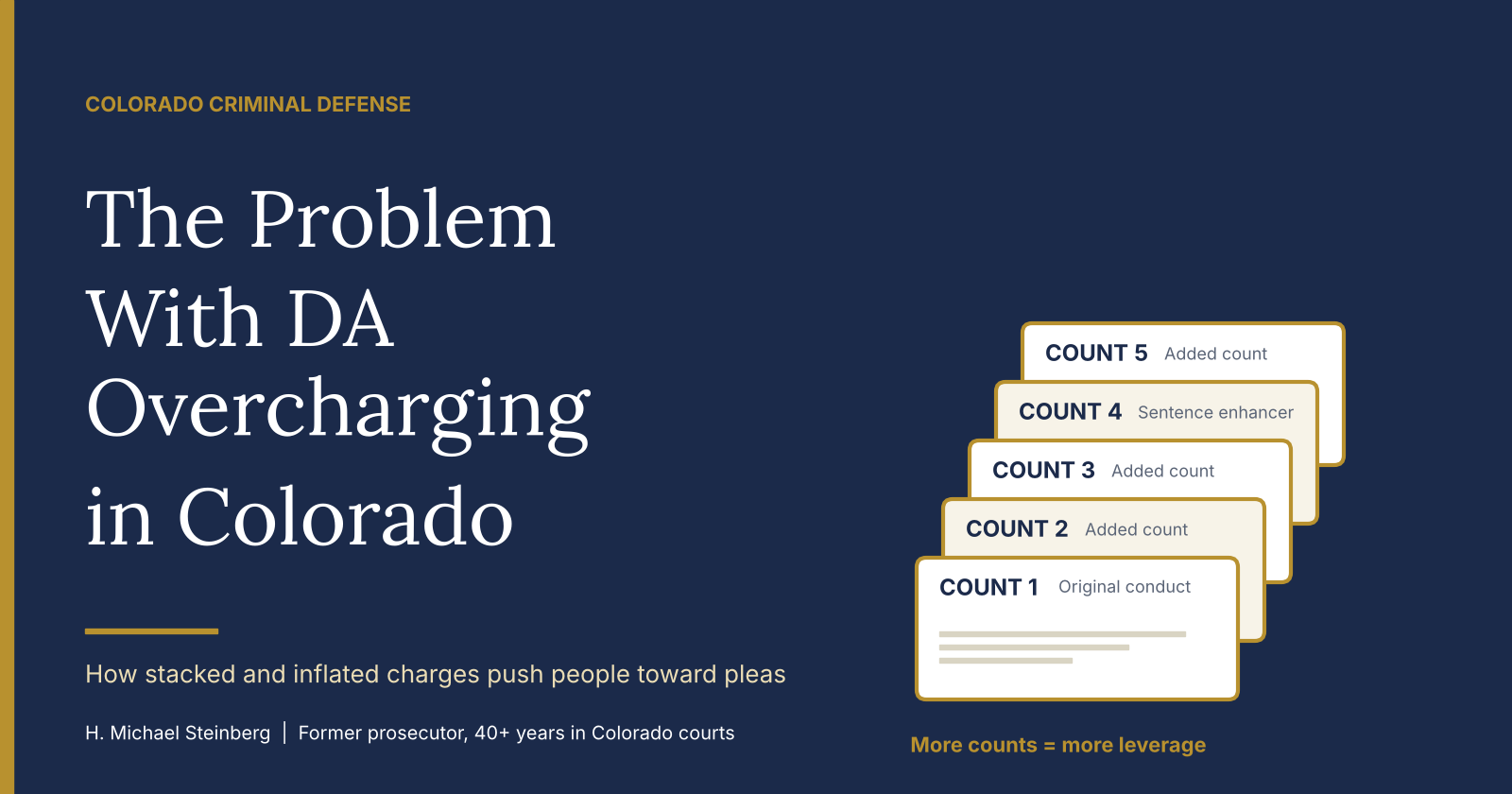
By H. Michael Steinberg, Colorado criminal defense attorney | Updated October 10, 2026
You are arrested after a single argument, a single traffic stop, or a single bad night. Then the complaint arrives, listing five counts. One is a felony. One carries a sentence enhancer. A few days later, a plea offer follows: plead guilty to one count and the rest will be dismissed.
It can feel like mercy. Often it is arithmetic. When the original filing is higher or broader than the evidence supports, dropping the extra counts costs the prosecution nothing and can cost the accused everything. That practice is called overcharging, and it is one of the least visible problems in Colorado criminal courts.
KEY TAKEAWAYS
- Overcharging means filing more counts, or more serious counts, than the evidence supports in order to gain leverage.
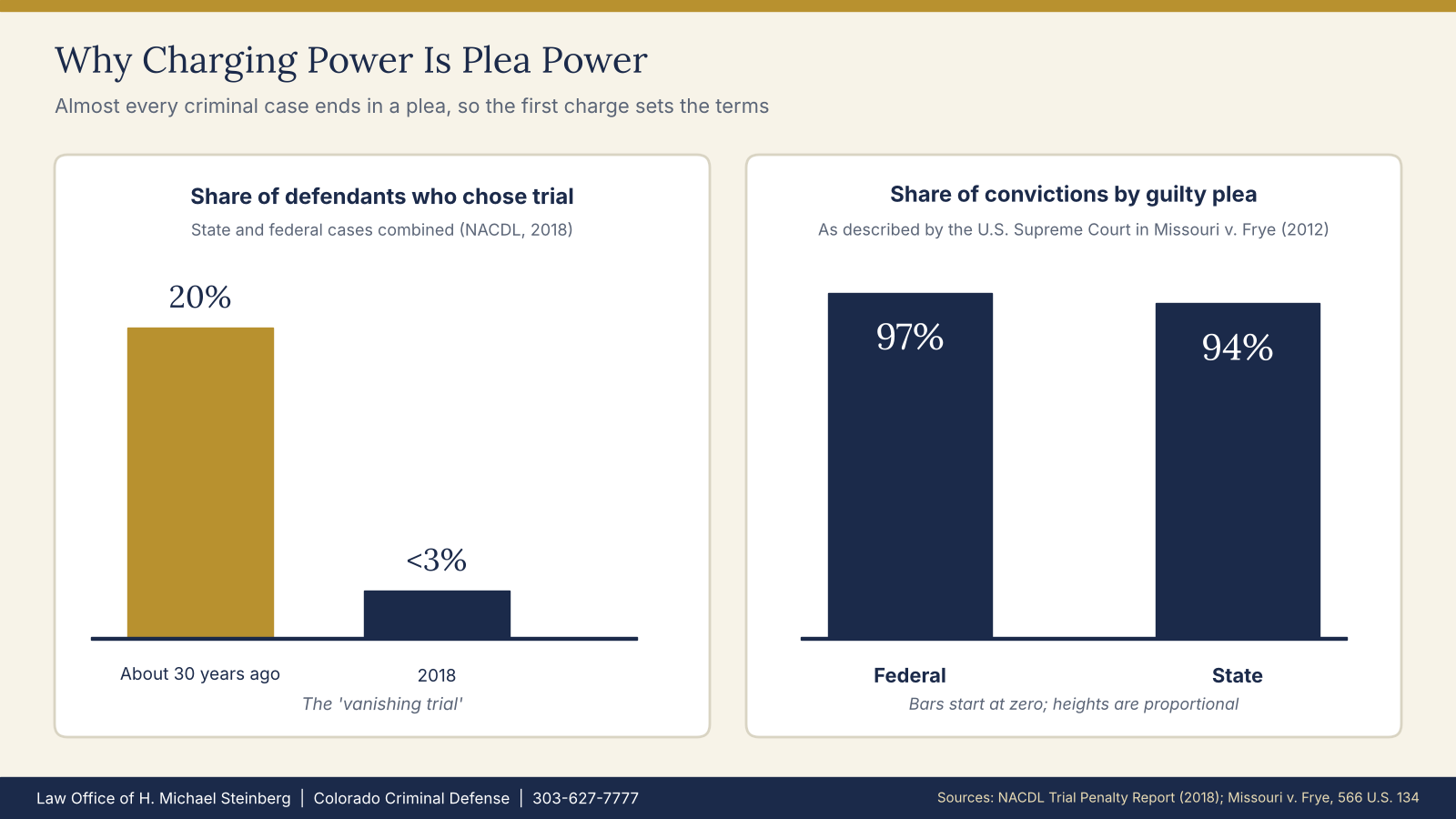
- It works because nearly every conviction comes from a plea. The U.S. Supreme Court has said roughly94 percent of state convictionsresult from guilty pleas.
- The Constitution generally allows a prosecutor to threaten and file charges the evidence supports. See Bordenkircher v. Hayes.
- Colorado limits prosecutors through Rule 3.8 of the Rules of Professional Conduct, the preliminary hearing, discovery duties, and judicial review of pleas.
- The earlier a defense lawyer tests each count, the less leverage the inflated charge carries.
What Is DA Overcharging?
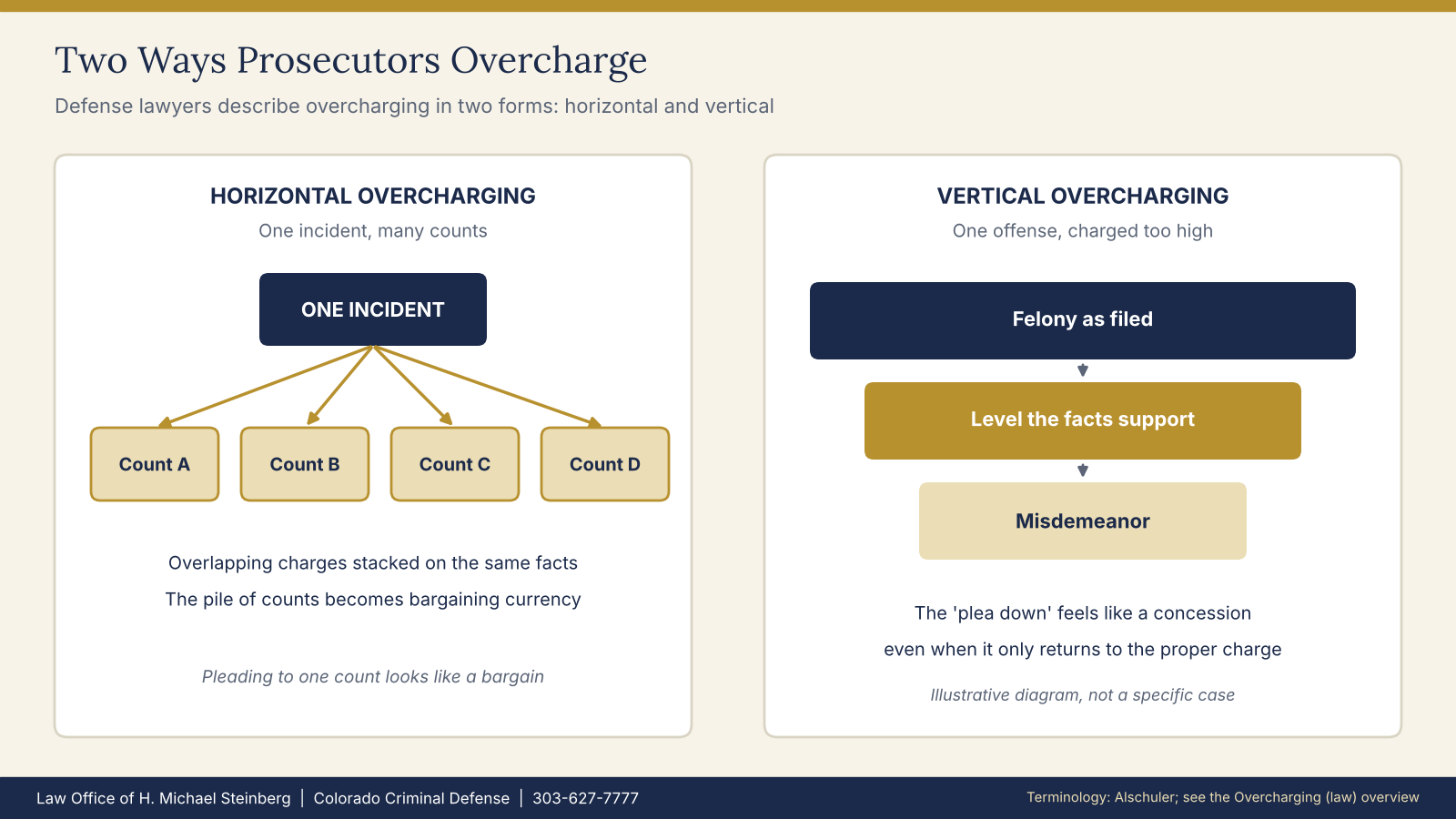
Overcharging describes a prosecutor adding counts the office cannot realistically prove, or charging an offense at a higher level than the facts warrant, to improve its position in plea talks. Defense lawyers usually describe two forms:
- Horizontal overchargingis the multiplication of counts against one defendant, often for one incident.
- Vertical overcharging is charging a single offense at a higher level than the circumstances seem to justify, such as a felony where a misdemeanor fits.
Prosecutors see it differently. Their usual defense is that a charging decision is an exercise of discretion, and that the Colorado District Attorneys’ Council states on its website that prosecutors file charges only after determining there is a reasonable likelihood of conviction at trial.Some commentators also argue that a prosecutor has to start high to reach a plea that still protects public safety.
Whether a given filing is an honest assessment or a bargaining chip is exactly the question a defense lawyer asks. Our firm has written about the practice of prosecutorial discretion and overchargingand about how it plays out in domestic violence filings.
The first charge sets the price of the plea.
Why Overcharging Works: The Plea Bargain Machine
Overcharging only matters because almost no case is tried. InMissouri v. Frye, the U.S. Supreme Court described ours as a system of pleas rather than a system of trials, noting that about 97 percent of federal convictions and 94 percent of state convictions come from guilty pleas.
The National Association of Criminal Defense Lawyers reported in its 2018 Trial Penalty report that defendants chose trial in less than three percent of state and federal cases, compared with about 20 percent three decades earlier. The Pew Research Center found that only two percent of federal defendants went to trial in fiscal 2018.
The NACDL calls the gap between a plea offer and the sentence after a trial loss the “trial penalty.”Overcharging feeds it directly. The bigger the pile of counts at filing, the larger the difference between the offer and the exposure at trial, and the more pressure a defendant feels to accept. Even people who believe they are innocent can find the arithmetic hard to ignore.
Courts and prosecutors also have their own reasons to favor pleas. Crowded calendars and limited resources reward quick resolutions, a dynamic we describe on our plea bargaining page. The Colorado Supreme Court has acknowledged the reality plainly: inPeople v. Darlington it wrote that plea bargaining is “an inescapable part of the judicial process.”
What the Law Allows: Bordenkircher v. Hayes
The leading case isBordenkircher v. Hayes, 434 U.S. 357 (1978). A prosecutor offered to recommend a five-year sentence if the defendant pleaded guilty. The defendant refused, and the prosecutor then obtained an indictment under a habitual-offender statute carrying a life sentence.
By a 5-4 vote, the Supreme Court held that due process was not violated, reasoning that a prosecutor with probable cause may pursue the more serious chargeand that plea bargaining involves a “give-and-take”in which the accused is free to accept or reject the offer.
A later decision, United States v. Goodwin, declined to presume vindictiveness when a prosecutor raised charges before trial after a defendant demanded a jury.
Together, these cases set the constitutional floor:
If the evidence supports the charge, the Constitution rarely stops a prosecutor from filing it, even for leverage. The real fight in most Colorado cases therefore turns on whether the evidence actually supports each count.
AUTHORITY
The federal constitutional baseline
Bordenkircher v. Hayes, 434 U.S. 357 (1978), and United States v. Goodwin, 457 U.S. 368 (1982). Pretrial charge escalation supported by probable cause is generally not treated as unconstitutional vindictiveness. Colorado courts and ethics rules can, and do, impose additional limits.
The Ethical Limits on Colorado Prosecutors
Colorado prosecutors are bound byColo. RPC 3.8,which describes their special responsibilities. Three provisions matter most for overcharging.
- Rule 3.8(a) forbids prosecuting a charge the prosecutor knows is not supported by probable cause.
- Rule 3.8(d) requires timely disclosure of information that tends to negate guilt, mitigate the offense, or would affect a defendant’s decision about whether to accept a plea. The Colorado Supreme Court amended this paragraph in 2022, effective July 1, 2022, to add the plea-decision language, and the rule bars conditioning plea negotiations on the postponement of disclosure of information that negates guilt.
- Rule 3.8(c) bars prosecutors from seeking a waiver of important pretrial rights, such as the preliminary hearing, from an unrepresented accused.
The comments to the rule add that knowing disregard of these obligations, or a systematic abuse of prosecutorial discretion, could violate Rule 8.4. Enforcement is another matter. A violation of the rule is a matter for attorney discipline, and the comments say a finding that paragraph (d) was violated should not by itself be the basis for relief in the criminal case. Rule 3.8 is therefore a floor on conduct, not a remedy for an inflated complaint.
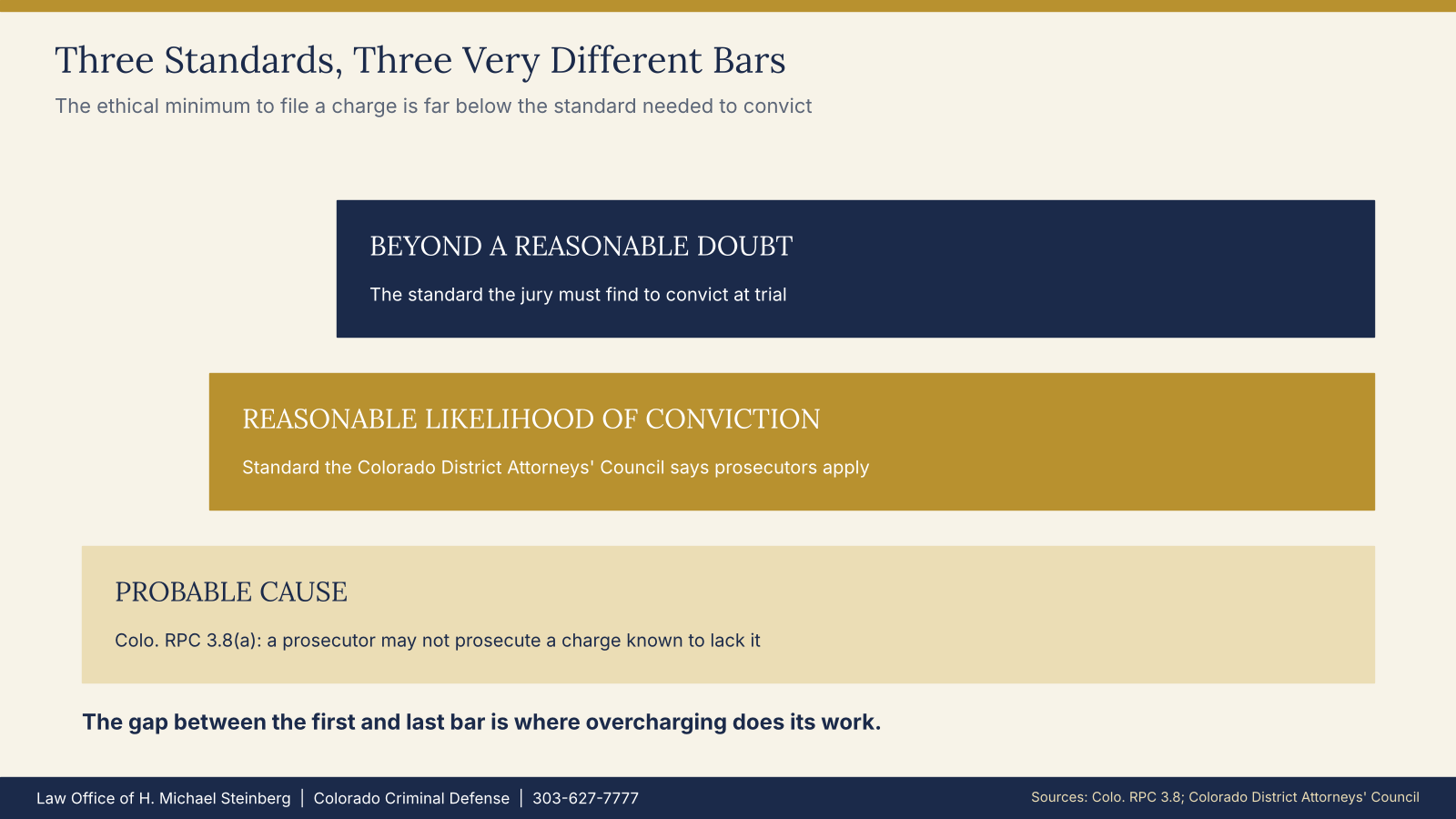
The standards graphic above shows the problem.
Probable cause is the minimum needed to file. The District Attorneys’ Council describes a higher internal test: a reasonable likelihood of conviction.
The jury must still find guilt beyond a reasonable doubt. The space between those standards is where counts that look serious on paper can fall apart under scrutiny. The American Bar Association’s Criminal Justice Standards for the Prosecution Function describe more demanding professional expectations, although they are aspirational rather than binding.
How Colorado Sentencing Statutes Raise the Stakes
In Colorado, which prosecutor a defendant’s attorney chooses to file can change the sentencing range itself, not just the label. Two statutes show how.
Crime-of-violence allegations
UnderC.R.S. § 18-1.3-406, a person convicted of a crime of violence must receive a prison sentence of at least the midpoint of the presumptive range and no more than twice its maximum, as the Colorado Supreme Court described the statute in People v. Austin,2018. The statute also requires charging documents to plead the crime-of-violence allegation as a separate count.
In practice, adding or omitting that count can decide whether a case carries a mandatory prison term.
Habitual criminal allegations
C.R.S. § 18-1.3-801provides sharply enhanced sentences, including life imprisonment in defined circumstances, for people with qualifying prior felony convictions. It is the same type of statute that produced the life sentence in Bordenkircher.
Whether prior convictions qualify, and whether they arose from separate and distinct criminal episodes, are legal questions a defense lawyer should test before any plea is discussed.
STATUTE
Where the leverage lives
C.R.S. § 18-1.3-406(mandatory sentences for violent crimes) and C.R.S. § 18-1.3-801 (habitual criminals). A charging decision that adds either allegation can multiply sentencing exposure, thereby widening the gap between a plea offer and a trial loss.
The Preliminary Hearing: A Checkpoint
One of the few built-in checks on a felony filing is the preliminary hearing, where a judge decides whether probable cause supports the charges. UnderC.R.S. § 16-5-301, a person accused of a class 1, 2, or 3 felony, or a level 1 or level 2 drug felony, has the right to demand one. Someone accused of a class 4, 5, or 6 felony, or a level 3 or 4 drug felony, may demand one if in custody on that offense.
InPeople v. Subjack, 2021 CO 10, the Colorado Supreme Court held that a defendant who cannot post bond on a class 4 felony is considered in custody for that purpose.
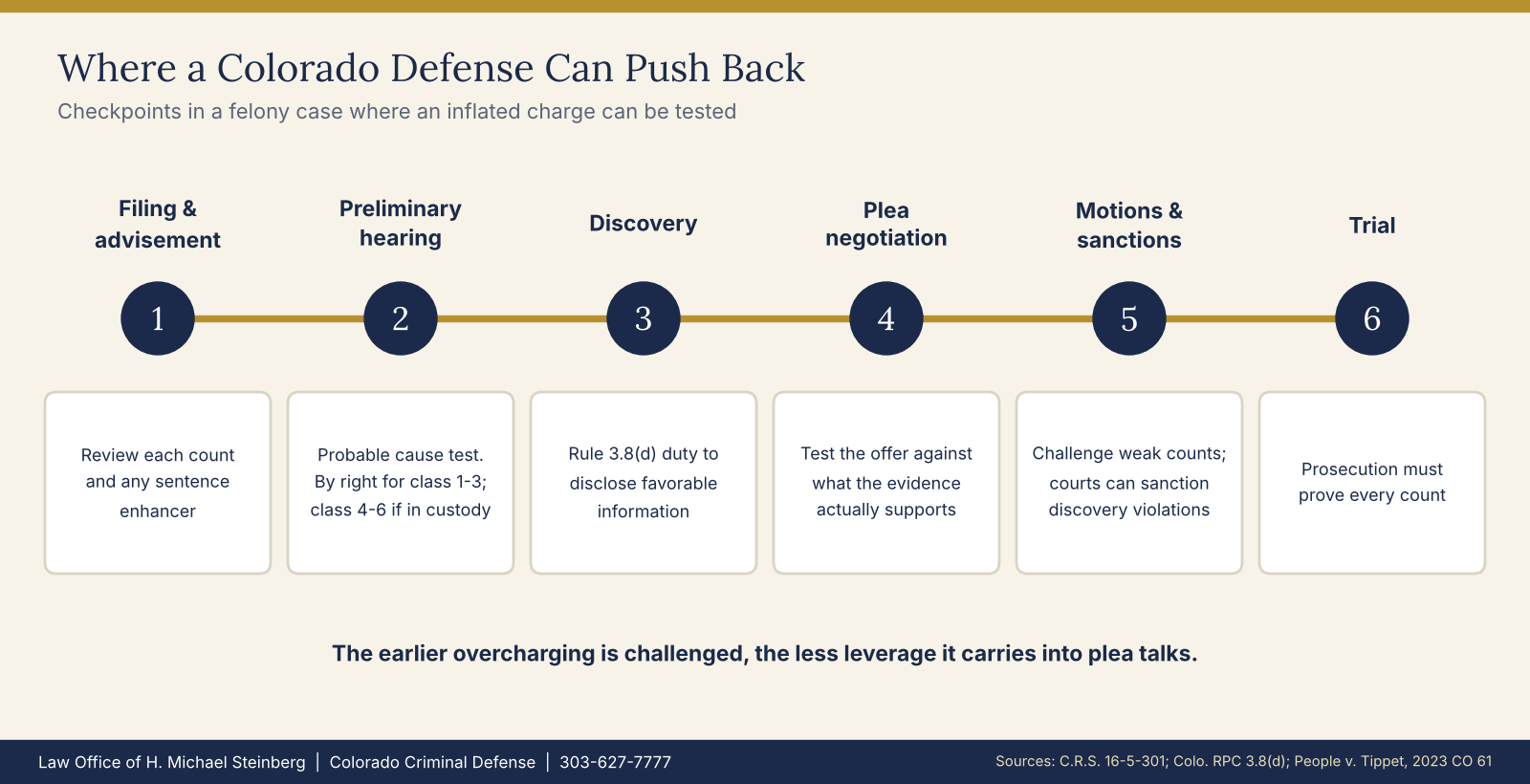
The hearing matters in overcharging cases because it forces the prosecution to place evidence on the record and allows the defense to test witnesses early. It also matters because the right can be lost. People who waive it, particularly without a lawyer, give up an early opportunity to challenge counts that may not hold up. That risk is the reason Rule 3.8(c) restricts prosecutors from seeking waivers from unrepresented defendants.
When Judges Step In: Tippet and Darlington
Courts rarely second-guess charging decisions, but there are limits. InPeople v. Tippet, 2023 CO 61,a 4-3 Colorado Supreme Court upheld a trial judge who reduced a first-degree murder charge to second-degree as a deterrent sanction after a district attorney’s office showed a pattern of late and incomplete discovery.
The Court called that sanction disfavored and reserved for rare cases, and prosecutors argued it infringed on the executive branch’s charging power, asColorado Politics reported. Tippet was a discovery case, not an overcharging case. It still shows two things: charges can be tested in court, and discovery is the tool that makes testing possible.
Judges also review plea agreements themselves. UnderC.R.S. § 16-7-302and Darlington, a trial court must independently decide whether to grant the charge and sentence concessions in a plea and may reject a plea only for sound reasons stated on the record. That oversight happens late, after the offer has already shaped the defendant’s choices, which is why early defense action matters.
Who Is Hurt Most
Overcharging does its greatest damage where the accused has the least power to push back. People without lawyers may not know a count is weak, that a sentence enhancer is optional, or that a first offer can improve.
We have written that unrepresented defendants in domestic violence cases are frequently persuaded to plead guilty by prosecutors who stack charges, such as adding a felony or a child-related count to a misdemeanor filing, then offer to reduce it.
The human cost reaches well beyond sentencing. A plea means a conviction record that can affect employment, housing, professional licenses, firearm rights, and family court. NACDL’s report identified the prevalence of innocent people pleading guilty to avoid a harsher sentence as one of its key findings.
That is the worst version of what overcharging can produce.
A hypothetical to illustrate the pattern
A heated argument outside a bar ends in a shoving match and a minor injury. The complaint lists a felony assault count, a menacing count, and a crime-of-violence allegation. The evidence is largely one witness whose account has changed.
The offer: plead to one misdemeanor and everything else disappears. Is that a favor, or the original charge returning to where it belonged? A count-by-count review is the only way to find out. This example is illustrative and does not describe any real case.
These dynamics show up across the practice areas we handle, including assault,domestic violence, drug crimes, sex crimes, DUI, andtheft cases.
How a Defense Lawyer Fights Overcharging
There is no single motion that cures an inflated complaint. Effective defense is a sequence of steps that gradually shrink the leverage the original filing created.
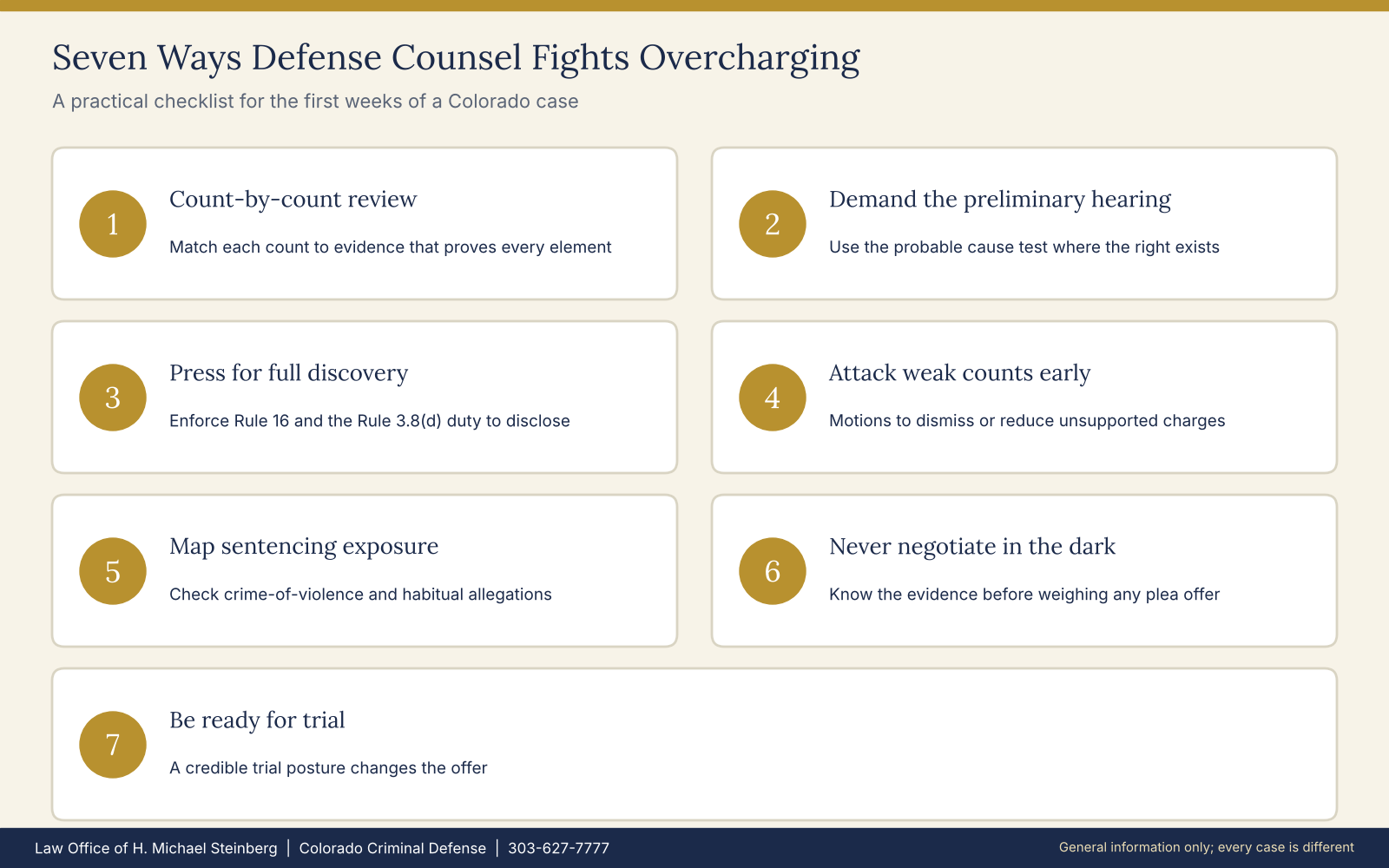
- Count-by-count review. Match each count to the evidence that proves every element. Counts that cannot be matched become targets.
- Demand the preliminary hearing where the right exists, and do not waive it without a strategic reason.
- Press for full discovery. Enforce Crim. P. 16 and the Rule 3.8(d) duty to disclose information that negates guilt, mitigates the offense, or affects the plea decision.
- Attack weak counts early through motions to dismiss or reduce charges that the evidence does not support.
- Map the sentencing exposure.Check whether crime-of-violence or habitual allegations are properly pleaded and legally sound.
- Never negotiate in the dark. Evaluate any offer against what the evidence supports, not against the worst-case complaint. Statements in plea talks have their own rules; see our article onColorado Rule 410 and plea negotiations.
- Prepare for trial.A credible willingness to try the case changes the offer.
Experience on both sides of the courtroom helps. H. Michael Steinberg spent 13 years as a career prosecutor in Arapahoe and Douglas counties before founding his own criminal defense practice, and has handled cases across the Front Range for more than four decades. Knowing how charging decisions are made, and how they are reconsidered, informs how we approach each file.
If You Have Been Charged in Colorado
- Do not discuss the casewith police, witnesses, or on social media. Statements can be used to support additional counts.
- Do not plead at the first appearancewithout understanding the evidence. Early offers are made before the defense has seen discovery.
- Do not waive a preliminary hearing or other rights without legal advice.
- Keep every documentfrom the arrest and the court, including the complaint or information, bond paperwork, and any plea offer.
- Talk to a Colorado criminal defense lawyer immediately.The window for early challenges to inflated charges is short.
Frequently Asked Questions About DA Overcharging in Colorado
Is overcharging illegal in Colorado?
Not by itself. A prosecutor may not pursue a charge the prosecutor knows lacks probable cause under Colo. RPC 3.8(a), and the Supreme Court’s decision in Bordenkircher v. Hayesallows charges supported by probable cause even when used as leverage. Charges the evidence cannot support are the target of defense motions, preliminary hearings, and negotiation.
What is the difference between overcharging and stacking charges?
Stacking is usually another term for horizontal overcharging, meaning multiple counts for a single incident. Vertical overcharging is a single offense charged at a higher level than the facts justify. Both can raise plea pressure.
Can a Colorado judge dismiss charges because of overcharging?
Courts are generally reluctant to dismiss charges that probable cause supports. Judges can dismiss or reduce counts the evidence does not support, and in rare circumstances can impose sanctions for discovery violations, as in People v. Tippet. The most reliable early tool is usually the preliminary hearing where it is available.
Should I accept the first plea offer?
Not before your lawyer has reviewed the evidence. Colorado’s Rule 3.8(d) now requires disclosure of information that would affect a plea decision, but your defense team still needs time to evaluate each count and the sentencing exposure.
How do I know whether I am overcharged?
Compare each count with the facts in the police report and the evidence produced in discovery. A defense lawyer can analyze whether every element of every count is supported and whether any sentence enhancer is legally sound. Our firm offers a free consultation.
Three relevant Colorado Criminal Lawyer Blog articles are linked naturally to this topic:
-
Understanding the Power of a Colorado District Attorney to Bring Charges and to Prosecute a Case.colorado-criminal-lawyer-online
-
Understanding How Colorado’s Prosecutors Make the Decision to File Charges in Felony Criminal Cases.colorado-criminal-lawyer-online
Facing Colorado criminal charges?
Call the Law Office of H. Michael Steinberg for a free consultation: main line 303-627-7777 or cell 720-220-2277. You can also contact the firm online, review case results, or explore the firm’s practice areas and Colorado Criminal Lawyer Blog.
Sources and Authorities
- Colo. RPC 3.8, Special Responsibilities of a Prosecutor
- Bordenkircher v. Hayes, 434 U.S. 357 (1978)
- United States v. Goodwin, 457 U.S. 368 (1982)
- Missouri v. Frye, 566 U.S. 134 (2012)
- People v. Tippet, 2023 CO 61 (Colo. 2023)
- People v. Darlington, No. 04SA186 (Colo. Jan. 24, 2005)
- People v. Subjack, 2021 CO 10
- People v. Austin, 2018 CO 47
- C.R.S. § 18-1.3-406, Mandatory sentences for violent crimes
- C.R.S. § 18-1.3-801, Punishment for habitual criminals
- C.R.S. § 16-5-301, Preliminary hearing or waiver
- C.R.S. § 16-7-302, Plea discussions and agreements
- NACDL, The Trial Penalty (2018)
- Pew Research Center, federal criminal defendants and trials (2019)
- Colorado District Attorneys’ Council, Prosecutors
- ABA Criminal Justice Standards, Prosecution Function
- Colorado Politics, coverage of People v. Tippet (Dec. 11, 2023)
- Overcharging (law), overview of horizontal and vertical overcharging
- Colorado Judicial Branch, annual statistical reports
- Our FAQ on prosecutorial discretion and overcharging
- Why police and prosecutors overcharge in Colorado domestic violence cases
- Colorado Rule 410 and plea negotiations
This article is for general informational purposes only and is not legal advice. Reading it does not create an attorney-client relationship. Colorado law, court rules, and statutes change, and every case turns on its own facts. Consult a licensed Colorado criminal defense attorney about your situation. Prior results do not guarantee a similar outcome.