 Colorado Criminal Lawyer Blog
A Missed Court Date Can Put Your Freedom at Risk


Missing a court date in Arapahoe county and other Colorado counties is one of the most common mistakes people make after an arrest, and one of the most avoidable. Sometimes it is a forgotten date, a changed address, a hospital stay, or a ride that never showed up. Sometimes it is fear. Whatever the reason, the court does not start by asking why. It starts by asking where you are.
I have practiced criminal defense in Colorado for more than forty years, including thirteen years as a career prosecutor in Arapahoe and Douglas counties before I opened my own firm in 1999. I have handled hundreds of arraignments and bail arguments from both sides of the courtroom. This guide explains what happens when someone misses court or breaks a bond condition in Colorado, what it can cost, and what to do about it.
Quick Answer
If you miss a court date in Colorado, the judge will usually issue a bench warrant for your arrest, and if you posted a cash, property or similar monetary bond, the court shall declare it forfeited.
Knowingly skipping court on a felony case with the intent to avoid prosecution is also a separate crime: a class 6 felony under C.R.S. 18-8-212(1). Breaking other bond conditions can lead to a higher bond, tighter conditions, revocation of release, or new charges under C.R.S. 16-4-109 and C.R.S. 16-4-105.
The sooner a defense lawyer addresses the problem, the more options you generally have.
What Counts as Missing Court
A “failure to appear,” often shortened to FTA, happens when you are required to be in court for an arraignment, a motions hearing, a pretrial conference, a trial, or sentencing, and you are not there and the court has not excused you. Colorado’s bond statute treats appearing in court as the “primary condition of the bond.” Every other condition sits underneath it. (See C.R.S. 16-4-111(3).)
Colorado courts run a text message reminder program under C.R.S. 13-3-101(14). Defendants in criminal (CR), misdemeanor (M) and traffic (T) cases are automatically enrolled and receive texts about upcoming court dates, missed court dates and unplanned closures. But a reminder is a courtesy, not a guarantee. The court’s own opt-in form says defendants do not have a right to receive reminders, so a text that never arrived is not a safe excuse.
One caution: scammers also send fake court texts. In May 2026 the Colorado Judicial Branch warned of fraudulent messages claiming recipients must appear in a generic “District Court of the State of Colorado.” If you are unsure whether you have a real court date, check your case on the Colorado Judicial Branch website or call the clerk of the court directly. Do not click a link or pay anyone who texts you.
The First Consequence: A Bench Warrant
When a defendant does not appear, the judge will usually issue a bench warrant. In county court cases begun by summons, C.R.S. 16-2-110 says that a bench warrant may issue for the arrest of a person who fails to appear in person or through counsel. A bench warrant is an order from the judge, not a police investigation, and it does not need new evidence of a crime.
Once the warrant is active, any officer who runs your name can arrest you. That can happen at a traffic stop, at an airport, at a workplace, or at your front door. You are then held until a judge can address your bond, which often means a night or a weekend in jail even if the original charge was minor.
At the next hearing the judge decides whether to keep your bond in place, raise it, add conditions, or revoke your release. That decision is driven by why you missed court and how quickly you came back.
What Happens to Your Bond Money
A missed appearance does not only affect you. If you posted cash or put up property, or if a family member did, that money is now at risk. Under C.R.S. 16-4-111(3), when a defendant released on a cash or property bond, or on an unsecured bond with a monetary condition, fails to appear, the court shall declare a forfeiture. The statute then sets a clock:
- The court mails notice of the forfeiture to the defendant, the sureties, and any depositors or assignees who have direct contact with the court, within fourteen days.
- If you do not appear and surrender within thirty-five days of the forfeiture, the court may enter judgment against you for the amount of the bond plus court costs.
- Cash deposited with the clerk is applied first to costs and then to the judgment.
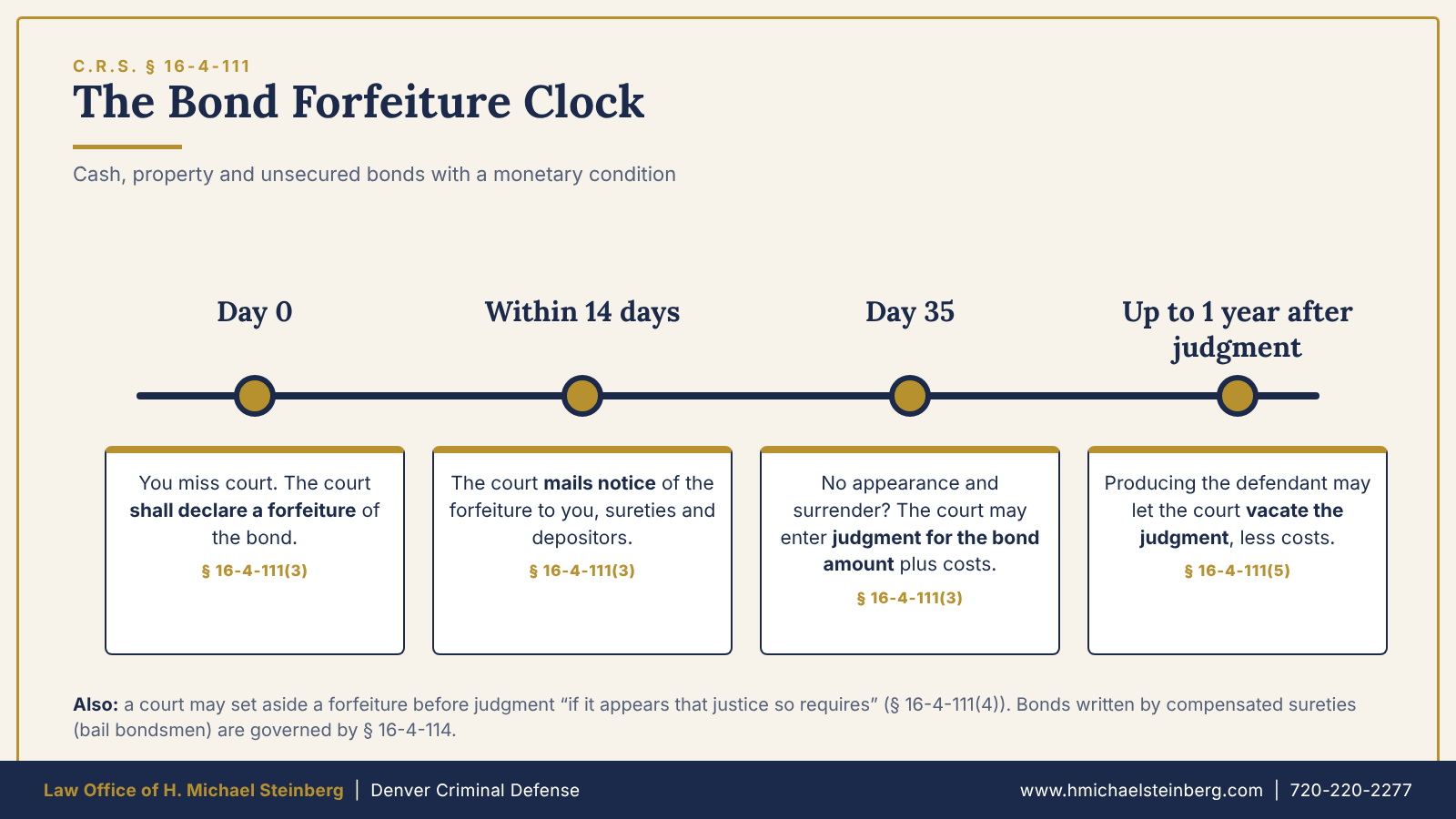
The forfeiture timeline for cash, property and unsecured monetary bonds.
The forfeiture is not always final. A court may order a forfeiture set aside, on whatever conditions it imposes, if justice so requires (C.R.S. 16-4-111(4)). The Colorado Supreme Court has described the standard as essentially an appeal to the court’s conscience, with no single factor controlling in every case. (Owens v. People, 194 Colo. 389, 572 P.2d 837 (1977).)
Colorado appellate decisions have looked at whether the defendant was produced within a reasonable time, whether the People lost any rights, whether the failure to appear was willful, and whether forfeiture would cause extreme hardship. (People v. Schliesser, 39 Colo. App. 54, 563 P.2d 377, rev’d on other grounds sub nom. Owens.) A defendant’s hospitalization after a car accident has been recognized as a valid excuse. (People v. Smith, 673 P.2d 1026 (Colo. App. 1983).)
If the defendant is apprehended or surrenders within one year after judgment, the court may vacate the judgment and order a remission less necessary and actual costs. (C.R.S. 16-4-111(5).)
If You Used a Bail Bondsman
Bonds written by compensated sureties, meaning bail bonding agents and bail insurance companies, follow a different enforcement procedure under C.R.S. 16-4-114. A surety can also be exonerated by surrendering the defendant to custody before judgment is entered, as provided in C.R.S. 16-4-110. Separate from the court, your bond contract with the bondsman may make you responsible for fees and recovery costs, so read it closely.
Failure to Appear Can Be a Separate Crime
Colorado makes failure to appear its own offense in C.R.S. 18-8-212, titled “Violation of bail bond conditions.” For offenses on or after March 1, 2022, the statute has two main parts:
- Subsection (1), class 6 felony. A person who is charged with any felony and released on bond commits a class 6 felony by knowingly failing to appear in that felony case with the intent to avoid prosecution.
- Subsection (2), class 2 misdemeanor. A person who is released on bond and charged with a felony or misdemeanor arising from the conduct for which the person was arrested commits a class 2 misdemeanor by intentionally failing to appear for proceedings at which victims or witnesses have appeared in court.
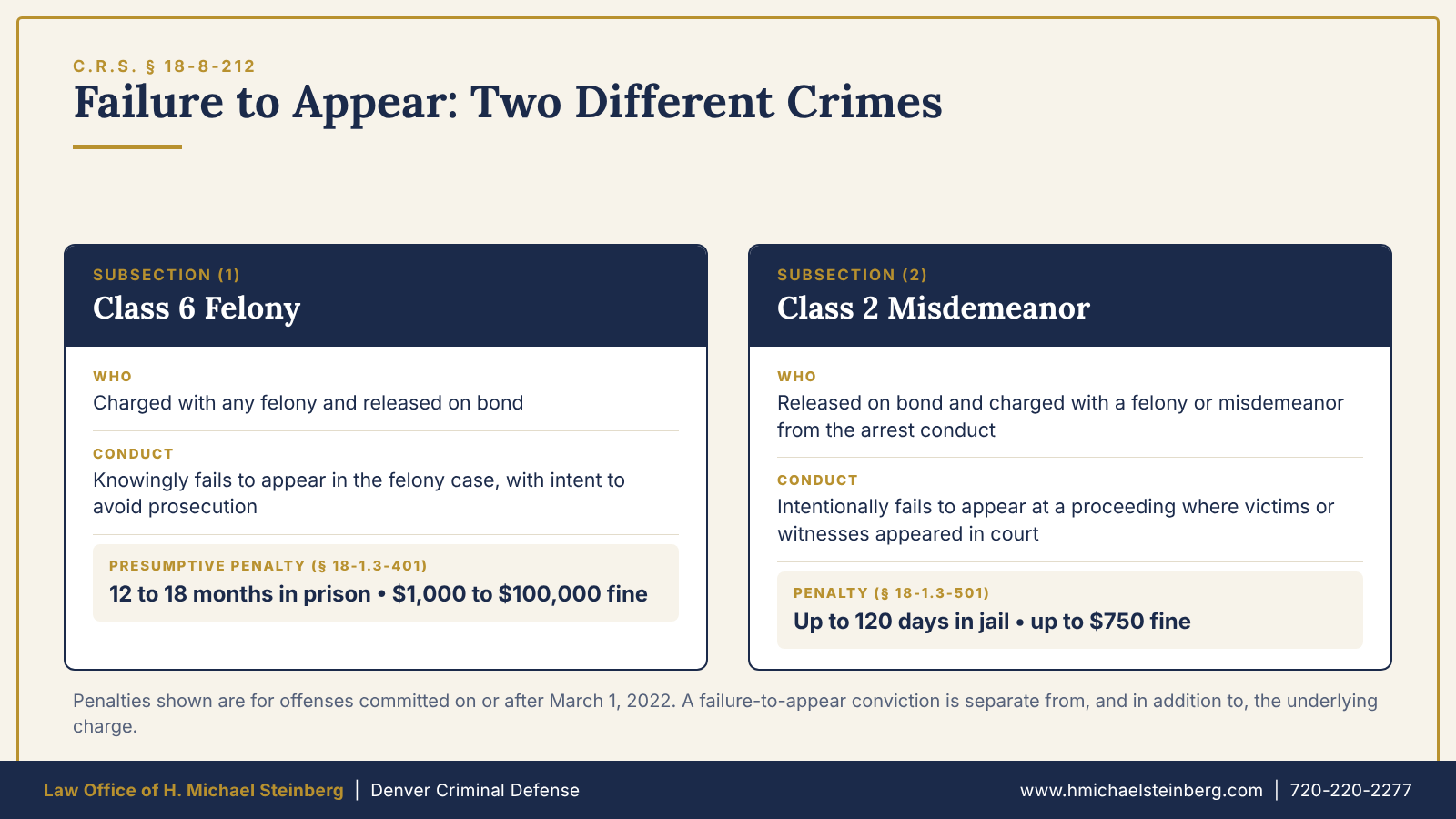
A class 6 felony carries a presumptive prison range of one year to eighteen months, followed by a mandatory one-year parole period, and a fine of $1,000 to $100,000 under C.R.S. 18-1.3-401. A class 2 misdemeanor committed on or after March 1, 2022 carries up to 120 days in jail and a fine of up to $750 under C.R.S. 18-1.3-501. These penalties are in addition to whatever happens in the case you were on bond for.
Two additional rules raise the stakes:
- Mandatory minimums. Subsection (3) sets minimum sentences of one year for a subsection (1) violation and six months for a subsection (2) violation in certain victim- and witness-related situations, such as a protection order violation under C.R.S. 18-6-803.5, and requires the sentence to run consecutively to any incarceration sentence on the underlying case.
- Sex offense bonds. Under subsection (3.5), a person on bond for a sex offense who is convicted of a bond violation under the section is not eligible for probation or a suspended sentence, must serve at least one year, and must serve that sentence consecutively to the sentence on the underlying case.
Authority Note: The 2022 Amendment
Senate Bill 21-271 amended subsections (1) and (2) of C.R.S. 18-8-212 effective March 1, 2022. Earlier versions of the statute also made it a class 6 felony to knowingly violate the conditions of a felony bond, not only to fail to appear. If your case involves conduct before March 1, 2022, a different version of the statute may apply. See the statute history and annotations.
What the Prosecution Has to Prove
These are knowledge and intent offenses. Forgetting a date, being confused about a time, or being unable to get to court is not the same as deliberately avoiding prosecution. The prosecution must also prove that the terms of the bond were actually in effect at the time of the alleged conduct. (People v. Luna, 2013 COA 67, 410 P.3d 471.) On the other side of the ledger, evidence that a defendant intended to flee the jurisdiction and attempted to do so can support an inference of a knowing failure to appear. (People v. Williamson, 839 P.2d 519 (Colo. App. 1992).) That is why the reason you missed court, and the proof of it, matters so much.
Violating Other Bond Conditions
Showing up is only the first condition. Under C.R.S. 16-4-105, every bond carries the condition that you not commit a felony while free on bail, and the court can add other conditions designed to assure your appearance and protect any person or the community, including supervision by a pretrial services program. In practice that can mean no-contact orders, check-ins, travel limits or monitoring. Domestic violence cases add mandatory protection orders, and violating one is its own crime under C.R.S. 18-6-803.5.
When someone alleges a violation, the process usually moves in steps:
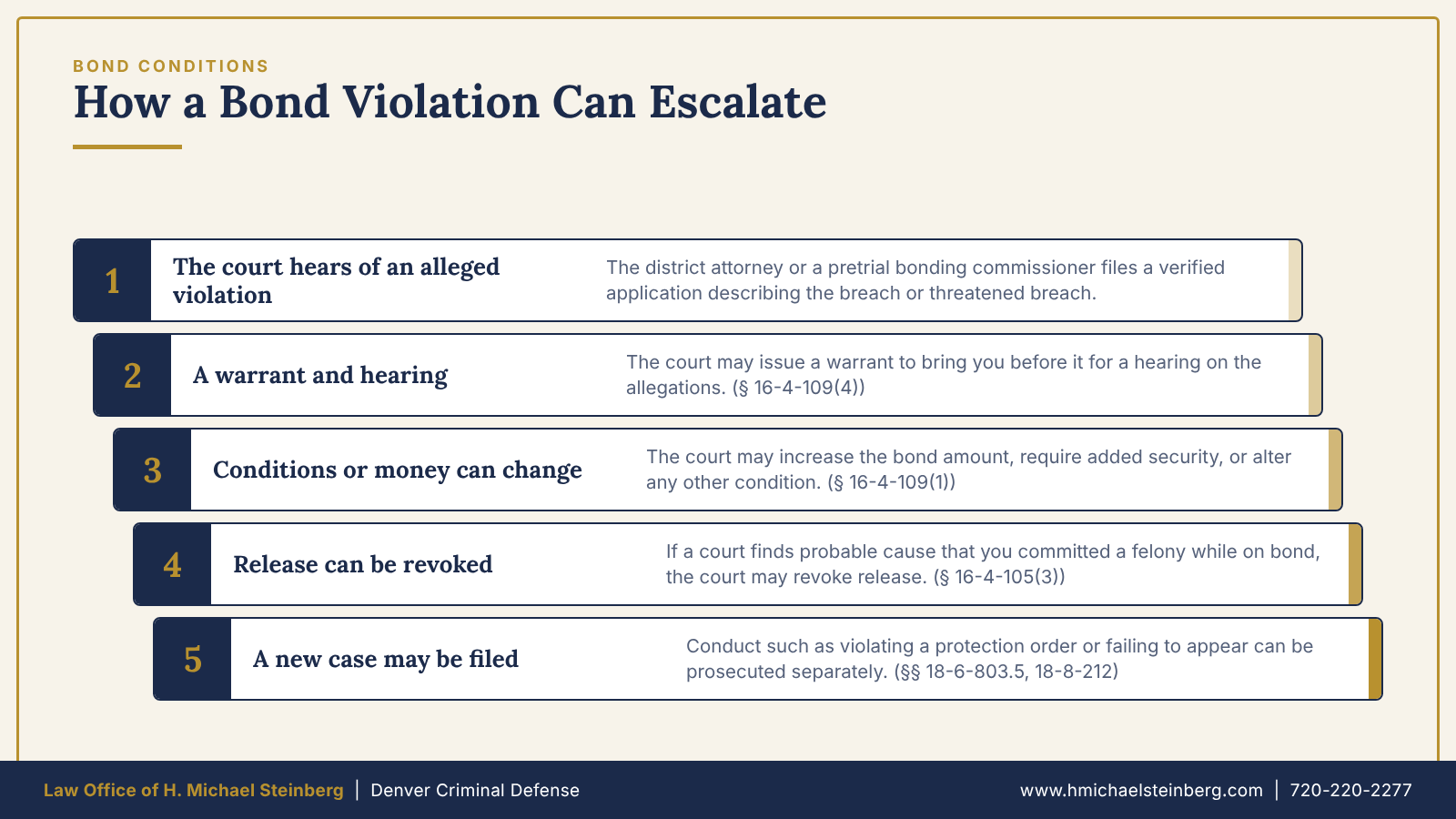
- A verified application. The district attorney or a pretrial bonding commissioner can file a verified application stating facts that show a breach or threatened breach of a bond condition. The court may then issue a warrant to bring you in for a hearing. (C.R.S. 16-4-109(4).)
- Modification. After the hearing the court can increase or decrease the financial conditions, require additional security, or alter any other condition of the bond. (C.R.S. 16-4-109(1).)
- Revocation for a new felony. If a competent court finds probable cause that you committed a felony while on bond, the court can revoke your release or change the bond conditions, including the amount. (C.R.S. 16-4-105(3).)
- New charges. Some violations are prosecuted separately, such as violating a protection order or failing to appear.
A Real Example: Leaving the State
In People v. Donald, 2020 CO 24, a man released on a felony bond signed a one-page bond form that prohibited him from leaving Colorado without court approval. He later missed court and was found in Mississippi. A jury convicted him of violating the bond condition, and the Colorado Supreme Court upheld that conviction, finding the evidence sufficient to show he knew about the out-of-state travel condition. The case was decided under the version of the statute that applied before March 1, 2022, but the practical lesson is current: read every condition before you sign, and ask the court before you travel.
Can the Court Set an Impossible Bond?
Judges have wide discretion after a violation, but not unlimited discretion. In People v. Rodriguez-Nunez, 2026 COA 48, decided June 4, 2026, the Court of Appeals held that a trial court erred by setting a cash bond whose amount was so high that it functioned as a denial of bond. That case involved a murder indictment rather than a missed court date, and the court also held that monetary bonds are not subject to an unattainability requirement, so bond amount arguments remain highly fact-specific. A rehearing petition was denied in July 2026, and anyone relying on the case should confirm its current status.
Defenses and Mitigation
Missing court does not have to end in the worst outcome. The strongest responses usually depend on facts that can be documented:
- No notice or wrong information. The date was changed, the notice went to an old address, or the court gave inconsistent information.
- No intent to avoid prosecution. A hospital stay, a medical emergency, a serious family crisis, or custody in another jurisdiction. Colorado cases have recognized hospitalization and imprisonment elsewhere as grounds that can excuse nonappearance (Allison v. People, 132 Colo. 156, 286 P.2d 1102 (1955)).
- Bond terms not in effect. The prosecution cannot convict under C.R.S. 18-8-212 without proving the bond terms applied at the time.
- A prompt, voluntary return. Judges generally look more favorably on a defendant who comes back on his or her own than on one who is arrested after months away.
The first days after a missed court date often decide whether a judge sees an emergency or an explainable mistake.
What to Do If You Missed Court
If you think you may have missed a court date, take these steps in order:
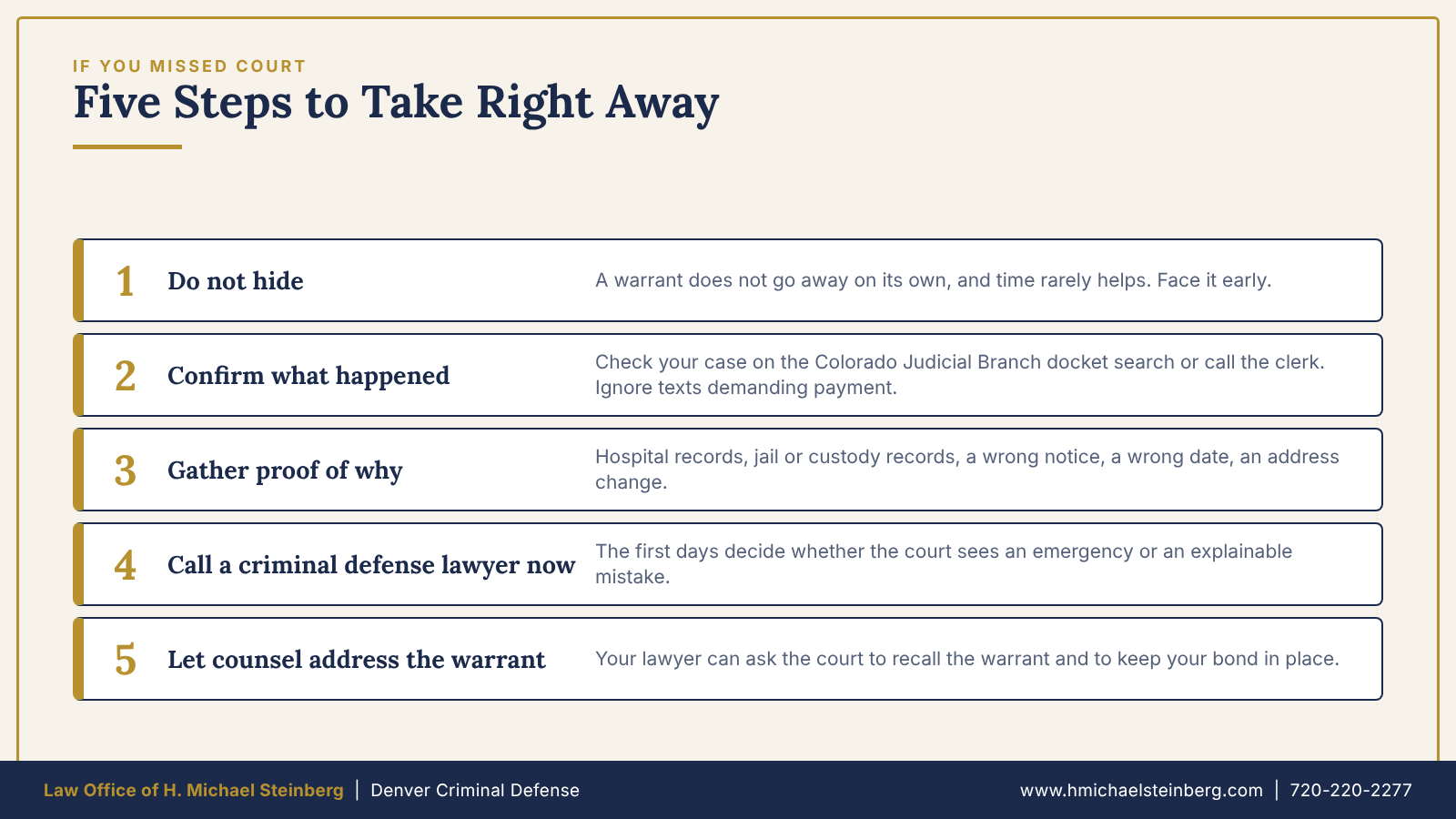
- Do not hide from the problem. A bench warrant does not expire on its own.
- Confirm what happened. Check your case through the Colorado Judicial Branch or call the clerk. Do not rely on a text message to tell you what you owe.
- Gather proof of why you missed court. Hospital records, custody or jail records, the notice you received, and anything showing a change of address or date.
- Call a criminal defense lawyer immediately. A lawyer can contact the court and the prosecutor and plan how you return.
- Let your lawyer address the warrant and the bond. That usually means asking the court to recall the warrant and to keep your bond in place, with the record of why you were absent.
Do not discuss the details with anyone who is not your lawyer, and do not leave the state or the country. Doing so can turn a missed date into evidence of intent to avoid prosecution.
Missed Court and Bond Violations at a Glance
| Situation | What can happen | Key authority |
|---|---|---|
| Missed hearing on a cash, property or unsecured monetary bond | Bench warrant; forfeiture declared; notice within 14 days; judgment possible after 35 days | C.R.S. 16-4-111 |
| Knowing failure to appear in a felony case with intent to avoid prosecution | Possible new class 6 felony charge | C.R.S. 18-8-212(1) |
| Intentional failure to appear where victims or witnesses appeared | Possible class 2 misdemeanor charge | C.R.S. 18-8-212(2) |
| Alleged violation of a bond condition | Verified application, warrant, hearing; bond or conditions can be modified | C.R.S. 16-4-109 |
| New felony while on bond | Court can revoke release or change conditions after a probable cause finding | C.R.S. 16-4-105(3) |
| Bond written by a bail bondsman | Enforcement against the surety; surrender before judgment can exonerate it | C.R.S. 16-4-114, 16-4-110 |
Frequently Asked Questions
Will I go to jail for missing one court date?
Not automatically, but you can be arrested on a bench warrant and held until a judge addresses your bond. The real risk is delay: the longer a warrant stays open, the more likely it is to be served at a traffic stop or another contact with police, and the harder it becomes to show that the missed date was an honest mistake.
Can I be charged with a crime for simply forgetting my court date?
The felony offense in C.R.S. 18-8-212(1) requires that you knowingly failed to appear with the intent to avoid prosecution, and the misdemeanor in subsection (2) requires an intentional failure to appear. An honest mistake is a defense to those charges. Even so, the court can still issue a bench warrant and move to forfeit your bond, so the mistake still has to be explained and documented quickly.
Do I lose my bond money if I miss court?
You can. For cash, property and unsecured monetary bonds, the court shall declare a forfeiture when you fail to appear, and it may enter judgment for the bond amount if you do not appear and surrender within 35 days. A court can set aside a forfeiture if justice requires, and returning the defendant can help. For a bond written by a bail bondsman, the bonding company is pursued under a separate enforcement procedure.
Does a bench warrant go away on its own?
No. A bench warrant stays in place until the court recalls it or you are taken into custody. Ignoring it does not make it expire, and it can surface years later during a routine encounter with law enforcement.
Can I get a bond again after I violated my bond conditions?
Often yes, but usually with a higher amount, added security, or stricter conditions. Colorado recognizes a strong right to bail, and the Court of Appeals held in 2026 that a judge cannot set a cash bond so high that it functions as a denial of bond. Whether you are released again turns on the facts of the violation and the charge.
What if I missed court because I was in the hospital or in custody somewhere else?
Colorado courts have treated hospitalization and custody in another jurisdiction as reasons that can excuse a nonappearance in bond forfeiture cases. Gather the records right away and have your lawyer present them to the court, ideally before the forfeiture timeline runs out.
Missed Court or Facing a Bond Violation in Colorado?
A bench warrant does not wait. If you or someone you love missed a court date or may have violated a bond condition, call the Law Office of H. Michael Steinberg for a free consultation.
Main office: 303-627-7777 | Contact us online | Attorney profile
Please do not include confidential or sensitive information in a contact form, text message or voicemail.
Related Colorado Criminal Defense Resources
- The Colorado Criminal Case: From Investigation Through Trial
- How Colorado Police Decide Who to Arrest in a Domestic Violence Case
- What Does a Prosecutor Look for Before Filing Criminal Charges?
- DA Overcharging in Colorado: How Prosecutors “Stack” Charges
- Colorado Rule 410 and Plea Negotiations
- More articles in Criminal Process
Missed court dates and bond problems come up in every kind of case. Learn how the firm handles domestic violence, DUI and DWAI, drug crimes, sex crimes and theft cases, browse all practice areas, review representative case results, or read client reviews. You can also learn more about attorney H. Michael Steinberg and visit the Colorado Criminal Lawyer Blog.
Sources and Authority
- C.R.S. 18-8-212, Violation of bail bond conditions
- C.R.S. 16-4-105, Conditions of release on bond
- C.R.S. 16-4-109, Reduction or increase of monetary conditions of bond; change in conditions
- C.R.S. 16-4-110, Exoneration from bond liability
- C.R.S. 16-4-111, Disposition of security deposits upon forfeiture or termination of bond
- C.R.S. 16-4-114, Enforcement procedures for compensated sureties
- C.R.S. 16-2-110, Failure to appear (county court summons)
- C.R.S. 18-1.3-401, Felonies classified and presumptive penalties
- C.R.S. 18-1.3-501, Misdemeanors classified and penalties
- C.R.S. 18-6-803.5, Crime of violation of a protection order
- C.R.S. 18-1-1001, Protection orders
- C.R.S. 13-3-101(14), Court reminder program
- People v. Donald, 2020 CO 24 (Colo. 2020)
- People v. Rodriguez-Nunez, 2026 COA 48 (Colo. App. June 4, 2026)
- Owens v. People, 194 Colo. 389, 572 P.2d 837 (1977), People v. Smith, People v. Schliesser, and Allison v. People (annotations to C.R.S. 16-4-111)
- People v. Luna, 2013 COA 67, and People v. Williamson (annotations to C.R.S. 18-8-212)
- Colorado Judicial Branch: Court Text Reminder Program notice (JDF 18)
- Colorado Judicial Branch: Court reminder program opt-in/opt-out form
- Colorado Judicial Branch: warning about fraudulent court appearance text messages (May 19, 2026)
This article is for general information only and is not legal advice. Reading it does not create an attorney-client relationship. Every case turns on its own facts. Contact a licensed Colorado attorney about your situation. Attorney advertising.