 Colorado Criminal Lawyer Blog
Colorado Rule 410 and Plea Negotiations: What You Say in Plea Talks


By H. Michael Steinberg, A Colorado Criminal Defense Lawyer – Practicing Colorado Criminal Law in the courts of Colorado for over 40 years. · Published October 7, 2026
Introduction
Almost every criminal case in Colorado ends the same way: not with a verdict, but with a negotiated resolution. Before that can happen, someone has to talk about the facts, the weaknesses in the evidence, the person behind the charge, and what a fair outcome might look like.
That conversation raises one question every accused person asks sooner or later: if the talks fall apart, can the prosecutor use my own words against me at trial?
I spent thirteen years as a career prosecutor in Arapahoe and Douglas counties before opening my own defense practice, and I have been on the other side of the table for more than two decades since. I have sat in plea negotiations as the lawyer who makes the offer and as the lawyer who answers it.
This article explains the Colorado rules that govern what is said in those rooms, how Colorado courts have applied them, and the practical steps I take to keep my clients’ words from being turned against them.
Key Takeaways
- Colorado Rule of Evidence 410 generally bars use against you of a withdrawn guilty plea, a no-contest plea, an offer to plead, and statements made “in any connection with” them.
- Crim. P. 11(f)(6) and C.R.S. § 16-7-303 separately bar evidence that plea discussions took place or that a plea agreement was made.
- Colorado appellate courts read the protection to reach actual plea negotiations with prosecutors, not casual conversations with police.
- The protection can be waived. A short form or proffer letter can change everything, so read every word.
- A plea that is accepted and never withdrawn is not protected, and a narrow impeachment and perjury exception applies to in-court statements.
- The trial judge may not participate in plea discussions.
- Have your lawyer do the talking. Do not negotiate on your own.
In This Article
- The short answer
- What Colorado Rule 410 actually says
- Three layers of protection
- Is what I said protected? A decision chart
- How Colorado courts apply the rule: People v. Garcia
- Where the protection ends
- Colorado versus federal Rule 410
- Why the judge stays out of the room
- A practical playbook for plea talks
- Frequently asked questions
- Why this matters in your type of case
- Authorities and sources
The Short Answer
If you and your lawyer are negotiating with a prosecutor, and the talks do not produce a plea that stands, what you said in those negotiations generally cannot be used against you as evidence of guilt. That is the heart of Colorado Rule of Evidence 410. It exists so defendants can be honest enough for a real negotiation to happen.
The qualifications matter just as much as the rule. The protection attaches to plea negotiations, not to everything a person says after an arrest. It can be contracted away. It does not cover a plea that stands. And Colorado’s version has a narrow exception for certain in-court statements. Each of those points is covered below.
What Colorado Rule 410 Actually Says
Here is the operative language of Colorado Rule of Evidence 410, as published by State Rules (check the current official text before relying on it in a filing):
“Except as otherwise provided by statutes of the State of Colorado, evidence of a plea of guilty, later withdrawn, or a plea of nolo contendere, or of an offer to plead guilty or nolo contendere to the crime charged or any other crime, or of statements made in any connection with any of the foregoing pleas or offers, is not admissible in any civil or criminal action, case, or proceeding against the person who made the plea or offer.
This rule shall not apply to the introduction of voluntary and reliable statements made in court on the record in connection with any of the foregoing pleas or offers where offered for impeachment purposes or in a subsequent prosecution of the declarant for perjury or false statement.”
Reading the Rule 410 – phrase by phrase:
- “A plea of guilty, later withdrawn.” If you plead guilty and the court permits you to take it back, the prosecution cannot show the jury that you once pleaded guilty.
- “A plea of nolo contendere.” A no-contest plea is likewise not admissible against you in other proceedings.
- “An offer to plead guilty … to the crime charged or any other crime.” The offer itself is protected, and the words “any other crime” mean negotiations can reach beyond the charged offense.
- “Statements made in any connection with” the pleas or offers. This is the phrase that protects what you actually say during negotiations.
- “Against the person who made the plea or offer.” The shield runs in your favor, and it applies in civil as well as criminal cases.
Three Layers of Protection
Rule 410 is not the only source of protection. Colorado also addresses plea discussions in its procedural rules and in the criminal code. Together they form three overlapping layers:
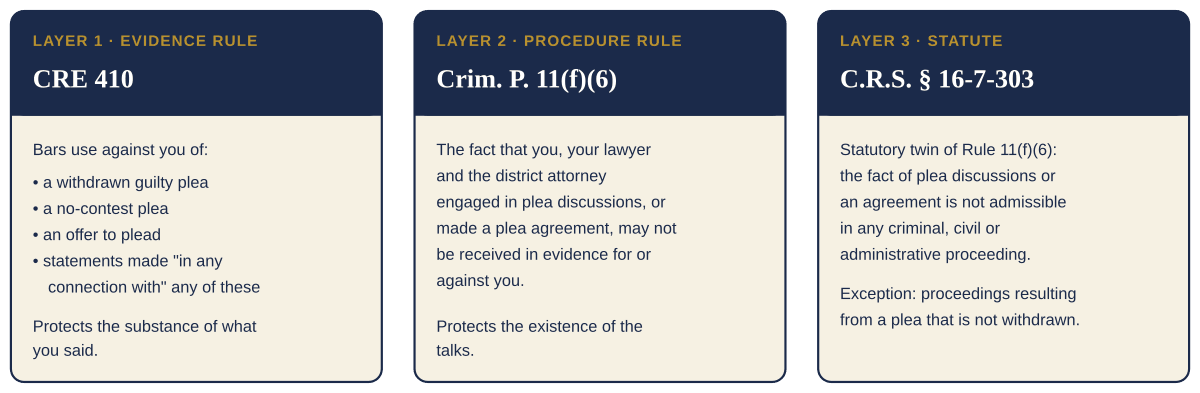
Why does the fact of negotiations get its own protection? Because a jury that hears “the defendant tried to make a deal” may draw exactly the inference the rule is meant to prevent.
The statute keeps the negotiation itself out of the trial.
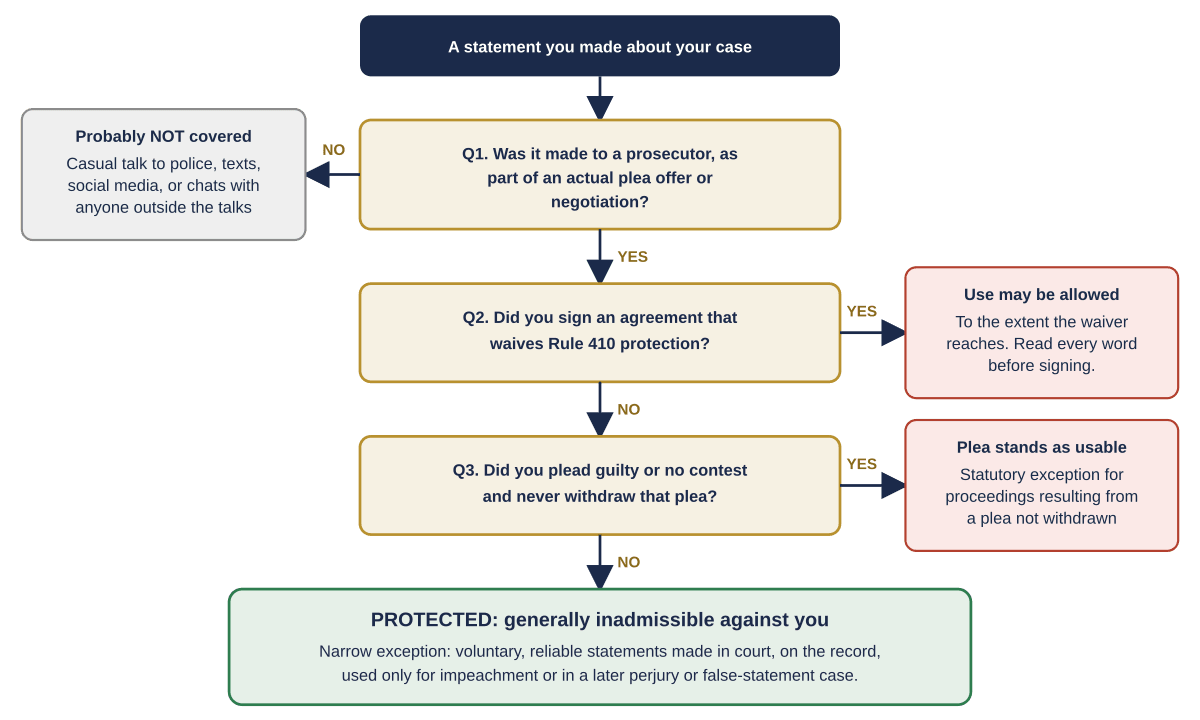
Is What I Said Protected? A Decision Chart
Whether a particular statement is protected depends on the setting in which it was made. The chart below walks through the questions I ask first when a client or a family member tells me, “I said something during plea talks.”
How Colorado Courts Apply the Rule: People v. Garcia
The best Colorado illustration I know of is People v. Garcia, No. 04CA2240 (Colo. App. May 3, 2007). The facts are instructive because the plea “negotiation” did not look like a traditional meeting at all.
Authority
People v. Garcia, No. 04CA2240 (Colo. App. May 3, 2007)— Division III held that CRE 410 barred the prosecution’s use, as substantive evidence of guilt, of statements the defendant made during a polygraph the prosecutor had proposed as part of resolving the case. The conviction for sexual assault on a physically helpless victim was reversed and remanded for a new trial.
What happened in the Garcia Case?
After the defendant’s arrest, the prosecutor asked defense counsel whether the defendant would take a polygraph “to help resolve the case.” After consulting with his lawyer, the defendant agreed. At the prosecutor’s office, he signed a general polygraph advisement stating that anything he said to the examiner could be used against him in court. He made admissions during the exam, no plea agreement followed, and the case went to trial, where the examiner testified to those admissions.
What the court held in the Garcia Case
The Colorado Court of Appeals concluded the polygraph was part of the plea negotiations even though no formal offer hinged on the result. The prosecutor himself had described the plan as seeing what happened with the polygraph and then discussing “what type of plea may or may not be made.”
Citing earlier Colorado decisions, the court said the phrase “statements made in any connection with” a plea or offer covers actual offers and statements made during plea negotiations with prosecutors. Because the statements were made in that setting, the rule discussed here, CRE 410, barred their admission at trial.
The court relied on the Colorado Supreme Court’s reasoning in Gelfand v. People, 196 Colo. 487, 586 P.2d 1331 (1978), where a defendant’s statements to a probation officer, required as a precondition to being considered for deferred sentencing, could not be used as substantive proof of guilt. As Gelfand put it, a defendant should not be penalized for cooperating with the prosecution by taking part in an approved plea negotiation process.
The waiver the court refused to enforce
The People argued the signed polygraph form waived any objection. The court disagreed. Because the prosecutor had impliedly promised that the polygraph statements would be treated as part of plea negotiations, and the defendant had relied on that promise to his detriment, due process required enforcing the promise.
The form did not mention CRE 410 at all. The court granted specific performance of the promise and held the error was not harmless, noting that credibility was central and that the statements were used to highlight inconsistencies.
Where the Protection Ends
Rule 410 is powerful, but it is not a perfect “blanket.” These are the limits I see most often in practice.
1. The impeachment and perjury exception
Colorado’s rule allows “voluntary and reliable statements made in court on the record in connection with” a plea or offer when offered for impeachment or in a later prosecution for perjury or false statement. This exception is narrower than its federal counterpart because it reaches only statements made in court and on the record. Informal statements in a conference room do not fall within it.
2. Waiver
In United States v. Mezzanatto, 513 U.S. 196 (1995), the U.S. Supreme Court held that a defendant may agree to waive the federal plea-statement protections, so that statements made in plea discussions can be used to impeach him if he later testifies inconsistently.
That Court rejected a blanket rule against such waivers and said courts should ask case by case whether the waiver was the product of fraud or coercion. In Mezzanatto,the defendant had conferred with his lawyer before agreeing.
Prosecutors in many jurisdictions now ask for waivers as a condition of discussing a case, particularly when a defendant is asked to “proffer”what he or she knows. Whether a waiver is enforceable, how far it reaches, and whether it covers use in the prosecution’s case-in-chief or only impeachment are questions that turn on the exact language.
Never sign one without counsel.
3. Conversations that are not plea negotiations
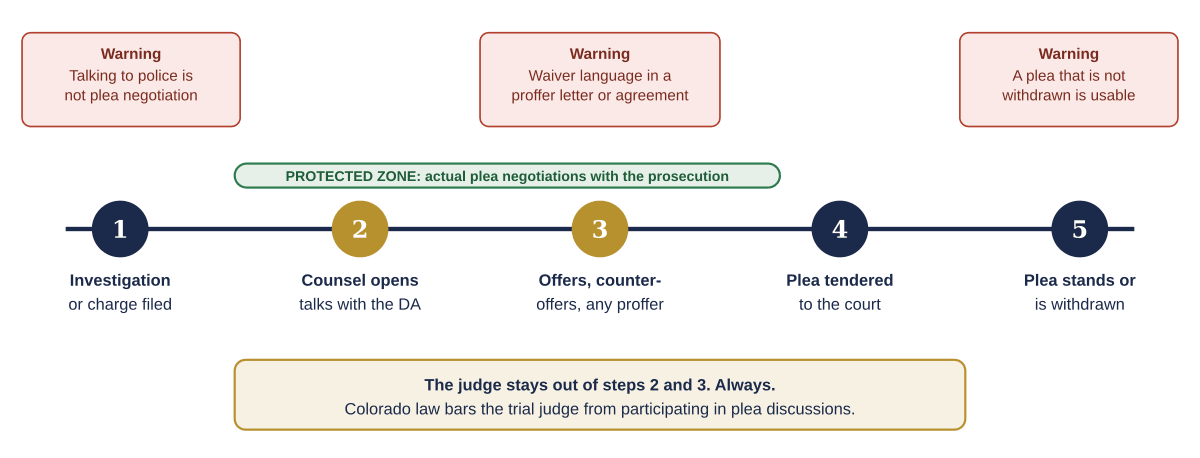
Colorado courts have tied the protection to actual plea offers and negotiations with prosecutors. A defendant who tries to talk his way out of trouble in a police interview, in a text message, or in a conversation with a friend is not in plea negotiations, and Rule 410 is not what protects him. The right to remain silent and the right to counsel are. For more on that, see my article “No Miranda Warning? Here Is What Actually Happens in Colorado”.
The flip side is just as important. AsGarcia andGelfandshow, when the prosecution itself requires an interview, evaluation, or test as a step in the negotiation, the statements made in that step can be part of the negotiation.
4. A plea that is accepted and never withdrawn
Rule 410 protects a guilty plea that is later withdrawn. If the plea is accepted and stands, it becomes the basis for the judgment, and the statutory exception in § 16-7-303for proceedings resulting from a plea that is not withdrawn applies. That is why the decision to plead should never be made in haste.
5. What the rule does not promise
Rule 410 governs what a court may admit as evidence. It is not a promise that investigators will ignore what they learn. Whether information from plea discussions can be used to develop other evidence is governed by the terms of any agreement you sign, which is another reason to have counsel negotiate those terms in writing.
Colorado’s Rule 410 Versus Federal Rule 410
Colorado’s rule is modeled on an earlier version of the federal rule, and the two now differ in important ways. If you have read about Federal Rule of Evidence 410or Federal Rule of Criminal Procedure 11, do not assume Colorado works identically.
| Issue | Colorado (CRE 410) | Federal (FRE 410) |
|---|---|---|
| What is covered | Withdrawn guilty plea, no-contest plea, an offer to plead, and statements made “in any connection with” them | Withdrawn guilty plea, no-contest plea, statements in a Rule 11 plea proceeding, and statements in plea discussions with a prosecuting attorney that did not end in a plea or ended in a withdrawn plea |
| Who you must be talking to | Text does not say. Colorado courts have read it to reach plea negotiations with prosecutors (People v. Garcia) | The text refers to an attorney for the prosecuting authority |
| “Fairness” exception | No counterpart in the rule’s text | Allows another statement from the same discussions if fairness requires considering them together |
| Perjury or impeachment exception | Voluntary and reliable statements made in court, on the record, for impeachment or a later perjury or false-statement prosecution | Perjury or false-statement prosecution if the statement was made under oath, on the record, with counsel present |
| Waiver | Enforceable waivers are a matter for case law; Garcia refused to enforce a generic waiver in light of a prosecutor’s implied promise | Waivable if knowing and voluntary (Mezzanatto) |
These differences matter in cases that involve both state and federal exposure, and when you read national articles on “Rule 410.” Federal commentary does not always carry over.
Why the Judge Stays Out of the Room
A protection that depends on candor would mean little if the person who will later sentence you were part of the discussion. Colorado law is clear that the trial judge may not take part.Crim. P. 11(f)(4)states that the trial judge shall not participate in plea discussions, and C.R.S. § 16-7-302 repeats the rule.
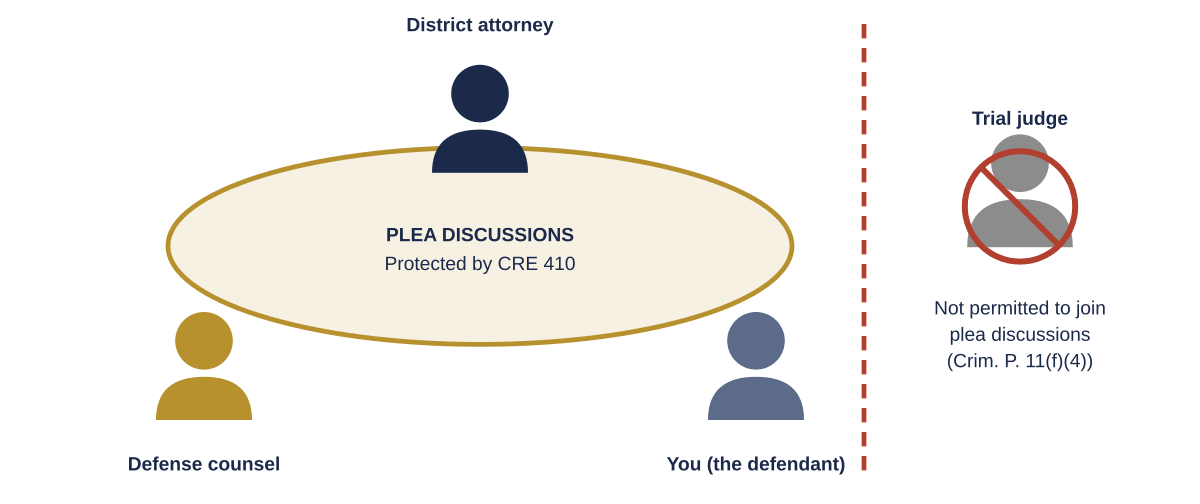
The statute does allow a limited role once a tentative agreement exists. On the parties’ request, the judge may hear the tentative agreement and the reasons for it before the plea is tendered and indicate whether he or she will concur, and the judge must still exercise independent judgment on any charge or sentence concessions.
If the judge concurs but later decides the final disposition should not include the contemplated concessions, the judge must say so and give the defendant the chance to affirm or withdraw the plea.
What happens when a judge crosses the line? In Crumb v. People, 230 P.3d 726 (Colo. 2010), the Colorado Supreme Court held that a trial judge’s comments, which pressed the defendant to take a deal and suggested the judge would be unhappy if there were no plea, amounted to participation in plea negotiations. The Court concluded the defendant had a fair and just reason to withdraw his guilty pleas and that the trial court abused its discretion by refusing.
Separately, the right to effective assistance of counsel applies during plea negotiations. In Carmichael v. People, No. 07SC478 (Colo. Apr. 13, 2009), the Colorado Supreme Court addressed a claim that a lawyer’s ineffective advice during plea bargaining led the defendant to reject an offer he otherwise would have accepted. The U.S. Supreme Court’s earlier decision inSantobello v. New Yorklikewise recognized that promises made during plea bargaining must be honored.
A Practical Playbook for Plea Talks
Rules on paper are only half the story. Here is how I try to protect clients who are in, or heading toward, plea negotiations.
- Let your lawyer do the talking. C.R.S. § 16-7-301 and Crim. P. 11(f)(1) say the district attorney should engage in plea discussions with a defendant only through or in the presence of defense counsel, with narrow exceptions such as an unrepresented defendant who is not eligible for appointed counsel or who refuses appointment.
- Do not “explain yourself” to investigators hoping for a deal. Statements to police are not plea negotiations. See What Should You Do in Colorado If You Learn You Are Under Criminal Investigation? and The Ten Biggest Mistakes People Make After Learning They Are Under Criminal Investigation.
- Make sure the discussions are clearly plea negotiations. The lesson of Garcia is that the setting and the prosecutor’s own words decide the question. I prefer to confirm in writing that a meeting, interview, or test is part of plea negotiations governed by CRE 410.
- Read every waiver. Ask who may use the statements, for what purposes (impeachment, rebuttal, case-in-chief), and whether leads derived from them may be pursued. If a waiver is required, negotiate its scope.
- Treat a proffer as a serious step. A proffer is a limited, written arrangement for a defendant to share information, and its terms vary. I do not allow a client to participate in one without a full review of the document.
- Do not contact the alleged victim or witnesses. Statements outside the negotiation are not protected, and a protection order may already be in place. See Colorado Mandatory Protection Orders and What Happens If You Violate a Colorado Criminal Protection Order?.
- Keep the judge out of it. If a judge begins to discuss the deal or the consequences of rejecting it, your lawyer should raise the issue promptly.
- Decide with open eyes before you plead. A plea that stands is not protected by Rule 410, and withdrawing a plea requires a fair and just reason. For a broader look at the process, see What Happens After an Arrest in Colorado?
 Frequently Asked Questions
Can a prosecutor use what I said in plea negotiations against me at trial?
Generally not. Colorado Rule of Evidence 410 makes statements made in any connection with a plea offer inadmissible against the person who made them, and Colorado courts have enforced that protection for statements made in actual plea negotiations with prosecutors. The protection has limits, including a narrow impeachment and perjury exception, valid waivers, and a plea that is accepted and never withdrawn.
Does Rule 410 protect what I tell a detective?
Usually not. Colorado appellate courts have described the rule as reaching actual plea offers and statements made during plea negotiations with prosecutors. A conversation with a detective who is trying to build a case is a different thing, and Miranda and the Fifth Amendment, not Rule 410, are the main protections there.
What if I sign a form saying my statements can be used?
A written waiver can matter a great deal. The United States Supreme Court has held that federal plea-statement protections can be waived, as long as the waiver is knowing and voluntary. A Colorado court refused to enforce a generic form where a prosecutor had effectively promised the statements would be covered by Rule 410, but you should never count on that result. Have your lawyer review every word before you sign.
Can the jury be told that we were negotiating a plea?
No. Crim. P. 11(f)(6) and C.R.S. § 16-7-303 provide that the fact that a defendant or defense counsel and the district attorney engaged in plea discussions or made a plea agreement may not be received in evidence for or against the defendant, except in proceedings resulting from a plea that is not withdrawn.
If I plead guilty and don’t withdraw the plea, is it protected?
No. Rule 410 protects a guilty plea that was later withdrawn. A plea that stands is the basis for the judgment, and the statutory exception for proceedings resulting from a plea that is not withdrawn applies.
Can the judge help the parties reach a deal?
No. Colorado law provides that the trial judge shall not participate in plea discussions. A judge may, on request, hear about a tentative agreement before the plea is tendered and indicate whether he or she will concur, but the judge must exercise independent judgment on charge and sentence concessions.
Should I talk to the prosecutor myself?
Almost never. Colorado law says the district attorney should engage in plea discussions with a represented defendant through or in the presence of defense counsel. Your lawyer can shape what is said, make sure the discussions are clearly plea negotiations, and negotiate any waiver language.
Why This Matters in Your Type of Case
Plea negotiation is part of nearly every kind of case I handle. People v. Garcia itself was a sexual assault prosecution, and the way statements are made and used can shape the outcome in sex crimes, domestic violence, and assault cases, where credibility is so often the central issue. It is equally important in drug crimes, theft and DUI/DWAI matters, where a negotiated resolution may involve diversion, a reduced charge or a deferred sentence. You can browse all of my practice areas or read more of my writing on the Plea Bargaining and Colorado Plea Bargaining topics on the Colorado Criminal Lawyer Blog.
Facing Plea Negotiations in Colorado? Talk to a Lawyer First.
What you say, who you say it to, and what you sign can decide whether your words are protected or used against you. I offer a free consultation, and I am available to talk quickly about a fast-moving investigation or charge.
Law Office of H. Michael Steinberg · The Edwards Building, 8400 E Prentice Ave, Penthouse 1500, Greenwood Village, CO 80111
 H. Michael Steinberg
Authorities and Sources
- Colorado Rule of Evidence 410 (text)
- Colorado Rule of Criminal Procedure 11 (Syfert)
- Colorado Rule of Criminal Procedure 11 (Colorado Judicial Branch)
- C.R.S. § 16-7-301, Propriety of plea discussions and plea agreements
- C.R.S. § 16-7-302, Responsibilities of the trial judge
- C.R.S. § 16-7-303, Fact of discussion and agreement not admissible
- People v. Garcia, No. 04CA2240 (Colo. App. May 3, 2007)
- Crumb v. People, 230 P.3d 726 (Colo. 2010), No. 08SC884
- Carmichael v. People, No. 07SC478 (Colo. Apr. 13, 2009)
- United States v. Mezzanatto, 513 U.S. 196 (1995)
- Colorado Courtroom Handbook for Civil Trials (CBA), § 10.16
- Santobello v. New York, 404 U.S. 257 (1971)
- Federal Rule of Evidence 410
- Federal Rule of Criminal Procedure 11
- Colorado Judicial Branch
Disclaimer: This article is general information about Colorado law as of October 7, 2026. It is not legal advice, does not create an attorney-client relationship, and may not reflect later changes in the law. Statutes, rules and case law should be verified against current official sources before you rely on them. Every case turns on its own facts. Please do not include confidential or sensitive information in a contact form, text message or voicemail; the contact form sends information by non-encrypted email.