 Colorado Criminal Lawyer Blog
A Guide to White Collar Defense in Colorado


COLORADO CRIMINAL LAWYER BLOG
A Guide to White Collar Defense in Colorado
Fraud, theft, embezzlement, securities, identity theft and federal exposure: how white collar cases are investigated, charged and defended in Colorado
Law Office of H. Michael Steinberg | Denver Criminal Defense | October 29, 2026
White collar cases rarely begin with handcuffs. They begin with a records request, an auditor’s question, a bank’s suspicious activity report, or a friendly call from an agent who says they just want to “clear a few things up.” By the time a charge is filed in Denver District Court or the United States District Court for the District of Colorado, investigators have often spent months or years assembling the documents, emails and bank statements that tell a story about what you supposedly knew and intended.
This guide explains how white collar defense in Colorado works: the state and federal crimes charged most often, how penalties are measured, who investigates, how long prosecutors have to file, and the defenses that matter most. It is written for business owners, executives, bookkeepers, healthcare providers, investment professionals, and anyone who has just learned they are the subject of an inquiry.
QUICK ANSWERS
- Colorado has no single “white collar crime” statute. The conduct is charged under theft, forgery, identity theft, computer crime, securities, organized crime and other laws.
- Embezzlement is prosecuted as theft, and the value taken sets the charge. The felony line is $2,000.
- A class 3 felony, the level assigned to willful securities fraud, carries a presumptive 4 to 12 years in prison.
- Most Colorado felonies must be filed within three years, but discovery and tolling rules can stretch the clock.
- The same facts can be prosecuted by both Colorado and federal authorities.
- The strongest defense work often happens before charges are filed.
What “White Collar Crime” Means in Colorado
“White collar crime” is a label, not a charge. Prosecutors use it for nonviolent offenses committed for financial gain, usually in a business, professional or financial setting.
Colorado has no one statute with that name. Instead, the same conduct may be charged under several different laws, and the choice of statute changes the penalty range, the proof the prosecution must offer, and the defenses available.
One point surprises many clients. Colorado does not have a separate embezzlement crime for private money. Under C.R.S. § 18-4-403, laws that refer to larceny, stealing, embezzlement (other than embezzlement of public money), false pretenses, confidence games or shoplifting are read as if the word “theft” were substituted. The General Assembly intended to define one crime of theft, and that crime is found in C.R.S. § 18-4-401.
The table below maps the offenses we see most often to their Colorado statutes. Classifications are general; the exact charge in your case depends on the facts alleged and the amounts involved.
| Offense | Colorado statute | Typical classification |
|---|---|---|
| Theft / embezzlement | C.R.S. § 18-4-401 | Petty offense up to class 2 felony, by value |
| Forgery | C.R.S. § 18-5-102 | Class 5 felony |
| Criminal impersonation | C.R.S. § 18-5-113 | Varies with the conduct alleged |
| Identity theft | C.R.S. § 18-5-902 | Class 4 felony (base offense) |
| Possession of identity theft tools | C.R.S. § 18-5-905 | Class 5 felony |
| Computer crime | C.R.S. § 18-5.5-102 | Graded by loss, up to class 2 felony |
| Securities fraud | C.R.S. § 11-51-501 and § 11-51-603 | Class 3 felony (willful violations) |
| Racketeering (COCCA) | C.R.S. § 18-17-104 and § 18-17-105 | Class 2 felony |
| Medicaid provider fraud | C.R.S. § 24-31-802 | Charged under the underlying criminal statutes |
Common Colorado white collar offenses and where to find them in the statutes.
The Most Common White Collar Charges
Theft and Embezzlement
A person commits theft when he or she knowingly obtains, retains or exercises control over something of value belonging to another person without authorization or by threat or deception, with the intent the statute requires. In a business setting, that can mean a bookkeeper accused of diverting payroll, an office manager accused of padding reimbursements, a partner accused of moving funds, or a contractor accused of taking deposits and not finishing work.
Value drives everything. Colorado grades theft on a ladder that runs from a petty offense to a class 2 felony, and the felony line begins at $2,000.
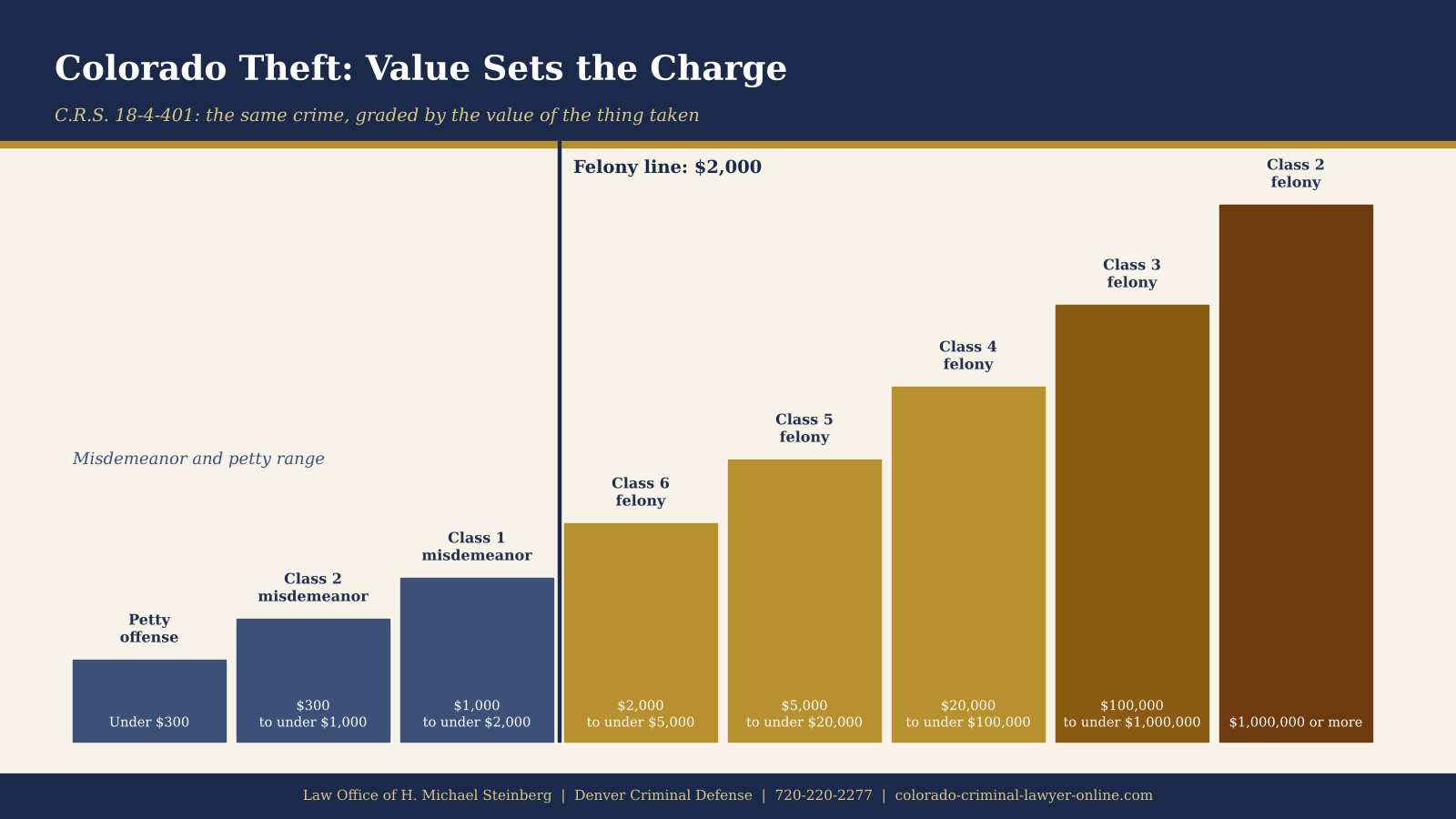
| Value of the thing involved | Classification | General penalty exposure |
|---|---|---|
| Less than $300 | Petty offense | Up to 10 days in jail and/or a $300 fine |
| $300 to less than $1,000 | Class 2 misdemeanor | Up to 120 days in jail and/or a $750 fine |
| $1,000 to less than $2,000 | Class 1 misdemeanor | Up to 364 days in jail and/or a $1,000 fine |
| $2,000 to less than $5,000 | Class 6 felony | 12 to 18 months; $1,000 to $100,000 fine |
| $5,000 to less than $20,000 | Class 5 felony | 1 to 3 years; $1,000 to $100,000 fine |
| $20,000 to less than $100,000 | Class 4 felony | 2 to 6 years; $2,000 to $500,000 fine |
| $100,000 to less than $1,000,000 | Class 3 felony | 4 to 12 years; $3,000 to $750,000 fine |
| $1,000,000 or more | Class 2 felony | 8 to 24 years; $5,000 to $1,000,000 fine |
Theft grading under C.R.S. § 18-4-401 with general penalty ranges from C.R.S. § 18-1.3-401. Ranges are presumptive and can change with aggravating or mitigating circumstances.
Three details deserve attention. First, prosecutors can add up separate thefts: two or more thefts within six months, or against the same person under one scheme or course of conduct, may be charged as a single offense graded by the combined value. That is how a series of small transactions becomes a high-value felony. Second, theft from an at-risk person, which includes people 70 or older and adults with disabilities, can be a class 4 felony regardless of value. Third, because the charge turns on dollars, the way the government calculates “value” is a battleground in its own right.
Forgery, Criminal Impersonation and Related Fraud Offenses
Article 5 of Title 18 contains Colorado’s core fraud offenses. Forgery is a class 5 felony and covers falsely making, altering or completing a written instrument with intent to defraud. Criminal impersonation covers assuming a false identity or capacity and acting in it to obtain a benefit or injure another. These charges often travel alongside theft counts and are also listed among the offenses that can qualify as “racketeering” under the definitions of Colorado’s organized crime act.
Identity Theft
Under C.R.S. § 18-5-902, identity theft is generally a class 4 felony, and possession of identity theft tools under § 18-5-905 is a class 5 felony. The statute has been the subject of important appellate rulings. In January 2025, the Colorado Supreme Court ruled in People v. Rodriguez-Morelos, 2025 CO 2, that “personal identifying information” in the statute refers to single, identified human beings, which led the court to vacate a conviction built on the use of a business’s information (coverage).
A second case is still pending. In People v. Brennan, 2025 COA 68, the Court of Appeals vacated identity theft and unauthorized-use convictions because the defendant’s conduct occurred entirely outside Colorado, even though the cardholder lived here (opinion summary). In May 2026 the Colorado Supreme Court granted review to decide whether an out-of-state defendant’s communication with a Colorado resident can support prosecution in Colorado (news report). The outcome will matter to anyone accused of a financial crime with a cross-border component.
Computer Crime and Cyber-Enabled Fraud
Colorado’s computer crime statute reaches unauthorized access to a computer, network or system, and use of a computer to commit fraud or theft. Like theft, it is graded by the amount of money, property or damage involved. The same conduct can also violate the federal Computer Fraud and Abuse Act, where a first offense can carry up to ten years depending on the subsection charged.
Securities Fraud and Investment Schemes
The Colorado Securities Act makes it unlawful to employ a scheme to defraud, make an untrue statement or omit a material fact, or engage in a course of business that operates as a fraud on any person in connection with securities (C.R.S. § 11-51-501). Willful violations are charged as a class 3 felony under § 11-51-603, which carries a presumptive range of 4 to 12 years. The Colorado provision is modeled closely on federal Rule 10b-5, and commentators note that it likely requires proof of scienter, meaning a culpable state of mind.
Securities cases often begin in the regulatory arena. The Division of Securities describes three enforcement tracks: criminal referral, civil court action and administrative proceedings. According to a legislative fiscal summary, fiscal year 2023-24 enforcement produced 15 administrative or civil referrals and 4 criminal referrals. The Commissioner can also seek injunctions and restitution and investors can pursue civil liability. A regulatory settlement can carry its own penalties: in February 2026, one Golden-based individual and his company stipulated to a ten-year bar from selling securities in Colorado. Appropriate cases are referred to prosecutors, as the Division explains on its enforcement page.
Racketeering Under the Colorado Organized Crime Control Act
Despite its name, the Colorado Organized Crime Control Act (COCCA) is not limited to organized crime. Modeled on the federal RICO statute, it prohibits conducting an enterprise through a pattern of racketeering activity, which requires at least two related acts of racketeering (C.R.S. § 18-17-104). Fraud offenses are among the listed predicates. A COCCA conviction is a class 2 felony with forfeiture consequences (§ 18-17-105), and the statute also creates a civil cause of action for threefold damages. Prosecutors may use COCCA to reach multi-defendant schemes and to raise the stakes in plea negotiations, so the “pattern” and “enterprise” elements are frequent targets for defense challenge.
Medicaid and Health Care Fraud
Colorado’s Medicaid Fraud Control Unit, created under C.R.S. § 24-31-802 and now operating as the Medicaid Fraud, Abuse & Neglect Unit within the Attorney General’s office, investigates and prosecutes provider fraud. It frequently works with federal partners. In June 2026, for example, the Attorney General’s office announced charges against two Jefferson County men in a $12 million Medicaid vision-program investigation. Charges are allegations, and defendants are presumed innocent. Health care cases are document-intensive, turn on billing rules and medical necessity, and often involve both state and federal prosecutors.
In a white collar case, the story prosecutors tell about criminal intent is built from “paper.”
The defense job is to read the same paper and tell the true story.
Federal White Collar Exposure
Many white collar investigations in Colorado are federal from the start. The U.S. Attorney’s Office for the District of Colorado works with the FBI Denver Field Office, IRS Criminal Investigation, the Postal Inspection Service and agency inspectors general. Colorado became one of five states with a designated COVID-19 Fraud Enforcement Strike Force in 2023, and recent sentencing show the office’s focus: a Philadelphia man received 78 months in March 2026 for pandemic-relief fraud and money laundering, and a Castle Rock woman was sentenced to a year and a day and ordered to pay more than $3.1 million in restitution in a romance-scam case.
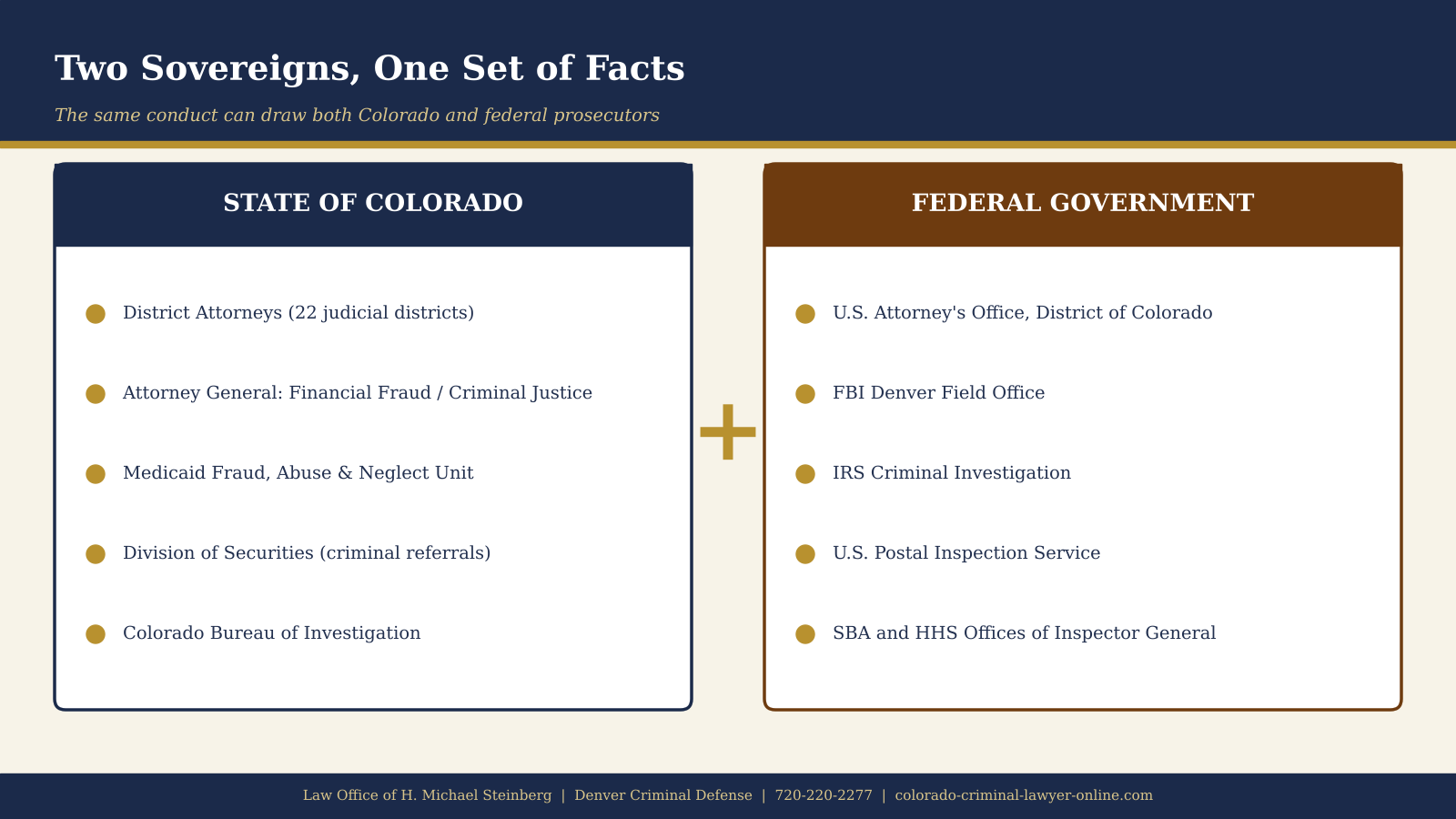
Colorado and federal agencies that investigate and prosecute white collar cases.
The federal statutes below form the backbone of most prosecutions. Figures are statutory maximums, not predicted sentences; actual federal sentences are driven by the Sentencing Guidelines.
| Federal statute | What it covers | Statutory maximum (general) |
|---|---|---|
| 18 U.S.C. § 1343 | Wire fraud: a scheme to defraud using interstate wires, including email and electronic payments | 20 years (30 if a financial institution is affected) |
| 18 U.S.C. § 1341 | Mail fraud: a scheme to defraud using the mail or private carriers | 20 years (30 if a financial institution is affected) |
| 18 U.S.C. § 1344 | Bank fraud: schemes to defraud a financial institution | 30 years |
| 18 U.S.C. § 1347 | Health care fraud | 10 years (more if injury or death results) |
| 18 U.S.C. § 1349 / § 371 | Conspiracy to commit fraud / general conspiracy | Same as the target offense / 5 years |
| 18 U.S.C. §§ 1956, 1957 | Money laundering and monetary transactions in criminal proceeds | 20 years / 10 years |
| 26 U.S.C. § 7201 | Tax evasion | 5 years |
| 15 U.S.C. § 78j(b) | Securities fraud (Exchange Act) | 20 years |
Common federal white collar statutes. Maximums shown are general; subsections and enhancements vary.
The Supreme Court Keeps Reshaping Federal Fraud Law
Federal fraud law has swung back and forth. In Ciminelli v. United States (2023), the Court rejected the “right to control” theory of wire fraud. Then in Kousisis v. United States, 605 U.S. 114 (2025), a unanimous Court held that a defendant can be convicted of wire fraud on a fraudulent inducement theory even if the victim suffered no net economic loss (opinion; Congressional Research Service analysis; law firm commentary). The Court stressed, however, that materiality remains a demanding limit: a lie that would not matter to a reasonable decision-maker is not fraud. That makes materiality one of the most important issues in modern federal fraud defense.
Loss Drives the Federal Sentence
Under the federal fraud guideline, §2B1.1, the sentencing range is driven largely by the amount of “loss,” defined as the greater of actual or intended loss, with the court making a reasonable estimate. See the Sentencing Commission’s primer on loss calculation and the Commission’s website. Disputes over what counts as loss, and whether a victim truly lost anything, can move a guideline range by years.
Two Sovereigns, Two Prosecutions
Because Colorado and the United States are separate sovereigns, the Constitution’s double jeopardy protection does not generally bar a federal prosecution after a state one, or the reverse. The Supreme Court reaffirmed that rule in Gamble v. United States (2019). In practice, coordination between agencies and prosecutors is common, so a defense strategy must account for both systems from the start.
How a White Collar Case Unfolds
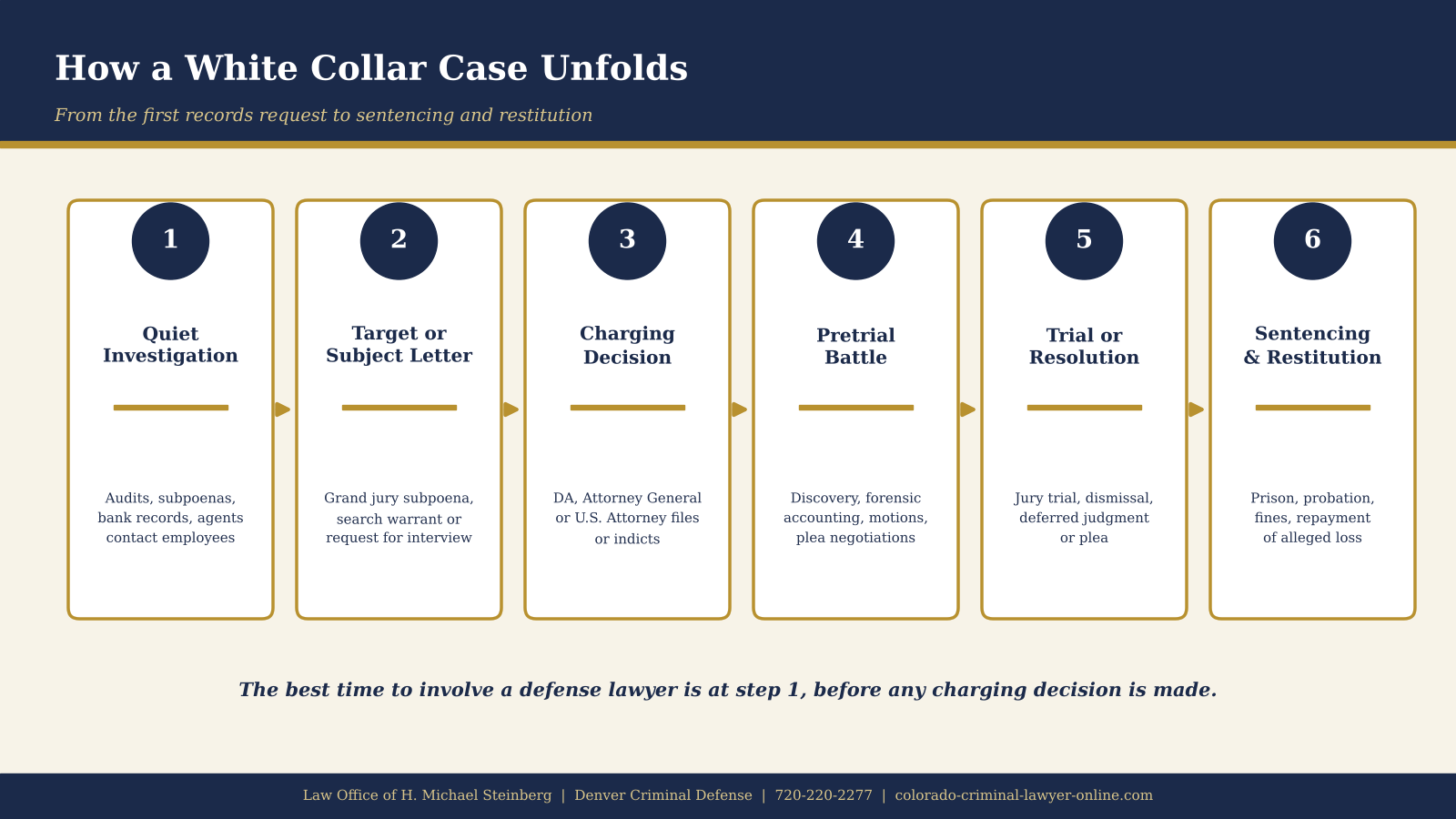
The typical path of a white collar prosecution.
- Quiet investigation. Auditors, regulators or agents gather bank records, emails and accounting data, often interviewing coworkers and customers before you know.
- Target or subject letter, subpoena or warrant. A grand jury subpoena, a search warrant or a request for an “informal” interview is the point where silence and counsel become critical.
- Charging decision. A district attorney, the Colorado Attorney General or a federal grand jury decides whether to file. Colorado’s Attorney General can also use a statewide grand jury.
- Pretrial battle. Discovery review, forensic accounting, suppression and jurisdiction motions, and negotiations. Many cases are resolved here.
- Trial or resolution. Dismissal, a trial verdict, or a negotiated plea.
- Sentencing and restitution. The court sets punishment and, in nearly every fraud case, the amount the defendant must repay.
The earlier a defense lawyer is involved, the more options remain. Before charges are filed, counsel can sometimes correct a misunderstanding of the records, present exculpatory context, negotiate the form and timing of any charge, or coordinate a response to a regulator. After charges, those opportunities narrow.
Penalties, Restitution and Collateral Consequences
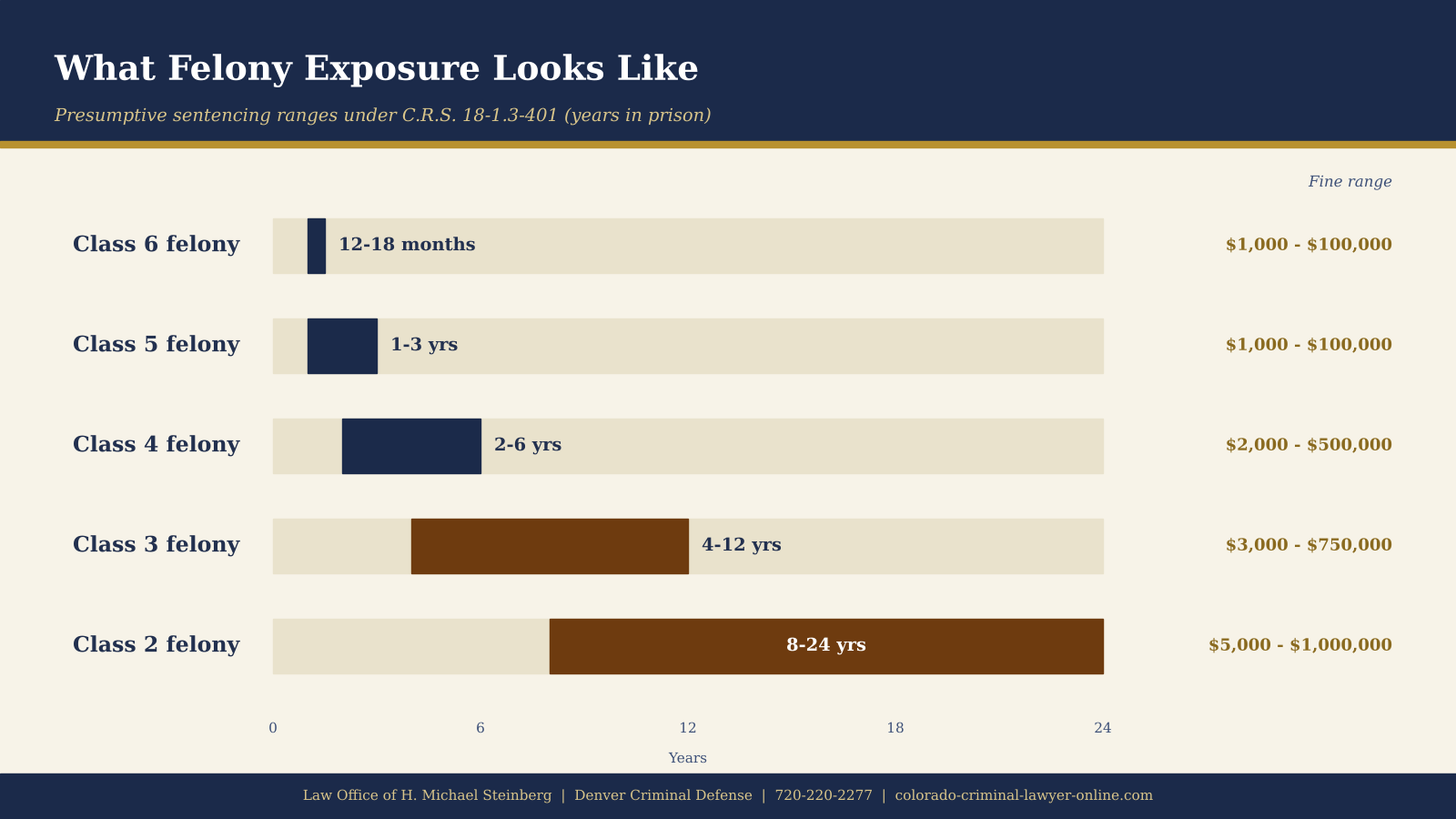
Presumptive felony ranges under C.R.S. § 18-1.3-401.
The felony classes in C.R.S. § 18-1.3-401 set the presumptive prison ranges shown above. Aggravating factors, prior history and mandatory parole terms can alter the picture, and some cases are eligible for probation or alternative sentences while others are not. For white collar offenses, prison is only part of the exposure.
Restitution
Colorado law requires every order of conviction to address restitution under C.R.S. § 18-1.3-603. When the amount is not set at sentencing, the court generally must determine it within 91 days unless it finds good cause to extend that time.
The deadline has generated a long line of appeals; in People v. Roberson, 2025 CO 30, the Colorado Supreme Court held that a defendant had waived her statutory right to the 91-day limit under the facts of that case (summary). Restitution orders are also treated as non-dischargeable in bankruptcy, which makes the number a lifelong financial issue. Contesting the amount, the victims and the causal link to the offense is a central part of white collar sentencing work.
Collateral Consequences
- Professional licenses and industry bars, including securities, accounting, real estate, health care and legal licensing.
- Firearm rights and other civil rights affected by a felony conviction.
- Employment and financial consequences, from lost positions to civil lawsuits seeking the same money the prosecution alleges was taken.
- Parallel civil and administrative actions by regulators, which can proceed alongside or after a criminal case.
The Statute of Limitations
Under C.R.S. § 16-5-401, prosecutors generally have three years to file felony charges, 18 months for misdemeanors, and six months for petty offenses. But white collar cases are full of exceptions. For theft, computer crime, securities fraud, bribery, organized crime and several other offenses, the limitation period begins to run on discovery of the criminal act rather than when it occurred. Time spent outside Colorado can pause the clock, generally for up to five years, and offenses built on a series of acts can be measured from the last act.
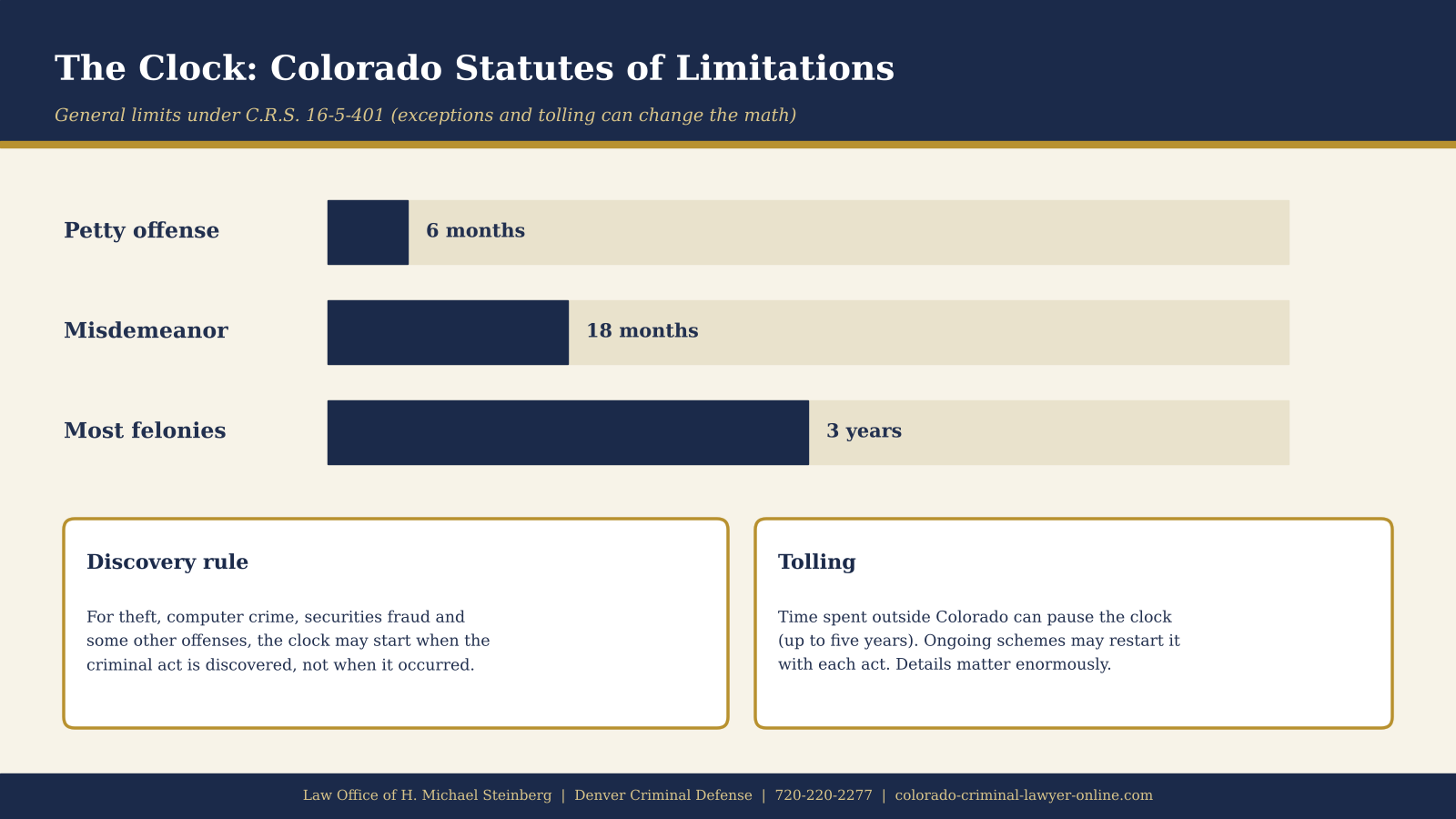 General Colorado limitation periods and the discovery rule under C.R.S. § 16-5-401.
The Colorado Supreme Court addressed how the discovery rule applies to theft from at-risk adults in People v. McKinney, 99 P.3d 1038 (Colo. 2004), and the Court of Appeals considered what “discovery of the criminal act” means in People v. Cito (Colo. App. 2012). Whether a charge was filed in time can require a careful reconstruction of when each act occurred and when it was discovered, and by whom. A late filing can end a case.
Defense Strategies That Matter
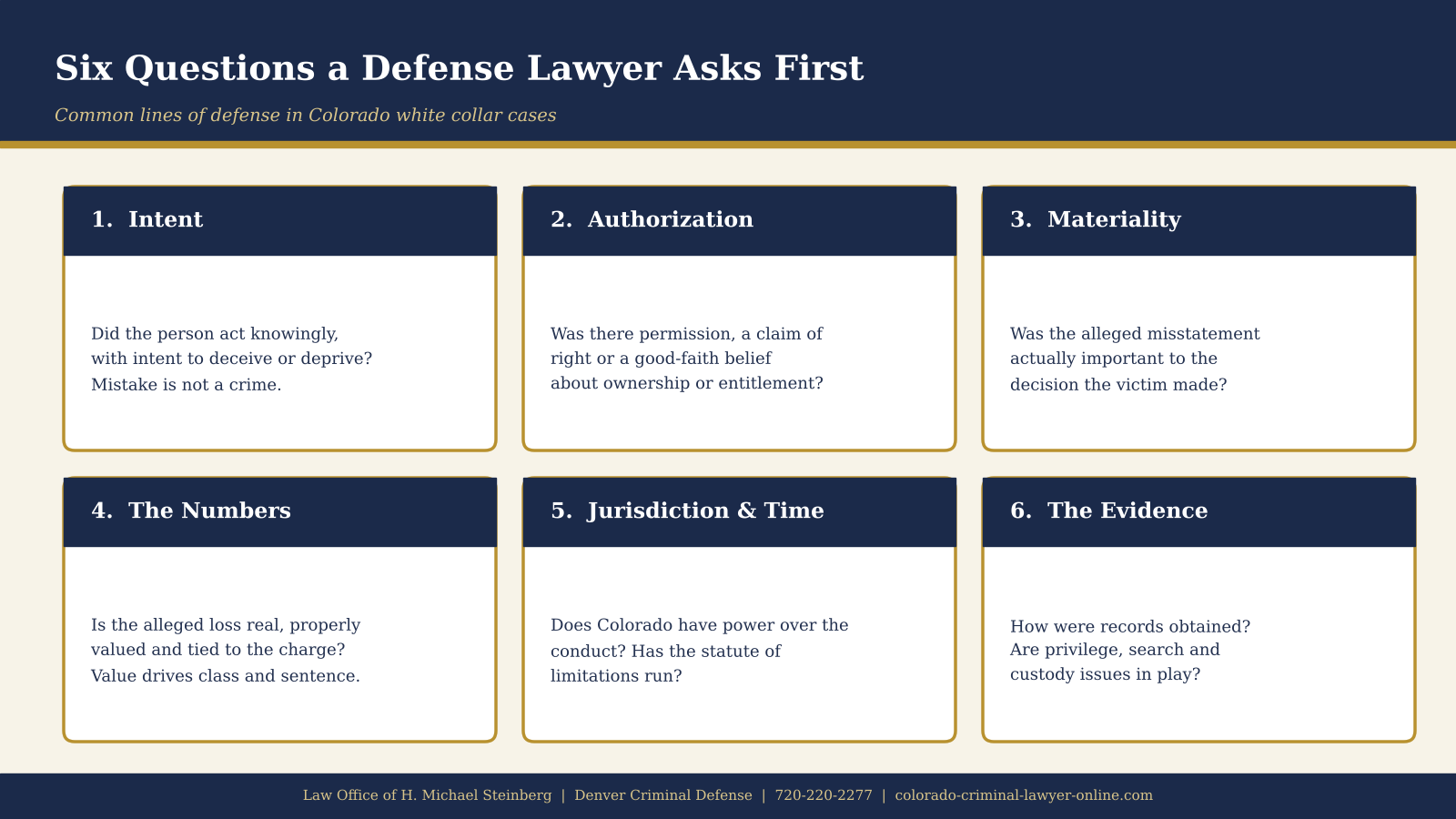 Six questions a defense lawyer asks first in a white collar case.
No two white collar cases are alike, but the same core questions seem to recur.
1. Intent and Knowledge
Most white collar crimes require a culpable mental state, such as acting knowingly or with intent to defraud. Sloppy bookkeeping, a misunderstood policy, a billing dispute or an honest mistake can look suspicious on paper without being criminal. The prosecution must prove the state of mind beyond a reasonable doubt, and it usually does so through circumstantial evidence such as emails, timing and the way money moved.
Challenging those inferences is often the heart of the defense. The question of mental state is also live at the appellate level: the Colorado Supreme Court heard argument on October 22, 2026 about whether language in a revised motor vehicle theft statute asking what a defendant “reasonably should have known” violates due process (report). No decision had been reported when this article was written.
2. Authorization and Good Faith
Theft requires that the property be taken or controlled without authorization or by deception. Permission, a good-faith belief about ownership or entitlement, an owner’s consent, or a genuine dispute over who is owed what can all defeat or reduce a charge. In business disputes, the line between a civil breach of contract and a crime is a recurring theme.
3. Materiality and Accuracy of the Alleged Statement
In fraud cases, the government must show that a misrepresentation was material and that it was made with the required intent. After Kousisis, the materiality requirement is the main legal limit on federal fraud-by-inducement theories. Whether the victim actually relied on, or cared about, the statement is therefore an important line of attack.
4. The Numbers: Value, Loss and Tracing
Because value or loss determines the felony class in state court and the guideline range in federal court, the accounting matters. We look at how value was computed, whether property was returned, whether items were double-counted, and whether the alleged loss is tied to the conduct charged. A forensic accountant is often essential.
5. Jurisdiction and Timing
Colorado courts have jurisdiction over conduct occurring “wholly or partly” within the state under C.R.S. § 18-1-201. As Brennan shows, an out-of-state defendant may have a strong jurisdictional argument. Statute-of-limitations defenses, discussed above, require a similar close reading of dates.
6. The Evidence: How It Was Gathered and Who Holds the Privilege
Search warrants for business records and digital devices, grand jury subpoenas, and employer-run internal investigations raise serious legal questions. One example: when company counsel interviews an employee, the attorney-client privilege generally belongs to the company, not the employee, as the Supreme Court explained in Upjohn Co. v. United States (1981). What you say to the company’s lawyers may be shared with prosecutors without your consent. Understanding who represents whom, and what is protected, should happen before any interview.
7. Early Advocacy
The best outcomes often come from engaging prosecutors and regulators early, with a documented presentation of the facts. That can mean a declination, a reduced charge, a civil resolution in place of a criminal one, or a favorable plea structure on restitution and sentencing. It can also mean preparing quietly for trial from day one so that negotiating positions are credible.
Recent Developments (2025-2026)
- Federal fraud law: Kousisis (May 2025) confirmed that fraudulent inducement can support a wire fraud conviction without net economic loss, but only with a demonstrable materiality showing.
- Identity theft: Rodriguez-Morelos (January 2025) limited the statute’s “personal identifying information” to individual human beings.
- Jurisdiction: the Colorado Supreme Court agreed in May 2026 to review Brennan, a case about prosecuting out-of-state defendants for financial crimes against Coloradans.
- Restitution: Roberson (2025) addressed the 91-day restitution deadline and waiver.
- Securities regulation: the Division of Securities, which was up for sunset review in 2026, was advancing in the legislature with a bill to continue it through 2037.
- Enforcement priorities: state and federal prosecutors have continued to prioritize Medicaid fraud and pandemic-relief fraud.
What to Do If You Are Under Investigation

Four first steps if you learn you are under investigation.
- Do not speak with agents or investigators on your own. You can politely decline an interview and ask them to contact your lawyer. Statements made in an “informal” conversation can become the centerpiece of a case.
- Do not delete, alter, move or “clean up” any records, devices or accounts. Destroying or changing evidence can create a separate, serious obstruction charge, and it makes a defensible case look guilty.
- Do not discuss the matter with coworkers, business partners or on text and email. Those conversations are not privileged and can be obtained.
- Contact a Colorado criminal defense lawyer immediately, ideally before responding to a subpoena, a records demand, or an employer interview.
- Preserve your own documents. Keep, but do not alter, your records, and give them to your lawyer rather than to the investigators.
Frequently Asked Questions
Is white collar crime a felony in Colorado?
It depends on the offense and the dollar amount. Theft of $2,000 or more is a felony, identity theft is generally a class 4 felony, willful securities fraud is a class 3 felony, and racketeering under COCCA is a class 2 felony. Lower-value theft can be charged as a misdemeanor or petty offense.
What is the difference between embezzlement and theft in Colorado?
For private funds there is no separate embezzlement crime. Under C.R.S. § 18-4-403, conduct that people call embezzlement is prosecuted as theft under C.R.S. § 18-4-401, with the value taken setting the classification.
How long can prosecutors wait to file white collar charges in Colorado?
Generally three years for felonies, 18 months for misdemeanors and six months for petty offenses under C.R.S. § 16-5-401. For theft, computer crime, securities fraud and certain other offenses, the clock may start at discovery, and it can be paused if the person is outside the state.
Can I be charged in both state and federal court for the same conduct?
Yes. Colorado and the federal government are separate sovereigns, and under Gamble v. United States the Constitution generally does not bar successive prosecutions by each. Coordination between agencies is common.
Will I have to pay restitution if I am convicted?
Usually, yes. Colorado courts must address restitution at sentencing under C.R.S. § 18-1.3-603, and restitution orders generally cannot be discharged in bankruptcy. The amount, the victims and the connection to the offense are often contested.
Should I talk to investigators if I did nothing wrong?
You should speak with a defense lawyer first. Innocent people can be harmed by incomplete or misinterpreted statements, and a lawyer can decide whether, when and how any interview should occur.
Talk to a Denver White Collar Defense Lawyer
White collar prosecutions are won and lost on paper, numbers and timing, and they are shaped by decisions made long before a courtroom. If you have received a subpoena, been contacted by an agent, learned your employer is conducting an internal review, or been charged with theft, fraud, embezzlement, identity theft, or a securities or health care offense, the time to act is now.
The Law Office of H. Michael Steinberg has practiced criminal in state and federal court for more than forty years. We handle serious felony and misdemeanor defense across the Denver metro area, including the Lindsey-Flanigan Courthouse and surrounding jurisdictions.
Call 720-220-2277 for a confidential consultation, visit www.hmichaelsteinberg.com, or read more on the Colorado Criminal Lawyer Blog.
Under Investigation or Already Charged?
Over forty years of Colorado criminal defense experience. Confidential consultations.
www.hmichaelsteinberg.com | colorado-criminal-lawyer-online.com
This article is for general information only and is not legal advice. It does not create an attorney-client relationship. Laws change, and the application of any law depends on the specific facts of a case. Penalty ranges are general and may vary with aggravating or mitigating circumstances. Contact a licensed attorney about your situation. Attorney advertising. Prior results do not guarantee a similar outcome.
Sources and Authorities
- Colorado theft statute, C.R.S. § 18-4-401
- C.R.S. § 18-4-403 (theft as a single crime)
- C.R.S. § 18-5-102 (forgery)
- C.R.S. § 18-5-113 (criminal impersonation)
- C.R.S. § 18-5-902 (identity theft)
- C.R.S. § 18-5-905 (identity theft tools)
- C.R.S. § 18-5.5-102 (computer crime)
- C.R.S. § 11-51-501 (securities fraud)
- C.R.S. § 11-51-603 (criminal penalties, securities)
- C.R.S. § 11-51-602 (injunctions)
- C.R.S. § 11-51-604 (civil liabilities)
- C.R.S. § 18-17-103 (COCCA definitions)
- C.R.S. § 18-17-104 (COCCA prohibited activities)
- C.R.S. § 18-17-105 (COCCA penalties)
- C.R.S. § 18-17-106 (COCCA civil remedies)
- C.R.S. § 24-31-802 (Medicaid fraud control unit)
- C.R.S. § 16-5-401 (statute of limitations)
- C.R.S. § 18-1.3-401 (felony classes and sentences)
- C.R.S. § 18-1.3-603 (restitution)
- C.R.S. § 18-1-201 (jurisdiction)
- People v. Brennan, 2025 COA 68 (summary)
- Colorado Supreme Court cert. order, People v. Brennan, May 2026
- Colorado Politics: Supreme Court to decide Brennan
- People v. Rodriguez-Morelos, 2025 CO 2 (coverage)
- People v. Roberson, 2025 CO 30 (summary)
- People v. McKinney, 99 P.3d 1038 (Colo. 2004)
- People v. Cito (Colo. App. 2012)
- Kousisis v. United States, 605 U.S. 114 (2025)
- Congressional Research Service: Kousisis and the reach of federal fraud statutes
- Commentary on Kousisis (Foley Hoag via JD Supra)
- Gamble v. United States (2019)
- Upjohn Co. v. United States (1981)
- U.S. Sentencing Commission: Primer on loss under §2B1.1
- Colorado Division of Securities: enforcement section
- Colorado Division of Securities: Gemelli press release
- Colorado legislative fiscal summary, HB26-1188
- Colorado Attorney General: $12 million Medicaid vision fraud charges
- USAO Colorado: Philadelphia man sentenced, March 2026
- USAO Colorado: Castle Rock woman sentenced, March 2026
- Denver7: Colorado COVID-19 Fraud Enforcement Strike Force
- Denver Gazette: Supreme Court hears vehicle theft law challenge