 Colorado Criminal Lawyer Blog
How a Colorado Trial Lawyer Prepares for Difficult Cases


Colorado Criminal Defense
Inside the investigation, discovery review, motions practice, and jury strategy that go into defending a serious criminal case in Colorado.
By the Law Office of H. Michael Steinberg | Denver Criminal Defense Attorney | October 31, 2026
When the stakes are a felony conviction, prison exposure, or a permanent criminal record, the trial itself is only the visible tip of the work. The outcome is usually shaped months earlier, in the hours when a defense lawyer reads every page of discovery, walks the scene, interviews witnesses, retains experts, and decides what the jury will, and will not, hear.
After more than forty years of Colorado practice, including countless hearings and trials at the Lindsey-Flanigan Courthouse in Denver, we have seen the same pattern repeat: cases that look unwinnable on day one often turn on details that only disciplined, early, methodical preparation uncovers.
This guide walks through how a Colorado trial lawyer prepares for difficult criminal litigation, step by step. For more on specific charges and defenses, visit our Colorado Criminal Lawyer Blog or the Law Office of H. Michael Steinberg.
Key Takeaways
- Preparation starts in the first days of a case: evidence preservation, a candid client interview, and a plan for the speedy-trial clock.
- Discovery is a battleground. Crim. P. 16, Brady, and Giglio define what the prosecution must disclose, and a careful audit finds what is missing.
- An independent investigation and well-vetted experts often matter more than the government’s version of events.
- Pretrial motions decide what the jury is allowed to hear, which can decide the case itself.
- Every decision, from jury selection to cross-examination, should serve one consistent, credible case theory.
- Clients keep control of the biggest decisions: whether to accept a plea, whether to testify, and whether to try the case to a jury.
Prepared for Difficult Criminal Trials
H. Michael Steinberg — Colorado Criminal Defense Attorney
A serious criminal charge can put your freedom, reputation, and future at risk—all at once. Whether your case may reach a jury is many times not known for a long time, trial preparation cannot be treated as something to address later.
My approach to defending difficult criminal cases begins with that understanding. Serious felony charges, sex offense allegations, and other high-stakes accusations demand careful preparation, close attention to the evidence, and a defense built around your individual circumstances.
Here is what that preparation means.
Trial Readiness Changes the Conversation
Preparing for trial requires more than knowing the allegations. It means investigating the facts, examining the government’s evidence, identifying weaknesses in its case, and developing a strategy grounded in what the evidence actually supports.
That preparation matters throughout a criminal case—not just inside the courtroom. It informs which motions to file, which evidence to challenge, how to evaluate a plea offer, and whether proceeding to trial serves your interests.
Difficult cases often involve complicated facts, intense emotions, and potentially life-changing consequences. Those pressures make thorough preparation more important, not less. Decisions should follow a careful assessment of the evidence and the law—not assumptions about how a case will resolve.
A Defense Built Around the Details
Effective trial preparation requires a close understanding of how the prosecution intends to prove its case. What must the government establish? How reliable are its witnesses? Does the physical or digital evidence support the allegations? Were your constitutional rights respected?
Just as important is understanding your account, your concerns, and what is at stake for you. A defense strategy should reflect the person facing the charge—not merely the accusation in the court file.
Preparation cannot guarantee an outcome. It can, however, provide the foundation for informed decisions, meaningful challenges to the government’s case, and a defense ready for the demands of trial.
Discuss Your Colorado Criminal Case
If you are facing criminal charges in Colorado, you deserve a clear explanation of your options and a careful examination of the evidence against you.
Contact H. Michael Steinberg to discuss your case and the preparation your defense may require.
Why Preparation Is the Defense
Colorado lawyers have an ethical duty to provide competent representation, which includes the thoroughness and preparation reasonably necessary for the matter (Colo. RPC 1.1), and to act with reasonable diligence and promptness (Colo. RPC 1.3). In a criminal case those duties sit on top of constitutional guarantees. The Sixth Amendment and Article II, Section 16 of the Colorado Constitution protect the accused’s rights to counsel, to know the charges, to confront witnesses, and to a speedy, public trial before an impartial jury.
The U.S. Supreme Court made the connection explicit in Strickland v. Washington, the leading decision on ineffective assistance of counsel, which treats a lawyer’s duty to investigate as central to effective representation. Put simply: a defense that is not prepared is not a defense.
Trials are rarely won in closing argument. They are won in the preparation that makes a credible closing possible.
Phase 1: The First Days (Intake, Bond, and Evidence Preservation)
The first conversation with a client sets the course of the case. A thorough intake in a privileged setting allows the lawyer to hear the client’s full account, identify the charges and potential penalties, and spot urgent problems. In the same window, the most time-sensitive work begins:
- Preservation letters. Body-worn camera and dash camera video, 911 and dispatch audio, jail calls, and business surveillance footage can be overwritten on short cycles. Written preservation demands go out immediately.
- Client instructions. No discussing the case with police, the complaining witness, or anyone online. Strict compliance with every bond condition. No deleting messages, photographs, or social media content.
- Bond and release. Advocating for reasonable conditions so the client can work, support a family, and help prepare the defense.
- Early witness identification. Locating people who saw or heard anything, before memories fade or witnesses relocate.
Phase 2: Arraignment, Speedy Trial, and Controlling the Calendar
At arraignment the defendant enters a plea, and in most contested cases that plea is not guilty. That plea matters beyond the courtroom because it generally starts Colorado’s statutory speedy-trial clock. Under C.R.S. § 18-1-405, a defendant must ordinarily be brought to trial within six months of the not-guilty plea, with defined exclusions for certain delays, such as those attributable to the defense. When the statute is violated, the remedy is dismissal of the charges.
The Colorado Supreme Court has repeatedly examined how the statute’s exclusions and continuance provisions work, including in Mosley v. People and Delacruz v. People, both decided in 2017. Because the calculation is technical, a trial lawyer tracks the speedy-trial date from the first day and treats every continuance as a strategic decision rather than a routine courtesy.
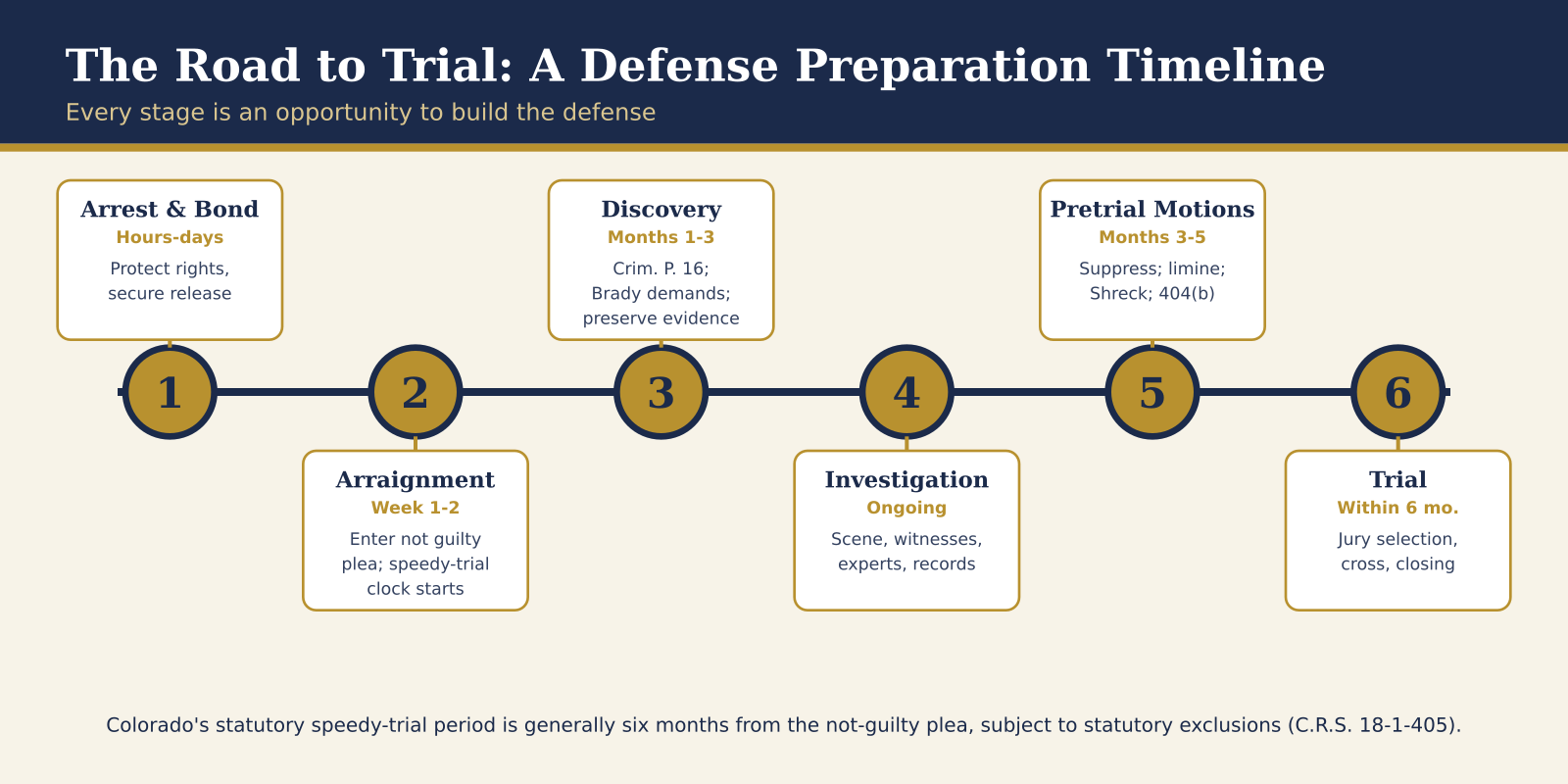 A simplified timeline of the stages a defense lawyer prepares for. Actual timing varies with the court and the case.
The strategic tension is real. More time can mean better investigation and expert work. Less time can mean the prosecution’s witnesses and resources are stretched thin. A trial lawyer weighs that tradeoff case by case and explains it to the client, because waiving or extending the speedy-trial period is a decision with consequences.
Phase 3: Mastering Discovery Under Crim. P. 16, Brady, and Giglio
Discovery is where difficult cases are most often won or lost. In Colorado, Crim. P. 16 governs what each side must disclose before trial. Part I imposes obligations on the prosecution, including police reports, witness statements, and certain scientific and expert materials. Part II requires reciprocal disclosures from the defense.
The prosecution’s duties go beyond the rule. Under Brady v. Maryland, suppressing evidence favorable to the accused violates due process when the evidence is material to guilt or punishment. The duty reaches impeachment evidence, such as benefits promised to a witness, under Giglio v. United States and United States v. Bagley.
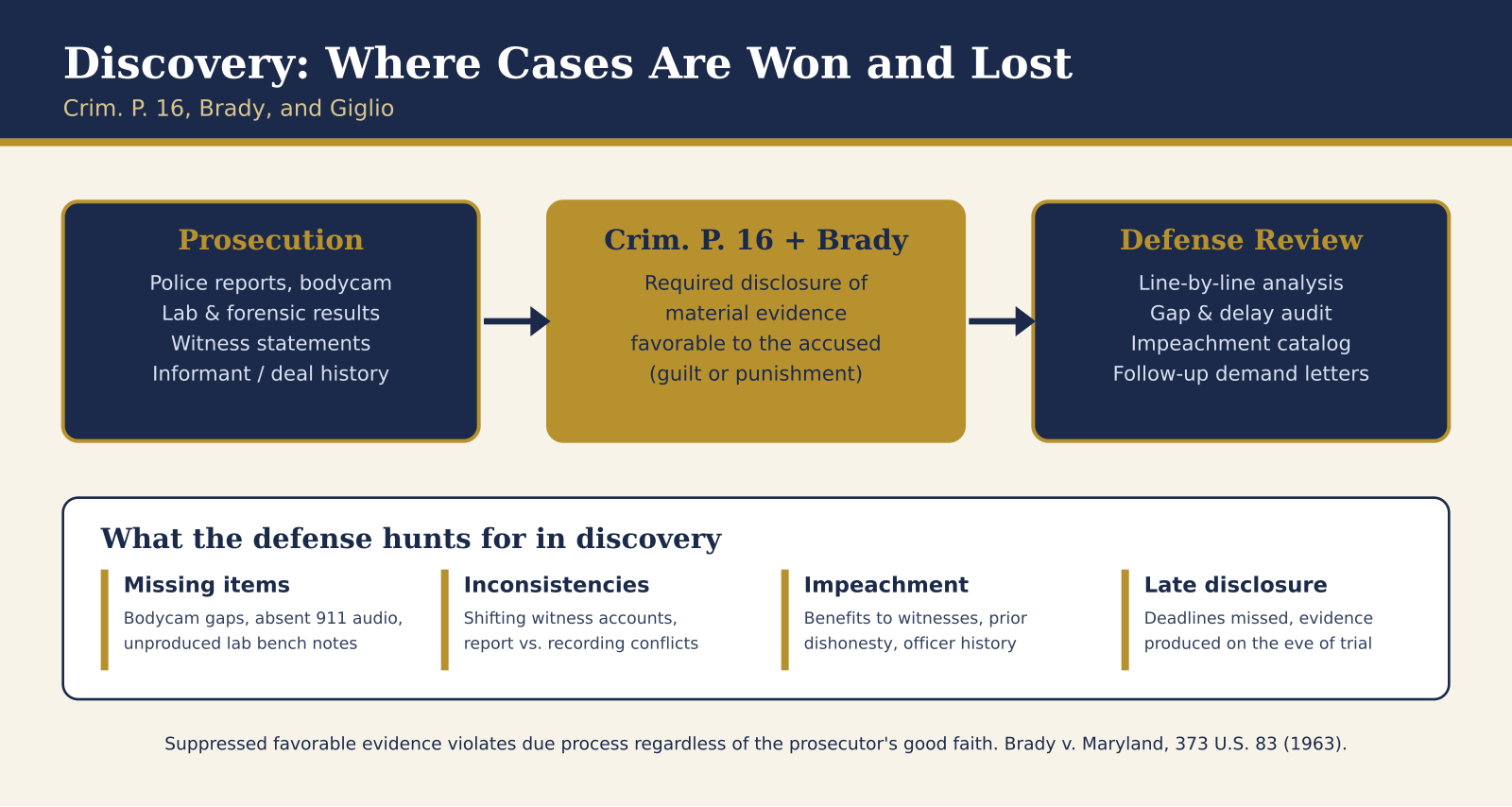 Discovery flows from the prosecution through Crim. P. 16 and Brady into a line-by-line defense review.
Compliance depends on prosecutors gathering material held by law enforcement. In Solano v. Newman, 2024 COA 93, the Colorado Court of Appeals examined how the prosecutor’s Crim. P. 16 obligations depend on cooperation with police agencies and noted that late or incomplete discovery has led courts to dismiss serious cases. For the defense, that makes a rigorous discovery audit essential.
| Discovery Item | Why It Matters | What We Look For |
|---|---|---|
| Police reports and CAD logs | They set the official timeline and the officers’ first account. | Inconsistencies, missing times, and details that appear only in later reports. |
| Body-cam and dash-cam video | Video often contradicts or confirms testimony. | Gaps, late activations, muted segments, and differences from the written report. |
| 911 and dispatch audio | Captures the earliest, least rehearsed description of events. | Statements that change later, and the caller’s actual words. |
| Lab and forensic results | Scientific evidence carries weight with jurors. | Chain of custody, testing methods, bench notes, and error rates. |
| Witness statements and interviews | These lock in testimony for cross-examination. | Shifting accounts, leading questions, and omissions. |
| Informant and cooperation records | Benefits to a witness bear on credibility. | Deals, dismissed charges, payments, and prior dishonesty. |
The defense has disclosure duties also. In People v. Dye (Colo. 2024), the Colorado Supreme Court addressed Crim. P. 16(II)(c) and held that a defendant must disclose the nature of any defense, including an alternate-suspect defense, within the rule’s deadlines, which run no later than 35 days before a felony trial or seven days before a non-felony trial unless the court extends them for good cause. A trial lawyer calendars those deadlines on day one.
Key Authorities on Discovery
- Colorado Crim. P. 16: discovery and procedure before trial
- Brady v. Maryland, 373 U.S. 83 (1963): suppression of favorable, material evidence violates due process
- Giglio v. United States, 405 U.S. 150 (1972): impeachment evidence is covered
- United States v. Bagley, 473 U.S. 667 (1985): impeachment and exculpatory evidence are treated alike under Brady
- Solano v. Newman, 2024 COA 93: prosecutor’s Crim. P. 16 obligations and law enforcement cooperation
- People v. Dye (Colo. 2024): defense disclosure of the nature of the defense
Phase 4: The Independent Defense Investigation
A defense built only on the government’s file inherits the government’s assumptions. A trial lawyer conducts an independent investigation that tests the prosecution’s theory against the physical world and against the people involved.
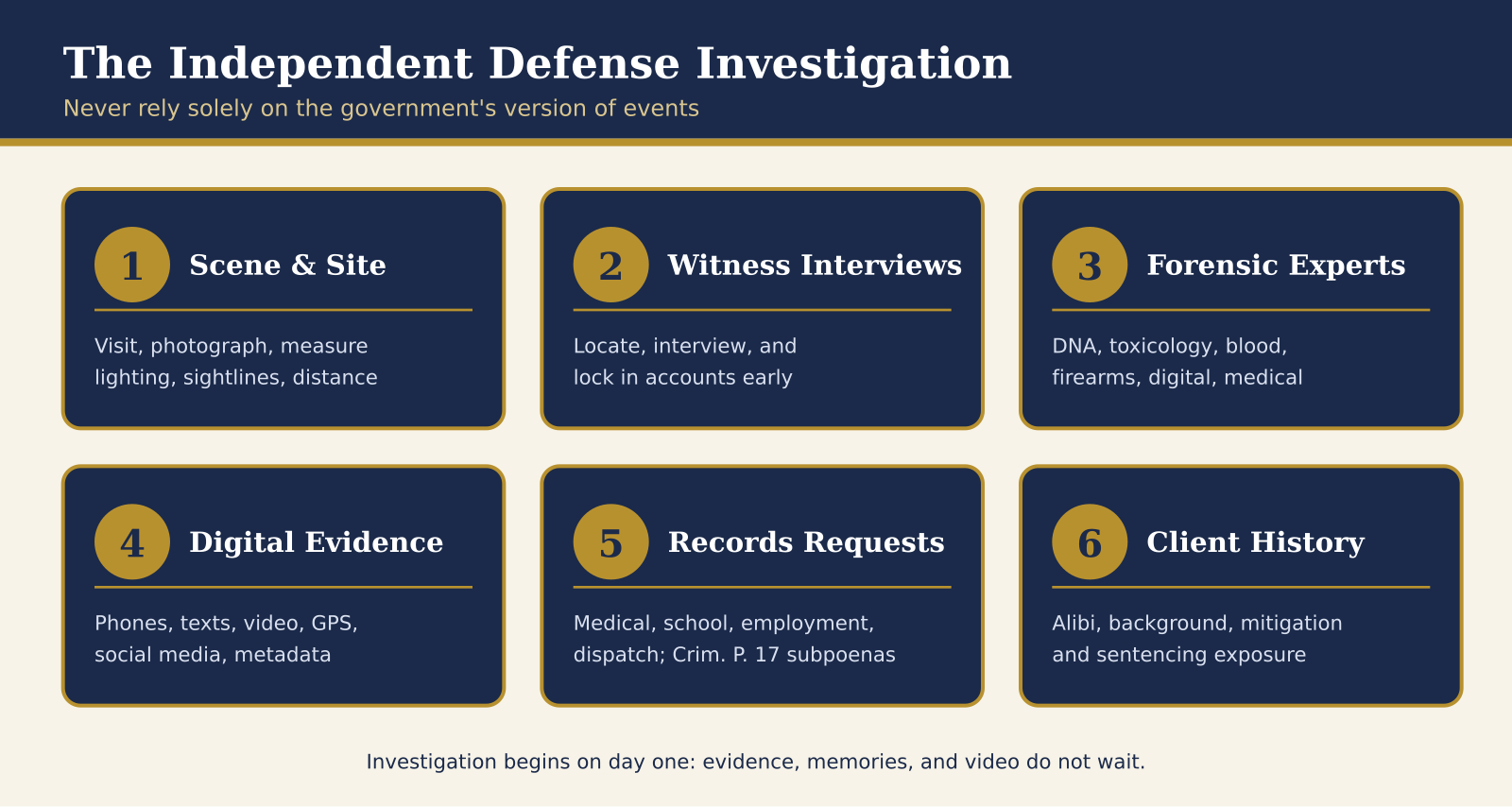 Six workstreams of a thorough defense investigation.
- Scene and site work. Visiting the location, photographing it at the relevant time of day, and measuring lighting, sightlines, and distances that witnesses described from memory.
- Witness interviews. Locating and interviewing eyewitnesses and character witnesses, often through a defense investigator, so that accounts are preserved and any inconsistencies are documented.
- Digital evidence. Phones, text messages, social media, GPS data, surveillance video, and metadata can corroborate an alibi or undermine a complainant’s timeline.
- Records and subpoenas. Medical, employment, school, and dispatch records can be sought by subpoena under Crim. P. 17, using the court’s motion and order form (JDF 85) in criminal cases. Rule 17 was amended in 2013 and remains subject to important limits.
- Client history. Background, employment, family, and community ties support bond, negotiation, and, if necessary, sentencing advocacy.
Those limits matter. The Colorado Supreme Court has cautioned in People v. Baltazar that Rule 17 subpoenas are not a vehicle for secret pretrial discovery and are subject to notice requirements. A careful lawyer uses the rule for what it allows and relies on motions practice for the rest.
Phase 5: Experts and Scientific Evidence
Modern prosecutions frequently rely on experts: forensic pathologists, DNA analysts, toxicologists, firearms examiners, digital forensic specialists, and medical providers. Jurors tend to trust them, so the defense must be ready both to challenge the prosecution’s experts and to present its own.
In Colorado, expert testimony is governed by CRE 702 and CRE 403, as explained in People v. Shreck.
A Shreck analysis asks whether the scientific principles are reasonably reliable, whether the witness is qualified, whether the testimony will help the jury, and whether its probative value is substantially outweighed by unfair prejudice.
The Colorado Supreme Court confirmed in Kutzly v. People that the Shreck framework applies to experience-based expert testimony as well as to scientific testimony.
- Consulting experts first. Retaining a consultant early, under privilege, shows the lawyer where the science is strong and where it is vulnerable before anyone commits to a position.
- Testing the foundation. Methods, equipment calibration, sample handling, and the analyst’s training are all fair game on cross-examination and in a pretrial Shreck motion.
- Plain-language presentation. A good defense expert makes complex material understandable without overstating it.
Phase 6: Pretrial Motions That Shape the Trial
Pretrial motions decide what evidence the jury will see. A single successful motion to suppress can end a prosecution, and a well-argued motion in limine can keep prejudicial material out of the courtroom entirely.
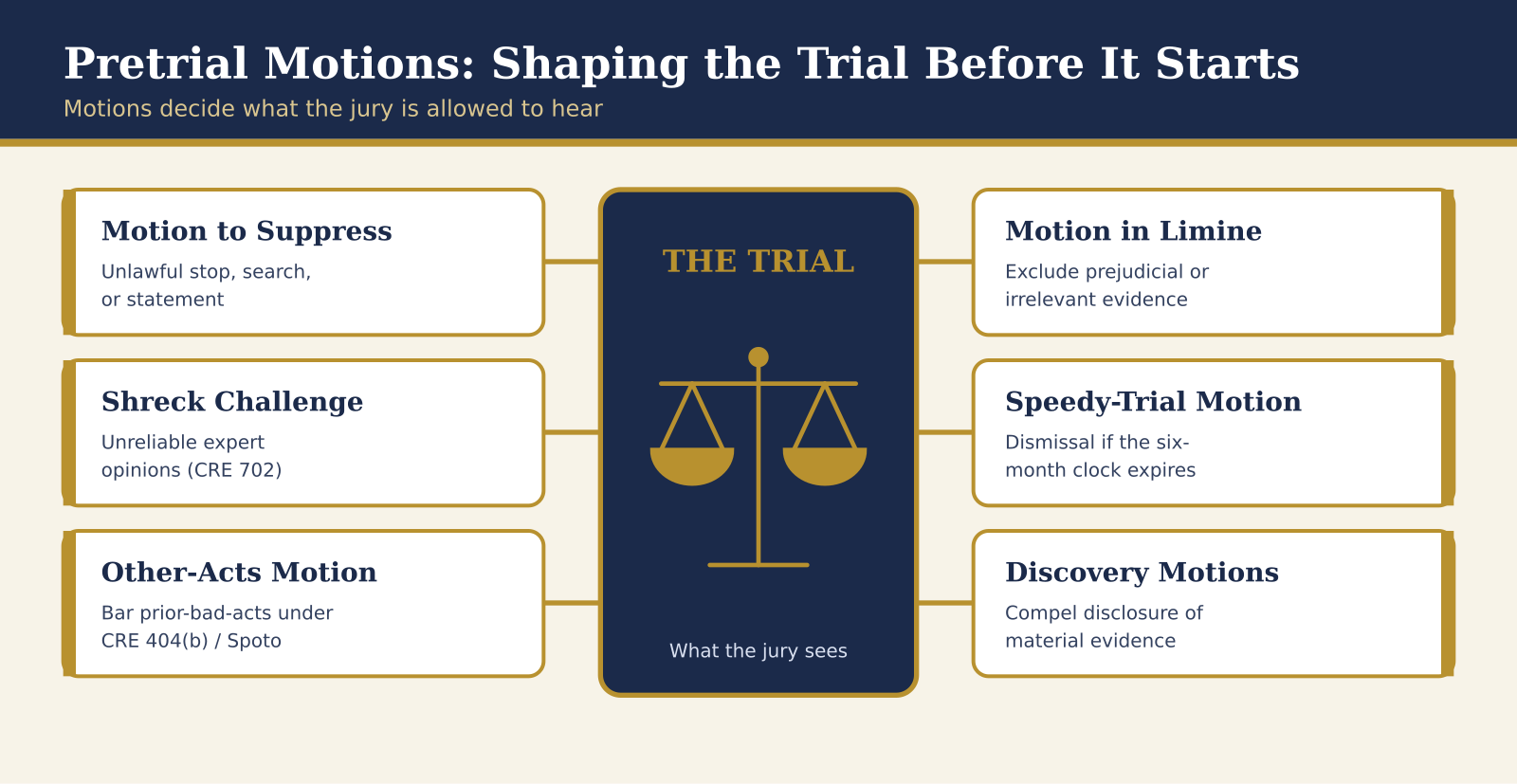 Pretrial motions determine what the jury is allowed to hear.
| Motion | Purpose | Primary Authority |
|---|---|---|
| Motion to suppress | Exclude evidence from an unlawful stop, search, or seizure, or an involuntary or unwarned statement. | Fourth Amendment; Colo. Const. art. II, § 7; Crim. P. 41 |
| Shreck motion | Challenge the reliability and relevance of expert testimony. | CRE 702 and 403; People v. Shreck |
| Other-acts motion | Keep out uncharged misconduct offered to suggest bad character. | CRE 404(b); Spoto test, applied in People v. Jones, 2013 CO 59 |
| Motion in limine | Exclude irrelevant or unfairly prejudicial evidence and arguments. | CRE 401-403 |
| Speedy-trial motion | Seek dismissal when the statutory period has run. | C.R.S. § 18-1-405 |
| Discovery motions | Compel disclosure of material the prosecution has not produced. | Crim. P. 16; Brady |
Other-acts evidence deserves special attention. Under CRE 404(b) and the four-part test from People v. Spoto, as applied in People v. Jones, the prosecution must show that the evidence relates to a material fact, is logically relevant independent of an inference about bad character, and has probative value that is not substantially outweighed by the danger of unfair prejudice. Contesting that showing before trial can change what the jury ever learns about a defendant’s past.
Phase 7: Building a Case Theory That Holds Together
Every decision in a trial should serve a single, credible story. A case theory is not a slogan. It is an account of what happened, or of why the prosecution cannot prove what it claims, that fits the facts, satisfies the law, and persuades the people who decide.
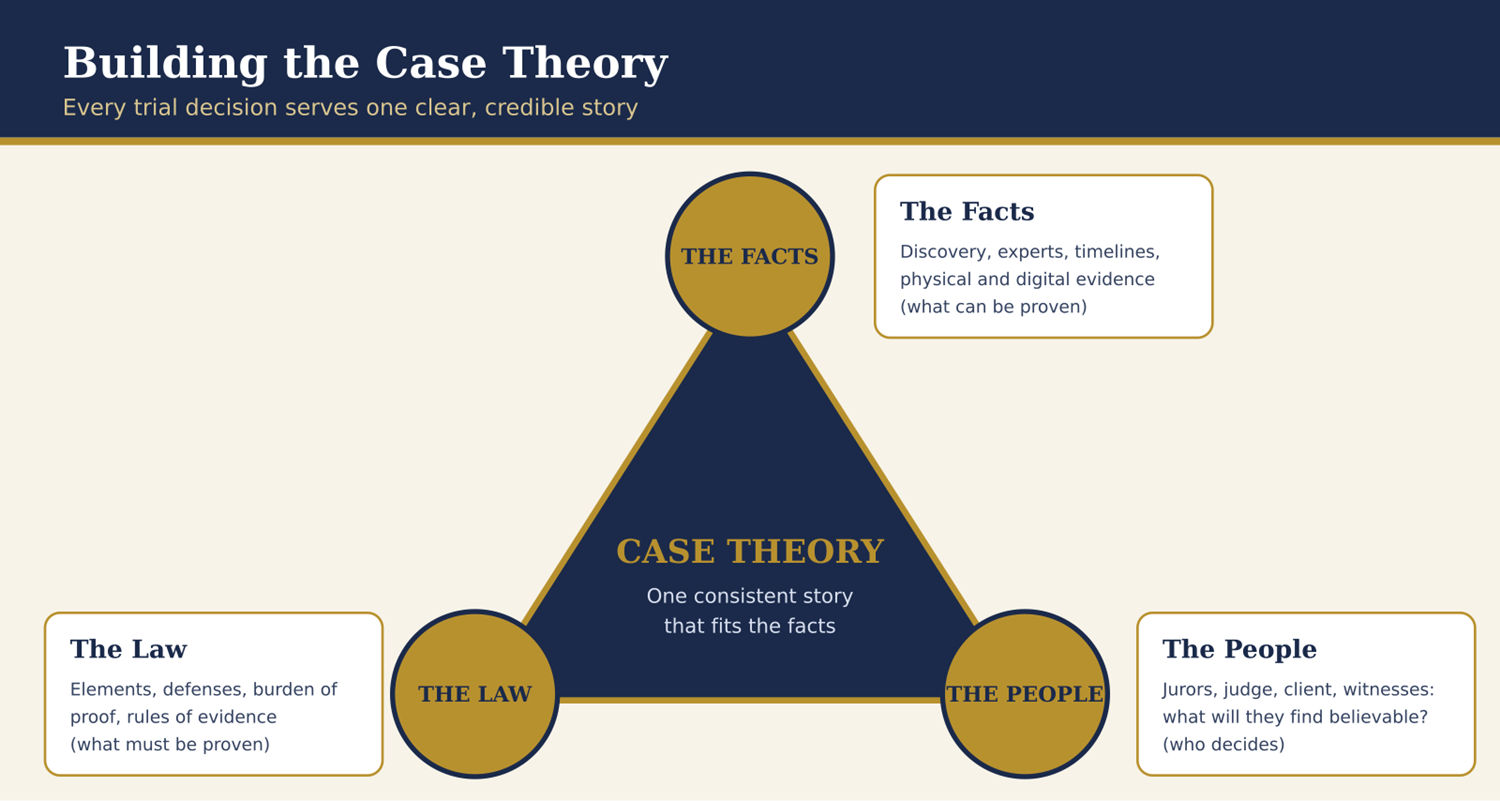 A strong case theory sits where the facts, the law, and the decision-makers meet.
- The facts. What can be proven through discovery, experts, timelines, and physical and digital evidence.
- The law. The elements the prosecution must prove beyond a reasonable doubt, available defenses, and the rules of evidence that control the proof.
- The people. How jurors, the judge, and the witnesses are likely to perceive the evidence, and what each will find believable.
If the theory involves an alternate-suspect defense, an alibi, self-defense, or another defense that triggers disclosure, the lawyer plans the timing and scope of the Crim. P. 16 disclosure carefully, consistent with Dye, so there are no surprises and no waiver.
Phase 8: Counseling the Client and Respecting Client Decisions
Preparing a case is also preparing a person. Under Colo. RPC 1.2(a), in a criminal case the client decides, after consultation, what plea to enter, whether to waive a jury trial, and whether to testify. A trial lawyer’s job is to give the client the information and honest evaluation needed to make those choices.
- Candid case assessment. Strengths, weaknesses, and realistic outcomes, delivered without sugar-coating.
- Plea offers. Every offer is communicated and explained, including the collateral consequences that can matter as much as the sentence. Genuine trial readiness is often what makes a better negotiated outcome possible, whether that is a reduced charge, a deferred judgment, or a dismissal.
- Testimony preparation. If the client may testify, the lawyer walks through direct and cross-examination so there are no surprises. Preparing a witness to tell the truth effectively is proper. Shaping what the truth is, is not.
- Courtroom readiness. Demeanor, attire, and what to expect from the process in a Denver courtroom.
Phase 9: Jury Selection
Jury selection is the first time the trial team speaks directly to the people who will decide the case. Colorado’s Rule 24 on trial jurors governs the process, and the Constitution forbids striking jurors because of race under Batson v. Kentucky.
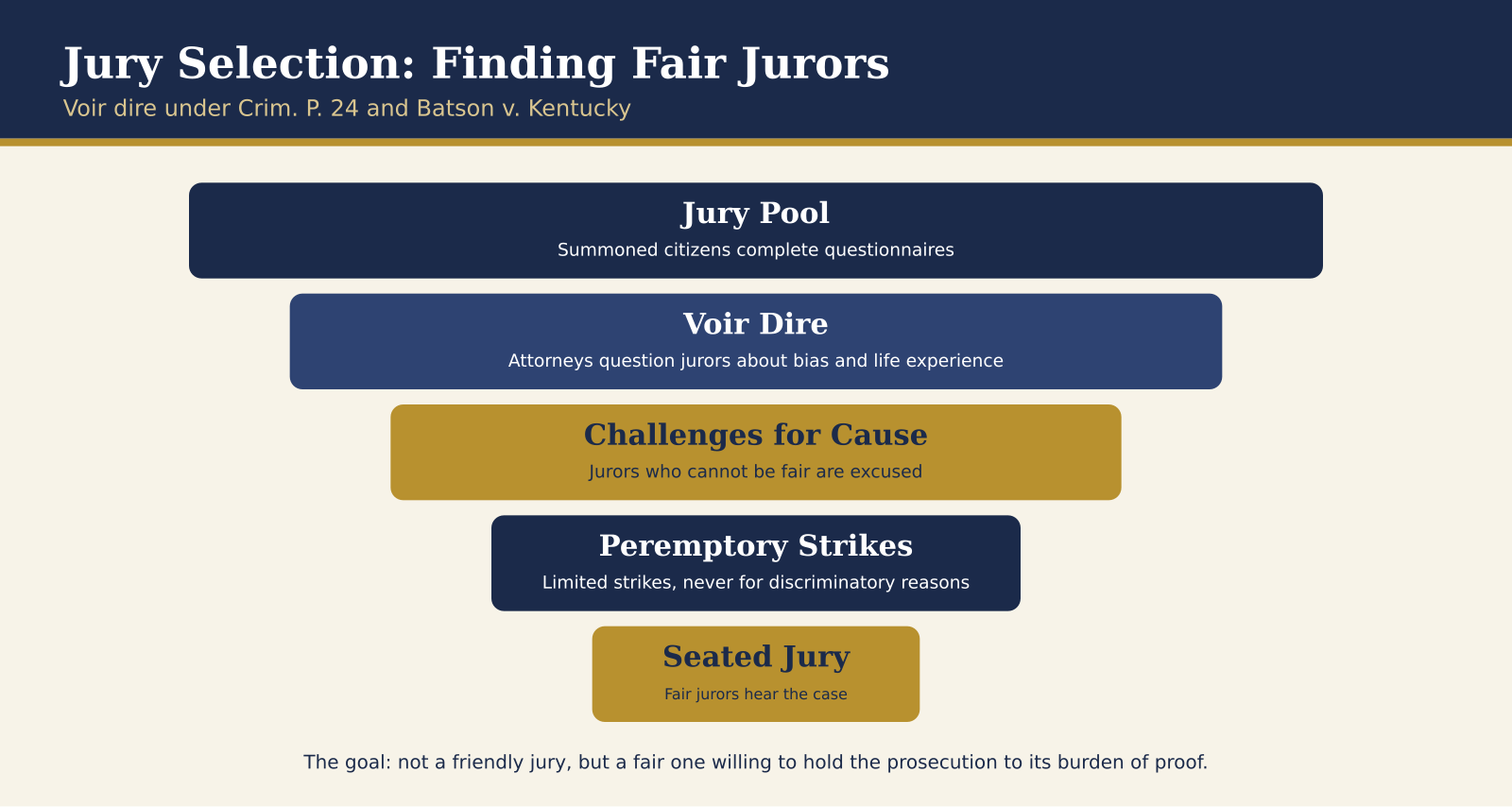
Jury selection narrows a broad pool to a fair panel.
- Questionnaires and research. Reviewing juror information in advance and preparing targeted questions.
- Voir dire themes. Exploring attitudes about police, the burden of proof, the presumption of innocence, and the specific issues in the case.
- Challenges for cause. Building a record that a juror cannot be fair, so that the court excuses that juror.
- Peremptory strikes. Using limited strikes wisely, and raising Batson objections when the other side’s strikes appear discriminatory.
The goal is not a friendly jury. It is a fair one that will hold the prosecution to its burden of proof.
Phase 10: The Trial Notebook (Openings, Cross-Examination, and Instructions)
By the time of trial, the preparation is organized into a working notebook: an opening statement tied to the case theory, a witness-by-witness cross-examination outline, exhibits with foundation notes, anticipated objections, and proposed jury instructions.
- Opening statement. A short, concrete preview that frames the evidence and does not promise more than the defense can deliver.
- Cross-examination. Controlled, leading questions built from discovery and the independent investigation. Where the prosecution offers out-of-court statements, the lawyer considers the Confrontation Clause analysis in Crawford v. Washington.
- Objections and the record. Timely, specific objections and offers of proof to protect issues for appeal.
- Jury instructions. Reviewing the court’s pattern instructions from the Model Criminal Jury Instructions Committee and, when the evidence supports it, requesting instructions tailored to the defense theory.
- Closing argument. Tying the evidence, the law, and the burden of proof into one story the jury can follow.
Phase 11: Preserving the Record
Even the best-prepared defense must plan for the possibility of an appeal. That means making specific objections, obtaining rulings on motions, offering excluded evidence into the record, and requesting instructions on the defense theory. Issues that are not preserved are often lost, so careful record-making is part of trial preparation, not an afterthought.
How Preparation Differs by Type of Case
The framework above applies to every serious case, but the details change with the charge. A trial lawyer adapts the investigation, the experts, and the motions to the specific proof problems each type of case presents.
| Type of Case | Typical Proof Issues | Where Preparation Focuses |
|---|---|---|
| DUI and DWAI | The legality of the traffic stop, field sobriety testing, and breath or blood test reliability. | Body-cam video, officer training and observations, testing procedures and records, and toxicology or breath-testing experts. |
| Domestic violence | Often turns on the credibility of a single complaining witness and an early 911 call or officer observation. | 911 audio, photographs, medical and phone records, prior statements, and a careful Brady and Giglio review. |
| Drug offenses | Search and seizure, possession and knowledge, and laboratory identification of a substance. | Motions to suppress, warrant and affidavit review, chain of custody, and lab testing records. |
| Sex offenses | Credibility, consent, delayed reporting, forensic interviews, and digital communications. | Phone and message forensics, interview recordings, timeline work, expert consultation, and other-acts motions under CRE 404(b). |
| Other felonies | Identity, intent, and the sufficiency of circumstantial evidence. | Surveillance video, cell-site and digital data, alibi and alternate-suspect investigation, and expert challenges under Shreck. |
Whatever the charge, the principle is the same: identify what the prosecution must prove, test every link in its chain of proof, and prepare a clear alternative account that a jury can accept.
Charges such as these also carry consequences beyond the sentence, including effects on employment, licensing, firearm rights, and immigration status for non-citizens, so a defense plan should account for them from the beginning.
Common Mistakes That Weaken a Defense
Over four decades we have watched avoidable errors damage otherwise defensible cases. Most of them happen before a lawyer is retained or in the early days afterward:
- Talking to the police. Explaining your side without counsel often creates admissions or inconsistencies that the prosecution later uses.
- Posting online. Social media posts, messages, and deleted content can become exhibits. Do not discuss the case online, and do not delete anything.
- Contacting the complaining witness. Even well-meaning contact can violate bond conditions and create new charges.
- Waiting to hire counsel. Video is overwritten, witnesses move, and deadlines pass. Early retention preserves options.
- Assuming the other side will play fair on disclosure. Discovery must be audited line by line, not taken on faith.
- Treating the speedy-trial date as someone else’s problem. Continuances have consequences that should be decided deliberately.
How to Choose a Trial Lawyer for a Difficult Case
Not every criminal defense lawyer prepares cases the same way. When you meet with a lawyer about serious charges, consider asking:
- How much of your practice is criminal defense, and how many cases have you taken to a jury verdict?
- How do you review discovery, and who in your office reads the video and the forensic reports?
- Do you work with investigators and experts, and how early?
- How do you track speedy-trial and Crim. P. 16 deadlines?
- How will you keep me informed, and who makes the final decision on a plea or on testifying?
Experience matters because trial preparation is a skill built over many cases. Our practice focuses on DUI, domestic violence, drug crimes, sex crimes, and a broad range of felony and misdemeanor defense across the Denver metro area, and we bring more than forty years of Colorado courtroom experience to every case. To learn more about our approach, visit the Law Office of H. Michael Steinberg or browse our Colorado Criminal Lawyer Blog.
Facing Serious Charges in Colorado?
Early preparation can change the outcome. Speak with a Denver criminal defense attorney with more than forty years of Colorado courtroom experience.
Law Office of H. Michael Steinberg | Colorado Criminal Lawyer Blog
Frequently Asked Questions
How long does a Colorado trial lawyer need to prepare for a felony trial?
It depends on the charges, the volume of discovery, and the experts involved. Under C.R.S. § 18-1-405, the prosecution generally must bring a defendant to trial within six months of the not-guilty plea, subject to statutory exclusions, so preparation is front-loaded. Complex cases may take longer when the defense requests more time.
What is Crim. P. 16 in Colorado?
Crim. P. 16 is the Colorado rule governing discovery and procedure before trial. Part I sets out what the prosecution must disclose to the defense, and Part II sets out the defense’s reciprocal disclosures, including the nature of any defense it intends to present.
Can a Colorado criminal case be dismissed for a speedy trial violation?
Yes. When the statutory speedy-trial period expires without an applicable exclusion or waiver, the remedy under § 18-1-405 is dismissal of the charges. Whether a violation occurred depends on a detailed calculation of the dates and exclusions in your case.
What is a Brady violation?
A Brady violation occurs when the prosecution suppresses evidence favorable to the accused that is material to guilt or punishment. The rule comes from Brady v. Maryland, and it extends to impeachment evidence under Giglio v. United States.
Should I hire a trial lawyer or just negotiate a plea?
The two are connected. A prosecutor’s offer is shaped by how credible the defense’s trial preparation appears, so a lawyer who is genuinely ready to try the case is usually in a stronger position to negotiate. The decision whether to accept any offer is always yours.
What should I do right after being charged with a crime in Colorado?
Do not discuss the case with police, the complaining witness, or on social media. Follow every bond condition, preserve anything that may help your defense, and speak with a criminal defense attorney as soon as possible so that evidence can be secured before it disappears.
Sources and Legal Authority
- Colo. RPC 1.1 (Competence), Colorado Bar Association
- Colo. RPC 1.3 (Diligence), Colorado Bar Association
- Colorado Rules of Professional Conduct (index)
- U.S. Const. amend. VI, Cornell Legal Information Institute
- U.S. Const. amend. IV, Cornell Legal Information Institute
- Colo. Const. art. II, § 16
- Colo. Const. art. II, § 7
- Strickland v. Washington, 466 U.S. 668 (1984)
- C.R.S. § 18-1-405 (speedy trial)
- Colorado Supreme Court Affirms the Spirit of Speedy Trial Statute, Law Week Colorado
- Mosley v. People, 2017 CO 20
- Delacruz v. People, 2017 CO 21
- Colorado Rules of Criminal Procedure (index)
- Colo. Crim. P. 16 (discovery and procedure before trial)
- Colo. Crim. P. 17 (subpoena)
- Rule Change 2013(05): Crim. P. 17 and 24, Colorado Judicial Branch
- JDF 85: Motion and Order to Issue a Subpoena (Criminal Cases)
- People v. Baltazar (Colo. 2010)
- People v. Dye (Colo. 2024), No. 23SA140
- Solano v. Newman, 2024 COA 93
- Brady v. Maryland, 373 U.S. 83 (1963)
- Giglio v. United States, 405 U.S. 150 (1972)
- United States v. Bagley, 473 U.S. 667 (1985)
- People v. Shreck, 22 P.3d 68 (Colo. 2001)
- Kutzly v. People, 2019 CO 55, 442 P.3d 838
- People v. Jones, 2013 CO 59 (CRE 404(b) and the Spoto test)
- Batson v. Kentucky, 476 U.S. 79 (1986)
- Crawford v. Washington, 541 U.S. 36 (2004)
- Colorado Model Criminal Jury Instructions Committee
- Denver District Court, Colorado Judicial Branch
This article is for general informational purposes only and is not legal advice. Reading it does not create an attorney-client relationship. Laws and court rules change, and every case turns on its own facts, so speak with a licensed Colorado attorney about your situation. Prior results do not guarantee a similar outcome. Attorney advertising.