 Colorado Criminal Lawyer Blog
What Does a Prosecutor Look For Before Filing Criminal Charges?


 Introduction
An arrest feels like the moment a criminal case begins. Legally, it is not. Police can arrest someone on probable cause, but only a prosecutor can decide whether to file formal charges. That decision is where many cases are strengthened, narrowed, diverted, or dropped before anyone steps into a courtroom.
I have practiced criminal defense in Colorado for more than forty years. Before opening my own firm in 1999, I spent thirteen years as a career prosecutor in Arapahoe and Douglas counties, so I have seen the charging decision from both sides of the table.
This guide explains what a prosecutor looks for before filing criminal charges, the legal standards that apply in Colorado, and what all of it means if you are under investigation or have just been arrested.
Key Takeaways
- An arrest is not a charge. National prosecution standards place the decision to start formal criminal proceedings with the prosecutor, not the arresting officer.
- Probable cause is the legal minimum. Colorado Rule of Professional Conduct 3.8(a) bars a prosecutor from prosecuting a charge the prosecutor knows is not supported by probable cause.
- Most offices look higher. The ABA standards ask whether the admissible evidence will be sufficient to convict beyond a reasonable doubt and whether the filing serves the interests of justice.
- Quality beats quantity. Admissibility, witness credibility, the accused’s statements, forensic evidence, and likely defenses determine whether a file is strong or fragile.
- What happens before charges are filed matters.Early, defense lawyer-led communication with the prosecutor can possibly change what is filed, or whether anything is filed at all.
Who Decides Whether You Are Charged?
Police investigate and arrest. Prosecutors charge. The ABA Criminal Justice Standards for the Prosecution Functionsay this directly: while the decision to arrest often belongs to law enforcement, the decision to institute formal criminal proceedings is the responsibility of the prosecutor (Standard 3-4.2).
The very same standard tells prosecutors to consider whether further investigation is needed before filing and, when the person is not in custody, whether a voluntary appearance would suffice instead of a custodial arrest.
Colorado is divided into judicial districts, each with its own district attorney, and each office develops its own internal charging policies.
The legal floor is the same statewide, but how a case is screened, who reviews it, and how quickly a decision is made can differ from Denver County to Arapahoe County to Douglas County.
If you want the full roadmap of what follows an arrest, see our guides on the Colorado criminal case from investigation through trial and what happens after an arrest in Colorado.
The Legal Floor: Probable Cause
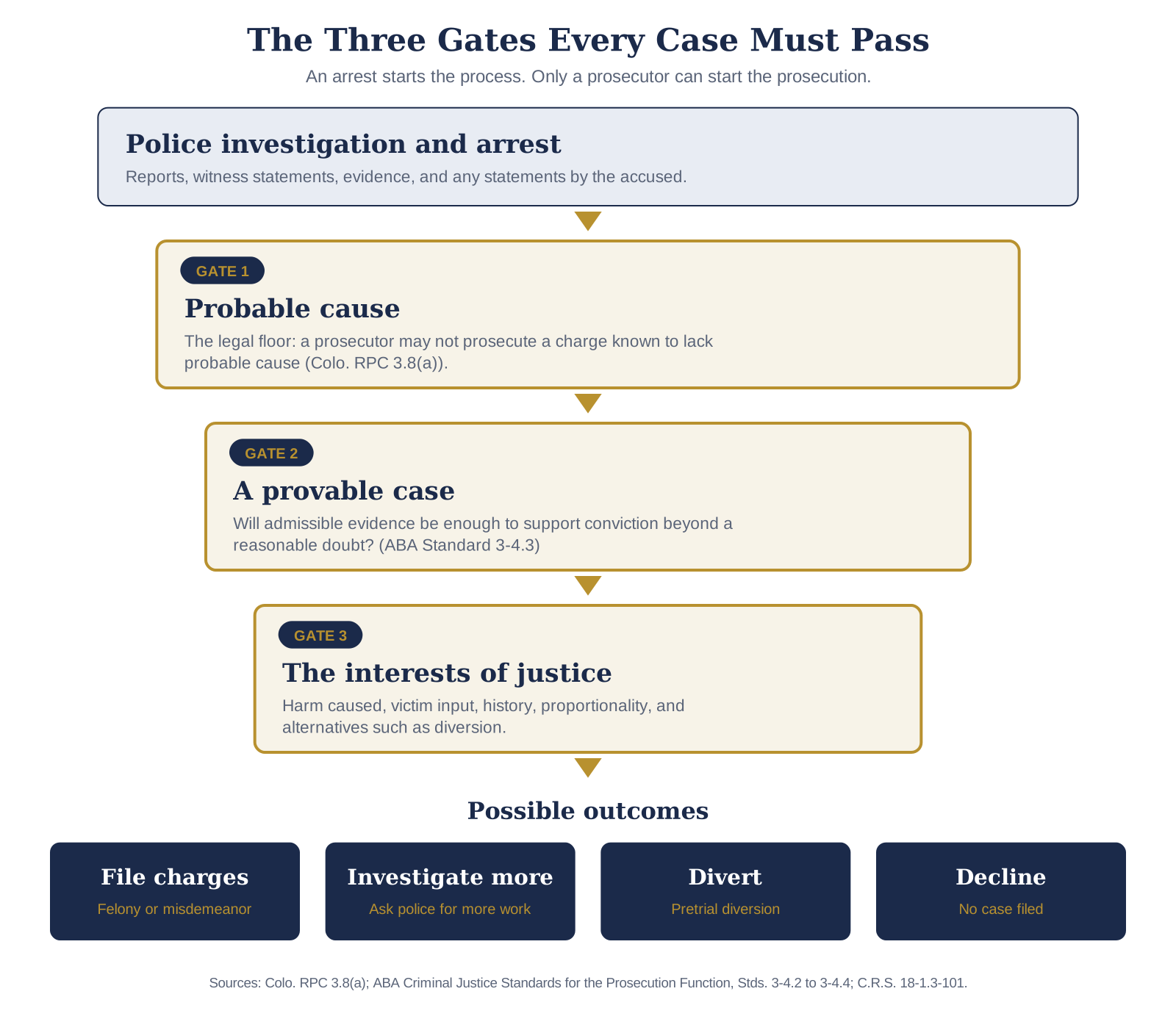
Colorado’s ethics rule for prosecutors is clear. Under Colorado Rule of Professional Conduct 3.8(a), a prosecutor must refrain from prosecuting a charge that the prosecutor knows is not supported by probable cause. This is the minimum, and it is mandatory.
Probable cause is not a precise number. The U.S. Supreme Court describes it as a practical, common-sense judgment based on the totality of the circumstances, asking whether there is a fair probability that a crime occurred and that the accused committed it (Illinois v. Gates). Colorado courts apply the same flexible approach, with limits. In People v. Smith, 2022 CO 38, the Colorado Supreme Court held that probable cause cannot be built by piling hunch upon hunch, and that courts must weigh the facts cutting against it along with the facts supporting it.
A recent Colorado example
In People v. McGee, 2026 CO 14 (March 9, 2026), officers arrested a man based on a description of a male in his 30s riding a scooter in a large park. The Colorado Supreme Court held the description was too vague to identify him as the suspect, so there was no probable cause for the warrantless arrest, and it affirmed the order suppressing the fruits of that arrest.
A prosecutor reviewing a file with a defect like that has to ask what evidence will survive.
Probable cause is also the standard tested at a preliminary hearing, where the prosecution carries the burden of establishing it. It is a low bar compared with what a jury must find at trial, which is why prosecutors who care about results do not stop there.
The Real Test: Can the State Prove It at Trial?
The ABA’s charging standard asks more than probable cause. Under Standard 3-4.3(a), a prosecutor should seek or file charges only if:
- the prosecutor reasonably believes the charges are supported by probable cause,
- that admissible evidence will be sufficient to support a conviction beyond a reasonable doubt, and
- that the decision to charge is in the interests of justice.
The standard adds that a prosecutor who has significant doubt about guilt or the quality or sufficiency of the evidence should raise it with supervisors, and that an office should not file or maintain charges if it believes the defendant is innocent, no matter what the evidence shows.
Two cautions are worth making. First, the ABA standards are aspirational. They describe best practices and are not a basis for discipline or a source of rights for the accused, which is why Colorado’s binding rule is the probable cause floor in Rule 3.8. Second, each district attorney sets its own policy, so the practical threshold varies. What does not vary is the reality every prosecutor faces: a Colorado jury must unanimously find guilt beyond a reasonable doubt, and a case that cannot clear that bar is a risk to file.
Eight Things a Prosecutor Looks For Before Filing
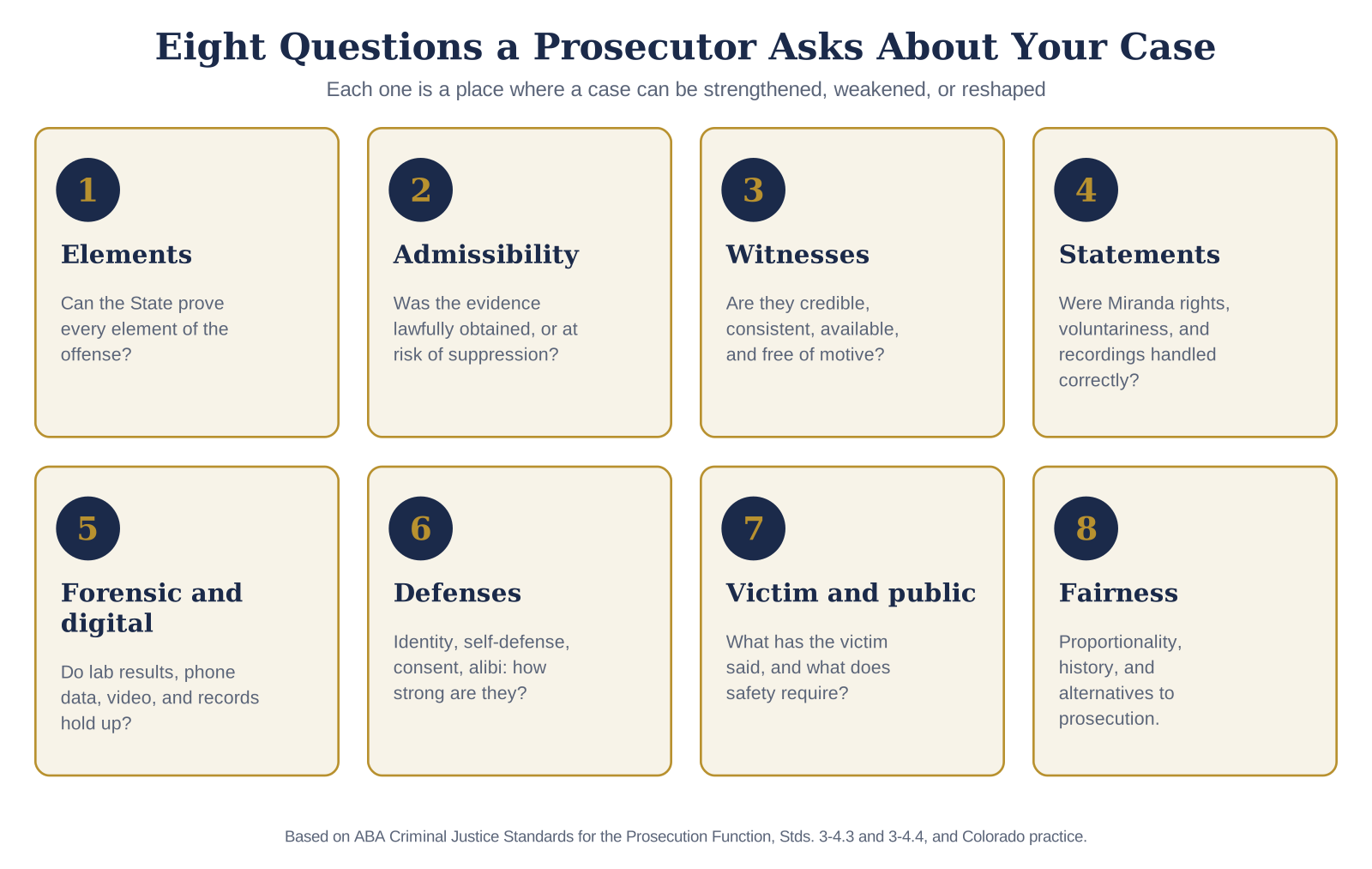
Charging review is less about a single smoking gun and more about whether the whole file hangs together. These are the questions experienced prosecutors work through.
Eight Things a Prosecutor Looks For Before Filing
1. Every element of the offense
A criminal charge is a legal formula, and the State must prove each part of it. A prosecutor reading a theft report asks whether anything shows the person knowingly took the property and intended to deprive the owner of it, not merely that the property is missing. In an assault case, the question is whether the injury and the mental state the statute requires can be shown.
Missing a single element can sink a charge.
2. Admissible, lawfully obtained evidence
Evidence the jury never hears does not help the prosecution. Prosecutors screen for suppression risk in the stop, the search, the arrest, and the interview. A traffic stop without a lawful basis, a search that outruns a warrant, or an arrest like the one in McGee can take the core of a case off the table. Our articles on search and seizure law and what happens when there is no Miranda warning explain how these issues arise.
3. Witnesses who are credible, consistent, and available
Prosecutors compare every witness statement against the others, against the physical evidence, and against the witness’s own earlier accounts. They look at motive, intoxication, delay in reporting, prior inconsistent statements, and whether the witness will actually come to court. In domestic violence cases, a complainant’s reluctance does not automatically end a case, but it changes what the prosecutor believes can be proved.
4. What the accused said
Statements to the police, texts to a friend, and messages to the complainant often become central to the file. Prosecutors check whether the statement was voluntary, whether Miranda warnings were required and properly given, and whether a recording exists. This is also why you should speak with a lawyer before you speak with an investigator. See what to do if you learn you are under criminal investigation.
5. Forensic and digital evidence
Lab results, phone extractions, video, location data, and social media can strengthen a case or expose its gaps. Prosecutors look at chain of custody, testing procedures, and whether the data is complete. For example, in DUI cases the chemical test and the observations behind the stop are both scrutinized, and in digital cases the question is often what investigators can actually recover. Our post on whether police can recover deleted text messages covers the digital side.
6. The defenses the case will face
A thoughtful prosecutor tests the file against the defenses likely to be raised: mistaken identity, self-defense, consent, alibi, or lack of intent. In sex crimes cases, for instance, the common legal defenses often turn on credibility and corroboration. If a defense is strong and the prosecution’s answer is thin, that weighs against filing or toward a reduced charge.
7. The victim and the public
Prosecutors consider the harm caused, the safety of the community, and the victim’s wishes. Colorado’s Victim Rights Act, C.R.S. 24-4.1-302.5, gives victims of qualifying crimes the right to consult with the prosecution before a disposition or trial, and the ABA standards encourage consulting victims of serious crimes before significant decisions such as whether to prosecute. But the victim is not the prosecutor’s client. The prosecutor serves the public, which is why a victim’s wishes carry weight without controlling the outcome.
8. Fairness and proportionality
Even a provable case may not be a case worth filing. Standard 3-4.4 lists factors a prosecutor may properly weigh, including the strength of the case, any doubt about guilt, the harm caused, the person’s background and any voluntary restitution or rehabilitation, whether the punishment or collateral consequences would be disproportionate, any improper conduct by law enforcement, and whether the public’s interest can be served by civil, regulatory, or other remedies.
| What the prosecutor checks | Weakness that can slow or stop a filing | How a defense lawyer may respond |
|---|---|---|
| Elements of the offense | No proof of intent, identity, or a required fact | Show the gap, or point to innocent explanations |
| Admissibility | Suppression risk in the stop, search, arrest, or interview | Identify the legal defect early and in writing |
| Witnesses | Inconsistent accounts, motive, delay, or unavailability | Document inconsistencies and bias |
| Statements | Miranda or voluntariness problems; unclear recordings | Review the full recording, not a summary |
| Forensic and digital | Chain of custody, testing gaps, incomplete data | Consult an expert and request preservation |
| Defenses | Credible self-defense, consent, or identity issues | Present the defense theory when strategy allows |
| Fairness | Disproportionate punishment, no history, restitution made | Offer mitigation, treatment, or restitution |
Discretion: Why Not Every Provable Case Is Filed
Prosecutors are not required to file every charge the evidence might support. The ABA standards recognize broad discretion, but they also draw lines. A prosecutor should not consider partisan or political pressure, personal hostility toward the accused, or bias based on race, sex, religion, national origin, or similar characteristics.
A prosecutor may file even where juries in the area have tended to acquit for that type of crime. A prosecutor should not file or maintain charges greater in number or degree than the evidence can reasonably support and that are needed to fairly reflect the gravity of the offense.
The standards also tell prosecutors to consider noncriminal dispositions and diversion. In Colorado, C.R.S. 18-1.3-101 authorizes district attorneys to operate pretrial diversion programs and to enter individualized diversion agreements signed by the defendant, the defendant’s attorney, and the district attorney. Availability, eligibility, and conditions vary by district, and some offenses are excluded. Juvenile matters have their own track; see our overview of Colorado juvenile diversion programs. If diversion is an option, raising it before the case hardens can matter.
How Colorado Charges Are Actually Filed
Once a prosecutor decides to proceed, C.R.S. 16-5-101 provides four ways to begin a criminal action: a grand jury indictment, an information filed in district court, a felony complaint filed in county court, or, for misdemeanors, petty offenses, and civil infractions, a summons and complaint or a complaint following arrest. A felony complaint is a written statement of the essential facts of the offense, signed by the prosecutor and filed in the court with jurisdiction (Crim. P. 3).
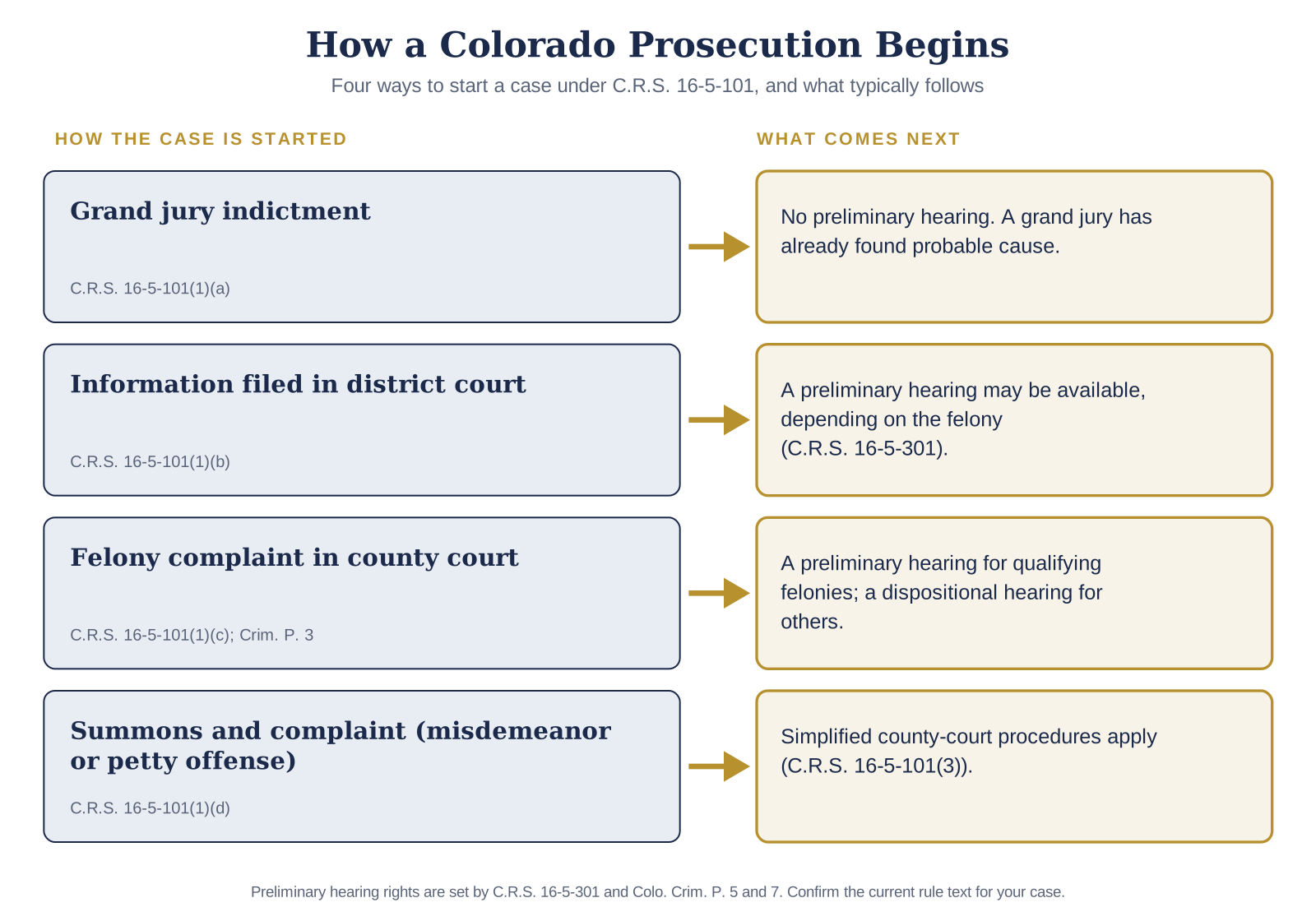
The route matters because it affects what hearing comes next. Under C.R.S. 16-5-301, a person charged by information or felony complaint with a class 1, 2, or 3 felony or a level 1 or 2 drug felony has the right to demand a preliminary hearing to test probable cause.
For class 4, 5, and 6 felonies and level 3 and 4 drug felonies, that right applies only when the offense carries a mandatory sentence, is a violent crime, or is a sexual offense; other cases proceed to a dispositional hearing for evaluation and possible resolution.
After a grand jury indictment, there is generally no preliminary hearing. These rules have been amended over time, so confirm the current text for your charge.
Charges also trigger consequences quickly. In most Title 18 cases, a mandatory protection order follows the filing automatically, and the prosecution’s disclosure obligations begin to run under Crim. P. 16, the ethics rule on disclosing evidence that tends to negate guilt (Rule 3.8(d)), and the constitutional rule of Brady v. Maryland. Those obligations have teeth.
In July 2026, a division of the Colorado Court of Appeals, in an unpublished opinion, affirmed a district court order dismissing ten charges as a sanction for discovery violations in People v. Burney (No. 25CA2112). Unpublished opinions are not binding precedent, but the case shows what is at stake.
The Clock: Statutes of Limitation
A prosecutor cannot wait forever. C.R.S. 16-5-401 sets the general limits: three years for most felonies, eighteen months for misdemeanors, one year for class 1 and 2 misdemeanor traffic offenses, six months for petty offenses, and five years for vehicular homicide.
The period can be tolled while a person is absent from Colorado, up to five years, and for a few offenses, such as theft, the period runs from the date of discovery.
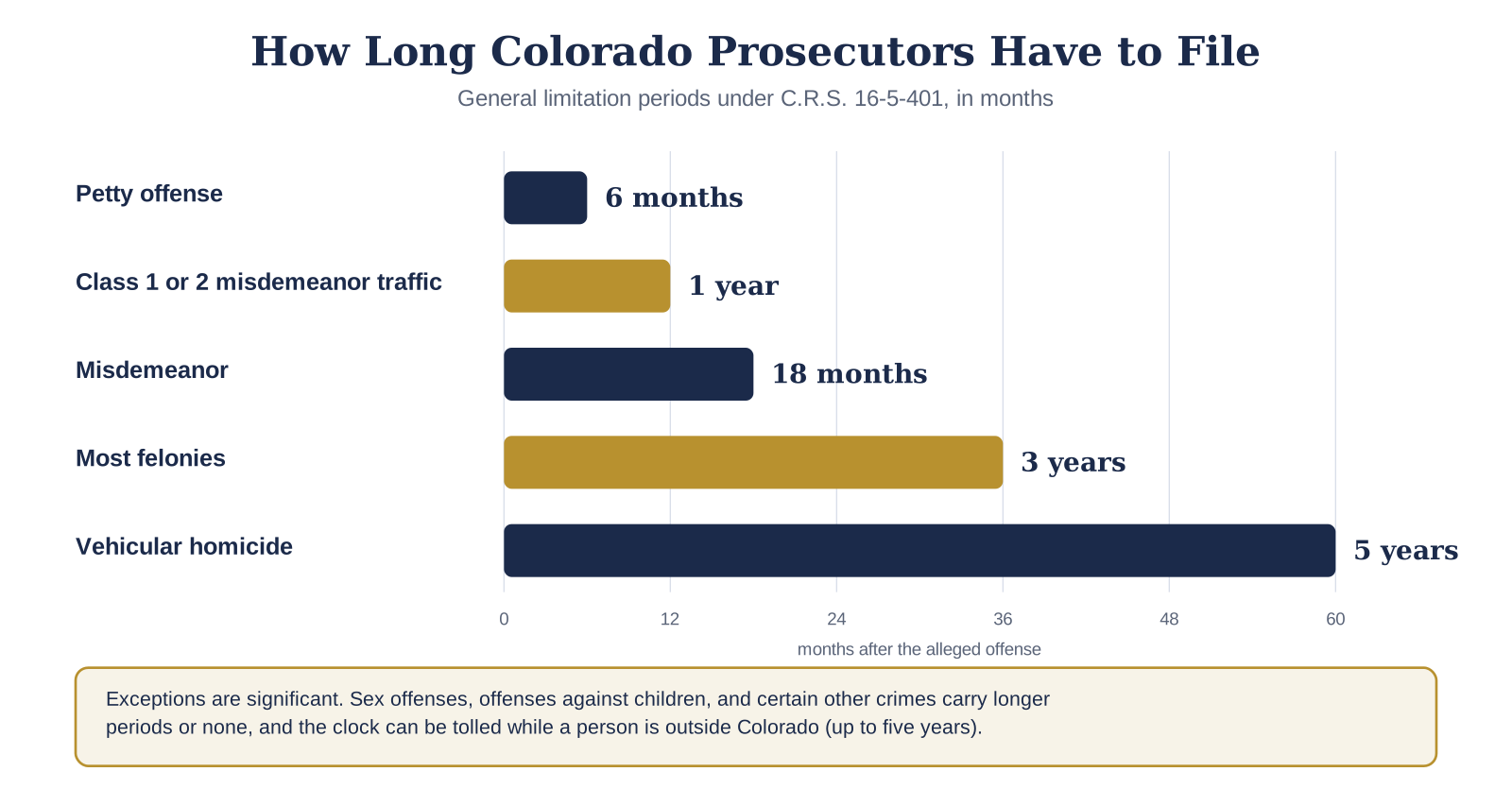
The exceptions are significant. Certain sex offenses, offenses against children, and other serious crimes carry longer periods or no limit at all.
Our guide to Colorado sex crimes statutes of limitation walks through that category.
Why Charges Sometimes Are Not Filed
When a prosecutor declines or delays a filing, the reason is usually one or more of these:
- The evidence does not establish every element, or the identification is weak.
- A key piece of evidence faces serious suppression risk.
- A witness is unreliable, unavailable, or contradicted by other evidence.
- A credible defense would be hard to overcome at trial.
- The harm is limited, and a noncriminal or diversion outcome serves the public better.
- Investigators are still working, and the prosecutor wants a stronger file before deciding.
One point deserves emphasis. A decision not to file now is not an acquittal. If the limitation period has not expired, charges can still be filed, especially if new evidence emerges. That is one more reason not to treat a quiet period as the end of the matter.
What to Do If You Think Charges May Be Coming
If you have been contacted by police, learned you are a suspect, or were arrested and released, the choices you make now often shape what a prosecutor can prove.
- Do not talk to investigators without a lawyer. Say that you want to speak with counsel first, and then stop talking. Explanations offered to “clear things up” are frequently used to fill gaps in the file.
- Do not contact the complainant or witnesses. Even well-meant messages can be treated as intimidation or as a protection order violation.
- Do not delete or alter anything. Deleting messages, photos, or files can create a new, more serious problem than the one you are worried about.
- Stay off social media about the incident, and tell no one but your lawyer the details.
- Hire counsel early. Pre-charge investigation representation exists because the period before filing is when a lawyer can still influence the outcome.
How a Defense Lawyer Can Influence the Charging Decision
A prosecutor deciding what to file is working from the police file, which reflects one side’s investigation. A defense lawyer who engages before filing can supply what the file lacks.
Depending on the case, that can include exculpatory evidence, a detailed explanation of suppression problems, witness issues the police did not explore, mitigation and treatment records, restitution, and a proposal for diversion or a lesser charge. A lawyer can also arrange a voluntary appearance, which the ABA standards encourage prosecutors to consider, in place of an arrest.
Experience matters here because a prosecutor is more likely to listen to a lawyer who understands how the office thinks and who will not waste its time. No lawyer can promise a particular result, and sometimes the wisest strategy is to say nothing and wait for the file to come to us. But where a conversation helps, timing is everything. Our overview of plea bargaining and our article on Colorado Rule 410 and plea negotiations explain what can and cannot be used once discussions begin.
The strongest time to challenge a case is before it is filed, when the prosecutor has not yet committed to a position.
Frequently Asked Questions
Can police file criminal charges without a prosecutor?
Officers arrest, and for many misdemeanors and petty offenses they issue a summons and complaint. But the prosecutor takes over from there and decides whether to proceed, and a felony case is started by a prosecutor-signed complaint, an information, or a grand jury indictment. In every case, the prosecutor is the gatekeeper for formal proceedings.
Is probable cause enough for a prosecutor to file charges?
Legally, it is the minimum. Under Colorado Rule of Professional Conduct 3.8(a), a prosecutor cannot prosecute a charge known to lack it. Many offices go further and ask whether admissible evidence is likely to support a conviction beyond a reasonable doubt, as the ABA Standards recommend.
How long does a Colorado prosecutor have to file charges?
It depends on the offense. Generally, three years for most felonies, eighteen months for misdemeanors, one year for class 1 and 2 misdemeanor traffic offenses, and six months for petty offenses, with longer periods or no limit for some serious crimes. See C.R.S. 16-5-401.
Can charges be filed after I was released without being charged?
Yes, if the limitation period has not expired. Being released, or having the case “rejected” for now, does not prevent a later filing if the prosecutor develops more evidence.
Can the victim drop the charges?
No. The victim is a witness and has rights to be consulted and informed, but the case belongs to the State. The prosecutor decides whether to file, dismiss, or negotiate, after considering the victim’s views along with the evidence and the public interest.
What is the difference between an arrest and a criminal charge?
An arrest is a police action based on probable cause. A charge is the prosecutor’s formal accusation filed with a court. A person can be arrested and never charged, and a person can be charged without ever being arrested, such as by summons.
Should I speak with the prosecutor myself?
No. A prosecutor is not your lawyer, and what you say can be used against you. If a conversation with the prosecutor would help, it should come through an experienced defense attorney.
Can a prosecutor change or add charges later?
Charges can be amended as a case develops. The ABA standards say a prosecutor should not file or maintain charges greater in number or degree than the evidence can reasonably support, which is one reason to scrutinize the original filing.
Talk to a Colorado Criminal Defense Lawyer Before the Decision Is Made
H. Michael Steinberg is a former career prosecutor with more than forty years of Colorado criminal law experience. Your first consultation is free.
Main: 303-627-7777 | Urgent: 720-220-2277
The Edwards Building, 8400 E Prentice Ave, Penthouse 1500, Greenwood Village, CO 80111
Serving Denver and clients throughout Colorado. See attorney profile, practice areas, and case results.
Related Reading From Our Colorado Criminal Law Blog
- The Colorado Criminal Case: From Investigation Through Trial
- What Happens After an Arrest in Colorado? Misdemeanor vs. Felony Timeline
- What Should You Do in Colorado If You Learn You Are Under Criminal Investigation?
- No Miranda Warning? Here Is What Actually Happens in Colorado
- Colorado Rule 410 and Plea Negotiations
- Colorado Mandatory Protection Orders: What Is the Impact on Daily Life
- More on the Colorado criminal process, plea bargaining, and the full blog
Sources and Authorities
- ABA Criminal Justice Standards for the Prosecution Function (4th ed.), Standards 3-4.2 to 3-4.4
- Colorado Rule of Professional Conduct 3.8, Special Responsibilities of a Prosecutor
- C.R.S. 16-5-101, Commencement of prosecution
- C.R.S. 16-5-301, Preliminary hearing or waiver; dispositional hearing
- C.R.S. 16-5-401, Limitation for commencing criminal proceedings
- C.R.S. 18-1.3-101, Pretrial diversion
- C.R.S. 24-4.1-302.5, Rights afforded to victims
- Colo. Crim. P. 3, The Felony Complaint (Rule Change 2006(19))
- Colo. Crim. P. 16, Discovery and Procedure Before Trial
- Illinois v. Gates, 462 U.S. 213 (1983)
- Brady v. Maryland, 373 U.S. 83 (1963)
- People v. McGee, 2026 CO 14
- People v. Smith, 2022 CO 38
- People v. Burney, No. 25CA2112 (Colo. App. July 30, 2026) (unpublished)
This article is general information about Colorado criminal law and procedure. It is not legal advice, it does not create an attorney-client relationship, and it is not a substitute for advice about your specific situation. Laws and court rules change, and outcomes depend on the facts of each case. Prior results do not guarantee a similar outcome. Please do not send confidential information through the website contact form.