 Colorado Criminal Lawyer Blog
Colorado Drug Distribution and Proximate Cause of Death: What Prosecutors Must Prove


Drug Distribution & Proximate Cause of Death: Colorado’s Fentanyl Death Enhancement Explained
Colorado prosecutors can charge a person who sold fentanyl with a level 1 drug felony, even for a small amount, if the sale is alleged to be the “proximate cause” of another person’s death.
That single phrase in C.R.S. § 18-18-405(2)(a)(III)(A) can move a case from a presumptive range of 2 to 4 years to a presumptive range of 8 to 32 years. In 2025, the Colorado Supreme Court explained what that phrase means in People v. Beverly, 2025 CO 18.
H. Michael Steinberg, a Denver metro criminal defense lawyer serving Adams, Denver, Douglas, and Arapahoe counties, provides an overview of what the Colorado statute says about certain crimes. He explains what the prosecution must prove in these cases and discusses how the Beverly case impacted the legal discussion about causation. Steinberg also outlines the most common defenses raised in these cases, helping readers understand potential defense strategies.
Key Takeaways
- The sentencing enhancement applies when a qualifying fentanyl distribution is the proximate cause of the deathof another person who used or consumed the substance.
- Proximate cause is a legal causation standard, not a simple “but for” test. An unforeseeable intervening cause can break the chain.
- People v. Beverly (2025) held that evidence of a purchaser’ssuicidal intentmay be relevant to proximate cause and may be an intervening cause. The jury decides.
- A “death”finding changes the stakes: level 1 drug felony exposure versus a level 3 for the same distribution without it.
- Good Samaritan immunity under C.R.S. § 18-1-711 can apply in some overdose situations.

What Does C.R.S. § 18-18-405(2)(a)(III)(A) Say?
The enhancement sits inside Colorado’s unlawful distribution statute, C.R.S. § 18-18-405. As currently published, subsection (2)(a)(III)(A) reads:
“Except as provided in section 18-1-711 (3)(i), the defendant committed a violation of subsection (2)(a)(I)(D), (2)(b)(I)(D), or (2)(c)(V) of this section, and the actions in violation of subsection (2)(a)(I)(D), (2)(b)(I)(D), or (2)(c)(V) of this section are the proximate cause of the death of another person who used or consumed the material, compound, mixture, or preparation that contained fentanyl, carfentanil, benzimidazole opiate, or an analog thereof as described in section 18-18-204 (2)(g).”
— C.R.S. § 18-18-405(2)(a)(III)(A)
In plain terms, the provision requires the prosecution to show two things beyond the underlying distribution offense: that a person died after using or consuming the fentanyl-containing substance, and that the defendant’s distribution was the proximate cause of that death. Notice the opening clause too. The enhancement is expressly subject to the overdose immunity in § 18-1-711(3)(i), which we discuss below. Cross-referenced definitions of controlled substances and analogs appear in C.R.S. § 18-18-204.
Where This Provision Came From: HB 22-1326
The death enhancement was added by the Fentanyl Accountability and Prevention Act, House Bill 22-1326, which took effect in July 2022. The bill lowered the weight thresholds for fentanyl offenses and created the death-resulting enhancement. It also amended the Good Samaritan statute so that certain people who seek help during an overdose are shielded from the enhancement. The Colorado Attorney General’s office testified in support of the bill before the legislature. Before the 2022 law, Colorado had no state-level equivalent of the federal “distribution resulting in death” penalty found in 21 U.S.C. § 841.
What the Prosecution Must Prove
Because the enhancement increases the felony level, each piece must be proven beyond a reasonable doubt. The prosecution’s burden breaks down into four steps:
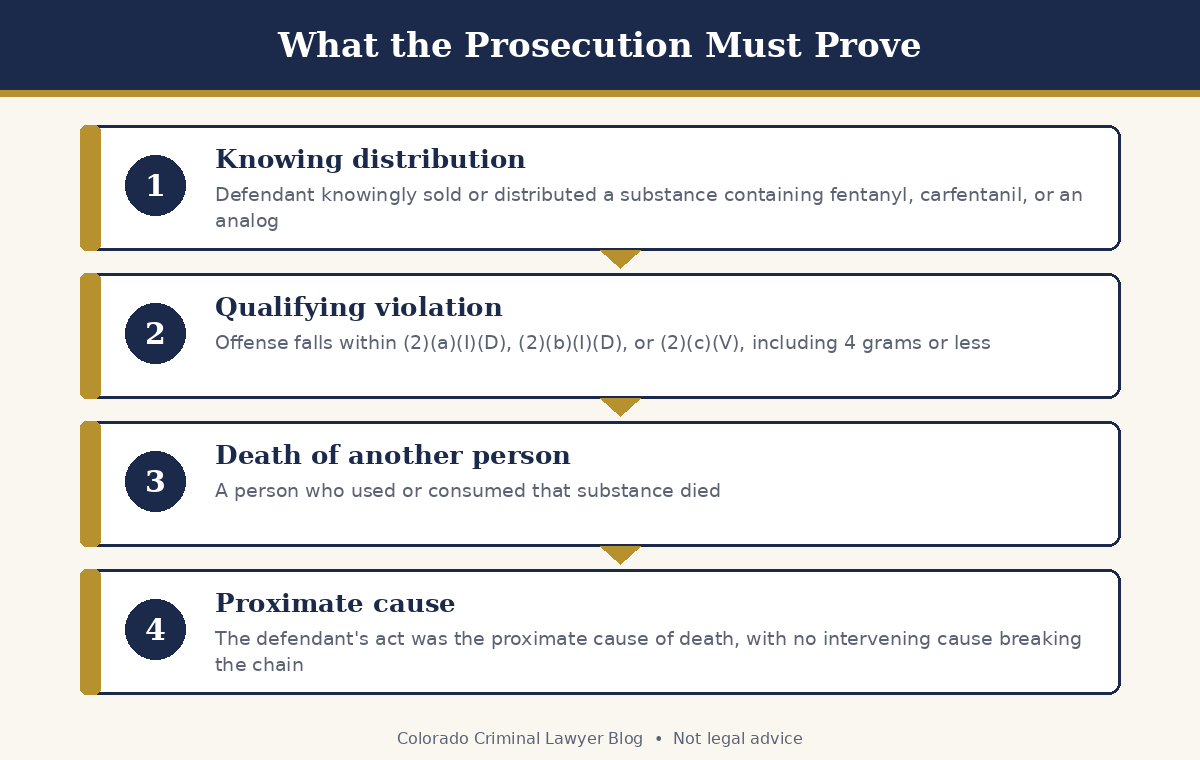
- Knowing distribution. The defendant knowingly sold, distributed, or otherwise committed a qualifying offense involving a substance containing fentanyl, carfentanil, or an analog. See § 18-18-405.
- A qualifying subsection. The conduct must fall within subsection (2)(a)(I)(D), (2)(b)(I)(D), or (2)(c)(V). The (2)(c)(V) route is the one at issue when the weight is four grams or less, as it was in Beverly.
- Death of another person. Someone who used or consumed that substance must have died.
- Proximate cause. The defendant’s actions must be the proximate cause of the death, with no intervening cause breaking the chain.
What “Proximate Cause” Means in Colorado
Proximate cause is a familiar concept in criminal and civil law. In Beverly, the Colorado Supreme Court applied the established legal meaning, describing it as a “cause which in natural and probable sequence produced the claimed injury.” The court emphasized that the General Assembly chose that term deliberately. An intervening cause, in the court’s description, is an event the defendant did not participate in, that was not reasonably foreseeable, and without which the death would not have occurred.
Proximate Cause Is Not the Federal “But-For” Standard
The federal distribution-resulting-death penalty has been read to require only “but-for” causation. In Burrage v. United States, 571 U.S. 204 (2014), the U.S. Supreme Court held that the federal statute’s language required that the drug be a but-for cause of death.
The Colorado Supreme Court contrasted that approach with Colorado’s wording. Colorado’s legislature used “proximate cause,” which carries the added legal requirement of a proper causal connection and is defeated by a qualifying intervening cause. For defendants, that difference is the doorway to a defense the federal framework does not offer in the same way.
Authority Box
- Statute: C.R.S. § 18-18-405(2)(a)(III)(A) (fentanyl death enhancement)
- Sentencing: C.R.S. § 18-1.3-401.5 (drug felony levels and presumptive ranges)
- Immunity: C.R.S. § 18-1-711 (overdose reporting immunity)
- Leading case: People v. Beverly, 2025 CO 18 (Colo. May 5, 2025)
People v. Beverly (2025): Purchaser Suicide and Intervening Cause
People v. Beverly is the first Colorado Supreme Court decision to interpret the enhancements causation requirement. The facts are important. Police found a purchaser dead in his car after an apparent overdose. Shortly before his death, he had texted his girlfriend a goodbye message.
The coroner concluded he died of fentanyl intoxication with lethal intent and classified the manner of death as suicide. Investigators tied the defendant to a $90 sale of fentanyl pills that day, and he was charged in El Paso County with distribution of less than four grams of fentanyl as a level 1 drug felony under the proximate-cause enhancement.
The prosecution asked the trial court to exclude all evidence of the purchaser’s suicidal intent. The trial court refused, and the prosecution took the question directly to the Colorado Supreme Court. By a 5-2 vote, the court sided with the defense on the evidentiary question.
Its holdings include:
- A purchaser’s suicide by intentional overdose may constitute an intervening cause that breaks the causal chain.
- Evidence of the purchaser’s suicidal intent may be relevant to whether the defendant’s distribution was the proximate cause of death.
- The trial court did not abuse its discretion in refusing to exclude the purchaser’s text message and the coroner’s testimony under CRE 402 and CRE 403.
- Factual disputes about proximate cause are for the jury.
“[A] drug purchaser’s suicide by intentional overdose may constitute an intervening cause.”
— People v. Beverly, 2025 CO 18, ¶ 6
The majority was careful about the limits of its ruling. Such evidence may not always be admissible, it may not always justify an intervening-cause instruction, and the prosecution can still persuade a jury that the death was a foreseeable result of the sale.
Two justices dissented, reasoning that illicit fentanyl carries an inherent risk of death and that the statute does not distinguish between accidental and intentional overdoses. You can read the full opinion, including the dissent, on the Colorado Judicial Branch website.
Why the Causation Finding Matters: The Penalty Gap
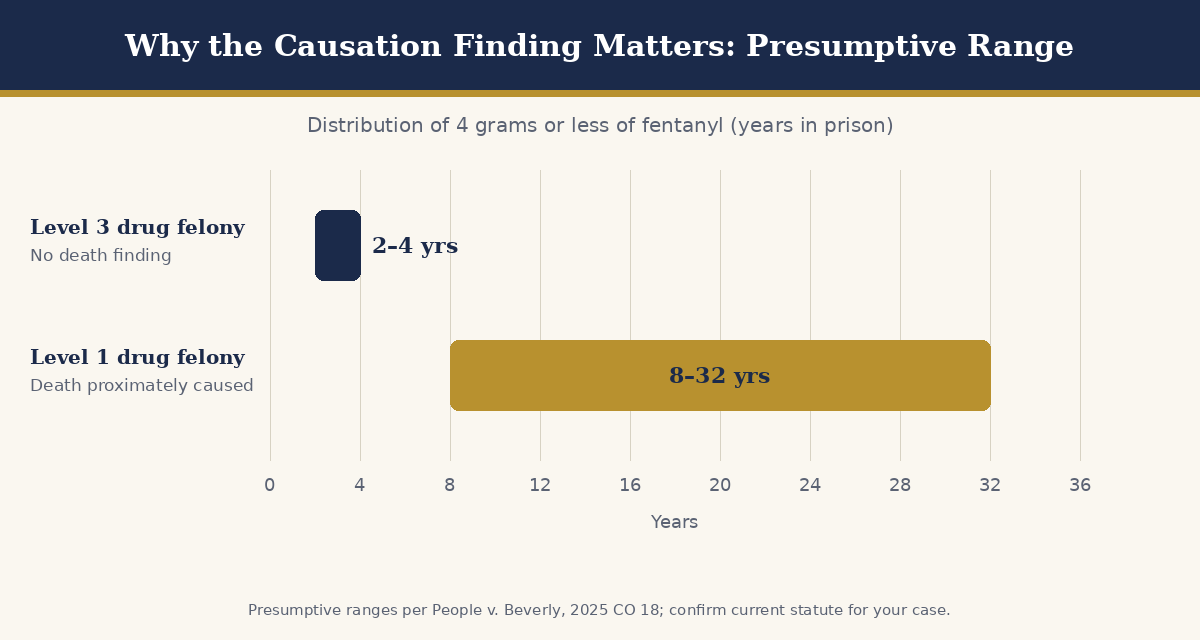
Fentanyl distribution of four grams or less is ordinarily a level 3 drug felony. The death enhancement elevates the same conduct to a level 1 drug felony. Under C.R.S. § 18-1.3-401.5, a level 1 drug felony carries a presumptive range of 8 to 32 years in prison, compared with 2 to 4 years at level 3. That gap is why the causation question is often the central battleground in these prosecutions.
One detail in the statute deserves attention. Subsection (2)(a)(III)(B) provides that a defendant whose violation falls under (2)(c)(V) and who is found to have proximately caused a death is not subject to the mandatory sentencing requirement in § 18-1.3-401.5(7). That matters for sentencing advocacy even where causation is established. The rules around sentencing are detailed, and you should review the statute with counsel.
You can also see how weight thresholds and drug felony levels interact in our companion article, Colorado Fentanyl Charges: What Colorado Law Means for Your Case.
The Good Samaritan Exception: C.R.S. § 18-1-711
The first words of the enhancement are “Except as provided in section 18-1-711 (3)(i).”HB 22-1326 amended Colorado’s overdose immunity statute so that a person who qualifies for protection cannot be prosecuted under (2)(a)(III)(A) when the underlying distribution involved four grams or less of a substance containing fentanyl, carfentanil, or a related compound.
Immunity generally depends on the person acting to obtain medical help for the overdose, remaining on scene, and cooperating with responders. The exact conditions are written into the statute, and whether they were met is a fact-heavy question, so any claim of immunity should be reviewed against the current text of § 18-1-711.
Common Defense Issues in Fentanyl Death Cases
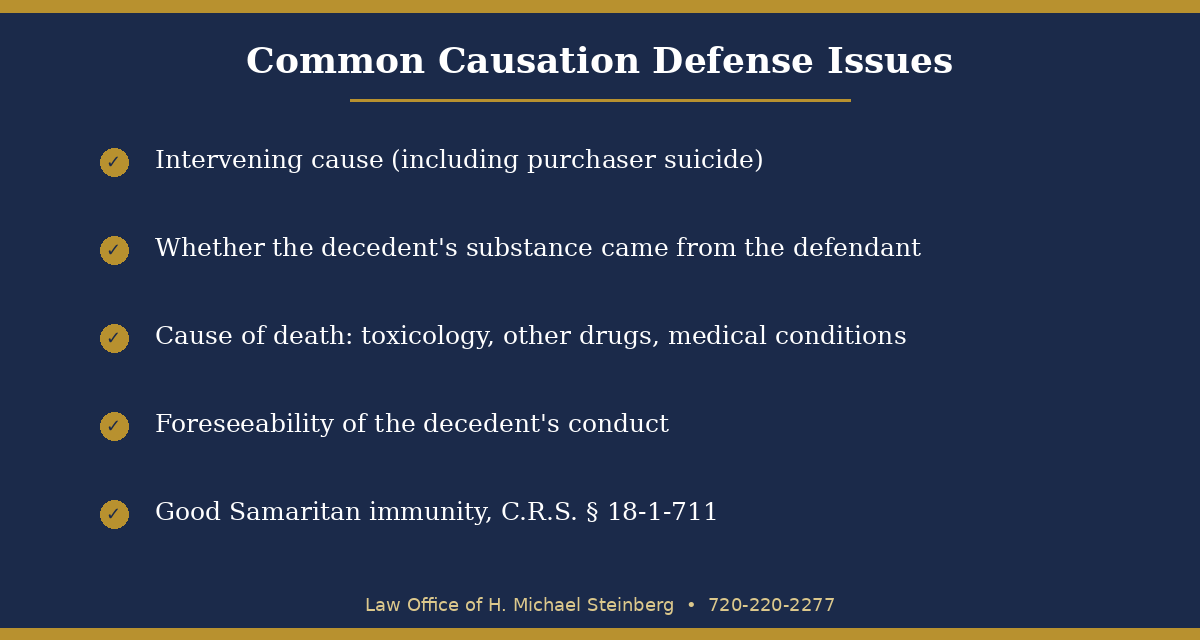
No two cases are alike, but several issues recur. A thorough defense investigation usually looks at each of them.
1. Intervening Cause
After Beverly, a purchaser’s intentional overdose is the clearest example, but the underlying principle is broader. Any independent, unforeseeable event that supersedes the defendant’s conduct as the true cause of death can be raised. Defense counsel should evaluate messages, medical history, and witness statements for facts bearing on foreseeability.
2. Source of the Substance
The enhancement requires that the decedent used or consumed the material that the defendant distributed. If the person had access to other sources, or used a different batch, the link between the defendant’s sale and the fatal dose can be contested. Lab testing and the chain of custody of pills, residue, and paraphernalia are central.
3. Cause of Death
Toxicology reports and autopsy findings should be examined closely. Poly substance use, underlying medical conditions, and the timing of death can all raise questions about whether fentanyl, as opposed to another factor, caused the death. Independent expert review is often warranted.
4. Knowledge and the Underlying Offense
The enhancement attaches only if the prosecution proves the underlying distribution violation. Challenges to knowing distribution, weight, identification of the substance, and the legality of the search or arrest apply here just as in any other drug case. If the evidence was obtained unlawfully, it may be suppressed. Our post on drug-dog sniffs and vehicle searches covers one common suppression issue.
5. Overdose Immunity
If the defendant sought help for the person who died, the Good Samaritan provision may be a complete answer to the enhancement. The facts about who called, when, and what happened afterward need to be gathered early.
What to Do If You Are Under Investigation
- Do not discuss the case with police or the decedent’s friends or family. Statements, texts, and social media messages are frequently used as evidence.
- Preserve your phone and messages. Do not delete anything. Deleted data can create separate problems and may be recovered anyway.
- Contact a Colorado drug defense attorney immediately. Early intervention can affect charging decisions. For an overview of how a Colorado case moves forward, see The Colorado Criminal Case: From Investigation Through Trial.
Frequently Asked Questions
What is proximate cause of death under Colorado’s fentanyl statute?
It is the legal causation standard in C.R.S. § 18-18-405(2)(a)(III)(A). The prosecution must show that the defendant’s distribution produced the death in a natural and probable sequence, without a qualifying intervening cause breaking the chain.
How much fentanyl does it take to be charged with causing a death?
The enhancement can apply even where the distribution involved four grams or less. In People v. Beverly, the charge arose from a sale of fewer than four grams.
Can a buyer’s suicide be a defense?
The Colorado Supreme Court held in People v. Beverly (2025) that a purchaser’s suicide by intentional overdose may be an intervening cause and that evidence of suicidal intent may be relevant. The jury decides whether the facts support it.
What is the penalty for a level 1 drug felony in Colorado?
The presumptive range is 8 to 32 years in prison under C.R.S. § 18-1.3-401.5, subject to the statute’s sentencing provisions.
Does the Good Samaritan law protect someone from this charge?
It can. The enhancement is expressly subject to C.R.S. § 18-1-711(3)(i), which provides immunity in qualifying overdose situations. Whether immunity applies depends on the facts.
Is this the same as the federal “distribution resulting in death” law?
No. The federal statute has been read to require but-for causation, as in Burrage v. United States. Colorado’s statute uses the narrower concept of proximate cause.
Speak With a Denver Drug Defense Attorney
A fentanyl death investigation or charge is among the most serious drug allegations a person can face in Colorado. Attorney H. Michael Steinberg has practiced criminal defense in Colorado for more than forty years, and the Law Office of H. Michael Steinberg represents clients accused of drug crimes throughout the Denver metro area. Learn more about our Colorado drug crimes defense practice, review our resources for Colorado and federal drug charges, or read about the firm. To discuss your situation, call 720-220-2277.
This article is for general information only and is not legal advice. Colorado drug laws change frequently, and this article was accurate only as of the date of publication. Reading it does not create an attorney-client relationship. Please do not send confidential information through website forms or voicemail until you have spoken with an attorney.
SOURCES & AUTHORITIES
- C.R.S. § 18-18-405 (Justia)
- C.R.S. § 18-18-204 (Justia)
- C.R.S. § 18-1-711 (Justia)
- C.R.S. § 18-1.3-401.5 (Justia)
- People v. Beverly, 2025 CO 18 (Colorado Judicial Branch)
- People v. Beverly (FindLaw)
- HB 22-1326, rerevised bill text
- Attorney General testimony on HB 22-1326
- Burrage v. United States, 571 U.S. 204 (Cornell LII)
- 21 U.S.C. § 841 (Cornell LII)