 Colorado Criminal Lawyer Blog
The Colorado Criminal Case: From Investigation Through Trial


The Colorado Criminal Case: From Investigation Through Trial
If you or someone you love has been arrested or is under investigation in Colorado, the hardest part is often not knowing what happens next. The criminal process has its own vocabulary, deadlines, and critical points, and decisions made in the first days can shape the outcome months later.
This guide walks through the Colorado criminal case from the first police contact to the jury’s verdict, so you will know what to expect and where a defense lawyer can make the most difference.
- Stage 1: The Investigation
- Stage 2: Arrest or Summons
- Stage 3: First Advisement and Bond
- Stage 4: The Charging Decision
- Stage 5: Preliminary Hearing
- Stage 6: Arraignment and Plea
- Stage 7: Discovery
- Stage 8: Pretrial Motions
- Stage 9: Plea Negotiations
- Stage 10: The Jury Trial
- Stage 11: Sentencing and Appeal
- Frequently Asked Questions
The Colorado Criminal Case at a Glance
Every case is different, but most Colorado prosecutions follow the same road map. Some cases leave the road early, through a dismissal or a plea agreement. Others travel all the way to a jury. The graphic below shows the eleven stages we cover in this article.
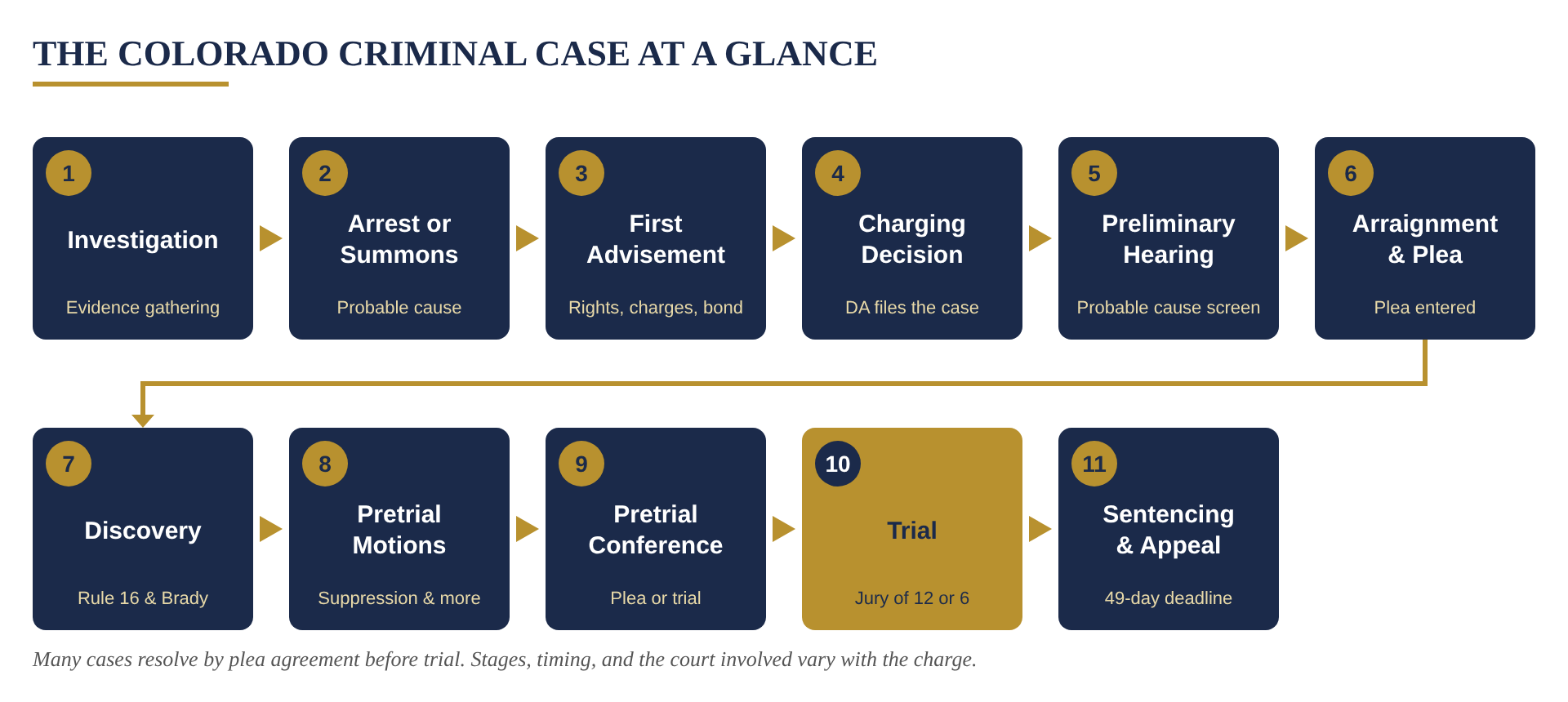
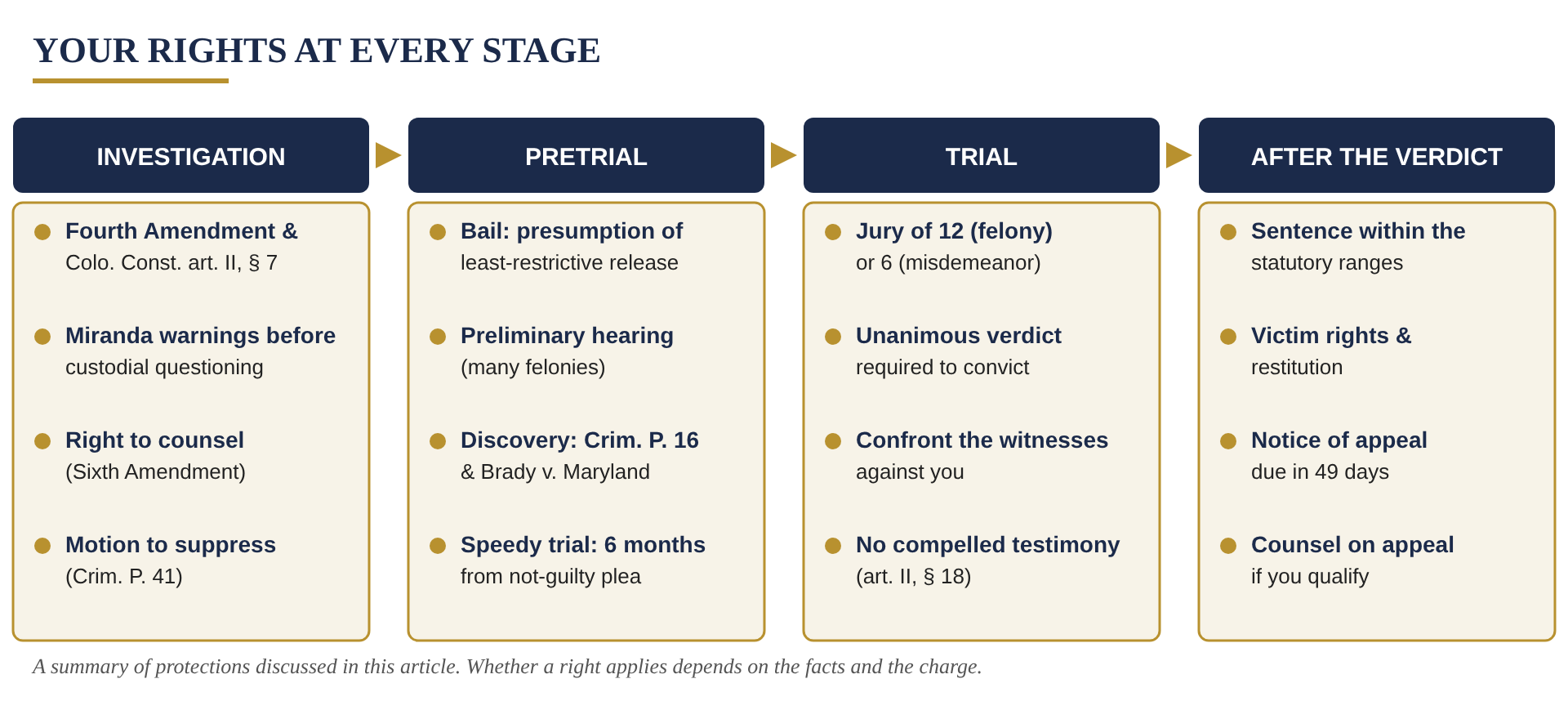
Two ideas run through every stage. First, the burden is always on the government: the prosecution must prove every element of a charge beyond a reasonable doubt. Second, you have constitutional rights at each step, found in the Fourth, Fifth, and Sixth Amendments and in Article II of the Colorado Constitution, the Colorado Bill of Rights.
The graphic below summarizes where those rights apply.
Stage 1: The Investigation
Most criminal cases begin before the accused person knows it. Police may interview witnesses, review surveillance video, collect digital records, request phone data and obtain search warrants. Sometimes an investigation ends in an immediate arrest. Sometimes it runs for months and the first sign you see is a detective’s phone call or a knock at the door.
The legal rules at this stage center on the Fourth Amendment and Colorado’s own protection against unreasonable searches and seizures. In general, officers need a search warrant supported by probable cause, or an exception to the warrant requirement such as consent, exigent circumstances, or a vehicle search supported by probable cause. Evidence gathered in violation of these rules can be challenged in a motion to suppress, a remedy rooted in Mapp v. Ohio.
The Fifth and Sixth Amendments also matter here. Under Miranda v. Arizona, statements made during custodial interrogation are generally inadmissible unless police first warn you of your right to remain silent and to have a lawyer. Once the process begins, the right to counsel attaches, and Gideon v. Wainwright guarantees a lawyer to those who cannot afford one.
Stage 2: Arrest or Summons
A case formally begins in one of two ways. In an arrest, an officer takes you into custody either with a warrant or without one, when there is probable cause to believe you committed a crime. In a summons case, usually for lower-level offenses, you receive a ticket-like document ordering you to appear in court on a set date and are not taken to jail.
After an arrest, you are booked: fingerprints, photographs, and entry into the jail system. Anything you say while in custody can be recorded. Whether you are arrested or summoned, missing a court date can lead to a warrant and new charges, so treat every date as mandatory.
Stage 3: First Advisement and Bond
The first court appearance is called the first advisement. The judge tells you the charges and your rights, addresses whether you have a lawyer, sets future dates, and decides the conditions of release. For a person in custody, this happens promptly after arrest.
Bond is often the most urgent issue. Colorado law starts from a strong presumption that a person should be released on the least restrictive conditions that reasonably ensure court appearance and community safety. See C.R.S. § 16-4-103 and the 2019 reforms in House Bill 19-1226. Conditions can include a personal recognizance bond, a cash or surety bond, pretrial supervision, electronic monitoring, no-contact orders, alcohol monitoring, and surrender of firearms. Article II, section 19 of the Colorado Constitution also addresses the right to bail. The Office of the State Public Defender explains the basics at its bail and pretrial release page.
A defense lawyer can ask the court to reconsider the amount or conditions of bond, present evidence of your community ties and employment, and propose supervision that keeps you out of custody while the case is pending.
Stage 4: The Charging Decision
Colorado is divided into 23 judicial districts, each with an elected district attorney who decides whether to prosecute and what to charge. You can find yours using the Colorado District Attorneys’ Council directory, and the Council’s overview of the process gives the prosecution’s perspective.
Charges are usually filed by a document called a complaint and information, or, in rarer cases, by a grand jury indictment. The initial charges are not always the final ones. Prosecutors can add, amend, or drop counts as the case develops, and a skilled and experienced Colorado criminal defense attorney often engages with the DA at this early stage to provide context, mitigation, or raise evidentiary issues.
How Colorado Classifies Crimes
Colorado separates offenses into felonies, misdemeanors, petty offenses and drug offenses, each with its own classes or levels. The class determines the possible punishment, which is why the charge itself matters so much.
| Category | Classes | Typical Consequences |
|---|---|---|
| Felony | Class 1 through Class 6; drug felonies Level 1 through Level 4 | Prison, probation, parole, fines, restitution and lasting collateral consequences |
| Misdemeanor | Class 1 through Class 3; drug misdemeanors Level 1 and 2 | County jail, probation, fines and a criminal record |
| Petty offense | Class 1 and 2 | Fines and limited jail exposure, generally no jury right |
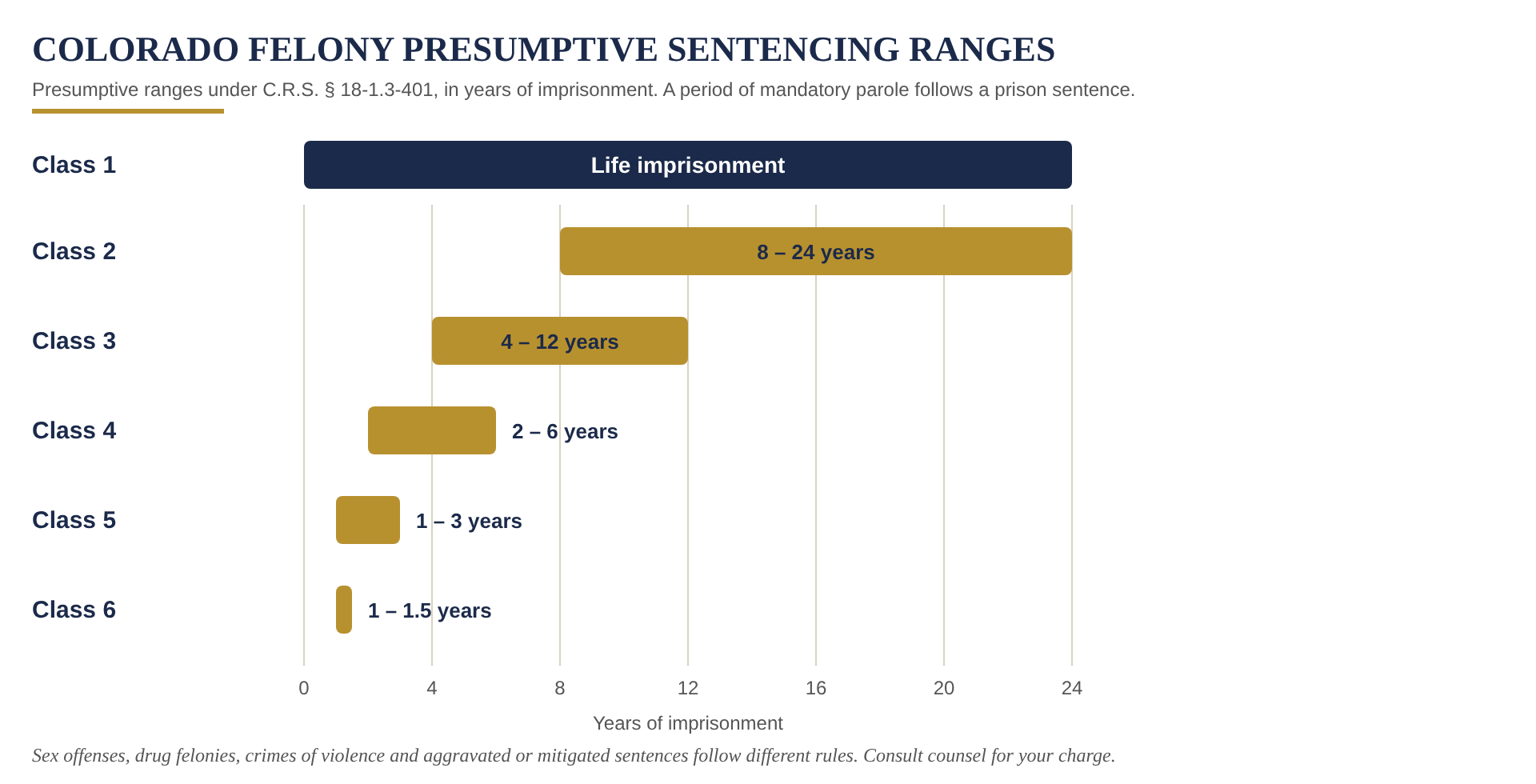
The presumptive sentencing ranges for each felony class are set by C.R.S. § 18-1.3-401. The chart below shows the standard ranges for the most common felony classes. The Colorado Commission on Criminal and Juvenile Justice offers a helpful overview of the sentencing scheme.
Stage 5: Preliminary Hearing
In many felony cases, the defense may request a preliminary hearing, a screening in which a judge decides after a litigated hearing whether the prosecution has enough evidence, meaning probable cause, to proceed with the case. Who is entitled to one depends on the class of the offense and on whether the defendant is in custody; the governing rule is C.R.S. § 16-5-301. The deadline to request the hearing is short, so this is another reason to retain counsel immediately.
The standard is far lower than at trial, and judges usually find probable cause. However the hearing is still valuable. It lets the defense cross-examine the prosecution’s witnesses under oath, lock in testimony, learn the strength of the case, and sometimes obtain reduced charges or a dismissal. In cases where a full preliminary hearing is unavailable, Colorado practice provides alternatives, such as a dispositional hearing to resolve the case.
Stage 6: Arraignment and Plea
At arraignment, the court formally reads the charges, and you enter a plea. The options under Crim. P. 11 are not guilty, guilty, not guilty by reason of insanity, and, with the court’s consent, nolo contendere.Defendants who are still evaluating the evidence nearly always plead not guilty, and that plea does not indicate what ultimately happens.
The not guilty plea also starts a critical clock. Under Colorado’s speedy trial statute, C.R.S. § 18-1-405, a defendant who pleads not guilty must generally be brought to trial within six months, with exceptions for delays caused or requested by the defense and certain other circumstances. If the deadline is violated, the charges must be dismissed. More background on the concept is available from Cornell’s Legal Information Institute on the right to a speedy trial.
Stage 7: Discovery
Discovery is the exchange of evidence. Under Crim. P. 16, the prosecution must disclose police reports, witness statements, recordings, expert reports, physical evidence, and other material. Separately, the case of Brady v. Maryland requires prosecutors to turn over evidence favorable to the accused that is material to guilt or punishment, including information that could be used to impeach a government witness.
Modern cases can involve enormous volumes of data: body-worn camera footage, 911 audio, cell phone extractions, social media records, and lab data. Careful review is where defenses are found.
defense lawyer reads this material for gaps in the timeline, unreliable identifications, inconsistent statements, procedural errors by officers, and weaknesses in forensic work. Defense investigators and expert witnesses may be retained to test the government’s evidence. The defense has its own limited disclosure obligations, for example, when it intends to raise certain defenses or call experts.
Stage 8: Pretrial Motions
Pretrial motions let the defense ask the judge to rule on legal questions before the jury is ever seated. Some of the most important are:
- Motion to suppress evidence. Challenges a search, seizure or arrest that violated the Fourth Amendment or the Colorado Constitution. If granted, the prosecution cannot use the evidence, which can end the case.
- Motion to suppress statements. Challenges confessions or admissions obtained in violation of Miranda or because they were involuntary.
- Motion to dismiss. Raises legal defects such as speedy trial violations or insufficient charging language.
- Motions in limine. Ask the court to limit or exclude prejudicial evidence at trial, such as prior bad acts.
- Motion to compel discovery. Seeks evidence the prosecution has not produced.
- Motion to sever or change venue. Addresses unfair joinder of defendants or counts and, in high-publicity cases, the fairness of the jury pool.
The court may hold an evidentiary hearing, with testimony from officers and other witnesses, before ruling. A win on a suppression motion can dramatically change plea negotiations. Even a loss builds the record for a later appeal.
Stage 9: Plea Negotiations and Pretrial Conference
Most criminal cases, in Colorado and nationally, resolve by agreement rather than verdict. A plea agreement under Crim. P. 11 can take many forms: pleading to a lesser charge, dismissing some counts, agreeing to a particular sentence or range, or a deferred judgment and sentence that allows the charge to be dismissed if you complete probation conditions successfully.
Whether to accept an offer is your decision, not your lawyer’s and not the prosecutor’s. A good attorney explains the strengths and weaknesses of the evidence, the realistic trial outcomes, the sentencing exposure, and the hidden consequences of a conviction, including effects on employment, professional licenses, firearm rights, housing, and immigration status.
The Office of the State Public Defender summarizes many of these in its excellent guide to collateral consequences of conviction, and a later sealing of records may or may not be available depending on the result.
Before trial, courts commonly hold a pretrial conference or readiness hearing where the judge confirms that motions are resolved, witnesses are lined up, and the case is truly ready for trial or for a plea.
Stage 10: The Jury Trial
If the case does not resolve, it goes to trial. The Sixth Amendment and Colorado law guarantee the right to a jury. Under C.R.S. § 18-1-406 and Crim. P. 23, felony cases are generally tried to twelve jurors and misdemeanors to six, and the verdict must be unanimous. A defendant may instead choose a bench trial before a judge in appropriate cases.
- Jury selection (voir dire). Lawyers question potential jurors to uncover bias and select a fair panel. Each side can challenge jurors for cause and use a limited number of peremptory challenges.
- Opening statements. Each side previews the evidence. Openings are not evidence.
- The prosecution’s case. Witnesses testify, and exhibits are admitted. The defense has the right to confront and cross-examine every witness against the accused.
- Motion for judgment of acquittal. After the prosecution rests, the defense may ask the judge to rule that the evidence is legally insufficient.
- The defense case. The defense may call witnesses or present none at all. Under the Fifth Amendment and Article II, Section 18 of the Colorado Constitution, the accused cannot be forced to testify, and the jury is instructed not to hold silence against them.
- Closing arguments and jury instructions. The judge explains the law, including the presumption of innocence and the prosecution’s burden of proof beyond a reasonable doubt.
- Deliberation and verdict. The jury must be unanimous to convict. If it cannot agree, the judge may declare a mistrial, and the prosecution may try the case again.
The prosecution must convince every juror, unanimously, beyond a reasonable doubt. The defense only needs one juror who is not convinced.
A trial is where preparation pays off. Effective defense lawyers use cross-examination to expose inconsistencies, present alternative explanations, challenge forensic methods, and humanize the client. Many cases are won not because of a single dramatic moment, but because the defense understood the evidence better than anyone else in the courtroom.
Stage 11: Sentencing and Appeal
After a guilty plea or verdict, if the defendant is convicted, the Court sets a sentencing date, typically several weeks out. A probation department prepares a presentence investigation report describing the offense, the defendant’s history, and the victim’s statements.
Victims have the right to be heard and may seek restitution. The defense can submit its own sentencing memorandum, character letters, treatment records, and other mitigation. The judge then imposes a sentence within the limits of C.R.S. § 18-1.3-401 and any applicable special statutes, from probation or community corrections to prison.
A conviction is not necessarily the end. A defendant has the right to appeal, and the deadline is tight. Under Colo. App. R. 4(b), a notice of appeal in a criminal case is generally due within 49 days of the sentence being imposed.
Appeals address legal errors such as improper evidence rulings, faulty jury instructions, insufficient evidence and sentencing mistakes. Separately, post-conviction relief under Crim. P. 35 can raise issues like ineffective assistance of counsel. The public defender’s page on appeals and post-conviction motions explains these options in plain language.
Sidebar: Felonies and Misdemeanors Follow Fifferent Routes
| Issue | Felony case | Misdemeanor or petty-offense case |
|---|---|---|
| Usual trial court | District court | County court for state charges |
| Early screening | May include an eligible preliminary hearing or a dispositional hearing | Generally does not include the felony preliminary-hearing process |
| Transfer between courts | Many cases begin in county court and are bound over; direct filings and indictments differ | Generally remains in county court |
| Trial preparation | Discovery, investigation, motions, negotiations, and trial preparation | The same core defense work, with procedures tailored to the case |
Five Mistakes That Can Hurt Your Colorado Case
- Talking to police without a lawyer. Statements are rarely helpful and are often the prosecution’s best evidence.
- Missing court dates. A failure to appear leads to warrants, bond forfeiture, and possible additional charges.
- Posting about the case online. Social media posts and messages can become exhibits.
- Violating bond conditions. Contacting a protected person or drinking when prohibited can land you back in custody.
- Waiting to hire counsel. Evidence disappears, deadlines pass, and early negotiating opportunities close.
Frequently Asked Questions
Talk to a Denver Criminal Defense Lawyer
Sources and Further Reading
- C.R.S. § 18-1.3-401, Felony sentencing (Justia)
- C.R.S. § 18-1-405, Speedy trial (Colorado Public Law)
- C.R.S. § 18-1-406, Trial by jury (Justia)
- C.R.S. § 16-5-301, Preliminary hearings (Colorado Public Law)
- C.R.S. § 16-4-103, Bail (Colorado Public Law)
- Colorado Constitution, Article II, Bill of Rights (Justia)
- U.S. Constitution, Fourth Amendment (Cornell LII)
- U.S. Constitution, Fifth Amendment (Cornell LII)
- U.S. Constitution, Sixth Amendment (Cornell LII)
- Miranda v. Arizona, 384 U.S. 436 (1966)
- Gideon v. Wainwright, 372 U.S. 335 (1963)
- Brady v. Maryland, 373 U.S. 83 (1963)
- Mapp v. Ohio, 367 U.S. 643 (1961)
- Colo. Crim. P. 11, Pleas
- Colo. Crim. P. 16, Discovery and procedure before trial
- Colo. Crim. P. 23, Trial by jury
- Colo. App. R. 4, Appeal as of right
- HB 19-1226, Bond reform (Colorado General Assembly summary)
- Overview of the Colorado Sentencing Scheme (CCJJ)
- Colorado District Attorneys’ Council: The Process
- Colorado Office of the State Public Defender: Applying for a Public Defender
- Colorado Office of the State Public Defender: Bail and Pretrial Release
- Colorado Office of the State Public Defender: Appeal and Post-Conviction Motions
- Colorado Office of the State Public Defender: Collateral Consequences
Disclaimer: This article is provided for general informational purposes only and is not legal advice. Reading it does not create an attorney-client relationship with the Law Office of H. Michael Steinberg. Laws change and every case turns on its own facts; consult a licensed attorney about your situation. Past results do not guarantee a similar outcome.