 Colorado Criminal Lawyer Blog
How Colorado Police Decide Who to Arrest in a Domestic Violence Case



When officers respond to a domestic dispute in Colorado, they do not get to walk away because the couple says they have worked it out. Colorado state law in “DV” cases actually forces them toward making an arrest, and it gives them a short checklist for deciding who goes to jail when both people say the other one started it.
As a Denver criminal defense attorney, I handle cases that result from the damage caused by those split-second decisions every week. This guide explains how the decision is made, what the laws actually require, and, of course, what happens next.
Why Colorado Police Arrest First and Let The Prosecutor Sort It Out Later
Colorado is a mandatory-arrest state. Section18-6-803.6of the Colorado Revised Statutes says that when a peace officer determines that an act of domestic violence has been committed, the officer “shall, without undue delay, arrest the person suspected of its commission.”
I was a young prosecutor in Arapahoe and Douglas Counties with about 6 years of experience under my belt when these laws were enacted, and I witnessed their massive impact on the Colorado criminal justice system.
The legislature adopted that approach in the 1990s because earlier practice, which left the decision to individual officers and often to the complaining party, too often ended with the officer leaving and the violence continuing.
Two practical consequences follow. First,the alleged victim does not control the arrest. Telling the officer “I don’t want to press charges”does not end the matter, because the decision belongs to the officer and, later, to the district attorney. Second, officers are protected when they arrest in good faith, so the system tends to favor action over waiting.
The U.S. Supreme Court confirmed inTown of Castle Rock v. Gonzales, 545 U.S. 748 (2005)that a person has no constitutional property right to compel police enforcement of a protection order, which is one reason the legislature built that duty into state procedure rather than relying on individual lawsuits.
What Counts as Domestic Violence in Colorado
Domestic violence in Colorado is not a standalone crime. It is a sentencing and procedural labelattached to an underlying offense. Under C.R.S. 18-6-800.3, it means an act or threat of violence, or any other crime, committed against a person with whom the actor is or has been in an intimate relationship, when it is used as a method of coercion, control, punishment, intimidation, or revenge. That is why the underlying charge might be harassment, assault, menacing, criminal mischief, or even a property crime, each carrying a “domestic violence”designation.
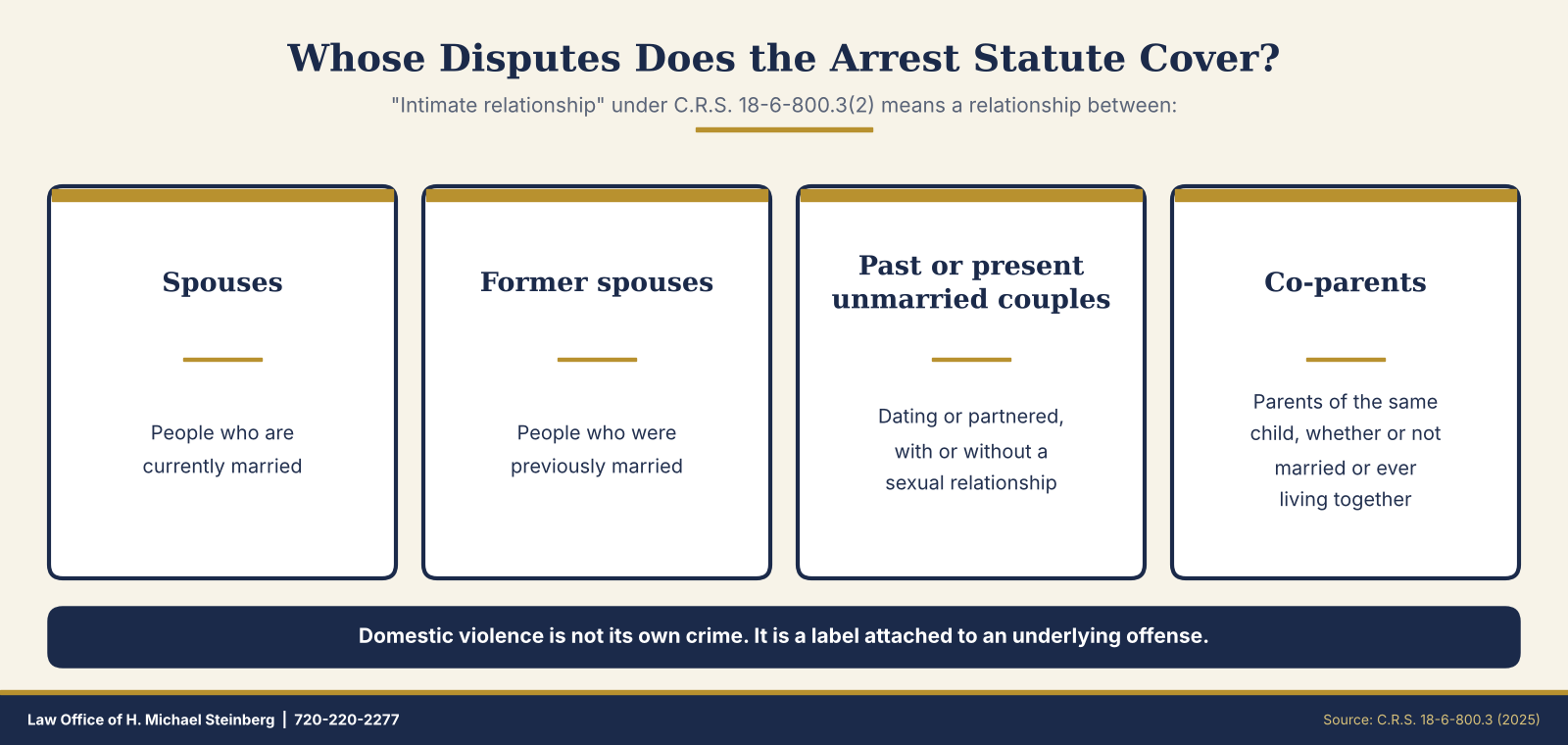
The statute defines an intimate relationship broadly: spouses, former spouses, past or present unmarried couples, and people who are parents of the same child, whether or not they were ever married or lived together. InPeople v. Disher (Colo. 2010), No. 07SC1088, the Colorado Supreme Court addressed how far that definition reaches and held that a sexual relationship is not required for an intimate relationship. A couple can be covered even when the officer and the couple would not describe the relationship in conventional terms.
The Decision Point: From the 911 Call to Handcuffs
Most domestic arrests follow the same sequence. Officers arrive, separate the people involved, take statements, look at the scene and any injuries, and then decide.
The graphic below walks through that path.
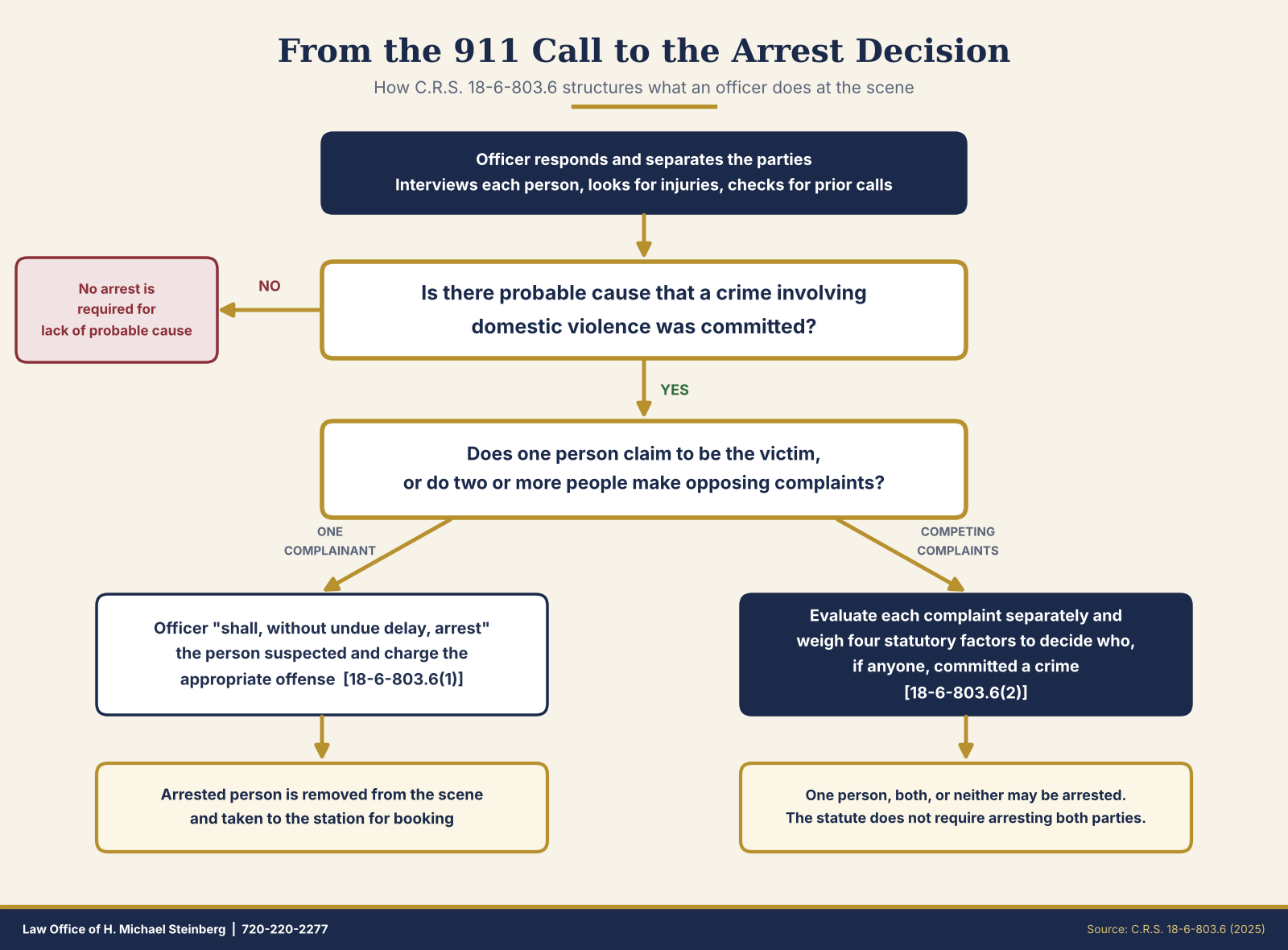
Step 1: Probable cause
An officer may arrest without a warrant when there is probable cause to believe an offense was committed by the person to be arrested, as provided in C.R.S. 16-3-102.
Probable cause is a lower standard than proof beyond a reasonable doubt. It means facts and circumstances that would lead a reasonable officer to believe a crime occurred and that this person did it.
Officers commonly rely on the following:
- Statements from each person and from any witnesses, including children, neighbors, and the 911 caller.
- Visible injuries, torn clothing, broken property, or signs of a struggle.
- The 911 recording and any body-worn camera footage.
- Text messages, photographs, and doorbell or home-security video.
- Whether either person has a history of prior calls or a protection order in place.
Step 2: One accuser or two
If only one person is identified as the likely offender, the mandatory-arrest rule usually ends the analysis. The harder scenario is the competing complaint, where each person says the other was the aggressor. That is where the statute gives officers specific guidance.
The Four Factors Officers Must Weigh When Both People Blame Each Other
Section 18-6-803.6directs an officer who receives conflicting complaints to evaluate each person’s allegations and to consider four things. Colorado does notuse the phrase “predominant aggressor,” which is common in other states, but these factors do the same job.
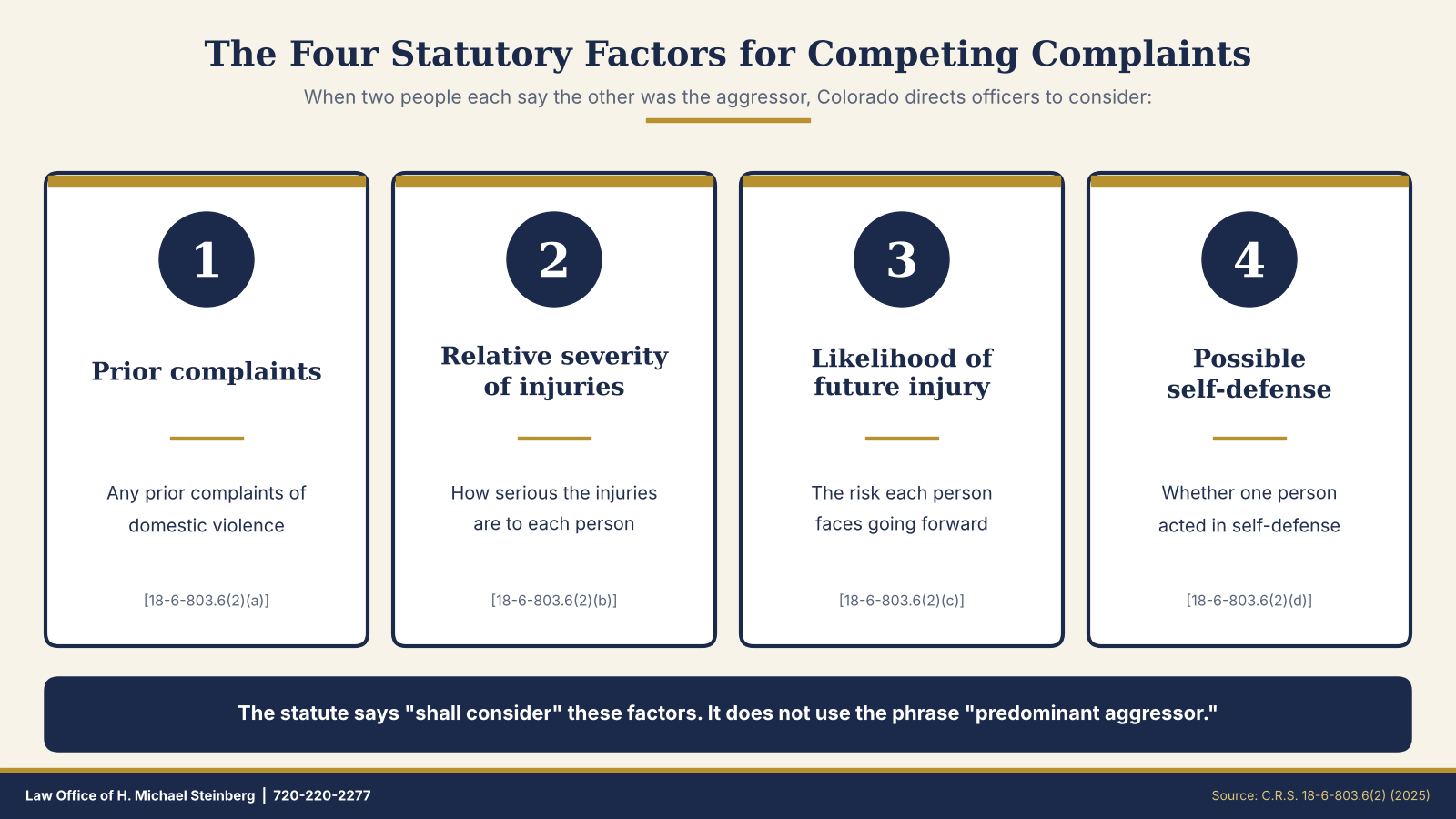
- Prior complaints of domestic violence. Earlier reports involving either person, whether or not they led to charges, can shape how the officer reads the current call.
- The relative severity of the injuries inflicted.A visible injury on one person and none on the other weighs heavily, which is why photographs matter.
- The likelihood of future injury to each person. The officer asks who is more at risk if the situation continues.
- Whether one of the persons acted in self-defense. A person who used force to protect themselves is not the intended target of the statute. See C.R.S. 18-1-704 on physical force in defense of a person.
The statute asks the officer to find the person most likely to be the principal wrongdoer. It does not ask the officer to arrest everyone and leave it to a judge to sort it out.
In practice, this is the most contested moment in a domestic case. Officers have minutes, not days, and the person who is calm, articulate, and visibly injured often becomes the complainant. The person who is angry, intoxicated, or who called 911 second can be treated as the aggressor even when the facts later tell a different story.
Can Both People Be Arrested?
Yes, but the statute does not call for it.
The law directs the officer to identify the likely principal aggressor in a competing-complaint case, and a dual arrest should be the exception, used when the evidence shows that each person committed a crime and neither acted in self-defense. If you were arrested alongside your partner, the fact that the officer made a dual arrest is itself useful.It can show that the officer did not apply the four factors or could not resolve them, which affects how the prosecutor and the court view the case.
Evidence Officers Are Required to Preserve
The same section also instructs officers to collect and preserve evidence, and it addresses children who witness domestic violence. Officers are expected to document the scene, note injuries, and identify and report on any children who were present. This evidence, and what officers failed to collect, becomes the foundation of the defense.
What Happens After the Arrest
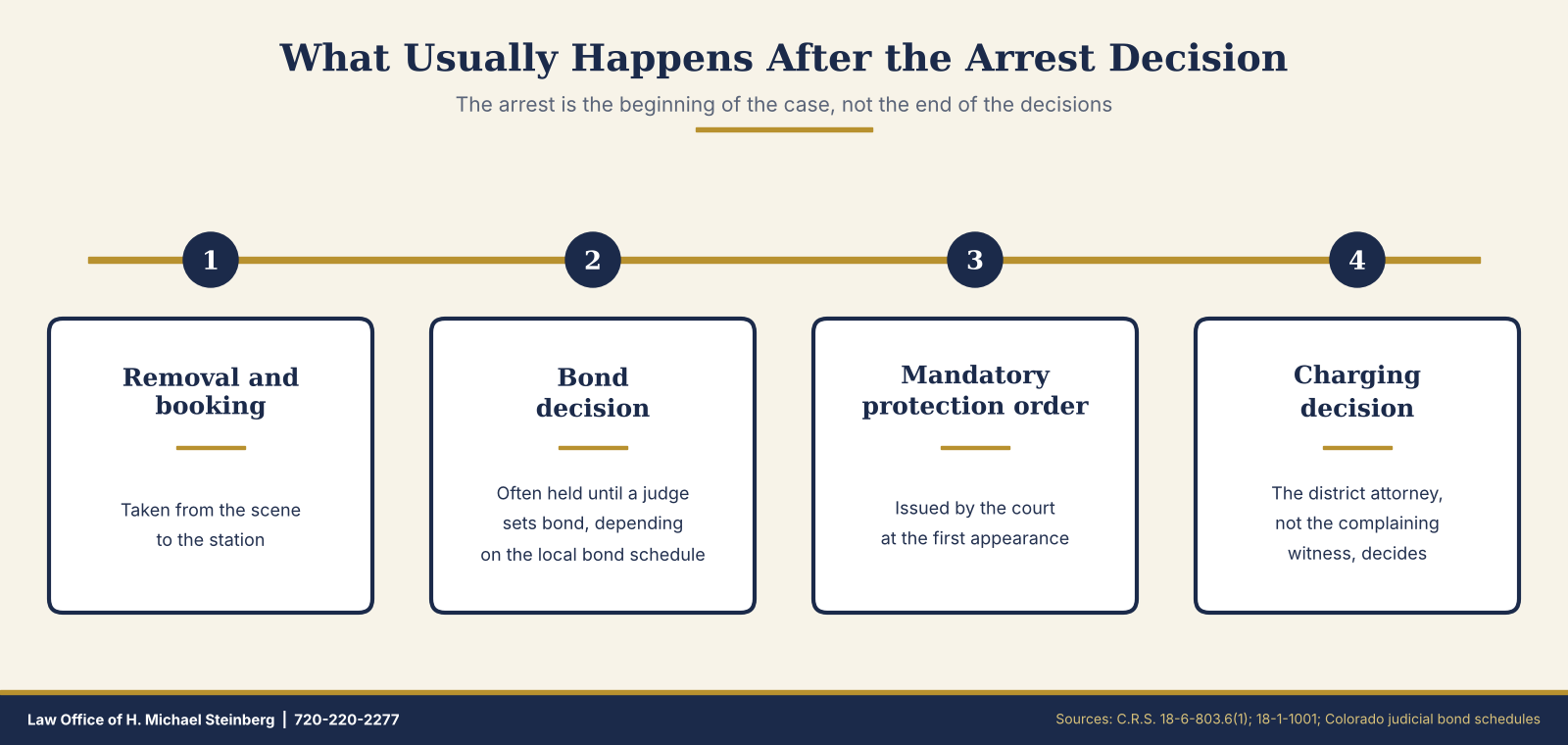
- Booking and removal. The arrested person is taken to jail and cannot return home or contact the other person while the case is being processed.
- Bond decision. A judge sets conditions for release at the first appearance, often with a no-contact condition.
- Mandatory protection order.In domestic violence cases,C.R.S. 18-1-1001requires the court to issue a protection order at the first appearance. Violating it is a separate crime under C.R.S. 18-6-803.5.
- Charging decision.The district attorney reviews the evidence and decides whether to file charges, regardless of whether the alleged victim wants to proceed.
Arrest Decisions at a Glance
| Situation | What the Officer Typically Does | Why |
|---|---|---|
| One person shows clear injuries; the other has none | Arrests the uninjured person | Relative severity of injuries is a statutory factor |
| Both claim self-defense, and both have injuries | Weighs all four factors; may arrest one or both | No automatic rule; the statute calls for a factor-by-factor evaluation |
| Alleged victim says “I don’t want to press charges” | Still arrests if probable cause exists | The arrest decision belongs to the officer, not the complainant |
| Allegation of strangulation | Almost always arrests | Potential felony assault under 18-3-203(1)(i) |
| Argument was verbal with no crime | No arrest | No probable cause that an offense occurred |
Looking Ahead: HB26-1009 and Lethality Assessments
The legislature has taken another step in how officers evaluate risk at a domestic scene. House Bill 26-1009, signed June 3, 2026, addresses lethality assessments in domestic violence responses and takes effect July 1, 2027.
House Bill 26-1009, Bill Summary
The act creates the ‘Colorado Mandatory Lethality Assessment Act’, which requires peace officers to conduct a lethality assessment when responding to a domestic violence incident and include the completed lethality assessment in the incident report. A peace officer is not required to administer a lethality assessment if a victim is unavailable, not at the scene, incapacitated, or if circumstances otherwise make the administration of the lethality assessment impossible or impracticable.
If the lethality assessment indicates that an individual is a high-risk victim based on the totality of the circumstances, the peace officer is required to immediately contact a community-based victim’s advocate either by phone or in person and provide the high-risk victim the opportunity to speak with the advocate.
Until then, the four-factor framework above remains the controlling guidance for competing complaints.
What to Do If You Were Arrested After a Domestic Call
- Say very little. Anything you say to officers, in the car, or on a jail phone is recorded and can be used against you.
- Do not contact the other person. A protection order is almost certain, and a violation creates a new charge even if the other person invites contact.
- Write down what happened while it is fresh, including who was where, what was said, and any injuries to you.
- Preserve evidence. Photograph your injuries, save texts, and identify witnesses and cameras before they disappear.
- Talk to a defense lawyer before the first court date. Early decisions about the protection order, bond, and self-defense claim shape the whole case.
Frequently Asked Questions
Do police have to arrest someone on every domestic call?
No. Officers must arrest when they have probable cause that a domestic violence offense was committed. If there is no crime, or the facts do not support probable cause, there is no required arrest.
Can the alleged victim stop the arrest?
Not once police have probable cause. The decision to arrest and the decision to prosecute belong to the state.
What if I was only defending myself?
Self-defense is one of the four factors officers must consider, and it remains a defense after arrest under C.R.S. 18-1-704. Raise it early and preserve proof of any injuries.
Is the person who called 911 considered the victim?
Not automatically, though the caller is often perceived that way. Officers are supposed to apply the statutory factors, not simply side with the first caller.
Can a domestic violence charge be dropped if my partner recants?
Only the district attorney can dismiss it. A recantation can matter a great deal, but it does not end the case on its own.
Sources and Authority
- C.R.S. 18-6-803.6, Mandatory arrest; competing complaints
- C.R.S. 18-6-800.3, Definitions (domestic violence; intimate relationship)
- C.R.S. 18-6-803.5, Crime of violation of a protection order
- C.R.S. 16-3-102, Arrest by a peace officer
- C.R.S. 18-3-203, Second degree assault
- C.R.S. 18-1-704, Use of physical force in defense of a person
- C.R.S. 18-1-1001, Protection orders
- People v. Disher (Colo. 2010), No. 07SC1088
- Town of Castle Rock v. Gonzales, 545 U.S. 748 (2005)
- Colorado HB26-1009
This article is for general information only and is not legal advice. Reading it does not create an attorney-client relationship. Every case turns on its own facts. Contact a licensed Colorado attorney about your situation. Attorney advertising.