 Colorado Criminal Lawyer Blog
Domestic Violence Convictions and Your Second Amendment Rights in Colorado


By H. Michael Steinberg, Colorado Criminal Defense Attorney | November 3, 2026 | Domestic Violence
A domestic violence case in Colorado is never only about the charge. It can also put your firearms, your hunting and sport-shooting life, and in some careers your livelihood at risk. The gun consequences can begin with a protection order on day one and, after certain convictions, can last for life under federal law.
With more than forty years of Colorado criminal law and defense experience, I see clients every year who learn about the firearm consequences only after a plea has been entered.
This guide explains how state and federal law work together, what recent court decisions mean, and what you can do about it.
KEY TAKEAWAYS
A domestic violence charge can trigger a mandatory protection order and a firearm restriction before any finding of guilt (C.R.S. § 18-1-1001).
A qualifying conviction triggers Colorado’s 24-hour relinquishment requirement (C.R.S. § 18-6-801(8)) and a federal prohibition under 18 U.S.C. § 922(g)(9).
The federal ban is often permanent for non-dating-partner cases, and courts across the country continue to uphold it after Bruen, Rahimi, and Hemani.
How a case is resolved (dismissal, trial, or plea) can decide whether a firearm ban ever applies. Do not plead before you understand the gun consequences.
How Colorado Defines Domestic Violence
Colorado does not have a single crime called “domestic violence.”Under C.R.S. § 18-6-800.3, domestic violence is an act or threatened act of violence, or any crime used as a method of coercion, control, punishment, intimidation, or revenge, directed against a person with whom the actor is or has been in an intimate relationship.
In practice, the label attaches to ordinary offenses such as assault, harassment, menacing, criminal mischief, and many others when the alleged victim is a spouse, former partner, a person you live or have lived with, someone you have a child with, or someone you have dated.
That label matters because of what follows from it. When a court finds on the record that the underlying factual basis of a conviction includes an act of domestic violence, C.R.S. § 18-6-801 imposes mandatory treatment, and, where the conviction meets the federal definition, firearm relinquishment.
Colorado also restricts plea bargains in these cases: under § 18-6-801(3), a defendant generally cannot plead to an offense that omits the domestic violence designation required by C.R.S. § 16-21-103 unless the prosecutor makes a good-faith record that the relationship cannot be proven.
Guns Before a Conviction: Protection Orders
Most people are surprised to learn that their firearm rights can be restricted before a trial. In a Colorado domestic violence case, the court enters a protection order at the outset under C.R.S. § 18-1-1001. When the act involved the threat, use, or attempted use of physical force, subsection (9) of that statute and C.R.S. § 13-14-105.5 (for civil protection orders) require the court to order the person to relinquish firearms and ammunition and to refrain from possessing or purchasing them while the order is in effect.
The Colorado Judicial Branch’s mandatory protection order form, JDF 440, shows how this works in practice. It includes a firearm relinquishment provision with a default 24-hour deadline, warns that a knowing violation is a crime under C.R.S. § 18-6-803.5, and warns that possessing a firearm while the order is in effect, or after a domestic violence misdemeanor conviction, may be a federal felony under 18 U.S.C. § 922(g)(8) and (g)(9).
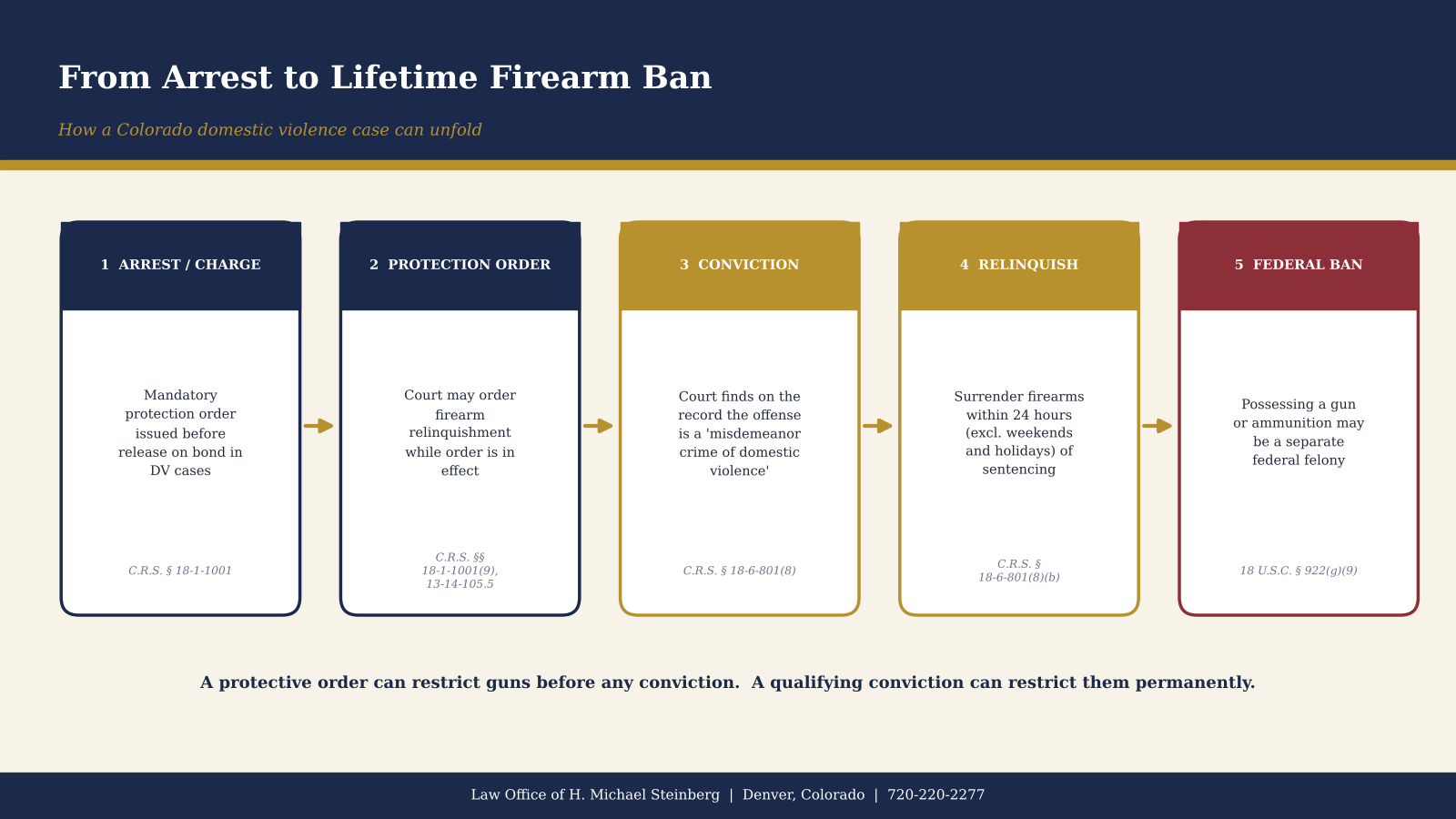
How a Colorado domestic violence case can move from a protection order to a lifetime federal firearm ban.
If you have been served with a protection order, consider talking with a lawyer before you move or transfer any firearm so that the relinquishment is documented properly.
After a Conviction: Colorado’s 24-Hour Relinquishment Rule
If you are convicted and the court finds on the record that the offense is a “misdemeanor crime of domestic violence” as defined in 18 U.S.C. § 921(a)(33), or a crime punishable by more than a year that includes an act of domestic violence, C.R.S. § 18-6-801(8) requires the court to order you to refrain from possessing or purchasing firearms and ammunition until your sentence is satisfied and to relinquish any firearms in your immediate possession or control. The statute sets a strict timetable:
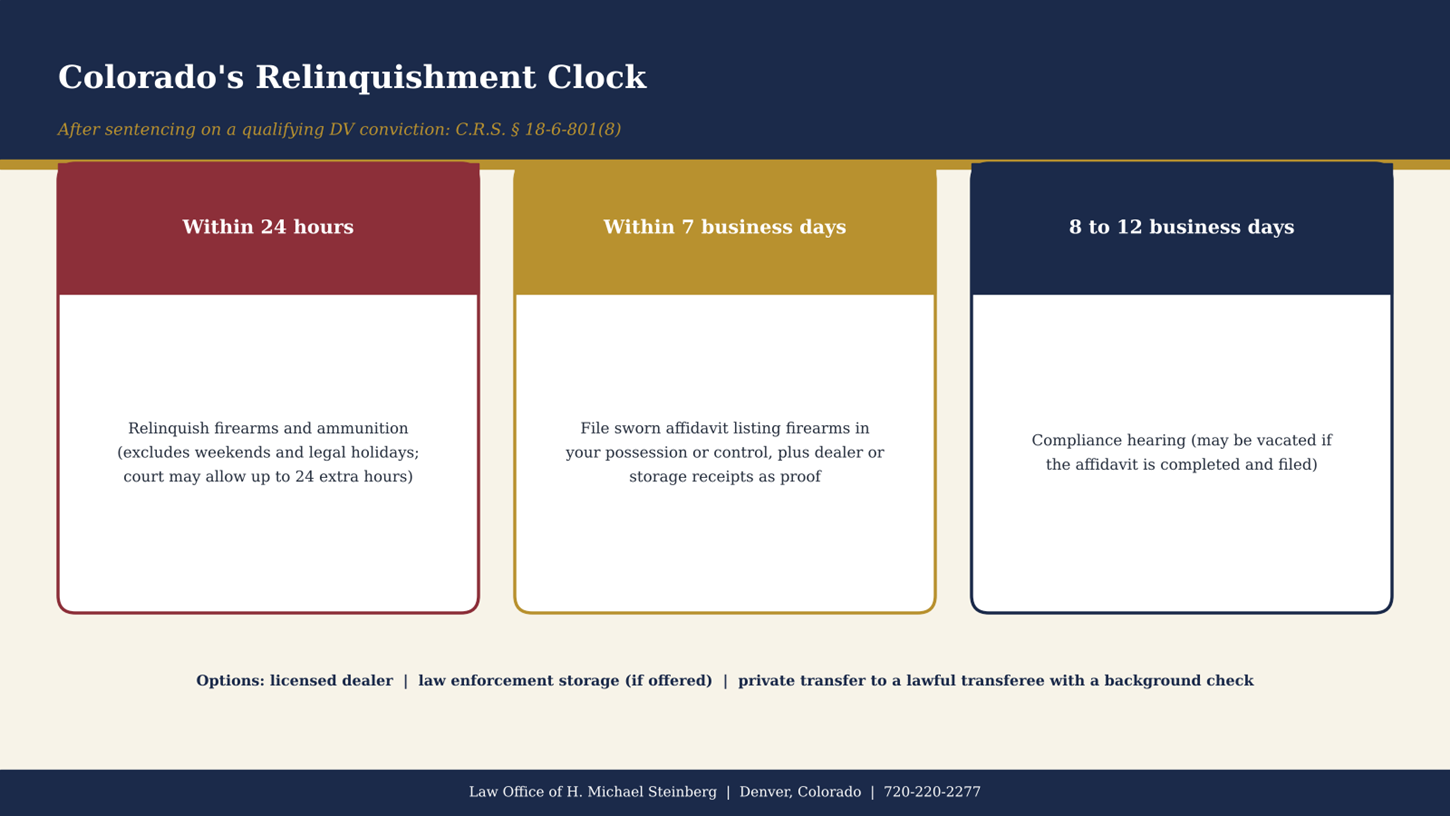
- Within 24 hours (excluding weekends and legal holidays) of sentencing, you must relinquish firearms and ammunition. The court may allow up to an additional 24 hours if you show you cannot comply sooner.
- Within seven business days, you must file a sworn affidavit stating how many firearms you possess or control, their make and model, and where they are, or stating that you have none.
- Eight to twelve business days after sentencing, the court holds a compliance hearing, which it may vacate if the affidavit has been properly completed.
- Relinquishment options are a sale or transfer to a federally licensed dealer, storage with a law enforcement agency or its contracted facility (if the agency chooses to offer it), or a transfer to a private party who may lawfully possess the firearm, with a background check under C.R.S. § 18-12-112.
Failing to timely transfer or sell a firearm, or to file the required declaration, is a class 2 misdemeanor and the court is directed to issue an arrest warrant, under § 18-6-801(8)(i). The statute also allows a search warrant if there is probable cause that a person did not relinquish all firearms. A defendant cannot transfer a firearm to a private party who lives in the same residence.
The Federal Lifetime Ban: 18 U.S.C. § 922(g)(9)
The federal “Lautenberg Amendment,” enacted in 1996 and codified at 18 U.S.C. § 922(g)(9), makes it unlawful for anyone convicted in any court of a “misdemeanor crime of domestic violence” to possess firearms or ammunition. Section 921(a)(33) defines that term as a misdemeanor under federal, state, tribal, or local law that has as an element the use or attempted use of physical force, or the threatened use of a deadly weapon, committed by a person in a covered relationship with the victim.
Unlike a protection order, this prohibition does not end when your sentence ends. For many convictions it is a lifetime prohibition. And it operates independently of Colorado law: the federal ban can apply even if your Colorado sentence is complete and you have no ongoing state obligations. The Colorado Bureau of Investigation lists § 922(g)(9) among the federal prohibitions it applies when screening firearm purchases.
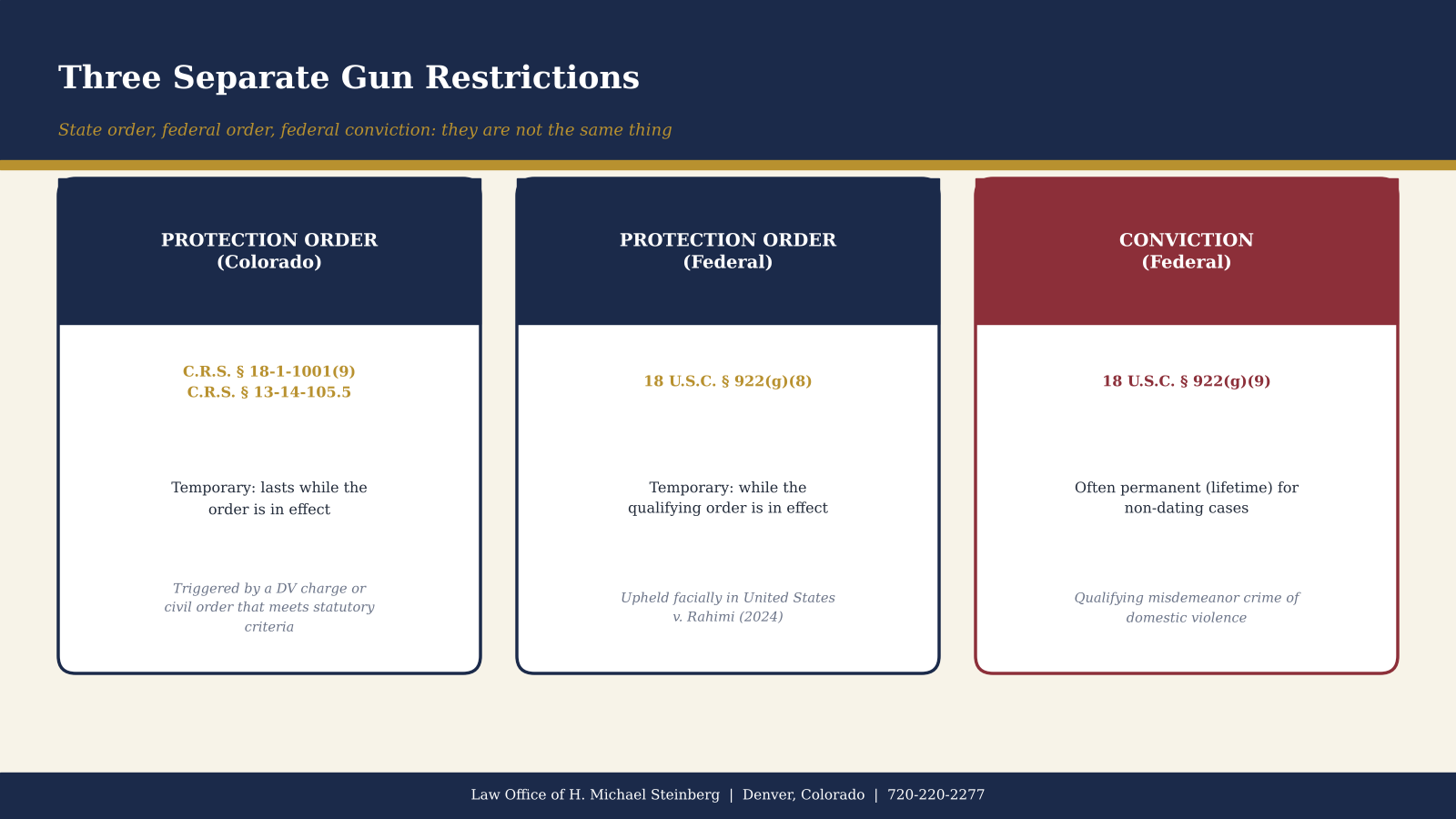
Three different legal sources can restrict your firearms,
and each has different triggers and durations.
COLORADO COURT OF APPEALS: MARQUEZ v. SCHAEFER (2025)
In Marquez v. Schaefer, 2025 COA 44, the Colorado Court of Appeals held for the first time in a published opinion that a domestic violence assault conviction under a municipal ordinance can be a “misdemeanor crime of domestic violence,” even though the municipal code did not expressly label the offense a misdemeanor.
The plaintiff’s firearm purchase was properly denied based on a 1997 Denver municipal conviction. A summary from the Colorado Bar Association is also available.
Why it matters: a “minor” municipal case is not necessarily minor for gun rights.
Who Is Covered: Relationships That Trigger the Ban
The federal ban turns on the relationship between you and the victim, not merely the offense. It covers current or former spouses, a parent or guardian of the victim, a person with whom you share a child, and a person who cohabits or has cohabited with the victim as a spouse, parent, or guardian.
In 2022, the Bipartisan Safer Communities Act expanded the definition to include current or recent former dating partners, closing the so-called “boyfriend loophole.” See the Congressional Research Service overview. Colorado law incorporates the federal definition, so the expansion also affects Colorado cases, as noted by Giffords Law Center’s Colorado summary.
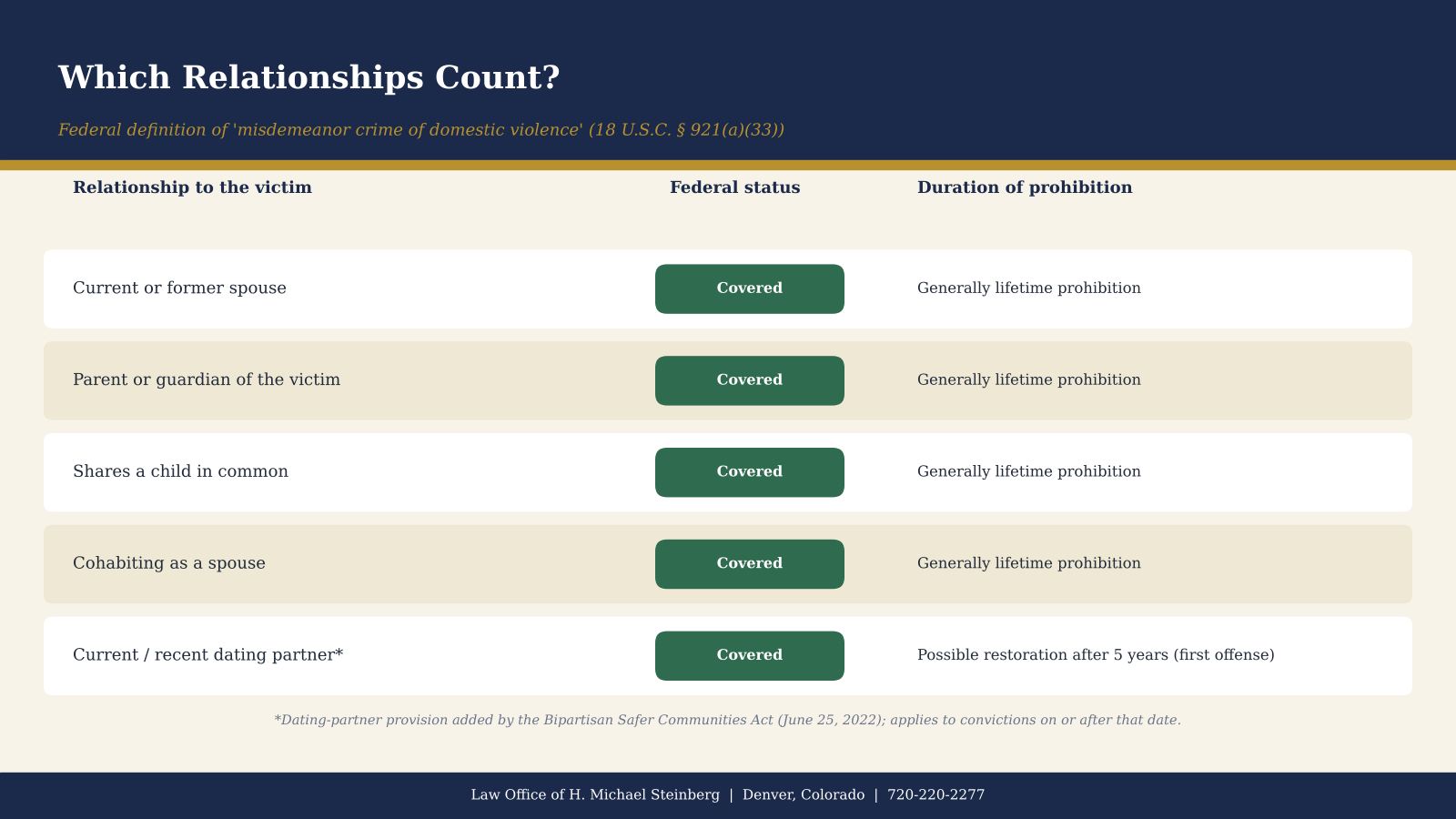
The 2022 law also created a limited restoration path:a first-offense dating-partner conviction (entered after June 25, 2022) may be eligible for restoration of firearm rights after five years if the person has no further qualifying offense. That path is not available for convictions involving spouses, co-parents, cohabitants, and the other non-dating relationships.
The ATF’s domestic violence FAQ explains the federal framework.
What Happens If You Keep Your Guns
The consequences of possessing a firearm while prohibited are serious and stack across systems. Federally, possessing a firearm or ammunition after a qualifying conviction is prosecuted as a felony under § 922(g)(9) and
§ 924.
The U.S. Attorney’s Office for the District of Colorado has publicly announced prosecutions of this type, including a case in which a defendant with a La Plata County misdemeanor domestic violence conviction was sentenced to federal prison for possessing six firearms.
In state court, violating a protection order is a crime under C.R.S. § 18-6-803.5, and failing to comply with the relinquishment statute is a misdemeanor under § 18-6-801(8)(i). Colorado’s possession-of-a-weapon-by-a-previous-offender statute, C.R.S. § 18-12-108, can also apply after qualifying convictions.
One practical warning: a person can be “in possession” without holding a gun. Firearms kept in a shared home, a vehicle, or a family member’s safe may still be within your “immediate possession or control.”If you share a household, talk to counsel about a lawful transfer plan instead of improvising.
The Second Amendment After Bruen, Rahimi, and Hemani
Many clients ask whether recent Supreme Court decisions make these laws unconstitutional. The short answer today: courts have largely upheld the domestic violence firearm bans, while the law on as-applied challenges continues to develop. Here is the landscape.
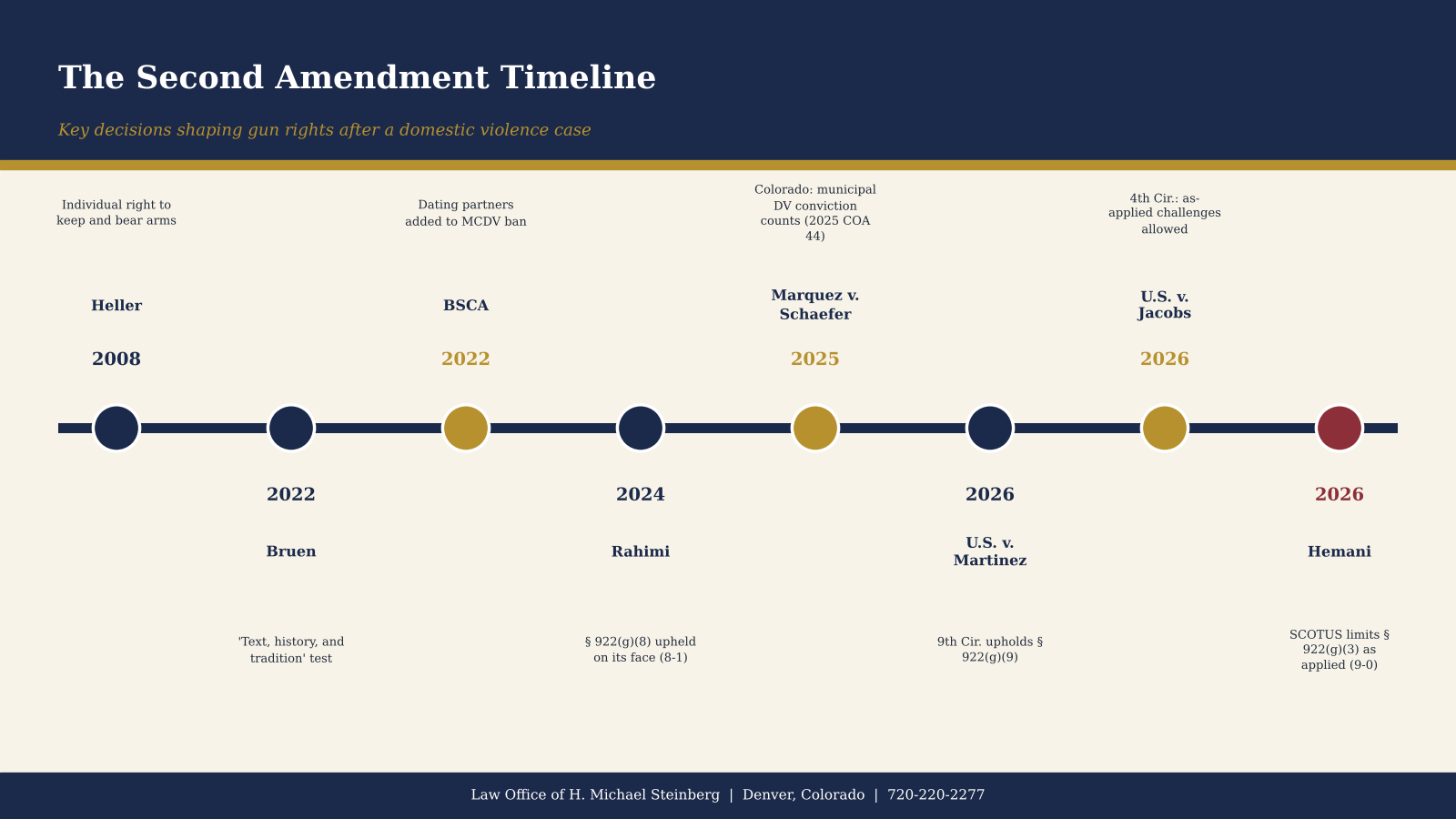 Key Second Amendment decisions affecting domestic violence firearm laws.
Heller and Bruen: the framework
In District of Columbia v. Heller (2008), the Supreme Court recognized an individual right to keep and bear arms.
In New York State Rifle & Pistol Ass’n v. Bruen (2022), it held that when the Second Amendment’s text covers conduct, the government must justify a regulation by showing it is consistent with the nation’s historical tradition of firearm regulation.
Rahimi (2024): protection-order ban upheld
In United States v. Rahimi, 602 U.S. 680 (2024), the Court rejected a facial challenge to § 922(g)(8), which bars firearm possession by people subject to certain domestic violence restraining orders, in an 8-1 decision by Chief Justice Roberts. The Court emphasized that the ban reflects a tradition of temporarily disarming people found to pose a credible threat to another’s physical safety.
Rahimi did not decide the constitutionality of § 922(g)(9), which attaches to a conviction rather than a restraining order and can be permanent.
Section 922(g)(9) in the courts of appeals
Since Rahimi, courts of appeals have continued to uphold the conviction-based ban. The Second Circuit rejected a Bruen challenge to § 922(g)(9); the Sixth Circuit did the same in United States v. Gailes(9)-post-bruen/view); and on March 18, 2026, the Ninth Circuit held in United States v. Martinez that § 922(g)(9) is constitutional, reasoning that it fits within the tradition of disarming people deemed dangerous. The Ninth Circuit also rejected the as-applied challenges before it.
Not every court has closed the door, however. In United States v. Jacobs, No. 24-4287 (4th Cir. Jan. 21, 2026), the Fourth Circuit remanded an as-applied § 922(g)(9) challenge for factual development, leaving open the possibility that the statute may be unconstitutional as applied to a particular defendant.
The issue is headed to the Supreme Court: defendants in the Ninth Circuit cases have asked for more time to file petitions for certiorari, which presents the question whether § 922(g)(9)’s lifetime prohibition is unconstitutional at least in some circumstances.
See the application in Martinez v. United States and the docket in Padgett and Ryno v. United States, No. 26A523. A petition being filed is not a grant of review, and no outcome should be assumed.
Hemani (2026): a different statute, a limiting principle
On June 18, 2026, the Supreme Court decided United States v. Hemani, No. 24-1234, unanimously holding that prosecuting a marijuana user under § 922(g)(3), the “unlawful user” provision, was inconsistent with the Second Amendment as applied. The Court rejected the government’s analogy to historical “habitual drunkard”laws and stressed the lack of individualized process.
Commentators describe the decision as narrow but potentially broad as a tool, and law-firm summaries note that it did not decide the constitutionality of other prohibitions such as the felon-in-possession ban. Hemaniis not a domestic violence case, and it does not invalidate § 922(g)(9), but defense lawyers are watching it closely for arguments about categorical, status-based disarmament.
WHAT THIS MEANS FOR YOU
Do not assume a court will excuse a violation because the Second Amendment law is “changing.”Today, § 922(g)(9) convictions are being affirmed in the federal appellate courts.
As-applied challenges are being litigated, so the facts of your prior case, the offense’s mental state, and your history may matter. Colorado sits in the Tenth Circuit, so any strategy should be built on current Tenth Circuit and Supreme Court authority.
The safest course is to avoid the disqualifying conviction in the first place.
Why Your Plea Decision Matters
Because the firearm consequences turn on the conviction, the relationship, and the offense’s elements, the way a case ends can change your rights for decades. A Colorado domestic violence defense is not only about avoiding jail; it is about preserving the right to hunt, to keep a firearm for protection, and in some professions to keep a job. Questions I analyze with every domestic violence client include:
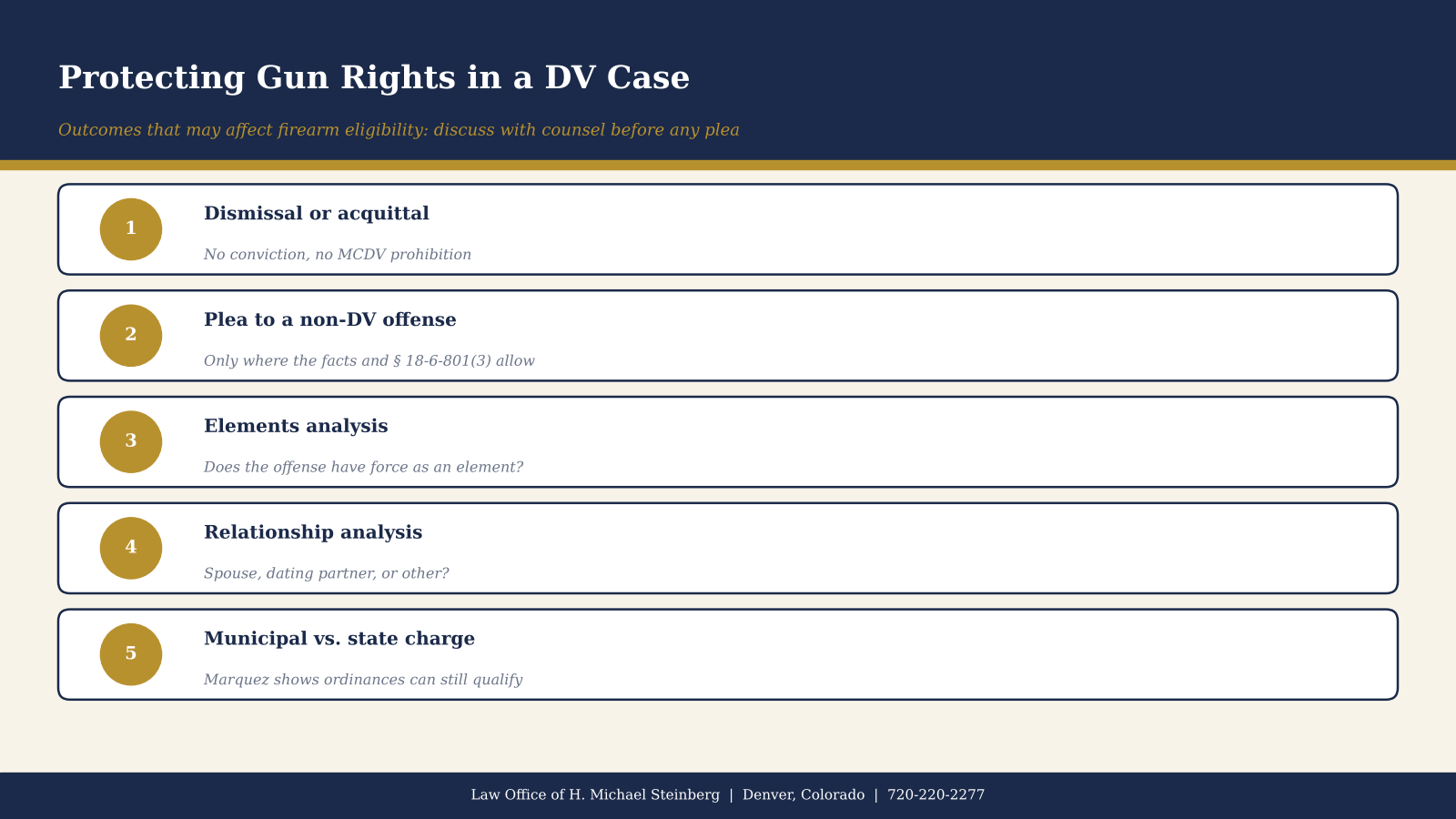
- Can the case be dismissed or won at trial? Many domestic violence cases rest on a single statement or a 911 call, and the prosecution must still prove each element beyond a reasonable doubt.
- Does the charged offense have physical force as an element? The federal definition in § 921(a)(33) is element-based. The precise offense and subsection of any plea matter.
- What is the relationship? Spouse, co-parent, and dating-partner cases are treated differently on restoration.
- Is the DV designation required? Under § 18-6-801(3), pleading to an offense without the designation is restricted by statute, so any negotiated outcome has to comply with it.
- Is it a municipal or state case? Marquez shows that an ordinance conviction can still count.
- What are the collateral consequences? Protection orders, treatment, immigration, professional licensing, and child-related matters.
If your case is dismissed or you are acquitted, the conviction-based bans should not attach, and the protection order’s firearm restrictions end with the order. That is one reason to treat even a “minor”domestic violence charge with the seriousness of a felony.
Deferred Judgments in Colorado Domestic Violence Cases
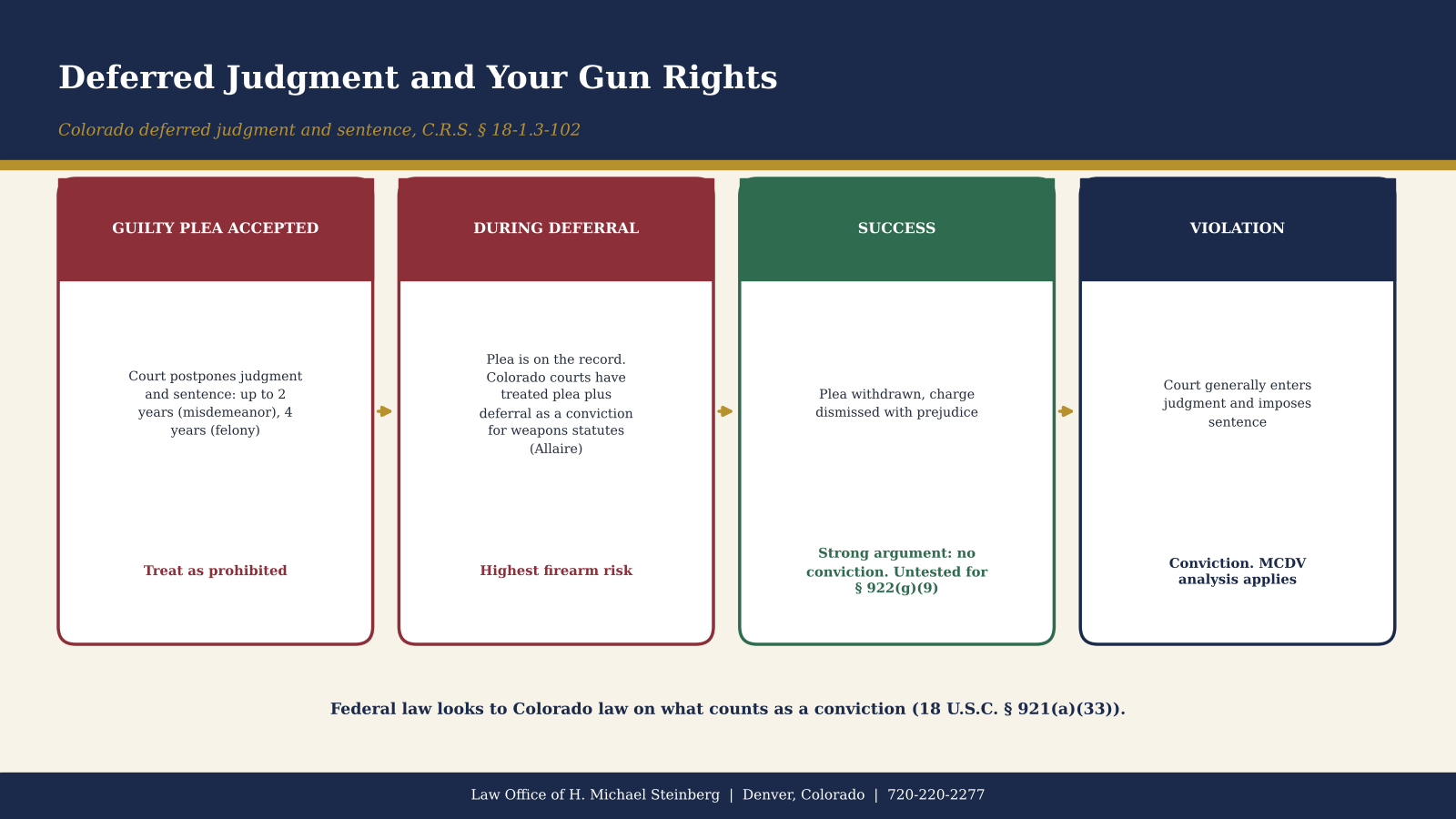
A deferred judgment and sentence can provide an important opportunity for a defendant charged with a domestic-violence-related offense in Colorado. But a deferred judgment is not the same as having the case dismissed at the beginning, and its consequences can be more complicated when firearm rights are involved.
Is a Colorado Deferred Judgment a Conviction?
Under C.R.S. § 18-1.3-102, a deferred judgment begins with the defendant entering a guilty plea. With the required written consent, the court postpones entry of judgment and sentence while the defendant completes the conditions contained in the deferred-judgment agreement.
For a misdemeanor, petty offense, or traffic offense, the statutory deferral ordinarily may not exceed two years; for a felony, it may not exceed four years, subject to statutory provisions permitting certain extensions. [law.justia.com]
The critical benefit comes with successful completion. Colorado law provides that when the defendant fully complies with the required conditions, the previously entered guilty plea is withdrawn and the charge is dismissed with prejudice. [law.justia.com]
If the defendant breaches a condition regulating his or her conduct, however, the deferred-judgment statute provides for the court to enter judgment and impose sentence on the guilty plea, subject to the provisions and exceptions contained in the statute. [colorado.public.law]
Are Domestic Violence Deferred Judgments Different?
They can be.
Colorado does not treat “domestic violence”simply as the name of a separate criminal offense for purposes of these provisions. The deferred-judgment statute specifically addresses a crime whose underlying factual basis included an act of domestic violence as defined by C.R.S. § 18-6-800.3(1) and requires the defendant to stipulate to the conditions specified in C.R.S. § 18-1.3-204(2)(b).
Colorado’s Domestic Violence Offender Management Board also states that its statutory purview extends to deferred sentences involving a stipulated or found domestic-violence factual basis.
For this reason, a defendant considering a domestic-violence deferred judgment should understand not only the benefit of an eventual dismissal, but also the conditions and consequences that apply while the deferred judgment remains pending.
A Deferred Judgment Is Not the Same as Pretrial Diversion
These terms are sometimes confused.
In a deferred judgment under C.R.S. § 18-1.3-102, the defendant has already entered a guilty plea, although judgment and sentencing have been deferred. Successful completion ultimately results in withdrawal of that plea and dismissal of the charge with prejudice. [law.justia.com]
Colorado’s DVOMB distinguishes this procedure from pretrial diversion or deferred prosecution. Its guidance describes successful diversion as resulting in dismissal of the charges and an outcome that is expressly not considered a conviction for any purpose
The difference can matter when evaluating the collateral consequences of a proposed plea agreement.
Does a Domestic Violence Deferred Judgment Affect Gun Rights?
This is where the analysis becomes considerably more complicated.
Federal law generally prohibits a person who has been convicted of a qualifying“misdemeanor crime of domestic violence” from possessing firearms or ammunition. See 18 U.S.C. § 922(g)(9).
ATF identifies persons convicted of qualifying misdemeanor crimes of domestic violence among the categories prohibited from possessing firearms or ammunition under federal law.
But not every Colorado case labeled “domestic violence” necessarily qualifies as a federal misdemeanor crime of domestic violence.
Under 18 U.S.C. § 921(a)(33), the federal definition requires, among other things, a misdemeanor offense having as an element the use or attempted use of physical force, or threatened use of a deadly weapon, together with one of the relationships specified by federal law. The statute also contains requirements concerning representation by counsel and waiver or exercise of jury-trial rights.
ATF likewise explains that an offense does not have to be called “domestic violence” to constitute a qualifying federal misdemeanor crime of domestic violence if it otherwise satisfies the federal requirements.
That means the federal question cannot reliably be answered merely by looking at whether “DV” appears on a Colorado case.
What Happens to Federal Firearm Rights After Successful Completion?
This requires an individualized legal analysis.
Federal law provides that, for purposes of the misdemeanor-domestic-violence firearms prohibition, a person is not considered convicted when the qualifying conviction has been expunged or set aside, or where qualifying pardon or restoration-of-rights provisions apply, subject to the statutory exceptions.
ATF also specifically states that when deciding whether a state-court disposition constitutes a “conviction” of a misdemeanor crime of domestic violence, the law of the jurisdiction determines whether a conviction occurred. According to ATF, if the law of that jurisdiction does not consider the person convicted, the federal firearms disability does not arise on that basis.
Colorado’s deferred-judgment statute, meanwhile, provides that after successful completion the defendant’s guilty plea“shall be withdrawn” and the charge on which judgment and sentence were deferred“shall be dismissed with prejudice.” [law.justia.com]
Those provisions are extremely important, but a person should not assume that completion of a Colorado domestic-violence deferred judgment automatically resolves every federal firearms issue. The precise offense, its statutory elements, the relationship between the parties, the procedural history of the plea, whether the deferred judgment has actually been successfully completed and dismissed, and other potential federal or state firearm prohibitions may matter.
Talk to a Colorado Domestic Violence Defense Lawyer Before Accepting a Deferred Judgment
A deferred judgment can potentially end with the guilty plea being withdrawn and the criminal charge dismissed with prejudice. But accepting one still requires entering a guilty plea at the beginning of the process, and a domestic-violence factual basis can carry consequences that extend beyond the immediate criminal charge. [law.justia.com]
Before accepting or rejecting a deferred judgment in a Colorado domestic violence case, discuss both the immediate criminal consequences and potential collateral consequences, including firearm restrictions, with an experienced Colorado criminal defense attorney.
Restoring Gun Rights After a Domestic Violence Conviction
Restoration is difficult, and the right path depends on the facts. Options that may exist include:
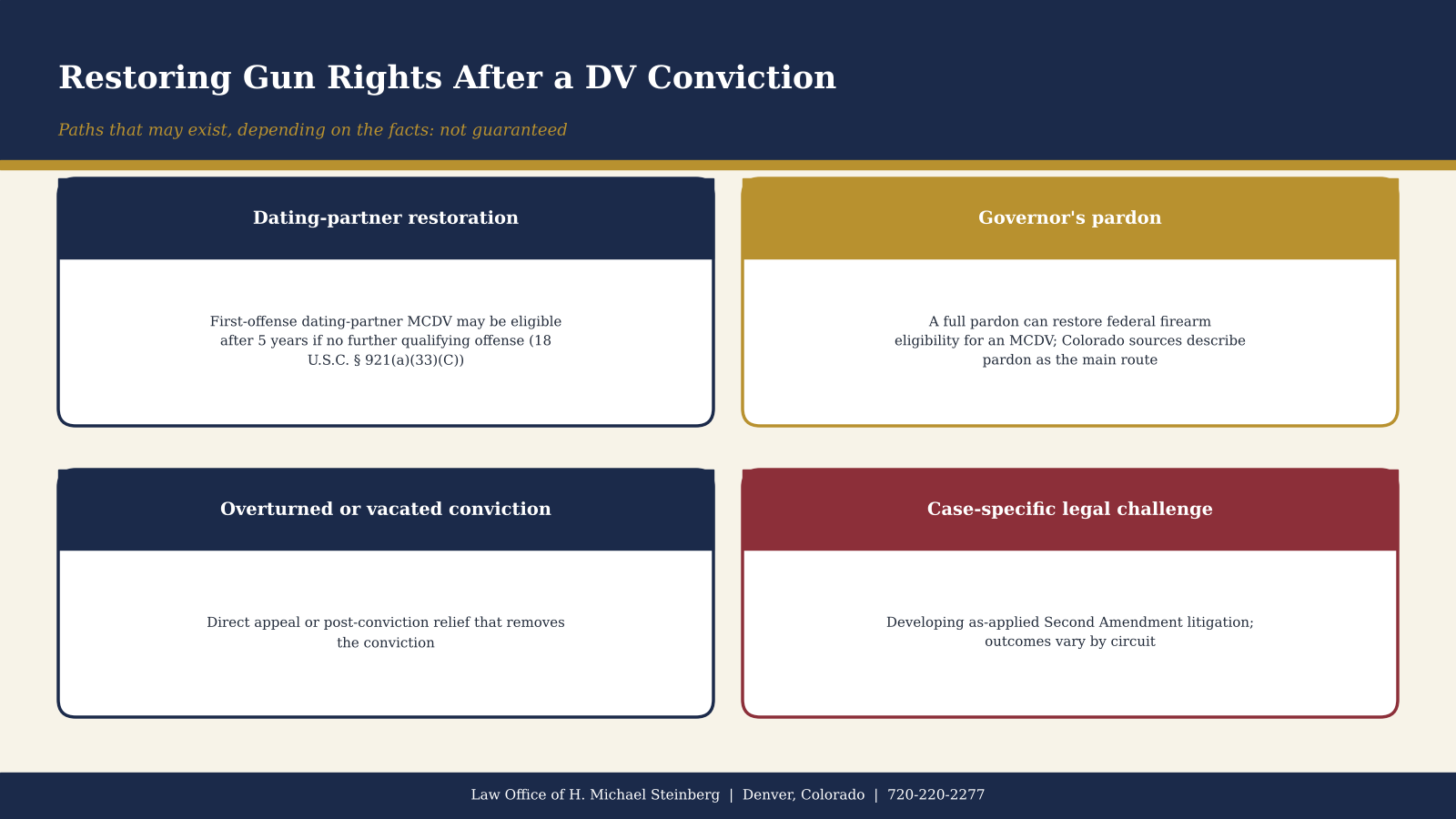
Possible, but not guaranteed, paths for restoring firearm rights.
- Five-year restoration for certain dating-partner convictions. Available only for qualifying first offenses involving dating partners, as described in § 921(a)(33) and the CRS overview.
Quick Data Point: “Dating Relationship”
(37) (A) The term “dating relationship” means a relationship between individuals who have or have recently had a continuing serious relationship of a romantic or intimate nature. (B) Whether a relationship constitutes a dating relationship under subparagraph (A) shall be determined based on consideration of— (i) the length of the relationship; (ii) the nature of the relationship; and (iii) the frequency and type of interaction between the individuals involved in the relationship. (C) A casual acquaintanceship or ordinary fraternization in a business or social context does not constitute a dating relationship under subparagraph (A).
- A gubernatorial pardon. Colorado resource guides describe a pardon as the principal restoration route, and a full pardon can remove the federal disability. See the Collateral Consequences Resource Center’s Colorado profile. Colorado also allows a pardoned conviction to be sealed under C.R.S. § 24-72-710.
- Vacating or overturning the conviction. Through direct appeal or post-conviction relief, where legal grounds exist.
- Constitutional challenge. A narrow and evolving route that should be evaluated only with counsel in light of the current case law above.
Be cautious about “record sealing” promises. Colorado’s sealing statutes generally exclude convictions whose underlying factual basis involves domestic violence (see § 24-72-709 and § 24-72-708), and sealing does not by itself eliminate a federal firearms disability.
Common Mistakes to Avoid
- Moving firearms to a friend or relative’s home without a documented, lawful transfer.
- Ignoring the 24-hour and seven-business-day deadlines after sentencing.
- Pleading guilty to “just a misdemeanor” without checking the federal definition and the relationship.
- Assuming a municipal ordinance conviction is not a federal firearm disqualifier.
- Assuming recent Supreme Court decisions have made the domestic violence prohibition unenforceable.
- Discussing the case, or your guns, with the alleged victim in violation of a protection order.
Frequently Asked Questions
Can I own a gun in Colorado after a domestic violence conviction?
Often, no. Federal law, 18 U.S.C. § 922(g)(9), bars anyone convicted of a “misdemeanor crime of domestic violence” from possessing firearms or ammunition, and for many convictions the bar is permanent. Colorado’s sentencing statute, C.R.S. § 18-6-801(8), separately requires relinquishment of firearms when the court finds a qualifying factual basis.
Do I lose my guns if I am only charged with domestic violence and not convicted?
You can lose access while the case is pending. Colorado courts issue protection orders in domestic violence cases under C.R.S. § 18-1-1001, and those orders can require relinquishment of firearms for as long as the order is in effect. If the case is dismissed or you are acquitted, the conviction-based federal ban does not attach.
How long do I have to turn in my firearms in Colorado?
After sentencing on a qualifying conviction, the statute requires relinquishment within 24 hours, excluding weekends and legal holidays, with limited additional time available if the court finds you could not comply. An affidavit must be filed within seven business days, and a compliance hearing is set eight to twelve business days after sentencing. See C.R.S. § 18-6-801(8).
Is a deferred judgment and sentence on a Colorado domestic violence charge a conviction under federal law?
Federal law does not have its own rule. Under 18 U.S.C. § 921(a)(33), whether a person was “convicted” is determined by the law of the state where the case was heard, as ATF guidance explains. Colorado has treated a guilty plea followed by a deferred judgment as a conviction in some contexts, such as People v. Allaire, but not in others. Because the guilty plea has been accepted during the deferral period, the cautious assumption is that you are a prohibited person until the case is dismissed. See the full discussion above.
Do I get my gun rights back after successfully completing a deferred judgment?
On successful completion, the guilty plea is withdrawn and the charge is dismissed with prejudice under C.R.S. § 18-1.3-102, which gives you a strong argument that you were never “convicted” for federal purposes. I am not aware of a reported decision squarely resolving that question for § 922(g)(9), so do not buy or possess a firearm without first getting advice and a certified copy of the dismissal.
Did the Supreme Court’s Rahimi decision change this?
Rahimi upheld 18 U.S.C. § 922(g)(8), the ban for people under certain domestic violence restraining orders, against a facial Second Amendment challenge. It did not strike down the conviction-based ban in § 922(g)(9). Since then, courts of appeals have continued to uphold § 922(g)(9), though some have left room for as-applied challenges. Read the Rahimi opinion and the 2026 decisions discussed below.
Can a domestic violence conviction be sealed to restore gun rights?
Colorado’s sealing statutes generally exclude convictions whose factual basis involves domestic violence (see C.R.S. § 24-72-709 and § 24-72-708), and sealing by itself does not undo a federal firearms disability. Federal law recognizes certain restoration paths, including a pardon and, for some first-offense dating-partner convictions, restoration after five years under 18 U.S.C. § 921(a)(33).
What is the best way to protect my gun rights in a domestic violence case?
Early, informed defense work. Whether the case is dismissed, tried, or resolved by plea can decide whether a firearm prohibition ever attaches. Do not accept a plea before a lawyer has analyzed the elements of the offense, the relationship to the alleged victim, and the domestic violence designation.
Talk to a Denver Domestic Violence Defense Attorney
If you have been arrested, charged, or served with a protection order in a Colorado domestic violence case, your firearm rights are on the line from the first day. I have defended Colorado domestic violence, DUI, drug, sex crime, and felony cases for more than forty years across the Denver metro area, including cases at the Lindsey-Flanigan Courthouse. Visit the Law Office of H. Michael Steinberg, read more on the Colorado Criminal Lawyer Blog, or call 720-220-2277 to discuss your case.
FACING A DOMESTIC VIOLENCE CHARGE IN COLORADO?
Protect your freedom and your firearm rights. Call the Law Office of H. Michael Steinberg for a confidential consultation.
This article is general information about Colorado and federal law as of the date above. It is not legal advice, does not create an attorney-client relationship, and may not reflect later changes in the law or developments in pending cases. Firearm eligibility depends on the specific facts of each case. Consult a licensed attorney about your situation. Prior results do not guarantee a similar outcome.
Sources and Further Reading
- C.R.S. § 18-6-801 (domestic violence sentencing)
- C.R.S. § 18-6-800.3 (definitions)
- C.R.S. § 18-1-1001 (protection orders)
- C.R.S. § 13-14-105.5 (civil protection orders and firearms)
- C.R.S. § 18-12-108 (possession by previous offenders)
- C.R.S. § 18-6-803.5 (violation of a protection order)
- 18 U.S.C. § 922
- 18 U.S.C. § 921
- 18 U.S.C. § 924
- District of Columbia v. Heller (2008)
- New York State Rifle & Pistol Ass’n v. Bruen (2022)
- United States v. Rahimi (2024)
- United States v. Hemani (2026)
- United States v. Martinez (9th Cir. 2026)
- United States v. Jacobs (4th Cir. 2026)
- Marquez v. Schaefer, 2025 COA 44
- Colorado Judicial Branch form JDF 440
- Colorado Bureau of Investigation: state and federal firearm prohibitors
- Congressional Research Service: Firearms Eligibility, Domestic Violence and Dating Partners
- ATF: Misdemeanor Crime of Domestic Violence FAQ
- Giffords Law Center: Domestic Violence and Firearms in Colorado
Related: Law Office of H. Michael Steinberg | Colorado Criminal Lawyer Blog