 Colorado Criminal Lawyer Blog
No Miranda Warning? Here Is What Actually Happens In Colorado


Police Do Not Have to Read You Your Rights When They Arrest You
Television has taught generations of Americans that the moment handcuffs go on, an officer must recite the warning, and that if the officer forgets, the case collapses. That is not how the law works.
In Miranda v. Arizona, 384 U.S. 436 (1966), the U.S. Supreme Court did not create a duty to announce rights at the moment of arrest. It created a rule about evidence: statements obtained through custodial interrogation may not be used by the prosecution unless police first warned the person of the right to remain silent, that anything said can be used against them, the right to an attorney, and the right to appointed counsel if they cannot afford one, and the person then knowingly, intelligently, and voluntarily waived those rights.
An officer can arrest you, book you, and never say a word about Miranda. If the officer never questions you, or you never say anything the prosecution wants to use, there is no Miranda problem at all. The warning matters only when police want to use your answers.
Miranda is a rule about what the prosecution may use against you, not a script officers must read at the moment of arrest.
When Miranda Actually Applies: Custody Plus Interrogation
Miranda protections are triggered only when both of these are true at the same time:
- Custody. You are in custody, meaning your freedom of movement is restricted to the degree associated with a formal arrest.
- Interrogation. Police are questioning you, or doing something they should know is reasonably likely to draw an incriminating response (the “functional equivalent” of questioning). Rhode Island v. Innis, 446 U.S. 291 (1980).
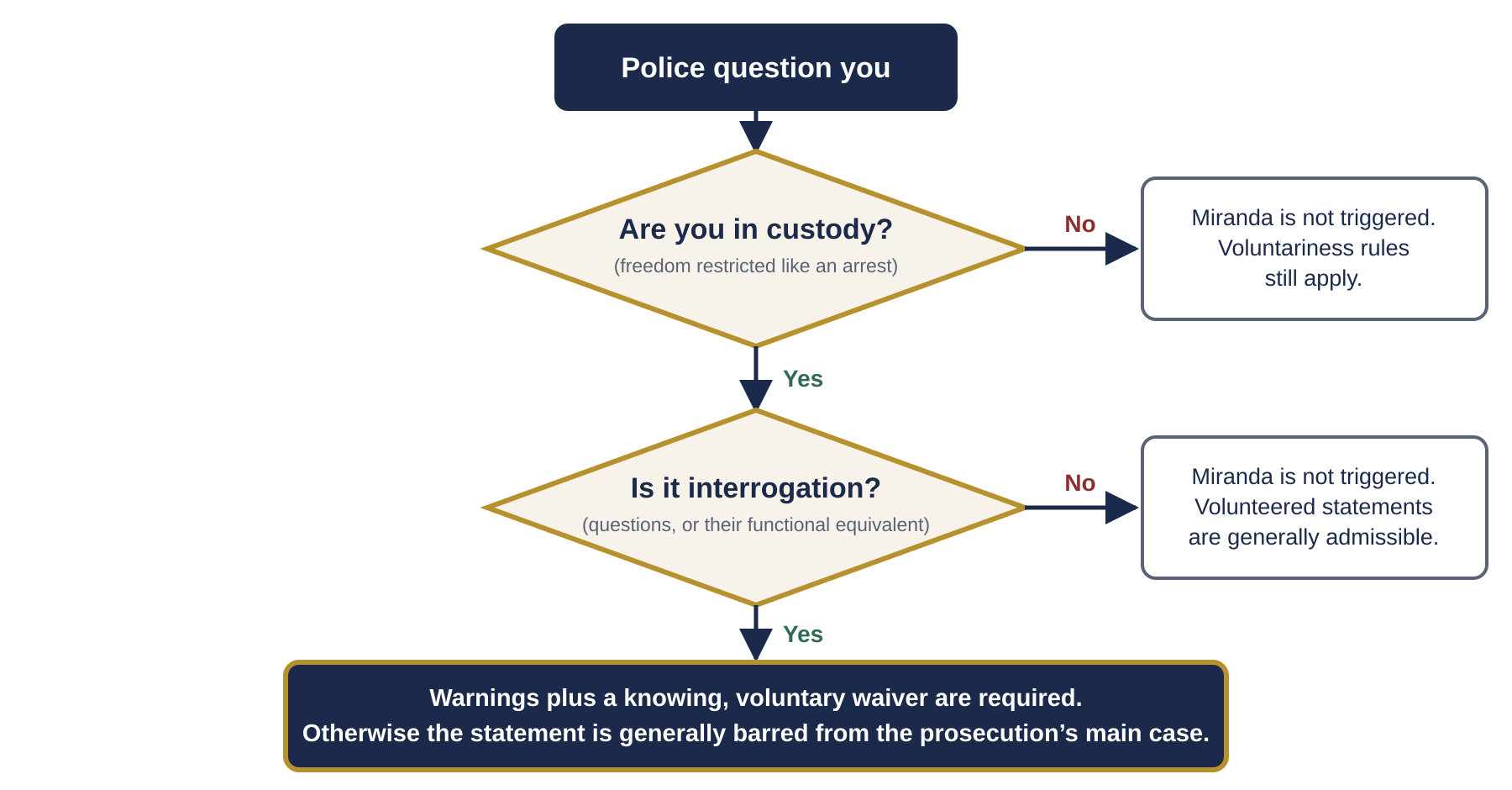
Miranda applies only when custody and interrogation occur together.
If either element is missing, Miranda does not apply.
A person who blurts out a confession to an officer who asked nothing was not interrogated. A person who answers questions at their own kitchen table, free to end the conversation, may not be in custody. That does not mean such statements are always admissible, because they must still be voluntary under the Due Process Clause, but the Miranda exclusionary rule is not available.
What “Custody” Means in Colorado
Custody is the battleground in most Miranda disputes. Colorado courts ask whether, under the totality of the circumstances, a reasonable person in the defendant’s position would believe their freedom of movement was restricted to the degree associated with a formal arrest. The factors courts weigh trace back to People v. Matheny, 46 P.3d 453 (Colo. 2002), and include:
| Factor | What courts look at |
|---|---|
| Time, place, and purpose | Station house or patrol car versus a public place or your own home; late-night versus daytime; the reason for the encounter. |
| Who was present | How many officers, whether others (family, a lawyer) were allowed to be there, and whether the person was isolated. |
| Officers’ words and tone | Requests versus commands; whether the person was told they were free to leave or not under arrest. |
| Restraint and force | Handcuffs or other restraints, drawn weapons, blocked exits, or limits on movement. |
| Escort and compliance | Whether officers escorted the person, held their belongings, or the person simply followed every direction given. |
| Duration | How long the encounter lasted and whether it was a brief question or a prolonged interview. |
What Happens When Police Violate Miranda
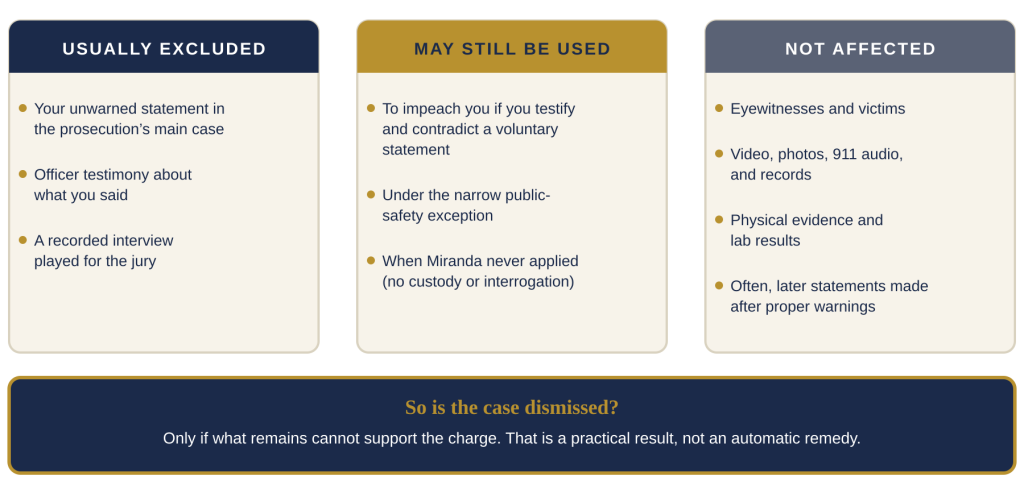
When a court finds custodial interrogation without valid warnings and waiver, the remedy is suppression: the court orders that the statement cannot be used in the prosecution’s case-in-chief. Nothing in the Miranda line of cases requires dismissal of the charges.
The prosecution bears the burden of proving that a defendant validly waived Miranda rights, generally by a preponderance of the evidence. Colorado v. Connelly, 479 U.S. 157 (1986).
A waiver can be express or implied by conduct, and it must be knowing and voluntary. In Colorado a motion to suppress statements is litigated at a pretrial hearing, often with the recorded interview as the central exhibit, and the prosecution may seek a pretrial appeal of an adverse suppression ruling under C.A.R. 4.1, as happened in Lulei.
What the Prosecution Can Still Use
Suppression is powerful, but it is not a clean slate. Even after a successful motion, the prosecution may be able to rely on:
- Impeachment. A statement taken in violation of Miranda, but that was voluntary, can be used to contradict you if you testify inconsistently at trial. Harris v. New York, 401 U.S. 222 (1971). This is a major reason to think carefully about whether a client should testify.
- The public-safety exception. Officers may ask questions reasonably prompted by an immediate threat to safety, such as the location of a discarded weapon, before giving warnings. New York v. Quarles, 467 U.S. 649 (1984).
- Physical evidence. Under United States v. Patane, 542 U.S. 630 (2004), a gun or drugs found because of a voluntary but unwarned statement is not automatically suppressed, because the “fruit of the poisonous tree” doctrine generally does not extend to Miranda-only violations.
- Independent evidence. Eyewitnesses, surveillance and body-worn camera video, 911 recordings, phone records, forensic analysis, and other proof that does not depend on what you said.
- Later-warned statements. Depending on the facts, a statement made after proper warnings may remain admissible, but deliberate “question first, warn later” tactics can doom it. Oregon v. Elstad, 470 U.S. 298 (1985); Missouri v. Seibert, 542 U.S. 600 (2004).
When a Miranda Violation Can Effectively End a Case
Although dismissal is not the legal remedy, a suppression order can end a prosecution in practice. That tends to happen when the statement was the prosecution’s case, for example:
- Cases with no independent eyewitness, video, or forensic proof, where the defendant’s admission supplied identity or intent.
- Cases where the only evidence of an element, such as knowledge or possession, came from the interview.
- Cases where suppression leaves the prosecution unable to meet its burden, prompting a dismissal, a reduced charge, or a far better plea offer.
Other defects are often present alongside a Miranda problem. An unlawful stop or arrest can lead to suppression of both the statement and the physical evidence under the Fourth Amendment, which is a stronger remedy than Miranda alone. A thorough defense reviews the entire encounter, from the first contact to the booking questions.
Common Colorado Scenarios
DUI stops and roadside questions
An ordinary traffic stop is generally not custody, so officers may ask “Have you been drinking?” without warnings. Berkemer v. McCarty, 468 U.S. 420 (1984). Once a driver is arrested, custodial questioning requires warnings. Routine booking questions such as name and address are treated differently. Pennsylvania v. Muniz, 496 U.S. 582 (1990). When a statement precedes a warning, the timing of the arrest decision becomes a critical fact.
Domestic violence scene interviews
Officers responding to a domestic violence call often separate the parties and ask what happened. Whether that is custody depends on whether you were restrained, whether you were told you could leave, and how many officers were present. Statements made at the scene are frequently the core of the prosecution’s proof, so the custody analysis deserves close attention.
“Voluntary” station interviews
Detectives often invite people to “come in and talk” and say they are free to leave. That framing can defeat a custody argument, as Lulei illustrates, but facts such as isolation, restraints, and refusal of requests can flip the result, as in Niemeyer.
Juveniles
Colorado’s Children’s Code imposes additional protections when a juvenile is questioned, including requirements involving a parent, guardian, or legal custodian. See C.R.S. § 19-2.5-203. A statement that satisfies Miranda for an adult may still be inadmissible against a juvenile.
Asking for a lawyer or staying silent
Invocation must be clear. Courts have held that an ambiguous reference, such as “Maybe I should talk to a lawyer,” does not require officers to stop. Davis v. United States, 512 U.S. 452 (1994). Staying silent without saying so can also fail to invoke the right to silence. Berghuis v. Thompkins, 560 U.S. 370 (2010). Before custody, a person who simply stops answering a question may be treated as having not invoked the privilege at all. Salinas v. Texas, 570 U.S. 178 (2013). Once you do clearly ask for counsel in custody, police must stop questioning and may not restart on their own. Edwards v. Arizona, 451 U.S. 477 (1981).
How Miranda Law Has Developed
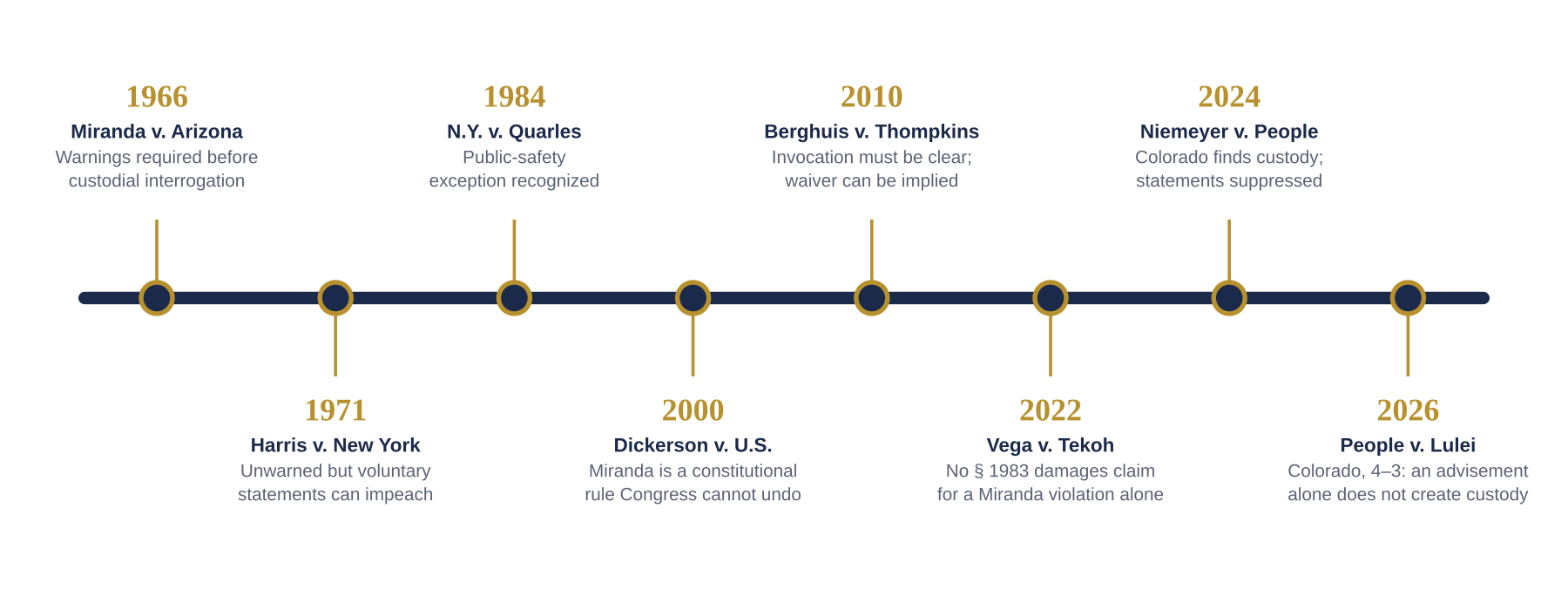
Miranda has been narrowed in some respects and reaffirmed in others. In Dickerson v. United States, 530 U.S. 428 (2000), the Court held that Miranda announced a constitutional rule that Congress can overrule by statute. In Vega v. Tekoh, 597 U.S. 134 (2022), the Court held that a Miranda violation alone does not support a civil rights damages claim against the officer under 42 U.S.C. § 1983, which makes suppression at the criminal trial the principal remedy.
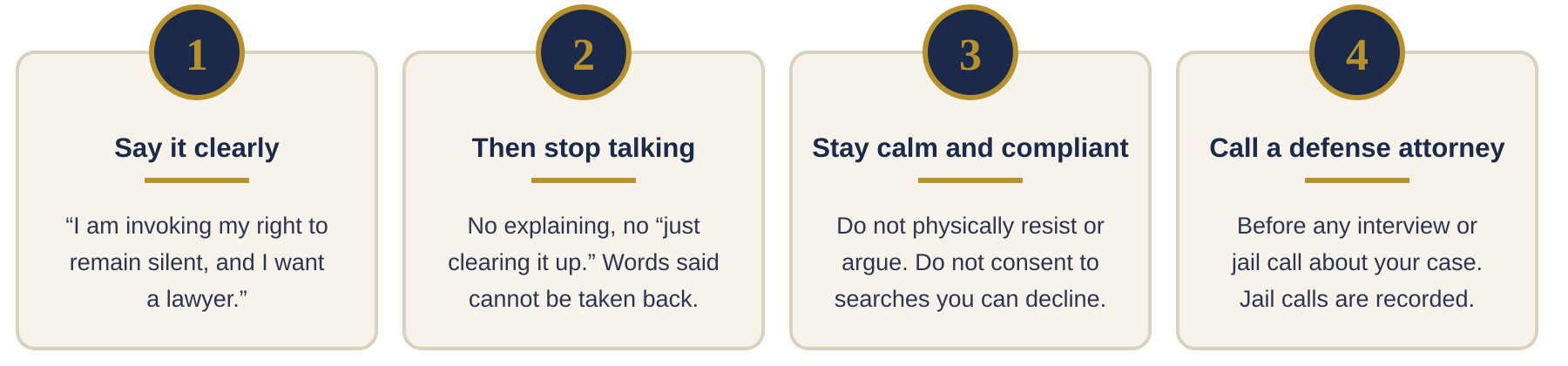
What to Do If Police Want to Question You
The best protection is not arguing about warnings after the fact; it is deciding before you speak. The law favors people who clearly assert their rights and punishes people who assume police will protect them.
How a Defense Attorney Challenges a Statement
A Miranda challenge is detailed, fact-driven work.
A thorough review typically includes:
- Obtaining and reviewing every recording, including body-worn camera, dash camera, interview-room video, and 911 audio, and building a minute-by-minute timeline.
- Identifying exactly when custody began and when questioning began, and whether any warning or waiver was valid, voluntary, and documented.
- Examining invocations of silence or counsel and whether officers honored them.
- Evaluating voluntariness: length of questioning, deception, promises, intoxication, injury, age, and mental state.
- Filing a motion to suppress under Colorado Rule of Criminal Procedure 41, presenting testimony at the hearing, and preserving issues for appeal.
- Weighing what the prosecution can still prove without the statement to guide negotiation or trial strategy.
Every case turns on its own facts. The timing of a single sentence in an interview can decide whether a statement is heard by the jury.
Frequently Asked Questions
If police never read me my Miranda rights, will my case be dismissed?
Almost never. The usual remedy is suppression of statements taken during custodial interrogation without valid warnings and waiver. The rest of the case continues, and charges are dropped only if the remaining evidence cannot support them.
Do police have to read Miranda rights when they arrest me?
No. Miranda warnings are required before custodial interrogation if the prosecution wants to use your answers. Police can arrest you without ever reading the warnings, as long as they do not question you or do not try to use what you say.
Can my statement still be used if I wasn’t in custody?
Yes. If you were not in custody, Miranda does not apply, though the statement must still be voluntary. Whether you were in custody depends on the totality of the circumstances, and Colorado courts have gone both ways on close facts.
Can an unwarned statement be used if I testify?
Possibly. A statement that violated Miranda but was voluntary can generally be used to impeach you if you take the stand and testify inconsistently. A truly involuntary statement cannot be used for any purpose.
What if I asked for a lawyer and the police kept going?
If you clearly asked for counsel during custodial interrogation, police must stop and may not restart questioning on their own. A clear request and the officers’ response are key facts for a suppression motion. Ambiguous statements may not count.
Should I hire a lawyer before talking to police?
If you are a suspect or even a possible suspect, yes. Speaking with an attorney before any interview protects your rights and avoids creating evidence that later has to be fought.
Questioned by Police in Colorado? Talk to a Denver Criminal Defense Attorney.
The Law Office of H. Michael Steinberg has defended Coloradans charged with DUI, domestic violence, drug crimes, sex crimes, and felony and misdemeanor offenses for more than forty years. If you gave a statement to police, or are about to, call before you say another word.
Law Office of H. Michael Steinberg · Denver, Colorado
Sources
- Colorado Supreme Court, Niemeyer v. People, 2024 CO 58
- Colorado Supreme Court, People v. Lulei, No. 25SA146 (Mar. 30, 2026)
- Denver Gazette, Divided Colorado Supreme Court finds Denver detective did not violate defendant’s Miranda rights (Mar. 30, 2026)
- U.S. Supreme Court, Vega v. Tekoh, 597 U.S. 134 (2022)
This article is for general informational purposes only and is not legal advice. Reading it does not create an attorney-client relationship. Laws change and every case depends on its own facts. Consult a licensed Colorado attorney about your situation. Prior results do not guarantee a similar outcome.