 Colorado Criminal Lawyer Blog
What Should You Do In Colorado If You Learn You Are Under Criminal Investigation?


The call comes at an ordinary moment. A detective leaves a voicemail asking you to “come in and clear a few things up.”
A card appears in your door. Your employer mentions that investigators were asking you questions. Or a subpoena arrives in the mail.However you find out…the days that follow matter more than most people realize because the choices you make before you are ever charged often shape what a prosecutor can prove and which options remain open to you.
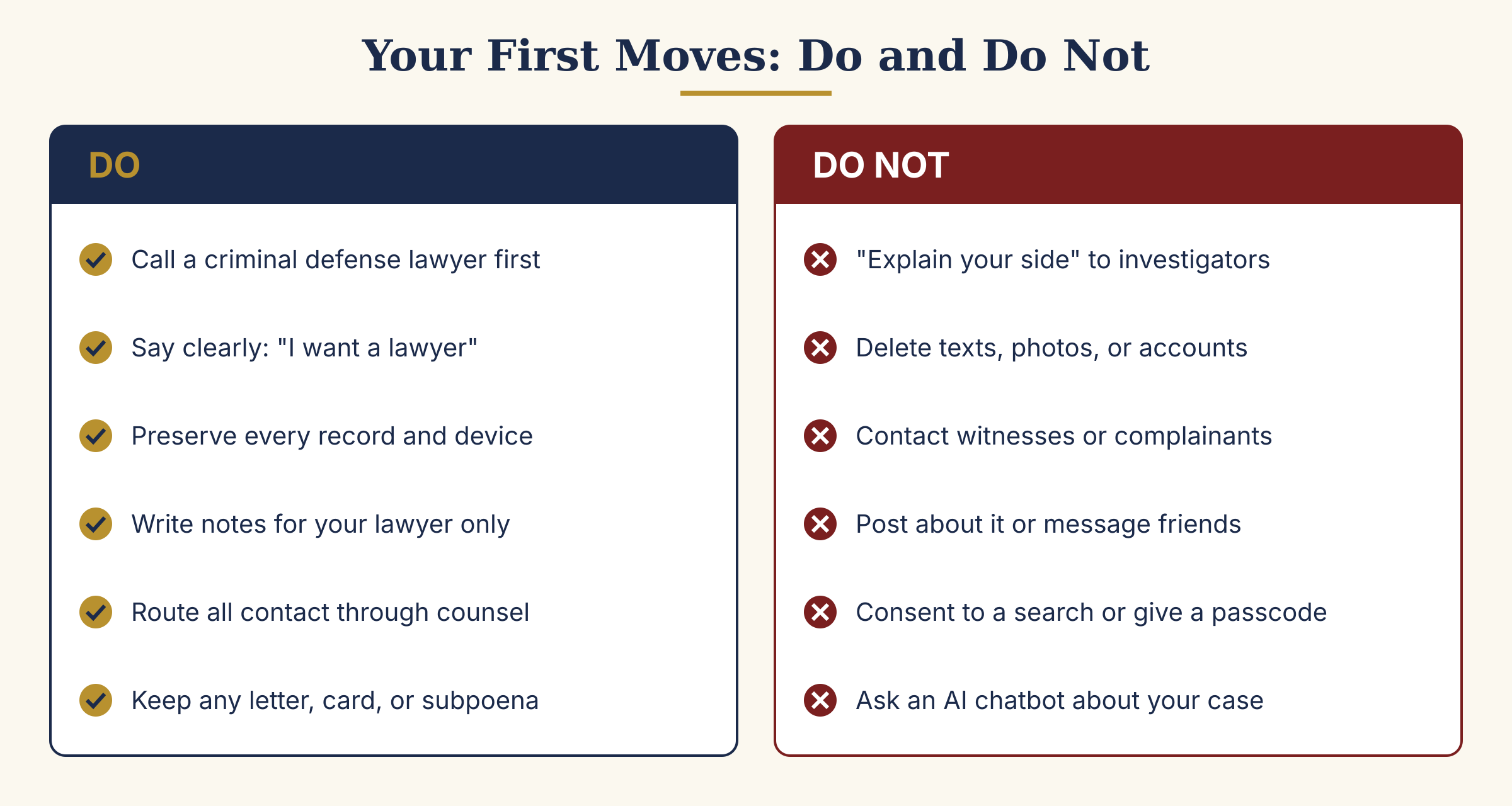
- Stay calm and do not give a statement.Do not try to explain or “clear things up.”
- Say clearly that you want a lawyerand will communicate only through counsel.
- Call a Colorado criminal defense attorney right away, before any interview or deadline.
- Preserve everything.Do not delete, wipe, move, or alter any message, file, account, or device.
- Talk to no one else about the case, including friends, family, coworkers, and AI chatbots.
- Do not consent to searches or hand over passcodes. Keep copies of any warrant, subpoena, or letter.
- Let your lawyer learn your status (witness, subject, or target) and build a strategy.
How People Learn They Are Under Investigation
Police and prosecutors have no general duty to tell you that you are being investigated. Many investigations run quietly for weeks or months while records are gathered and witnesses are interviewed. People often find out indirectly, and the way they learn can tell you how far along the case is.
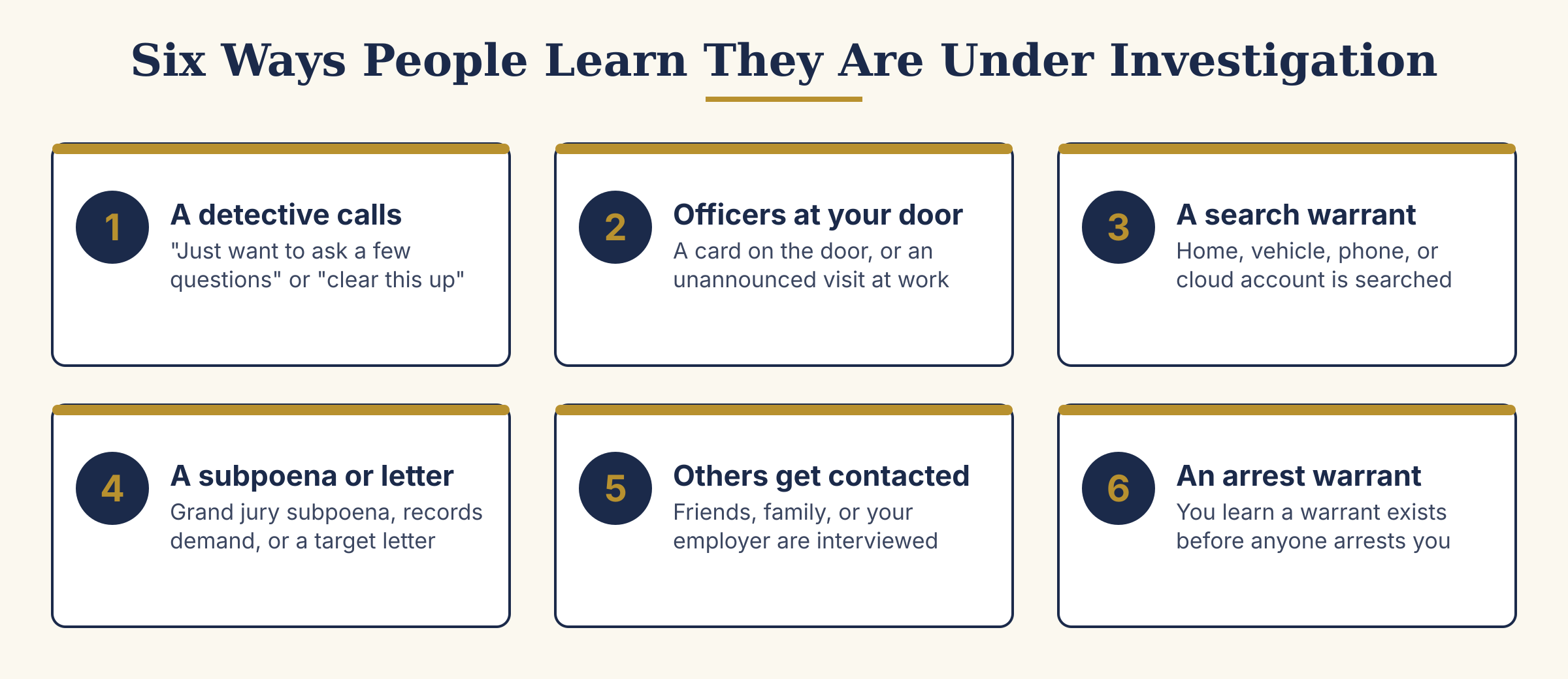
None of these is a reason to panic, and none means you will be charged. But each is a reason to act deliberately, and to act now.
Step 1: Stop Talking and Invoke Your Rights Clearly
The most common and most damaging mistake people makeis trying to explain themselves.
It feels natural. If you did nothing wrong, why not just say so?
An interview is not a conversation. Investigators are trained to gather statements, and anything you say can be quoted, summarized, or taken out of context. Small inconsistencies in an innocent account are later presented as lies.
An innocent explanation, delivered to the wrong audience at the wrong time and without a lawyer, can become the prosecution’s best evidence.
Your protection comes from the Fifth Amendment and Article II, Section 18 of the Colorado Constitution, which protect you from being compelled to incriminate yourself, and from the Sixth Amendment right to counsel. But those protections are not self-executing. You have to invoke them clearly, and Colorado courts have recently shown how much the exact circumstances matter.
People v. Torres, 2026 CO 15 (Mar. 9, 2026). The Colorado Supreme Court held that the defendant did not clearly invoke his right to remain silent, that he voluntarily waived it, and that his statements were admissible. Ambiguous statements are not enough.
People v. Lulei, 2026 CO 17 (Mar. 30, 2026). The court held that a request for a lawyer made when the defendant was not in custody did not trigger the Miranda/Edwards rule against police re-initiating questioning, and that merely giving a Miranda advisement does not by itself create a custodial setting.
Salinas v. Texas, 570 U.S. 178 (2013), and Berghuis v. Thompkins, 560 U.S. 370 (2010). In general, a person must expressly and unambiguously assert the privilege or the right to counsel. Staying quiet, or saying something vague, may not protect you.
The practical lesson: do not rely on a half-sentence to protect you. State your position plainly, then let a lawyer handle the rest.
What to say
If a detective calls, visits, or approaches you, stay polite and calm, and say something like this:
“I am invoking my right to remain silent and my right to an attorney. I will not answer questions or consent to any searches. Please contact me through my lawyer.”
Then stop. Do not argue, do not “just clarify one thing,” and do not lie. If you are not in custody, you may end the encounter. If officers are arresting you, do not resist, even if you believe the arrest is wrong. Your lawyer can and will address that in court.
Be aware that investigators are not always police officers. In Densmore v. People, 2025 CO 6, the Colorado Supreme Court held that a child-protection caseworker who interviewed a person in custody was not, on the facts of that case, acting as an agent of law enforcement, so Miranda warnings were not required.
Statements to caseworkers, school officials, employers, and others can still end up in a criminal case.
Step 2: Call a Criminal Defense Lawyer Immediately
Hiring a lawyer is not an admission of guilt. It is the single most protective step you can take, and it works best early.
At the investigation stage, an experienced defense attorney can:
- Find out your status by contacting the detective or prosecutor and learning, where possible, whether you are a witness, subject, or target.
- Control the flow of information. All contact goes through counsel, which protects you from unplanned statements.
- Decide whether any statement should be made, and if so, how, when, and under what protections.
- Preserve favorable evidence and witnesses before memories fade and records are lost.
- Investigate independently, so the first version of events is not only the government’s.
- Advocate before charges are filed. In many cases, a lawyer can present mitigating information or legal problems with the case to the prosecutor before a charging decision is made.
- Prepare for the worst case,including arranging a voluntary surrender and a bond plan if a warrant is likely.
No lawyer can promise an outcome, and every case is different. But the window before charges are filed is often the point at which a defense lawyer has the most room to help. Look for a lawyer who handles criminal cases every day in the courthouse where yours would be filed.
Understand Your Status: Witness, Subject, or Target
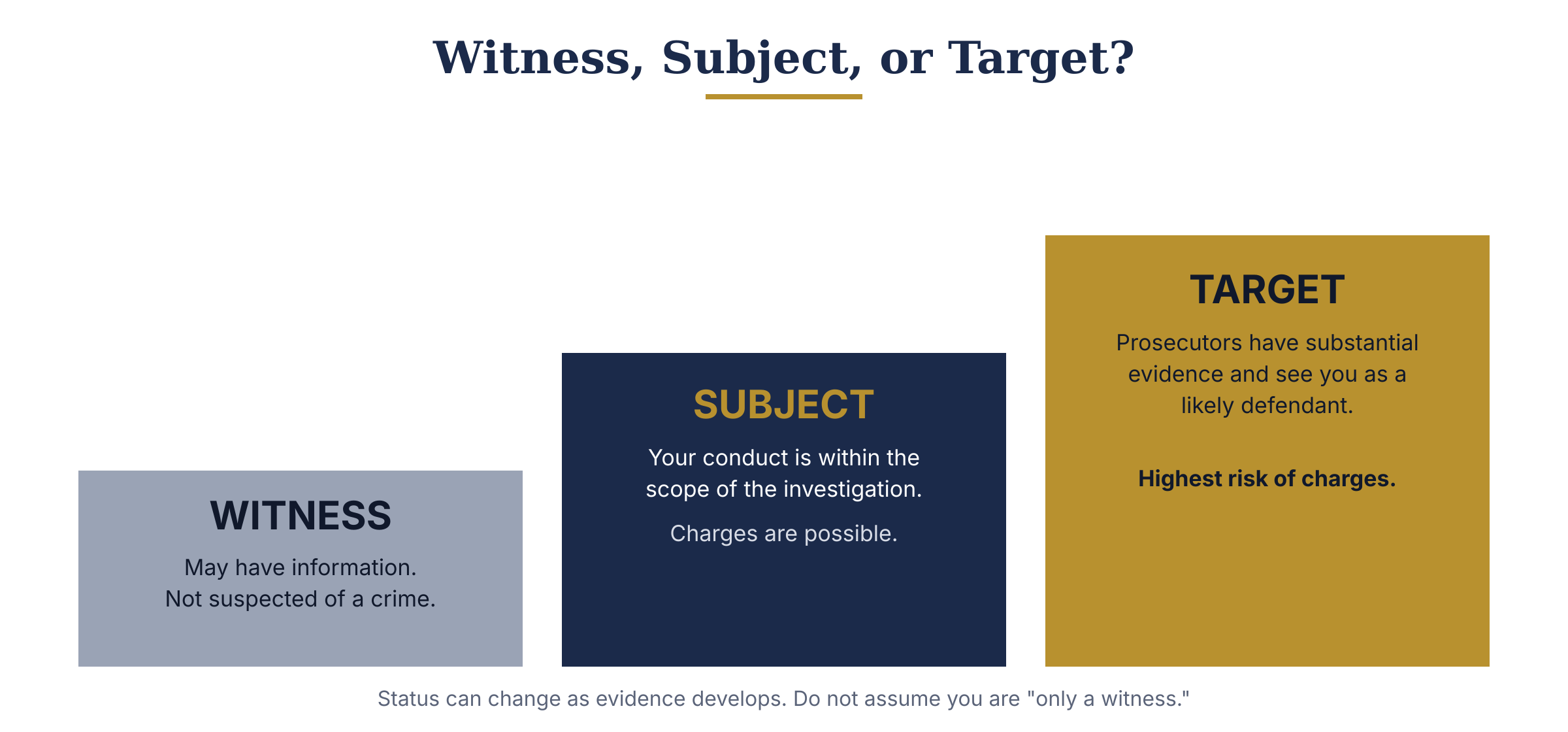
In federal investigations, prosecutors use three labels. Under the Justice Department’s Justice Manual (§ 9-11.151), a target is a person as to whom the prosecutor or grand jury has substantial evidence linking him or her to a crime and who, in the prosecutor’s judgment, is a putative defendant.
A subject is a person whose conduct is within the scope of the investigation.
A witness is someone who may have information but is not suspected. Colorado district attorneys do not always use those labels, so one of the first jobs of your lawyer is to ask.
| Status | What it generally means | What to do |
|---|---|---|
| Witness | You may have information, but investigators do not suspect you of a crime. | Still speak to a lawyer before any interview. Witnesses can become subjects based on what they say. |
| Subject | Your conduct falls within the scope of the investigation. Charges are possible. | Do not give a statement. Retain counsel immediately and route all contact through counsel. |
| Target | Prosecutors believe they have substantial evidence and view you as a likely defendant. | Treat as urgent. Do not testify or meet with investigators without counsel. Prepare for a charging decision. |
Step 3: Preserve Evidence. Never Destroy It.
When people are afraid, they sometimes delete texts, wipe their phones, close social media accounts, or throw things away. This is a serious mistake.
Colorado’s tampering statute, C.R.S. § 18-8-610, makes it a felony to destroy, conceal, remove, or alter physical evidence when you believe an official proceeding or investigation is pending or about to begin and you intend to impair its availability.
Deleting data can also be treated as evidence of guilt, and forensic tools often recover what you thought was gone. A person who might have faced a weak case can end up facing a strong tampering charge.
- Do not delete or edit messages, photos, emails, call logs, browsing history, or app data.
- Do not factory-reset, trade in, or dispose of a phone, computer, or storage device.
- Turn off automatic-deletion or “disappearing message” features, and ask your lawyer what else to keep.
- Keep any warrant, subpoena, target letter, business card, or voicemail you receive.
- Write down what happened, who was there, and what was said, but only for your lawyer, and label it “Prepared for my attorney.”
If Officers Arrive With a Search Warrant
A search warrant means a judge has found probable cause for a search of a specific place or thing. If officers show up with one:
- Stay calm and do not physically interfere, even if you disagree with the search.
- Ask to see the warrant and request a copy. It identifies what officers may search for and where.
- State once: “I do not consent to any search beyond this warrant, and I will not answer questions without my lawyer.”
- Call your lawyer. Do not chat with officers while they work.
- Note names and badge numbers, and write down what was taken and the condition of your property once you are able.
If officers have no warrant, you may decline to consent to a search. Say so clearly and politely.
A “yes” to be cooperative can accidentally waive protections your lawyer could otherwise use.
Phones, passcodes, and cloud accounts
Phones hold much of a person’s life, and investigators know it. Do not volunteer a passcode or unlock a phone “to show you have nothing to hide.” In People v. Davis (Colo. 2019), the Colorado Supreme Court held that a defendant who voluntarily gave police his phone passcode no longer had a legitimate expectation of privacy in that passcode, so police could use it to carry out a valid search warrant.
Whether the government can compel you to disclose a passcode is a more complicated and evolving constitutional question. Let your lawyer handle it.
Be Careful Who You Talk To
Conversations with friends, relatives, coworkers, and partners are generally not privileged. Those people can be interviewed, subpoenaed, or asked to wear a recording device. Colorado does recognize a limited spousal communications privilege, but it has exceptions and does not protect what you say to anyone else.
The safest rule is also the simplest: discuss the case only with your lawyer.
- Social media: Do not post, comment, or message about the allegations or the people involved. Public statements are easy to collect and use.
- Complainants and witnesses: Do not contact them, directly or through others, even to apologize or “fix it.” Contact can lead to protection-order violations and to new charges under Colorado’s witness-tampering and intimidation statutes.
- Your employer: Do not agree to an internal interview before speaking with counsel. What you tell an employer may be shared with law enforcement. Public employees may have special protections under Garrity v. New Jersey, 385 U.S. 493 (1967), which a lawyer can explain.
- AI chatbots: Do not type the facts of your case into a public AI tool. Those conversations are generally not protected by attorney-client privilege and could be sought by investigators.
Subpoenas, Grand Juries, and Target Letters
A subpoena is a legal order to produce records or testify. Do not ignore it, and do not hand over documents or answer questions on your own. Deadlines can sometimes be negotiated, the scope can sometimes be narrowed, and the Fifth Amendment may protect some testimony.
A target letter is a federal notice that you are a target of a grand jury investigation. According to the Justice Department’s own sample letter, it typically advises the recipient of the right to refuse to answer self-incriminating questions, the right to consult counsel, and the warning that destroying documents may violate federal obstruction laws.
A target letter does not mean you will be indicted, and some cases end in declination. But ignoring one does not make it go away, and responding without counsel can create problems you cannot undo.
If You Learn There Is a Warrant for Your Arrest
Do not hide and do not ignore it. An outstanding warrant means you can be arrested at work, at home, or during a routine traffic stop. A defense lawyer or bail bondsman can often confirm whether a warrant exists, negotiate a voluntary surrender at a set time, and prepare a bond presentation in advance.
Colorado’s Constitution (Art. II, § 19) protects the right to bail in most cases, and a prepared bond argument can make a significant difference in how quickly you go home.
Think About Collateral Consequences Early
Even an investigation that never results in charges can ripple into other parts of your life. Tell your lawyer about anything that could be affected, including:
- Immigration status. Noncitizens face special risks, and defense counsel must consider them (Padilla v. Kentucky, 559 U.S. 356 (2010)).
- Professional licenses and security clearances, which may carry self-reporting duties.
- Employment and education, including workplace policies and any required disclosures.
- Family court matters, where allegations can affect parenting-time and custody disputes.
What Happens Next? How an Investigation Can Unfold
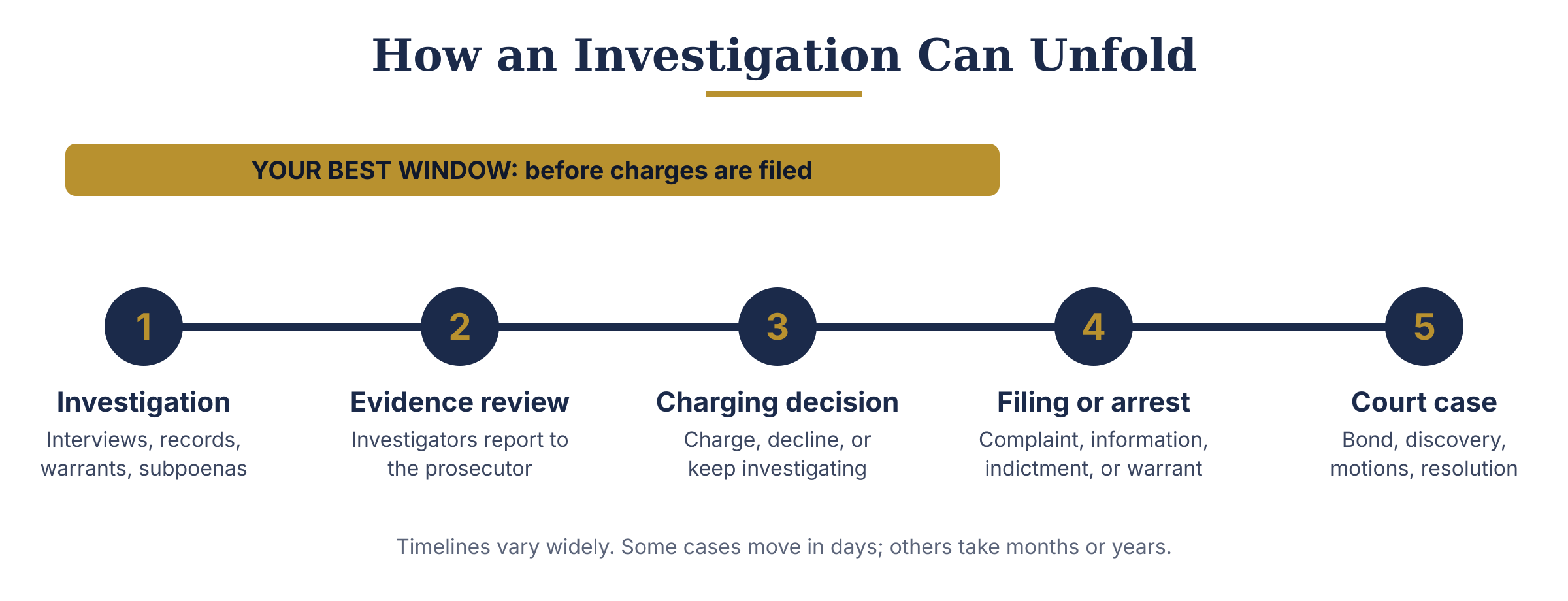
There is no fixed schedule. Some investigations conclude in days; others stay open for months or years. Prosecutors may charge, decline to charge, or continue investigating.
The time limit for filing charges depends on the offense.
Under C.R.S. § 16-5-401, most felonies carry a three-year limit and most misdemeanors an eighteen-month limit, while certain serious offenses, such as murder, kidnapping, and felony sex offenses against children, have no limit at all.
The clock can also be paused while a person is outside Colorado, and some offenses, such as theft, run from the date of discovery. Because the rules have many exceptions, never assume that “enough time has passed” without your lawyer checking.
Common Mistakes and Better Moves
| Common mistake | Why it hurts | Better move |
|---|---|---|
| “I’ll just explain it.” | Statements are admissible, and small inconsistencies can be portrayed as lies. | Politely decline. Let counsel communicate. |
| “I have nothing to hide.” | Innocent people are harmed by incomplete context and misunderstood facts. | Using your rights is not an admission of guilt. |
| Deleting messages or accounts | Can create a tampering charge and looks like consciousness of guilt. | Preserve everything. Let your lawyer advise. |
| Waiting to see if it goes away | You lose the pre-charge window while evidence and memories fade. | Call a lawyer now. |
| Contacting the complainant | Risks witness-tampering allegations and protection-order violations. | No contact of any kind, direct or indirect. |
| Consenting to a search to seem cooperative | Waives warrant and probable-cause protections. | Decline politely and call counsel. |
Frequently Asked Questions
In a voluntary, non-custodial encounter, you generally have no obligation to answer questions or agree to an interview. State clearly that you will speak only through your lawyer, then end the call. Do not lie, and do not ignore a subpoena or court order, which are different from a voluntary request.
No. Asking for counsel is a constitutional right that detectives and prosecutors encounter every day. A lawyer’s job at this stage is to protect you from avoidable mistakes.
Often, yes. A defense lawyer can contact the assigned detective or the district attorney’s office to learn what they are willing to share. Investigators do not always disclose, but your lawyer can ask and can open a channel that protects you.
You should still speak to a lawyer before any interview. Witnesses can become subjects based on what they say, particularly when the case involves people they know or events they took part in.
Investigations are not always closed with a formal notice. A case can remain open until the limitations period runs, so silence from investigators does not guarantee the matter is over. Your lawyer can help you evaluate where things stand.
As soon as you learn of the investigation, and before you agree to an interview, respond to a subpoena, or consent to any search.
If you believe you are under criminal investigation, do not wait for charges to be filed. With more than forty years of Colorado criminal defense experience, the Law Office of H. Michael Steinberg represents clients in DUI, domestic violence, drug, sex crimes, and other felony and misdemeanor matters across the Denver metro area. Call for a confidential consultation.
Disclaimer: This article is provided for general informational purposes only and does not constitute legal advice or create an attorney-client relationship. Criminal law is complex and fact-specific, and laws and court decisions change. Last reviewed October 6, 2026. If you are under investigation or have been charged with a crime, consult a licensed Colorado criminal defense attorney about your specific situation. Past results do not guarantee a similar outcome.