 Colorado Criminal Lawyer Blog
What Happens After an Arrest in Colorado? Misdemeanor vs. Felony Timeline


 Introduction
An arrest is the moment most people remember, but it is only the first page of a much longer story. The handcuffs, the booking photo and the night in a holding cell are over quickly. What follows can stretch across days, weeks and months, and the path it takes depends heavily on one question: is the charge a misdemeanor or a felony?
I have practiced criminal defense in Colorado for more than forty years, and the same scene repeats itself in my office. A frightened client, or more often a frightened parent or spouse, sits down and asks the same questions.
When will I get out?
When do I go to court?
Will this be a real case or will it go away?
How long will this take?
The honest answers are different for a misdemeanor and a felony, and they are different again depending on whether the person is in custody, whether a protection order is involved, and which county is handling the case.
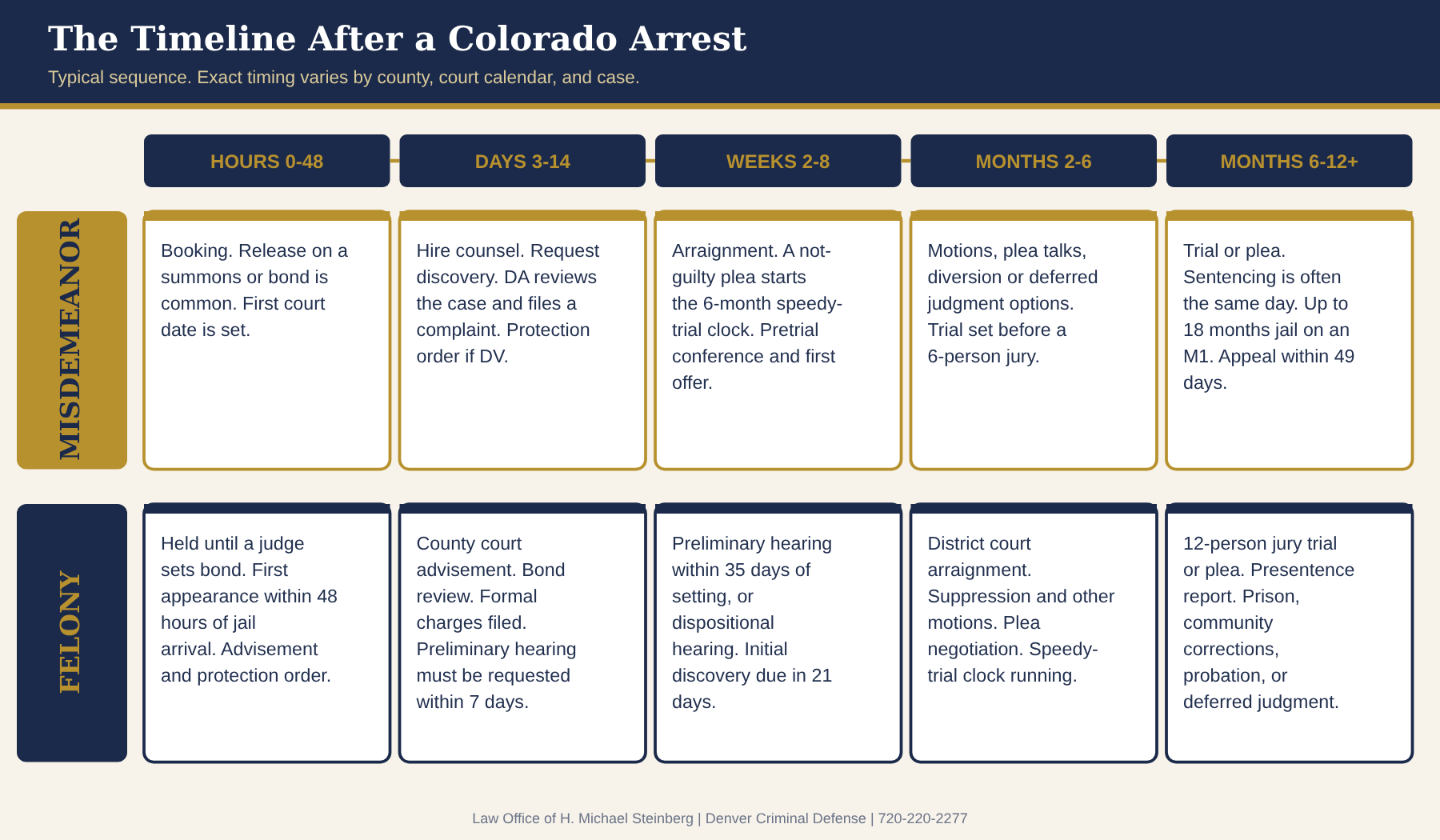
This guide walks through the Colorado process in the order it actually unfolds. It separates the first 48 hours, days 3 to 14, weeks 2 to 8, months 2 to 6, and month 6 and beyond. At every stage it explains what is the same for all arrests and what changes when the charge is a felony. Where the law sets a hard deadline, I give you the number and the source, because in a criminal case deadlines are where rights are won and lost.
Key takeaways
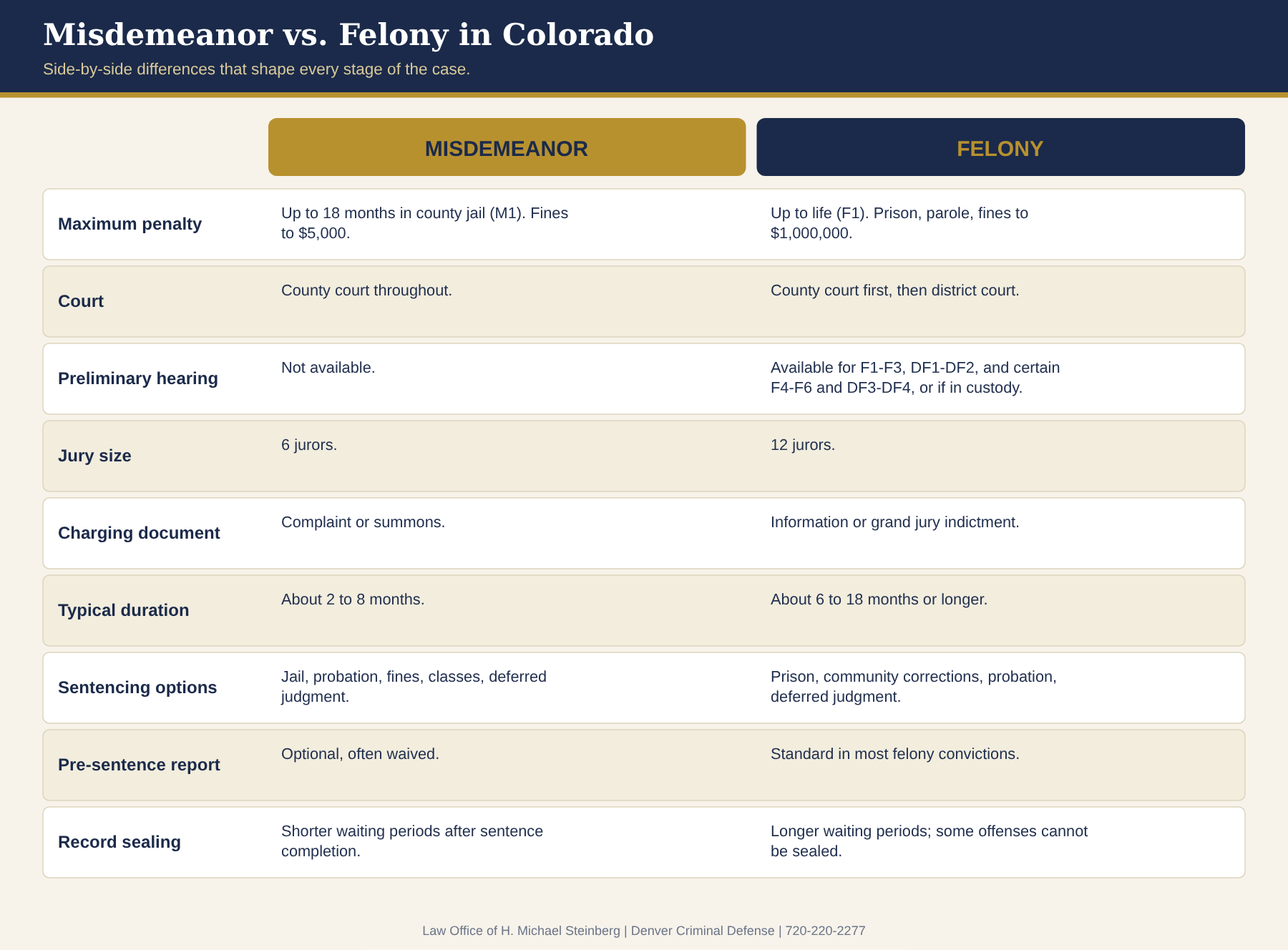
A misdemeanor stays in county court, is tried before a jury of six, and carries a maximum of 18 months in county jail for the most serious class. A felony begins in county court, then moves to district court; it may include a preliminary hearing, is tried before a jury of 12, and can carry a sentence of decades or life.
In both, the first appearance, the first set of discovery, and the speedy-trial clock follow set rules. What you do and say in the first 72 hours often matters more than anything that happens later.
 First, the Threshold Question: Misdemeanor or Felony?
Nearly every procedural difference in this article stems from how Colorado classifies the offense. Colorado sorts crimes into felonies, misdemeanors, and petty offenses, and then ranks each category by class. Felonies run from class 1 (the most serious) down to class 6.
Misdemeanors run from class 1 down to class 3. Drug offenses have their own ladder: drug felonies are levels 1 through 4 and drug misdemeanors are levels 1 and 2. Petty offenses sit at the bottom.
The classification matters long before sentencing. It determines which court hears the case, whether you are entitled to a preliminary hearing, how many jurors decide guilt, how large the bond is likely to be, and what a conviction can cost you in prison time, fines, firearm rights, employment and immigration status.
Misdemeanors in Colorado
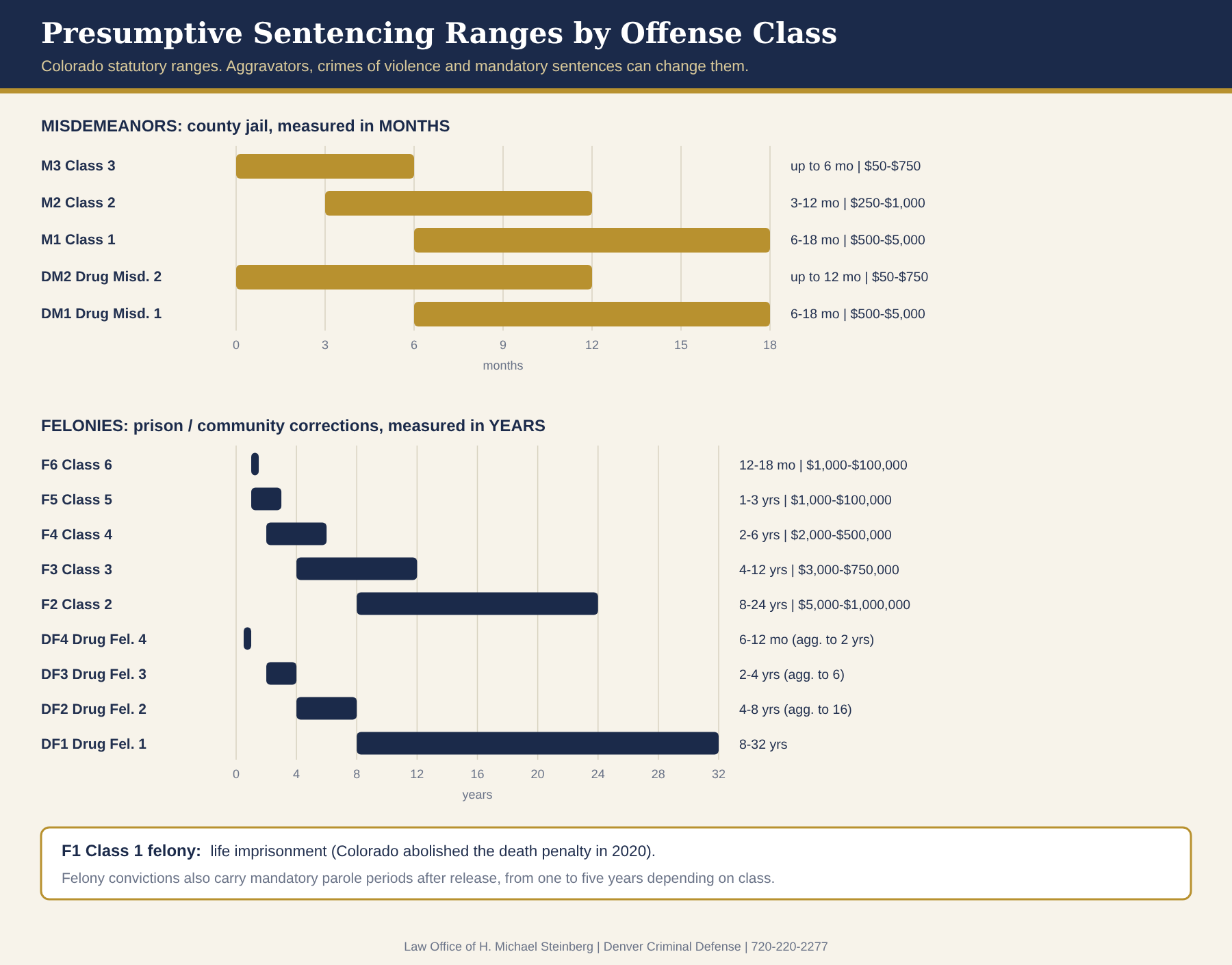
Under the general sentencing statute, a class 1 misdemeanor carries 6 to 18 months in county jail and a fine of $500 to $5,000. A class 2 misdemeanor carries 3 to 12 months and a fine of $250 to $1,000. A class 3 misdemeanor carries up to 6 months and a fine of $50 to $750. Drug misdemeanors track a similar pattern: a level 1 drug misdemeanor carries 6 to 18 months, and a level 2 drug misdemeanor carries up to 12 months. Many of these cases end in probation, classes, treatment, and fines rather than jail, but the exposure is real, and the conviction is permanent unless it is later sealed.
Commonly charged misdemeanors include first- and second-offense DUI and DWAI, many assault and harassment charges, theft below the felony thresholds, third-degree assault, criminal mischief, trespass, and violation of a protection order. Domestic violence is not a stand-alone crime in Colorado.
It is a label attached to an underlying offense, such as assault or harassment, and it can turn a misdemeanor into a case with mandatory arrest, a mandatory protection order, firearm consequences and court-ordered treatment.
Felonies in Colorado
Colorado’s presumptive felony ranges are structured by class. A class 6 felony carries 12 to 18 months in prison, a class 5 carries 1 to 3 years, a class 4 carries 2 to 6 years, a class 3 carries 4 to 12 years and a class 2 carries 8 to 24 years.
A class 1 felony carries life imprisonment, since Colorado abolished the death penalty in 2020. Fines range from $1,000 on the low end to $1,000,000 for a class 2 felony, and felony convictions are followed by a mandatory parole period.
Drug felonies follow their own scale. A level 4 drug felony carries 6 months to 1 year in the presumptive range, a level 3 carries 2 to 4 years, a level 2 carries 4 to 8 years and a level 1 carries 8 to 32 years.
Aggravating circumstances, designation as a crime of violence, mandatory minimum provisions and habitual-offender counts can push the actual exposure well above these numbers, which is why a charging document must be read alongside the statute, not just the class label.
Authority: Classification and Penalties
- C.R.S. 18-1.3-401: felony classes and presumptive penalties
- C.R.S. 18-1.3-501: misdemeanor classes and penalties
- C.R.S. 18-1.3-406: crimes of violence and mandatory sentencing
- Presumptive ranges are a starting point. The court may sentence above or below them when the statute allows.
Where Petty Offenses Fit
Petty offenses are the lowest tier of criminal charge. They are rarely the result of a custodial arrest, though they can be filed alongside more serious counts. If you were arrested, the charge on the paperwork is more likely to be a misdemeanor or a felony. Even so, the final resolution of a felony case sometimes lands on a lesser misdemeanor or petty offense, which is one of the most common goals of a negotiated disposition.
The First Hours: Arrest, Booking and the Interview Trap
An arrest in Colorado requires probable cause, meaning facts that would lead a reasonable officer to believe a crime was committed and that the person arrested committed it. An officer may arrest with a warrant signed by a judge, or without a warrant when probable cause exists at the scene.
Domestic violence is the notable exception to officer discretion: under C.R.S. 18-6-803.6, when an officer has probable cause that a domestic violence offense occurred, arrest is mandatory in most circumstances, even if the alleged victim asks that no arrest be made.
Cite and release versus custodial arrest
Not every misdemeanor arrest means a night in jail. For many lower-level offenses, officers may issue a summons that orders you to appear in court on a future date and then release you at the scene. If that happens, the clock still starts running. A summons is a charge, and a missed court date turns a small case into a warrant case. Felony arrests almost always involve transport to jail and booking.
Booking
Booking is administrative but consequential. Staff collect fingerprints, photographs and personal information, inventory your property, run a criminal history check and, in many counties, ask a series of screening questions about medical needs and mental health. The information gathered at booking is used by pretrial services, by the judge at the first appearance and by the prosecutor. Answer medical questions truthfully and completely. Do not answer questions about what happened.
The interview trap
The most dangerous moment of the first hours is not the cell. It is the conversation. Miranda warnings are required before custodial interrogation, and they tell you that you can remain silent and have a lawyer. Many people hear this, decide they have nothing to hide and begin to explain. In my experience, explanations made in the first hours are among the most damaging pieces of evidence a prosecutor ever receives. They are recorded, they are rarely complete, and they are almost never as exculpatory as the person believed when making them.
Say one sentence: “I want to speak with a lawyer, and I am not answering questions.” Then stop. It is the safest sentence you will ever say to the police. An explanation can follow you into every courtroom.
The rules do not change between a misdemeanor and a felony. The stakes do. A statement to police in a misdemeanor shoplifting case can add a felony count if the officer later claims the value was higher. A statement in a felony assault case can become the prosecutor’s centerpiece. Invoke your rights in either case.
Jail telephone calls, video visits and written messages are recorded and routinely produced in discovery. Do not describe the facts of the case to a family member on a jail phone, and do not ask anyone to contact the alleged victim.
The First 48 Hours: Bond, the First Appearance and the Advisement
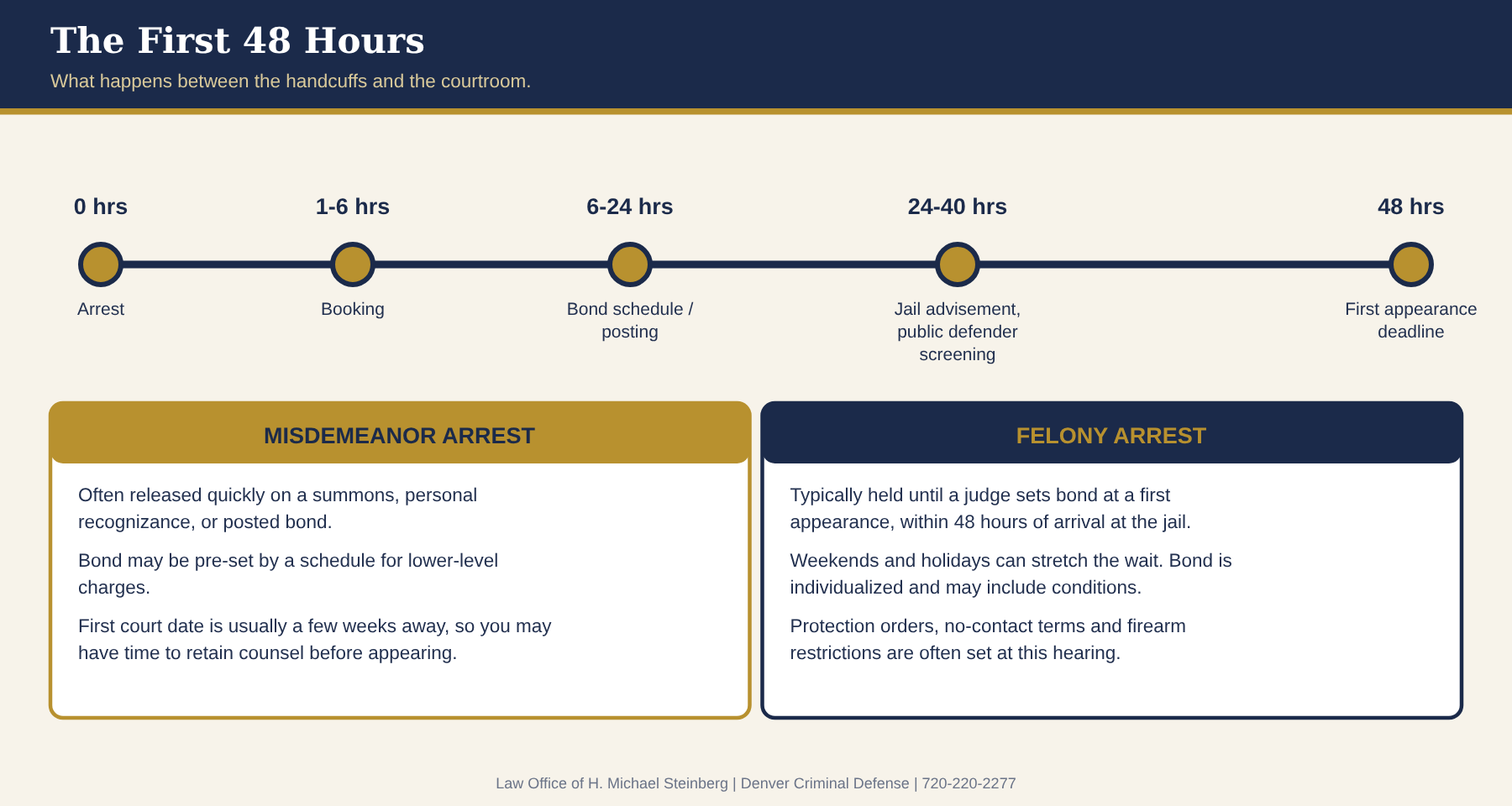
The next legal event is the first appearance, sometimes called the advisement. It is the first time a judge has seen you since the arrest. Colorado Rule of Criminal Procedure 5 requires that an arrested person be taken without unnecessary delay before the nearest available county or district court.
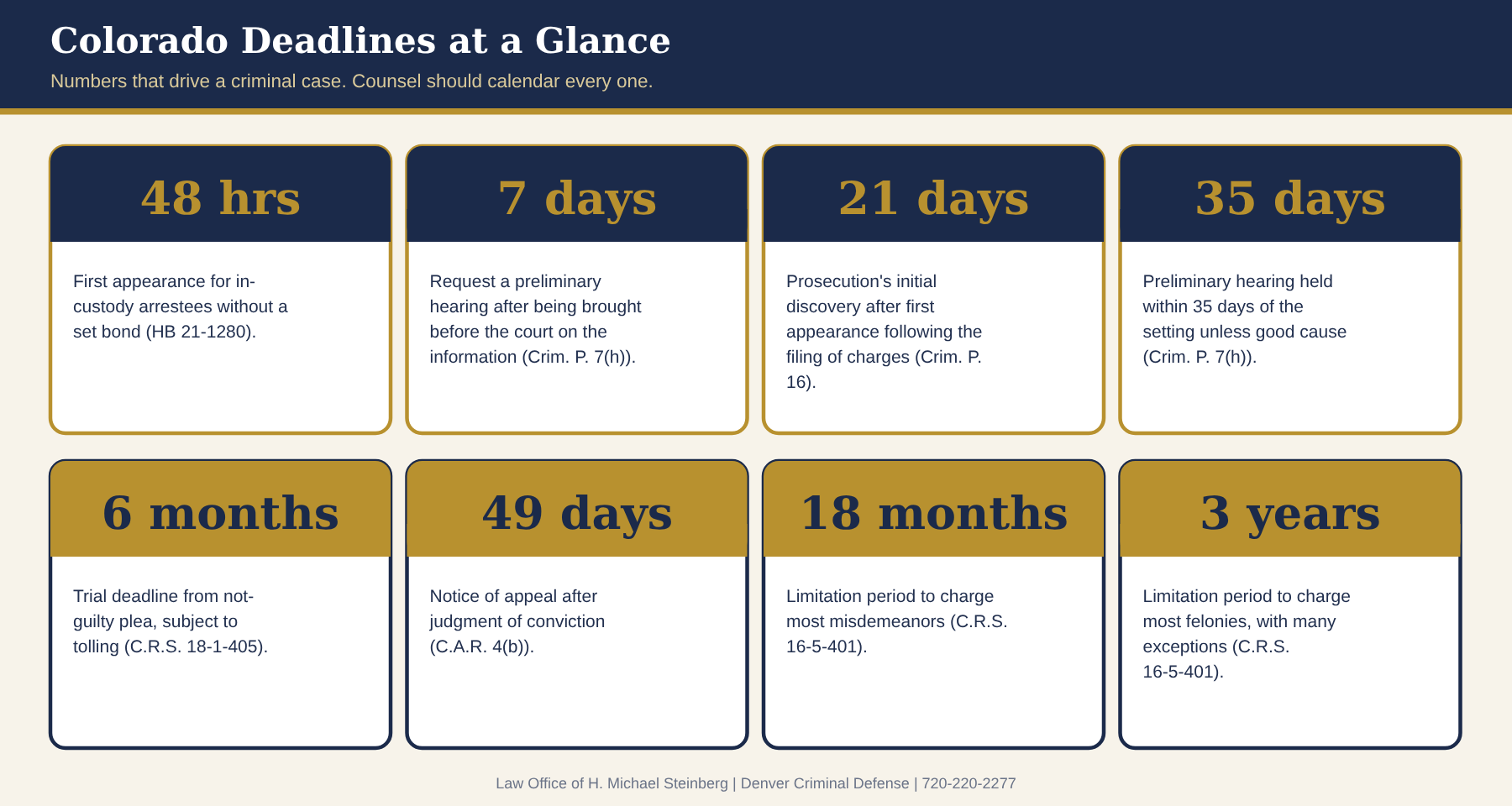
For people in custody who have been arrested without a warrant, or on a warrant with no bond set, state law, adopted in House Bill 21-1280 and in effect since April 1, 2022, requires that they be brought before a judge within 48 hours of their arrival at the jail if they are bond-eligible.
What the judge must tell you
At the advisement, the court informs you of the charges, your right to remain silent, your right to counsel, your right to appointed counsel if you cannot afford one, the nature of bail, your right to a jury trial, and, in felony cases, your right to demand a preliminary hearing. The judge does not decide guilt or consider the strength of the evidence in any detail. This hearing is about bond, conditions and counsel.
How bond works in Colorado
Colorado law presumes that persons in custody are eligible for release on bond with the least restrictive conditions that will reasonably ensure their appearance in court and protect the safety of any person and the community.
C.R.S. 16-4-103 directs judges to consider all methods of release to avoid unnecessary pretrial incarceration, and any monetary condition must be reasonable. The judge weighs individualized factors, including employment, family and community ties, residence, criminal history, prior failures to appear, and any risk of witness intimidation.
The available forms of release include a personal recognizance bond (your signed promise to appear), an unsecured bond (you owe money only if you fail to appear), a cash bond, a surety bond posted through a bonding company, and a property bond. The court can also add non-monetary conditions: no-contact orders, alcohol and drug monitoring, GPS or location monitoring, travel limits, pretrial supervision and surrender of firearms.
Authority: Bond
- Colo. R. Crim. P. 5: first appearance and advisement
- C.R.S. 16-4-103: setting the type of bond and conditions; presumption of release on the least restrictive terms
- C.R.S. 16-4-104: types of bond
- C.R.S. 16-4-105: factors the court considers
- C.R.S. 16-4-101: limited categories of non-bailable offenses
- H.B. 21-1280: 48-hour hearing requirement for qualifying in-custody arrestees
Misdemeanor versus felony at the bond stage
Misdemeanor. Lower-level arrests often resolve within hours. Many jurisdictions use a bond schedule: a preset amount tied to the charge that allows release without a judge. If bond is posted, you walk out with a court date, typically a few weeks away. Domestic violence cases are the exception. They require a hearing before a judge before release, and a mandatory protection order will be imposed.
Felony. Felony arrestees are far more likely to remain in custody until the first appearance. Bond amounts are higher, conditions are more restrictive, and prosecutors argue for them more aggressively. Certain violent offenses and arrests while already on bond or probation can limit bond eligibility, and a small category of offenses are not bailable when the proof is evident, or the presumption is great. A bond hearing can be reopened later. A defense lawyer can file a motion to reduce or modify bond when circumstances change, or new information becomes available.
Protection orders
In domestic violence cases, Colorado requires a mandatory protection order at the first appearance under C.R.S. 18-1-1001. Even in non-DV cases, judges often issue a stay-away or no-contact order protecting the alleged victim or witnesses. These orders are not suggestions. Violating one is a separate crime, may revoke your bond and can create a new case regardless of what the alleged victim says. Because the order may bar you from your own home, the practical consequences can be immediate and severe. A lawyer can seek a modification, for example, to allow contact for childcare or to retrieve belongings through a third party, but you must not take the matter into your own hands.
Public defender or private counsel
If you cannot afford a lawyer, the court will appoint one, usually the Office of the State Public Defender, after an application showing financial need. If you can retain counsel, the sooner the better.
Early involvement matters in a way people do not expect. A lawyer can contact the district attorney before charges are filed, advocate on bond, collect surveillance video before it is overwritten, identify witnesses while memories are fresh, and keep you from making the one statement that cannot be taken back.
Days 3 to 14: Getting Out, Getting a Lawyer and Waiting for Charges
The first two weeks are where cases are quietly won or lost. Not because anything dramatic happens in court, but because the groundwork is laid. What you do now with evidence, witnesses, your employer, and your lawyer will shape what the prosecutor sees when deciding what to file.
Charging decisions: filed, declined, or pending
Whether a charge has actually been filed when you are released is one of the biggest sources of confusion. Colorado prosecutors can file in several ways. In many in-custody cases, the district attorney files before or at the first appearance. In others, the first appearance is a bare advisement, and the district attorney reviews the police report in the following days or weeks.
For people released on bond or a summons, a district attorney’s office may take considerably longer to decide what to file. You can be arrested and released, with a court date, and nothing ever filed. You can also be arrested, released with no court date, and receive a charging document months later.
There is a legal ceiling on that wait. The statute of limitations in C.R.S. 16-5-401 generally gives prosecutors three years to charge most felonies and eighteen months for most misdemeanors, with numerous exceptions.
Murder, kidnapping, many sex offenses against children, and certain financial crimes have extended or no limitation periods. A pending investigation does not mean nothing is happening. It is often a window in which a defense lawyer can provide information that changes the charging decision, or at least the charging level.
 Misdemeanor: complaint and first court date
In a misdemeanor, the charge is typically a complaint or a summons and complaint filed in county court. The first date on your paperwork is usually an arraignment or first appearance. In a number of Colorado courts, a lawyer can file an entry of appearance and request a waiver of the defendant’s presence at routine settings.
That can be valuable to someone with a job and no desire to spend mornings in a courthouse hallway, but it should only be done when the court allows it and when your lawyer is satisfied your presence is not needed.
Felony: advisement then formal charging
A felony begins in county court. After the first appearance, the district attorney files a felony complaint and information, or the matter is presented to a grand jury, which can return an indictment. Once the information is filed and you have appeared, a ticking clock begins: the right to request a preliminary hearing, if you have one, must be exercised within a specific time, discussed below. Missing it is not always fatal, but it can cost leverage that is hard to recover.
Collecting evidence for the defense
In the second week, the most valuable thing a defendant can do is organize and preserve. Write down what happened, with dates and times, while memory is fresh. Save text messages, emails, social media posts, photos, and receipts. Make a list of witnesses, including people who saw events before and after the incident.
Identify any business whose cameras might have captured the scene, because many systems overwrite footage in as little as seven to thirty days. A prompt preservation letter or investigator visit can retrieve what would otherwise vanish.
Equally important is what not to do. Do not delete anything, including posts you now regret. Deleting evidence after an arrest can create an entirely new charge of tampering with physical evidence. Do not contact the alleged victim, even to apologize. Do not discuss the case on social media. Prosecutors read it.
Special deadlines that start immediately
Some consequences run on their own clocks and do not wait for the criminal case. If you were arrested for DUI, for example, your driving privileges are administratively at risk. After a chemical test failure or refusal, the Department of Revenue’s Division of Motor Vehicles process runs separately from the court case, and a request for a hearing to contest the revocation must be made within seven days of the notice.
Missing that window can cost you your license regardless of how the criminal case ends. Other arrests carry their own collateral clocks, including professional-license reporting duties, school or employer notification policies and, for non-citizens, immigration consequences that should be reviewed before any plea discussion.
Why speed matters
Evidence disappears, witnesses move, video is overwritten and DMV deadlines pass. The first two weeks are when a defense lawyer can still shape the evidence the prosecutor relies on.
Weeks 2 to 8: The Case Takes Shape
By the third week, most cases have a docket number, a courtroom and a prosecutor. What happens next diverges sharply depending on the level of the charge.
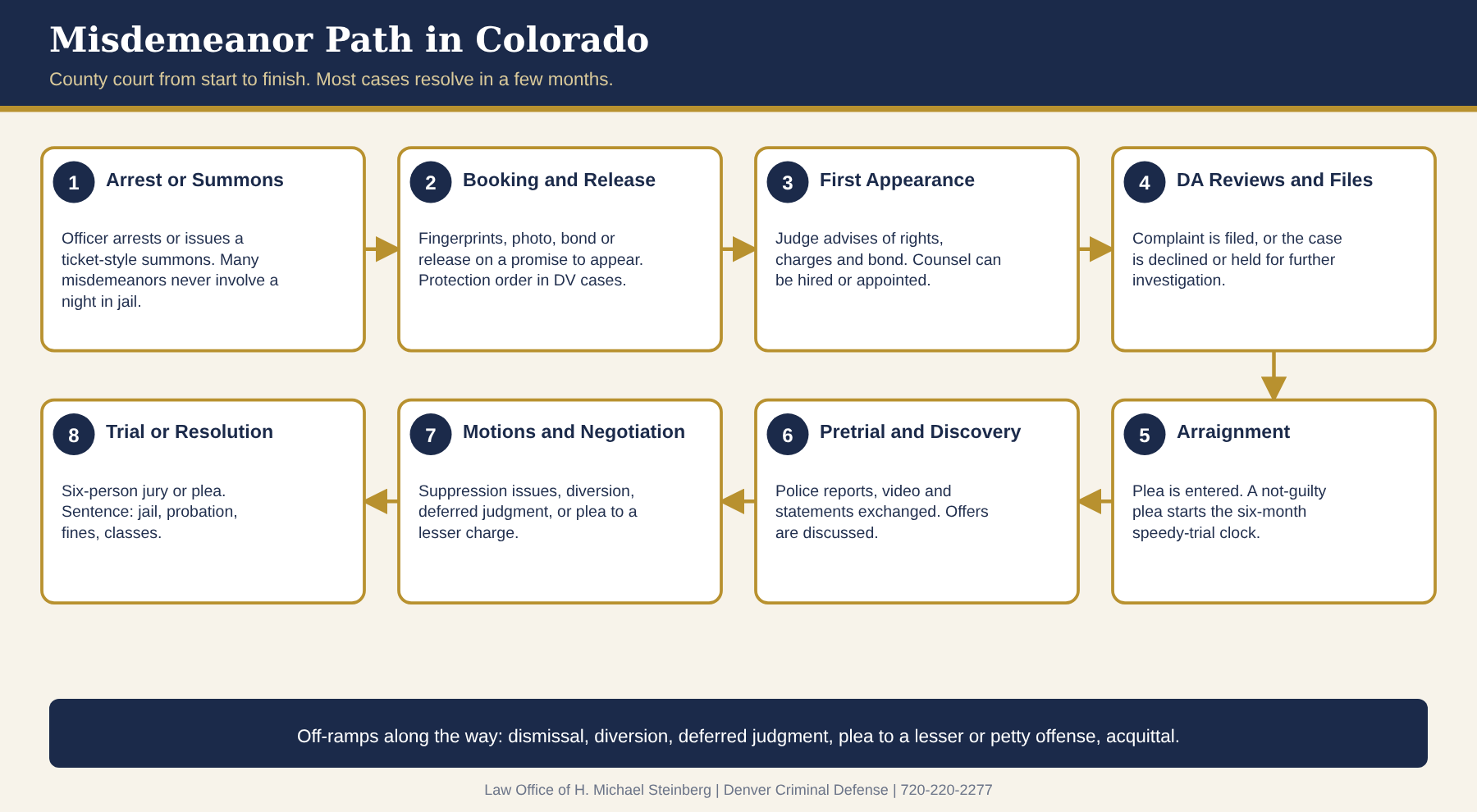
The misdemeanor path in this window
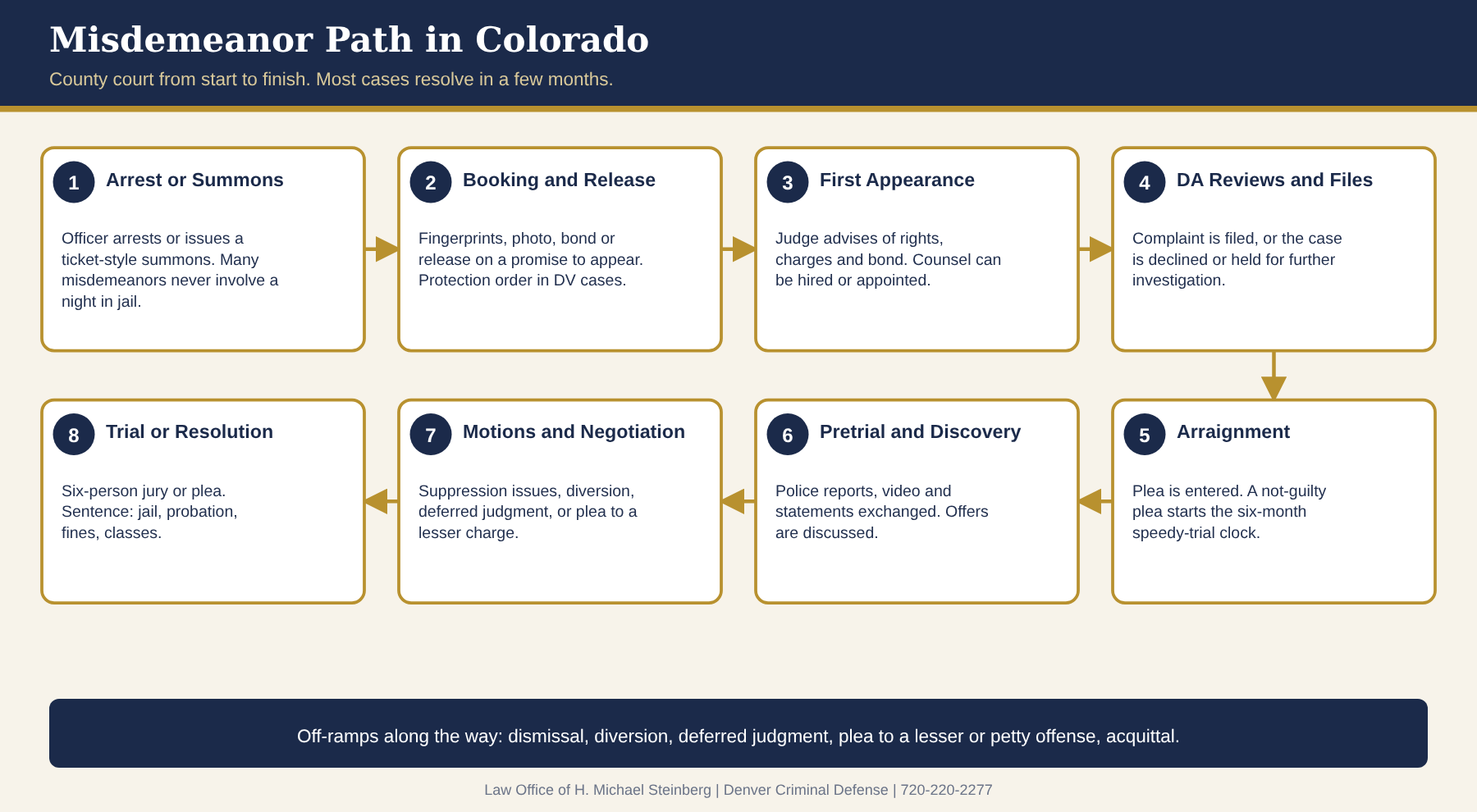
Arraignment. At arraignment the court reads or summarizes the charges and you enter a plea. Under Rules 10 and 11 of the Colorado Rules of Criminal Procedure, the options include not guilty, guilty, and in some situations no contest with the court’s consent. Almost every defendant with a lawyer enters a plea of not guilty at this stage, not because the person is declaring innocence but because it preserves every right and every option. A not-guilty plea also starts the speedy-trial clock described below.
Discovery. Discovery is the process by which the defense receives the prosecution’s evidence. Under Rule 16, the prosecution must make its initial disclosures, including police reports, witness statements, physical evidence and any statements by the defendant, within 21 days after the defendant’s first appearance following the filing of charges. Additional disclosures follow, and everything must be produced at least 35 days before trial. Prosecutors also have a constitutional duty under Brady v. Maryland to disclose evidence favorable to the accused. In practice, important material, such as body-worn camera video, dispatch recordings and laboratory reports, may arrive late and must be requested specifically. A diligent lawyer reviews all of it and asks for what is missing.
Pretrial conference. In county court the next setting is often a pretrial conference, where the defense lawyer and prosecutor discuss the case, narrow the issues and exchange offers. Many misdemeanors are resolved at or shortly after this stage. Resolutions include dismissal when evidence is insufficient, a plea to a reduced charge, a deferred judgment, or a diversion agreement in which charges are dismissed after the person completes conditions such as treatment, community service or classes.
Jury demand. Misdemeanor trials in Colorado are tried to a six-person jury. The right must be preserved in a timely way. A lawyer will make the demand at the right time so the right is not waived by default.
The felony path in this window
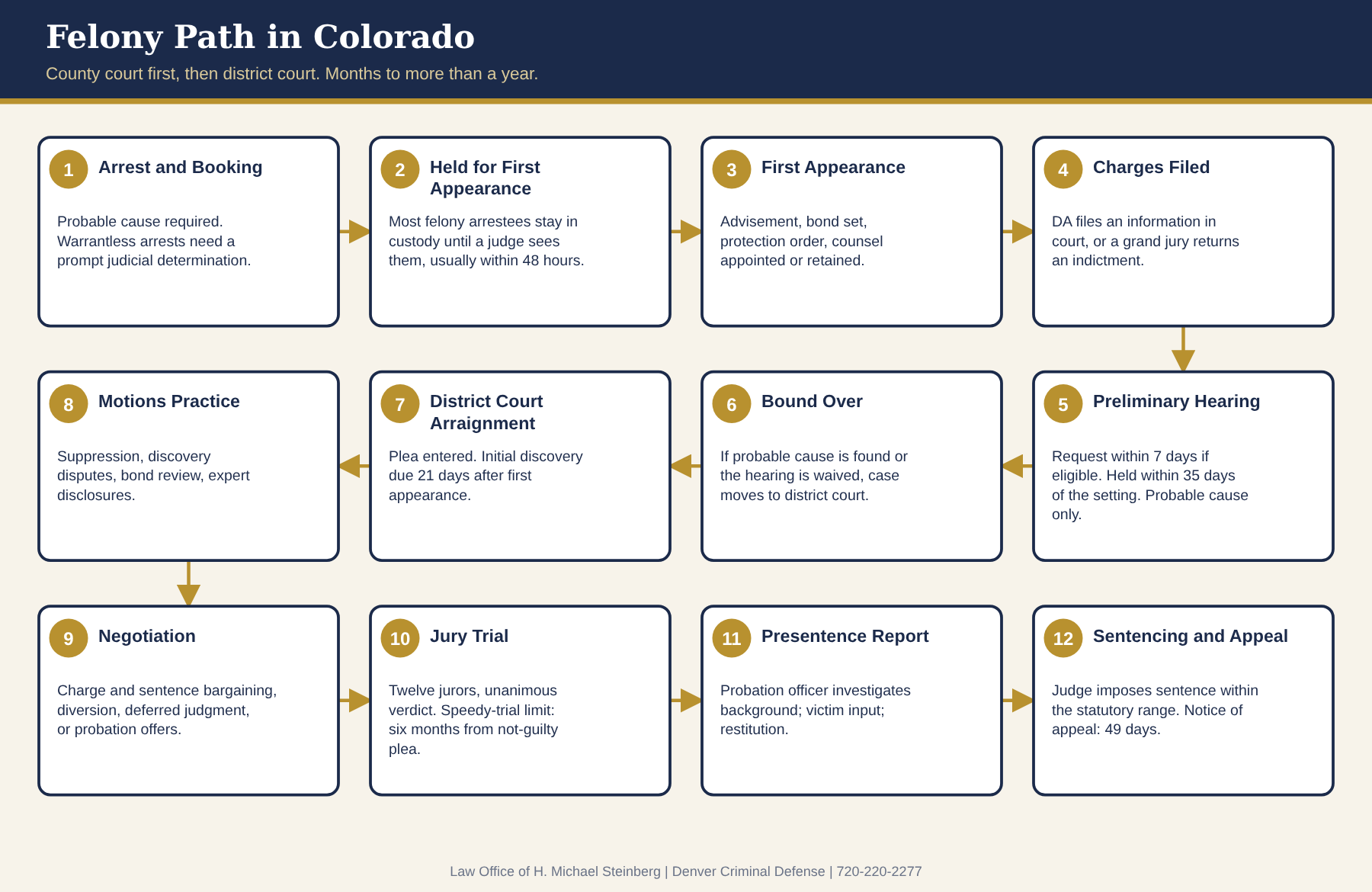
Charging and the preliminary hearing. The defining feature of this stage in a felony case is the preliminary hearing. It is a mini-hearing in which the prosecutor must show a judge that there is probable cause to believe the charged crime was committed and that you committed it. It is a lower standard than guilt beyond a reasonable doubt, and judges find probable cause in most cases that reach this point. But the hearing is valuable anyway.
It forces the prosecution to commit to a version of events under oath; it allows the defense to cross-examine witnesses at an early stage; it reveals weaknesses; and it can sometimes lead to charges being reduced or dismissed.
A preliminary hearing is not available in every case. Under Colorado Rule of Criminal Procedure 7(h) and C.R.S. 16-5-301, the right applies to class 1, 2, and 3 felonies and level 1 and 2 drug felonies. For class 4, 5 and 6 felonies and level 3 and 4 drug felonies, the right exists only if the offense involves a mandatory sentence, qualifies as a crime of violence or is a sexual offense, or if the defendant is in custody for the offense. Misdemeanors do not get one at all.
The deadlines are tight. The request for a preliminary hearing must be made within seven days after the defendant is brought before the court following the filing of the information, and before a plea is entered. The hearing must then be held within 35 days of the setting unless good cause justifies a continuance. When a defendant is not eligible, the court sets a dispositional hearing instead. That is a status conference for case evaluation and discussions toward resolution, not an evidentiary hearing.
Authority: Preliminary Hearings
- Colo. R. Crim. P. 7(h): eligibility, 7-day request window, 35-day hearing deadline, dispositional hearing
- C.R.S. 16-5-301: preliminary hearings in felony cases
- The prosecution bears the burden of establishing probable cause.
- A defendant may waive the hearing; doing so should be a deliberate strategic decision, not a default.
Bindover. If the court finds probable cause, or the hearing is waived, the case is bound over to district court for arraignment. If it does not, the charge can be dismissed, though prosecutors can often refile or amend. The district court is where almost all of the substantive litigation in a felony takes place.
Felony discovery. Rule 16 timing applies here too: initial disclosures are due within 21 days after the first appearance following the filing of charges. In large cases, such as those involving digital forensics, wiretaps, multiple witnesses or forensic laboratory work, discovery may continue to flow for months. The defense has reciprocal disclosure obligations, including notice of alibi and the nature of the defense, due 35 days before a felony trial.
What the prosecutor is doing
During this period, the prosecutor evaluates the case. A prosecutor assigned to a felony case is considering the strength of the evidence, the credibility of witnesses, the alleged victim’s wishes, the defendant’s record, and the available pathways for resolution. This is the window in which early defense advocacy has the highest value. A prosecutor who has been given a well-documented mitigation package, evidence of a legal defense or a candid explanation of a weakness in the case may change a charge, an offer or a bond position long before a judge ever rules on anything.
Months 2 to 6: Motions, Negotiation and the Speedy-Trial Clock
From roughly the second month on, most Colorado cases settle into a rhythm of court settings spaced several weeks apart. Both sides review discovery, file motions, trade offers and prepare to try the case if it cannot be resolved. This is the longest stretch of the process, and it is where patience and preparation matter more than drama.
The speedy-trial clock
Colorado’s statutory speedy-trial rule, C.R.S. 18-1-405, provides that a defendant must be brought to trial within six months of entering a plea of not guilty. If that does not happen, and no exclusion applies, the charges must be dismissed and cannot be refiled for the same offense. That is a powerful remedy, and it is not as simple as it sounds.
The six-month period is extended by delays attributable to the defendant, including defense requests for continuances. It is also tolled for periods such as an interlocutory appeal, the defendant’s incompetence or inability to appear, certain mistrials, and a prosecution continuance for unavailable material evidence when the state shows due diligence.
Because of these exceptions, the date on which the clock expires is calculated, not assumed. A good defense lawyer tracks it from the first day and decides, with the client, whether the case is best served by pressing for a prompt trial or waiving time to prepare.
Motions that can change the case
The motions practice that follows is where a Colorado criminal case can turn. Common motions include:
- Motion to suppress evidence.(Crim. P. 41(e)). Challenges the legality of a search, seizure, or arrest, including traffic stops, vehicle and home searches, cell phone searches, and K-9 sniffs. If the court finds a constitutional violation, the evidence can be excluded and the case may collapse.
- Motion to suppress statements. (Crim. P. 41(g)). Challenges confessions or admissions on grounds such as a Miranda violation or involuntariness.
- Motions to compel discovery. Seek missing police reports, video, lab data, informant information, or impeachment material.
- Motions regarding bond. Seek reduction of money bond, removal of conditions or modification of a protection order.
- Motions in limine and evidentiary motions. Narrow what the jury may hear, including prior acts, hearsay, and expert testimony.
- Motions to dismiss. Raise defects in the charging document, speedy-trial violations, statute of limitations problems, or insufficient evidence.
Motions practice looks similar in misdemeanor and felony cases, but the scale differs. In a misdemeanor case, a suppression hearing may involve a single witness and a short argument. In a felony, it can run for days, with multiple officers, forensic experts, and extensive briefing.
Plea negotiation
Most criminal cases in Colorado, like in every state, end in a negotiated disposition. The decision whether to accept an offer belongs to you alone. A lawyer’s role is to give you the information to make it: the strengths and weaknesses of the evidence, the likely outcome at trial, the sentencing range, the collateral consequences and the realistic alternatives.
Common structures include:
- Dismissal when the evidence cannot be proven, or a defense is strong.
- Plea to a lesser charge, for example a felony reduced to a misdemeanor, or a misdemeanor to a petty offense.
- Charge bargain versus sentence bargain. In a charge bargain the count changes. In a sentence bargain, the count stays, but the agreed sentence is limited, for example, to probation.
- Deferred judgment and sentence (C.R.S. 18-1.3-102). The defendant pleads guilty, but entry of judgment is deferred. If the person completes supervision and conditions, the plea is withdrawn and the case dismissed. Supervision may last up to two years in a misdemeanor and up to four years in a felony.
- Diversion (C.R.S. 18-1.3-101). A prosecutor-run program in which charges are dismissed after the defendant completes conditions such as treatment and community service, often without a conviction ever being entered.
- Probation, community corrections, or jail for cases that end in a conviction. Probation is typically supervised by a probation officer with conditions such as testing, treatment, restitution and reporting.
A plea has permanent consequences that are easy to underestimate in the stress of a negotiation. A felony conviction can bar firearm ownership, affect professional licenses, create immigration problems and shape employment and housing for decades. Even some misdemeanors, particularly domestic violence offenses, carry firearm restrictions. Ask about every collateral consequence before you sign.
A note on offers
Offers are not static. The first offer is rarely the best. As motions are litigated, evidence is tested, and the trial date approaches, an experienced defense lawyer can often improve a resolution.
But an offer can also be withdrawn, so decisions should be informed and deliberate, not rushed or delayed out of fear.
Arraignment in district court and the felony calendar
In felony cases the district court arraignment is the formal start of the trial court phase. A scheduling order follows. Expect a motions deadline, a hearing date for motions, a pretrial readiness conference and a trial date. Colorado courts, particularly in busy jurisdictions, are often congested, which is part of why speedy-trial calculations matter. Trial dates can move several times, and each movement has consequences for the clock and for your life.
Months 6 to 12 and Beyond: Trial, Sentencing and Aftermath
Many misdemeanors are resolved long before six months pass. Felony cases frequently extend into the second half of the year or later, particularly when the case involves multiple counts, forensic evidence or a complex motions record. If the case does not settle, the next major stage is trial.
Trial
Colorado law provides for a six-person jury in misdemeanor trials and a twelve-person jury in felony trials. Verdicts must be unanimous. The prosecution carries the burden of proving every element of the charged offense beyond a reasonable doubt, and a defendant has no obligation to testify or present evidence.
A felony trial is typically longer and more elaborate than a misdemeanor trial: more witnesses, more experts, more exhibits and more pretrial litigation. A misdemeanor jury trial can often be completed in a day or two. Serious felony trials run for a week or more.
Defendants also have the option of a bench trial, in which the judge decides the facts. This is a strategic choice that depends on the nature of the case, the judge and the evidence. A lawyer can explain when each makes sense.
Sentencing
When there is a conviction, by plea or verdict, the court proceeds to sentencing under Rule 32. In misdemeanor cases, sentencing often occurs the same day or within a few weeks. In felony cases, a presentence investigation is ordinarily ordered. A probation officer interviews the defendant, reviews the record, collects victim input, and prepares a report with a recommendation. The judge sets a sentencing date several weeks later. Prosecutors and defense lawyers submit sentencing memoranda, and the defense can present mitigation such as treatment progress, employment, family support, and character letters.
Possible outcomes in Colorado courts include:
- Probation, with conditions and a defined supervision period. Misdemeanor probation is generally limited to two years; felony probation can run longer.
- County jail for misdemeanors, sometimes with work release, or as a condition of probation.
- Community corrections, a residential placement program that is an alternative to prison for some felony offenders.
- Department of Corrections prison sentences, followed by mandatory parole.
- Fines, costs and restitution. Restitution to a victim may be ordered, and the court must determine the amount within 91 days of the judgment unless good cause extends the period (C.R.S. 18-1.3-603).
- Mandatory treatment or classes, such as alcohol education and treatment for DUI or domestic violence offender treatment.
Appeal
A defendant convicted at trial or by plea can appeal in some circumstances. The notice of appeal must be filed within 49 days after the judgment of conviction is entered (C.A.R. 4(b)). Felony appeals go to the Colorado Court of Appeals. Appeals from county court misdemeanor convictions go to the district court. An appeal is not a new trial. It is a review for legal error in what happened below, and the deadline is strict.
After the case: sealing and record relief
A resolved case is not always the end of the problem. Colorado allows sealing of criminal justice records in many situations, and the rules are more generous than people expect. Records of arrests that never led to charges, or cases that ended in dismissal or acquittal, may be eligible for sealing under C.R.S. 24-72-705. Some convictions can be sealed after a waiting period that begins when the sentence is completed, under C.R.S. 24-72-706, with longer waiting periods and more limits for felonies than misdemeanors. Sealing can make an enormous difference to jobs, housing and licensing. It is worth addressing at the time of resolution, because the structure of a plea can determine whether sealing is available later.
Special Tracks: DUI, Domestic Violence, Drug and Sex Offense Arrests
The general timeline above governs most cases. Four types of arrest have wrinkles that change what happens in the days and weeks that follow.
DUI and DWAI
A first or second DUI in Colorado is typically a misdemeanor, so the case follows the county-court path. But two tracks run at once: the criminal case and the DMV license process. The seven-day hearing request deadline for the license action is the most time-sensitive deadline in the case. A DUI can become a felony when the defendant has multiple prior DUI convictions or when a death or serious injury results. Those cases follow the felony path, with higher bond and sentencing exposure.
Domestic violence
Mandatory arrest, a mandatory protection order at the first appearance, strict bond conditions and the possibility that the alleged victim does not want to cooperate define these cases. The prosecutor, not the alleged victim, controls the decision to proceed. In many counties, a DV case can be filed as a misdemeanor or a felony depending on injury, strangulation allegations, weapons, a prior history or violation of a protection order. The protection order and its effect on housing and children is often the most disruptive consequence in the first weeks.
Drug cases
Drug offenses are graded by drug type, quantity and intent. Possession of small amounts of certain substances is charged as a drug misdemeanor or a lower-level drug felony, while distribution and larger quantities are charged under the higher drug-felony levels. Suppression motions are especially important in drug cases, because the evidence usually comes from a search or seizure that can be challenged.
Sex offense arrests
These cases are charged as felonies in most circumstances and carry heightened bond conditions, a preliminary hearing right regardless of felony class, special sentencing provisions and, on conviction, registration and potentially indeterminate sentencing. They also often start with a pre-arrest investigation. If you learn that you are being investigated, speak to a lawyer before you speak to a detective.
Seven Mistakes That Make the Timeline Worse
- Talking to police without a lawyer. It is the single most common avoidable mistake.
- Assuming a minor charge is not serious. A misdemeanor conviction can carry jail, a permanent record and firearm or immigration consequences.
- Missing a court date. The result is a warrant, bond forfeiture and sometimes a new charge. Calendar every date and confirm it with your lawyer.
- Violating a protection order or bond condition. Even a friendly text from the alleged victim does not excuse it.
- Deleting evidence or posting about the case. Tampering charges and damaging posts turn a defensible case into a harder one.
- Waiting to hire a lawyer. The window to influence the charging decision, preserve video and challenge bond closes quickly.
- Ignoring the DMV deadline in a DUI case. The seven-day request window is separate from the court case and cannot be recovered once missed.
Frequently Asked Questions
How long does a criminal case take in Colorado?
A misdemeanor often resolves in roughly two to eight months, though contested cases can run longer. A felony commonly takes six to eighteen months, and complex felonies can extend beyond that. The speedy-trial statute sets a six-month target from a not-guilty plea, but the clock is extended by continuances requested by the defense and by other statutory exclusions.
Will I go to jail immediately after an arrest?
You will be booked. Whether you stay depends on the charge and the bond decision. Many misdemeanor arrestees are released within hours on a summons or bond. Felony arrestees are generally held until a judge sets bond at a first appearance, which must occur within 48 hours of arrival at the jail for most bond-eligible people without a bond already set.
What is the difference between an arraignment and a first appearance?
The first appearance (advisement) is the initial hearing after arrest, where the judge informs you of your rights and the charges and sets bond. Arraignment is the later hearing at which you enter a plea. In a felony case, arraignment happens in district court after the case is bound over.
Do I have a right to a preliminary hearing?
Not in every case. Misdemeanors have no preliminary hearing. In felony cases the right applies to class 1, 2 and 3 felonies and level 1 and 2 drug felonies, and to lower-level felonies that involve mandatory sentencing, crimes of violence, sex offenses or defendants in custody. The request must be made within seven days of appearing on the information.
What happens if the DA never files charges?
Some arrests are never charged. Prosecutors have until the statute of limitations expires, generally eighteen months for most misdemeanors and three years for most felonies, to file. If charges are not filed, you may be able to seal the arrest record under Colorado law.
Can charges be dropped after an arrest?
Yes. Charges can be dismissed at any stage if the evidence is insufficient, a key witness is unavailable, evidence is suppressed, a speedy-trial violation occurs or the parties agree on another resolution.
Should I hire a private lawyer or use a public defender?
Public defenders are experienced trial lawyers and are appointed when you cannot afford counsel. Many people prefer to retain a private defense lawyer for the added time and attention a single client can receive. The most important thing is to have a lawyer involved early.
What if I was arrested but not yet charged?
Treat it as a pre-filing period. A lawyer can sometimes communicate with the district attorney, present mitigating information and influence the charges or whether they are filed at all. Do not wait for paperwork to arrive.
The Bottom Line
The days after an arrest are fast and disorienting, the weeks are procedural and the months are strategic. A misdemeanor typically moves through county court in a matter of months, with no preliminary hearing and a six-person jury. A felony moves from county court to district court, may include a preliminary hearing, is tried to twelve jurors and carries consequences that can last a lifetime. Across both, a few rules are constant: do not talk to the police, follow every bond condition, protect evidence, calendar every deadline and get a lawyer involved early.
An arrest is not a conviction. The system is built to test the government’s evidence, and the people who are best served by that system are the ones who understand it from the start. If you or someone you love has been arrested in Denver or anywhere in the metro area, the time to act is now, while the choices are still open.
Arrested in Colorado? Talk to a Defense Lawyer Today.
The Law Office of H. Michael Steinberg has defended misdemeanor and felony cases across the Denver metro area for more than forty years. Call 720-220-2277 for a confidential consultation.
This article is for general information only and is not legal advice. It does not create an attorney-client relationship. Colorado criminal law and court procedure change, and every case turns on its own facts. Deadlines and penalty ranges stated here may be altered by statute, rule amendment, local practice or the particular charges in your case. Consult a licensed Colorado criminal defense attorney about your situation. Attorney advertising.