 Colorado Criminal Lawyer Blog
What Happens If You Violate a Colorado Criminal Protection Order?


Introduction
It usually starts small: a text that says “I just want to explain,” a wave across a parking lot, a message passed along through a mutual friend. Under Colorado law, any of these can be treated as a violation of a protection order, and the consequences can arrive faster than the case that produced the order.
A violation of a Colorado criminal protection order can lead to arrest, a new criminal charge, possible jail and fines, contempt of court, and serious consequences in the underlying criminal case.
The order remains enforceable unless and until the court changes it—permission from the protected person does not cancel or modify its terms.
If you are restrained by a criminal protection order, the stakes are especially high. This guide explains what counts as a violation, what happens after an arrest, the penalties under C.R.S. § 18-6-803.5,how contempt and felony exposure fit in, and the defenses worth examining. It also reflectsHouse Bill 25-1148, a 2025 law that changed parts of the system. Many online articles still describe the old rules.
Key Takeaways
- A violation is a separate crime, generally prosecuted on its own track apart from the case that produced the order.
- For offenses on or after March 1, 2022, a class 2 misdemeanor carries up to 120 days in jail and a $750 fine; a class 1 misdemeanor carries up to 364 days and $1,000. Violating a criminal protection order is a class 1 misdemeanor.
- The protected person’s permission is not a defense. Only the court can change an order.
- Stalking while an order is in effect is a felony, and related conduct can support witness-intimidation or retaliation charges.
- Figures of “18 months and $5,000” you may see online describe the law before March 1, 2022.
What Is a Colorado Criminal Protection Order?
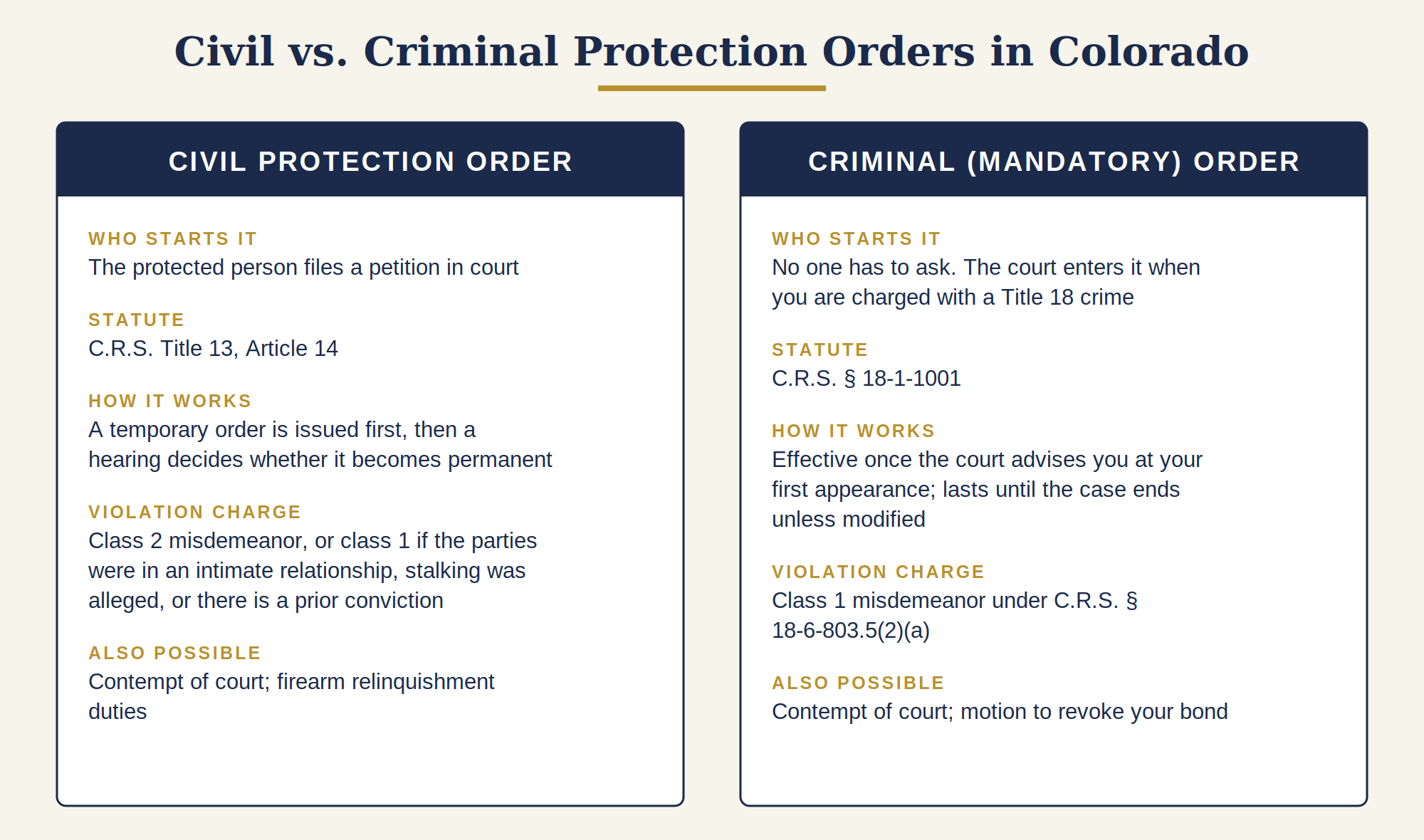
When someone is charged with a crime under Title 18 of the Colorado Revised Statutes, the law creates a mandatory protection order automatically. Under C.R.S. § 18-1-1001, the order takes effect when the court advises the defendant of it at arraignment or the first appearance, and it stays in place until final disposition of the case unless the court modifies or dismisses it. At a minimum it must restrain the defendant from harassing, molesting, intimidating, retaliating against, or tampering with any witness to or victim of the acts charged.
In domestic violence cases and certain other cases, the judge can add more: staying away from the alleged victim’s home and other places they are likely to be, no direct or indirect contact, no firearms or other weapons, limits on alcohol or controlled substances when the information supports a link to the victim’s safety, and protections for animals. These add-on terms are where many people get caught. They are also a separate track from civil protection orders, which a protected person requests by filing a petition under Title 13, Article 14.
What Changed on July 1, 2025
- Criminal protection orders are now limited to protecting a witness to, or victim of, the acts charged. They may not include pretrial release (bond) conditions.
- At the first appearance, the court must tell the defendant that a violation may be a misdemeanor and, where applicable, that the conduct may be felony intimidation of a witness or victim or felony retaliation.
- At sentencing or other resolution, the court must review each provision of the order and decide whether to modify it.
- These changes apply to protection orders issued in connection with offenses committed on or after July 1, 2025. Older cases follow the earlier rules.
What Counts as a Violation?
Under C.R.S. § 18-6-803.5(1), the crime applies once a person has been personally served with an order naming them as the restrained person, or has otherwise gained actual knowledge of its contents from the court or law enforcement. After that point, the statute reaches anyone who:
- Contacts, harasses, injures, intimidates, molests, threatens, or touches the protected person or protected property, including an animal;
- Enters or remains on premises, or comes within a specified distance of the protected person, protected property, or premises named in the order;
- Possesses or consumes alcohol or controlled substances when the order prohibits it;
- Violates another provision meant to protect the protected person from imminent danger to life or health;
- Hires or contracts with someone else to locate or help locate the protected person; or
- Where an order carries firearm terms, possesses or tries to buy a firearm or ammunition, or fails to file the required affidavit or statement on time.
Because so many orders bar both direct and indirect communication, prosecutors commonly build cases on text messages, voicemails, social media messages, and messages relayed through friends or relatives. Being in the same place by chance is treated differently from seeking someone out, but the fact pattern matters, and it is exactly what a defense lawyer will examine.
“But She Contacted Me First”
This is the most common misunderstanding. The order binds the person it restrains, not the person it protects. A protected person’s invitation, apology, or decision to reconcile does not end or change the order. The statute places the duty on the restrained person, and only the court can modify or dismiss the order. The defendant can apply to the court at any time for modification or dismissal, and so can the district attorney.
A protection order binds the person it restrains, not the person it protects.
What Happens Right After an Alleged Violation
Police can be called at any hour. Under C.R.S. § 18-6-803.5(3)(b), an officer with probable cause that a restrained person violated or attempted to violate an order, and that the person was served or had actual notice, must arrest or, if an arrest would be impractical, seek an arrest warrant.
House Bill 25-1148 added a narrow exception: for a short list of situations, an officer may use discretion to arrest, seek a warrant, or issue a summons instead. Those situations are alcohol or drug possession terms, certain imminent-danger terms in orders that do not arise from a domestic violence or Victim Rights Act case, and failure to file the firearm affidavit on time. For ordinary contact or proximity allegations, arrest remains the expected outcome.
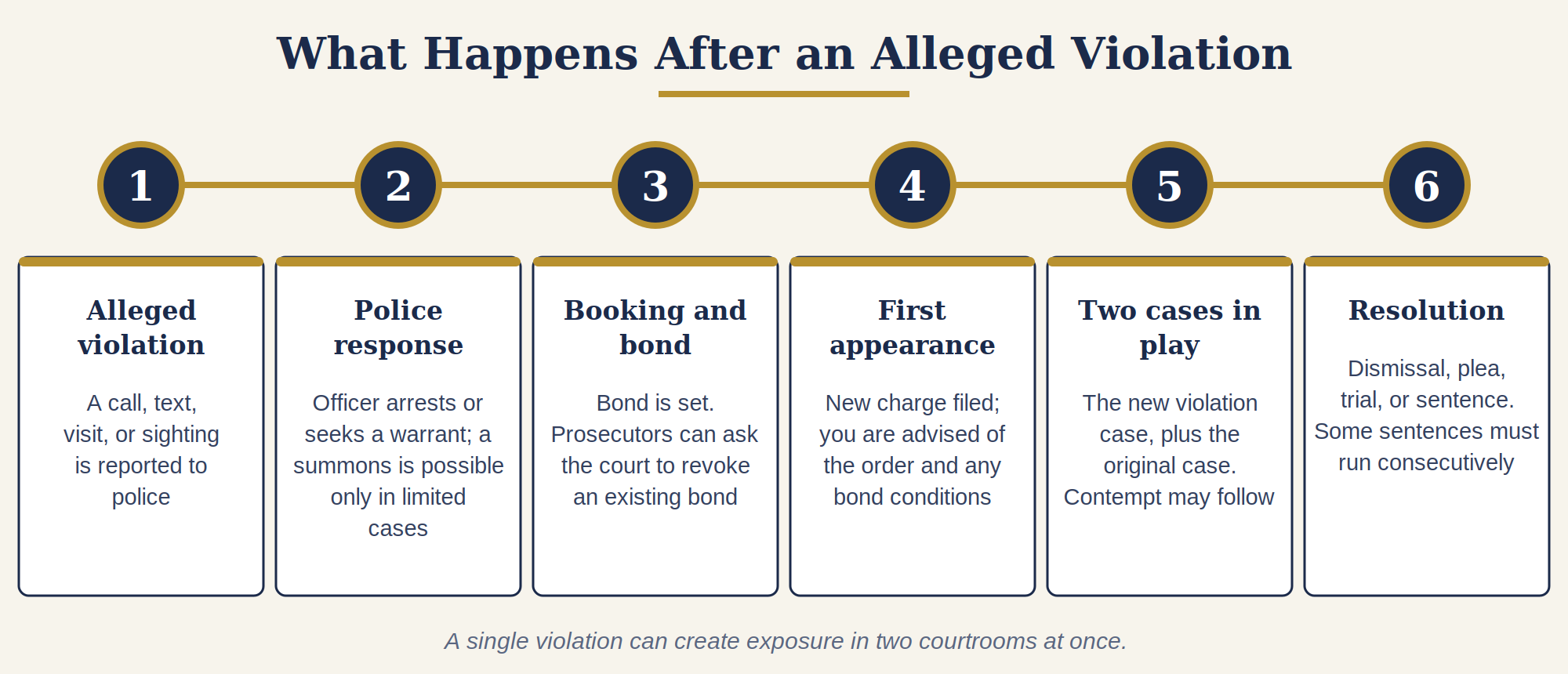
After booking, the arrested person may be held or released under the jurisdiction’s bond schedule. At the first court appearance, the prosecutor presents the arrest affidavits and the restrained person’s criminal history.
The statute also directs that if a restrained person already on bond for a protection order violation is arrested for another, the prosecutor must ask the court that set the earlier bond to revoke it and issue an arrest warrant when probable cause exists. The case may be tried in the county where the violation happened or in the county of the court that issued the order.
Penalties for Violating a Colorado Protection Order
Under C.R.S. § 18-6-803.5(2)(a), violating a protection order is a class 2 misdemeanor. It becomes a class 1 misdemeanor if any of these is true: the restrained person has a prior conviction for violating an order, the order was issued under C.R.S. § 18-1-1001 (a criminal protection order), the basis for the order included an allegation of stalking, or the parties were in an intimate relationship. In practice, that makes class 1 the default for criminal protection orders and most domestic violence cases.
| Charge | When it applies | Jail | Fine |
|---|---|---|---|
| Class 2 misdemeanor | Civil order with none of the aggravating factors below | Up to 120 days | Up to $750 |
| Class 1 misdemeanor | Criminal protection order; intimate relationship; stalking allegation; or prior conviction for violating an order | Up to 364 days | Up to $1,000 |
| Felony stalking | Stalking while a protection order or bond condition is in effect (class 4 felony, C.R.S. § 18-3-602) | Felony prison range | Felony fine range |
Misdemeanor ranges from C.R.S. § 18-1.3-501(1)(a.5). The maximum consecutive misdemeanor jail time in a single case is 24 months.
Watch for Outdated Numbers
- Before March 1, 2022, a class 1 misdemeanor carried six to 18 months and a fine of $500 to $5,000, and second or later violations were treated as “extraordinary risk” crimes with an added six months on the maximum.
- Many articles online, including some from law firms, still quote “up to 18 months and $5,000.” That describes older offenses. The date of the alleged violation controls which range applies.
Consecutive Sentences
A sentence for violating a protection order must run consecutively, meaning on top of and not at the same time as, the sentence for the crime that gave rise to the order. House Bill 25-1148 narrowed that rule to cases involving domestic violence or crimes listed in the Victim Rights Act (with two exceptions in that list) for orders tied to offenses committed on or after July 1, 2025. If your case is in that category, a short jail sentence on the violation can stack onto the original sentence.
Contempt of Court
A violation can also be punished as contempt of court, separately from a new criminal charge. The protected person may start contempt proceedings when the order came from a civil case, or ask the prosecutor to do so when it came from a criminal case. Colorado separates remedial contempt, meant to force compliance, from punitive contempt, meant to punish past conduct. Punitive contempt is generally kept to six months or less because longer sentences trigger a right to a jury trial. When stalking is involved, the stalking statute requires sentences for the stalking, the protection order violation, and any contempt to be served consecutively.
When a Violation Becomes a Felony
- Stalking. Colorado’s stalking statute, C.R.S. § 18-3-602, is a felony even on a first offense. It rises to a class 4 felony when a protection order, bond condition, or other court order was in effect at the time.
- Intimidating or retaliating against a witness or victim. Contact meant to pressure someone about the case can be charged under C.R.S. §§ 18-8-704 and 18-8-706. Since 2025, courts must warn defendants about this at the first appearance.
- Firearms. Possessing or trying to buy a firearm or ammunition while an order with firearm terms is in effect is itself a violation under § 18-6-803.5(1)(c). Federal law can separately restrict firearm possession for people subject to certain protection orders.
How a Violation Affects the Original Case
A new violation rarely stays in its own lane. Prosecutors on the original case can point to it when arguing about bond, offers, and sentencing. If the original case involves domestic violence as defined in C.R.S. § 18-6-800.3, the order is harder to shed: the court may dismiss a criminal protection order at resolution only when the case is not a domestic violence or Victim Rights Act case. A violation can also complicate probation, parenting time, employment screening, and firearm rights. Noncitizens should speak with an immigration attorney before resolving any charge.
Defenses to a Protection Order Violation Charge
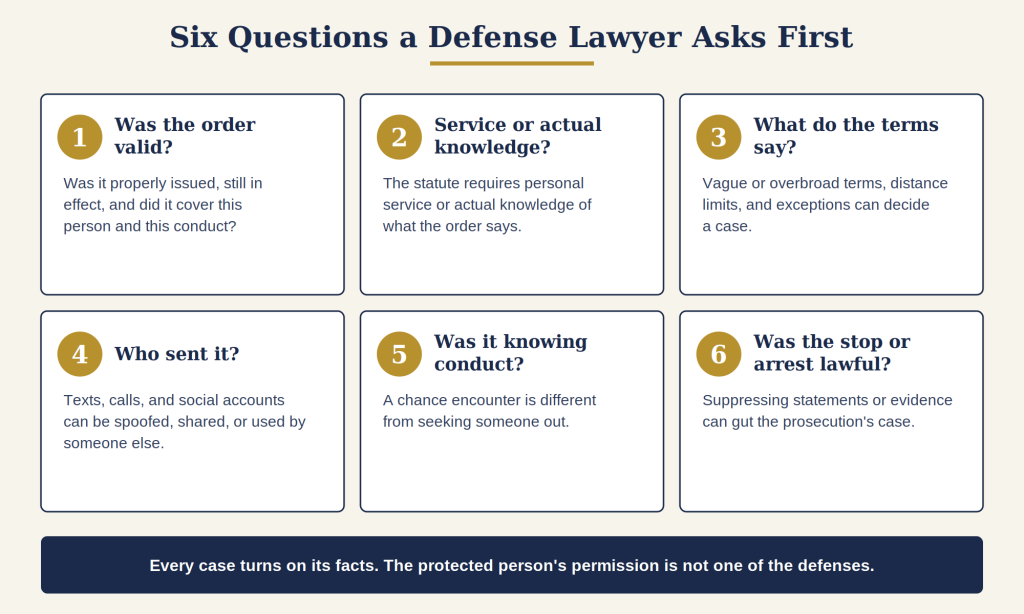
Scope of the order. The conduct charged must be conduct the order actually prohibited. Vague wording, distance limits, exceptions for child exchanges or court appearances, and later modifications can all matter. The statute treats an amending or superseding order as part of the protection order, so the exact version in force on the date matters.
Identity and authorship. Texts can be sent from a shared phone, a spoofed number, or an account controlled by someone else. Proof that the defendant personally sent the message is not automatic.
Lawfulness of the stop or arrest, and suppression. If officers violated constitutional limits, statements or evidence may be suppressed, which can leave a case with little else.
What does not work. Saying the protected person agreed, started the contact, or wanted to reconcile does not excuse a violation. If an order is unfair or no longer needed, the remedy is to file a motion with the court, not to violate the order.
What to Do If You Are Accused, or Unsure What the Order Allows
- Stop all contact, direct and indirect. That includes messages through friends, relatives, and social media.
- Get the actual order. Read the exact terms. The standardized form lists the people, places, and distances covered.
- Do not talk it through with police or the protected person. Anything said can become evidence.
- Preserve, never delete. Keep messages, call logs, and location records that show who reached out and when.
- Talk to a Colorado criminal defense lawyer before filing anything. A lawyer can ask the court to modify or dismiss an order and can handle the new charge and the original case together.
Frequently Asked Questions
Can the protected person drop a protection order in Colorado?
Not on their own. The protected person can ask the court to modify or dismiss an order, but the order stays in force until a judge changes it. In a criminal case, the district attorney and the defendant can also ask for changes. Until a judge modifies the order, contact can still be charged.
Can I be arrested for a single text message?
Yes, if the order prohibits contact and you were served or otherwise knew what it said. One message can support an arrest and a new charge.
Is violating a protection order a felony in Colorado?
The violation itself is a misdemeanor. The surrounding conduct can be a felony, such as stalking while an order is in effect or intimidating or retaliating against a witness or victim.
Will I go to jail for a first violation?
Jail is possible, up to 120 days for a class 2 misdemeanor or 364 days for a class 1 misdemeanor, but outcomes depend on the facts, your history, and the court. A lawyer can tell you what is realistic in your county.
What if I did not know about the order?
The statute requires personal service or actual knowledge of the order’s contents from the court or law enforcement. Whether the prosecution can prove that is a central issue in many cases.
Accused of Violating a Protection Order?
One alleged violation can put two cases at risk. The Law Office of H. Michael Steinberg has defended Colorado criminal cases for more than forty years, across the Denver metro area, including at the Lindsey-Flanigan Courthouse.
Sources
- C.R.S. § 18-6-803.5, Crime of violation of a protection order
- C.R.S. § 18-1-1001, Protection order against defendant
- C.R.S. § 18-1.3-501, Misdemeanors classified
- C.R.S. § 18-3-602, Stalking
- HB25-1148, Criminal Protection Order & Protection Order Violation (Colorado General Assembly)
- HB25-1148, signed act (PDF)
This article is general information for Colorado readers, last updated September 30, 2026. It is not legal advice and does not create an attorney-client relationship. Laws change and every case turns on its own facts, so speak with a licensed attorney about your situation.