 Colorado Criminal Lawyer Blog
Tenth Circuit Upholds Drug-Dog Sniff Outside a Car: What U.S. v. Ostertag Means for Colorado Defendants


Introduction
On September 8, 2026, the Tenth Circuit Court of Appeals issued a published opinion in United States v. Ostertag, No. 25-8055, holding that a drug-detection dog sniffing the outside of a car during a traffic stop was not a Fourth Amendment search.
The court also held that, even if the dog’s later physical contact with the car counted as a search, officers already had probable cause. Because the Tenth Circuit covers Colorado, the ruling matters to anyone facing a drug crimes or weapons charge that began with a traffic stop and a K-9.
The Short Version
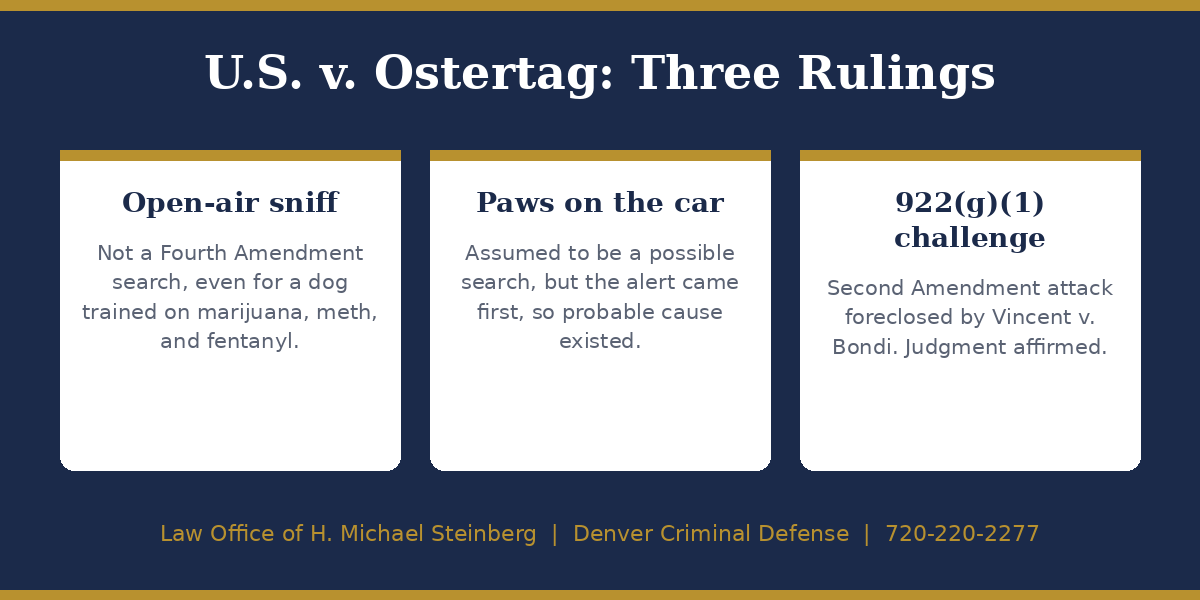
- Open-air sniff: A dog sniffing the exterior of a vehicle from a public road is not a “search,” even for a dog trained on marijuana, methamphetamine, and fentanyl.
- Paws on the car: The court assumed, without deciding, that the dog’s physical contact might be a search. It did not matter, because the dog had already shown an alert.
- Timing is everything: The district court found the alert came before the contact. The Tenth Circuit would not second-guess that factual finding.
- Felon in possession: The Second Amendment challenge to 18 U.S.C. § 922(g)(1) was foreclosed by existing Tenth Circuit precedent.
What Happened in U.S. v. Ostertag
The Traffic Stop and the Dog Sniff
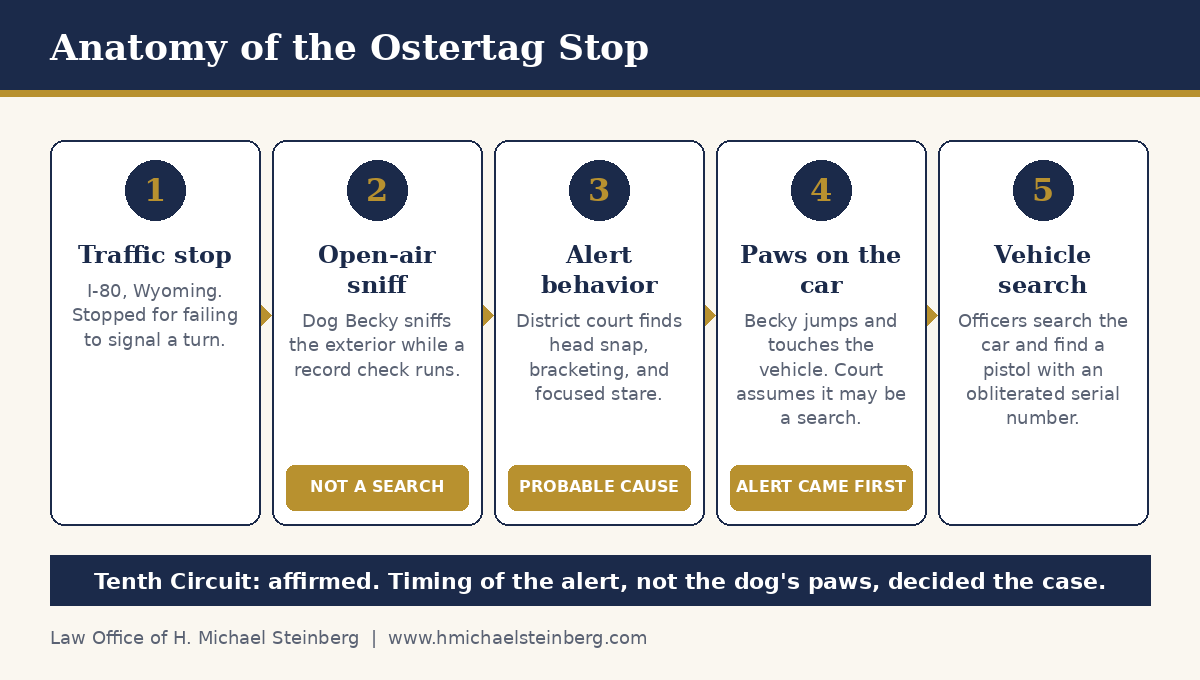
A Wyoming Highway Patrol sergeant stopped George Ostertag on Interstate 80 for failing to signal a turn. A K-9 trooper arrived with a narcotics-detection dog named Becky. While the sergeant ran a records check, Becky was deployed to sniff the vehicle from the roadside.
Becky was then brought closer. She ran back and forth along the passenger side, repeatedly jumped up and put her front paws on the vehicle, and then sat still, focused on the car. The trooper told the sergeant that Becky had given a positive alert. Officers removed Ostertag from the car and searched it. They found a 9mm pistol with an obliterated serial number between the driver’s seat and the center console.
The Charges and the Suppression Fight
Ostertag had a prior felony conviction, so he was indicted for possessing a firearm as a felon under 18 U.S.C. § 922(g)(1) and for possessing a firearm with an obliterated serial number under § 922(k).
His lawyers moved to suppress the gun, arguing that the sniff was an unconstitutional search and that officers lacked probable cause. They also attacked Becky’s reliability, scrutinizing her certification, training, and performance.
The federal district court in Wyoming held a suppression hearing that stretched over five days. It found Becky sufficiently reliable and found that she showed a positive alert behavior after the open-air sniff but before she touched the car. The motion was denied.
Ostertag then entered a conditional guilty plea that preserved his right to appeal, the government dismissed the serial-number count, and he was sentenced to eighteen months in prison followed by three years of supervised release.
What the Tenth Circuit Decided
Ruling 1: A Sniff From the Roadside Is Not a Search
Under Illinois v. Caballes, 543 U.S. 405 (2005), a sniff by a well-trained dog on the outside of a car during a lawful traffic stop is not a search, because it reveals only the presence or absence of contraband. Ostertag asked the court to move away from that rule. He argued that a dog trained on marijuana can’t tell legal hemp from illegal marijuana, and that the odor of methamphetamine or fentanyl could trace back to lawful prescriptions that reveal medical information. He also compared the sniff to the thermal imaging device that the Supreme Court found to constitute a search in Kyllo v. United States.
The court was not persuaded. It put the burden on Ostertag to show a legitimate expectation of privacy and noted that people have a lesser expectation of privacy in a car than in a home.
It reasoned that a sniff reveals only an odor, not what the substance is or why it is there, so the privacy interest Ostertag claimed was “several inferential leaps removed” from what a sniff can actually disclose. I
t also stressed the practical limits of a sniff: it stays on the exterior, it detects only scents strong enough at that moment, it can produce false negatives, and under Rodriguez v. United States, 575 U.S. 348 (2015), it cannot be used to prolong a traffic stop beyond the time needed to handle the traffic violation.
Ruling 2: Paws on the Car, and Probable Cause
Ostertag argued that Becky searched his car a second time when she put her paws on it, relying on United States v. Jones, which treats a physical intrusion on a person’s property to gather information as a search. The Tenth Circuit did not decide that question. It assumed, for argument’s sake, that the contact combined with the sniff could be a search and held that it made no difference, because police had probable cause once Becky alerted.
The alert’s timing was the whole case.
The district court reviewed the video and found that Becky showed alert behavior, including a head snap, bracketing, and a focused stare, near the start of her sniff and before any contact with the car.
It declined to credit the trooper’s suggestion that her jumping was itself an alert, because he also conceded that jumping could be simple exploratory behavior. That is a factual finding, reviewed only for clear error, and the Tenth Circuit said Ostertag’s counterarguments went to the weight of the evidence, which an appeals court may not reweigh.
Ruling 3: The § 922(g)(1) Challenge Was Already Foreclosed
Ostertag also argued that applying the felon-in-possession statute to him violated the Second Amendment, both on its face and as applied. He conceded that Vincent v. Bondi, 127 F.4th 1263 (10th Cir. 2025), which allows § 922(g)(1) to be applied to people without violent felony convictions, controls in the Tenth Circuit. His facial challenge failed, and the judgment was affirmed.
Why This Case Matters
Ostertag is a published opinion, so it binds federal courts throughout the Tenth Circuit: Colorado, Kansas, New Mexico, Oklahoma, Utah, and Wyoming. Three things make it significant.
- It closes the door on the “legal hemp and prescriptions” argument. Defense lawyers have increasingly argued that a dog trained on marijuana, or on drugs that can be lawfully prescribed, can detect lawful activity and should therefore trigger Fourth Amendment protection. In federal court in this circuit, that argument now has a published loser, and the court refused to stretch Kyllo to reach it.
- It shows how much a trial-court fact-finding is worth. Ostertag lost on appeal largely because the district judge found, after reviewing the footage, that the alert came first. Once that finding was made, the appeal was an uphill climb. The fight over dog behavior is won or lost at the suppression hearing.
- It leaves the contact question open. The court assumed, without deciding, that a dog touching a car while sniffing could be a search. A case where the alert comes only after the dog’s paws land on the vehicle would present the issue squarely.
The most important evidence in a drug dog case is often not the dog. It is the video, the timeline, and what the handler said.
What Colorado Defendants Should Know
1. Ostertag Controls in Federal Court, Not Automatically in Colorado State Court
If you are charged in the United States District Court for the District of Colorado, Ostertag is binding precedent.
If you are charged in a Colorado state court, the Colorado Constitution may provide greater protection than the Fourth Amendment.
In People v. McKnight, 2019 CO 36, the Colorado Supreme Court held that a sniff by a dog trained to detect marijuana is a search under the state constitution, because adults over 21 may lawfully possess marijuana.
The Colorado Supreme Court held that a drug‑detection dog’s alert to marijuana constitutes a search under the Colorado Constitution, requiring probable cause, and reversed McKnight’s conviction because no such cause existed
Ostertag does not change that, though prosecutors may cite it as persuasive authority. Which court you are in, and which constitution your lawyer invokes, can decide whether a K-9 sniff is a search at all. For more on the state-court rules, see our guide to Colorado drug dog searches.
2. A Gun Found After a K-9 Alert Can Become a Federal Case
Ostertag’s traffic stop led to a federal felon-in-possession prosecution, and the same path exists in Colorado. A stop on I-25, I-70, or I-76 that ends with a firearm in the car can bring in federal agents and the U.S. Attorney. In the Tenth Circuit, prior-conviction defenses under the Second Amendment face steep odds after Vincent v. Bondi, which makes the suppression motion the main battleground.
3. Timing Decides Most Dog-Sniff Cases
The issue poses questions such as exactly when the dog alerted, what the handler called an alert, and whether the dog had already touched the car. Body-camera and dash-camera footage, the handler’s training records, and the dog’s field performance history are all fair game.
The Supreme Court has said in Florida v. Harris, 568 U.S. 237 (2013), that a defendant must have the chance to challenge a dog’s reliability, and Ostertag’s team used five days of hearing to do it. Notably, he did not press the reliability point on appeal.
4. A Stop Cannot Be Stretched to Wait for the Dog
The sniff in Ostertag happened while the sergeant was still running the record check. That detail matters. Under Rodriguez, police may not hold a driver after the traffic matter is complete just to bring in a K-9 unless they have independent reasonable suspicion. If the dog arrived after the stop’s purpose had been fulfilled, that is a separate issue your lawyer should examine.
5. Preserve Your Issues Before You Plead
Ostertag kept his appeal alive by entering a conditional plea under Federal Rule of Criminal Procedure 11(a)(2). Anyone who plans to challenge a search or a statute on appeal needs that agreement in writing before pleading, and the constitutional arguments must be raised and developed in the trial court. You can browse more of our search-and-seizure articles.
Frequently Asked Questions
Can police use a drug dog during a traffic stop without a warrant?
Under Caballes and now Ostertag, a sniff of a car’s exterior from a public road is not a search, so no warrant or suspicion is required, as long as the sniff does not extend the stop. Colorado state courts may apply stricter rules for dogs trained on marijuana, and our article on car searches based on the smell of marijuana covers how that plays out.
Does a dog alert give police probable cause to search my car?
In the Tenth Circuit, an alert from a reliable, trained dog generally supplies probable cause to search a vehicle. That is why the dog’s training, certification, and behavior on the day of the stop are such important areas for a defense attorney to investigate.
What if the dog jumped on my car before it alerted?
Ostertag did not answer whether that contact is a search. The answer may turn on the timing of the alert, which is why the video evidence and the handler’s testimony matter so much.
Stopped, Searched, and Charged After a K-9 Alert?
The facts of the stop, the timing of the alert, and the court you are in can decide whether the evidence against you survives. With more than forty years of Colorado criminal defense experience, attorney H. Michael Steinberg reviews the stop, the video, and the K-9 records to identify suppression issues in drug and weapons cases across the Denver metro area.
Request a Confidential Consultation
Call 720-220-2277
This article is for general informational purposes and is not legal advice. Reading it does not create an attorney-client relationship. Every case turns on its own facts, and past results do not guarantee a similar outcome. The summary reflects the published Tenth Circuit opinion in United States v. Ostertag, No. 25-8055 (10th Cir. Sept. 8, 2026); read the full opinion before relying on it.