 Colorado Criminal Lawyer Blog
MPO Colorado Mandatory Protection Orders: What Is The Impact On Daily Life


Colorado’s mandatory protection order, often shortened to “MPO,” is created by statute rather than by a judge’s individual decision. It follows nearly every person charged with a crime under Title 18 of the Colorado Revised Statutes.
Because it takes effect so early and reaches so far into daily routines, it is one of the most misunderstood parts of a Colorado criminal case. This guide explains how it works, what it changes about everyday life, and what happens if it is violated.
- An MPO arisesautomatically when a person is charged with a Title 18 criminal offense. No one has to petition for it.
- It binds you from the moment the court advises you of it at your first appearance until “final disposition” of the case.
- It always bars harassing, molesting, intimidating, retaliating against, or tampering with a witness or victim. Courts can add terms to vacate the home, avoid all contact, avoid weapons, avoid alcohol or drugs, and protect animals.
- In qualifying domestic violence cases, firearms must be relinquished within 24 hours of service (weekends and legal holidays excluded), with proof filed within 7 business days.
- Violating the order is aclass 1 misdemeanor; the sentence runs consecutively, and the protected person’s permission is never a defense.
- You can ask the court to modify or dismiss the order at any time. Colorado changed several rules for offenses committed on or after July 1, 2025(HB25-1148).
What Is a Mandatory Protection Order?
Under C.R.S. § 18-1-1001(1), a mandatory protection order exists against any person charged with a criminal violation of Title 18. The order remains in effect from the time the person is advised of it at arraignment or first appearance until final disposition of the case. At a minimum, it restrains the person charged from harassing, molesting, intimidating, retaliating against, or tampering with any witness to or victim of the acts charged.
The order is issued on a standardized form prescribed by the Colorado Judicial Department (the form commonly seen in court isJDF 440), and a copy goes to the protected parties. It is not a finding of guilt. It comes into being by operation of the statute, before any evidence has been tested and before any plea has been entered.
On top of that baseline, the court may add more specific terms. Upon a motion by the district attorney, or on the court’s own motion, C.R.S. § 18-1-1001(3)(a)(II) allows orders that:
-
require you to vacate, or stay away from, the home of the alleged victim or witness and any other place where that person is likely to be found;
-
prohibit contact or direct or indirect communication with the alleged victim or witness;
-
prohibit possession or control of firearms or other weapons;
-
prohibit possession or consumption of alcohol or controlled substances without a valid prescription, but only when the statute’s requirements are met (see below);
-
prohibit taking, transferring, concealing, harming, disposing of, or threatening an animal owned, kept, or held by the alleged victim or witness; and
-
impose any other order the court considers necessary to protect the protected person from imminent danger to life or health.
Statutory Authority
C.R.S. § 18-1-1001(1) and (3)(a)(II): creates the mandatory protection order and lists the further orders a court may enter. Further orders exist only for the protection of a victim or witness, not for the protection of the defendant (§ 18-1-1001(3)(b)).
MPO vs. Civil Protection Order vs. Bond Conditions
People often confuse three different court-imposed restrictions. They can all be in place at once, and you must obey each of them.
| Mandatory (criminal) protection order | Civil protection order | Bond conditions | |
|---|---|---|---|
| How it starts | Automatically, when a Title 18 criminal charge is filed and you are advised at your first appearance | A petition filed in a civil case, usually by the protected person | Set by the court when it sets bail in your criminal case |
| Main purpose | Protect the alleged victim or witness from the acts charged | Protect the person who petitioned | Support court appearance and community safety |
| Governing law | C.R.S. § 18-1-1001 | C.R.S. Title 13, Article 14 | C.R.S. § 16-4-105 |
| How long | Until final disposition of the criminal case | As set by the civil court; may be temporary or longer term | Until the court changes them or the case ends |
Since HB25-1148 took effect, a criminal protection order issued for an offense committed on or after July 1, 2025 is limited to protecting a witness or victim andmay not include conditions of pretrial release under § 16-4-105. In other words, the legislature drew a firmer line between the protection order and the bond conditions. That helps, but it does not shorten the list of rules you must follow while the case is pending.
When It Starts and How Long It Lasts
The Start Date
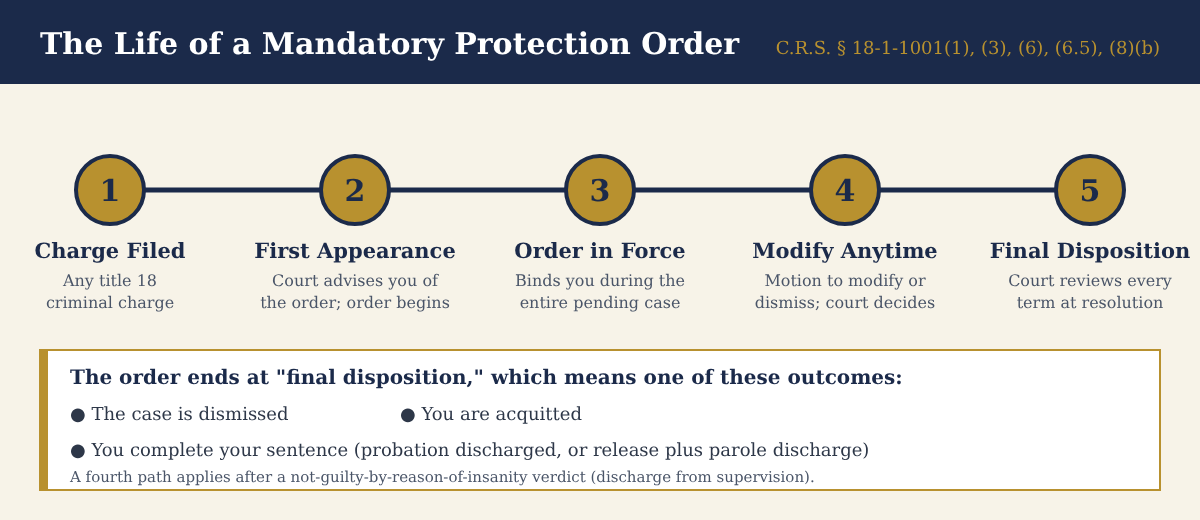
The court must tell you about the order at arraignment or your first appearance, and must advise you that a violation is punishable by contempt and may be charged as the misdemeanor crime of violation of a protection order.
As applicable, it must also warn that conduct violating the order may be charged as the felony of intimidating a witness or victim (§ 18-8-704) or retaliation against a witness or victim (§ 18-8-706). (§ 18-1-1001(2).)
In domestic violence, stalking, and unlawful sexual behavior cases,there is an extra step. Before you are released on bail, the court must state the terms of the order on the record, and you must acknowledge the order in court and in writing as a condition of your bond.
The prosecutor must notify the protected person if that person is not present. (§ 18-1-1001(5).)
The End Date
The order lasts until “final disposition of the action.” The statute defines that as the case being dismissed, the defendant being acquitted, or the defendant completing the sentence.
If you are sentenced to probation, you complete the sentence when you are discharged from probation. If you are sentenced to prison incarceration, you complete it on release plus discharge from parole supervision. (§ 18-1-1001(8)(b).) The standard court form adds that if you appeal, the order stays in effect until the appeal is decided.
You can be bound by a protection order for months, or longer, before any court decides whether you did anything wrong.
There is now a checkpoint at the end. At sentencing, or at any other resolution of the case, the court must revieweach provision of the order to confirm the information is accurate and decide whether to modify any term. The court may dismiss the order if it is no longer necessary and the case did not involve domestic violence or a crime listed in the Victim Rights Act. (§ 18-1-1001(6.5).)
How an MPO Reshapes Everyday Life
Your Home
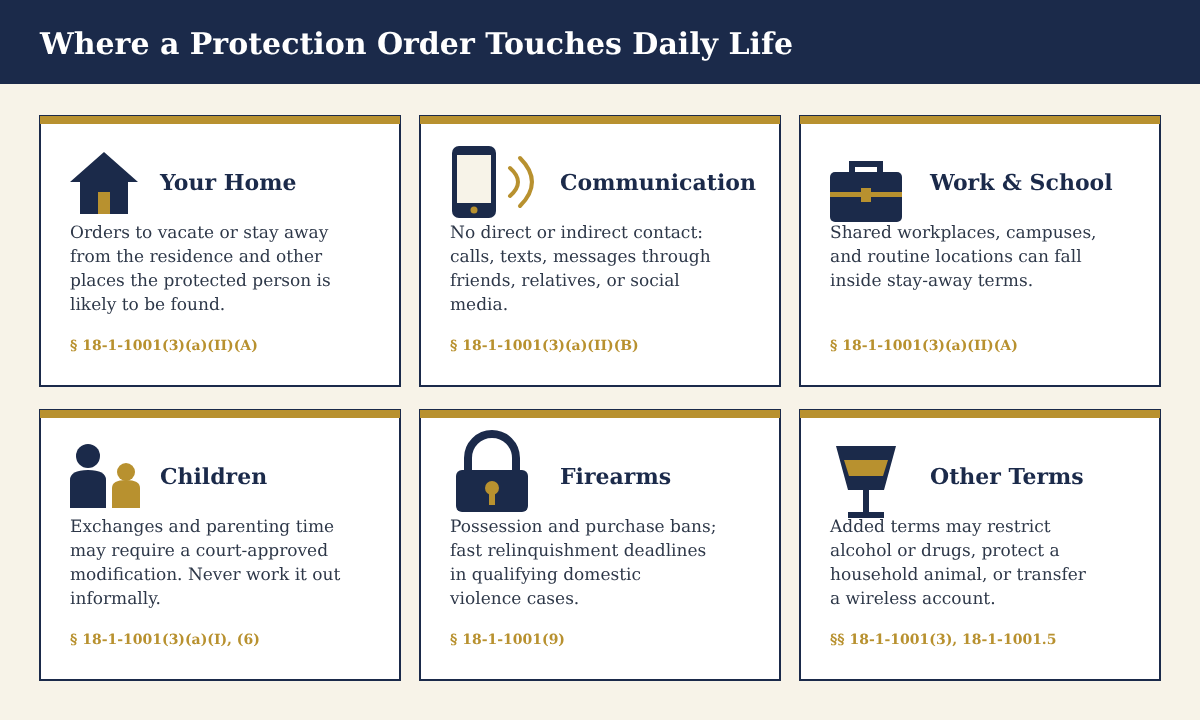
A vacate or stay-away term can require you to leave the residence you share with the protected person, even if you own it or your name is on the lease. It can also keep you away from other places where that person is likely to be found.
The practical fallout arrives fast:finding somewhere to stay on short notice, getting medication, work tools, identification, and clothing, and continuing to pay a mortgage or rent on a home you cannot enter.
Do not go back to the home to collect your belongings on your own, even if the door is open and no one is there. Ask your attorney to arrange a safe, lawful way to retrieve what you need, or to request a modification that allows you to do so.
Communication, Phones, and Social Media
A no-contact term covers direct and indirect communication.
That means calls, texts, email, direct messages, and also messages passed through friends, relatives, or coworkers.The law also treats it as a violation to hire or contract with someone else to locate the protected person (§ 18-6-803.5(1)(b)).
Online activity deserves particular care. Messages, tags, and posts directed at the protected person can be treated as contact, and a seemingly harmless reply to a message the protected person sent first is still a violation. Talk to your attorney before you interact with any shared account, a group chat that includes the protected person, or a family-sharing app.
Colorado law also lets a court order a wireless carrier to transfer the account responsibility and rights for a phone number to the alleged victim or witness in certain cases, if that person is not the account holder and proves by a preponderance of the evidence that they and any minor children in their care are the primary users of the number (§ 18-1-1001.5). If you pay for a family phone plan, that is one more practical issue to raise with your lawyer early.
Work and School
Stay-away language reaches “any other location where the victim or witness is likely to be found.”For many people, that includes a shared workplace, a campus, a gym, a place of worship, or a child’s school. If you and the protected person work in the same building or attend the same classes, tell your attorney at the first meeting so the court can be asked for a workable modification.
Do not try to arrange schedule swaps or separate entrances informally.
An arrest or a protection order can also trigger reporting duties under some employer policies, professional licenses, and security clearances. Review those policies carefully and have your attorney help you decide what to disclose and when.
Children and Co-Parenting
The criminal protection order does not decide parenting time, but a no-contact term can make ordinary parenting impossible: exchanges, school communications, medical decisions, and holiday plans.
Do not assume that a parenting-time order from a family court gives you permission to contact the protected person. The criminal order stays in place until the criminal court changes it.
The statute gives you a path. A defendant may ask the court at any time to modify or dismiss the order, and when a hearing to modify is requested the court must set one, with notice to the alleged victim. (§ 18-1-1001(3)(a)(I), (6).) Courts have discretion to tailor terms, for example by limiting permitted communication to child-related logistics. That relief has to come from a judge, never from an informal agreement between the parties.
Pets and Property
A court can add a term prohibiting you from taking, transferring, concealing, harming, disposing of, or threatening to harm an animal owned, possessed, leased, kept, or held by the alleged victim or witness. If there is a family pet in the home, do not remove it on your own. Raise it with your attorney immediately.
Alcohol and Drugs
For protection orders issued in connection with offenses committed on or after July 1, 2025, HB25-1148 tightened the requirements in this area. A term prohibiting alcohol or controlled substances may be included only when available information shows a sufficient nexus between possession or consumption and the safety of the alleged victim or witness.
The court may make an exception where the case involves domestic violence or a crime listed in the Victim Rights Act, and the court considers the term appropriate for the safety of the alleged victim or witness. The prohibition is “without a valid prescription.” (§ 18-1-1001(3)(a)(II)(D).)
The same law also made a violation of an alcohol or controlled-substance term part of the crime of violation of a protection order, according to the legislature’s fiscal analysis of the bill. If your order contains one of these terms, treat it as seriously as a no-contact
Here is a summary of the new legislation – HB25-1148
Under existing law, a person charged with a criminal offense is subject to a criminal protection order, which remains in effect until final disposition of the criminal action.
The act:
- Prescribes what must be included in the standardized form for a criminal protection order;
- Limits a criminal protection order to orders for the protection of a witness to, or victim of, the acts charged and prohibits a court from including in a criminal protection order an order to enforce a mandated condition of bond or a condition of bond that assists in obtaining the appearance of the defendant in court or ensuring community safety;
- Requires a court to inform a defendant that a violation of a criminal protection order may constitute a misdemeanor offense of violation of a protection order and that conduct that violates the criminal protection order may constitute a felony offense of intimidating a witness or victim or retaliation against a witness or victim;
- Only allows a criminal protection order to prohibit possession or consumption of alcohol or controlled substances without a valid prescription when available information supports a sufficient nexus between that restriction and the safety of the alleged victim or witness; except that, in a case involving domestic violence or crimes listed in the “Victim Rights Act”, the court may enter an order prohibiting possession or consumption of alcohol or controlled substances without a valid prescription if the court deems it appropriate for the safety of an alleged victim or witness; and
- Requires a court to review a criminal protection order at the time of sentencing or other resolution of the criminal case.
Under existing law, a sentence for violating a protection order runs consecutively with any sentence imposed for the crime that gave rise to the protection order. The act limits this consecutive sentence provision to crimes involving domestic violence or crimes listed in the “Victim Rights Act”.
The act grants a peace officer discretion to arrest, seek a warrant to arrest, or issue a summons to a restrained person for violating, or attempting to violate, a protection order by possessing or consuming alcohol or controlled substances; violating a term included in the protection order to protect the protected person from imminent danger to life or health in cases that do not involve domestic violence or crimes listed in the “Victim Rights Act”; or failing to timely file a signed affidavit or written statement with the court as required by law
Firearms and Ammunition
Firearms can arrive in two ways.
First, in any case, a court may add a weapons term under
§ 18-1-1001(3)(a)(II)(C) on the district attorney’s motion or on its own.Second, and more rigid, is the mandatory track in § 18-1-1001(9).
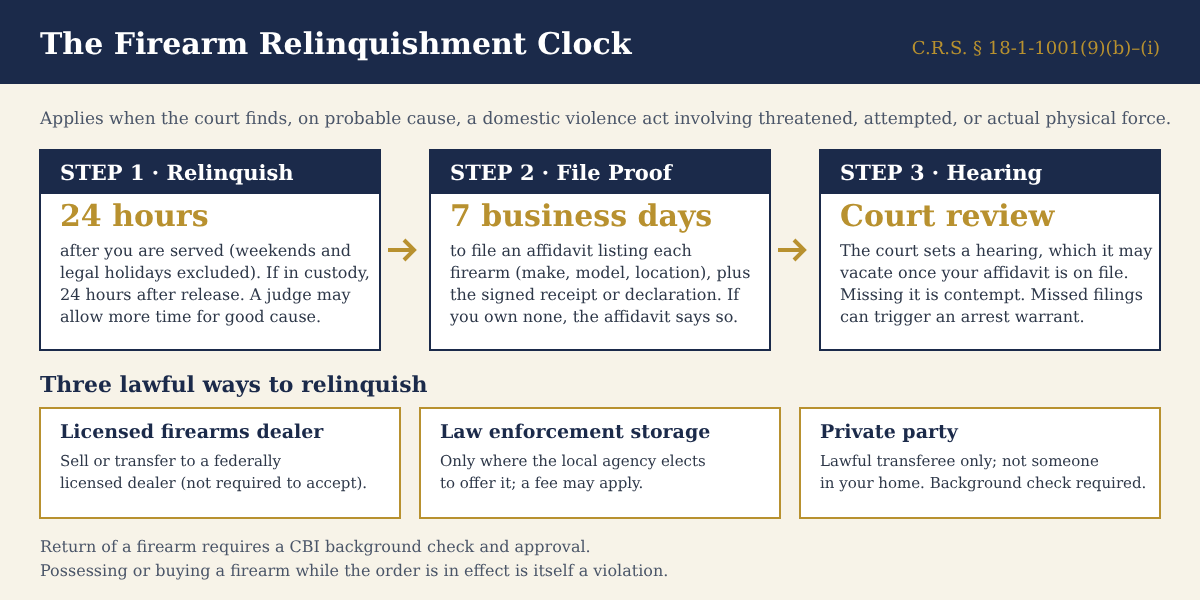
When the court finds on the record, using the probable cause standard, that the case includes an act of domestic violence involving the threat of use, use, or attempted use of physical force, the court shall order you to refrain from possessing or purchasing any firearm or ammunition and to relinquish any you possess or control.
- Deadline to relinquish: not more than 24 hours after you are served, excluding weekends and legal holidays. A court can allow more time on a showing of good cause. If you are in custody, the 24 hours generally run from your release.
- Ways to relinquish: sell or transfer to a federally licensed firearms dealer; store with a law enforcement agency that elects to offer storage (a fee may apply); or sell or transfer to a lawful private party, with a background check, and never to someone who lives in your residence.
- Proof: within seven business days of the order, file a sworn affidavit listing the number, make, model, and location of each firearm you possess or control (or stating you have none), along with the signed receipt or declaration from the transfer.
- Compliance hearing: the court must set one, and may vacate it once the affidavit is filed. Missing it is contempt. Failing to transfer or to file the required proof is a violation of the order and requires the court to issue an arrest warrant.
- Getting them back: a dealer, agency, or private party holding your firearm cannot return it without a CBI background check and approval.
Two details are worth knowing. The affidavit statements you are compelled to make cannot be used against you in a criminal case except in a perjury prosecution (§ 18-1-1001(9)(e)(IV)). And if the court has probable cause to believe you did not relinquish all firearms or a concealed carry permit, it must issue a search warrant (§ 18-1-1001(9)(e)(VI))
Separate federal firearm laws can also apply to people who are charged with, or convicted of, certain offenses, so ask your attorney about federal exposure before you take any step. If your job requires you to carry a firearm, say so at your first consultation.
Statutory Authority
C.R.S. § 18-1-1001(9)(a)-(m): firearm and ammunition relinquishment in qualifying domestic violence cases, including the 24-hour deadline, the 7-business-day affidavit, relinquishment options, and the compliance hearing.
What Counts as a Violation, and What It Costs
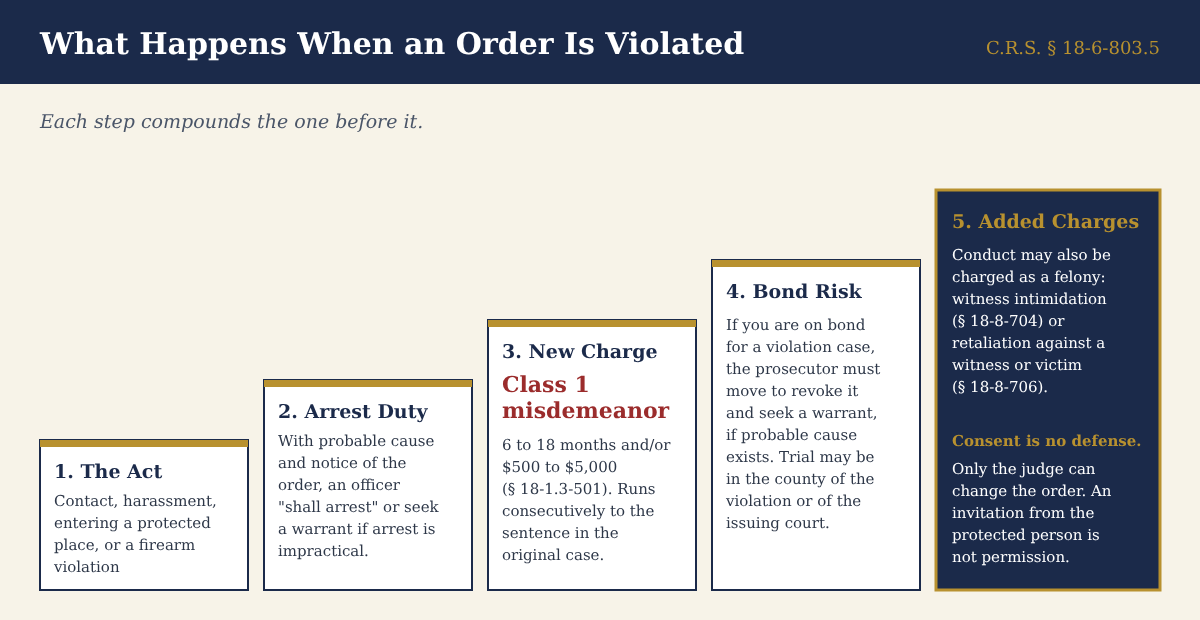
A person commits the crime of violation of a protection order when, after being personally served with the order or otherwise acquiring actual knowledge of its contents, the person contacts, harasses, injures, intimidates, molests, threatens, or touches the protected person or protected property (including an animal), enters or remains on protected premises, comes within a specified distance, or violates another term designed to protect the person from imminent danger.
Possessing or trying to buy a firearm or ammunition while a mandatory order is in effect, or failing to timely file the required affidavit or declaration, also qualifies. (§ 18-6-803.5(1).)
Whether a particular encounter was intentional, accidental, or started by the protected person can matter to a defense. It is never something to test.
The Consequences
- Arrest is expected. An officer with probable cause that you violated the order, and that you were served or had actual notice of it, shall arrest, or seek an arrest warrant if an arrest would be impractical. (§ 18-6-803.5(3)(b).)
- Higher-level misdemeanor. Violating a protection order is generally a class 2 misdemeanor, but it is a class 1 misdemeanor when the order was issued under § 18-1-1001 (and in other listed circumstances, such as a prior conviction or an intimate relationship). (§ 18-6-803.5(2)(a).) A class 1 misdemeanor carries 6 to 18 months in jail and/or a fine of $500 to $5,000 under the general sentencing statute, § 18-1.3-501.
- Consecutive sentence. Any sentence for the violation must run consecutively to, not concurrently with, a sentence for the crime that led to the order. (§ 18-6-803.5(2)(c).)
- Bond exposure. If you are on bond and are arrested for violating or attempting to violate a protection order, the prosecutor must move to revoke the bond and for a warrant if the court is satisfied that probable cause exists. (§ 18-6-803.5(4).)
- Flexible venue. The case may be tried in the county where the violation happened or in the county of the court that issued the order. (§ 18-6-803.5(9).)
- Possible felonies. Contact meant to scare, pressure, or punish a witness or victim can be charged under separate felony statutes, which is why the court warns about them at the outset.
Only a judge can change a protection order. An invitation, an apology, or a request from the protected person does not.
Statutory Authority
C.R.S. § 18-6-803.5: defines the crime of violation of a protection order and sets out penalties, peace officer duties, bond revocation, and venue.
Changing or Ending the Order
The statute leaves the door open. You can apply to the court at any time for modification or dismissal of the order, and the district attorney can apply at any time for further orders, additional provisions, or modification or dismissal.
The trial court retains jurisdiction to enforce, modify, or dismiss the order until final disposition. (§ 18-1-1001(3)(a)(I).)
You may request a hearing to modify the terms, and in domestic violence, stalking, and unlawful sexual behavior cases, the prosecutor may as well. The court must then set a hearing, and the prosecutor sends notice to you and the alleged victim. (§ 18-1-1001(6).)
Because the order exists to protect the alleged victim or witness, that is the lens the court uses. A motion is more persuasive when it is specific and practical, such as a narrowly drawn exception for child exchanges or a defined arrangement for retrieving property, than when it simply asks the court to lift everything.
- Keep complying. The order stays fully in force until the judge changes it in writing or on the record.
- Retain counsel before you file. The request should be framed around safety and specific logistics.
- Decide what you actually need. Parenting exchanges, property retrieval, and a shared workplace are common requests.
- Expect notice and input. The alleged victim is notified of the hearing, and the prosecutor will state a position.
- Never ask the protected person to drop the order. Reaching out to ask is itself a violation and can appear to be tampering.
Everyday Do’s and Don’ts
| Do | Don’t |
|---|---|
| Read the order carefully and keep a copy on your phone and in your vehicle. | Reply to calls, texts, or messages from the protected person, even if they contact you first. |
| Ask your attorney before going to any location the protected person might be. | Pass messages through friends, relatives, or coworkers. |
| Relinquish firearms on time and file the affidavit and declaration if the mandatory firearm track applies. | Show up at the home, workplace, school, or other familiar places to “just talk.” |
| Keep a simple log of any contact you did not initiate and give it to your attorney. | Post about the case or the protected person on social media. |
| Use your attorney to arrange retrieval of belongings and parenting logistics. | Delete messages, photos, or posts without first asking your attorney. |
Common Myths About Mandatory Protection Orders
| Myth | What the law says |
|---|---|
| “If she (or he) invites me over, it is fine.” | The order binds you, not the protected person. Only the court can modify it, and consent is no defense to a violation charge. |
| “The charges will be dropped, so the order will disappear.” | The order lasts until final disposition, such as a dismissal or the completion of a sentence. It does not end because someone says they want it to. |
| “This only applies to domestic violence cases.” | The baseline order applies to any Title 18 charge. Domestic violence adds firearm relinquishment and stricter modification procedures. |
| “It is not a conviction, so it cannot hurt me.” | Violating it is its own crime, and for a § 18-1-1001 order it is a class 1 misdemeanor. |
| “Alcohol bans are automatic.” | For offenses on or after July 1, 2025, an alcohol or drug term generally requires a nexus to the safety of the alleged victim or witness, with a broader allowance in domestic violence and Victim Rights Act cases. |
Frequently Asked Questions
Does a mandatory protection order apply to every criminal charge in Colorado?
The statute creates one against any person charged with a criminal violation of Title 18. Additional terms, and the mandatory firearm track, depend on the facts and on whether the case involves domestic violence. A court can also add more terms on motion.
How long does a mandatory protection order last?
Until final disposition: dismissal, acquittal, or completion of your sentence. For probation, that means discharge from probation. For incarceration, it means release plus discharge from parole. At sentencing the court must review each term and decide whether to modify it.
Can I go home to get my belongings?
Not on your own if the order requires you to vacate or stay away. Ask your attorney to arrange retrieval through a civil assist by the police or to request a modification from the court.
Can the protected person cancel the order?
No. Only the court can modify or dismiss it. The protected person’s views can be considered at a hearing, but a message or invitation from that person does not change your obligations.
Do I have to give up my guns?
In domestic violence cases where the court finds an act involving the threat, use, or attempted use of physical force, yes. You must relinquish firearms and ammunition within 24 hours of service, excluding weekends and holidays, and file proof of relinquishment within 7 business days. In other cases, a court may still add a weapons term on motion.
What should I do if the protected person contacts me first?
Do not respond. Preserve the message, write down the date and time, and tell your attorney. The order restrains you, so a reply can be charged as a violation even when the other person started the conversation.
Why Experienced Defense Counsel Matters
A mandatory protection order is where your case really begins. The terms you accept at the first appearance, the way you handle your belongings and your firearms, and the first motion you file to modify can all shape bond, negotiations, and the final outcome. Missteps in these first days can turn an already serious case into two.
The Law Office of H. Michael Steinberg has handled Colorado criminal cases for more than forty years, and exclusively criminal defense. We help clients understand the exact terms of their order, comply with it, and ask the court for realistic changes when everyday life requires them. For related reading, see our resources on domestic violence defense, bail bonds in domestic violence cases, domestic violence and gun rights, and permanent restraining orders.
A plain-English guide to what C.R.S. § 18-1-1001 does to your home, phone, job, family, and firearms from the moment you are charged, and what you can do about it.
By the Law Office of H. Michael Steinberg · October 5, 2026
Free Consultation
Charged in Colorado? Talk to a lawyer before you talk to anyone else.
Over 40 years of Colorado criminal defense experience, focused on protecting your rights from your first court appearance onward.
Request Your Free Consultation
The Edwards Building, 8400 E Prentice Ave, Penthouse 1500
Greenwood Village, CO 80111
Serving Denver, Arapahoe, Adams, Douglas, Jefferson, El Paso, Gilpin, and Weld Counties
Sources and Statutory References
- HB25-1148, Criminal Protection Order & Protection Order Violation (Colorado General Assembly)
- HB25-1148 fiscal note, Legislative Council Staff
- Colorado Revised Statutes (Office of Legislative Legal Services)
- C.R.S. § 18-1-1001, as amended through the 2025 session (Right Law Group statute library)
- C.R.S. § 18-1-1001.5, wireless telephone service transfer
- C.R.S. § 18-6-803.5, violation of a protection order
- C.R.S. § 18-1.3-501, misdemeanor classifications and penalties
- JDF 440, Mandatory Protection Order (Colorado Judicial Branch)