 Colorado Criminal Lawyer Blog
Inadequate Miranda Warnings Under Colorado Law – People v. Vanpelt – H. Michael Steinberg


COLORADO CRIMINAL LAW • POLICE QUESTIONING
“The Police Never Read Me My Rights”: The Four Questions Colorado Courts Ask Before Throwing Out Your Statement
Custody, interrogation, an adequate warning, and voluntariness — and why People v. Vanpelt, 2026 CO 66, shows that a Miranda violation and a coerced confession are two very different things.
By H. Michael Steinberg, Colorado Criminal Defense Lawyer • Over 40 Years of Colorado Criminal Defense Experience
Published November 25, 2026
Quick SUMMARY
An inadequate Miranda warning does not automatically make your statement disappear from a Colorado case. A court asks four separate questions: (1) Were you in custody? (2) Were you interrogated? (3) Was the warning legally adequate? (4) Even if Miranda was violated, was the statement voluntary?
If the answer to the first three is yes-yes-no, the prosecution generally cannot use the statement in its case-in-chief. But if the statement was voluntary, the prosecution may still be able to use it to impeach you if you testify. Only an involuntary (coerced) statement is barred for every purpose.
In People v. Vanpelt, 2026 CO 66, the prosecution conceded a Miranda violation during a 75-minute jail interrogation — and the Colorado Supreme Court still held the statements and a written apology letter were voluntary.
In This Article
- Why “They Never Read Me My Rights” Is the Wrong Starting Question
- Question One: Were You in Custody?
- Question Two: Was There an Interrogation?
- Question Three: Was the Miranda Warning Legally Adequate?
- What a Miranda Violation Actually Gets You — and What It Doesn’t
- Question Four: Was the Statement Voluntary?
- People v. Vanpelt: A Conceded Violation That Still Lost on Voluntariness.
- Why This Distinction Changes Trial Strategy.
- Common Colorado Scenarios Run Through the Four Questions.
- What to Do If Colorado Police Want to Question You.
- Frequently Asked Questions.
After more than forty years of defending people charged with crimes in Colorado, I can tell you which sentence I hear in a first consultation more often than almost any other: “The police never read me my rights.” It is usually said with hope — the hope that those six words will end the case.
Sometimes they help a great deal. Often they matter less than the client expects. And occasionally — as the Colorado Supreme Court’s October 12, 2026 decision in People v. Vanpelt demonstrates — even a warning that everyone agrees was defective does not keep a statement out of the courtroom entirely.
This article is not another case summary. I wrote a full breakdown of the Vanpelt facts and rulings in Colorado Police Gave You an Inadequate Miranda Warning—Is Your Statement Automatically Suppressed?, and the basics of when warnings are required are covered in No Miranda Warning? Here Is What Actually Happens in Colorado.
Here, I want to give you the framework a Colorado judge actually uses — four separate questions, each with its own law and its own consequences — so you can see where your own case fits.
Why “They Never Read Me My Rights” Is the Wrong Starting Question
The Fifth Amendment says no person “shall be compelled in any criminal case to be a witness against himself.” In Miranda v. Arizona, 384 U.S. 436 (1966), the United States Supreme Court built a set of procedural safeguards around that privilege for one specific situation: custodial interrogation. The Court later confirmed in Dickerson v. United States, 530 U.S. 428 (2000) that Miranda is a constitutional rule that legislatures cannot simply override.
Colorado went further. In 2023 the General Assembly passed House Bill 23-1155, now codified at C.R.S. § 16-3-406. That statute writes the Miranda advisement into Colorado law, spells out five specific advisements, and puts the burden on the prosecution to prove a valid waiver.
But neither the Constitution nor the statute says “no warning, no case.” Instead, a judge deciding a motion to suppress statements works through four distinct questions. The answer to each one changes what happens next:
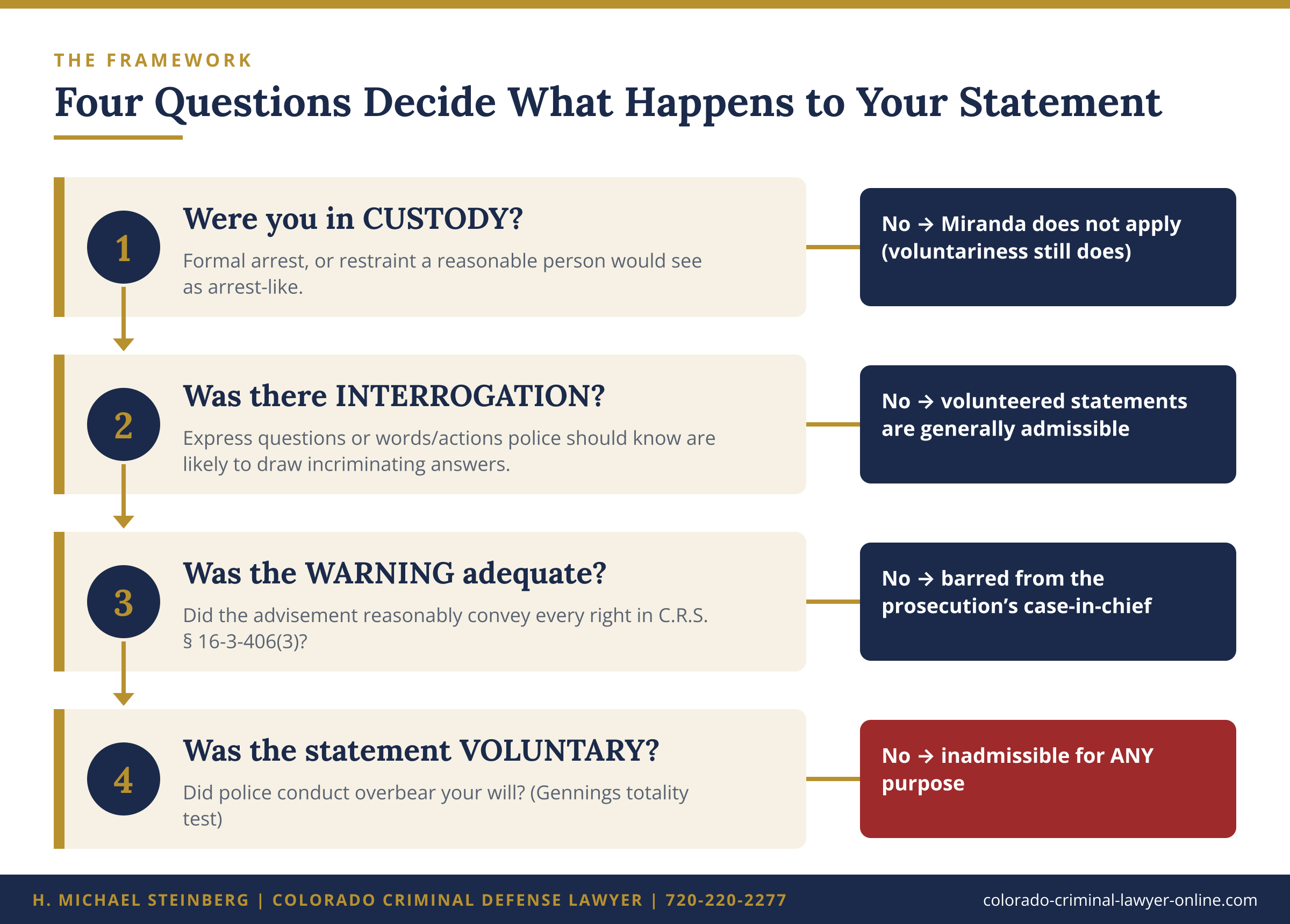 The four-question framework. A “no” at each step leads to a different result — only an involuntary statement is barred for every purpose.
Notice the last box. A failure at the first three steps is a Miranda problem. A failure at the fourth step is a due process problem. They are not the same thing, and confusing them is the most common mistake people make when they evaluate their own cases.
Question One: Were You in Custody?
Miranda applies only when a person is “in custody.” That does not simply mean “not free to walk away.” In Colorado, the test is whether a reasonable person in the suspect’s position would believe his freedom of action had been curtailed to the degree associated with a formal arrest. The Colorado Supreme Court laid out the factors in People v. Matheny, 46 P.3d 453 (Colo. 2002), and Colorado courts still apply them today.
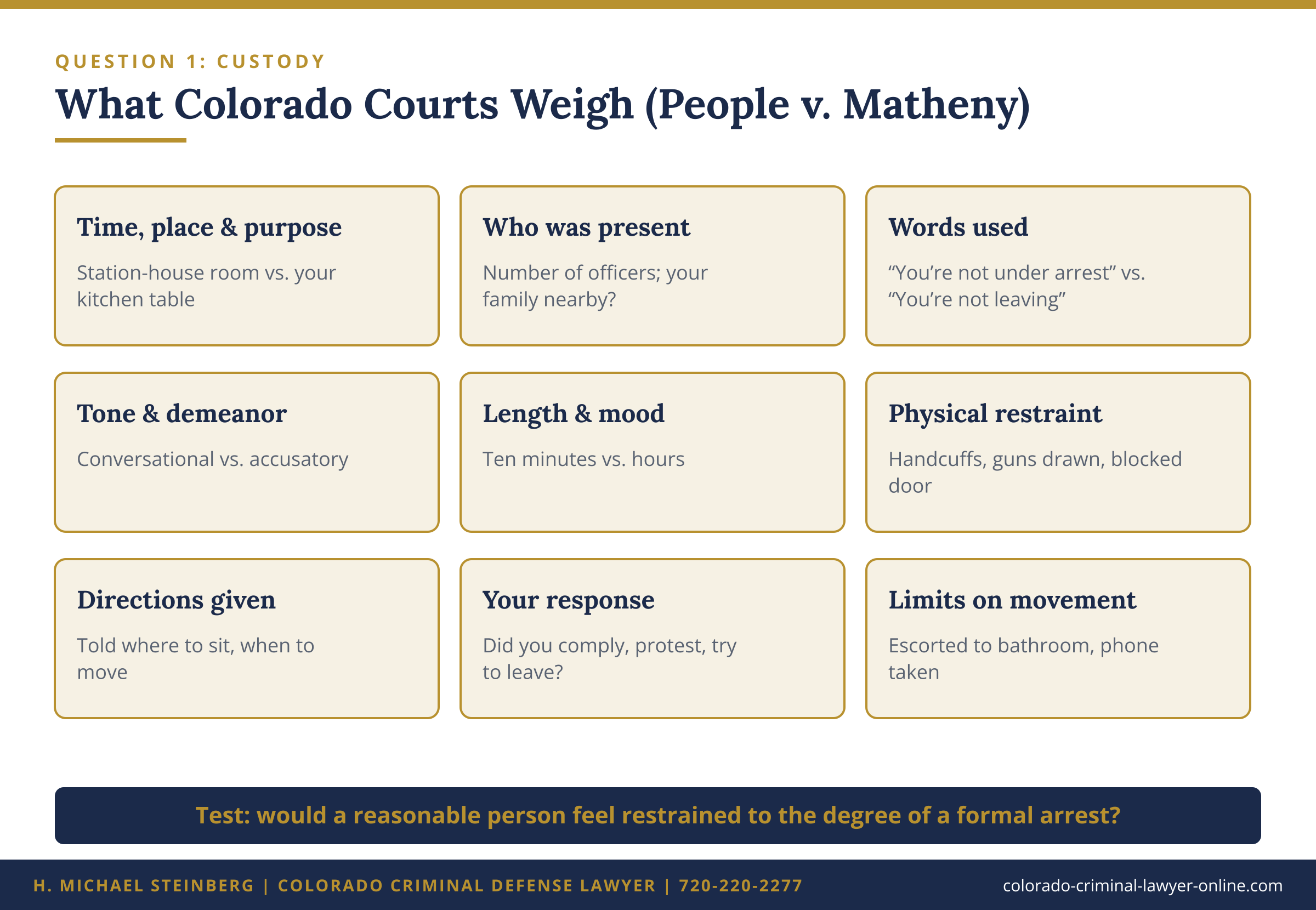
No single factor decides custody. Courts weigh the totality of the circumstances.
Several practical points follow from that test:
- A traffic stop is ordinarily not custody. In Berkemer v. McCarty, 468 U.S. 420 (1984), the Supreme Court held that roadside questioning during a routine stop usually does not trigger Miranda — although a stop can ripen into custody if it starts to look like an arrest. This is a frequent issue in Colorado DUI cases.
- Being detained is not the same as being in custody. A Fourth Amendment seizure — like the investigative detentions I discussed in Parked After Midnight in a “High-Crime Area” — can occur without Miranda custody.
- “Voluntary” station-house interviews are the gray zone. Police often tell a person, “You’re not under arrest; you can leave anytime.” That language weighs heavily against custody, but it is not conclusive if everything else about the encounter says otherwise. I explore this further in Am I in Custody? Understanding Your Miranda Rights.
- Jail is custody. In Vanpelt, the questioning happened inside the Las Animas County Jail after the defendant had been taken there and an active warrant was discovered. Custody was never seriously disputed.
Authority: The Custody Standard
The question is objective. Courts ask what a reasonable person in the suspect’s position would have believed — not what the officer secretly intended or what the suspect privately feared. See People v. Matheny, 46 P.3d 453, 465–67 (Colo. 2002); Berkemer v. McCarty, 468 U.S. 420 (1984).
Question Two: Was There an Interrogation?
Custody alone does not trigger Miranda. There must also be interrogation. In Rhode Island v. Innis, 446 U.S. 291 (1980), the Supreme Court defined interrogation as express questioning or its functional equivalent — words or actions by police that they should know are reasonably likely to elicit an incriminating response.
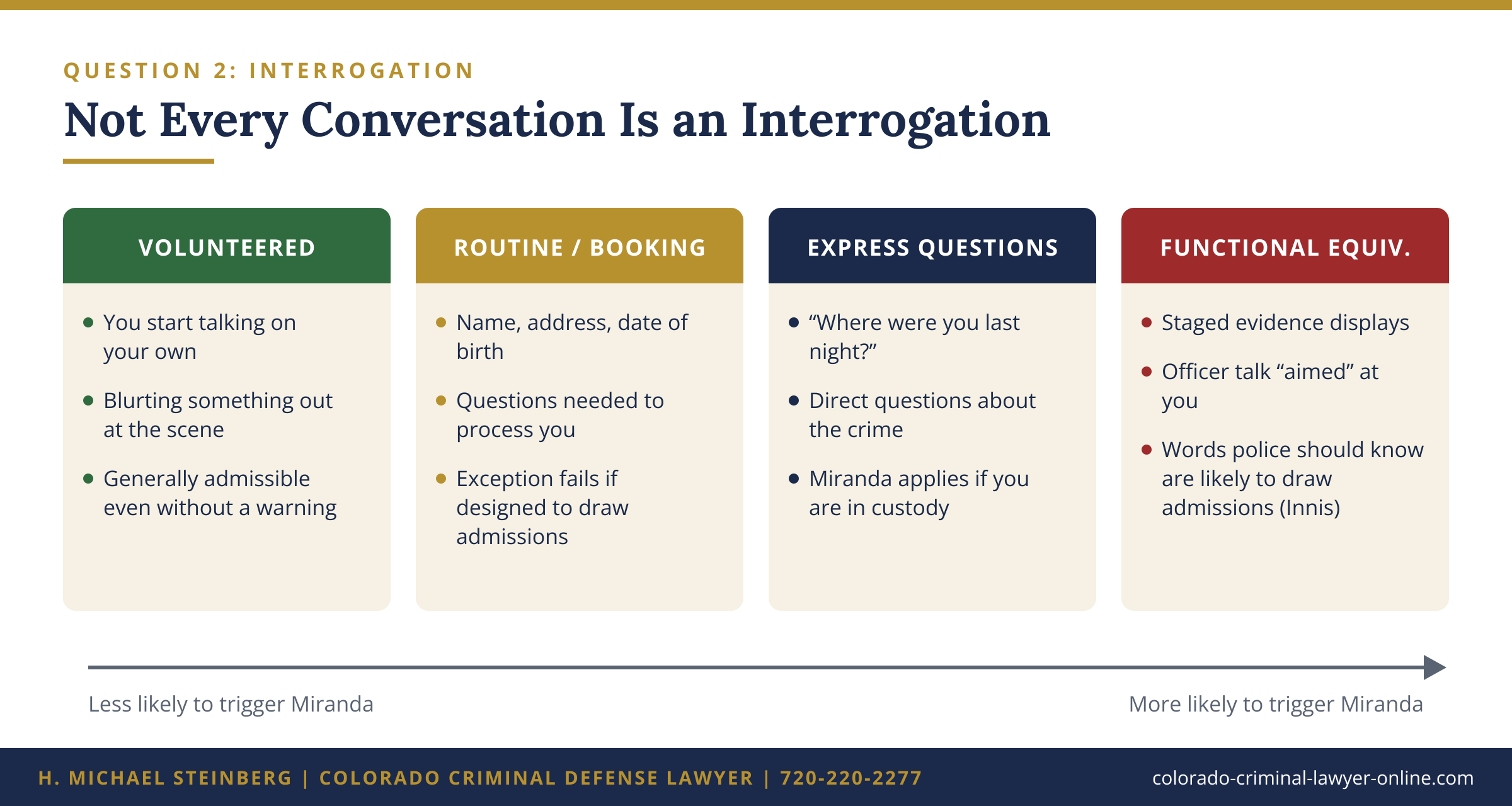 Interrogation is broader than direct questions — but it does not cover statements you volunteer on your own.
Three recurring categories fall outside Miranda or are treated specially:
- Volunteered statements. If you start talking on your own — in the back of a patrol car, at the scene, in a holding cell — Miranda generally does not protect what you say, even if you are in custody.
- Booking questions. Routine questions needed to process you (name, address, date of birth) generally fall within the booking exception recognized in Pennsylvania v. Muniz, 496 U.S. 582 (1990). If the “routine” questions are really designed to draw out admissions, the exception should not apply.
- Public safety questions. Under New York v. Quarles, 467 U.S. 649 (1984), officers facing an immediate safety threat — “Where is the gun?” — may ask narrow questions before giving warnings.
Colorado’s statute expressly preserves these established exceptions. Under § 16-3-406(6), a statement may still be admitted if the prosecution proves by a preponderance of the evidence that a recognized Miranda exception, such as the public safety or booking exception, applies.
In Vanpelt, there was no question about this step either. Two Loveland officers traveled to the jail specifically to question the defendant about two shootings. That is interrogation in its classic form.
Question Three: Was the Miranda Warning Legally Adequate?
This is where Vanpelt becomes instructive — and where Colorado law now differs in an important way from the federal baseline.
The federal rule: no magic words, but the substance must be there
The Supreme Court has never required police to read a precise script. In California v. Prysock, 453 U.S. 355 (1981), Duckworth v. Eagan, 492 U.S. 195 (1989), and Florida v. Powell, 559 U.S. 50 (2010), the Court asked whether the warnings, read as a whole, reasonably conveyed the suspect’s rights. Imperfect phrasing can survive; missing substance should not.
The Colorado rule: five specific advisements under C.R.S. § 16-3-406(3)
Since July 1, 2023, Colorado has had its own statutory checklist. Under C.R.S. § 16-3-406(3), a court may not admit a statement from custodial interrogation against the defendant at trial unless, before the statement, the defendant was advised in a manner that reasonably conveyed all five of the following:
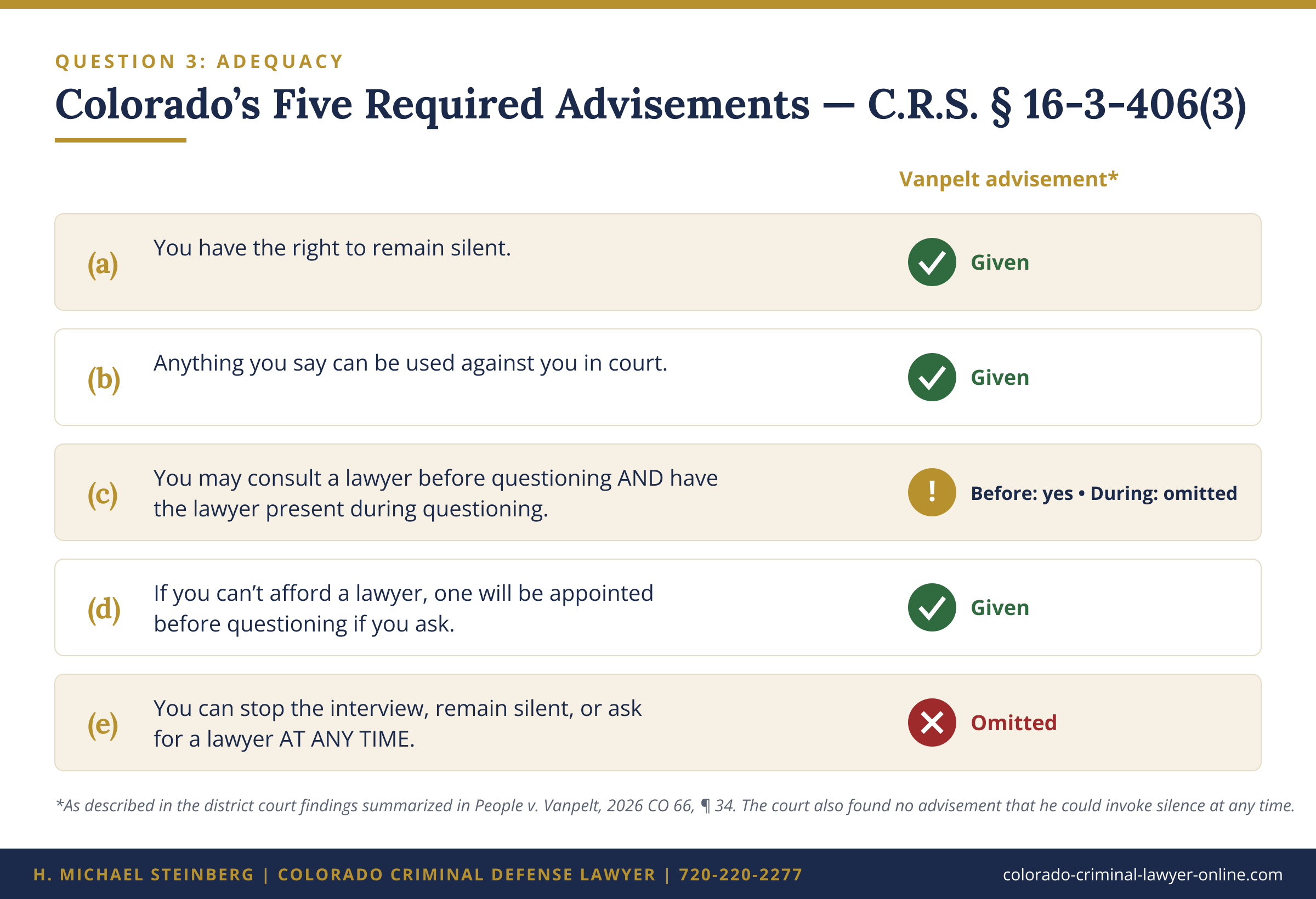 The five statutory advisements, compared with the advisement the district court found incomplete in Vanpelt.
Advisement (e) deserves emphasis. Federal law has never required a specific script, and many courts have not insisted on a separate warning that the suspect may stop questioning at any time. Colorado’s statute lists that right expressly. In my view, that makes the “at any time” language one of the most important things to check in any Colorado body-camera or interview-room recording.
What the warning looked like in Vanpelt
According to the opinion, the sergeant told Vanpelt he had the right to remain silent, that what he said could be used against him in court, that he had the right to an attorney present before questioning, and that counsel would be appointed if he could not afford one. Vanpelt said he understood and was willing to talk.
The district court found that advisement incomplete because it never told him that he could invoke silence at any time, ask for a lawyer at any time, have a lawyer present during questioning, or stop the interview at any time.
On appeal, the People conceded that the statements were taken in violation of Miranda.
Waiver: the other half of question three
Even a perfect warning is only half the equation. The prosecution must also prove a valid waiver — one that is knowing, intelligent, and voluntary. Colorado codified that burden: under § 16-3-406(4), once the issue is properly raised, the prosecution must prove the waiver by a preponderance of the evidence.
- Implied waiver is possible. Under Berghuis v. Thompkins, 560 U.S. 370 (2010), a suspect who understands the warnings and then answers questions can be found to have waived his rights without saying so.
- Invocation must be clear. Under Davis v. United States, 512 U.S. 452 (1994), an ambiguous remark like “Maybe I should talk to a lawyer” does not require police to stop. The Colorado Supreme Court applied the clarity requirement to the right to silence earlier this year in People v. Torres, 2026 CO 15, holding that the defendant had not clearly invoked his right to cut off questioning.
- A clear request for counsel stops everything. Under Edwards v. Arizona, 451 U.S. 477 (1981), once a suspect clearly asks for a lawyer, police may not resume interrogation unless the suspect himself reinitiates.
- “Question first, warn later” is suspect. A deliberate two-step interrogation — obtaining a confession without warnings, then warning and having the suspect repeat it — can require suppression of the second statement under Missouri v. Seibert, 542 U.S. 600 (2004), although Oregon v. Elstad, 470 U.S. 298 (1985) allows a later warned statement in other circumstances.
What a Miranda Violation Actually Gets You — and What It Doesn’t
Suppose all three Miranda questions come out in your favor: custody, interrogation, and a defective warning or waiver. Here is what you win — and what you do not.
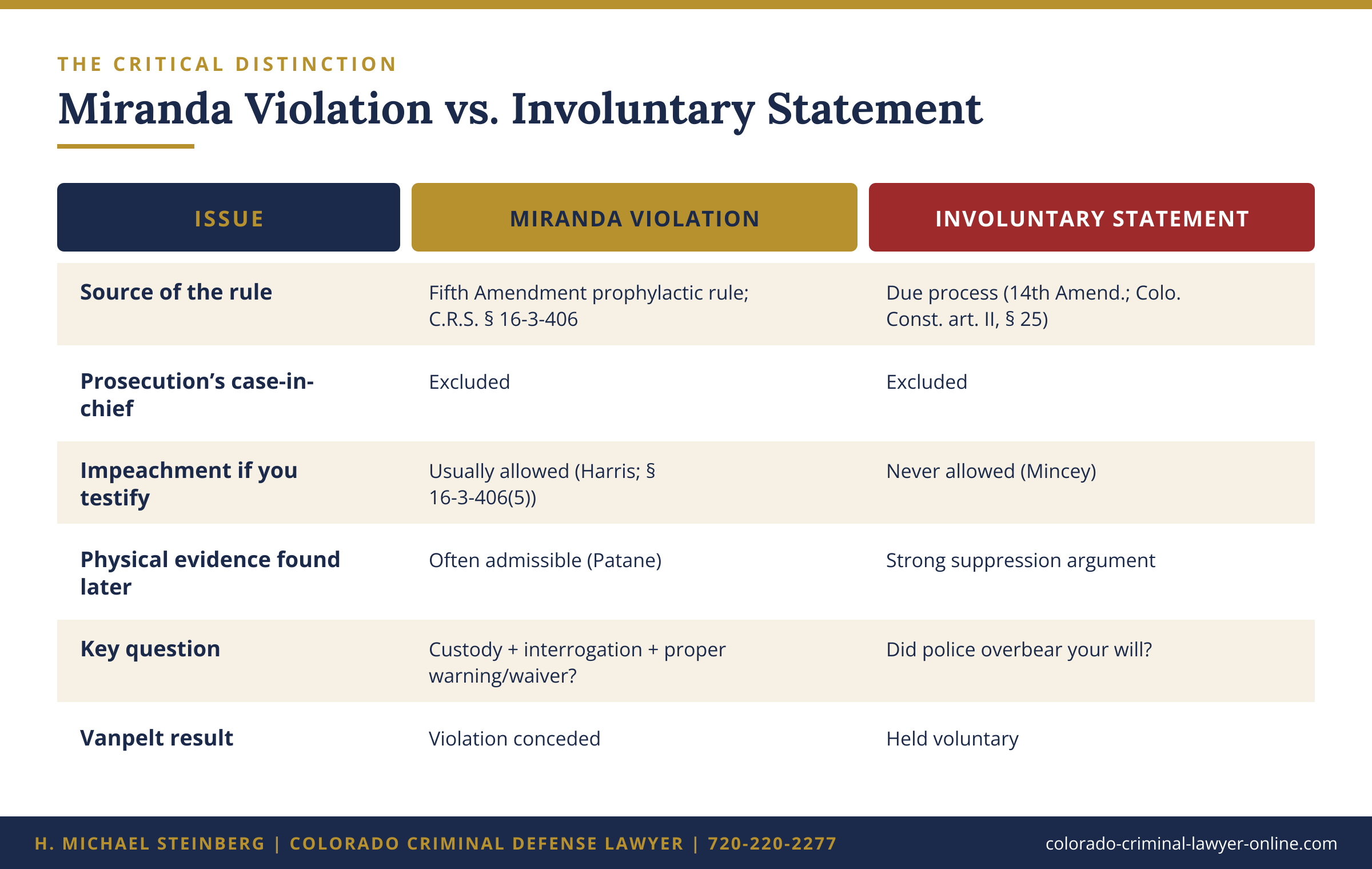 A Miranda violation and an involuntary statement carry very different consequences at trial.
- You win exclusion from the prosecution’s case-in-chief. The prosecutor cannot play the interview for the jury as substantive evidence of guilt.
- You do not win dismissal. A Miranda violation is a rule about evidence, not a ground for throwing out charges. If the prosecution has other evidence, the case goes forward.
- The statement may still be used to impeach you. In Harris v. New York, 401 U.S. 222 (1971) and Oregon v. Hass, 420 U.S. 714 (1975), the Supreme Court allowed Miranda-defective statements to be used to challenge a defendant’s credibility if he testifies inconsistently. Colorado’s statute says the same thing: § 16-3-406(5) does not preclude admitting a voluntary statement to impeach the defendant’s credibility as a witness.
- Physical evidence found as a result may survive. In United States v. Patane, 542 U.S. 630 (2004), a plurality held that the physical fruits of a voluntary but unwarned statement are not automatically suppressed.
“A Miranda violation keeps the statement out of the prosecution’s case. A coerced statement keeps it out of the courtroom. That difference often decides whether a defendant can safely testify.”
— H. Michael Steinberg
That is why the fourth question matters so much — and why the prosecution in Vanpelt fought so hard over it even after conceding the Miranda violation.
Question Four: Was the Statement Voluntary?
Voluntariness is a separate constitutional requirement rooted in the Due Process Clauses of the Fourteenth Amendment and article II, section 25 of the Colorado Constitution. It applies to every statement police obtain — custodial or not, warned or not. Colorado also has a long-standing statutory command in C.R.S. § 16-3-401(1) that no unlawful means of any kind be used to obtain a statement from a person in custody.
A statement is voluntary if it is the product of an essentially free and unconstrained choice. See People v. Klinck, 259 P.3d 489 (Colo. 2011). Two features of the test are critical:
- There must be coercive police conduct. Under Colorado v. Connelly, 479 U.S. 157 (1986) — a Colorado case — a defendant’s mental illness or vulnerability alone does not make a statement involuntary. Something the police did must be coercive.
- The coercion must have significantly induced the statement. The Vanpelt court described the inquiry as two steps: whether the officers’ conduct was coercive, and whether it played a significant role in inducing the statements.
Courts weigh the totality of the circumstances using the seven factors from People v. Gennings, 808 P.2d 839 (Colo. 1991):
- Whether the defendant was in custody or free to leave, and aware of his situation;
- Whether Miranda warnings were given before interrogation, and whether the defendant understood and waived them;
- Whether the defendant had an opportunity to confer with counsel or anyone else before the interrogation;
- Whether the statement was made during an interrogation or was volunteered;
- Whether any overt or implied threat or promise was directed to the defendant;
- The method and style of the interrogation, and its length and location; and
- The defendant’s mental and physical condition, education, employment, and prior experience with law enforcement.
Procedurally, the defendant must make an initial showing of involuntariness. Once that showing is made, the prosecution must prove voluntariness by a preponderance of the evidence. A defendant is entitled to a hearing on the issue under Jackson v. Denno, 378 U.S. 368 (1964).
And the consequence of losing on voluntariness is absolute. Under Mincey v. Arizona, 437 U.S. 385 (1978), an involuntary statement cannot be used for any purpose — not in the case-in-chief, not for impeachment, not at all.
People v. Vanpelt: A Conceded Violation That Still Lost on Voluntariness
With the framework in place, Vanpelt reads differently. It is a case in which the defense won the first three questions and lost the fourth.
| People v. Vanpelt at a Glance | |
|---|---|
| Citation | People v. Vanpelt, 2026 CO 66, No. 26SA142 |
| Decided | October 12, 2026 (Colorado Supreme Court, en banc) |
| Author | Justice Brian D. Boatright, for the court |
| Posture | Prosecution’s interlocutory appeal from a Larimer County suppression order |
| Interrogation | About 75 minutes, in custody at the Las Animas County Jail |
| Miranda | Advisement incomplete — violation conceded by the People |
| Holding on statements | Statements and written apology letter were voluntary; suppression on voluntariness grounds reversed |
| Other rulings | Firearm seizure upheld; appeal of the in-court identification ruling dismissed for lack of jurisdiction |
What happened
The charges arise from two July 2024 incidents. According to the opinion, officers tried to stop a Toyota Sequoia without license plates near a Loveland gas station; the driver fled.
A motorist who followed and photographed the driver had a shot fired into his Jeep’s bumper. Less than an hour later, someone fired at a Ford Explorer, hitting a tire. Days later, officers conducting a welfare check found Vanpelt unconscious on a motorcycle with a holstered handgun and took him to jail, where they discovered the arrest warrant. Vanpelt is charged with attempted first-degree murder and related offenses. He is presumed innocent, and the opinion resolves only pretrial evidentiary issues.
Two Loveland officers then interviewed him at the jail for about 75 minutes. He made incriminating statements and wrote an apology letter to the Loveland victims.
Why the district court suppressed everything
The trial judge found the warning deficient and also found the statements involuntary. She relied on two things: what she viewed as promises by the sergeant, and what she described as Vanpelt’s cognitive delay or comprehension difficulties.
Why the Supreme Court reversed on voluntariness
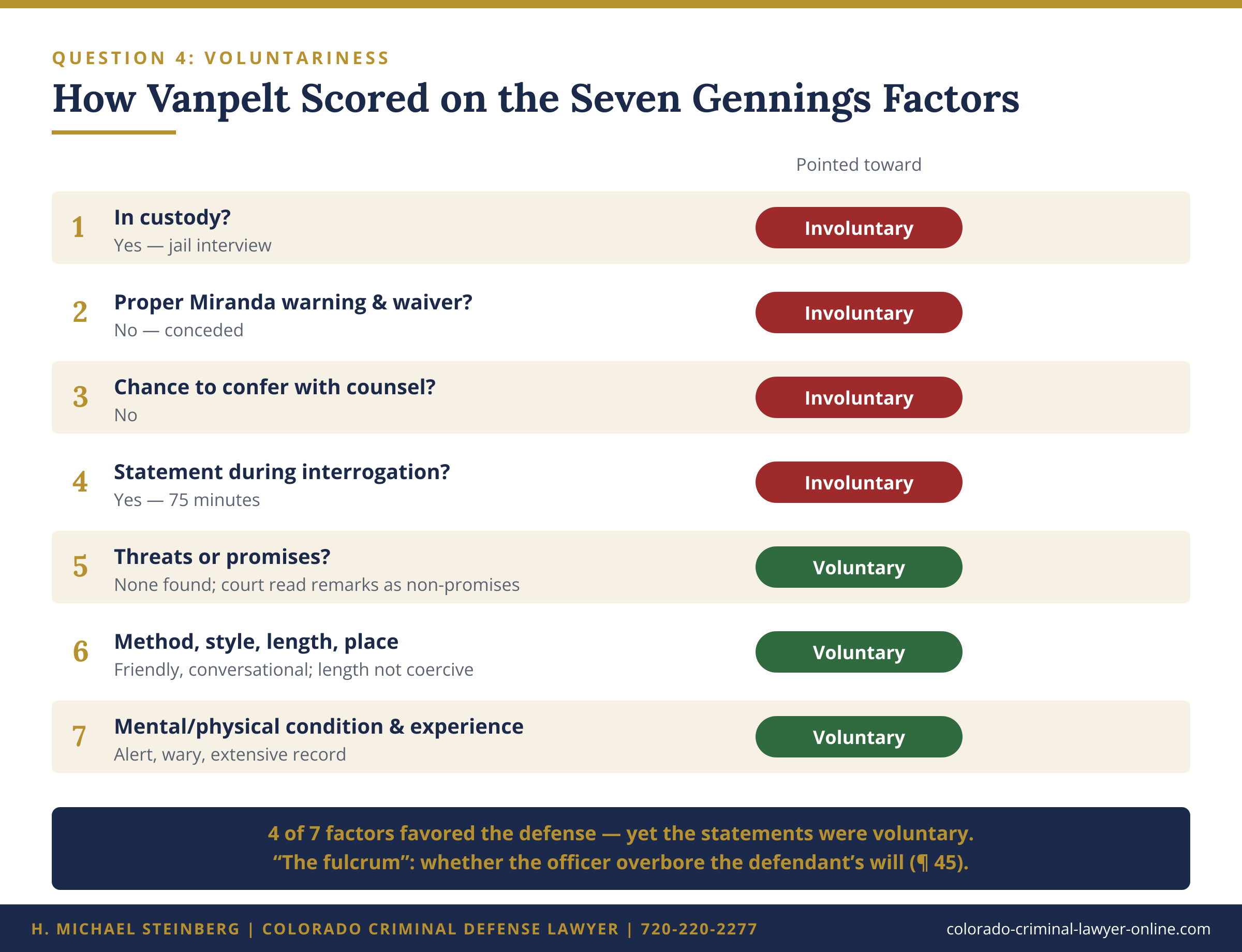 Four of the seven Gennings factors pointed toward involuntariness — and the court still found the statements voluntary.
The court agreed that the first four Gennings factors favored involuntariness: Vanpelt was in custody, his warnings were inadequate, he had no chance to consult counsel, and the statements came during interrogation. But it found the remaining factors decisive:
- No promises. The court read the record differently from the trial judge. The sergeant confirmed he would be in court, did not say he would give the apology letter to the judge, and described his role as passing “observations” to the district attorney rather than promising leniency. The court also noted that most of the incriminating statements came before the remarks the trial court treated as promises — and a later promise cannot retroactively coerce an earlier statement.
- A permissible interrogation style. The sergeant was conversational and friendly, not abusive. Encouraging a suspect to take accountability is not coercion. Seventy-five minutes was not coercive in itself, and most of the statements came in the first half.
- No support for the cognitive finding. The court concluded the record did not support the finding of cognitive delay. Vanpelt was responsive and wary, and his extensive criminal history showed experience with police pressure.
The court’s summary line captures the whole doctrine: the fulcrum of the voluntariness question is whether the officer overbore the defendant’s will. Here, it held, the officers did not.
Authority: Statement Voluntariness vs. Waiver Voluntariness
In a footnote, the court observed that the district court had conflated the voluntariness of Vanpelt’s statements with the voluntariness of his Miranda waiver — two questions the court called analytically distinct. See People v. Vanpelt, 2026 CO 66, n.8. A suppression motion should argue each separately, with its own facts.
What the court did not decide
The court did not rule that the prosecution may impeach Vanpelt with his statements if he testifies. It noted the People’s position and the impeachment language in § 16-3-406(5), but that question remains for the trial court if and when it arises. What Vanpelt establishes is that the constitutional bar to any use of the statements — involuntariness — was not met on this record.
Why This Distinction Changes Trial Strategy
For a defendant, the practical effect of Vanpelt is felt most at one decision point: whether to testify.
- If a statement is suppressed only on Miranda grounds, it sits in the prosecutor’s file like a loaded weapon. If you take the stand and say something inconsistent with it, the jury may hear it.
- If the statement is found involuntary, it is gone. You can testify without that risk.
- A written apology letter is especially dangerous. In Vanpelt, the defendant himself reportedly described the letter as a confession. If a voluntary letter like that can be used to impeach, it can shape every decision about the defense theory of the case.
That is why an experienced Colorado defense lawyer litigates both theories in every statement-suppression motion: the Miranda violation and involuntariness, supported by separate facts.
Defense Takeaway: What We Look For
The recording, frame by frame. Colorado courts may review an audio-visual recording themselves when no facts outside it are disputed. See People v. Kutlak, 2016 CO 1. The exact words of the advisement — especially “at any time” — must be transcribed and compared against § 16-3-406(3).
Recording requirements. C.R.S. § 16-3-601 requires electronic recording of custodial interrogations in a permanent detention facility for certain serious felonies and sex offenses. Gaps and missing recordings matter.
Timing of every promise or threat. Vanpelt shows that a statement made before an improper remark is analyzed separately from one made after.
The client’s real condition. Intoxication, injury, sleep deprivation, medication, and cognitive limits must be documented with evidence, not just argued — the Vanpelt court rejected a cognitive-delay finding it believed the record did not support.
Juvenile protections. For young clients, C.R.S. § 19-2.5-203 makes a juvenile’s custodial statement presumptively inadmissible when officers knowingly used false information or deception.
Common Colorado Scenarios Run Through the Four Questions
Here is how the framework typically plays out in situations I see every week. Every case turns on its own facts; this table illustrates the analysis rather than predicting any result.
| Scenario | Custody? | Interrogation? | Typical Issue |
|---|---|---|---|
| Roadside DUI questioning (“How much have you had?”) | Usually not (Berkemer) | Yes | Whether the stop escalated to arrest-like restraint |
| Domestic violence call — questioning at the home | Often disputed | Yes | Number of officers, separation from family, handcuffs |
| “Voluntary” interview at the police station | Often no, if told free to leave | Yes | Whether the setting became arrest-like; voluntariness still applies |
| Interview in jail after arrest (Vanpelt) | Yes | Yes | Adequacy of warning, waiver, and voluntariness |
| Blurting out a statement in the patrol car | Yes | Often no | Whether officers prompted it (Innis) |
| Questioning in a hospital bed | Fact-specific | Yes | Medication, pain, and condition under Gennings |
What to Do If Colorado Police Want to Question You
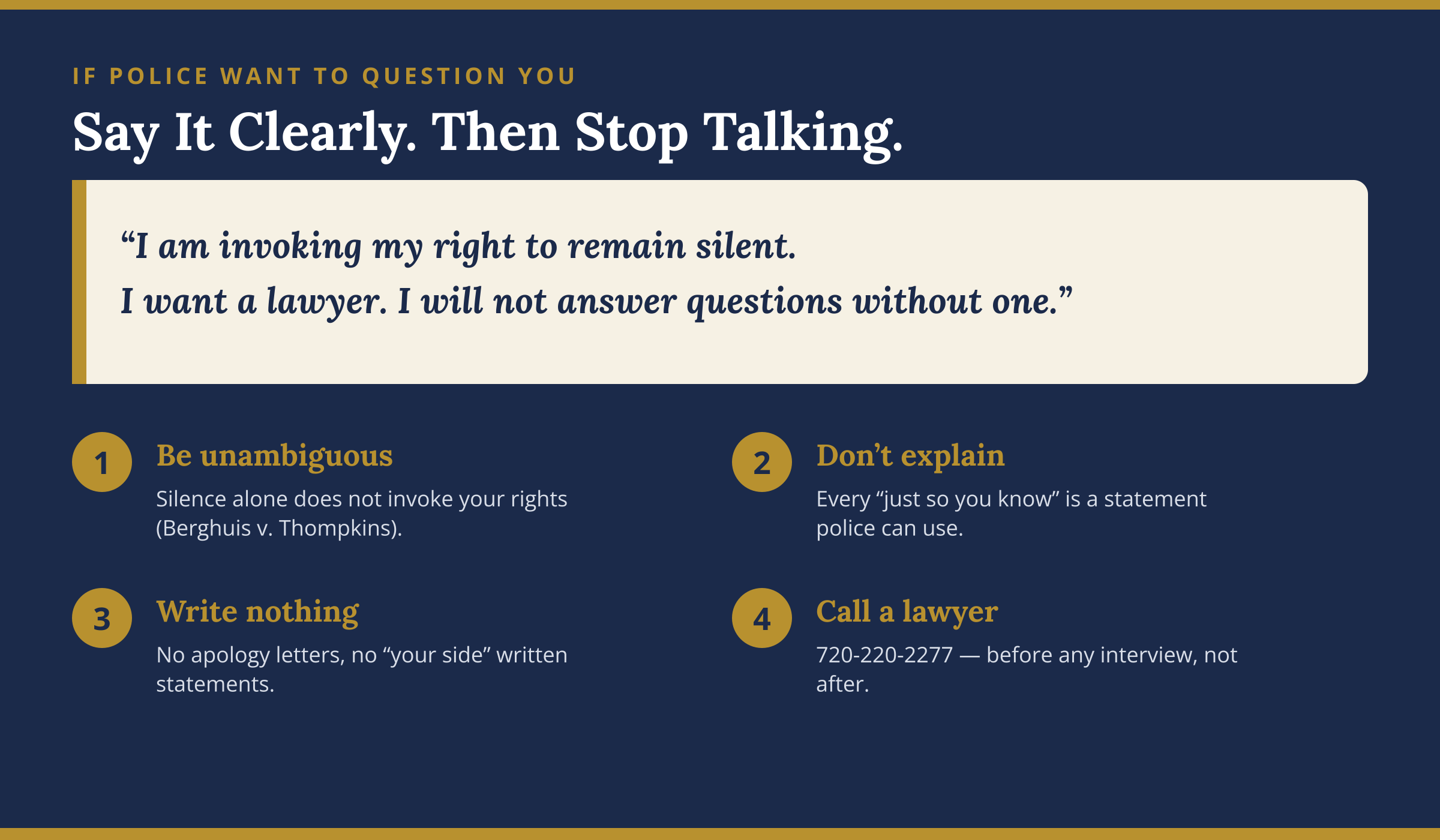
Invoke your rights clearly, then stop talking.
Everything in this article is about what happens after a person talks. The best protection is to avoid the problem. As I explain in Why Innocent People Sometimes Hurt Their Cases by Talking to Colorado Police, good intentions do not prevent damaging statements.
- Say it clearly. “I am invoking my right to remain silent. I want a lawyer.” Silence alone may not be enough — and pre-arrest silence can sometimes be used against you, as I discussed in this article on pre-custodial silence.
- Then stop. Do not explain, justify, or try to “clear things up.”
- Write nothing. Decline invitations to write your “side of the story” or an apology.
- Be polite and do not resist. Invoking your rights is not obstruction. Physically resisting is a separate crime.
- Call a Colorado criminal defense lawyer immediately — before any interview, not after.
If you have already talked, do not assume the case is lost — and do not assume a defective warning will save it. Have a lawyer obtain the recordings and run every statement through all four questions. That analysis matters in assault, drug, sex offense, and every other type of criminal case.
Frequently Asked Questions
If police didn’t read me my rights, will my case be dismissed?
Almost never. A Miranda violation is a rule about evidence. The usual remedy is suppression of the statement from the prosecution’s case-in-chief, not dismissal. If the prosecution has enough other evidence, the case continues.
Do police have to read me my rights when they arrest me?
No. Miranda warnings are required before custodial interrogation, not at the moment of arrest. If police arrest you and never question you, the absence of warnings usually does not matter.
What makes a Miranda warning “inadequate” in Colorado?
Under C.R.S. § 16-3-406(3), the advisement must reasonably convey five rights: silence; that statements can be used in court; consulting a lawyer before questioning and having one present during it; appointed counsel if you can’t afford one; and the right to stop the interview and request silence or a lawyer at any time. Leaving out the substance of any of them can make the warning inadequate.
Can a statement taken in violation of Miranda still be used against me?
Yes, potentially. If the statement was voluntary, the prosecution may be able to use it to impeach you if you testify inconsistently. See Harris v. New York and § 16-3-406(5).
What is the difference between a Miranda violation and an involuntary confession?
A Miranda violation concerns whether proper warnings and a valid waiver preceded custodial interrogation. Involuntariness concerns whether police conduct overbore your will. An involuntary statement cannot be used for any purpose, including impeachment (Mincey v. Arizona).
Is a promise of leniency enough to make a confession involuntary?
It can be a significant factor, but courts look closely at what was actually said and when. In Vanpelt, the court found the officer’s remarks were not promises of leniency, and that most incriminating statements came before them.
Does a long interrogation make my statement involuntary?
Not by itself. Length is one factor. In Vanpelt, the court held a 75-minute interview was not coercive in itself, especially where the officer’s style was conversational.
Does it help that I have a learning disability or was impaired?
Your condition is relevant, but under Colorado v. Connelly there must also be coercive police conduct. The condition must be proven with evidence, and its effect must connect to what police did.
Related Reading
- Colorado Police Gave You an Inadequate Miranda Warning—Is Your Statement Automatically Suppressed? — my full Vanpelt case breakdown
- No Miranda Warning? Here Is What Actually Happens in Colorado
- Colorado Criminal Law – Am I in Custody? Understanding Your Miranda Rights
- Why Innocent People Sometimes Hurt Their Cases by Talking to Colorado Police
- Colorado Miranda Rights Law – What Is the Law in Colorado on Miranda?
- Can a Colorado Felony Be Dismissed at the Preliminary Hearing?
Sources and Authorities
- People v. Vanpelt, 2026 CO 66 (Colo. Oct. 12, 2026)
- People v. Torres, 2026 CO 15
- People v. Smiley, 2023 CO 36
- People v. Kutlak, 2016 CO 1, 364 P.3d 199
- People v. Klinck, 259 P.3d 489 (Colo. 2011)
- People v. Matheny, 46 P.3d 453 (Colo. 2002)
- People v. Gennings, 808 P.2d 839 (Colo. 1991)
- Miranda v. Arizona, 384 U.S. 436 (1966)
- Dickerson v. United States, 530 U.S. 428 (2000)
- Rhode Island v. Innis, 446 U.S. 291 (1980)
- Berkemer v. McCarty, 468 U.S. 420 (1984)
- Pennsylvania v. Muniz, 496 U.S. 582 (1990)
- New York v. Quarles, 467 U.S. 649 (1984)
- California v. Prysock, 453 U.S. 355 (1981)
- Duckworth v. Eagan, 492 U.S. 195 (1989)
- Florida v. Powell, 559 U.S. 50 (2010)
- Berghuis v. Thompkins, 560 U.S. 370 (2010)
- Davis v. United States, 512 U.S. 452 (1994)
- Edwards v. Arizona, 451 U.S. 477 (1981)
- Oregon v. Elstad, 470 U.S. 298 (1985)
- Missouri v. Seibert, 542 U.S. 600 (2004)
- Harris v. New York, 401 U.S. 222 (1971)
- Oregon v. Hass, 420 U.S. 714 (1975)
- United States v. Patane, 542 U.S. 630 (2004)
- Mincey v. Arizona, 437 U.S. 385 (1978)
- Colorado v. Connelly, 479 U.S. 157 (1986)
- Jackson v. Denno, 378 U.S. 368 (1964)
- C.R.S. § 16-3-406 (custodial interrogation — required advisements; enacted by HB 23-1155)
- C.R.S. § 16-3-601 (recording custodial interrogations)
- C.R.S. § 16-3-401 (treatment while in custody)
- C.R.S. § 19-2.5-203 (juvenile statements)
- U.S. Const. amend. V; U.S. Const. amend. XIV; Colo. Const. art. II, § 25
Talk to a Colorado Criminal Defense Lawyer About Your Statement
If you made a statement to police — with or without a Miranda warning — the four questions in this article will shape your case. With over forty years of Colorado criminal defense experience in Denver and throughout the metro area, I can review the recordings, identify every suppression issue, and give you an honest assessment.
Call H. Michael Steinberg: 720-220-2277 — or contact the Law Office of H. Michael Steinberg online.
Disclaimer: This article provides general information about Colorado criminal law and is not legal advice. Reading it does not create an attorney-client relationship. Every case depends on its specific facts; consult a qualified Colorado criminal defense attorney about your situation. People v. Vanpelt involves pending charges, and the defendant is presumed innocent.