 Colorado Criminal Lawyer Blog
Why Innocent People Sometimes Hurt Their Cases by Talking to Colorado Police


By H. Michael Steinberg | Colorado Criminal Defense Attorney, Denver | October 9, 2026 |
Most people believe the same thing when a detective calls or knocks on the door: “I didn’t do anything wrong, so I’ll just explain.” That instinct feels honest, cooperative, and safe. In a criminal investigation, it is often the most dangerous decision a person makes.
Criminal defense lawyers see the same pattern repeat across Denver and the Colorado metro area. A person with a real defense gives a voluntary statement to “clear things up,” and months later that statement becomes the centerpiece of the prosecution’s case. The problem is rarely a confession. It is a collection of small, honest, imperfect answers that the State later arranges into a story of guilt.
This article explains why talking to police can hurt an innocent person, how Colorado law treats police interviews, and what to do instead. If you are facing a DUI, domestic violence, drug, sex crime, or any other investigation, the guidance below applies from the first contact.
Key Takeaways
- Police interviews are evidence-gathering, not a chance to be “cleared.” Your words become the State’s exhibits.
- Honest mistakes about times, places, and details are routinely reframed as lies.
- Police may lawfully use deception with adults. False confessions are documented in about 29% of DNA exonerations.
- Miranda warnings apply only to custodial interrogation, so many damaging conversations happen with no warning at all.
- You must clearly invoke your rights out loud: “I am invoking my right to remain silent. I want a lawyer.”
- Colorado requires you to identify yourself in a lawful stop. After that, stop talking.
The “I Have Nothing to Hide” Trap
The phrase sounds like confidence, but it misunderstands what a police interview is. Officers are trained to gather admissions and lock in a version of events. They are not neutral fact-finders deciding whether you are innocent. By the time they ask for your side, they have already formed a working theory, and your answers are tested against it.
You also do not know what the officer knows. You cannot tell whether a video, a text message, a phone location record, or a witness statement exists. If your recollection differs from that evidence by even a small detail, the difference looks like deception, regardless of why it happened.
The State carries the burden of proof. Talking to police can quietly shift that burden onto you.
Under the Fifth Amendment, no person “shall be compelled in any criminal case to be a witness against himself.” You can read the full text at the Library of Congress Constitution Annotated. That protection belongs to the innocent as much as the guilty. It is the legal system’s recognition that stress, fear, and confusion produce unreliable statements.
Seven Ways an Innocent Person’s Words Backfires
1. Honest Mistakes Become “Lies”
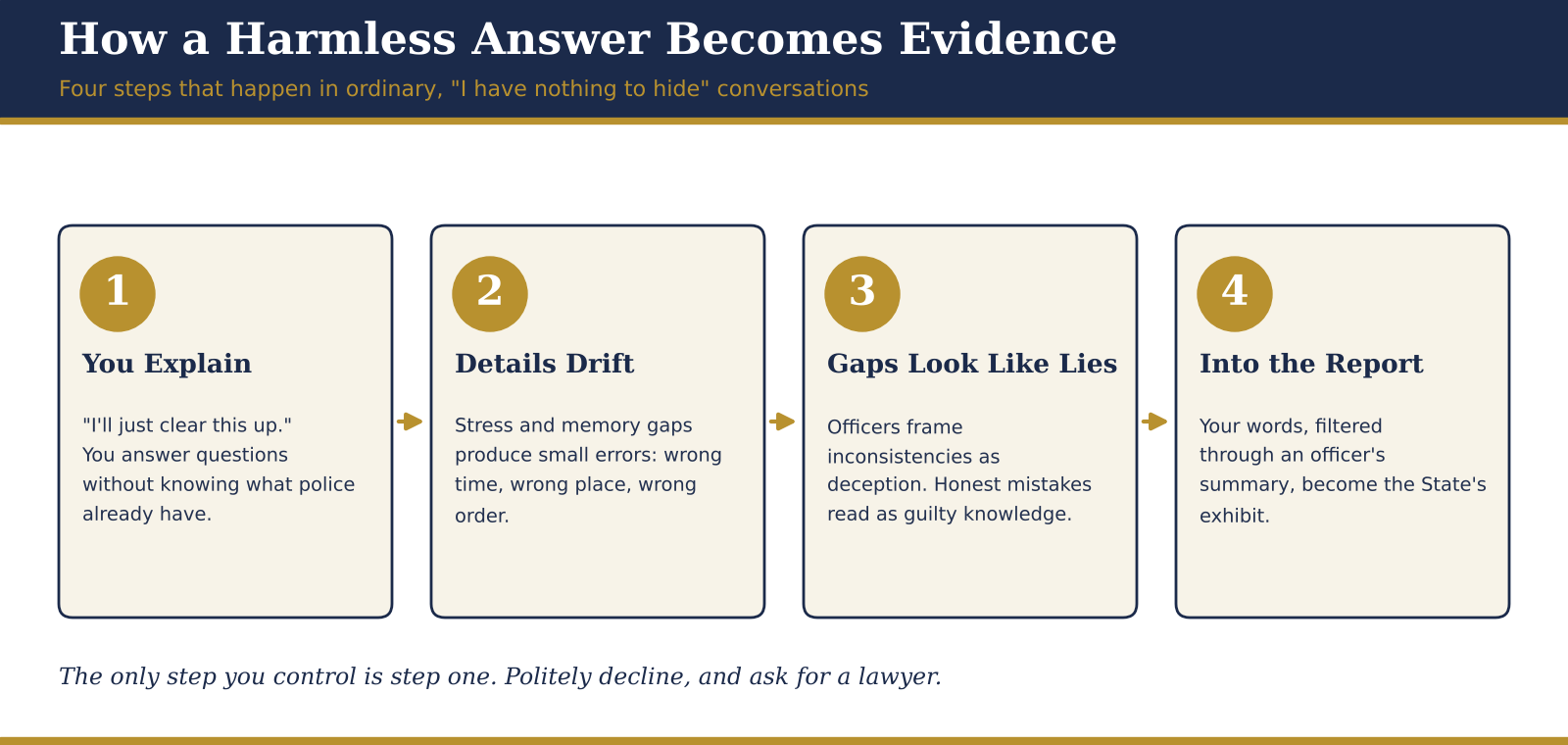
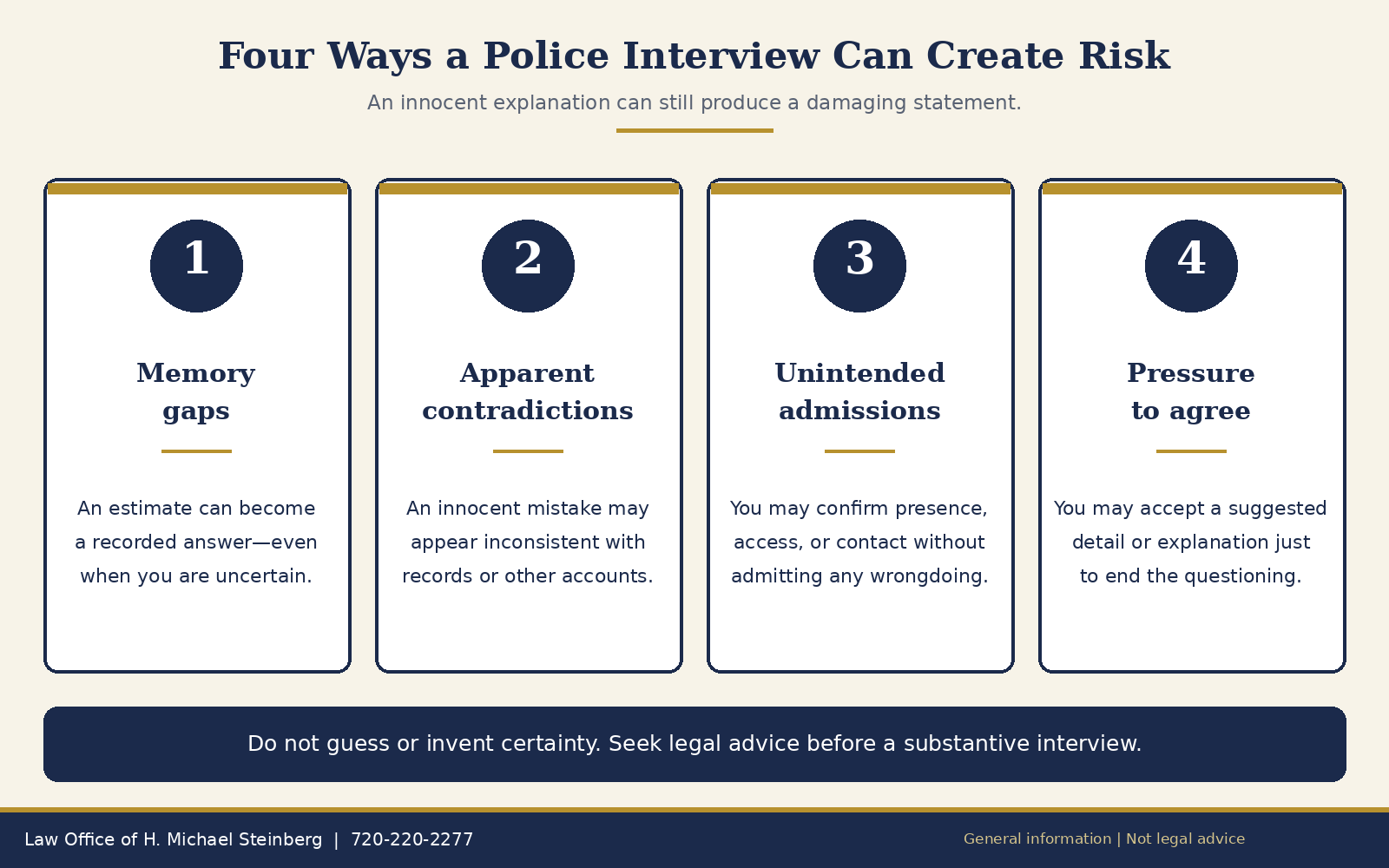
Memory is reconstructive. Under stress, people misstate times, mix up days, and forget details. Investigators call these inconsistencies, and prosecutors argue them as “consciousness of guilt.” A person who says they left at 9:00 p.m. when the phone log says 9:40 has not necessarily lied, but a jury may be told that they did.
2. Small Admissions Complete the State’s Case
Many prosecutions turn on a handful of facts: you were there, you had the keys, it was your phone, you had been drinking. Each fact feels harmless when you say it. Together, they can supply the identity, access, or presence the State could not otherwise prove.
3. Trying to Be Helpful Leads to Speculation
Cooperative people guess. They speculate about who else might have done it, what a text “probably meant,” or how a bruise “might have” happened. Those guesses are later quoted as statements of fact, and may point suspicion at the wrong person or contradict other evidence.
4. Volunteering Unrelated Information
Explaining too much opens doors: prior arguments, alcohol or drug use, past police contact, or relationship history. Information you offer to look credible can become motive, intent, or bad-character evidence.
5. Your Own Words Are Admissible Against You
When the prosecution offers your statement against you, the rules of evidence generally treat it as an admission by a party-opponent rather than as barred hearsay. See Federal Rule of Evidence 801(d)(2), which Colorado’s rules mirror. The practical result is that your words come in through the officer, even if you later disagree with how they were summarized.
6. Silence Can Be Used Against You If You Do Not Invoke
In Salinas v. Texas, 570 U.S. 178 (2013), a man voluntarily answered questions at the police station until he was asked whether his shotgun would match shell casings at the scene. He fell silent, and prosecutors used that silence as evidence of guilt. The plurality held that, in a voluntary interview, a person must expressly invoke the privilege. Simply going quiet was not enough.
7. Vague Requests for a Lawyer Do Not Count
Courts require a clear and unambiguous invocation. In Davis v. United States, 512 U.S. 452 (1994), the statement “Maybe I should talk to a lawyer” did not require officers to stop questioning.
In Berghuis v. Thompkins, 560 U.S. 370 (2010), a suspect who sat mostly silent through hours of questioning was treated as having waived the right because he never unambiguously invoked it.
| What an innocent person says | How it can be used | Safer alternative |
|---|---|---|
| “I was home all night.” | If a phone ping, receipt, or camera shows otherwise, an honest misremembering is presented as a lie. | Let a lawyer verify your timeline against records first. |
| “I only had two beers.” | Admits drinking and puts a number on it the State may contest with later evidence. | “I’m not answering questions. I want a lawyer.” |
| “Yes, that’s my car and my phone.” | Establishes ownership and ties you to the evidence without the State proving it. | Do not claim or disclaim property. Speak to counsel. |
| “We only argued once, I barely know her.” | Minimizing or guessing at history can conflict with texts and witnesses. | Decline to characterize relationships or history. |
| “Sure, go ahead and look.” | Consent can waive Fourth Amendment objections to the search. | “I do not consent to any searches.” |
| “Maybe I should talk to a lawyer?” | Courts may treat this as ambiguous, and questioning may continue. | “I am invoking my right to remain silent. I want a lawyer.” |
Why Innocent People Confess
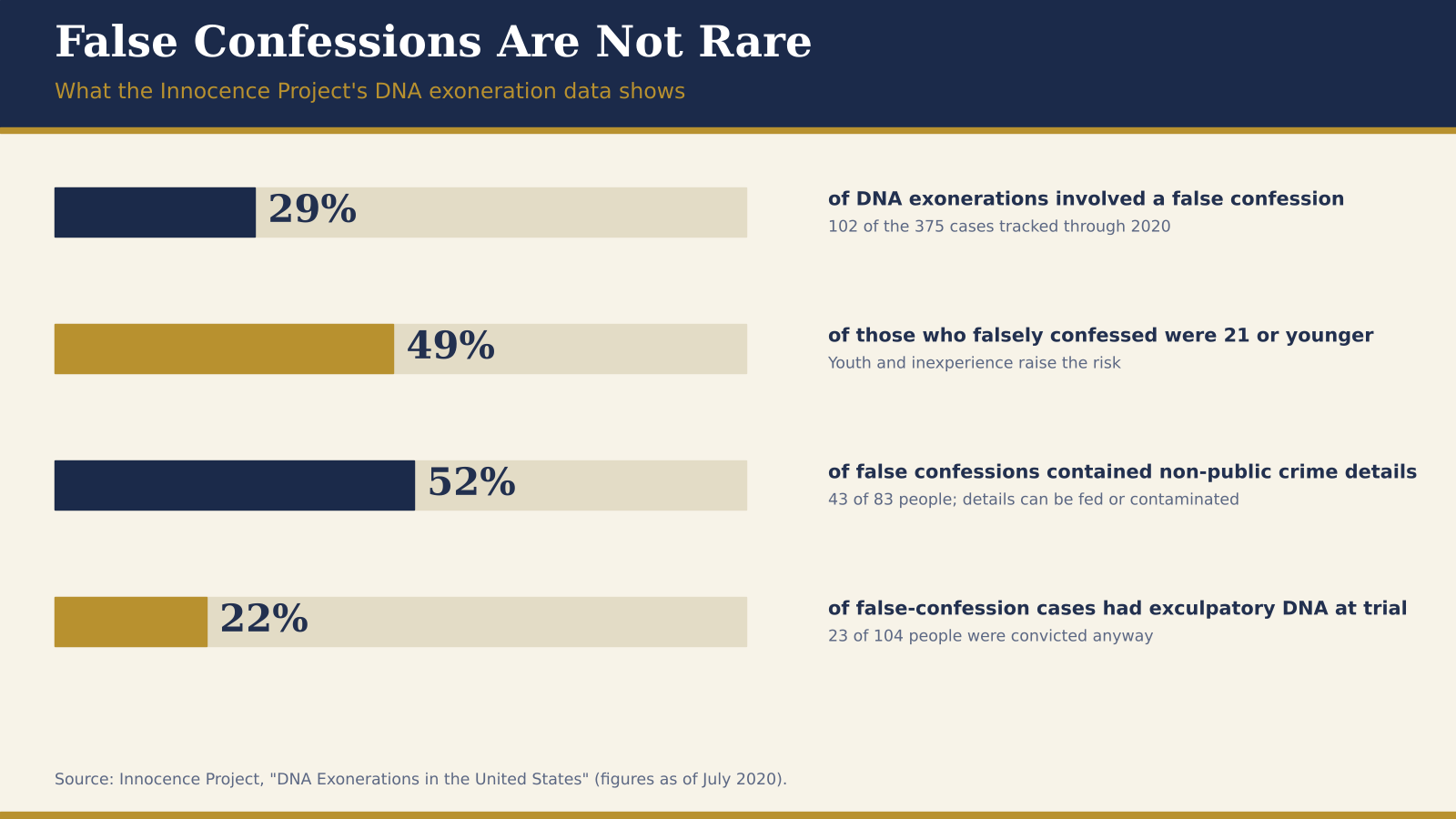
It is natural to assume that no innocent person would confess. The data says otherwise. According to the Innocence Project’s DNA exoneration data, 29% of DNA exonerations through 2020 involved a false confession, and nearly half of those who falsely confessed were 21 or younger at the time. In more than half of the cases examined, the false confession included non-public facts about the crime, which jurors treat as proof of guilt.
Several pressures explain this. Long interrogations produce exhaustion. Officers may minimize the consequences (“this is just a misunderstanding”), suggest leniency, or claim evidence exists when it does not.
As the Supreme Court acknowledged in Frazier v. Cupp, a false statement about evidence does not by itself make a confession involuntary. Frightened, tired, or young suspects sometimes decide that agreeing is the fastest way out of the room.
Colorado has seen the consequences. A 14-year-old in Denver, Lorenzo Montoya, falsely confessed to a murder in 2000 after officers told him they had fingerprints and other physical evidence. Advocates cited his case in support of House Bill 23-1042, signed in 2023, which is discussed in this Colorado Sun commentary.
Miranda Is Narrower Than Most People Think
Television teaches that police must read your rights before they can question you. In reality, Miranda v. Arizona, 384 U.S. 436 (1966), applies to custodial interrogation: questioning that begins after you are in custody. Colorado codified its own version of those warnings in C.R.S. § 16-3-406.
Roadside conversations, questions at your front door, and a “voluntary” interview at the station where you are told you are free to leave typically require no warnings. Statements made in those settings can still be used against you. For a deeper explanation, read our article, No Miranda Warning? Here Is What Actually Happens in Colorado.
Colorado Authority: Interview Recording
- C.R.S. § 16-3-601 requires electronic recording of certain custodial interrogations, including those in a permanent detention facility for class 1 and 2 felonies and felony sexual assault, subject to listed exceptions.
- Since 2023, all juvenile custodial interrogations must be recorded regardless of the offense. See the Innocence Project’s summary of Colorado’s recording law.
- When a required recording is missing, the court may admit the evidence but can give the jury a cautionary instruction.
The recording statute is narrow. Many encounters are preserved only through an officer’s report or partial camera footage, which means the version of your words a jury hears may be the officer’s summary.
Young People Face Extra Risk, and Extra Protection
Teenagers and young adults are particularly vulnerable to pressure. Colorado law reflects that. Under C.R.S. § 19-2.5-203, a juvenile’s statement obtained during a custodial interrogation is inadmissible unless a parent, guardian, or custodian was present and both were advised of the juvenile’s rights, except when the juvenile’s lawyer is present.
HB 23-1042, signed May 18, 2023, added further protection. A juvenile’s statement is presumptively inadmissible if a law enforcement official knowingly used deception during the custodial interrogation, unless the prosecution proves the statement was voluntary despite the deception. The law also requires recording of all juvenile custodial interrogations. If your child is contacted by police, call a lawyer before anyone answers questions.
What to Do Instead: A Calm, Colorado-Specific Plan
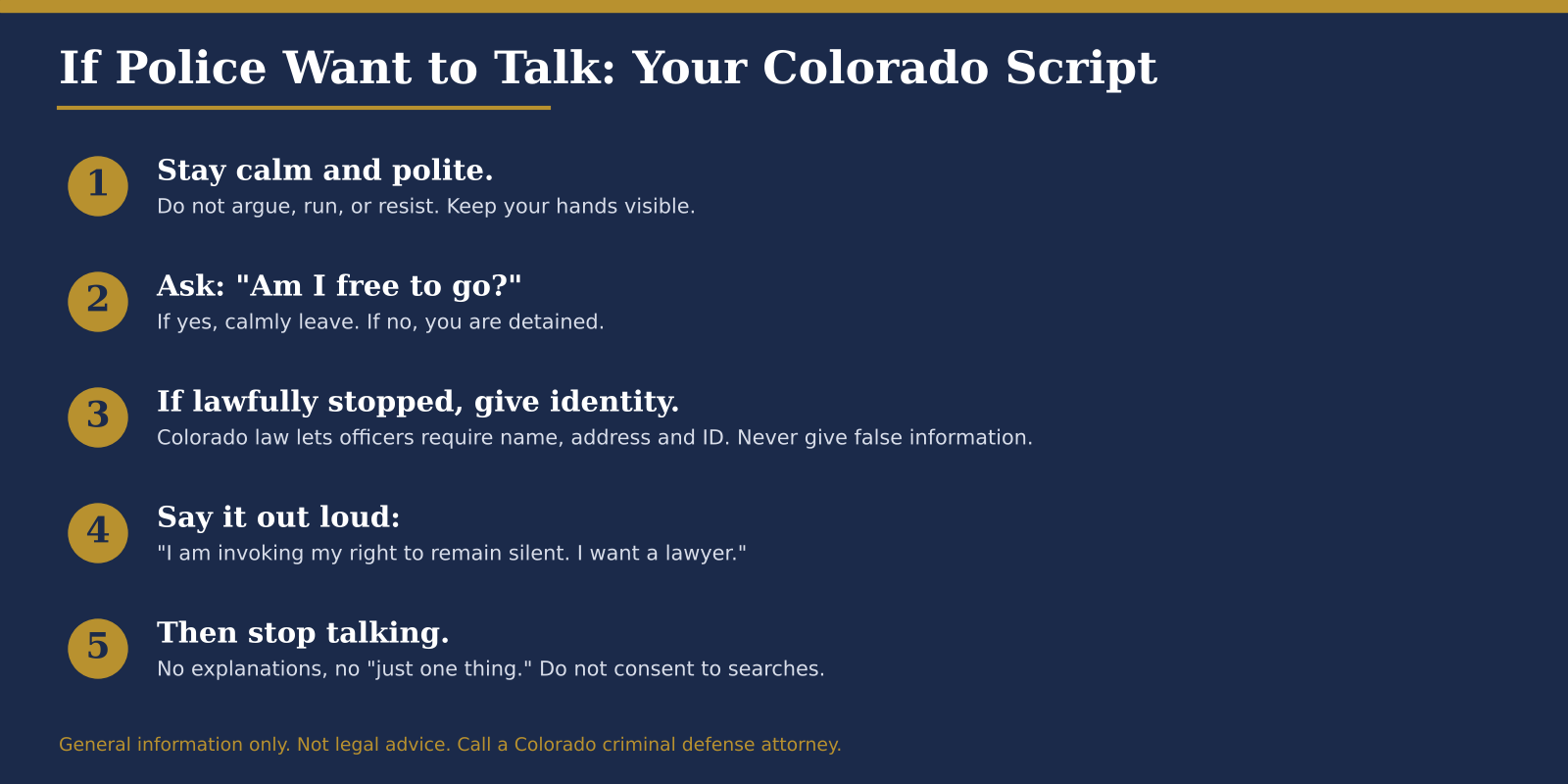
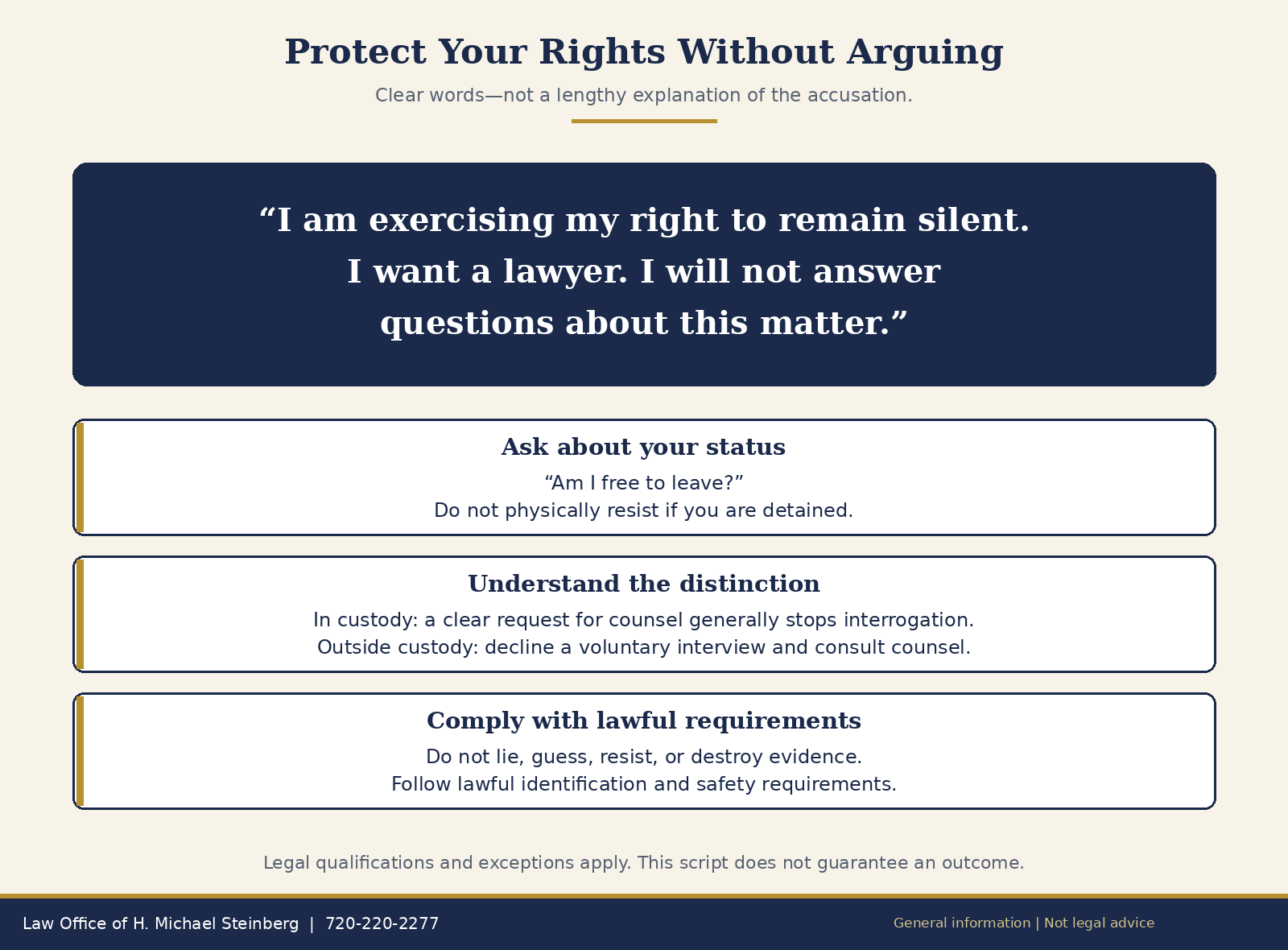
- Stay calm and polite. Do not argue, run, or physically resist. Keep your hands visible.
- Ask whether you are free to go. If the answer is yes, calmly leave. If not, you are being detained.
- Identify yourself if you are lawfully stopped. Colorado’s stop-and-identify statute allows an officer who reasonably suspects a crime to require your name, address, and identification if available. Never provide false information, which is a crime under C.R.S. § 18-8-111.5.
- Say the words out loud. “I am invoking my right to remain silent. I want a lawyer.” Clear, simple, and unambiguous.
- Then stop talking. No explanations, no “just one thing,” and no casual conversation in the patrol car. Do not consent to searches.
- Call a Colorado criminal defense attorney immediately. Do not wait for charges to be filed.
The same statute also refers to “an explanation of his actions.” How that language interacts with your Fifth Amendment protection is a question a lawyer should answer for your specific facts. It is one more reason to seek counsel at the earliest opportunity. For a fuller roadmap, see What Should You Do in Colorado If You Learn You Are Under Criminal Investigation?
Colorado Authority: Stopping and Identifying
- C.R.S. § 16-3-103: officers may stop a person they reasonably suspect of a crime and may require a name, address, and identification if available.
- C.R.S. § 18-8-111.5: knowingly giving law enforcement false identifying information is a class 2 misdemeanor, with a felony level when it substantially impedes a felony investigation.
- C.R.S. § 18-8-111: false reporting to authorities is a separate offense.
Common Situations Where Innocent People Say Too Much
Roadside Questions During a DUI Investigation
“Where are you coming from?” and “How much have you had to drink tonight?” are evidence-gathering questions, not small talk. Polite answers can provide the State with evidence of timing, consumption, and impairment. You may courteously decline to answer questions beyond identifying yourself, and a DUI defense lawyer can address the rest.
Domestic Violence Calls
Emotions run high, officers separate everyone, and every statement is captured in a report or on body-camera video. Words said in the heat of the moment, including apologies, can later be offered as admissions. Early legal advice matters in domestic violence cases because the first account often drives the decision to charge.
The Detective Who Calls and Says, “I Just Want to Get Your Side”
A phone call or a card left on your door is not a request you must answer on the spot. A calm response is: “I’d be glad to have my attorney contact you.” Then call a lawyer. Do not delete messages, contact witnesses, or post about the matter online.
Knock at the Door and Requests to “Come Down to the Station”
An invitation to a voluntary interview often means no Miranda warnings, because you are told you are free to leave. That label can change the legal analysis of what you say. Ask whether you are free to go, and consider speaking with counsel before you agree to attend.
Why “Lawyer First” Protects Innocent People

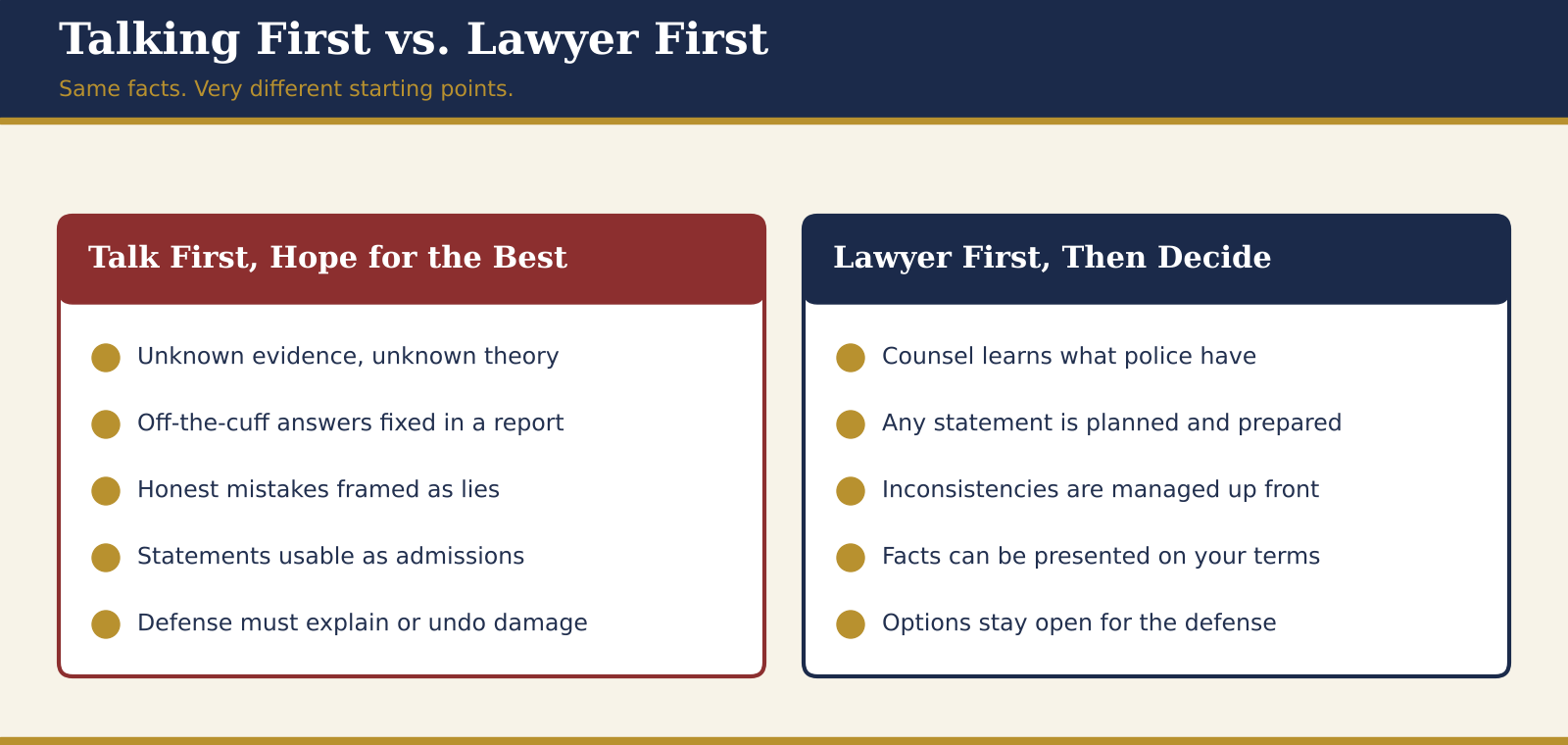
Calling a lawyer is not obstruction, and it is not an admission. It is how innocent people keep control of their own story.
A Colorado criminal defense lawyer can:
-
- Learn what the investigators actually have before you say anything.
- Decide whether a statement helps, and if so, prepare it carefully, sometimes through a lawyer’s presentation of alibi evidence or video rather than a live interview.
- Communicate with the detective and prosecutor on your behalf.
- Obtain and review recordings, reports, and body-camera footage if charges follow.
- Challenge statements that were taken without proper Miranda warnings, after you invoked your rights, or that were involuntary or improperly recorded.
These issues arise in every kind of case we defend, including DUI, domestic violence, sex crimes, drug crimes, assault, and theft.
Frequently Asked Questions About Talking to Police
Won’t refusing to talk make me look guilty?
No. Invoking your rights is a constitutional protection, not an admission. Police and prosecutors often suggest that innocent people “have nothing to hide,” but the Fifth Amendment exists precisely because honest people can be misunderstood. The key is to invoke clearly and out loud, because under Salinas v. Texas simple silence in a voluntary interview may not be protected.
What if the officer says this is my only chance to tell my side?
That is a common interview technique, not a legal deadline. Your side can be presented later, through a lawyer, with preparation, supporting records, and a strategy. A lawyer can also decide whether a statement helps at all.
I’m only a witness. Is it safe to talk?
Not necessarily. People move from witness to suspect during an investigation, and anything you say can be used. If you are unsure of your status, politely ask whether you are a suspect and consider calling a Colorado criminal defense attorney before any interview.
Can police lie to me during questioning?
In general, yes. The Supreme Court held in Frazier v. Cupp that a deliberate misstatement about a codefendant’s confession did not make a confession involuntary on its own. Colorado has added limits for juveniles under HB 23-1042, but adults get far less protection from deception.
What if I already talked to the police?
Stop talking, do not try to “fix” your statement, and speak with a lawyer as soon as possible. A defense attorney can obtain recordings and reports, evaluate whether Miranda or voluntariness problems exist, and decide how to deal with what was said.
Do I have to give police my name?
If you are lawfully stopped on reasonable suspicion, Colorado’s stop-and-identify statute allows an officer to require your name, address, and identification if available. Giving false identifying information is a separate crime under C.R.S. § 18-8-111.5. Beyond identifying yourself, invoke your right to remain silent.
Will asking for a lawyer make police suspicious?
Officers hear it every day. Asking for counsel is lawful, and once you are in custody and have been given Miranda warnings, prosecutors generally cannot use your request as proof of guilt. It also protects you from the statement-making mistakes that cause most avoidable damage.
Speak With a Denver Criminal Defense Attorney Before You Speak With Police
If police have contacted you, or you believe you are under investigation, do not wait. The earlier a defense lawyer is involved, the more options you keep. Attorney H. Michael Steinberg has practiced criminal law first as a career District Attorney in Arapahoe and Douglas counties and later, after opening his own firm in 1999, for more than 40 years in the Denver metro area, including cases at the Lindsey-Flanigan Courthouse and in surrounding jurisdictions.
Law Office of H. Michael Steinberg
Denver Criminal Defense Attorney, over 40 years of Colorado experience
Free consultation
Explore more on our blog, the Colorado Criminal Lawyer Blog, including the categories When Miranda Actually Applies, You Learn You Are Under Criminal Investigation, and The Colorado Criminal Case: From Investigation Through Trial.
Sources and Authorities
- U.S. Const. amend. V (Fifth Amendment)
- Miranda v. Arizona, 384 U.S. 436 (1966)
- Frazier v. Cupp, 394 U.S. 731 (1969)
- Davis v. United States, 512 U.S. 452 (1994)
- Berghuis v. Thompkins, 560 U.S. 370 (2010)
- Salinas v. Texas, 570 U.S. 178 (2013)
- Federal Rule of Evidence 801
- C.R.S. § 16-3-103, Stopping of suspect
- C.R.S. § 16-3-406, Custodial interrogation
- C.R.S. § 16-3-601, Recording custodial interrogations
- C.R.S. § 18-8-111, False reporting to authorities
- C.R.S. § 18-8-111.5, False reporting of identifying information
- C.R.S. § 19-2.5-203, Juvenile statements
- Colorado House Bill 23-1042, Admissibility Standards for Juvenile Statements
- Innocence Project, DNA Exonerations in the United States
- Innocence Project, Recording of Interrogations in Colorado
- The Colorado Sun, commentary on HB 23-1042 (May 28, 2023)
Disclaimer: This article provides general information about Colorado criminal law and is not legal advice. Reading it does not create an attorney-client relationship. Laws change and every case is different. Statutes, rules, and cases cited were checked against public sources on October 9, 2026, and should be confirmed by a licensed attorney for your situation.