 Colorado Criminal Lawyer Blog
First-Degree Motor Vehicle Theft Law: What Hurtado Means If You Have Prior Car Theft Convictions


Colorado Appeals Court Upholds First-Degree Motor Vehicle Theft Law: What People v. Hurtado Means If You Have Prior Car Theft Convictions
On November 19, 2026, a unanimous three-judge division of the Colorado Court of Appeals decided People v. Hurtado, 2026 COA 83, rejecting a constitutional challenge to Colorado’s first-degree motor vehicle theft statute, C.R.S. § 18-4-409(2).
The case matters to anyone in Colorado who already has two prior car theft or unauthorized-use convictions on their record — because under the 2023 version of the law, those prior convictions are not just a sentencing issue. They are part of the crime itself, and the jury will hear about them.
- The ruling: The Court of Appeals affirmed Rudy Levi Hurtado’s first-degree motor vehicle theft conviction and his 12-year community corrections sentence.
- The argument rejected: Making prior convictions an element of the crime (rather than a sentence enhancer) does not violate equal protection under the Fourteenth Amendment or the Colorado Constitution.
- Why it failed: A defendant charged with motor vehicle theft is not “similarly situated” to a defendant charged with animal cruelty under C.R.S. § 18-9-202 — the comparison the defense relied on.
- The practical effect: In a first-degree MVT trial, jurors will learn about your prior vehicle theft convictions. A limiting instruction is the main protection.
- Still pending: The Colorado Supreme Court is separately deciding People v. Ruiz, a due process challenge to the statute’s “reasonably should have known” language.
What Happened in People v. Hurtado?
According to the Court of Appeals’ published opinion, police arrested Rudy Levi Hurtado for possessing a stolen vehicle. Because he had two prior convictions involving motor vehicle theft or unauthorized use of a motor vehicle, Adams County prosecutors charged him with first-degree motor vehicle theft under § 18-4-409(2) — a class 3 felony.
Before trial, the defense moved to bifurcate the “prior convictions element” — that is, to have the jury decide the current theft allegation first, and only then hear about Hurtado’s criminal history. The defense argued that the prior-conviction evidence was highly prejudicial and that the statute violated equal protection. The trial court denied the motion.
The court did give the jury a limiting instruction before the prior convictions came in. Jurors were told they could consider that evidence for one purpose only: deciding whether Hurtado actually had the prior motor vehicle theft convictions the statute requires. The jury convicted him as charged, and the court imposed a 12-year sentence to community corrections.
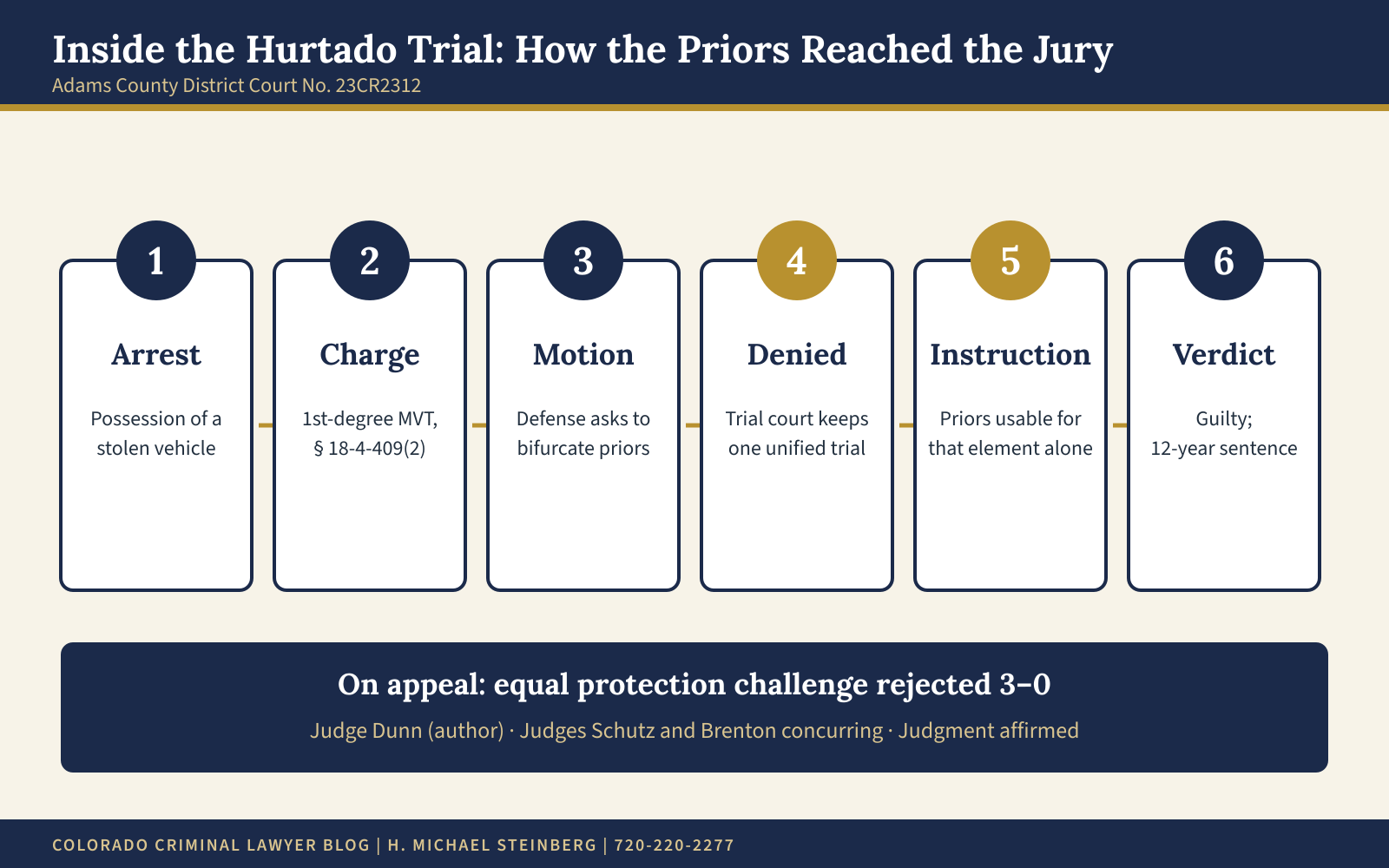
From arrest to verdict: how Hurtado’s prior convictions became trial evidence.
The Equal Protection Argument — and Why It Failed
On appeal, Hurtado’s lawyer, Alternate Defense Counsel Lindsey Parlin, argued that § 18-4-409(2) violates equal protection because it treats prior convictions as an element of the offense, while many other Colorado statutes treat prior convictions as sentence enhancers that a judge decides after the verdict.
The practical concern was obvious: a jury that hears, over and over, that the accused has stolen cars before may convict on history rather than on the evidence in the current case.
To make the point, the defense compared the vehicle theft statute to Colorado’s animal cruelty law. Under C.R.S. § 18-9-202(2)(b), a prior cruelty conviction elevates a later offense — but the Colorado Supreme Court held in Caswell v. People, 2023 CO 50, that this prior conviction is a sentence enhancer, not an element. So, the argument went, why should a repeat animal-cruelty defendant get a trial free of prior-conviction evidence while a repeat car-theft defendant does not?
Equal protection guarantees like treatment for people who are similarly situated. Defendants charged with entirely different crimes are not.
Judge Stephanie Dunn, writing for the division (Judges Timothy J. Schutz and Kyle Brenton concurring), rejected that comparison at the threshold. Relying on Dean v. People, 2016 CO 14, the court explained that the “threshold question” in any equal protection claim is whether the compared groups are similarly situated. If they are not, the challenge “will generally fail.”
First-degree motor vehicle theft and animal cruelty have different elements and prohibit entirely different conduct. Because the two statutes do not “proscribe identical conduct,” Hurtado could not show that the law treats the same behavior differently. And without similarly situated groups, there is no equal protection violation.
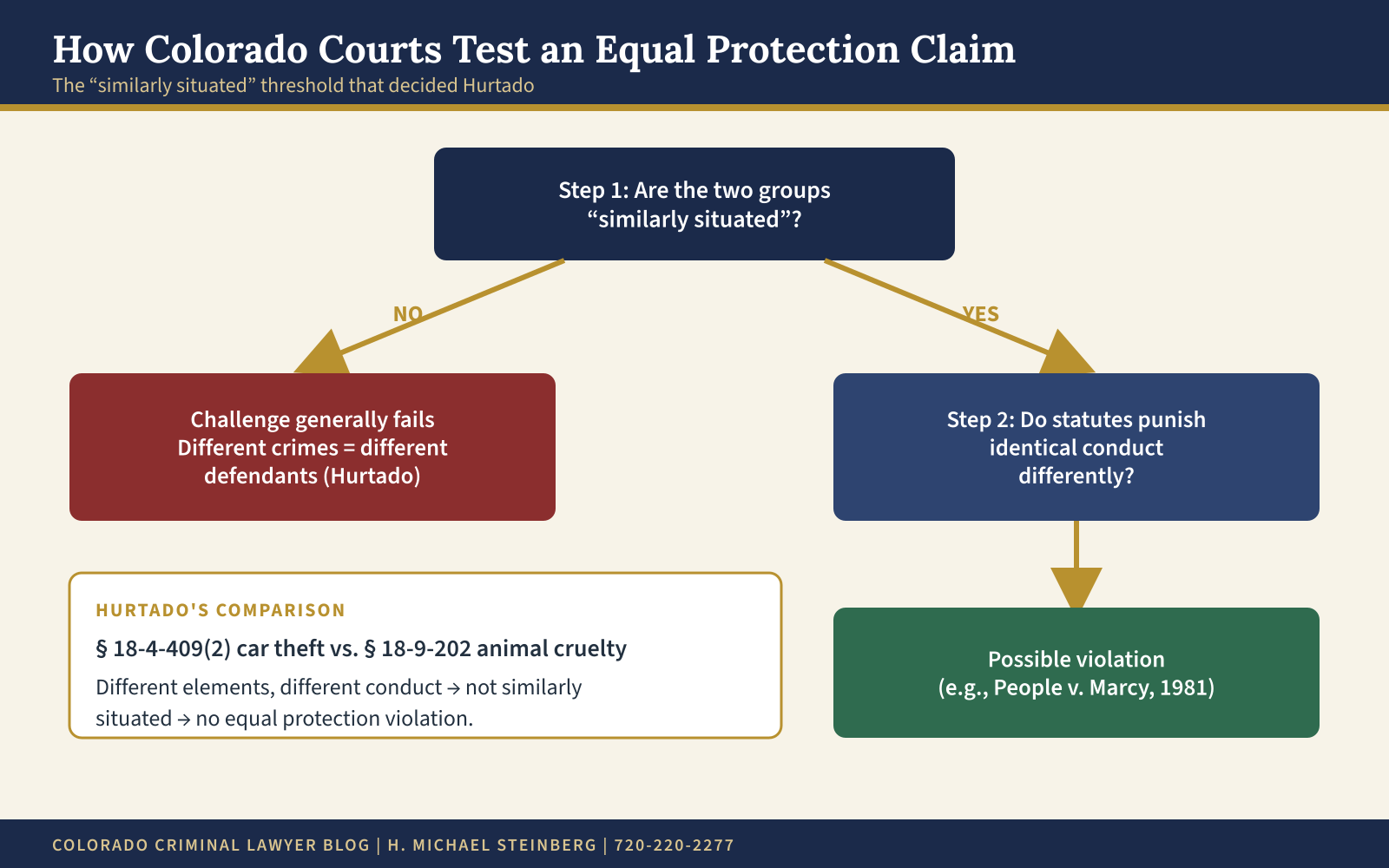 The two-step equal protection analysis. Hurtado’s claim ended at Step 1.
“The Legislature Decides”: Elements vs. Sentence Enhancers
The division also framed Hurtado’s real complaint as a disagreement with a policy choice. Citing Caswell, the court observed that the General Assembly holds the power to define criminal conduct and to establish the legal components of criminal liability — including whether a fact like a prior conviction is an element of the offense or a sentence enhancer. When lawmakers rewrote the statute in 2023, they chose to make two prior convictions an element of first-degree motor vehicle theft.
Notably, the court did not dismiss the fairness concern. Judge Dunn acknowledged that trying the current allegation and the prior convictions together creates a real risk of unfairness — but concluded that the Equal Protection Clauses are simply not the tool that addresses it.
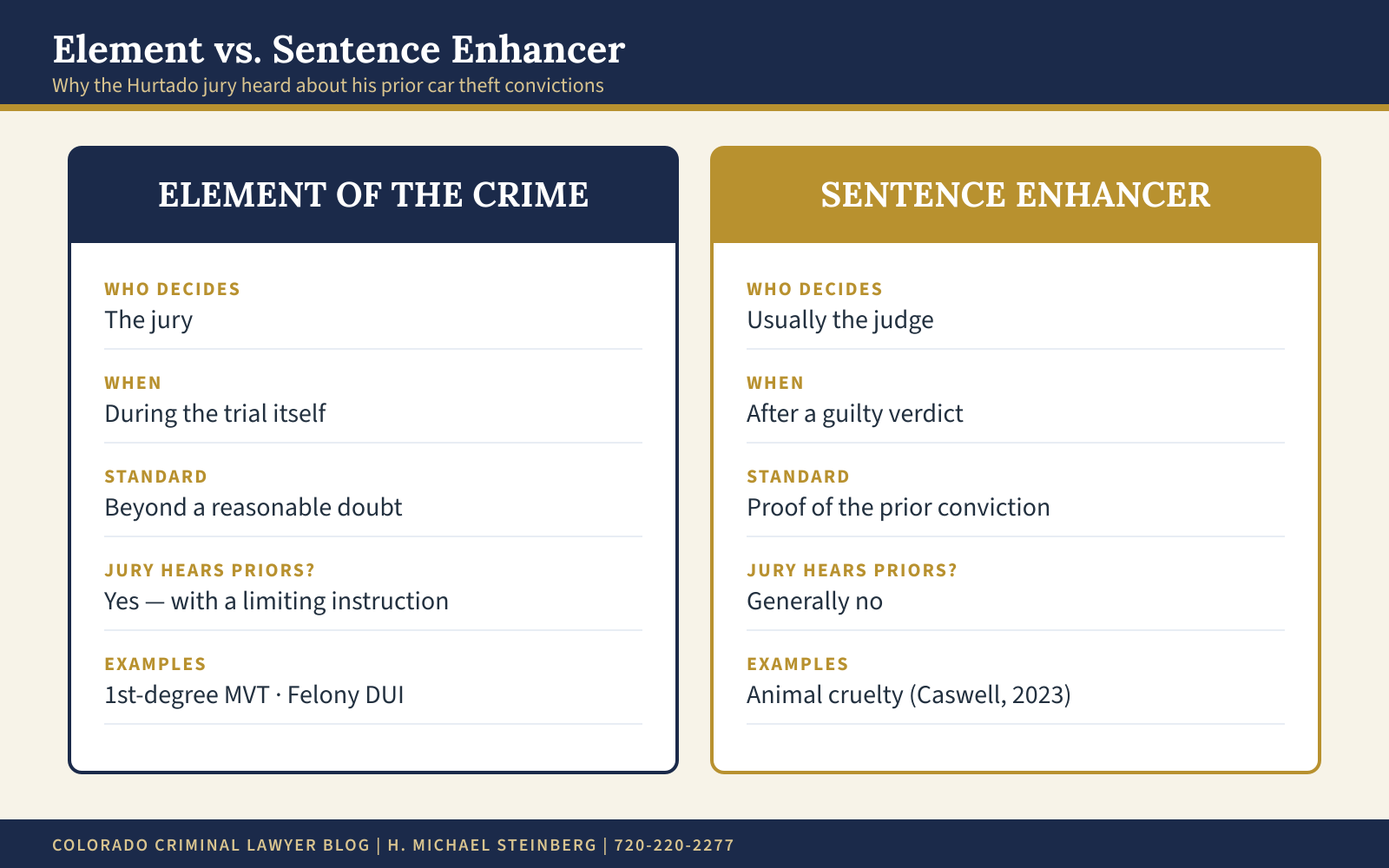
Why the label matters: an element goes to the jury during trial; an enhancer is usually handled after the verdict.
- C.R.S. § 18-4-409(2) — First-degree motor vehicle theft. Requires proof that the person committed motor vehicle theft and has two prior convictions or adjudications, separately brought and tried, for motor vehicle theft or unauthorized use of a motor vehicle (in Colorado or elsewhere). Class 3 felony.
- C.R.S. § 18-4-409.5 — Unauthorized use of a motor vehicle, one of the qualifying prior offenses.
- C.R.S. § 18-1.3-401 — Felony sentencing ranges, including the class 3 presumptive range of 4 to 12 years.
- Senate Bill 23-097 (Session Law Ch. 309) — The 2023 overhaul that created the current three-degree structure.
How SB23-097 Rewrote Colorado’s Car Theft Law
The statute in Hurtado is relatively new. In 2023 the General Assembly passed Senate Bill 23-097, adopting recommendations from the Colorado Commission on Criminal and Juvenile Justice. The bill renamed “aggravated motor vehicle theft” as simply “motor vehicle theft,” rewrote the elements of the first and second degrees, created a new third degree, and — most significantly — stopped tying penalties to the value of the stolen vehicle. Governor Polis signed it on June 2, 2023, and it applies to offenses committed on or after July 1, 2023, as the Colorado State Patrol announced.
Under the prior law, an older car worth less than $2,000 could be charged as a misdemeanor. Today, nearly all motor vehicle theft is a felony, and the most serious tier is reserved for people with a history of vehicle offenses:
| Degree | Felony Class | Presumptive Prison Range | What Elevates It |
|---|---|---|---|
| First degree §18-4-409(2) |
Class 3 | 4–12 years | Two prior convictions for motor vehicle theft or unauthorized use (an element) |
| Second degree — §18-4-409(3) |
Class 4 | 2–6 years | Theft plus an aggravating factor in § 18-4-409(3) — e.g., keeping the vehicle 24+ hours, altering the VIN, causing $1,000+ in damage, or using it in another crime |
| Third degree — §18-4-409(4) |
Class 5 | 1–3 years | All other motor vehicle theft |
Ranges are presumptive ranges under C.R.S. § 18-1.3-401; aggravated ranges, fines, parole, and probation or community corrections eligibility depend on the facts of each case.
Colorado’s three tiers of motor vehicle theft after SB23-097.
Hurtado Fits a Larger Colorado Pattern on Prior Convictions
Hurtado is the latest chapter in a long-running Colorado debate over who decides prior convictions — and when. The courts have consistently answered with a single principle: it depends on how the legislature wrote the statute.
- Felony DUI. In Linnebur v. People, 2020 CO 79M, the Colorado Supreme Court held that prior DUI convictions are an element of felony DUI that must be proven to a jury beyond a reasonable doubt. In People v. Kembel, 2023 CO 5, it held that trial courts may not bifurcate that element — the same problem Hurtado faced. (See our DUI law articles.)
- Animal cruelty and sex offender registration. In Caswell v. People, 2023 CO 50, and Dorsey v. People, 2023 CO 51, the Court held that the prior-conviction provisions in those statutes are sentence enhancers decided by the court.
- Limiting instructions. In People v. Chilleen, 2026 COA 69, a division of the Court of Appeals addressed the guardrails that apply when prior-conviction evidence reaches a felony DUI jury.
- Habitual criminal cases. After Erlinger v. United States, 602 U.S. 821 (2024), Colorado moved habitual-criminal findings to juries through SB25-189 and People v. Gregg, 2025 CO 57 — but in a separate proceeding under C.R.S. § 18-1.3-803, after the verdict on the substantive charge.
The contrast is striking. A person accused of being a habitual criminal gets a bifurcated hearing on prior felonies, but a person charged with first-degree motor vehicle theft does not — because the legislature built the priors into the offense itself. Hurtado confirms that, at least as an equal protection matter, the legislature is entitled to make that choice.
The Other Challenge Still Pending: People v. Ruiz
Hurtado is not the last word on the 2023 statute. The Colorado Supreme Court is considering People v. Ruiz, No. 25SA342, which attacks different language in the same law. The statute permits conviction if the accused knew or reasonably should have known that his control of the vehicle was unauthorized. The defense contends that the “should have known” alternative allows a felony conviction without proof of actual knowledge, in violation of due process; the prosecution defends it as permissible constructive knowledge proven by circumstantial evidence.
An El Paso County district judge struck the “reasonably should have known” language as unconstitutional, and the Court of Appeals transferred the case to the Supreme Court. At oral argument on October 22, 2026, several justices appeared receptive to the defense position.
As of this writing, no decision has issued. Ruiz does not involve the equal protection issue decided in Hurtado, but its outcome could significantly change how motor vehicle theft cases are tried in Colorado.
What Hurtado Means If You Are Charged With First-Degree Motor Vehicle Theft
For now, the law in Colorado is clear: if prosecutors charge first-degree motor vehicle theft, the jury will hear that you have two prior vehicle-related convictions. That reality changes how these cases must be defended from the very first court appearance. An experienced defense lawyer will focus on several pressure points:
- Test every prior conviction. The prosecution must prove two qualifying priors beyond a reasonable doubt — that they exist, that they were separately brought and tried, that they involved motor vehicle theft or unauthorized use, and that the person convicted is actually you. Defective, mismatched, or poorly documented priors can defeat the first-degree charge altogether.
- Limit what the jury hears. Even when priors come in, the defense can fight over how much detail jurors see and insist on a clear limiting instruction. Ask whether a stipulation to the bare fact of the convictions would keep inflammatory details out.
- Challenge knowledge and authorization. Many stolen-vehicle cases turn on what the accused actually knew — a borrowed car, a vehicle bought from a stranger, or permission from someone who seemed to have authority. Watch Ruiz closely on this point.
- Look hard at the stop and search. Stolen-vehicle cases often begin with a traffic stop or a parked-car contact. If police lacked legal grounds, suppression may follow — see our discussion of police detention of parked cars.
- Use the preliminary hearing. A preliminary hearing can expose weak identification or possession evidence early, as our analysis of Hawkins and weak identification evidence explains.
- Negotiate the degree. Because first-degree MVT is a class 3 felony, reducing it to second- or third-degree MVT, or to unauthorized use, can mean years of difference in exposure. Learn more in our plea bargaining articles.
- Build the sentencing case early. Hurtado received community corrections rather than prison. Treatment, employment, restitution, and family support can matter enormously — and in lesser cases, probation alternatives may be on the table.
Above all, these cases need a coherent defense theory of the case built around the facts the jury will actually hear — including the priors. Pretending the history does not exist is not a strategy; explaining why it does not prove this charge is. For more on how juries and trial rights work in Colorado, visit our Trial Rights archive, and for related property-crime defense see our guide to Colorado identity theft and financial exploitation charges.
Frequently Asked Questions
What is first-degree motor vehicle theft in Colorado?
It is motor vehicle theft committed by a person who has two prior convictions or adjudications, separately brought and tried, for motor vehicle theft or unauthorized use of a motor vehicle. It is a class 3 felony under C.R.S. § 18-4-409(2).
Will the jury hear about my prior car theft convictions?
Yes. Because the prior convictions are an element of first-degree motor vehicle theft, the prosecution must prove them at trial. In Hurtado, the trial court refused to bifurcate them, and the Court of Appeals rejected the equal protection challenge to that structure. A limiting instruction tells jurors to use the evidence only to decide whether the priors exist.
Can I ask the court to try the prior convictions separately?
You can ask, and in the right case the request should be preserved for appeal. But under Kembel (felony DUI) and now Hurtado, Colorado courts have refused to split the elements of a single offense into separate phases.
What sentence does first-degree motor vehicle theft carry?
As a class 3 felony, the presumptive range is 4 to 12 years in prison, with higher ranges possible in aggravated circumstances. Community corrections or probation may be available depending on the case and criminal history.
Does the value of the car still matter?
Not for the felony classification. Since SB23-097 took effect for offenses on or after July 1, 2023, the degree of motor vehicle theft depends on criminal history and statutory aggravating factors, not on the vehicle’s value. Value can still matter for restitution.
Is the 2023 law likely to change again?
Possibly. The Colorado Supreme Court’s decision in People v. Ruiz could invalidate the “reasonably should have known” language, and Colorado law continues to evolve on how prior convictions are proven.
Charged With Motor Vehicle Theft in Colorado? Talk to an Experienced Defense Lawyer Now.
First-degree motor vehicle theft is a class 3 felony, and after People v. Hurtado your history will be part of the trial. H. Michael Steinberg has defended people accused of Colorado crimes for more than forty years, in Denver and throughout the metro area. Call 720-220-2277 or contact the Law Office of H. Michael Steinberg to discuss your case. Learn more at hmichaelsteinberg.com.
Sources and Further Reading
- People v. Hurtado, 2026 COA 83 (Colo. App. Nov. 19, 2026)
- C.R.S. § 18-4-409 — Motor vehicle theft
- C.R.S. § 18-9-202 — Cruelty to animals
- SB23-097 — Motor Vehicle Theft and Unauthorized Use
- Caswell v. People, 2023 CO 50
- People v. Kembel, 2023 CO 5
- Dean v. People, 2016 CO 14
- People v. Ruiz, No. 25SA342 — Opening Brief
- Colorado Politics — Colorado justices consider vehicle theft law’s constitutionality (Oct. 22, 2026)
- Colorado State Patrol — Colorado Auto Theft Laws Are Changing
DISCLAIMER: This article is for general informational purposes only and is not legal advice. Reading it does not create an attorney-client relationship. Every case is different; consult a qualified Colorado criminal defense attorney about your specific situation. The Law Office of H. Michael Steinberg, Denver, Colorado — 720-220-2277.
{“@context”:”https://schema.org”,”@graph”:[{“@type”:”BlogPosting”,”headline”:”Colorado Appeals Court Upholds First-Degree Motor Vehicle Theft Law: What People v. Hurtado Means If You Have “,”datePublished”:”2026-11-23″,”author”:{“@type”:”Person”,”name”:”H. Michael Steinberg”,”url”:”https://www.hmichaelsteinberg.com/”},”publisher”:{“@type”:”LegalService”,”name”:”Law Office of H. Michael Steinberg”,”telephone”:”720-220-2277″,”areaServed”:”Denver, Colorado”},”description”:”Colorado’s Court of Appeals upheld the first-degree car theft law in People v. Hurtado. What it means if you have prior car theft convictions.”,”keywords”:”first-degree motor vehicle theft Colorado, People v. Hurtado, Colorado car theft prior convictions, C.R.S. 18-4-409, SB23-097 motor vehicle theft, Colorado auto theft lawyer, motor vehicle theft equal protection Colorado, Colorado motor vehicle theft penalties, People v. Ruiz Colorado”},{“@type”:”FAQPage”,”mainEntity”:[{“@type”:”Question”,”name”:”What is first-degree motor vehicle theft in Colorado?”,”acceptedAnswer”:{“@type”:”Answer”,”text”:”It is motor vehicle theft committed by a person who has two prior convictions or adjudications, separately brought and tried, for motor vehicle theft or unauthorized use of a motor vehicle. It is a class 3 felony under C.R.S. § 18-4-409(2).”}},{“@type”:”Question”,”name”:”Will the jury hear about my prior car theft convictions?”,”acceptedAnswer”:{“@type”:”Answer”,”text”:”Yes. Because the prior convictions are an element of first-degree motor vehicle theft, the prosecution must prove them at trial. In Hurtado, the trial court refused to bifurcate them, and the Court of Appeals rejected the equal protection challenge to that structure. A limiting instruction tells jurors to use the evidence only to decide whether the priors exist.”}},{“@type”:”Question”,”name”:”Can I ask the court to try the prior convictions separately?”,”acceptedAnswer”:{“@type”:”Answer”,”text”:”You can ask, and in the right case the request should be preserved for appeal. But under Kembel (felony DUI) and now Hurtado, Colorado courts have refused to split the elements of a single offense into separate phases.”}},{“@type”:”Question”,”name”:”What sentence does first-degree motor vehicle theft carry?”,”acceptedAnswer”:{“@type”:”Answer”,”text”:”As a class 3 felony, the presumptive range is 4 to 12 years in prison, with higher ranges possible in aggravated circumstances. Community corrections or probation may be available depending on the case and criminal history.”}},{“@type”:”Question”,”name”:”Does the value of the car still matter?”,”acceptedAnswer”:{“@type”:”Answer”,”text”:”Not for the felony classification. Since SB23-097 took effect for offenses on or after July 1, 2023, the degree of motor vehicle theft depends on criminal history and statutory aggravating factors, not on the vehicle’s value. Value can still matter for restitution.”}},{“@type”:”Question”,”name”:”Is the 2023 law likely to change again?”,”acceptedAnswer”:{“@type”:”Answer”,”text”:”Possibly. The Colorado Supreme Court’s decision in People v. Ruiz could invalidate the \”reasonably should have known\” language, and Colorado law continues to evolve on how prior convictions are proven.”}}]}]}