 Colorado Criminal Lawyer Blog
Outnumbered in a Fight: How Colorado Self-Defense Law Treats Multiple Attackers


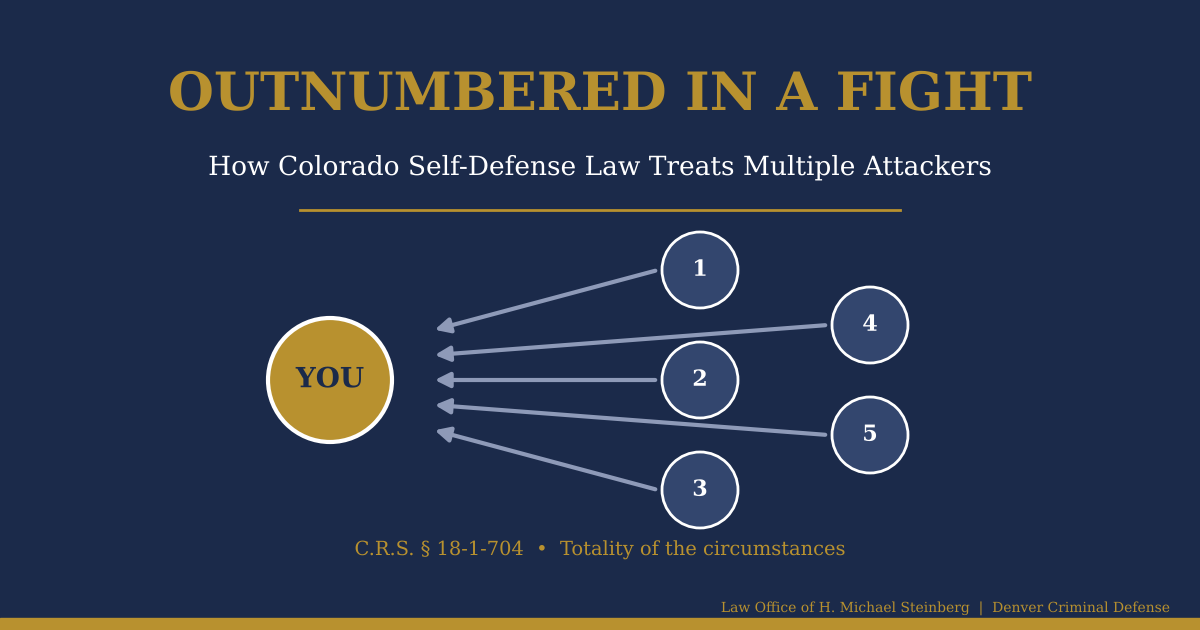
Colorado law asks a jury to consider everyone who reasonably appeared to threaten you, not just the person whose punch landed first.
Quick Answer
Colorado does not give a special rule for multiple attackers, but it does something just as important: the jury must weigh the number of people who reasonably appeared to threaten you when deciding whether your fear and your response were reasonable.
Under C.R.S. § 18-1-704, you may use the force you reasonably believe necessary against what you reasonably believe is the use or imminent use of unlawful physical force, and deadly force only when lesser force is inadequate and the statute’s other conditions are met. Once the issue is raised, the prosecution must disprove self-defense beyond a reasonable doubt.
Example:
It is 1:30 a.m. outside a bar. One man shoves you. Two of his friends step in. Someone is on the ground, someone is kicking, and in about eight seconds you do something that a detective will later describe as an “assault.” Months later a jury is asked a question that sounds simple and is not: was it reasonable?
Fights against more than one person are among the hardest self-defense cases to understand, and the law surrounding them continues to develop. In 2026 alone, Colorado’s Court of Appeals reversed serious convictions in three separate cases because jurors were not given complete self-defense instructions.
This article explains the framework, the multiple-attacker cases that matter, where self-defense can be lost, and what to do (and not do) if you are ever in this situation.
In This Article
- What Colorado’s self-defense statute actually says
- The force ladder: non-deadly vs. deadly force
- How the law treats multiple attackers
- Key cases: Jones, Riley, and the 2026 decisions
- How self-defense can be lost
- Who has the burden of proof?
- No duty to retreat
- What to do after a fight
- Frequently asked questions
What Colorado’s Self-Defense Statute Actually Says
The core rule is C.R.S. § 18-1-704 (the full text is also available in the official Colorado Revised Statutes, Title 18). Paraphrased, subsection (1) provides that a person is justified in using physical force upon another person to defend himself or a third person from what he reasonably believes to be the use or imminent use of unlawful physical force, and may use the degree of force he reasonably believes to be necessary for that purpose.
Three words in that sentence do nearly all of the work: reasonably believes, imminent, and necessary. Colorado looks at the situation from the defendant’s perspective at that moment, and it can protect a person who was mistaken about the danger as long as the mistaken belief was a reasonable one.
The U.S. Supreme Court put the idea memorably more than a century ago in Brown v. United States, 256 U.S. 335 (1921), observing that “detached reflection cannot be demanded in the presence of an uplifted knife.” Colorado cases, including Beckett v. People, 800 P.2d 74 (Colo. 1990), likewise emphasize that what matters is the defendant’s reasonable belief at the time, not what a calm observer later concludes.
The Force Ladder: Non-Deadly vs. Deadly Force
Colorado treats force as a ladder. Non-deadly physical force is available when you reasonably believe unlawful physical force is being used or is about to be used against you or someone else. Deadly physical force carries more conditions. Under subsection (2) of § 18-1-704, you must reasonably believe that a lesser degree of force is inadequate and one of the statute’s predicates is present, such as a reasonable belief that you or another person is in imminent danger of being killed or receiving great bodily injury, or that the other person is committing or about to commit one of the listed crimes (the list includes kidnapping, robbery, sexual assault, and certain assaults, including second-degree assault under C.R.S. § 18-3-203).
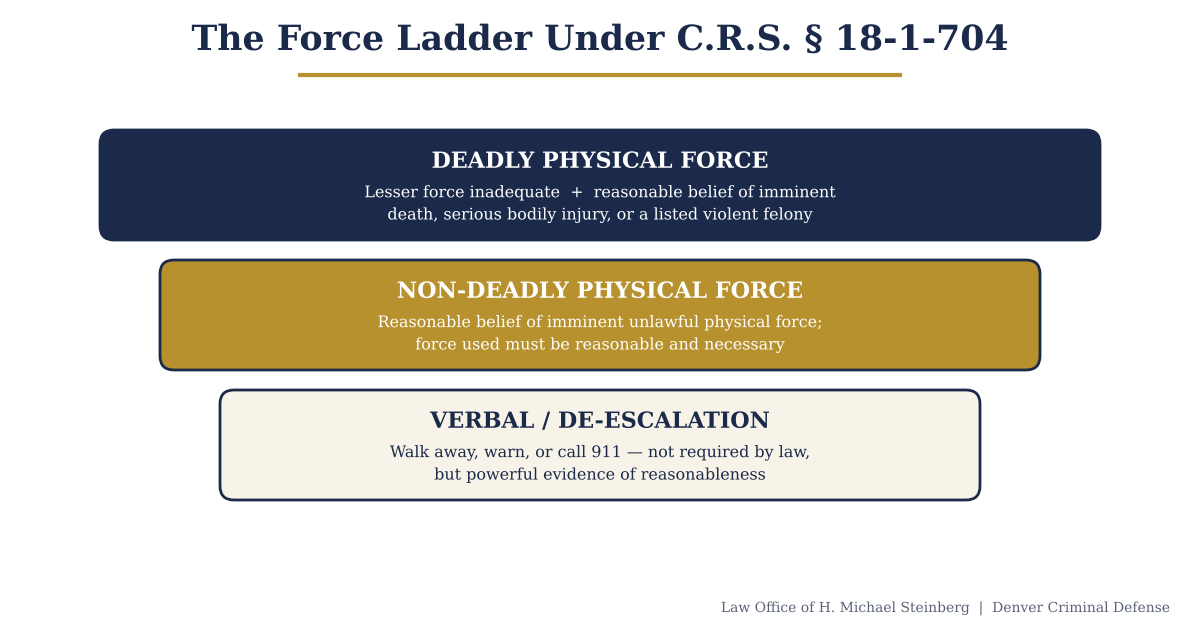
The more force you use, the more the statute asks of you. The ladder matters most when you are outnumbered.
Notice what that means for a multiple-attacker fight. In an ordinary one-on-one scuffle, fists-for-fists is usually a proportionate exchange. When three or four people are punching and kicking you, the question changes: was a lesser degree of force realistically adequate against that group, and was the belief that someone was about to cause serious injury reasonable? Those are fact questions for a jury, which is why the instructions the jury receives are so important.
How the Law Treats Multiple Attackers
There is no separate “multiple attackers statute” in Colorado. Instead, courts apply the ordinary self-defense framework and insist that the jury consider the totality of the circumstances, including the number of people who reasonably appeared to threaten the defendant. In practice, that means a jury should weigh:
- How many people were involved, and whether they acted together, surrounded you, or blocked an exit.
- Relative size, strength, and conduct: a group of larger men is a different threat than a group of teenagers.
- Weapons, or objects that could function as weapons, and what was said before and during the fight.
- Whether you were on the ground, outnumbered, or unable to see everyone: vulnerability matters to both reasonableness and necessity.
- Whether the threat was continuing: whether one attacker retreating ended the danger, or whether the others kept coming.
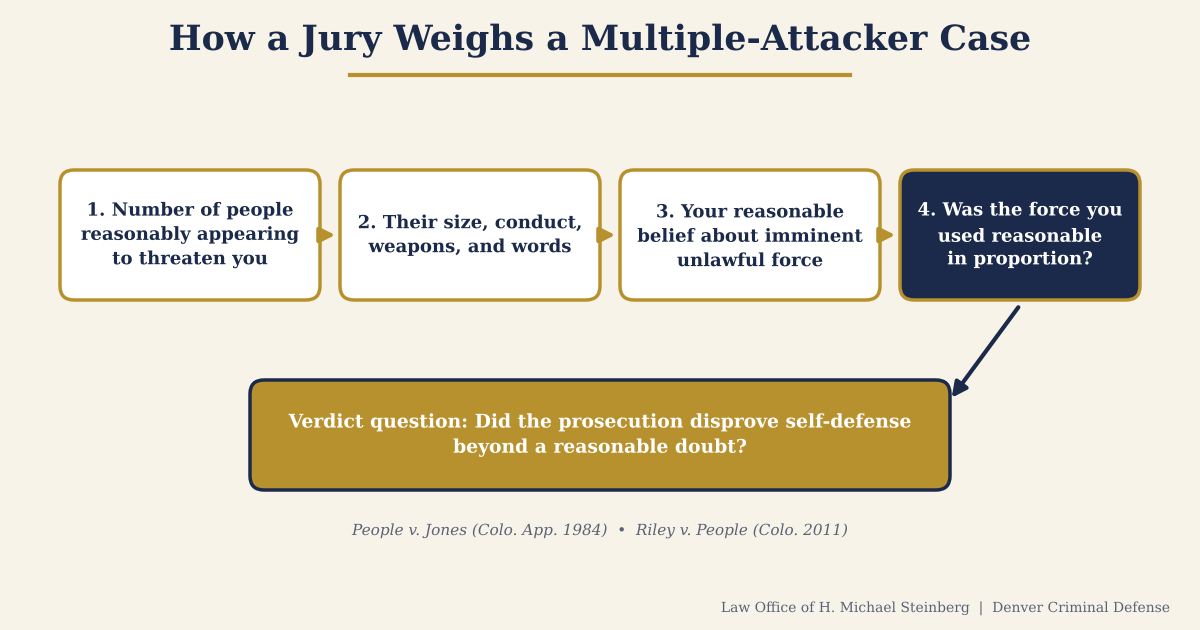
The jury’s task: put itself in the defendant’s position, count the people, and ask whether the belief and the response were reasonable.
⚖ Authority Box: Why the Number of Attackers Counts
In People v. Jones, 675 P.2d 9 (Colo. 1984), the Colorado Supreme Court held that where self-defense is raised, the jury must be able to consider the circumstances as they appeared to the defendant, including the number of persons the defendant reasonably believed he faced.
In Riley v. People, 266 P.3d 1089 (Colo. 2011) (also available at CourtListener), the court addressed self-defense against multiple assailants and held that a separate “multiple assailants” instruction is not required so long as the instructions as a whole direct the jury to consider the totality of the circumstances, including the number of people reasonably appearing to threaten the defendant.
That second point is the part many people miss. A defendant is not automatically entitled to an instruction with the words “multiple assailants” in it. But the jury must be told, one way or another, that the number of people involved bears on both the reasonableness of the fear and the reasonableness of the force. When it is not told that, the verdict may not survive appeal, and the 2026 decisions below show how often that argument is being made.
Key Cases: Jones, Riley, and the 2026 Decisions
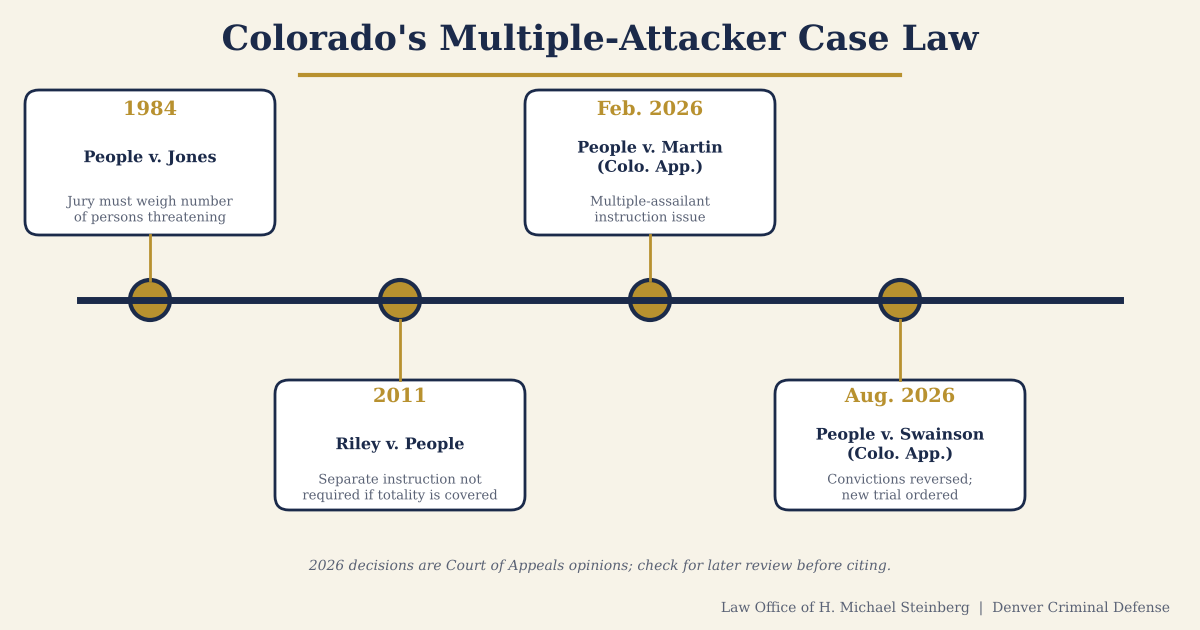
From Jones to Swainson: four decades of Colorado law on outnumbered defendants.
People v. Jones (1984) and Riley v. People (2011)
These two Colorado Supreme Court decisions form the foundation: the jury must consider the circumstances as the defendant reasonably perceived them, including how many people he faced, and the instructions as a whole must let it do so. Riley is the case to know if a trial judge refuses a specially worded multiple-assailants instruction; the question on review is whether the instructions, taken together, fairly directed the jury to the totality of the circumstances.
Three 2026 Court of Appeals Decisions
This year, the Colorado Court of Appeals has reversed several serious convictions because of defective self-defense instructions. Coverage below is from Colorado Politics, and the linked opinions are published by The Gazette. These are Court of Appeals opinions. Before citing or relying on any of them, confirm their current status, since petitions for rehearing or review can change an opinions weight.
- People v. Martin, No. 22CA1854 (Colo. App. Feb. 19, 2026): In a divided decision, a panel reversed murder convictions arising from a late-night shooting at a Colorado Springs club after concluding the self-defense instruction omitted key language. The evidence suggested as many as five different weapons were fired at the scene. See Colorado Politics coverage.
- People v. Banks, No. 23CA1700 (Colo. App. May 28, 2026): The court reversed an Adams County murder conviction where the defendant said he acted in self-defense after the victim pointed a gun at his head, concluding the jury’s instructions and the prosecutor’s argument about “trespassers” likely undermined the defense. See Colorado Politics coverage.
- People v. Swainson, No. 23CA0014 (Colo. App. Aug. 20, 2026): This is the most directly on point. A unanimous panel reversed second-degree murder, attempted murder, and assault convictions in a Denver case where the defendant testified that one man attacked him and then two others joined in, hitting and kicking him.
- The panel held the jury should have been instructed that deadly force can be justified when a person reasonably believes attackers are committing or about to commit second-degree assault, which requires only bodily injury caused with a deadly weapon, and it treated the attackers’ fists and feet as potentially functioning as deadly weapons. It also found the evidence supported a heat-of-passion instruction, noting the defendant was on the ground, had poor vision, and faced multiple assailants in a continuous fight. See Colorado Politics coverage.
★ Defense Takeaway
In a multiple-attacker case, the instructions are the case. A jury that is never told that deadly force may be justified against a group, or that the number of attackers bears on reasonableness, cannot fairly evaluate what the defendant did. Reviewing the proposed jury instructions line by line against § 18-1-704 and the pattern instructions is one of the most important steps in preparing a self-defense trial.
How Self-Defense Can Be Lost
Self-defense is not unlimited. Subsection (3) of § 18-1-704 lists circumstances in which the defense is unavailable or limited. Three come up constantly in group-fight cases:
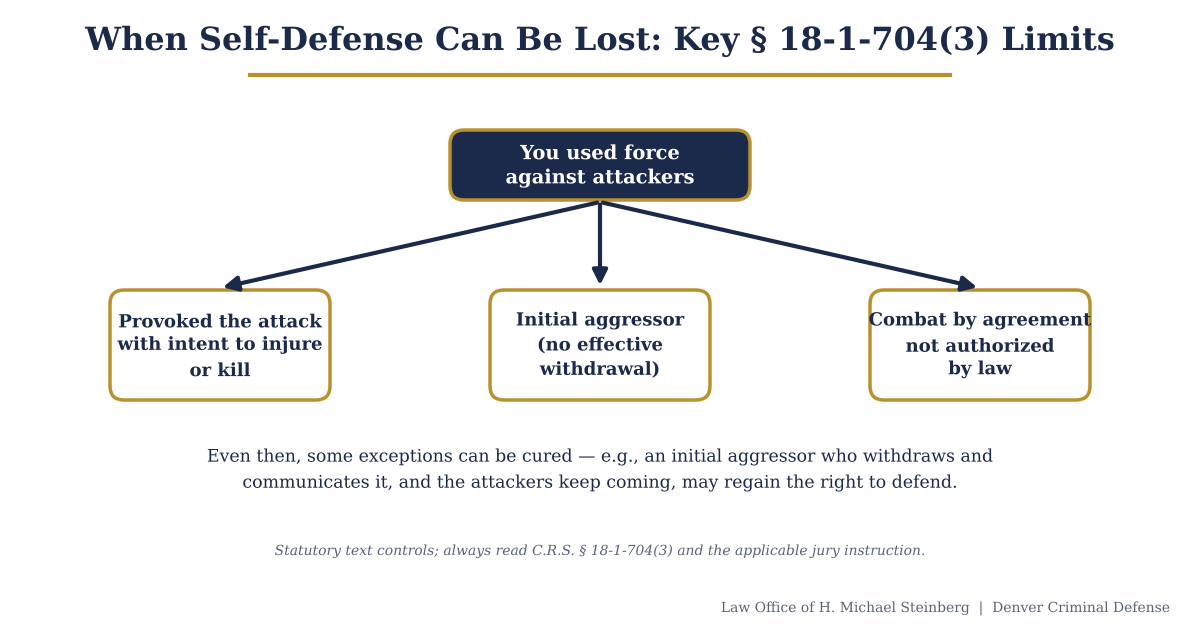
Three of the Limits on Self-defense That Prosecutors Rely on Most Often
- Provocation. Self-defense is unavailable if you provoked the use of unlawful force against you with intent to cause bodily injury or death.
- Initial aggressor. If you started the physical conflict, you generally cannot claim self-defense, unless you withdraw and effectively communicate that you are doing so, and the other side keeps attacking or threatening anyway. In Castillo v. People, 2018 CO 62, the Colorado Supreme Court addressed what it means to be the initial aggressor.
- Combat by agreement. If the fight was a mutual agreement to fight that is not authorized by law, self-defense is generally not available.
Multiple attackers complicate these exceptions. Suppose you throw the first punch at one man, then his two friends jump you. Were you the initial aggressor as to all of them? Did you withdraw? Did the group’s escalation (kicking you on the ground, say) create a new, independent threat? Those questions turn on the sequence of events, which is why witness statements, surveillance video, and cell-phone footage often decide these cases. (Our post on how social-media evidence is used in Colorado criminal cases discusses why that footage matters.)
Who Has the Burden of Proof?
Self-defense in Colorado is an affirmative defense, but with an important twist. Under C.R.S. § 18-1-407 and C.R.S. § 18-1-710, once the defendant presents “some credible evidence” supporting the defense, the prosecution bears the burden of disproving it beyond a reasonable doubt, in addition to proving every element of the charged offense. (See People v. Pickering, 276 P.3d 553 (Colo. 2011).)
For crimes with a reckless, extreme-indifference, or criminally negligent mental state, § 18-1-704(4) allows the defendant to use self-defense evidence to negate the culpable mental state itself; see also Montoya v. People, 2017 CO 40 and Kaufman v. People, 202 P.3d 542 (Colo. 2009).
No Duty to Retreat, But the Facts Still Matter
Colorado does not require a non-aggressor to retreat before using lawful self-defense force. See Cassels v. People, 92 P.3d 951 (Colo. 2004). In Monroe v. People (Colo. 2020), the Colorado Supreme Court again addressed the no-duty-to-retreat rule, in the context of whether prosecutors may argue that a defendant acted unreasonably because she failed to retreat. That said, a person who walked away, shouted a warning, or tried to leave often appears more reasonable to a jury. The failure to retreat is not a legal bar, but the history of a de-escalation attempt can be powerful evidence.
The “Make My Day” statute, § 18-1-704.5, applies to unlawful entries into a dwelling and is a separate framework from the street-fight analysis above; defense of other persons is addressed in § 18-1-704 itself, and defense of premises in § 18-1-705. Terms like “deadly physical force” and “serious bodily injury” are defined in § 18-1-901.
What to Do After a Fight
- Get to safety and call 911. Reporting promptly and calmly is strong evidence of reasonableness.
- Do not argue your case to the police. Say you were attacked, that you want medical attention if needed, and that you want to speak to a lawyer. We explain why in Why Innocent People Sometimes Hurt Their Cases by Talking to Colorado Police.
- Preserve evidence. Photograph injuries, note witnesses, and identify cameras (doorbells, storefronts, ride-share dash cams) before footage is overwritten.
- Stay off social media. Posts about the fight can be used against you.
- Call a Colorado criminal defense lawyer immediately. Early involvement can shape charging decisions; see how DA overcharging works in Colorado.
Frequently Asked Questions
Is there a special Colorado law for multiple attackers?
No. Colorado applies C.R.S. § 18-1-704 and requires the jury to consider the totality of the circumstances, including the number of people who reasonably appeared to threaten the defendant. See Riley v. People.
Can I use deadly force if I am outnumbered?
Only if the statute’s conditions are met: you reasonably believe lesser force is inadequate and, for example, that you or another person faces imminent death or great bodily injury, or that the attackers are committing or about to commit a listed crime. Being outnumbered can make those beliefs more reasonable, but it does not by itself authorize deadly force.
Do I have to retreat before defending myself?
Generally, no. A non-aggressor has no duty to retreat in Colorado, though evidence that you tried to leave can help a jury view your conduct as reasonable.
What if I threw the first punch?
That can make you the initial aggressor, which limits self-defense, but you may regain the right to defend yourself by withdrawing and communicating that withdrawal, or if the other side escalates in a way that creates a new unlawful threat. These are fact-intensive questions.
Who has to prove self-defense?
Once there is some credible evidence of self-defense, the prosecution must disprove it beyond a reasonable doubt. See § 18-1-407.
What did the 2026 Court of Appeals decisions change?
They did not rewrite the statute, but they reinforce that incomplete self-defense instructions can require reversal. They are Court of Appeals opinions, so their current status should be confirmed before anyone relies on them.
Facing Charges After a Fight? Talk to a Denver Self-Defense Attorney
H. Michael Steinberg has defended Coloradans against assault, homicide, and other violent-crime charges for more than 40 years. If you were outnumbered and are now the one being charged, call (303) 627-7777 or contact the firm online for a confidential consultation. Learn more about Attorney Steinberg or visit the Law Office of H. Michael Steinberg.
Related Reading
- Why Innocent People Sometimes Hurt Their Cases by Talking to Colorado Police
- Social Media Evidence in Colorado Criminal Cases
- DA Overcharging in Colorado
- False, Exaggerated, or Mistaken Domestic Violence Allegations: How Are They Defended?
Sources and Authorities
- C.R.S. § 18-1-704 (use of physical force in defense of a person)
- C.R.S. § 18-1-704 (Justia)
- Colorado Revised Statutes, Title 18 (official PDF)
- C.R.S. § 18-1-704.5
- C.R.S. § 18-1-705
- C.R.S. § 18-1-407
- C.R.S. § 18-1-710
- C.R.S. § 18-1-901
- C.R.S. § 18-3-203
- People v. Jones, 675 P.2d 9 (Colo. 1984)
- Riley v. People, 266 P.3d 1089 (Colo. 2011)
- Beckett v. People, 800 P.2d 74 (Colo. 1990)
- Cassels v. People, 92 P.3d 951 (Colo. 2004)
- People v. Pickering, 276 P.3d 553 (Colo. 2011)
- Kaufman v. People, 202 P.3d 542 (Colo. 2009)
- Montoya v. People, 2017 CO 40
- Castillo v. People, 2018 CO 62
- Monroe v. People (Colo. 2020)
- Brown v. United States, 256 U.S. 335 (1921)
- People v. Martin, No. 22CA1854 (Colo. App. Feb. 19, 2026)
- People v. Banks, No. 23CA1700 (Colo. App. May 28, 2026)
- People v. Swainson, No. 23CA0014 (Colo. App. Aug. 20, 2026)
- Colorado Politics: appeals court reverses murder convictions over self-defense instruction (Martin)
- Colorado Politics: Adams County murder conviction reversed (Banks)
- Colorado Politics: Denver murder and assault convictions reversed (Swainson)
This article is for general information only and is not legal advice. Reading it does not create an attorney-client relationship. Every case turns on its own facts, and laws change. See our disclaimer. Attorney advertising. Prior results do not guarantee a similar outcome. Posted October 19, 2026 by H. Michael Steinberg, Law Office of H. Michael Steinberg, Denver, Colorado. Also listed on Justia.