 Colorado Criminal Lawyer Blog
Colorado | C.R.S. § 18-6-701 Contributing to the Delinquency of a Minor Law: First-Degree Class 4 Felony and Second-Degree Class 1 Misdemeanor Charges


COLORADO CRIMINAL LAW BLOG
Colorado Contributing to the Delinquency of a Minor Law: First-Degree (Class 4 Felony) and Second-Degree (Class 1 Misdemeanor) Charges | C.R.S. § 18-6-701
Colorado prosecutors do not need the child to be the one who gets caught. Under C.R.S. § 18-6-701, any person who induces, aids, or encourages someone under 18 to violate the law can be charged with contributing to the delinquency of a minor. Since March 1, 2022, that charge comes in two levels: first degree, a class 4 felony, and second degree, a class 1 misdemeanor. Which one you face depends largely on what the child was allegedly encouraged to do.
This guide explains how Colorado’s contributing statute works after the 2022 reform, what the prosecution must prove, the sentencing ranges, the consequences that follow a conviction, and the defenses a Colorado criminal defense lawyer looks at first.
- Statute: C.R.S. § 18-6-701 (contributing to the delinquency of a minor).
- First degree: inducing, aiding, or encouraging a child to violate a state felony that is a Victims Rights Act crime. Class 4 felony.
- Second degree: inducing, aiding, or encouraging a child to violate any other law, ordinance, or court order. Class 1 misdemeanor.
- “Child” means anyone under 18.
- Offense date matters: before March 1, 2022, every violation was a class 4 felony.
What Is Contributing to the Delinquency of a Minor in Colorado?
The statute is short. It targets conduct by the person doing the inducing, not conduct by the child. Colorado law says a person commits the offense by inducing, aiding, or encouraging a child to violate a federal or state law, a municipal or county ordinance, or a court order.
The statute defines “child”as any person under the age of eighteen. You can read the current text on Colorado’s online statute database or compare the pre-2022 and post-2022 versions on Justia.
The statute punishes what a person does to push, help, or cheer a child toward breaking the law, not what a child does alone. H. Michael Steinberg
The reader should notice what the statute does not say. It is not limited to parents, guardians, or teachers. It does not require a special relationship with the child. “Any person” can be charged, which is why these cases arise in households, schools, online chats, sports teams, workplaces, and friend groups.
The 2022 Change: Two Degrees Replace a Single Felony
For decades, contributing to the delinquency of a minor was a single class 4 felony no matter how minor the underlying conduct. Encouraging a teenager to break a curfew ordinance carried the same felony label as encouraging a teenager to commit a robbery.
That changed with Senate Bill 21-271, the 2021 misdemeanor reform law. For offenses committed on or after March 1, 2022, the statute now separates the offense into first degree and second degree. Offenses committed before that date remain governed by the older, single-felony version. If your case involves conduct that straddles that date, the offense date can change the entire charging picture.
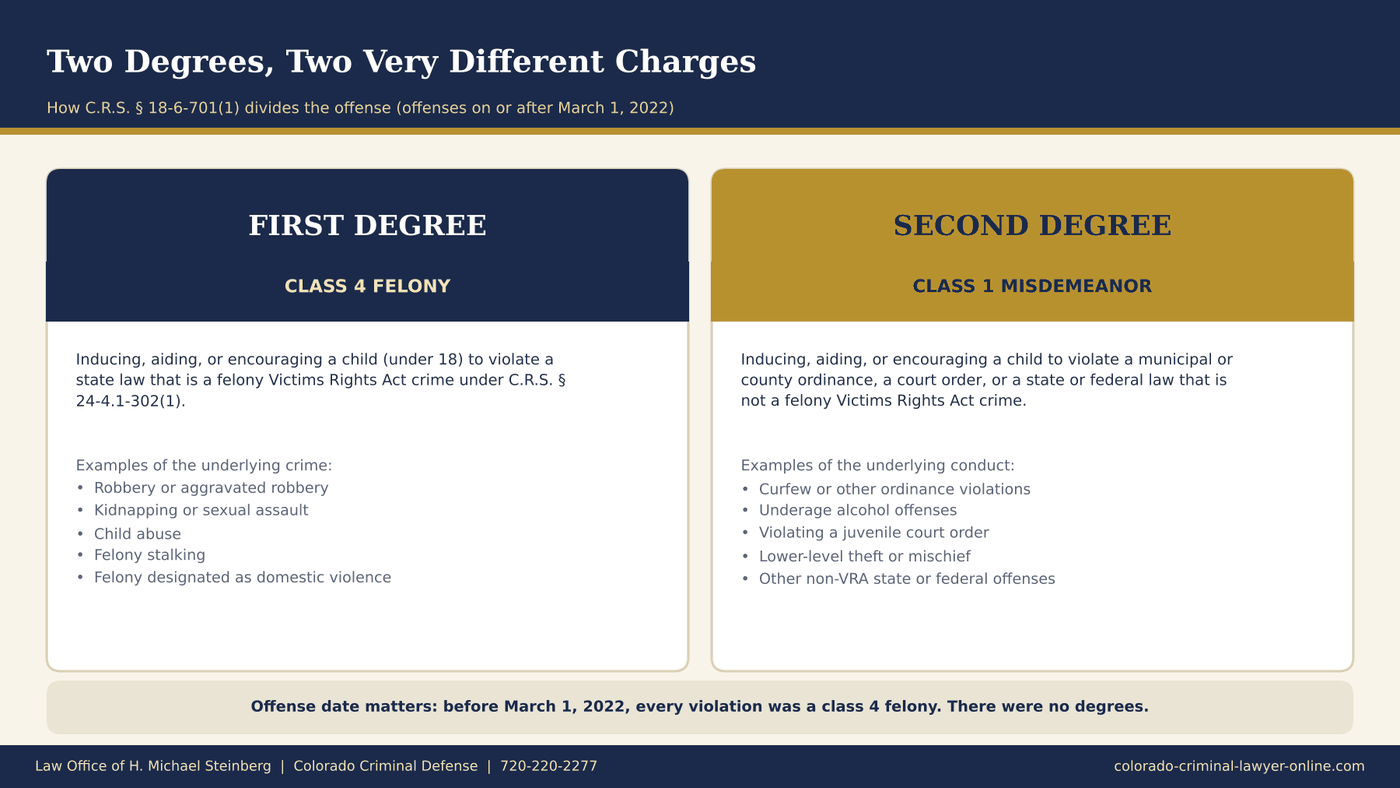 Figure 1: How the statute separates first-degree from second-degree charges.
| First Degree | Second Degree | |
|---|---|---|
| Classification | Class 4 felony | Class 1 misdemeanor |
| Underlying violation | A state law that is a felony Victims Rights Act crime under C.R.S. § 24-4.1-302(1) | A municipal or county ordinance, a court order, or a state or federal law that is not a felony Victims Rights Act crime |
| Presumptive penalty | 2 to 6 years in the Department of Corrections, plus 3 years of mandatory parole (C.R.S. § 18-1.3-401) | Up to 364 days in county jail (C.R.S. § 18-1.3-501) |
| Fine range | $2,000 to $500,000 | Up to $1,000 |
| Educator reporting | Yes, if the court knows the person is a school district employee or licensed educator | Yes, same rule |
First-Degree Contributing: Class 4 Felony
A first-degree charge applies when a person induces, aids, or encourages a child to violate a state law that is a felony Victims Rights Act (VRA) crime as defined in C.R.S. § 24-4.1-302(1). The VRA list is long and covers crimes against persons and certain property and family offenses. Examples of felony VRA crimes that can serve as the underlying offense include:
- Robbery, as defined in C.R.S. § 18-4-301, and aggravated robbery
- Second-degree kidnapping, C.R.S. § 18-3-302
- Sexual assault, C.R.S. § 18-3-402
- Child abuse, C.R.S. § 18-6-401
- Sexual exploitation of a child, C.R.S. § 18-6-403
- Stalking and other felonies that fall within the VRA definitions
- Felonies that a district attorney formally designates as acts of domestic violence
Because the definition is tied to a different statute, a first-degree charge can turn on technical questions: Was the underlying offense actually a felony? Was it actually on the VRA list? Did the allegations as charged fit the definition?
These are questions a defense lawyer can litigate, and the answers can move a case from a class 4 felony to a class 1 misdemeanor or dismissal. When the underlying allegations involve drugs, sexual allegations, or domestic violence, related defense resources include our pages on Colorado drug crimes, Colorado sex crimes, and Colorado domestic violence crimes.
Second-Degree Contributing: Class 1 Misdemeanor
Second-degree contributing is the catch-all.
It applies when a person induces, aids, or encourages a child to violate a municipal or county ordinance, a court order, or a state or federal law that is not a felony VRA (victim’s rights) crime.
Hypothetical examples include encouraging a minor to violate a city curfew, to drink alcohol, to ignore a juvenile court order, or to commit a lower-level theft or property offense.
A class 1 misdemeanor is still a serious charge. It is the most serious general class of misdemeanor in Colorado, it creates a criminal record, and as discussed below it triggers reporting obligations for educators. For offenses on or after March 1, 2022, the presumptive jail exposure is up to 364 days, and probation is a common outcome. See C.R.S. § 18-1.3-501.
What the Prosecution Must Prove
In every contributing case the district attorney carries the burden of proof beyond a reasonable doubt. Breaking the statute into parts shows where cases are won and lost.
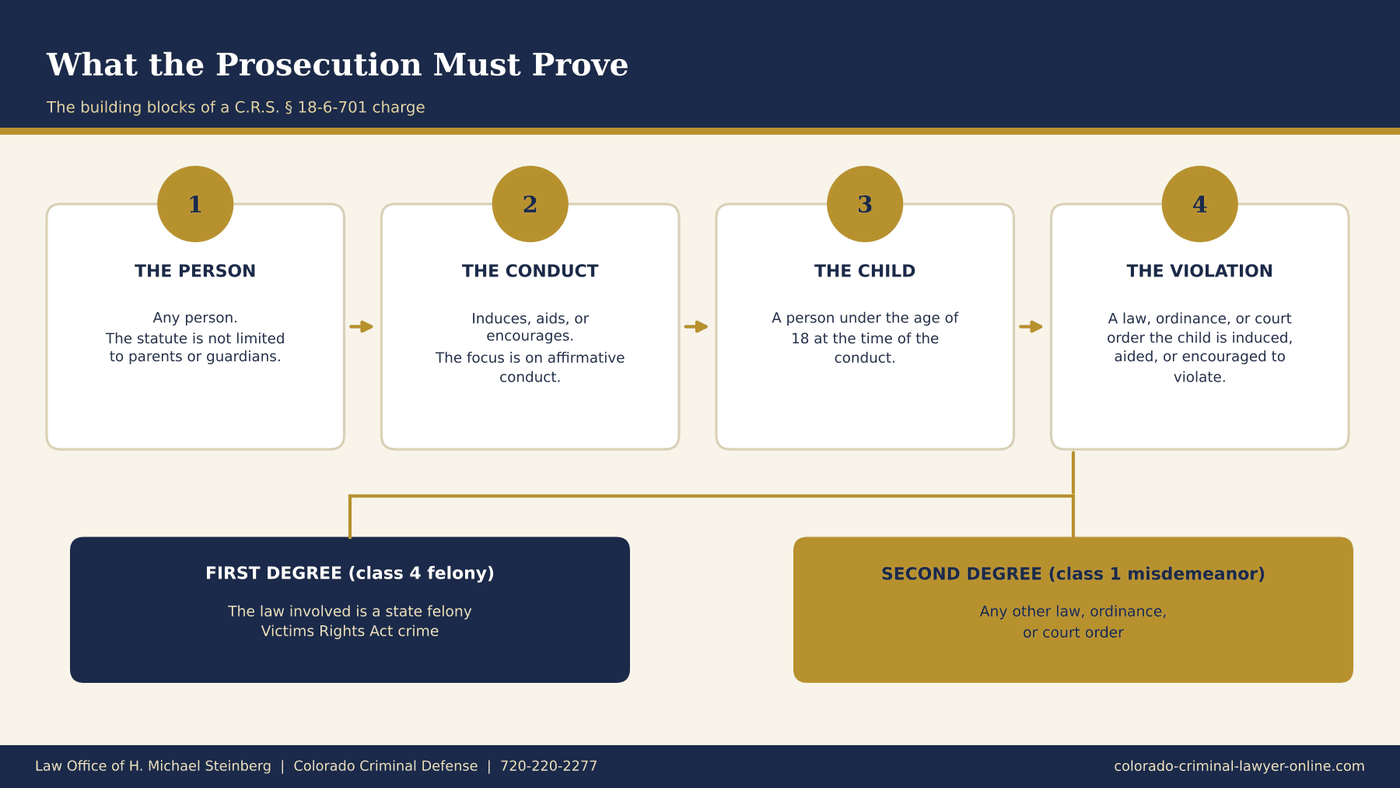
1. The Defendant Induced, Aided, or Encouraged
The statute requires affirmative conduct. Inducing means persuading or pressuring. Aiding means helping. Encouraging means urging on or supporting. Mere presence, a failure to prevent something, or a child’s independent decision is not the same as inducing, aiding, or encouraging.
Defense counsel scrutinizes texts, social media messages, witness statements, and body-camera footage to test whether the evidence shows actual inducement or only a bad outcome after the fact.
2. The Person Was a Child
The statute defines a child as anyone under eighteen. Age is a fact the prosecution must prove. In close cases, such as a young-looking seventeen-year-old or an eighteen-year-old classmate, records and testimony about date of birth matter.
3. A Violation of Law, an Ordinance, or a Court Order
The prosecution must identify what the child was induced, aided, or encouraged to violate. That identification does double duty, because it also determines the degree of the charge. A felony VRA crime means first degree. Everything else means second degree.
4. The Child Does Not Have to Be Charged or Convicted
The Colorado Court of Appeals has held that an adult can be charged under the statute regardless of whether the minor was actually charged with or convicted of a crime, and regardless of whether the minor was old enough to be charged. See the case annotations to the statute, citing People v. Miller, 830 P.2d 1092 (Colo. App. 1991). Whether the prosecution can proceed when the underlying act was never completed is a fact-specific legal question that depends on the allegations and charging language, and it is worth raising early with counsel.
Penalties for Contributing to the Delinquency of a Minor in Colorado
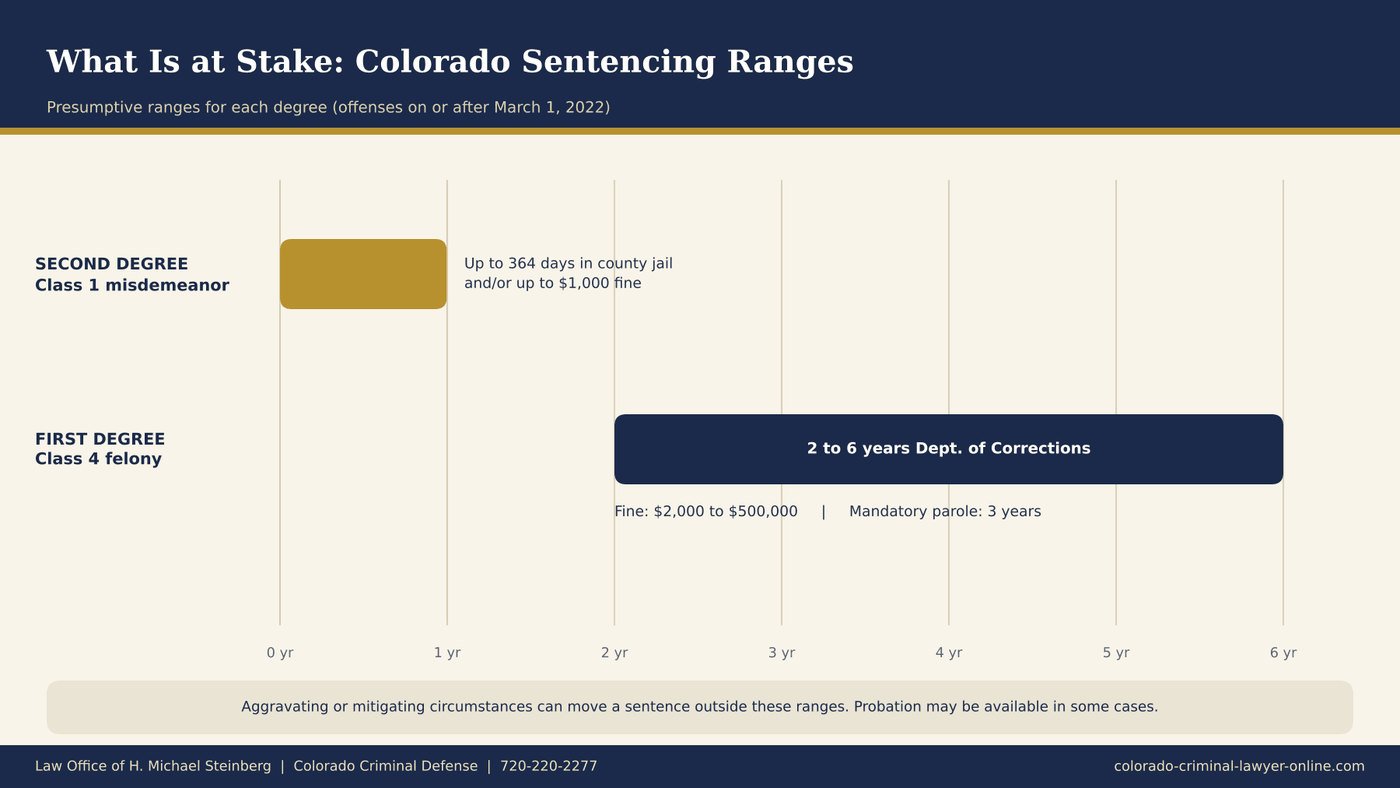 Figure 2: Presumptive sentencing ranges for each degree.
First-Degree: Class 4 Felony
Under C.R.S. § 18-1.3-401, the presumptive range for a class 4 felony is two to six years in the Colorado Department of Corrections, a fine of $2,000 to $500,000, and a three-year period of mandatory parole. Aggravating or mitigating circumstances can move a sentence outside the presumptive range, and probation or other alternatives can be available depending on the facts, the criminal history, and the plea or verdict.
Second-Degree: Class 1 Misdemeanor
For offenses committed on or after March 1, 2022, a class 1 misdemeanor carries up to 364 days in county jail, a fine of up to $1,000, or both. See C.R.S. § 18-1.3-501. Courts frequently impose probation, community service, classes, or no-contact conditions rather than jail.
Offenses Before March 1, 2022
Because the pre-2022 statute made every violation a class 4 felony, a case based on older conduct is still evaluated under the felony ranges. Check the date alleged in the complaint carefully, because charging dates are sometimes stated as ranges.
Realistic Examples of How These Charges Arise
The following hypotheticals are illustrations only. They are not based on any client matter, and real cases turn on their own evidence.
- An adult supplies alcohol and a party follows. An adult buys alcohol for a group of teenagers. Prosecutors may charge furnishing alcohol under C.R.S. § 44-3-901 and may add second-degree contributing, arguing the adult encouraged underage drinking.
- An older acquaintance recruits a teen for a theft. An adult tells a seventeen-year-old to take items from a store and hand them over. If the underlying theft is not a felony VRA crime, the contributing charge is second degree. If the plan involves a robbery, the stakes rise to first degree.
- Online encouragement. An adult chats with a minor and urges them to break a court order. The evidence is the chat log, so authentication, context, and who actually wrote what become the central issues.
- A parent and a teen’s friends. A parent allows a gathering where marijuana is passed around. The prosecution must still prove inducing, aiding, or encouraging, not merely presence or tolerance.
A reported Colorado case shows how these charges can stack. In People v. Graybeal, 155 P.3d 614 (Colo. App. 2007), a jury convicted the defendant of contributing to the delinquency of a minor involving marijuana, contributing involving alcohol, and transferring marijuana to a person under fifteen. The Court of Appeals also addressed whether possession of marijuana was a lesser included offense of the contributing charge and held that it was not. The case is a reminder that prosecutors often file contributing alongside more specific offenses.
Related Colorado Offenses Involving Minors
Contributing is often charged alongside, or instead of, more specific statutes. Understanding the whole charging landscape matters because a plea to a narrower offense can avoid a contributing conviction.
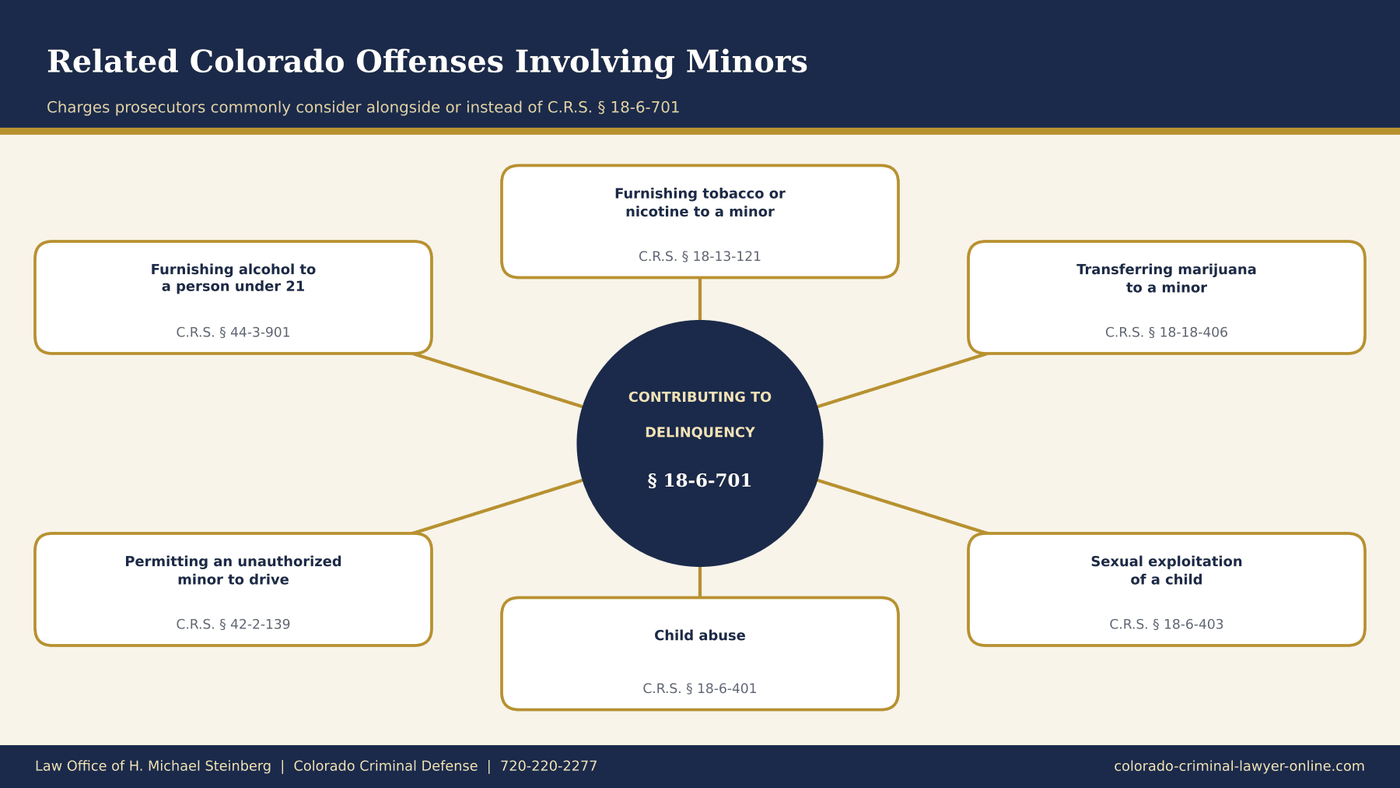
Figure 4: Related Colorado offenses involving minors.
| Offense | Statute | What it addresses |
|---|---|---|
| Furnishing alcohol to a person under 21 | C.R.S. § 44-3-901 | Alcohol-specific unlawful acts involving underage persons |
| Furnishing tobacco or nicotine products to a minor | C.R.S. § 18-13-121 | Providing cigarettes or tobacco products to minors |
| Transferring marijuana to a minor | C.R.S. § 18-18-406 | Marijuana transfer offenses, with penalties tied to the minor’s age |
| Permitting an unauthorized minor to drive | C.R.S. § 42-2-139 | Allowing a minor who is not authorized to drive to operate a vehicle |
| Child abuse | C.R.S. § 18-6-401 | Harm or risk of harm to a child; also a VRA crime |
| Sexual exploitation of a child | C.R.S. § 18-6-403 | Serious felony offense; also a VRA crime |
Consequences Beyond Jail, Fines, and Probation
The formal sentence is only part of the picture. A contributing conviction can follow someone for years.
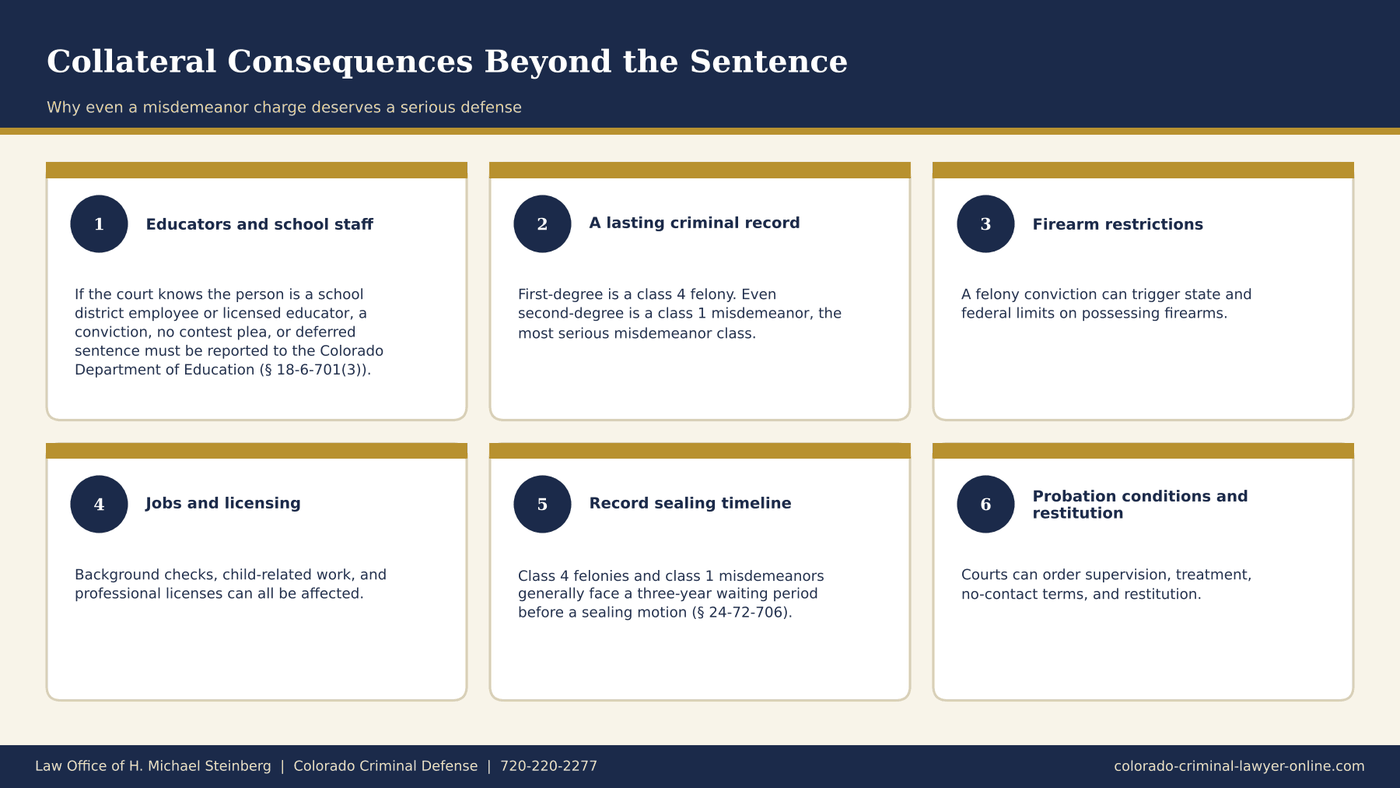 Figure 5: Collateral consequences that follow the sentence.
Reporting for Educators and School Employees
Subsection (3) of the statute addresses a consequence many people do not expect. When a person is convicted, pleads no contest, or receives a deferred sentence for contributing, and the court knows the person is a current or former school district employee in Colorado or holds a license or authorization under article 60.5 of title 22, the court must report that fact to the Colorado Department of Education. See C.R.S. § 18-6-701 and the Colorado Department of Education. Even a deferred sentence triggers the reporting, which can complicate a plea strategy for teachers, coaches, aides, and other school staff.
Firearms
A felony conviction can restrict firearm possession under both Colorado and federal law. See C.R.S. § 18-12-108 and 18 U.S.C. § 922. That is another reason a reduction from first degree to second degree can be worth fighting for.
Employment, Licensing, and Background Checks
Allegations involving minors draw extra scrutiny from employers and licensing boards. Even a misdemeanor outcome may show up on background checks used for jobs involving children, volunteering, coaching, and professional licenses.
Record Sealing
Colorado allows sealing of some convictions after a waiting period. Under C.R.S. § 24-72-706, class 4 felonies and class 1 misdemeanors are generally eligible for a sealing motion three years after the later of final disposition or release from supervision, if the person has no new convictions. Some convictions are excluded from sealing entirely, including certain felonies listed in the Victims Rights Act, so eligibility has to be confirmed for the specific conviction. The Colorado Judicial Branch publishes a conviction-sealing information sheet (JDF 611) that lists the rules.
Defenses to Contributing to the Delinquency of a Minor
Every case is different, but experienced defense counsel usually starts with the following questions.
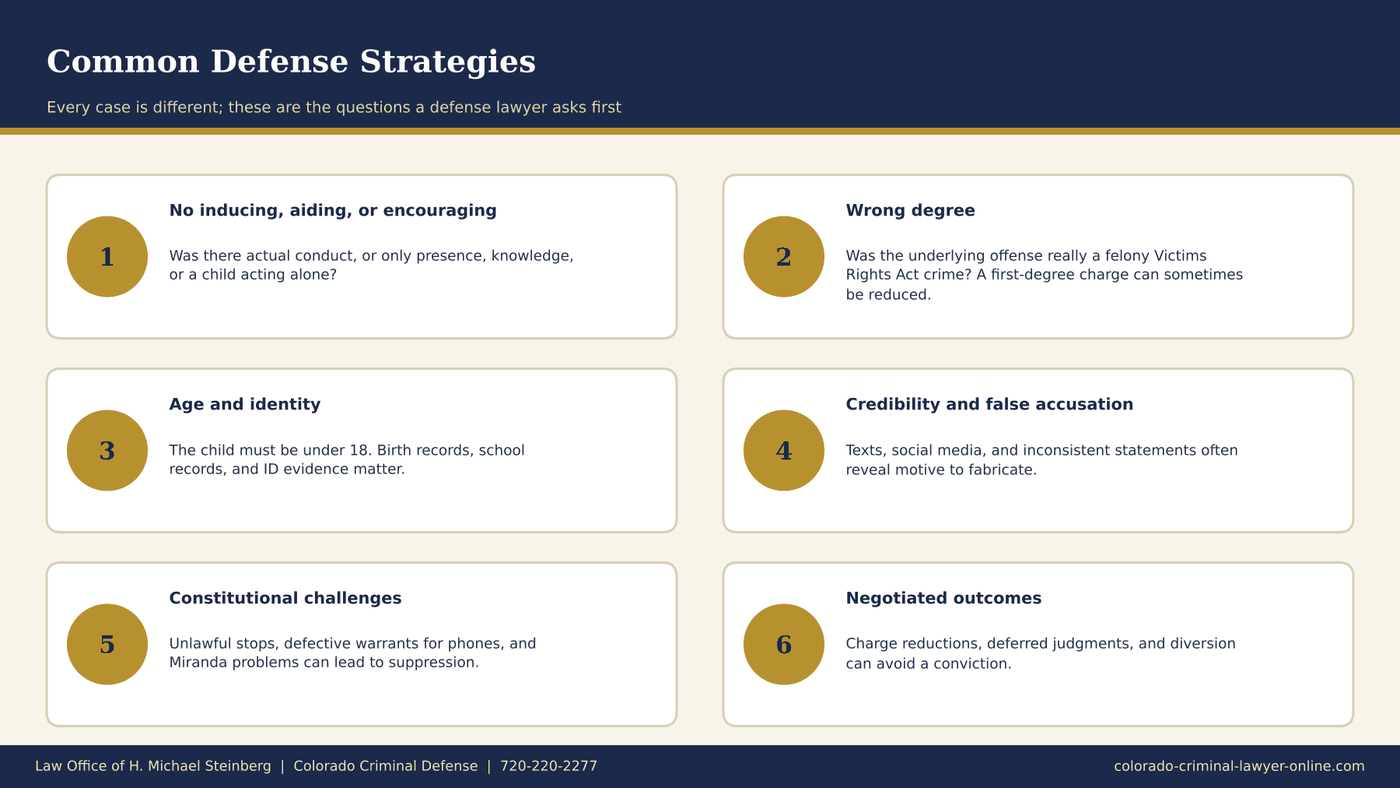
Figure 6: Common defense strategies.
- Was there actual inducing, aiding, or encouraging? Prosecutions sometimes rest on an adult’s presence or knowledge. The statute requires conduct that pushes, helps, or urges.
- Is the degree charged correct? First degree requires an underlying felony VRA crime. If the alleged underlying offense is not on the list, the case may be only second degree, or not chargeable at all.
- Can the prosecution prove the child’s age? The statute covers persons under 18. Proof of age is part of the prosecution’s case.
- Is the accuser credible? Teen witnesses and family disputes can generate unreliable accusations. Text messages, social media, school records, and timelines often reveal inconsistencies or motive.
- Were constitutional rights violated? Unlawful stops, overbroad phone searches, and Miranda problems can lead to suppression of key evidence.
- Can the case be resolved without a conviction? Possible outcomes include a charge reduction, a deferred judgment under C.R.S. § 18-1.3-102, diversion where available, or dismissal. Remember that a deferred sentence can still trigger educator reporting under subsection (3).
How a Contributing Case Moves Through Colorado Courts
Cases begin with an investigation, often triggered by a school, a parent, a social-services report, or a police contact. Charges are filed in county court for misdemeanors and in district court for felonies. In Denver, many first appearances take place at the Denver County Court and the Lindsey-Flanigan Courthouse. For statewide court information, see the Colorado Judicial Branch
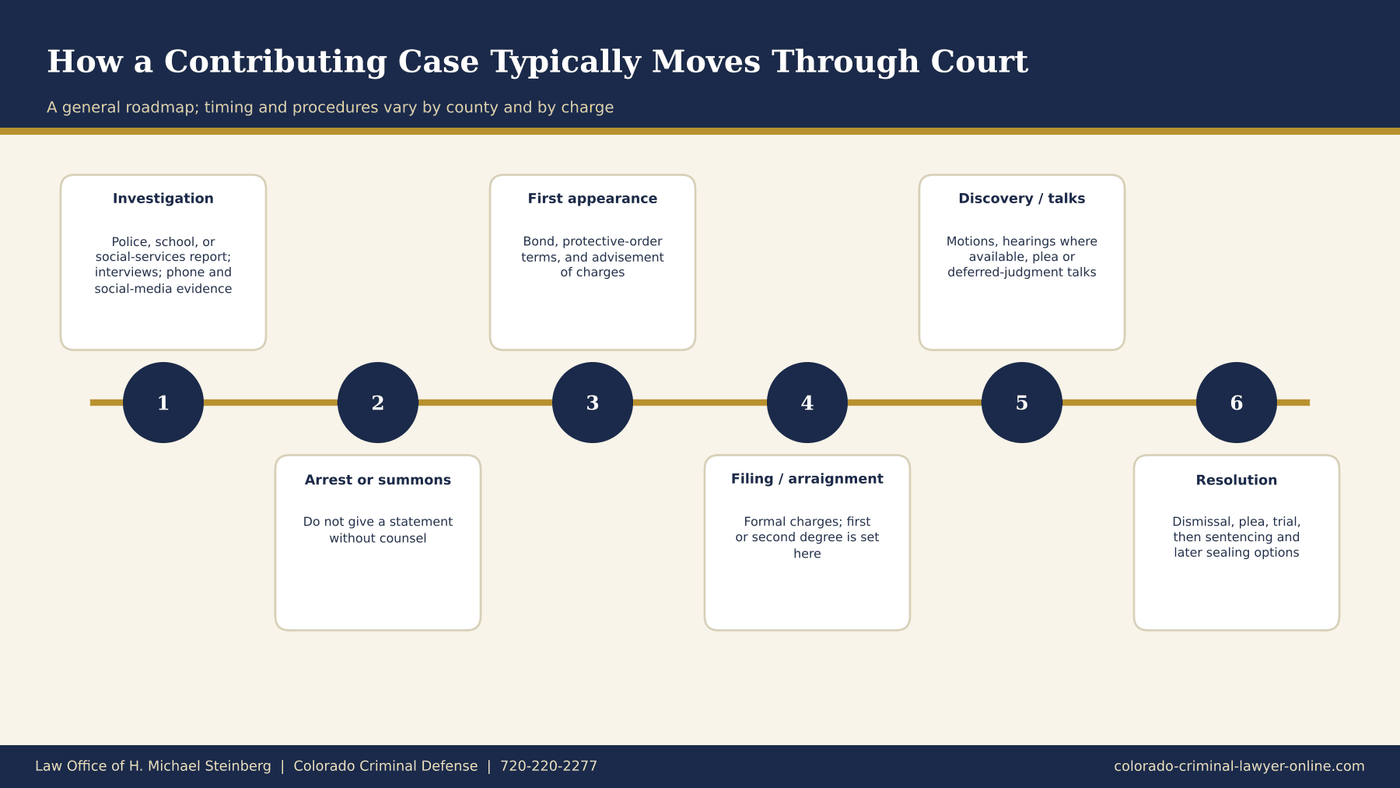 Figure 7: A general roadmap of a Colorado criminal case.
In felony cases, a preliminary hearing may be available depending on the charge and the defendant’s custody status, and it can be a valuable chance to test the evidence early. For background, see our page on preliminary hearings in Colorado.
Time Limits to File Charges
Colorado generally limits when charges can be filed. As a general rule, the limit is three years for felonies and eighteen months for misdemeanors, subject to exceptions and tolling. See C.R.S. § 16-5-401. Do not assume a delay protects you, and do not assume a charge is too old to matter. Have counsel evaluate the dates.
What to Do If You Are Under Investigation or Charged
- Do not give a statement without a lawyer. Detectives and school officials may sound informal. Statements are evidence.
- Do not contact the child or the child’s family about the case. Even well-meant contact can be portrayed as pressure or interference, and can lead to additional allegations such as witness tampering under C.R.S. § 18-8-707.
- Preserve evidence. Do not delete messages, photos, or social-media content. Deleting can look like concealment and can destroy exculpatory material.
- Write down your own timeline now. Memory fades. Keep it for your lawyer only.
- Hire a Colorado criminal defense lawyer early. Early advocacy can influence charging decisions and bond conditions.
Our blog covers many related topics in Colorado criminal law. You can browse the full archive at the Colorado Criminal Lawyer Blog, and learn more about the firm at www.hmichaelsteinberg.com. For juvenile-side issues, see our page on Colorado juvenile crimes.
The Law Office of H. Michael Steinberg has more than forty years of Colorado criminal defense experience and defends felony and misdemeanor cases across the Denver metro area. Call 720-220-2277 to talk about your situation.
Frequently Asked Questions
Is contributing to the delinquency of a minor a felony in Colorado?
It can be. First-degree contributing is a class 4 felony. Second-degree contributing is a class 1 misdemeanor. Before March 1, 2022, every violation was a class 4 felony. See C.R.S. § 18-6-701.
What is the difference between first-degree and second-degree contributing?
The degree depends on what the child was induced, aided, or encouraged to violate. A state law that is a felony Victims Rights Act crime means first degree. A municipal or county ordinance, a court order, or any other state or federal law means second degree.
Who can be charged under the statute?
Any person. The statute is not limited to parents, guardians, or adults. A child is anyone under 18.
Does the minor have to be charged or convicted for me to be charged?
No. Colorado case law, including People v. Miller, holds that an adult can be charged regardless of whether the minor was charged or convicted.
Is giving alcohol or marijuana to a teenager the same as contributing?
Not automatically. Providing alcohol, tobacco, or marijuana to minors is usually addressed by specific statutes such as C.R.S. § 44-3-901, C.R.S. § 18-13-121, and C.R.S. § 18-18-406. Prosecutors sometimes file contributing in addition, as the Graybeal case illustrates.
What is the maximum penalty?
For a class 4 felony, the presumptive range is two to six years in prison, a fine of $2,000 to $500,000, and three years of mandatory parole. For a class 1 misdemeanor committed on or after March 1, 2022, the maximum is 364 days in jail and a fine of up to $1,000.
Can a contributing conviction be sealed?
Possibly. Class 4 felonies and class 1 misdemeanors generally become eligible for a sealing motion three years after final disposition or release from supervision, but some convictions are excluded. See C.R.S. § 24-72-706 and confirm eligibility for your specific conviction.
What happens if I work in a school?
If you are convicted, plead no contest, or receive a deferred sentence and the court knows you are a school district employee or licensed educator, the court must report that to the Colorado Department of Education.
Should I talk to the police or school officials?
Speak with a criminal defense lawyer first. Statements made in informal conversations can be used as evidence.
Key Authorities and Further Reading
- C.R.S. § 18-6-701 (contributing to the delinquency of a minor)
- C.R.S. § 24-4.1-302 (Victims Rights Act definitions)
- C.R.S. § 18-1.3-401 (felony classes and presumptive penalties)
- C.R.S. § 18-1.3-501 (misdemeanor classes and penalties)
- C.R.S. § 18-1.3-102 (deferred judgment and sentence)
- C.R.S. § 24-72-706 (sealing of conviction records)
- C.R.S. § 16-5-401 (limitations on prosecution)
- C.R.S. § 44-3-901, C.R.S. § 18-13-121, C.R.S. § 18-18-406, C.R.S. § 42-2-139 (related minor-specific offenses)
- C.R.S. § 18-4-301, C.R.S. § 18-3-302, C.R.S. § 18-3-402, C.R.S. § 18-6-401, C.R.S. § 18-6-403 (examples of underlying felony crimes)
- C.R.S. § 18-12-108 and 18 U.S.C. § 922 (firearm restrictions)
- C.R.S. § 18-8-707 (tampering with a witness or victim)
- People v. Miller, 830 P.2d 1092 (Colo. App. 1991) (child need not be charged or convicted)
- People v. Graybeal, 155 P.3d 614 (Colo. App. 2007) (contributing convictions; possession not a lesser included offense)
- Colorado Senate Bill 21-271 (2021 reform creating two degrees, effective March 1, 2022)
- Statute history and annotations on Justia
Disclaimer: This article is general information about Colorado law as of November 5, 2026. It is not legal advice and does not create an attorney-client relationship. Statutes and court decisions change, and every case depends on its own facts. Examples are hypothetical. If you are under investigation or have been charged, consult a Colorado criminal defense lawyer about your specific situation. Prior results do not guarantee a similar outcome.