 Colorado Criminal Lawyer Blog
Colorado Fentanyl Charges: What Colorado Law Means for Your Case


By H. Michael Steinberg, A Colorado Criminal Defense Lawyer – Practicing Colorado Criminal Law in the courts of Colorado for over 40 years.
 Introduction:
A fentanyl-related arrest in Colorado can carry serious consequences even when the amount involved appears small.
The classification of the offense may depend on the total weight of the substance or mixture, the evidence connecting a person to it, laboratory results, prior convictions, and whether law enforcement alleges an intent to distribute.
Because fentanyl is frequently found in counterfeit pills and mixed substances, these cases often raise factual questions far beyond a laboratory result.
A strong defense begins with a close review of the search, seizure, testing, weight calculation, and the prosecution’s proof of knowing possession.
Colorado’s Fentanyl Possession Thresholds
Colorado law treats fentanyl possession differently from ordinary possession of many other controlled substances. The governing statute addresses a substance that contains fentanyl, carfentanil, a benzimidazole opiate, or certain covered analogs.
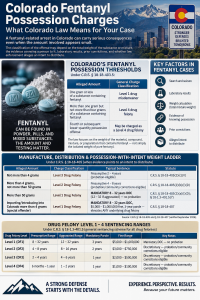
Under the framework reflected in C.R.S. § 18-18-403.5:
The crucial point is that the law focuses on the weight of the material, compound, mixture, or preparation that contains fentanyl—not simply the isolated weight of pure fentanyl.
For example, if a laboratory identifies fentanyl in a powder mixture or in counterfeit tablets, prosecutors may rely on the total qualifying mixture weight when determining whether a felony threshold has been crossed. That measurement can make a substantial difference in the charge filed.
Manufacture, Distribution & Possession-With-Intent Weight Ladder
Once evidence points to intent to distribute — packaging, scales, quantity, communications — fentanyl cases shift from the possession thresholds above into this separate, far steeper weight ladder under C.R.S. § 18-18-405.
| Not more than 4 grams | Level 3 Drug Felony | Presumptive 2–4 years · probation-eligible | C.R.S. § 18-18-405(2)(c)(V) |
| More than 4 grams, not more than 50 grams | Level 2 Drug Felony | Presumptive 4–8 years · probation/community corrections eligible | C.R.S. § 18-18-405(2)(b)(I)(D) |
| More than 50 grams | Level 1 Drug Felony | MANDATORY 8–32 years DOC (12–32 if aggravated) — no probation | C.R.S. § 18-18-405(2)(a)(I)(D); § 18-1.3-401.5(7) |
| Importing/introducing into Colorado more than 4 grams (special offender) | Level 1 Drug Felony | MANDATORY 8–32 years DOC, $5,000–$1,000,000 fine, 3-year parole — elevates ANY underlying drug felony | C.R.S. § 18-18-407 |
Drug felony Level 1–4 Sentencing Ranges
The general sentencing scheme under C.R.S. § 18-1.3-401.5 for all four drug felony levels, including the aggravated range, mandatory parole period, and fine schedule.
| Level 1 (DF1) | 8 – 32 years | 12 – 32 years (with aggravator) | 3 years | $5,000 – $1,000,000 | Mandatory DOC — no probation |
| Level 2 (DF2) | 4 – 8 years | 8 – 16 years | 2 years | $3,000 – $750,000 | Discretionary — probation/community corrections eligible |
| Level 3 (DF3) | 2 – 4 years | 4 – 6 years | 1 year | $2,000 – $500,000 | Discretionary — probation/community corrections eligible |
| Level 4 (DF4) | 6 months – 1 year | 1 – 2 years | 1 year | $1,000 – $100,000 | Discretionary generally; fentanyl 1–4g DF4 has a special no-DOC/no-parole guardrail (see below) |
The Fentanyl DF4 Sentencing Guardrail
Simple possession of 1–4 grams of a fentanyl-containing mixture is technically a Level 4 drug felony — but Colorado carved out a special, more lenient sentencing scheme just for this offense (and for a 4th-or-subsequent low-quantity offense elevated to DF4).
Under C.R.S. § 18-1.3-401.5, a defendant convicted of this specific DF4 violation:
- Is not subject to the Department of Corrections’ jurisdiction and is not subject to any mandatory period of parole.
- Must instead be sentenced to probation of up to 2 years with up to 180 days in county jail as a condition or violation sanction — or straight county jail up to 180 days.
- Faces a county-jail cap that rises to 364 days for a third or subsequent offense.
- May be fined up to $1,000 — well below the general DF4 fine range of $1,000–$100,000.
This guardrail does not extend to fentanyl quantities over 4 grams, to the pending 60%-composition DF2 charge, or to any distribution-adjacent charge under § 18-18-405 — all of which carry full DOC and mandatory-parole exposure.
C.R.S. § 18-1.3-401.5; § 18-18-403.5(2.5) — Justia: 18-1.3-401.5
Mandatory Level 1 Exposure: 50 Grams and the “Special Offender” trap
Two separate provisions push a fentanyl case into mandatory 8–32-year Level 1 territory, and both are keyed to total mixture weight rather than purity:
- Distribution over 50 grams under § 18-18-405(2)(a)(I)(D) is an automatic Level 1 drug felony subject to the mandatory sentencing floor in § 18-1.3-401.5(7) — at least 8 years, up to 32, with no probation.
- Importing or introducing into Colorado more than 4 grams of a fentanyl-containing mixture makes a person a “special offender” under § 18-18-407, which independently elevates any underlying drug felony to Level 1 — regardless of the offense’s original weight tier.
An aggravating circumstance tied to distributing more than 50 grams also forces a 12–32 year floor instead of 8–32 years. § 18-1.3-401.5(10)(a)(V).
C.R.S. § 18-18-405; § 18-18-407 — Justia: 18-18-407
Revisited For Clarity:
Why the Felony Conversion Matters Even Though Jail Exposure Stays Capped
- A felony conviction — even a “guardrail” DF4 — is a permanent disqualifier for many professional licenses, federal firearms rights, and certain housing and employment screens that a misdemeanor is not.
- A prior felony conviction exposes a defendant to sentence-enhancing circumstances under § 18-1.3-401.5(11) in any future felony case (e.g., being on bond, probation, or parole at the time of a new offense), and two prior felony convictions bar eligibility for a fine in lieu of incarceration under § 18-1.3-401.5(2)(b).
- A felony record changes immigration consequences and can independently support special-offender or aggravated-range findings in later cases.
C.R.S. § 18-18-403.5(2.5)(a)(II); § 18-1.3-401.5(2)(b), (11) — Justia: 18-1.3-401.5
Why Laboratory Evidence Matters
In many fentanyl prosecutions, the laboratory report becomes central to the case. But a lab report is not the end of the analysis. The prosecution must still be able to prove that the tested substance was the same item seized, that testing was reliable, and that the reported weight supports the particular charge.
A defense investigation may examine:
-
Whether the substance actually tested positive for fentanyl or a covered substance.
-
The testing method used by the laboratory.
-
The reported gross and net weights.
-
Whether packaging or non-controlled material affected the measurement.
-
Whether separate packages were improperly aggregated.
-
The chain of custody from seizure through laboratory testing.
-
Discrepancies between police reports, property records, and lab documentation.
-
Whether the state can produce qualified testimony supporting the laboratory’s conclusions.
A small difference in measurement or classification can determine whether the allegation remains a misdemeanor or becomes a felony. In other cases, unreliable handling, incomplete documentation, or testing deficiencies may create meaningful doubt about what was seized and tested.
How the Total Mixture Weight Drives the Charge
Every threshold in this guide — 1 gram, 4 grams, 50 grams, the 4-gram special-offender import line — measures the entire weighed mass of the material, compound, mixture, or preparation that contains any quantity of fentanyl, carfentanil, benzimidazole opiate, or a covered analog. Colorado law does not require the state to isolate or weigh pure fentanyl separately.
That single design choice has an outsized effect in practice:
- Counterfeit pills carry filler weight. A pressed “M30” counterfeit oxycodone pill typically weighs roughly 0.1–0.2 grams but may contain only a fraction of a milligram of actual fentanyl. Ten to twenty such pills can cross the 1-gram misdemeanor line; forty or more can cross the 4-gram felony-to-distribution boundary — independent of how much fentanyl is actually present.
- Cutting agents inflate weight without inflating danger proportionally. Because the statute weighs the whole mixture, a heavily “cut” batch can reach the 50-gram mandatory Level 1 threshold faster than a smaller amount of higher-purity material — even though the cut batch may contain comparable or less actual fentanyl.
- The pending purity-based charge works differently. Once the Colorado Bureau of Investigation formally certifies to the Revisor of Statutes that it can reliably measure fentanyl as a percentage of total composition, § 18-18-403.5(2.7) will independently make possession of a mixture that is more than 60% fentanyl by composition a Level 2 drug felony — a purity test layered on top of, not replacing, the weight-based thresholds. As of this guide’s publication, that notice has not been issued and subsection (2.7) has not yet taken effect.
- Weight determinations are frequently contestable. Gross vs. net weight, packaging material, moisture content, and whether separately packaged units were properly aggregated are all recurring points of dispute in fentanyl weight determinations, and can move a case across a threshold in either direction.
C.R.S. § 18-18-403.5(2.5)–(2.7); § 18-18-204(2)(g) — Colorado.Public.Law: 18-18-403.5
Possession Must Be Knowing
The state must prove more than proximity to drugs. In a possession case, prosecutors generally need evidence that the accused knowingly possessed the controlled substance.
Possession can be alleged in two main ways:
-
Actual possession: The substance was allegedly found on the person, such as in clothing, in a bag carried by the person, or in another item under immediate control.
-
Constructive possession: The prosecution argues that the person had knowledge of and control over the substance even if it was not physically on them.
Constructive-possession cases can be especially complicated. Drugs found in a shared home, borrowed car, hotel room, vehicle with multiple occupants, or common storage area do not automatically establish that a particular person knowingly possessed them.
Relevant questions may include:
-
Who owned or controlled the place where the drugs were found?
-
Did other people have equal access to the area?
-
Was there evidence identifying a specific person as the owner?
-
Did officers recover fingerprints, messages, admissions, or other corroborating evidence?
-
Did police make assumptions based only on presence at the scene?
The prosecution carries the burden of proof. Mere association with another person or presence near a controlled substance is not necessarily enough to establish knowing possession beyond a reasonable doubt.
Lack of Knowledge About Fentanyl
Counterfeit pills and mixed drugs can create difficult knowledge issues. A person may claim they believed a pill was a prescription medication, or that a powder was a different drug, without knowing it contained fentanyl.
Colorado’s fentanyl statute historically included a specific reasonable-mistake-of-fact provision for certain possession allegations. A 2024 proposal, House Bill 24-1306, sought to eliminate both the lower-quantity misdemeanor treatment and the reasonable-mistake provision, but the bill was postponed indefinitely and did not become law. leg.colorado
Whether a lack-of-knowledge argument applies in a particular case depends on the exact charge, the dates of the alleged offense, the evidence available, and the current text of the statute. It is not an automatic defense. Still, evidence concerning what a defendant was told, what the substance appeared to be, communications with others, and the surrounding circumstances can be highly important.
Possession Versus Distribution
A case can become much more serious when prosecutors allege that fentanyl was intended for sale, transfer, or distribution rather than personal use. Possession with intent to distribute, distribution, manufacturing, or conspiracy allegations can carry materially greater sentencing exposure than simple possession.
The state may cite evidence such as:
-
Quantity of drugs or alleged drug mixtures.
-
Individual packaging or multiple baggies.
-
Scales, ledgers, or packaging materials.
-
Cash, financial transactions, or digital-payment records.
-
Text messages, social-media communications, or phone data.
-
Statements attributed to the accused.
-
Surveillance or confidential-informant allegations.
None of these items automatically proves intent to distribute. A scale, cash, a large quantity, or suspicious messages may have explanations that require careful investigation and context. The defense should challenge assumptions and require the prosecution to prove each element of the offense with admissible evidence.
Search and Seizure Issues
Fentanyl evidence is often discovered during a traffic stop, home search, probation contact, arrest, vehicle search, or encounter with law enforcement. The legality of that encounter may be a major issue.
Potential Fourth Amendment and Colorado constitutional questions include:
-
Did the police have a lawful basis for the traffic stop or initial detention?
-
Was the search based on valid consent?
-
Did officers exceed the scope of consent?
-
Did law enforcement have probable cause to search a vehicle, person, or residence?
-
Was a warrant valid and properly executed?
-
Did officers have legal authority to open containers, search a phone, or enter a residence?
-
Were statements obtained after a valid Miranda advisement and voluntary waiver?
If evidence was obtained through an unconstitutional search or seizure, the defense may seek suppression. Suppression can substantially weaken the prosecution’s case and, in some circumstances, lead to a reduction or dismissal of charges.
Potential Consequences of a Conviction
A fentanyl conviction can affect more than a sentence imposed by the court. A drug felony can create long-term consequences involving employment, professional licensing, housing, education, firearms rights, immigration status, and future criminal cases.
The actual consequences depend on factors such as:
-
The offense level charged.
-
The alleged weight and substance.
-
Whether prosecutors allege distribution activity.
-
Prior convictions.
-
The defendant’s criminal history and sentencing-risk assessment.
-
The availability of treatment, diversion, probation, or alternative sentencing.
-
Aggravating or mitigating evidence.
A Level 4 drug felony is still a felony conviction, even when the sentence does not involve a lengthy prison term. Early legal representation can be important to preserving evidence, evaluating treatment options, identifying suppression issues, and pursuing a resolution that accounts for the individual circumstances of the case.
Steps to Take After a Fentanyl Arrest
If you are being investigated or charged, avoid making the situation worse.
-
Do not give explanations to police without legal advice. Statements made during an investigation may be used against you, even if you believe you are clarifying a misunderstanding.
-
Preserve potentially helpful evidence. This may include messages, receipts, prescription records, location data, witness information, photographs, or other evidence that bears on knowledge, ownership, or possession.
-
Do not alter, delete, or conceal evidence. Deleting messages or trying to dispose of property can create additional problems and may be perceived as an indication of guilt.
-
Get a prompt case evaluation. An attorney can review the complaint, arrest affidavit, body-camera footage, laboratory reports, search-warrant materials, discovery, and potential defenses.
November 2026 Colorado Ballot Measure: Proposition 132:
A 2026 Colorado ballot measure aimed at increasing criminal penalties for fentanyl-related offenses, including mandatory minimum sentences and treatment requirements for certain drug possession cases.
Overview
Proposition 132, appearing on the November 3, 2026, ballot, seeks to increase penalties for the manufacture, distribution, sale, and possession of fentanyl and certain synthetic opioids.
It would classify these offenses as Level 1 drug felonies, with mandatory minimum sentences ranging from eight to 32 years for distribution of any detectable amount of a covered substance.
Possession penalties would also increase, with small amounts (up to one gram) treated as a treatment-mandated Level 4 felony, while larger amounts would be classified as Level 2 or Level 3 felonies depending on quantity and concentration.
Key Provisions
- Distribution and Sale: Any detectable amount of fentanyl or related synthetic opioids would be a Level 1 felony with an eight-year mandatory minimum sentence.
- Possession:
- Up to 1 gram: Level 4 felony with mandatory treatment.
- 1–4 grams: Level 3 felony.
- Material with more than 60% fentanyl: Level 2 felony.
- Sentencing Exceptions: The measure eliminates the current provision allowing lower charges if a person did not know the substance contained fentanyl.
- Treatment and Rehabilitation: Certain low-level offenders could have convictions vacated and replaced with misdemeanor convictions after completing treatment.
Voting Implications
- YES vote: Supports increasing penalties for fentanyl-related felonies, requiring treatment for certain drug offenses, and limiting sentencing exceptions in fentanyl-related crimes that cause another person’s death.
- NO vote: Maintains current fentanyl-related penalties and sentencing rules, emphasizing an evidence-based approach.
Speak With a Colorado Drug Defense Attorney
Fentanyl cases are fact-specific. The reported weight, the identity of the substance, the location of the evidence, the knowledge requirement, the police conduct, and the alleged intent all matter. A charge that initially appears straightforward may involve significant weaknesses in the state’s evidence.
If you are facing a Colorado fentanyl possession, distribution, or related controlled-substance allegation, consult a qualified Colorado criminal defense attorney promptly. An early review can help protect your rights, identify defenses, and develop a strategy based on the facts—not assumptions.
Colorado Criminal Law – Colorado Fentanyl Charges: What Colorado Law Means for Your Case
The reader is alerted that Colorado criminal law, like criminal law in every state and at the Federal level, changes constantly. The article above was accurate when it was drafted, but it cannot account for changes that occurred after it was uploaded.
 ABOUT THE AUTHOR: H. Michael Steinberg – Email the Author at: hmsteinberg@hotmail.com
A Denver, Colorado Criminal Defense Lawyer – or call his office at 303-627-7777 during business hours – or call his cell if you cannot wait and need his immediate assistance – please call 720-220-2277.
“A good criminal defense lawyer is someone who devotes themselves to their client’s case from beginning to end, always realizing that this case is the most important thing in that client’s life.”
Putting more than 40 years of Colorado criminal defense experience to work for you.
You should be careful to make a responsible choice when selecting a Colorado criminal defense lawyer. We encourage you to “vet” our firm. Over the last 40 years – by focusing ONLY on Colorado criminal law – H. Michael has had the time to continually update himself in nearly every area of criminal law, including Colorado criminal law, procedure, and trial and courtroom practice.
H. Michael works hard to deliver the best possible results for his clients, both in and out of the courtroom. He has written extensively on Colorado criminal law and continues to do so, and he hopes this article helps you in some small way.