 Colorado Criminal Lawyer Blog
The Ten Biggest Mistakes People Make After Learning They Are Under Criminal Investigation


 Introduction
The call usually comes without warning. A detective leaves a voicemail asking you to “come in and clear a few things up.” Officers knock at 6 a.m. with a search warrant. A relative mentions that police have been asking questions about you. Or you simply learn — from a text, a subpoena, an employer, a former friend — that someone has made an accusation.
In that moment, most people do what feels natural: they try to fix it. They explain, apologize, reach out, delete, post, or wait and hope. Nearly every one of those instincts is understandable. Many of them are also the precise moves that turn a defensible situation into a difficult one — and sometimes into a second, separate crime.
Quick-Reference: What to Do First
If You Learn You May Be Under Investigation
A person under investigation should not assume that a polite conversation with police is informal or harmless. Statements can be misunderstood, taken out of context, compared against other evidence, or used to identify new witnesses and evidence.
Talking to law enforcement without legal counsel is consistently one of the most consequential mistakes people make.
★ Key Takeaways
- Being under investigation is not the same as being charged — and the time before charges is often when you have the most influence over the outcome.
- Do not discuss the facts with police, witnesses, friends, or anyone else until you have spoken with a criminal defense lawyer.
- Do not delete, edit, hide, or “tidy up” anything — texts, photos, posts, devices, or physical items.
- Do not contact the accuser or any potential witness, directly or through someone else.
- Do not consent to a search — and do not physically resist one.
What “Under Investigation” Actually Means
Police and prosecutors use loose labels — “suspect,” “person of interest,” “subject,” “target.” Those labels have no fixed legal meaning in most local investigations in Colorado, and hearing that you are “just a witness” does not mean you cannot become the defendant. You may never receive formal notice. An investigation can run quietly for weeks or months, and a charging decision can arrive long after the first phone call.
What matters is this: the moment you know, you are in the most consequential stretch of the case. What you say and do now becomes part of the file the prosecutor eventually reads.
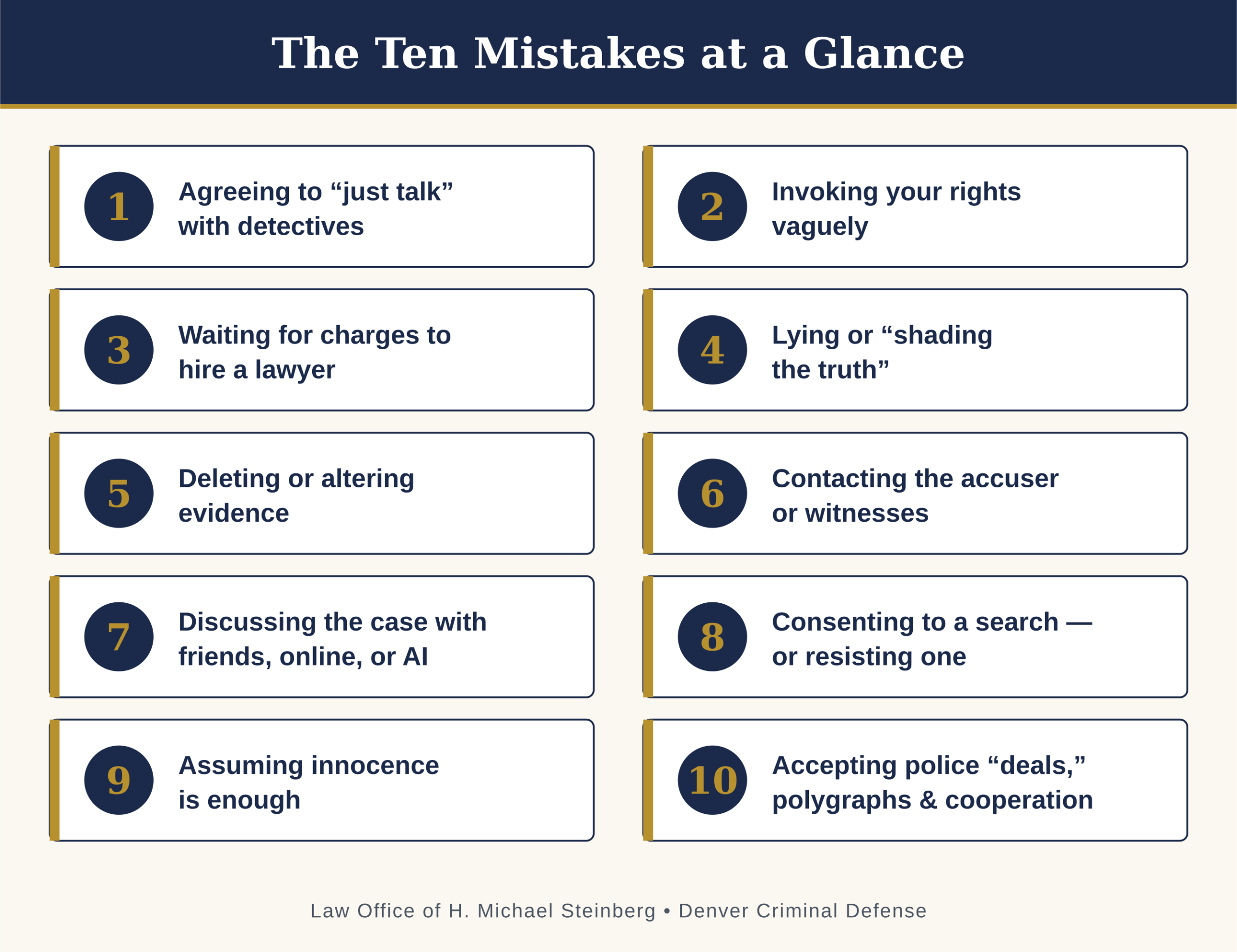
Mistake #1: Agreeing to “Just Talk” With the Detective
The invitation sounds harmless: We only want to hear your side. You’re not under arrest. You’re free to leave. Often that is literally true — and that is exactly why the conversation is treated as non-custodial.
Miranda warnings apply only to custodial interrogation. Colorado courts look at the totality of the circumstances and ask whether a reasonable person in your position would have believed they were in custody. If the answer is no, officers may question you without warnings, and what you say can be used against you. In March 2026, the Colorado Supreme Court reversed a trial court’s suppression order in People v. Lulei, concluding the defendant was not in custody when he asked for a lawyer — and that giving a Miranda advisement, without more, does not by itself create a custodial interrogation.
Do not count on Miranda to rescue a conversation you chose to have.
Police are also generally permitted to use certain deceptive tactics — overstating the evidence, claiming a friend “already talked” — so long as the resulting statement remains voluntary. And innocent people are not immune to the risks. In a stressful interview, people guess at dates, misremember details, volunteer information about others, and place themselves at a scene or in a relationship that later looks incriminating.
What to do instead
Politely decline. You can say: “I’m not going to answer questions without my attorney. Please direct any communication to my lawyer.” Then let your attorney decide whether any statement — for example, a carefully prepared attorney-led presentation — makes strategic sense.
 Mistake #2: Invoking Your Rights Halfway
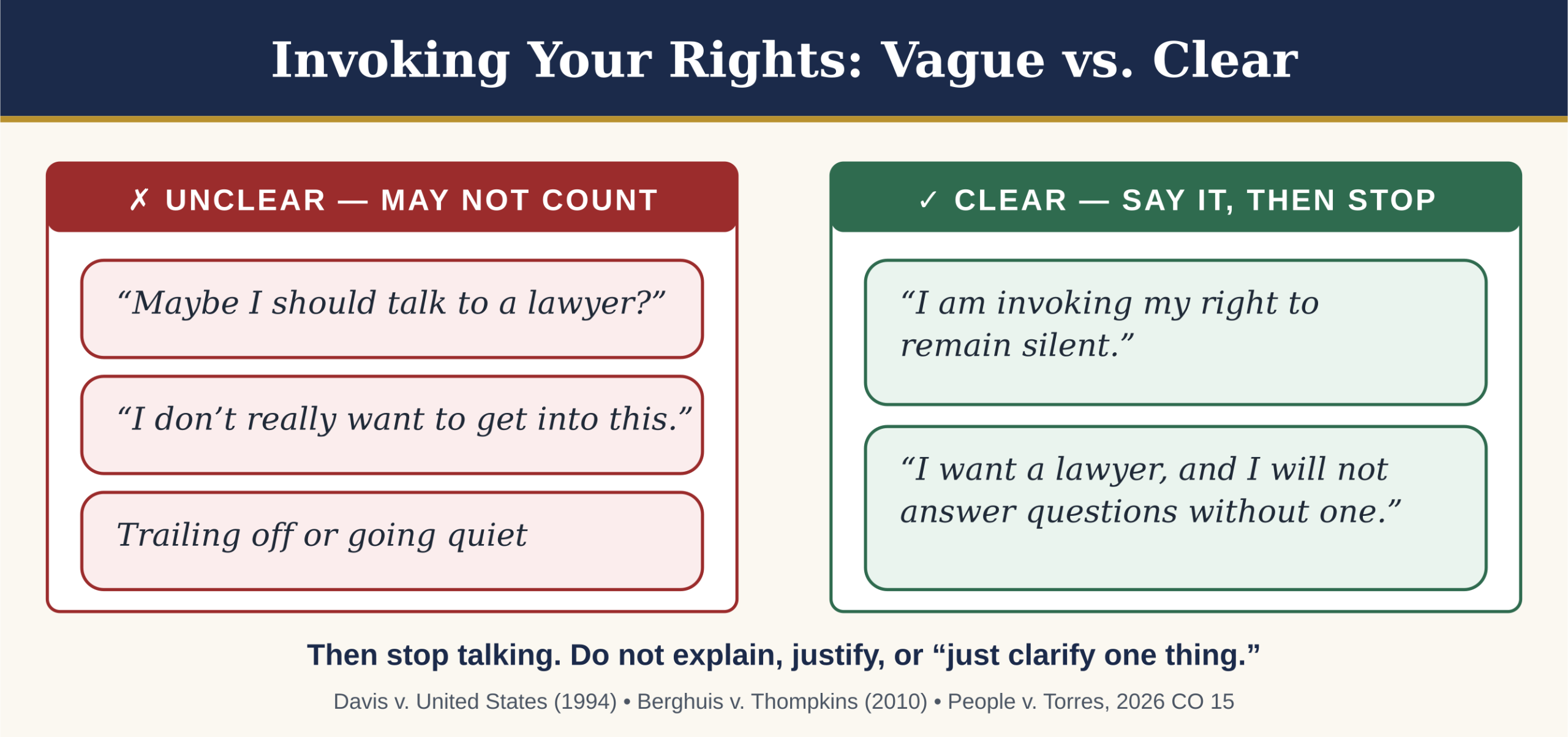
Many people assume that staying quiet, hesitating, or mentioning a lawyer will automatically stop the questioning. It often will not. Under U.S. Supreme Court precedent, the right to counsel must be invoked unambiguously (Davis v. United States), and simply remaining silent does not by itself invoke the right to silence (Berghuis v. Thompkins). Even before arrest, silence in a voluntary interview can be treated as evidence if you have not clearly invoked the privilege (Salinas v. Texas).
Colorado’s highest court applied these principles this year. In People v. Torres, 2026 CO 15, a 5–2 majority held that the defendant never clearly invoked his right to remain silent and later waived his rights voluntarily, so his statements to a Longmont detective could be used. A defendant’s words are read in context — and vague or trailing statements can be read against you.
What to do instead
- Use plain, complete sentences: “I am invoking my right to remain silent. I want a lawyer, and I will not answer questions without one.”
- Do not add “but” — do not follow up with explanations or partial answers.
- Do not sign waivers or “consent” forms.
- Repeat the statement if questioning continues, then stay silent.
Invoking your rights is not a crime, and it is not an admission. It is the most effective sentence in the entire process.
Mistake #3: Waiting Until You Are Charged to Hire a Lawyer
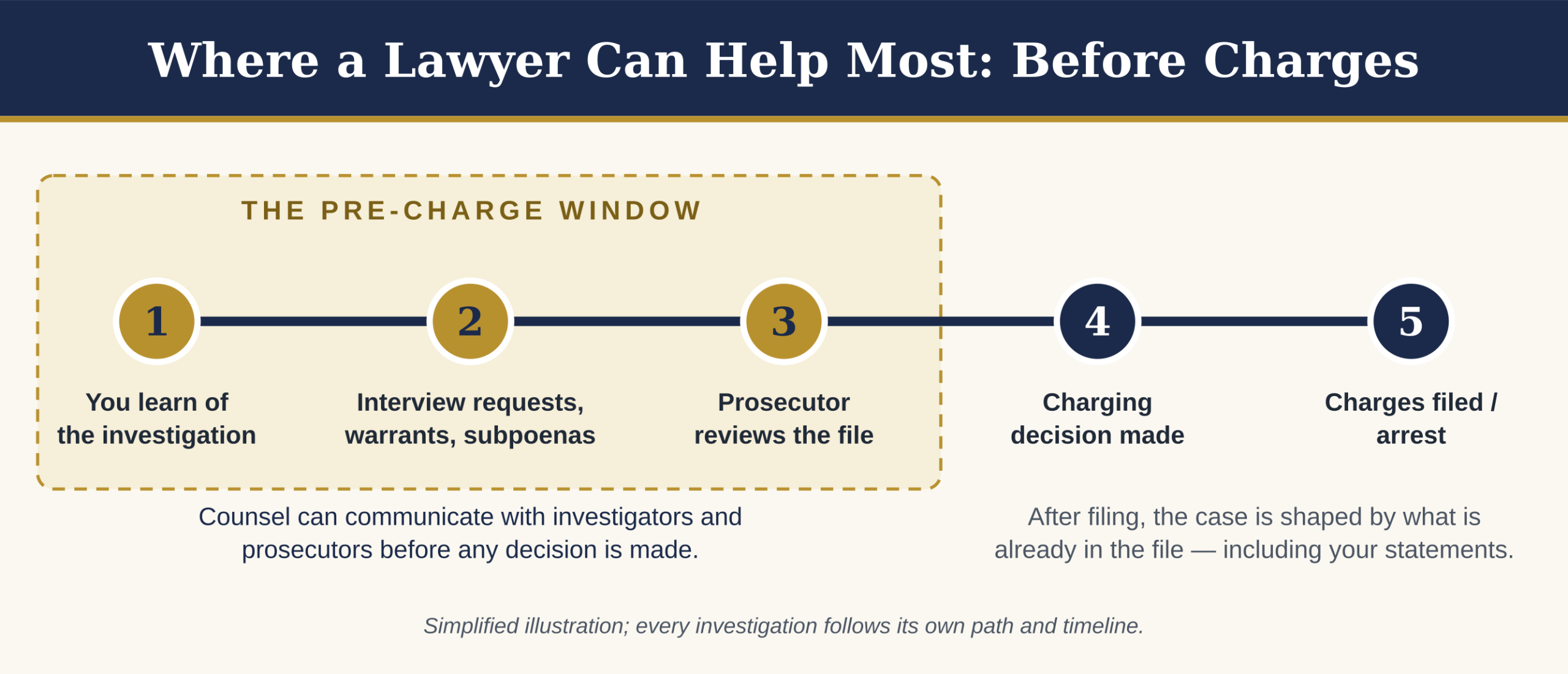
“I’ll get a lawyer if it comes to that” is one of the costliest sentences in criminal law. By the time charges are filed, the most important pieces of the file — your statements, your messages, the witness accounts, the framing of the case — may already be set.
A defense lawyer engaged before charges can often:
- Find out, as far as possible, whether you are a subject of the investigation and what investigators are focused on.
- Serve as the single point of contact so you never have to speak with detectives directly.
- Advise on what to preserve, what not to touch, and how to handle devices and accounts safely.
- Identify and, where appropriate, present favorable evidence, context, and witnesses at a strategic time.
- Communicate with the prosecutor’s office before a charging decision is made.
- If an arrest warrant issues, arrange a controlled surrender instead of an arrest at work, at home, or during a traffic stop.
No lawyer can promise that charges will not be filed. But the pre-charge period is the only time anyone can potentially influence what the prosecutor sees before the prosecutor decides. Local knowledge matters here, too: the Denver District Attorney’s Office, the 18th Judicial District (Arapahoe, Douglas, Elbert, and Lincoln counties), the 17th Judicial District (Adams and Broomfield counties), and the 1st Judicial District (Jefferson and Gilpin counties) each have their own practices and personalities.
Mistake #4: Lying — or “Shading the Truth” — to Investigators
Panic makes people minimize: I wasn’t really there. We only talked for a minute. I don’t remember. When those statements are contradicted by phone location data, video, receipts, or another witness, the problem is no longer the allegation — it is your statement.
Colorado law separately punishes knowingly false statements to authorities. Under C.R.S. § 18-8-111, false reporting to authorities — including knowingly reporting false information about an incident or providing false identifying information — is a criminal offense, and obstructing a peace officer under § 18-8-104 is charged as a misdemeanor. If federal agents are involved, a false statement can be a federal felony under 18 U.S.C. § 1001.
A provable lie is almost always easier for a prosecutor to prove than an underlying accusation.
Even when a lie never becomes its own charge, it becomes evidence — a prosecutor will argue it shows a guilty conscience. Not every inaccurate statement is a crime, and intent matters, but you should never test that line in an interview room.
What to do instead
Silence is not a lie. Declining to answer is lawful. (One narrow caution: Colorado’s stop-and-identify rules generally require you to give your name and address during a lawful stop — and giving false identifying information is its own offense.)
Mistake #5: Deleting, Altering, or “Cleaning Up” Evidence
Scrubbing a phone, deleting a text thread, wiping a browser history, disappearing a social media post, washing a vehicle, or “getting rid of” an item are among the most common and most damaging reactions we see.
⚖ Colorado Law: Tampering With Physical Evidence — C.R.S. § 18-8-610
- A person commits the offense if, believing that an official proceeding is pending or about to be instituted and acting without legal right, they destroy, mutilate, conceal, remove, or alter physical evidence with intent to impair its verity or availability — or knowingly present false or altered physical evidence.
- “Physical evidence” includes any article, object, document, record, or other thing of physical substance.
- Tampering with evidence of a felony is a class 6 felony; Tampering with evidence of a misdemeanor is a class 1 misdemeanor.
Notice the trigger: a belief that a proceeding is pending or about to be instituted.
Learning that you are under investigation is exactly what supplies that belief. Conduct that would have been harmless housekeeping last month can become a felony this month.
Deletion also rarely works. Forensic extraction, cloud backups, carrier records, and the other person’s copy of a message often survive. Then the state has both the original evidence and proof that you tried to make it disappear.
What to do instead
- Leave everything exactly as it is — devices, accounts, messages, photos, posts, receipts, clothing, vehicles.
- Do not ask anyone else to delete or hold anything for you.
- Ask your lawyer about auto-delete and “disappearing message” settings that may already be running.
- Do not volunteer to hand items over yourself. Preserve now; let counsel decide what is produced, and when.
Mistake #6: Contacting the Accuser, Witnesses, or Their Families
The urge is powerful: to apologize, to explain, to ask them to “just tell the truth,” or to persuade them to drop it. It is also one of the most dangerous things you can do.
Under C.R.S. § 18-8-707, tampering with a witness or victim is a class 4 felony. It applies when a person intentionally attempts — without bribery or threats — to induce a witness or victim (or someone they believe may be called to testify as a witness to or victim of a crime) to testify falsely, unlawfully withhold testimony, avoid a legal summons, or stay away from an official proceeding. Colorado courts construing the predecessor statute held that the attempt need not succeed, and the case law indicates the attempt need not even be communicated to the witness. Separate statutes address intimidating a witness or victim (§ 18-8-704) and retaliating against one (§ 18-8-706).
Once charges are filed, a protection order under C.R.S. § 18-1-1001 typically prohibits direct or indirect contact with the alleged victim, and violating it can create new criminal exposure of its own. Messages sent through friends, relatives, or social media count as contact for practical purposes — and screenshots make excellent exhibits.
Colorado courts do draw lines. The Court of Appeals has held, for example, that merely advising a person they have a right not to speak with police is not, standing alone, witness tampering. But those lines are fact-specific, and they are argued after you have been charged. You do not want to be the test case.
What to do instead
Send no messages, place no calls, and do not “bump into” anyone. If contact with a witness is needed, your attorney or a defense investigator can arrange it properly and document it.
How These Mistakes Can Become New Charges
Obstruction-type offenses stand on their own. A person can be acquitted of the original accusation and still face — or be convicted of — a charge that grew out of how they reacted to it.
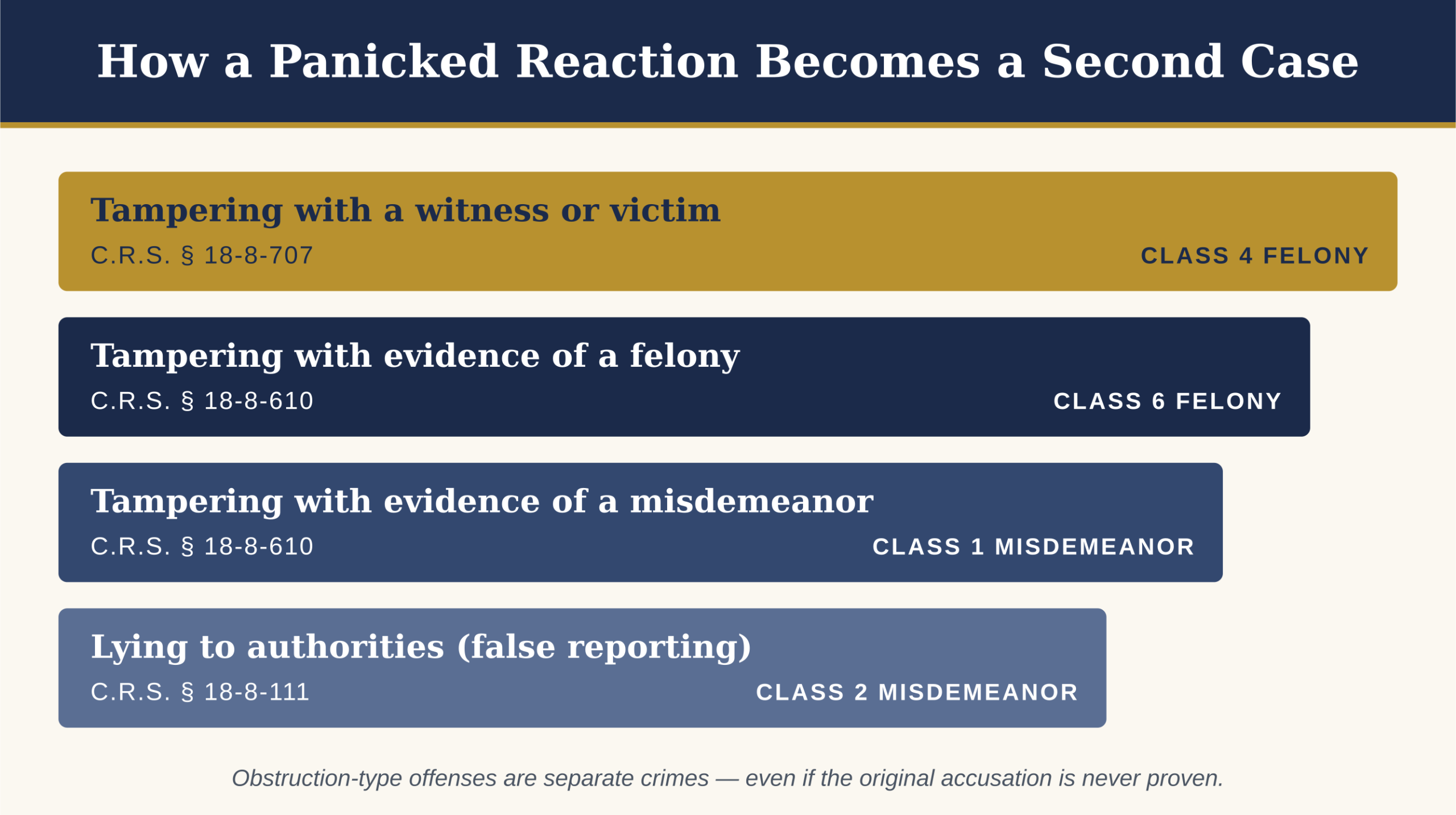
| Offense | Statute | Classification | Presumptive range* |
|---|---|---|---|
| Tampering with a witness or victim | C.R.S. § 18-8-707 | Class 4 felony | 2–6 years, plus mandatory parole |
| Tampering with physical evidence (felony case) | C.R.S. § 18-8-610 | Class 6 felony | 12–18 months, plus parole |
| Tampering with physical evidence (misdemeanor case) | C.R.S. § 18-8-610 | Class 1 misdemeanor | Set by C.R.S. § 18-1.3-501 |
| False reporting to authorities | C.R.S. § 18-8-111 | Class 2 misdemeanor (generally) | Up to 120 days jail and/or $750 |
*Ranges are general presumptive guidelines. Enhancers, aggravating factors, and later legislative changes can affect the actual sentence. Always confirm against the current statute.
Mistake #7: Talking About the Case — With Friends, Family, Coworkers, Social Media, or an AI Chatbot
People need to vent, and they want support. But the only conversations that are reliably protected are conversations with your own lawyer. Spousal privilege in Colorado is narrower than most people assume, and it does not extend to friends, relatives, coworkers, or online contacts.
- Anything you say can be repeated. A friend can be interviewed, subpoenaed, or compelled to cooperate with the police.
- Any participant can record. Colorado is a one-party-consent state (C.R.S. § 18-9-303), so someone on the other end of a call may lawfully record you without telling you — including at police direction.
- Social media is permanent evidence. “Vague posting,” jokes, and “I can’t talk about it, but…” are all quotable. Deleting them afterward raises the tampering problem in Mistake #5.
- Jail calls are recorded. If an arrest occurs, assume every call is monitored.
- AI tools are not your lawyer. Typing the details of your situation into a consumer chatbot is not a privileged communication with an attorney. Depending on the service and its settings, those conversations may be stored and, in some circumstances, can be accessed through legal process.
- Work and licensing. If you hold a professional license, commercial driver’s license, or security clearance, there may be reporting obligations. Ask your lawyer before you report — or decide not to report.
What to do instead
Tell people you have been advised not to discuss the matter, and leave it at that. Bring your questions, your fears, and your whole story to your lawyer — that conversation is protected.
Mistake #8: Consenting to a Search — or Resisting One
Two opposite errors happen here. The first is saying “sure, go ahead” or handing over a phone because you have “nothing to hide.” Consent replaces the need for a warrant or probable cause, and a smartphone can hold years of messages, locations, photos, and searches — much of it unrelated to the accusation and easy to misread. The second error is physically interfering when officers arrive with a warrant, which can produce new charges such as obstructing a peace officer or resisting arrest.
What to do instead
- At the door, without a warrant: you generally do not have to let officers in or answer questions. You can speak through the door or step outside and close it behind you.
- If they have a warrant: calmly ask to see it and read it. Do not obstruct. State clearly: “I do not consent to any search beyond what this warrant authorizes. I am invoking my right to remain silent, and I want my lawyer.”
- Do not volunteer passcodes or unlock devices. Whether a person can be compelled to unlock a phone is a developing, fact-specific area of law — one more reason to talk to your lawyer first.
- Afterward: ask for the inventory of what was taken, note what happened, and call your attorney immediately.
Mistake #9: Assuming Innocence Is Enough — or That It Will “Blow Over”
“I didn’t do anything, so I have nothing to worry about” may be the most sympathetic mistake of all. Innocence is a fact. The outcome is a process — driven by the information investigators have, how they interpret it, and what you have already handed them. Ambiguous texts, incomplete video, an unreliable witness, or a mistaken identification can point in the wrong direction regardless of the truth.
- Ignoring calls, letters, or subpoenas does not make the problem disappear. It can create suspicion, missed deadlines, and separate consequences.
- Leaving town or going silent to everyone can look like flight.
- Playing detective yourself — visiting the scene, quizzing witnesses, gathering “proof” — creates the witness-contact risk described in Mistake #6.
- Assuming that “they would have arrested me already” is unreliable. Investigations can continue for months, and for the most serious offenses there may be no limitation period at all.
- Holding back facts from your lawyer undermines your own defense. Everything you tell your attorney is protected — the unflattering facts especially need to be known early.
Mistake #10: Accepting Police “Deals,” Polygraphs, and Cooperation Offers
Investigators may say: cooperate and it’ll go easier, write an apology letter and this can be over, take a polygraph to clear your name, or help us with someone bigger. Before you agree to anything, remember who decides what happens next: the prosecutor, not the detective. Officers cannot bind the district attorney’s office to leniency, and it’ll go easier; write an apology letter and this can be over; take a polygraph to clear your name;
- Apology letters and “explanations” become confessions.
- Polygraphs are generally not admissible at trial in Colorado without agreement, but what you say before, during, and after the exam is usable — and the pre- and post-test conversations are often the real objective.
- Informant and “wire” arrangements carry serious personal and legal risk and should never be accepted without counsel.
- Emotional appeals work. In Torres, the majority held that a detective’s references to how a judge would view the defendant’s character, and to possibly being released in time for a future milestone in his child’s life, did not make his statements involuntary; two justices dissented, viewing that tactic as an emotional ploy that succeeded. The lesson: assume that appeals to your family, your future, or your conscience will not protect a statement later.
If cooperation truly is in your interest, it should be negotiated by your lawyer, in writing where possible, with the terms clear before you say a word.
What To Do Instead: Your First 24 Hours
If you take only one page from this article, take this one
- Stop talking. Politely decline all questions from police, investigators, and anyone connected to the accusation.
- Leave the evidence alone. Do not delete, edit, move, or discard anything.
- Call an experienced criminal defense attorney before any interview, search, or contact.
- Make no contact with the accuser or witnesses — directly, indirectly, or online.
- Let your lawyer speak for you. Give detectives and prosecutors your attorney’s name and number, and nothing else.
 Frequently Asked Questions
If I’m innocent, should I still refuse to talk to police?
In most situations, yes — at least until you have consulted a lawyer. Innocent people are often hurt by mistakes, memory gaps, and misread statements.
Your lawyer can decide whether, when, and how any information should be shared.
The detective says I’m “free to leave.” Do I still need to be careful?
Yes. “Free to leave” usually means the interview is non-custodial, which is when Miranda protections generally do not apply. Everything you say can be used, so the safest approach is to decline and refer them to your lawyer.
Is it obstruction to refuse to answer questions?
Declining to answer questions is not, by itself, obstruction or false reporting. The offenses arise from actions — lying, tampering, physically interfering, or interfering with witnesses. (Colorado’s stop-and-identify rules require you to provide your name and address during a lawful stop.)
Can a lawyer stop the investigation?
No lawyer can promise that. What counsel can do is protect your rights, control communications, avoid harmful mistakes, and, when appropriate, present information to investigators or prosecutors before a charging decision is made.
What if I already made one of these mistakes?
Do not try to fix it yourself — especially not by contacting witnesses, retrieving deleted items, or “correcting” a statement. Speak to a criminal defense lawyer right away. Mistakes made early can often be managed, but only if they are handled carefully and honestly.
Protect Yourself Before the Case Is Written
Learning You Are Being Investigated Can Feel Overwhelming
People often learn they are under criminal investigation before an arrest ever occurs. A detective may call and ask to “hear your side.” Officers may appear at your home or workplace. You may receive a subpoena, learn that law enforcement has spoken with someone close to you, or discover that a search warrant has been executed.
In that moment, many people make decisions based on fear, embarrassment, anger, or a belief that they can quickly “clear things up.” Those impulses are understandable—but they can create serious legal problems.
An investigation is not the same thing as a conviction, a charge, or even an arrest. It means law enforcement is gathering information. What someone says, sends, deletes, posts, signs, or does after learning about the investigation can influence the evidence prosecutors later review.
The safest response is usually calm, deliberate, and lawyer-guided: do not panic, do not try to manage the investigation yourself, and do not make permanent decisions in a temporary crisis.
Being investigated is frightening, and the pressure to act is intense. But the strongest move is often the quietest one: stop, preserve, and get counsel. Every one of these ten mistakes comes from the same impulse — the belief that you can talk your way out of trouble. In a criminal investigation, the fastest way out is usually through a lawyer.
CONFIDENTIAL CONSULTATION
Think you may be under investigation?
Do not wait for charges. With more than forty years of Colorado criminal defense experience, the Law Office of H. Michael Steinberg can help you protect your rights before any statement is made or decision is reached.