 Colorado Criminal Lawyer Blog
Colorado Sexual Exploitation of Children and AI Deep Fakes


Creating a realistic nude image of a real person no longer takes a camera, a studio, or technical skill. It takes an app and a photograph pulled from a social media profile.
In 2025, the Colorado legislature responded with Senate Bill 25-288, the Intimate Digital Depictions Criminal & Civil Actions bill, which brings AI-generated and digitally altered images squarely inside Colorado’s laws on nonconsensual intimate images.
For anyone accused under the new law, the stakes are serious: a criminal charge, a mandatory fine, civil liability that can reach six figures, and, when an image involves a minor, one of the most serious charges in Colorado criminal law.
This article walks through what the law says, what the prosecution has to prove, and where a defense typically begins.

What SB25-288 Actually Does
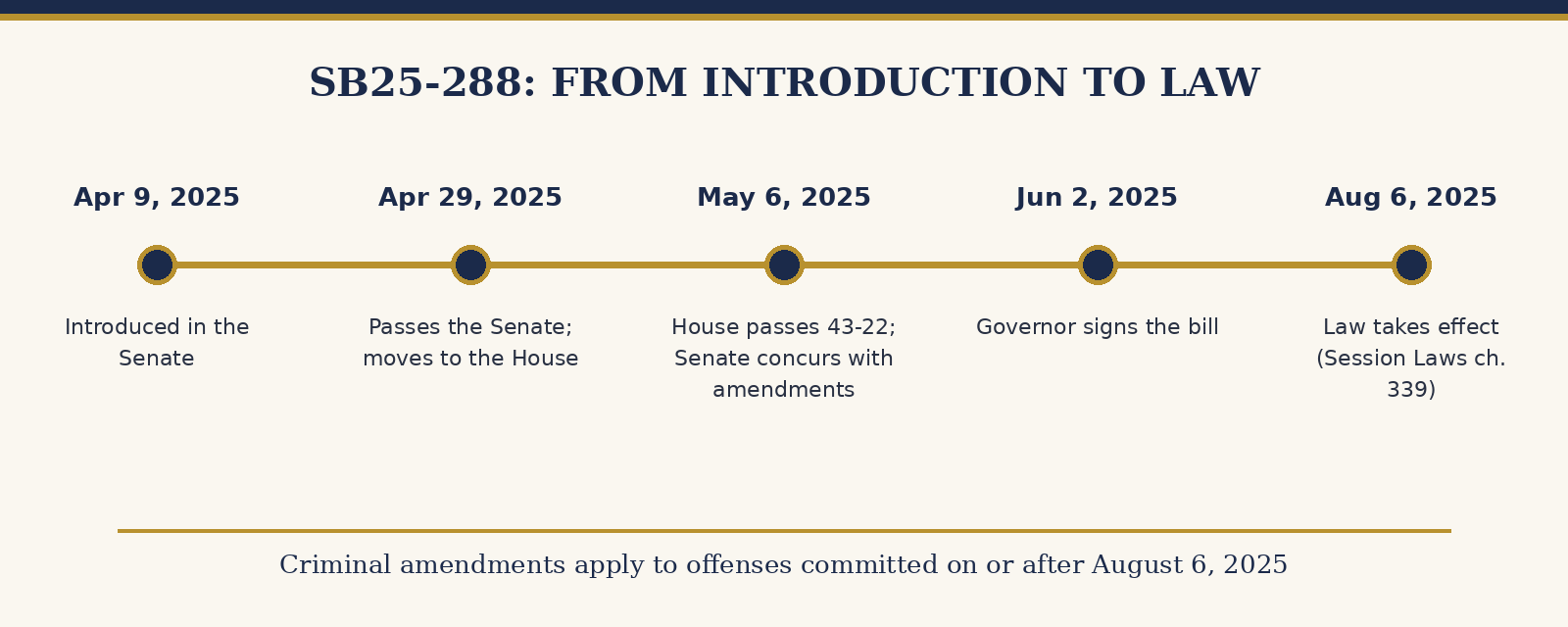
Governor Polis signed the bill on June 2, 2025, and it took effect on August 6, 2025 (Session Laws chapter 339).
The act works on four fronts:
- Criminal disclosure offenses. It amends C.R.S. § 18-7-107 (harassment) and § 18-7-108 (pecuniary gain) so they reach the actual or threatened disclosure of a private intimate image or an AI-generated or digitally altered “intimate digital depiction.”
- Sexual exploitation of a child. It amends § 18-6-403 so that “sexually exploitative material” includes a realistic computer-generated or altered depiction of an identifiable child.
- Juvenile offenses. It amends § 18-7-109 so the same concepts apply to people under 18, with lighter penalties.
- A new civil cause of action. It adds the Preventing Unauthorized Disclosure of Intimate Digital Depictions Act, C.R.S. §§ 13-21-1501 through 13-21-1507.
What Counts as an “Intimate Digital Depiction”
The statute does not reach every edited photo.
Under the criminal provisions, a “digital depiction” must be all of the following:
-
- a photograph, film, recording, digital file, or other highly realistic visual depiction of a person;
- one that falsely appears to be authentic or truthful and shows the person acting in a way the person did not act; and
- one that was created, altered, or produced through digitization or computer-generated means, expressly including generative AI and image editing software.
It becomes an “intimate digital depiction” when it shows the person’s intimate parts or sexual acts, and the person must be an identifiable adult, meaning recognizable by face, likeness, or another distinguishing characteristic such as a birthmark.
Handmade drawings and cartoons are expressly excluded.
One drafting point deserves attention. The criminal and civil provisions do not define the covered imagery identically. For example, the civil part defines “intimate parts” to include the buttocks and covers “sexual contact” and “explicit sexual conduct,” while the criminal part ties “sexual acts” to sexual intrusion or penetration as defined in 18-3-401 and defines “private intimate parts” without the buttocks.
Whether an image fits the particular statute charged is a legitimate question in every case.
The Criminal Charges: Two Offenses, One Structure
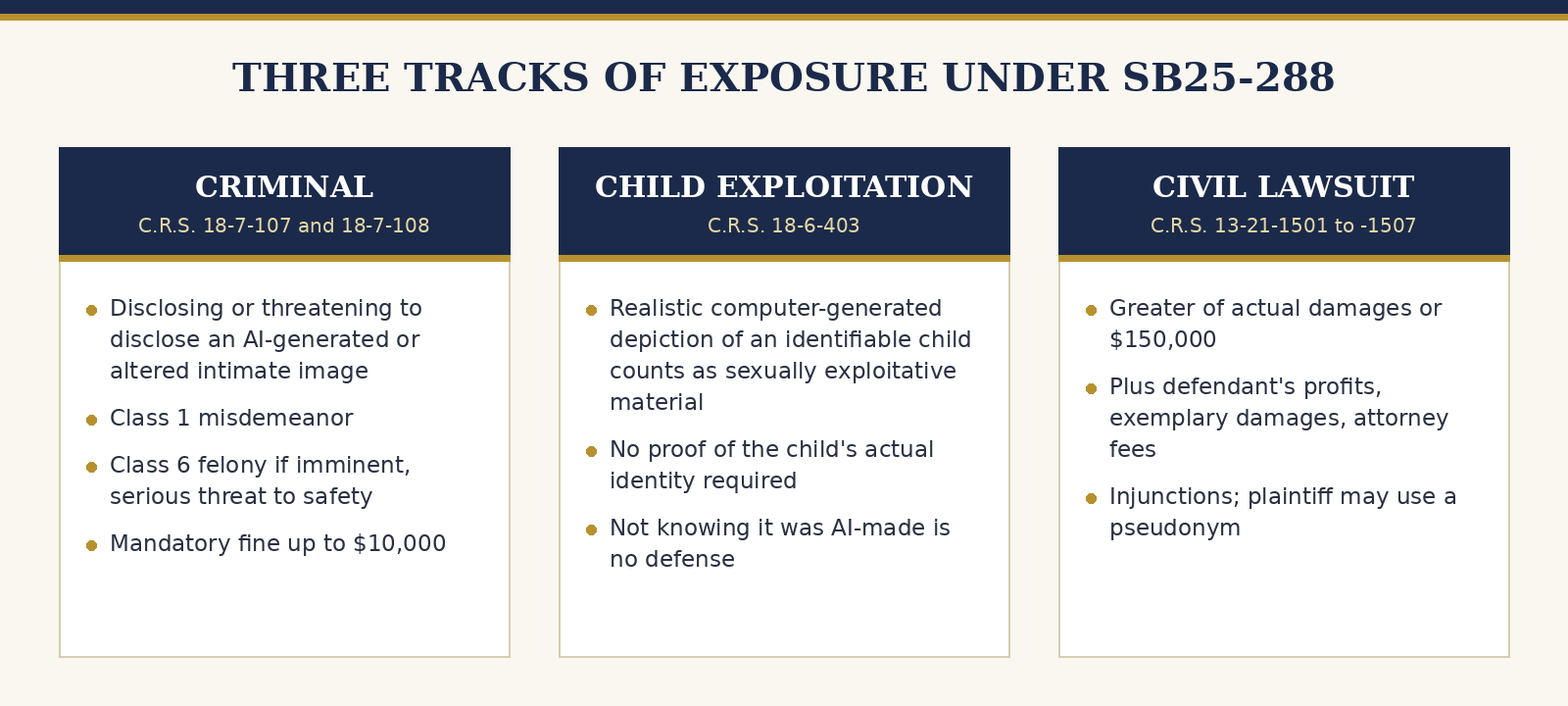
The two offenses, § 18-7-107 (harassment) and § 18-7-108 (pecuniary gain), both require an actor who is 18 or older and who discloses, or threatens to disclose, a private intimate image or an intimate digital depiction through electronic media or a website without the depicted person’s consent.
“Disclose” is defined broadly to mean transfer, publish, distribute, or make accessible, and “electronic media” includes direct messages and email, so a single private message can qualify.
| Element | Harassment Offense | Pecuniary Gain Offense |
|---|---|---|
| Mental state or circumstances | Intent to harass, intimidate, or coerce the depicted person; OR the actor knew or reasonably should have known the person expected the image to stay private | Intent to obtain a pecuniary benefit from the disclosure, threat, or retraction; OR the actor knew or reasonably should have known the person expected privacy and that disclosure would cause financial harm |
| Harm | The disclosure or threat caused physical, emotional, or reputational harm | Financial harm (on the privacy-expectation route) |
| Classification | Class 1 misdemeanor; class 6 felony if the disclosure posed an imminent and serious threat to safety | Class 1 misdemeanor; class 6 felony if the disclosure posed an imminent and serious threat to safety |
| Added penalty | Mandatory fine of up to $10,000, paid into the crime victim compensation fund | Mandatory fine of up to $10,000, paid into the crime victim compensation fund |
For context, a class 1 misdemeanor committed since March 1, 2022 generally carries up to 364 days in jail and a fine of up to $1,000 under § 18-1.3-501, and a class 6 felony carries a presumptive 12 to 18 months in prison plus one year of mandatory parole under § 18-1.3-401.
The $10,000 mandatory fine described above is on top of those penalties. The statute also keeps a rule that matters in practice: it is not a defense that the image came with a disclaimer saying it was unauthorized or that the depicted person did not take part in creating it.
Labeling an image “AI-generated” does not make sharing it legal.
Where the Defense Usually Starts
- Who actually disclosed it. Attribution is often the weakest link. Shared devices, shared accounts, spoofed profiles, and anonymous uploads all raise real questions about who sent or posted the image.
- Whether the image meets the definition. The statute requires a highly realistic image that falsely appears authentic. Obvious fakes, stylized images, and cartoons may fall outside it, and that can be a question for forensic or expert review.
- Identifiability. The depicted person must be identifiable by face, likeness, or distinguishing feature. A generic or composite figure is a different case.
- What was actually threatened. A “threat to disclose” is covered, so the prosecution must show a real threat tied to a qualifying image, not just angry words.
- Mental state and harm. Intent to harass or a reasonable expectation of privacy, plus resulting harm, are elements the prosecution must prove beyond a reasonable doubt.
- Consent and context. The criminal sections turn on whether the depicted person consented to the disclosure. Messages, prior sharing, and the relationship history all matter.
- Constitutional questions. The criminal statute contains narrow good-faith exceptions, for reports to law enforcement and for use in a criminal proceeding under the section, but it has no express parody, satire, or public-concern exception like the one in the civil part. Whether that raises First Amendment over breadth or vagueness issues depends on the facts of the case.
AI Images of Minors and the Child Exploitation Statute
The most severe part of the act amends the sexual exploitation of a child statute,C.R.S. § 18-6-403. “Sexually exploitative material” now includes a realistic visual depiction, created or altered by digitization or computer-generated means, of an “identifiable child” engaged in explicit sexual conduct.
The prosecution does not have to prove the child’s actual identity, and it is not a defense that the defendant did not know the image was computer-generated or altered.
Convictions for this offense carry felony exposure and can carry sex offender registration consequences, so these cases call for early, careful representation. Juvenile conduct that is limited to the elements of the petty offense of possession, or the civil infraction of exchange, under § 18-7-109 is shielded from prosecution under the felony provisions.
Juveniles: A Separate Track
Section 18-7-109 now applies to disclosing, possessing, or exchanging private intimate images or intimate digital depictions by a juvenile. Disclosure is a class 2 misdemeanor, rising to a class 1 misdemeanor with intent to coerce or intimidate, a prior program or adjudication, or three or more depictions of three or more people.
Possession is a petty offense, and a juvenile who deletes the image or reports it within 72 hours of first viewing is not in violation. Exchange is a civil infraction handled through an education program or a fine of up to $50. Coercion is an affirmative defense.
The Civil Side: $150,000 Without Proving a Dollar of Loss
Separately from any prosecution, a depicted person who has been harmed can sue under C.R.S. § 13-21-1503 if the defendant knew, or acted with reckless disregard for whether, the person did not consent, would suffer severe emotional distress, and was identifiable.
A prevailing plaintiff may recover:
- the defendant’s monetary gain from creating or disclosing the depiction;
- the greater of actual damages (including emotional distress) or liquidated damages of $150,000;
- exemplary damages; and
- costs and reasonable attorney fees, plus injunctive relief ordering the defendant to stop disclosing the image.
Under the civil act, consent to creating an image is not consent to disclosing it; earlier consensual sharing does not by itself establish consent to later sharing; and consent is valid only if set out in a signed, plain-language agreement that describes the image and its specific use.
A civil suit can run alongside a criminal case, which creates its own risks. Anything said in a civil answer or deposition can surface in the prosecution, so coordinating the two proceedings, including Fifth Amendment concerns and the possibility of a stay, is part of defending these cases well.
The civil act also does not extend to the provider of the technology used to create the image, nor does it impose liability on platforms for content posted by others.
The Federal Overlay: The TAKE IT DOWN Act
Colorado is not the only sovereign watching this conduct. The federal TAKE IT DOWN Act (Pub. L. 119-12, codified at 47 U.S.C. § 223(h)), signed May 19, 2025, criminalizes knowingly publishing nonconsensual intimate images, including AI-generated “digital forgeries” of identifiable people, with imprisonment of up to two years in the adult-victim publication offenses and higher maximums when minors are involved.
Covered online platforms had until May 19, 2026, to set up a notice-and-removal process. Because state and federal prosecutors are separate sovereigns, one post can in principle expose a person to both.
If You Are Under Investigation or Have Been Charged
- Do not contact the accuser or ask anyone else to. Even a well-meant apology can be framed as harassment, intimidation, or witness interference.
- Do not delete or alter files, accounts, or messages. Destroying evidence can create a separate charge, such as tampering with physical evidence under C.R.S. §18-8-610, in addition to the original allegation. Let your attorney direct what is preserved.
- Do not explain yourself to police. Statements about who created or sent an image are often the prosecution’s best proof of identity and intent.
- Call a criminal defense attorney right away. Early involvement can affect how a search warrant is challenged, how devices are handled, and whether charges are filed at all.
Sources
- Colorado General Assembly, SB25-288 bill page and summary
- SB25-288 as signed (enrolled act text)
- C.R.S. § 18-7-107, disclosing a private intimate image or intimate digital depiction for harassment
- C.R.S. § 18-7-108, disclosing a private intimate image or intimate digital depiction for pecuniary gain
- C.R.S. § 18-7-109, disclosure, possession, or exchange by a juvenile
- C.R.S. § 18-6-403, sexual exploitation of a child
- C.R.S. §§ 13-21-1501 to -1507, Preventing Unauthorized Disclosure of Intimate Digital Depictions Act (see Sections 1 and 2 of the signed act)
- C.R.S. § 18-3-401, definitions (sexual intrusion and sexual penetration)
- C.R.S. § 18-8-610, tampering with physical evidence
- C.R.S. § 18-1.3-401, felony classification and presumptive penalties
- C.R.S. § 18-1.3-501, misdemeanor classification and penalties
- 47 U.S.C. § 223(h), federal nonconsensual intimate visual depictions provision
- KRDO: New law cracking down on AI “revenge porn”
- Congressional Research Service, The TAKE IT DOWN Act (LSB11314)
This article is provided for general informational purposes only and is not legal advice. Reading it does not create an attorney-client relationship. Laws change, and every case turns on its own facts; consult a licensed Colorado attorney about your situation. Past results do not guarantee a similar outcome. Attorney advertising.