 Colorado Criminal Lawyer Blog
Understanding Colorado Crimes: Criminally Negligent Homicide §18-3-105


 Introduction
If you have never heard the phrase “criminally negligent homicide” before, you are not alone. Most people assume homicide always means intent. Like, somebody meant to hurt somebody.
Colorado does not frame it that narrowly.
Colorado’s criminally negligent homicide statute, C.R.S. §18-3-105, is basically the state saying: sometimes people die because someone was careless in a way the law considers criminal. Not evil. Not intentional. But still blameworthy enough that the system treats it as a homicide charge.
This is a plain English explanation of the statute, how prosecutors typically use it, what “criminal negligence” actually means in Colorado, what the penalties look like, and the defenses that come up in real cases.
Colorado Criminally Negligent Homicide — C.R.S. § 18-3-105
The Statute
Criminally negligent homicide is defined as of September 1, 2026, C.R.S. § 18-3-105. The law provides:
(1)(a) A person who causes the death of another person by conduct amounting to criminal negligence commits criminally negligent homicide.
(1)(b) If a person operates or drives a motor vehicle with criminal negligence and the conduct is the proximate cause of the death of another person, the person commits criminally negligent homicide.
(2) Criminally negligent homicide is a class 5 felony.
✓ Key Takeaway
Important recent change: SB26-072, signed by the Governor on May 28, 2026 and effective September 1, 2026, added a new subsection (1)(b) explicitly covering vehicular conduct — a person now also commits criminally negligent homicide if they operate or drive a motor vehicle with criminal negligence and that conduct is the proximate cause of another person’s death.
The act also repealed the old class 1 misdemeanor “careless driving resulting in death” traffic offense, giving prosecutors a felony charging option that sits between careless driving (misdemeanor) and vehicular homicide/reckless or DUI-related deaths (class 4 felony) (Colorado General Assembly; Bicycle Colorado legislative recap). The new law is a class 5 felony (non-extraordinary-risk).
This is a meaningful development as it changes how fatal crash cases can be charged going forward.
Note: SB26-072 also repeals the class 1 misdemeanor traffic offense that previously covered some fatal crashes. Supporters of the change framed it as filling a gap where Colorado’s District Attorneys had to choose between a class 1 misdemeanor and a class 4 felony; the bill also strips the language that automatically classified a fatal crash involving cell phone use as a class 1 misdemeanor, so such conduct can now be charged as criminally negligent homicide.
A conviction for criminally negligent homicide while driving now also triggers mandatory license revocation.
SB26-072, now lets prosecutors charge criminally negligent homicide against drivers whose negligence — not just recklessness or DUI — causes a death, closing the old careless-driving-misdemeanor loophole. It also covers how the charge differs from manslaughter and vehicular homicide, common defense angles (standard-of-care jury instructions, causation.
The Definition of “Criminal Negligence”
Under § 18-1-501(3), a person acts with criminal negligence when, through a gross deviation from the standard of care a reasonable person would exercise, they fail to perceive a substantial and unjustifiable risk that a result (here, death) will occur or that a circumstance exists.
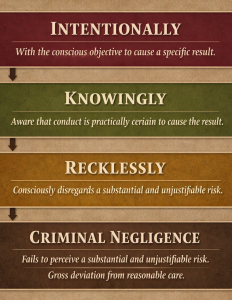 Criminal negligence is the lowest culpable mental state in Colorado’s homicide scheme — an unintentional killing, distinguished from manslaughter’s “recklessness” (conscious disregard of a known risk) because the negligent actor doesn’t even perceive the risk, though a reasonable person would have.
The Specific Elements the Prosecution Must Prove Broken Down
-
The defendant,
-
in the State of Colorado, at or about the date and place charged,
-
caused the death of another person,
-
by conduct amounting to criminal negligence.
Recklessness means you actually perceived the risk and disregarded it anyway.
Criminal negligence means you did not perceive the risk, but you should have.
The Penalty for Colorado Criminally Negligent Homicide — C.R.S. § 18-3-105
As a standard (non-extraordinary-risk) class 5 felony,the presumptive sentencing range is:
-
1 to 3 years in the Department of Corrections.
-
$1,000 to $100,000 fine.
-
2 years mandatory parole.
How Criminally Negligent Homicide C.R.S. § 18-3-105 – Differs From Related Homicide Offenses
-
Manslaughter (§ 18-3-104) — a class 4 felony — requires the person to recklessly cause death (consciously disregarding a known risk) rather than merely failing to perceive one. Courts have held that a jury sometimes cannot distinguish between the two on close facts.
-
Vehicular homicide (§ 18-3-106) is a class 4 felony – remains the more serious felony for deaths caused by reckless driving or DUI/DUID; the new § 18-3-105(1)(b) fills the gap for merely negligent (not reckless or impaired) driving that kills someone.
Note: Vehicular Homicide is a Class 4 felony for reckless driving (§ 18-3-106(a)) and for DUI-related vehicular homicide (§ 18-3-106(b)(I.5)) but it is a Class 3 felony for DUI-related vehicular homicide (§ 18-3-106(b)(I)).
The Exact Legal Ideas Underlying The Importance Of Mental States In Colorado Criminal Cases
Colorado separates homicide charges largely by mental state. Meaning, what was going on in your mind, and the risk you should have perceived.
Here’s the usual ladder, simplified:
- First-degree murder: intentional, with additional factors.
- Second-degree murder: knowingly causing death.
- Manslaughter: recklessly causing death (you knew the risk and disregarded it).
- Criminally negligent homicide: you should have known the risk, but you failed to perceive it.
So negligent homicide is not “an accident” in the casual sense. It is an accident that the law thinks you could have prevented if you were acting like a reasonable person.
That word “reasonable” matters more than people realize.
A Closer Look at What “Criminal Negligence” Means Under Colorado Law
Colorado defines mental states in a separate statute (the general definitions section). Criminal negligence is essentially:
You fail to perceive a substantial and unjustifiable risk that a result will occur (here, a death), and that failure is a gross deviation from the standard of care a reasonable person would use.
Three pieces prosecutors try to prove:
- There was a substantial and unjustifiable risk.
- You failed to perceive it.
- That failure was a gross deviation from reasonable care.
Not a small mistake. Gross deviation. That is where the argument tends to live.
Civil Negligence vs. Criminal Negligence
People hear “negligence” and think of car insurance. Civil lawsuits. Money damages.
Criminal negligence is a higher form of negligence. It is not just being imperfect. It is so careless that the state wants to punish you, not just make you pay.
A person can be civilly negligent and not criminally negligent.
Three things distinguish it from ordinary civil negligence and from the higher mental states used in Colorado’s other homicide statutes:
-
It’s a failure to perceive, not a conscious choice. Unlike manslaughter, which requires the defendant to consciously disregard a risk they recognized, criminally negligent homicide punishes someone who never recognized the risk at all — but should have.
-
The deviation must be “gross.” Ordinary carelessness — the kind that supports a civil negligence lawsuit — is not enough. The conduct must fall far below what a reasonable person would do under the circumstances.
-
The “reasonable person” standard can shift with the defendant’s role. As the Elijah McClain litigation showed, when a defendant has specialized training — a paramedic, a nurse, a commercial driver — the applicable standard of care may be that of a reasonable person in that profession, not a generic member of the public. No statute defines this precisely, which is exactly why it became the central issue on appeal (Justia — People v. Cooper, 2026 COA 44).
This is why these cases often turn into battles of experts, reconstruction, timelines, training, warnings, signage, prior incidents, and common practices.
Common Real-World Scenarios For Criminally Negligent Homicide
There is no single “typical” negligent homicide case, but you see patterns.
1) Vehicle-related deaths (non-DUI and sometimes DUI-adjacent)
Not every fatal crash is a crime. But prosecutors may look at negligent homicide when there is something more than ordinary driving error, such as these examples:
- Falling asleep at the wheel after ignoring obvious fatigue signals.
- Extremely unsafe passing.
- Driving with an obstructed windshield or unsafe load.
- Ignoring known mechanical issues that make the vehicle dangerous.
- Texting or distraction, depending on facts and level of risk.
Important note: Colorado also has vehicular homicide statutes, including for DUI. So charging decisions depend on impairment evidence, driving conduct, and what the prosecution can prove.
2) Firearms “accidents”
These can be charged when someone handles a gun as if it were a toy.
Examples that tend to trigger criminal negligence arguments:
- Thinking a gun is unloaded without checking, then firing.
- Pointing a firearm at someone as a “joke.”
- Unsafe storage that leads to a fatal discharge, depending on circumstances.
- Cleaning or manipulating a firearm in a reckless environment.
Firearm cases often hinge on basic safety rules and whether the defendant’s actions were a gross deviation from them.
3) Child care and vulnerable adult cases
These are some of the hardest cases emotionally and legally.
Negligent homicide might be alleged where a caregiver:
- Leaves a child in a hot car.
- Provides access to hazards and fails to supervise.
- Fails to seek medical care in a situation where a reasonable person would.
- Ignores obvious signs of distress, illness, overdose, or injury.
The key is always the same question. Was there a substantial and unjustifiable risk, and was the failure to perceive it a gross deviation from reasonable care?
4) Workplace and “safety” related deaths
Sometimes these are handled as regulatory matters. Sometimes they turn criminal, especially when there is evidence of:
- Bypassing safety protocols.
- Ignoring repeated warnings.
- Using equipment in obviously dangerous ways.
- Failing to follow required procedures where the risk is clear.
These cases can be complicated because you may have multiple actors, complex chains of supervision, training issues, and corporate policies. The defense will often argue that the causation of the injury is too attenuated to sustain a criminal charge.
5) Drug overdose death situations
Colorado has other statutes that might be used in overdose contexts depending on the facts, but negligent homicide can come up when the theory is that someone created a dangerous situation and failed to perceive a deadly risk.
These cases are fact-sensitive. Very. The legal fight often centers on causation and foreseeability, as well as what the person knew or should have known about potency, the mixing of substances, and the victim’s condition.
The Elements the Prosecution Must Prove – Revisited For Clarity
While jury instructions can vary by case, the basic idea is consistent. The state generally must prove beyond a reasonable doubt that:
- The defendant caused the death of another person, and
- The defendant acted with criminal negligence
That “caused the death” is a key issue.
Causation Explained
Colorado cannot convict just because you were negligent and someone died nearby. The prosecution must link your conduct to the death.
This involves causation issues:
- Actual cause: but for the defendant’s conduct, the death would not have occurred.
- Proximate cause: the death was a reasonably foreseeable result, not some freak chain of unrelated events.
Intervening causes also matter. Medical complications matter. The victim’s actions sometimes matter, and third parties’ actions also matter.
If the defense can “break” causation, they may be able to “break” the case.
Restitution
In homicide cases, restitution is common and can be substantial, and it may include:
- Funeral and burial costs.
- Medical expenses prior to death.
- Counseling costs in some circumstances.
- Other losses allowed under Colorado restitution law.
Restitution is not the same as a civil wrongful death lawsuit, but restitution orders can still be financially very substantial.
Collateral Consequences
Even if someone avoids prison, a felony conviction can affect:
- Employment (background checks, professional licensing).
- Housing.
- Immigration status (non-citizens need immediate, specific counsel).
- Firearm rights (a huge issue after any felony conviction).
The Investigation of Criminally Negligent Homicide Cases
Negligent homicide cases usually start with tragic circumstances. And then there is a slow build of evidence.
Investigations can include:
- Accident reconstruction.
- Body camera footage and 911 recordings.
- Toxicology.
- Phone downloads (distraction cases).
- Surveillance video.
- Interviews with witnesses, friends, coworkers.
- Training manuals, policies, warnings.
- Autopsy results and medical examiner opinions.
Common Defenses In Criminally Negligent Homicide Cases
There is no one-size-fits-all defense. But there are themes.
1) It was not criminal negligence, at most ordinary negligence
This is often the central defense.
The argument is basically:
- The risk was not substantial and unjustifiable, or
- A reasonable person could have missed it too, or
- The conduct was a mistake, not a gross deviation from reasonable care.
Defense lawyers usually push hard on the “gross deviation” language. Because that is the line between a terrible accident and a felony.
2) Causation is not provable beyond a reasonable doubt
This defense focuses on:
- Intervening events.
- Pre-existing medical conditions.
- Actions of the deceased.
- Third-party actions.
- Timing and medical evidence.
If the prosecution cannot clearly connect the defendant’s conduct to the death, the charge can collapse.
3) The facts are being overcharged (manslaughter vs. negligent homicide, or vice versa)
Sometimes the defense wants to show that the state is stretching a theory upward. Sometimes it is the opposite.
In a case where the state files manslaughter, the defense may argue it should be negligent homicide because the defendant did not perceive the risk.
In a case where the state files negligent homicide, defense may argue it should be a non criminal matter because the conduct was not grossly careless.
4) Expert battles
In many negligent homicide cases, experts are critically important.
- Crash reconstruction experts.
- Firearms experts.
- Medical experts.
- Human factors experts (attention, perception, reaction time).
- Toxicologists.
Two experts can look at the same data and tell two very different stories. Juries are left to decide who is more credible and whose story fits the evidence.
5) Constitutional issues, improper statements, and suppression
Depending on the investigation, issues can come up, such as:
- Unlawful searches (phones, vehicles, homes).
- Miranda violations.
- Coerced or unreliable statements.
- Chain of custody problems.
These are technical, but they matter. A suppressed phone extraction or excluded statement can change the entire posture of a case.
Is Probation Possible?
Yes, often it depends on:
- The specific facts (how extreme the conduct was).
- The defendant’s criminal record.
- Whether alcohol or drugs were involved.
- Whether there are aggravating circumstances.
- The county and the DA’s policies.
- What a judge will accept.
Even when probation is legally available, it may come with strict conditions, including jail time, treatment, community service, and long-term supervision.
What Should Someone Do if They Are Under Investigation for Criminally Negligent Homicide?
This is not legal advice for your specific situation, but as a general reality check:
- Do not “talk it out” with police, hoping it will clear things up. Your statements often become evidence of your mental state.
- Preserve evidence that helps you (texts showing warnings, maintenance records, training logs, phone location data, surveillance requests). This stuff disappears.
- Get a lawyer early. Not later, not after the interview, early. Negligent homicide cases are built in the first days and weeks.
And if you are a non-citizen, treat this as two emergencies at once. Criminal and immigration. You need counsel who will take that seriously.
How can this charge be resolved?
A lot of criminally negligent homicide cases end in:
- Dismissal (rare, but it happens when proof falls apart).
- Plea to the charge as filed.
- Plea to a lesser offense (depending on facts.)
- Trial and verdict.
Because these cases are emotionally intense, both sides usually prepare as if they are going to trial, even when a plea is likely. That preparation drives outcomes.
Quick Recap
- C.R.S. §18-3-105 is Colorado’s criminally negligent homicide statute.
- It applies when someone causes a death by criminal negligence.
- Criminal negligence means failing to perceive a substantial and unjustifiable risk, and that failure is a gross deviation from reasonable care.
- The big fights are usually about mental state and causation.
- It is generally a felony, with life-changing consequences even if prison is not the outcome.
If you are reading this because something awful happened and you are trying to understand what you are facing, focus on two questions. What exactly is the state claiming the risk was, and what evidence do they have that you should have perceived it?
The Big Change: SB26-072 and Vehicular Criminally Negligent Homicide
For years, Colorado prosecutors handling fatal car crashes faced an awkward gap. If a driver’s conduct was reckless or impaired, they could be charged with vehicular homicide — a class 3 or class 4 felony. But if the driver was merely careless or inattentive — not reckless, not drunk, just negligent — the only option was often “careless driving resulting in death,” a class 1 misdemeanor traffic offense with comparatively minor consequences.
The act does three things that matter directly to Colorado drivers:
-
Adds motor vehicle deaths to § 18-3-105. A driver whose criminal negligence proximately causes a death can now be charged with criminally negligent homicide — a class 5 felony — instead of only the old misdemeanor.
-
Repeals the misdemeanor cell-phone carve-out. Previously, causing a death while driving and using a mobile electronic device was, by statute, automatically only a class 1 misdemeanor. That carve-out is gone; such conduct can now be charged as a felony.
-
Adds mandatory license consequences. A conviction under the new § 18-3-105(1)(b) now triggers mandatory license revocation, the same consequence that already applied to vehicular homicide convictions, and it can count toward “habitual offender” status after repeated violations.
Quick Reference: Criminally Negligent Homicide After SB26-072
This table summarizes the statute’s core mechanics for general orientation only and is not a substitute for case-specific legal advice.
FAQs (Frequently Asked Questions)
What is criminally negligent homicide under Colorado law?
Criminally negligent homicide, defined by Colorado statute C.R.S. §18-3-105, occurs when a person causes the death of another by failing to perceive a substantial and unjustifiable risk, which is a gross deviation from the standard of care a reasonable person would exercise. It does not require intent or evil, but rather criminal negligence.
How does criminally negligent homicide differ from manslaughter in Colorado?
The key difference lies in the mental state: manslaughter requires recklessness, meaning the person actually perceived and disregarded a risk; criminally negligent homicide requires criminal negligence, meaning the person failed to perceive a risk they should have recognized. This distinction affects penalties and legal strategies.
What does ‘criminal negligence’ mean in the context of Colorado’s homicide laws?
Criminal negligence means failing to perceive a substantial and unjustifiable risk that results in death, where such failure is a gross deviation from what a reasonable person would do. It’s more severe than ordinary negligence and implies blameworthy carelessness punishable by law.
In what real-world scenarios might someone be charged with criminally negligent homicide in Colorado?
Common scenarios include vehicle-related deaths involving careless driving beyond ordinary errors (like falling asleep at the wheel), firearm accidents due to unsafe handling or storage, child care or vulnerable adult neglect leading to fatal outcomes, and workplace safety violations causing death.
Is criminally negligent homicide considered an accident or a crime in Colorado?
While it may be called an accident colloquially, under Colorado law criminally negligent homicide is treated as a crime because it involves gross deviation from reasonable care. It reflects blameworthy conduct where the individual should have recognized and avoided a substantial risk that led to death.
What factors do prosecutors consider when proving criminally negligent homicide charges?
Prosecutors typically aim to prove three elements: there was a substantial and unjustifiable risk of death; the defendant failed to perceive this risk; and this failure was a gross deviation from reasonable care. Evidence often includes expert testimony, timelines, warnings, prior incidents, and common safety practices.
Additionally, prosecutors may examine the defendant’s background or training to assess whether they should have been aware of the risk. Circumstantial evidence, such as disregard for safety protocols, can also play a crucial role in building the case.
Colorado Criminal Law –Understanding Colorado Crimes: Criminally Negligent Homicide §18-3-105
The reader is alerted that Colorado criminal law, like criminal law in every state and at the Federal level, changes constantly. The article above was accurate when it was drafted, but it cannot account for changes that occurred after it was uploaded.
 ABOUT THE AUTHOR: H. Michael Steinberg – Email the Author at: hmsteinberg@hotmail.com
A Denver, Colorado Criminal Defense Lawyer – or call his office at 303-627-7777 during business hours – or call his cell if you cannot wait and need his immediate assistance – please call 720-220-2277.
“A good criminal defense lawyer is someone who devotes themselves to their client’s case from beginning to end, always realizing that this case is the most important thing in that client’s life.”
Putting more than 40 years of Colorado criminal defense experience to work for you.
You should be careful to make a responsible choice when selecting a Colorado criminal defense lawyer. We encourage you to “vet” our firm. Over the last 40 years – by focusing ONLY on Colorado criminal law – H. Michael has had the time to continually update himself in nearly every area of criminal law, including Colorado criminal law, procedure, and trial and courtroom practice.
H. Michael works hard to deliver the best possible results for his clients, both in and out of the courtroom. He has written extensively on Colorado criminal law and continues to do so, and he hopes this article helps you in some small way.