 Colorado Criminal Lawyer Blog
Colorado Police Cell Phone Searches: The Law In 2026



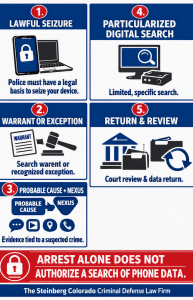
Colorado police generally may seize a cell phone or computer when a lawful arrest, warrant, consent, probable cause plus a recognized seizure doctrine, or a genuine emergency permits them to take control of the device.
But lawful possession of the hardware does not automatically authorize examination of its digital contents.
Under Riley v. California and Colorado law, an arrest alone does not permit police to browse messages, photographs, applications, files, or other stored data; police must obtain a search warrant or establish a separate, narrowly defined exception to the warrant requirement.
Modern “Digital” Warrants
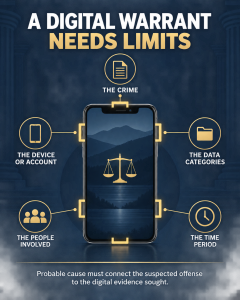
A valid digital-device warrant must rest on a sworn statement showing probable cause and a nexus connecting the suspected offense, the particular device or account, and the categories of data sought.
The statement must also specifically describe the device or account and cabin the search by the alleged crime, relevant victims or participants, data categories, and an appropriate time period.
This article is a plain English guide to what’s legal in Colorado right now, what the police can and cannot do, and what you can say or should not say in the moment to avoid making things worse.
Your Phone Is Basically Your Life in a Small Rectangle
Messages. Photos. Banking. Maps. Health information. That note you wrote at 2:00 am and never told anyone about. If a cop asks to “take a quick look” or tries to grab it during a stop, it is a different task than just a wallet search. It feels more personal.
Because it is.
Colorado has its own laws and courts, but the big rules for phone searches mostly come from the US Constitution and a handful of court cases that recently changed everything. As of 2026, the short version is this: police usually need a warrant to search the contents of your phone, but there are exceptions. And the exceptions are where people can get burned.
Here is an excerpt from a recent Colorado case explaining the view of the courts to the Riley case:
The Court recognized that modern cell phones can store very large quantities of data and many people‘s phones contain a vast array of private information. Moreover, it is often difficult to distinguish between information stored on the cell phone and information merely accessed with the cell phone but stored elsewhere. Consequently, a search of a cell phone is not the “narrow intrusion on privacy” that other searches incident to arrest are. instead, searching a cell phone is an intrusion on many of “the privacies of life,” (quoting Boyd v. United States, 116 U.S. 616, 630 (1886)).
Based on these modern realities, and the fact that searching a cell phone is seldom necessary to prevent the destruction of evidence or protect officer safety, the Court held that a warrant is required to search a cell phone even if the phone is discovered during a lawful search incident to arrest.
The Core Rule: Your Phone Is Not “Just Another Object” to Search
For years, police leaned on old search rules. If they could search your pockets, they figured they could search what was in your pockets. Then smartphones happened.
The key modern rule comes from the US Supreme Court case Riley v. California (2014). The Court basically said that a smartphone contains a massive amount of private information, so police generally need a warrant to search it, even if they arrest you.
That principle applies in Colorado. Colorado courts treat phone contents like highly protected information. The state constitution also has a search-and-seizure clause (similar to the Fourth Amendment) that, in some contexts, can be interpreted even more protectively than the federal baseline.
Therefore, if the police want to look through your photos, read your texts, scroll your DMs, open your email, check your notes, search your browser history, or go through your apps, with very few exceptions, they usually need a warrant signed by a judge.
And not a vague warrant, either. It must be specific. More on that later.
The Biggest Trap: “Do You Mind If I Look?”
Many phone searches are not warrant searches. they are consent searches.
Meaning the officer asks, you say yes (or something that sounds like yes), and now they do not need a warrant. And once you consent, the fight shifts from “Was there a warrant?” to “Was consent voluntary, and “how far did it go?” That’s a harder argument, and it’s messy.
Some ways people accidentally consent:
- “Sure, I guess.”
- “It’s fine; I have nothing to hide.”
- Unlocking the phone and handing it over.
- Saying “Okay” after the officer says it’ll be “quick.”
- Trying to “prove” you’re innocent by showing one thing, then the officer starts clicking around.
Here’s the uncomfortable truth: consent is the easiest legal pathway for a phone search. If you say yes, you’re giving law enforcement a shortcut around the warrant requirement.
If you don’t want them searching your phone, your best move is to be calm and clear:
“I do not consent to a search of my phone.”
That sentence matters. In Colorado. In court and especially in body cam footage.
Now, will they still take the phone? They might. But saying you don’t consent helps protect you later if they search anyway or try to expand what you allowed.
Can Police Seize Your Phone, Even If They Can’t Search It?
Yes. They can sometimes seize the phone, meaning take possession of it, without immediately searching it.
This happens a lot in cases where police claim the phone might contain evidence and they don’t want it destroyed.
Common scenarios:
- During an arrest, they take what you have on you. They can hold the phone.
- They believe the phone contains evidence of a crime, and they want to “preserve” it while applying for a warrant.
- They have a valid search warrant for your home or car and seize devices listed in the warrant.
But there’s a difference between holding it and digging through it. Riley v. California (2014). drew that line sharply.
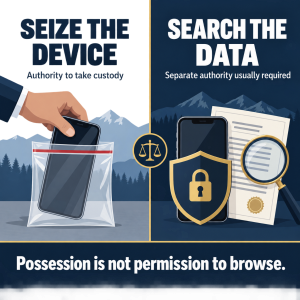 So yes, a seizure can be legal even when a search is not. Still, police do not get unlimited time. If they seize your phone and keep it forever without a warrant, that can become a legal problem.
The exact timing issues are fact-specific, but courts look at whether the police acted reasonably and diligently.
Search Incident to Arrest: What Still Applies, and What Doesn’t
Colorado officers can search certain things incident to arrest. That’s the classic rule: you arrest someone; you can search their person and nearby area for weapons or evidence. But cell phones changed the game.
What police can do incident to arrest (usually):
- Take the phone off your person.
- Secure it so it can’t be used as a weapon (rare, but that’s the theory).
- Prevent you from destroying evidence in the moment (again, limited).
What they usually cannot do incident to arrest without a warrant:
- Scroll through the phone.
- Read texts.
- Open photo galleries.
- Search apps.
- Look through call logs and contacts just because you were arrested.
There are some edge cases officers argue about, like quickly checking the screen for something visible without unlocking it, or “plain view” notifications that pop up. But the baseline is: arrest does not automatically equal phone-content search.
The “Exigent Circumstances” Exception: When They Say There Wasn’t Time for a Warrant
Exigent circumstances is the legal term used for emergency circumstances.
Police sometimes search without a warrant if waiting would create a real risk; examples include:
- Someone is in immediate danger.
- There’s an urgent threat (kidnapping, active assault situation).
- Evidence is about to be destroyed, and they can’t reasonably stop it any other way.
But courts don’t like vague “what if” excuses. The emergency has to be real and specific.
An example is a fact pattern where the police have credible info a missing child is being trafficked and the suspect’s phone has current location data that could save the child right now.
Example that’s shakier: “We thought he might delete texts.” That’s often not enough because police can seize the phone, put it in airplane mode, or place it in a Faraday bag to block signals while they obtain a warrant.
So in Colorado, like most states, exigent circumstances can justify a warrantless phone search, but it’s not a free pass. It’s one of the first things defense attorneys attack.
Car Stops in Colorado: Can They Search Your Phone Because You’re in a Vehicle?
Being in a car does not magically reduce phone privacy. The car has its own search rules (probable cause, automobile exception, inventory search, etc.), but those rules generally apply to the vehicle and its contents, not to the digital contents of your phone.
So if you get pulled over in Denver, Aurora, Colorado Springs, Fort Collins, wherever, and the officer has probable cause to search the car, that doesn’t automatically allow them to search your phone’s contents. They might seize it, but searching it is different.
Also, if the officer asks for your phone to “verify insurance” or “pull up your registration,” you can show the document without handing over your phone.
A practical move is to keep insurance cards and registration available without unlocking your whole phone, such as a printed copy or a lock screen widget if your device supports it.
Inventory Searches: “We Towed Your Car, So We Searched Everything”
Colorado police can conduct an inventory search when they lawfully impound a vehicle. The stated purpose is to document property, protect the owner’s items, and reduce claims against the police department.
Inventory searches are not supposed to be investigative fishing trips. In real life, inventories can feel an intrusive “back door” search. But even then, applying an inventory-search idea to the contents of a phone runs into the same Riley problem because digital content is different.
If your phone is found in the car during an inventory search, law enforcement can note it and secure it. But going through it “to inventory it” is not the same thing.

When The Police Have A Warrant: How It Works – The Two Stages
Police ordinarily execute a digital warrant in two stages:
(1) officers first seize or copy the device or electronically stored information within the warrant’s execution period, then
(2) they conduct a later off-site forensic review consistent with the warrant.
Colorado Rule of Criminal Procedure 41 expressly recognizes this two-step process and permits the inventory to identify the physical media seized or copied rather than every responsive file discovered.
The Two Decisions
A sound analysis separates the investigation into two government actions:
| Government action | What it means | Usual legal question |
| Seizure | Taking physical custody of a phone, computer, drive, or other medium, or meaningfully interfering with its possession | Did police have a warrant, lawful arrest authority, probable cause with a recognized seizure doctrine, consent, abandonment, probation/parole authority, or an emergency? |
| Search | Viewing, extracting, decoding, copying, querying, or analyzing digital information | Did a warrant or a specific exception authorize access, and did the examination remain within the authorized scope? |
✓ Key Takeaway
A phone may therefore be lawfully removed from an arrested person, yet it may be unlawfully searched if an officer begins opening applications or reviewing data without further authority.
Colorado’s Court of Appeals has applied Riley beyond phones, holding that police could not search the contents of an iPod merely as an incident of arrest search.
Probable Cause and Warrants: What a Phone Search Warrant Needs in Colorado
If the police want to do it the clean way, they get a warrant.
In Colorado, warrants are issued by a judge based on probable cause supported by an affidavit. The warrant should describe with reasonable particularity what they’re allowed to search and seize.
For phone warrants, that often means:
- The specific device (or devices).
- The categories of data (texts, photos, location data, app records).
- A date range.
- The crime being investigated.
- Sometimes keywords or account identifiers.
Now, warrants can be overbroad. It happens. A warrant that basically says “search the entire phone for anything relevant” can be challenged. Courts often allow broad searches when the crime is broad, but judges also act as gatekeepers to this issue. This addresses the “scope” of the warrant, and Colorado criminal defense attorneys argue scope and particularity often in digital evidence cases.
There’s also the reality that even with a warrant, the search might be conducted later using forensic tools, rather than right there on the roadside. That’s common.
If the Police Searched Your Phone Illegally, What Would Happen?
The remedy is suppression. Meaning your lawyer asks the court to exclude evidence obtained through an unconstitutional search.
If the judge agrees, the prosecution may lose key evidence. Sometimes, but not always, depending on the other evidence in the case, the case may fall apart. Sometimes the state pivots to other evidence.
Suppression fights are technical. Prosecutors may argue:
- That the suspect consented.
- They had exigent circumstances.
- The search was within the scope of a warrant.
- The “good faith” exception applies (they relied on a warrant they thought was valid).
- The evidence would have been inevitably discovered anyway.
So yes, illegal searches can be punished in court. But it’s not automatic. It’s a fight.
Common Search Warrant Defects
| Defect | Why it matters | Defense inquiry |
| Generic statement that “criminals use phones” | Does not create a case-specific nexus | What facts connect this device and data to this offense? |
| “Any and all data” | Risks a “general search” | Are crime, victim, account, category, and time limits present? |
| Ownership evidence without limits | Can become a pretext for whole-device review | Was ownership genuinely disputed, and what minimal data would resolve it? |
| Excessive date range | Exposes unrelated private life | Why does probable cause cover the whole range? |
| Affidavit not incorporated | Details may not constrain execution | Did the warrant incorporate it, and did it accompany execution? |
| Seizing every device on premises | Lacks individualized device nexus | Which facts tied each device to evidence? |
| Review beyond authorized applications or files | Exceeds warrant scope | What did extraction and audit logs show? |
| Unreasonable delay | Prolongs interference with possession and privacy | Apply the Mills factors and examine diligence |
| Passcode or brute-force process not authorized | Access method may itself be a search | What did the warrant expressly permit? |
| Provider return broader than request | Creates a secondary scope problem | What did investigators retain, search, and use? |
The Suppression Process
Pretrial motions
 Colorado Rule 41(e) permits an aggrieved person to move for return of property and suppression in the district court where the property was seized; a suppression motion may also be filed in the trial court. Ordinarily, it must be made and heard before trial unless there was no earlier opportunity or the defendant lacked awareness of the grounds, although the court retains limited discretion to hear it at trial.
The suppression motion can allege:
- The device or data was seized without a warrant, and no exception applies.
- The warrant is facially insufficient.
- Police seized or searched material not described in the warrant.
- The affidavit failed to establish probable cause or nexus.
- The warrant was illegally executed.
- Consent was involuntary, or the search exceeded its scope.
- An emergency did not exist, or the response exceeded the emergency.
- Officers unreasonably delayed seeking judicial authorization.
- Passcode acquisition or compelled unlocking violated constitutional protections.
The Motion to Suppress Evidentiary Hearing
At the motions hearing, the trial judge reviews the evidence on disputed facts necessary to decide the motion. Relevant evidence may include body-camera video, consent forms, interview recordings, device property logs, warrant drafts, forensic examiner testimony, extraction reports, audit trails, keyword lists, provider returns, and evidence of when officers obtained, opened, imaged, and searched the device.
Four-Corners and Affidavit Challenges
If there is a search warrant, the probable-cause review generally focuses on the warrant application presented to the issuing judge. Separate procedures may permit a defendant to challenge intentional or reckless material falsehoods or omissions in the warrant affidavit. The defense must distinguish a weak inference from a material misrepresentation affecting the probable cause analysis.
“Scope of the Warrant” Challenges
A “scope”challenge compares what the warrant permitted against what investigators actually did. The defense will reconstruct the examination chronologically and technically: which extraction was created, which data sources were parsed, which filters were applied, which searches were run, who reviewed results, when unrelated evidence appeared, and whether a supplemental warrant followed.
Remedy and Severability – Trying to “Save” The Lawful Parts Of the Warrant
A constitutional violation may lead to suppression of particular data, derivative evidence, or, in some cases, the broader extraction. Courts may consider whether valid portions can be severed from invalid portions and whether challenged evidence arose from an independent source, inevitable discovery, attenuation, or another doctrine.
The “Good-Faith” Exception
Colorado Revised Statutes section 16-3-308 generally prevents suppression for a peace officer’s good-faith mistake or technical violation and creates prima facie evidence of good faith when officers obtain evidence pursuant to and within the scope of a warrant, absent intentional and material misrepresentation.
That presumption is rebuttable (attackable). Reliance is not objectively reasonable where, among other recognized circumstances, a warrant rests on knowingly or recklessly false material, the judge abandons the judicial role in reviewing and signing the warrant, the warrant is so nonspecific that officers cannot identify the authorized place or things, or the affidavit is so lacking in probable-cause indicators that belief in probable cause is unreasonable.
A Properly Prepared Warrant Contains
A properly drafted computer warrant commonly separates:
| Component | Proper function |
| Target description | Identifies the computer, drive, account, device class, or premises with adequate precision |
| Offense limitation | States the crime or crimes whose evidence may be sought |
| Evidence categories | Defines documents, communications, media, records, or artifacts connected to those crimes |
| People and accounts | Identifies users, victims, correspondents, or accounts when known |
| Temporal scope | Limits the review to a justified period or explains why a broader period is necessary |
| Forensic authority | Permits imaging, decoding, recovery, metadata review, or laboratory examination only as needed to locate authorized evidence |
The Constitution does not necessarily require an advance list of every technical forensic step. It does require a substantive limiting principle so that search methodology serves the authorized evidentiary objective rather than becoming a general hunt for wrongdoing.
 Some Additional Issues To Explore
Can the Police Force you to Unlock Your Phone in Colorado?
This is where people want a clear yes-or-no, and the truth is… it depends. It will depend on the type of unlocking and the legal theory being used.
1) Can the police force you to give your passcode?
Often, your defense will argue that forcing you to disclose or type a memorized passcode is testimonial, meaning it implicates the Fifth Amendment right against self-incrimination.
Courts across the US have gone back and forth on this issue in different contexts. The details matter. Colorado-specific outcomes can depend on the case facts, the court, and what exactly is being compelled. The variations exceed the breadth of this article but will be addressed in a separate blog post soon.
But for now, if you’re in the moment and an officer asks for your passcode, you can say:
“I’m not providing my passcode.”
And then stop talking.
2) Can the police force a face ID or fingerprint unlock?
Biometrics are trickier because prosecutors often argue that they are like a physical key rather than testimony.
But even if biometrics are treated differently, police still generally need legal authority to do it — meaning a warrant or a valid exception. Some warrants explicitly authorize biometric unlocking attempts.
So the most practical advice is less about debating case law on the roadside and more about what you control. If you think you might be detained, you can disable biometrics temporarily on most phones so it requires a passcode instead.
That’s not you obstructing anything. That’s you using your device settings.
“Plain view” and notifications: what if something pops up?
If your screen lights up and a text preview appears, and the officer sees it, police may argue plain view. Plain view is a doctrine that allows seizure of evidence when it’s immediately apparent and lawfully observed.
But plain view doesn’t automatically let them open the phone and start digging. It might support probable cause to get a warrant, though.
Practical tip: disable message previews on lock screens. Not because you’re hiding crimes, but because your phone should not be an open billboard during a stressful encounter.
School situations, probation, and parole: different rules
This is where the “warrant required” rule starts to bend.
If you’re on probation or parole
Many probation and parole conditions include search provisions. Some people sign terms allowing searches of their person, residence, and sometimes digital devices. Colorado supervision conditions vary a lot.
If you’re on probation/parole, you need to read your paperwork carefully and talk to your attorney about what you agreed to. In some cases, your supervising officer (or law enforcement working with them) may have more leeway.
If you’re a student
If you’re dealing with school officials (not police), the rules can be different. If police are involved, we’re back in Fourth Amendment territory, but the setting still changes how courts analyze reasonableness.
This area gets fact-specific fast. If it’s a real situation, get legal help early.
Border patrol and airports in Colorado?
Colorado doesn’t have an international land border, but it does have major airports. Federal agents can be involved in airport contexts. Federal “border search” powers are a whole separate beast, and they can sometimes search devices under different standards at actual borders and their functional equivalents.
At Denver International Airport, for example, you’re not automatically subject to border search just because you’re at an airport. But if you’re entering the country, different rules can apply.
If federal agents want access to your phone, this can turn into a federal case quickly. Don’t risk it. Ask for a lawyer.
 What Should You Do on the Street “In the Moment?”
This is the part people need direction. Because knowing the law is one thing, but your brain can go blank when it’s happening.
1) Don’t consent.
Say it clearly:
“I do not consent to a search of my phone.”
Then stop. Don’t explain. Don’t argue.
2) Don’t unlock it for law enforcement.
If they ask you to unlock it, you can say:
“I’m not going to unlock my phone.”
If they keep pushing, repeat yourself. Calmly.
3) Ask if you’re free to leave.
During a stop or contact:
“Am I being detained, or am I free to leave?”
If you’re free to leave, leave. If you’re detained, don’t discuss the contents of your phone.
4) Don’t lie
Just don’t. Lying can become its own problem. Silence is allowed. “I want a lawyer” is allowed.
5) If they take the phone, don’t resist physically.
This is important. You can challenge the seizure and search later in court. Resisting in the moment can create new charges or escalate risk.
A Review: If This Happens To You…
None of this is legal advice for a specific situation, but these are the procedural facts worth knowing in the moment.
- You can ask directly: “Do you have a warrant for my phone?” and “Am I free to go?” Officers are not required to answer the second question truthfully, but asking preserves the issue.
- You are not required to unlock a device or provide a passcode on request. Declining is not, by itself, a crime — though refusal can sometimes be used against you depending on the context, which is exactly the kind of fact-specific question worth a lawyer’s input.
- If you consent, you can limit or withdraw that consent at any time, including mid-search (“you can look at my texts, not my photos,” or simply “stop, I withdraw consent”).
- Ask for a copy of the warrant and the inventory/return listing what was taken. You’re entitled to know the scope of what was authorized.
- If a device was searched and you’re facing charges, a motion to suppress focused on particularity, staleness, or the good-faith exception is often where digital cases are actually won or lost — raise it early with counsel.
Some Common Colorado Scenarios
“They found drugs in the car, so they searched my texts”
Not automatically legal. Drugs in a car can justify a car search. Phone content still typically requires a warrant or consent.
“They arrested me and immediately started scrolling”
Usually a Riley problem. They can seize it. Scrolling is where they often cross the line.
“They said if I don’t unlock it, I’ll be charged with obstruction”
That threat gets thrown around. Whether it sticks depends on the circumstances. But in most cases, refusing consent and refusing to unlock is not obstruction. If this happens, say you want a lawyer and stop talking.
“I only showed them one photo, and then they kept going”
That’s a consent scope issue. Consent can be limited. But you need to clearly limit it and ideally not hand the phone over at all. Once it’s in their hands, it can spiral.
Summary and Conclusion: So What Is Legal In Colorado In 2026?
If you want it in a tight list, here you go.
Police in Colorado generally CAN:
- Ask for consent to search your phone.
- Seize your phone during an arrest or with probable cause to preserve evidence.
- Seek a search warrant to examine phone contents.
- In limited emergencies, search without a warrant under exigent circumstances (but they’ll have to justify it later).
Police in Colorado generally CANNOT (without a warrant or a valid exception):
- Search the contents of your phone just because you were arrested.
- Search your phone during a traffic stop just because they searched your car.
- Pressure you into “consent” and then pretend it was voluntary if the circumstances show coercion (this gets litigated).
- Use a vague warrant as a license to rummage forever, without limits, in every app and account (also litigated).
And you generally do not have to:
- Consent to a phone search.
- Hand over your passcode just because they ask.
- Unlock the phone voluntarily for them.
Wrap up
The biggest takeaway is boring, but it’s the one that saves people:
Most phone searches come down to two things. Consent and warrants.
If you remember nothing else, remember the sentence:
“I do not consent to a search of my phone.”
Say it like you mean it. Then stop talking.
And if the police have already searched your phone or taken it, don’t try to outsmart the situation on your own. Get a lawyer, fast. Digital evidence is powerful, but it’s also where police make procedural mistakes. Sometimes big ones.
FAQs (Frequently Asked Questions)
Do police officers in Colorado need a warrant to search the contents of my phone?
Yes, as of 2026, police in Colorado generally need a warrant signed by a judge to search the contents of your phone, including photos, texts, emails, apps, and browser history. This is based on the US Supreme Court ruling in Riley v. California (2014) and Colorado’s own constitutional protections.
Can I legally refuse a police officer’s request to look at my phone during a stop in Colorado?
Yes. You have the right to refuse consent to a phone search. The best way is to calmly and clearly say, “I do not consent to a search of my phone.” Saying no helps protect your rights later if officers search your phone without a warrant or exceed the scope of any consent given.
What happens if I say ‘yes’ when an officer asks to look at my phone?
If you give consent—even by saying things like “Sure,” “It’s fine,” or unlocking and handing over your phone—you effectively waive your right against warrantless searches. Consent is the easiest legal way for police to search your phone without obtaining a warrant.
Can police seize my phone during an arrest even if they don’t have a warrant to search it?
Yes. Police can seize (take possession of) your phone during an arrest or if they believe it contains evidence that might be destroyed. However, seizing your phone does not automatically allow them to search its contents without a warrant.
Are there exceptions where police can search my phone without a warrant in Colorado?
Yes, there are exceptions such as exigent circumstances—emergencies where waiting for a warrant isn’t feasible—and limited searches incident to arrest (like securing the device). However, these exceptions are narrowly defined and do not generally permit browsing through texts or photos without a warrant.
What does ‘search incident to arrest’ mean for phone searches in Colorado?
‘Search incident to arrest’ allows officers to search your person and nearby area for weapons or evidence when you’re arrested. However, after Riley v. California, this does NOT include searching through your phone’s contents without a warrant. Officers can take and secure your phone but cannot scroll through photos or messages just because you were arrested.
Colorado Criminal Law – Colorado Police Cell Phone Searches: The Law In 2026
The reader is alerted that Colorado criminal law, like criminal law in every state and at the Federal level, changes constantly. The article above was accurate when it was drafted, but it cannot account for changes that occurred after it was uploaded.
 ABOUT THE AUTHOR: H. Michael Steinberg – Email the Author at: hmsteinberg@hotmail.com
A Denver, Colorado Criminal Defense Lawyer – or call his office at 303-627-7777 during business hours – or call his cell if you cannot wait and need his immediate assistance – please call 720-220-2277.
“A good criminal defense lawyer is someone who devotes themselves to their client’s case from beginning to end, always realizing that this case is the most important thing in that client’s life.”
Putting more than 40 years of Colorado criminal defense experience to work for you.
You should be careful to make a responsible choice when selecting a Colorado criminal defense lawyer. We encourage you to “vet” our firm. Over the last 40 years – by focusing ONLY on Colorado criminal law – H. Michael has had the time to continually update himself in nearly every area of criminal law, including Colorado criminal law, procedure, and trial and courtroom practice.
H. Michael works hard to deliver the best possible results for his clients, both in and out of the courtroom. He has written extensively on Colorado criminal law and continues to do so, and he hopes this article helps you in some small way.