 Colorado Criminal Lawyer Blog
The Dangers of Committing Witness Intimidation Under Colorado Law


COLORADO CRIMINAL LAW
The Dangers of Committing Witness Intimidation Under Colorado Law
How a single phone call, text, or social media post to a witness can turn a manageable case into a new felony under C.R.S. § 18-8-704 — and what to do if you are accused
By H. Michael Steinberg, Colorado Criminal Defense Lawyer — Over 40 Years of Experience | November 2026
Colorado treats any attempt to influence a witness through threats or harm as a serious, stand-alone felony.
Key Takeaways
- Intimidating a witness or victim is a class 4 felony in Colorado under C.R.S. § 18-8-704 — punishable by 2 to 6 years in prison — even when the original charge is only a misdemeanor.
- The crime is complete when you attempt to influence a witness through a threat, harassment, or harm. The witness does not have to change a word of testimony.
- Using or displaying a deadly weapon raises the charge to aggravated intimidation, a class 3 felony under C.R.S. § 18-8-705.
- Jail calls, texts, social media posts, and messages passed through friends are the most common sources of evidence.
- Witness offenses are Victim Rights Act crimes, which affects protection orders, victim notification, and — for felony convictions — the ability to ever seal the record.
Few mistakes in a Colorado criminal case do more damage, more quickly, than reaching out to a witness. I have seen it happen many times during my more than four decades defending people across the Denver metro area.
Someone is arrested — often on a domestic violence or assault charge — and in the hours or days that follow, frustration, fear, or love leads to a phone call from the jail, a text message, or a social media post directed at the person who called the police.
That single contact can turn a defensible misdemeanor into a felony case with prison exposure. It can also give the prosecution powerful evidence on the original charge, cost you your bond, and follow you for the rest of your life. This article explains what Colorado law prohibits, the hidden dangers of a witness intimidation charge, and how these cases can be defended.
What Colorado Law Prohibits: The Witness and Victim Protection Statutes
Colorado’s witness protection laws are found in Title 18, Article 8, Part 7 of the Colorado Revised Statutes. Intimidation is only one of several related crimes, and prosecutors frequently charge more than one of them from the same set of facts.
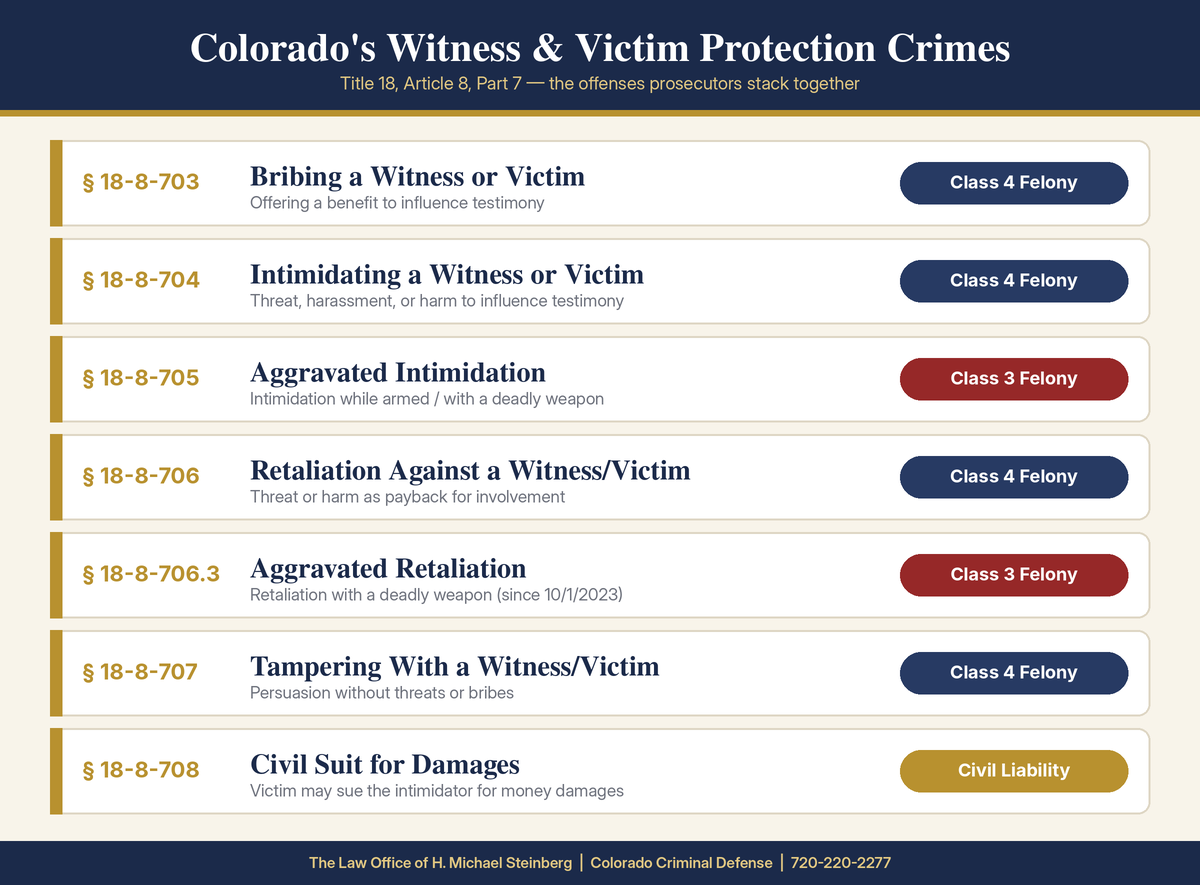 Colorado’s witness and victim protection statutes — prosecutors often charge several of these together.
| Statute | Offense | Core Conduct | Classification |
|---|---|---|---|
| § 18-8-703 | Bribing a witness or victim | Offering a benefit to influence testimony or attendance | Class 4 felony |
| § 18-8-704 | Intimidating a witness or victim | Threat, harassment, or harm to influence testimony or cooperation | Class 4 felony |
| § 18-8-705 | Aggravated intimidation | Intimidation while armed with, or using, a deadly weapon | Class 3 felony |
| § 18-8-706 | Retaliation against a witness or victim | Threat, harassment, or harm as payback for involvement | Class 4 felony |
| § 18-8-706.3 | Aggravated retaliation | Retaliation with a deadly weapon | Class 3 felony |
| § 18-8-707 | Tampering with a witness or victim | Inducing false testimony or absence without threats or bribes | Class 4 felony |
| § 18-8-708 | Civil suit for damages | Victim may sue for harm caused by intimidation or retaliation | Civil liability |
One recent change matters. Under House Bill 23-1293, effective October 1, 2023, the legislature reduced simple retaliation from a class 3 to a class 4 felony and created the new class 3 crime of aggravated retaliation for cases involving a deadly weapon. Older articles and court decisions may still describe retaliation as a class 3 felony.
The Elements of Intimidating a Witness or Victim — C.R.S. § 18-8-704
§ C.R.S. § 18-8-704 — Intimidating a Witness or Victim (summary)
- Means: a threat, an act of harassment as defined in § 18-9-111, or an act of harm or injury to any person or property;
- Directed at: a witness or victim, a person believed to have information relevant to a criminal investigation, a family member, a person in a close relationship with or living with the witness or victim, or a person who reported a crime;
- With intent to: influence the person to testify falsely or unlawfully withhold testimony, avoid legal process, skip an official proceeding, or withhold information from or give false information to law enforcement or a defense attorney or investigator — or to inflict harm before testimony;
- Penalty: a class 4 felony under subsection (2).
Paraphrased summary. Read the full statute at Justia — C.R.S. § 18-8-704.
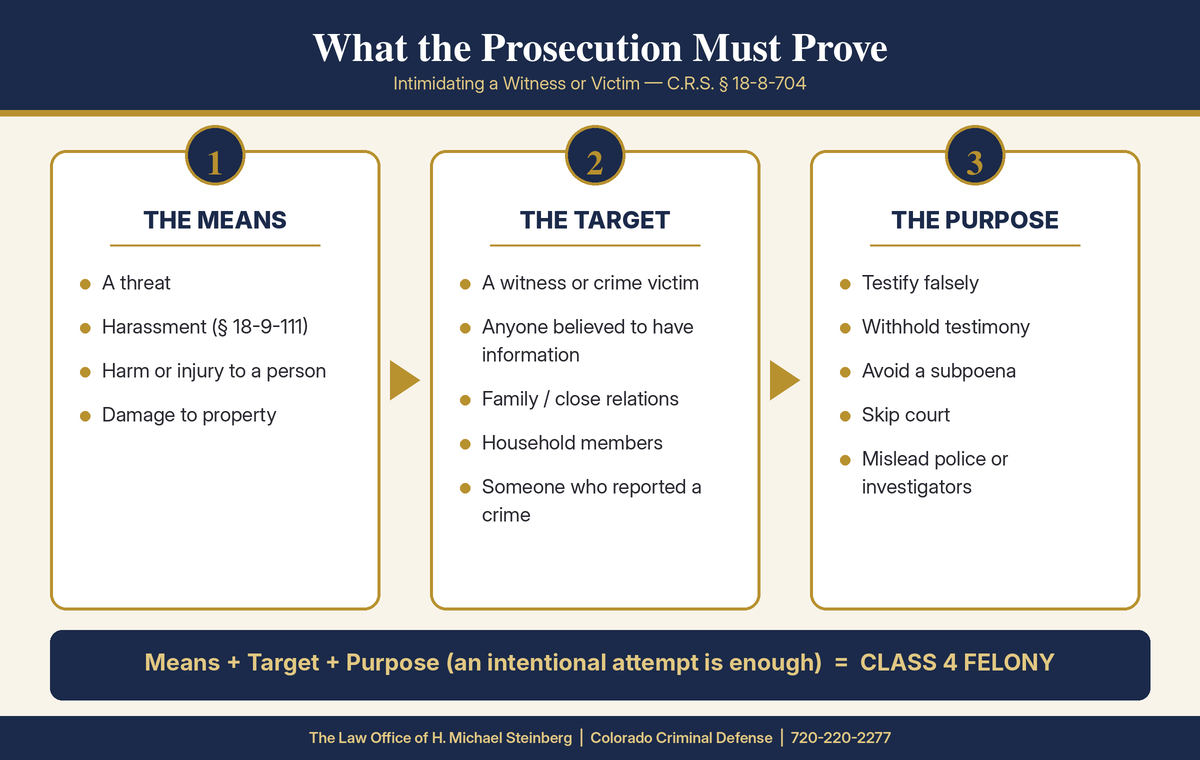
The three building blocks of a § 18-8-704 charge.
The definitions in C.R.S. § 18-8-702 make the reach of the statute very broad. A “victim” is anyone against whom a crime has been committed or attempted, and a “witness” includes people who have knowledge of facts relevant to a case — not only those who have been formally subpoenaed.
Danger #1: It Is a Separate Felony — Even if the Original Case Is a Misdemeanor
The most important thing to understand is that witness intimidation stands on its own. It does not merge into the original charge, and it does not disappear if the original charge is dismissed. In People v. Rester, 36 P.3d 98 (Colo. App. 2001), the Court of Appeals held that the intimidation charge is independent of the underlying case. The defendant there was acquitted of the assault and harassment charges but still convicted of intimidating the victim.
“A misdemeanor case can become a felony case in the time it takes to make one phone call.”
In practical terms, a person facing a misdemeanor charge with a likely plea to a deferred judgment can find themselves facing a class 4 felony that carries a presumptive range of two to six years in prison.
Danger #2: You Do Not Have to Succeed — or Even Reach the Witness
Colorado courts have consistently held that these crimes are complete at the moment of the attempt:
- In People v. Proctor, 570 P.2d 540 (Colo. 1977), the Colorado Supreme Court held the offense is complete when the defendant presently tries, through threats, to get someone to withhold future testimony — even before a subpoena is issued.
- In People v. Moyer, 670 P.2d 785 (Colo. 1983), the Court held the defendant does not have to succeed in influencing the witness.
- In People v. Scialabba, 55 P.3d 207 (Colo. App. 2002), the court held that because the crime is complete once the attempt is made, it cannot be abandoned afterward. An apology or a follow-up message saying “never mind” does not undo the charge.
- In People v. McIntier, 134 P.3d 467 (Colo. App. 2005), the court held that a threat need not be communicated directly to the protected person — threats delivered to third parties can be prosecuted.
- In People v. Brooks, 2017 COA 80, 454 P.3d 270, a tampering case, the division held the attempt does not even have to be communicated to the witness.
This means the witness’s reaction is largely irrelevant. If the witness laughed it off, ignored the message, or testified truthfully anyway, the prosecution can still proceed.
Danger #3: “Witness” and “Victim” Are Defined Far More Broadly Than Most People Think
Many people assume that a person only becomes a “witness” once they are served with a subpoena or scheduled to testify. That is not the law.
- The statute protects anyone you believe has been or will be called as a witness, or may have information relevant to a criminal investigation.
- It extends to the witness’s or victim’s family members, people in a close relationship with them, and people living in the same household.
- In People v. Cunefare, 102 P.3d 302 (Colo. 2004), the Colorado Supreme Court held that the tampering statute’s false-testimony provision does not require interference with testimony at a formal proceeding, and the witness need not be under subpoena.
- In People v. Trujillo, 2025 COA 22, the Court of Appeals held the retaliation statute does not require the victim to be scheduled to testify.
Telling the alleged victim’s mother or new partner to “make sure she doesn’t show up” can be charged exactly as if you had said it to the victim directly.
Danger #4: Jail Calls, Texts, and Social Media Are the Prosecution’s Best Evidence
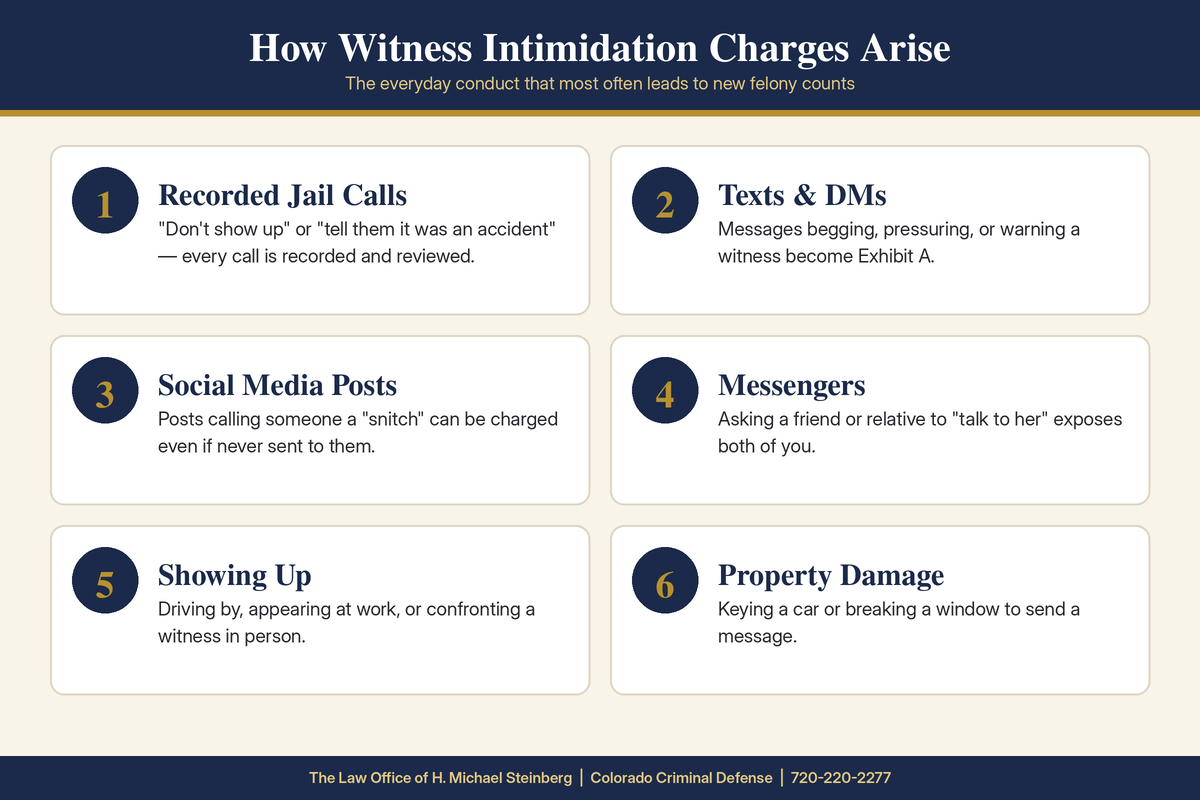
Most intimidation charges begin with ordinary communication — recorded and saved.
Nearly every call made from a Colorado jail is recorded, and prosecutors and investigators routinely review those recordings — especially in domestic violence cases.
Text messages, direct messages, emails, and social media posts are preserved and easily obtained. People who would never threaten anyone in person often say things on a recorded line, out of anger or desperation, that sound very different when played for a jury.
Social media is particularly dangerous. A post calling someone a “snitch” or warning that someone “better not show up” can support a charge even if it was never sent to the witness, because the threat need not be delivered directly (McIntier). In People v. Nozolino, 2014 COA 95, 350 P.3d 940, the division held that a pre-printed statement urging witnesses to remain silent before a grand jury fell within the tampering statute — illustrating how written materials circulated to witnesses can be enough.
The Messenger Problem
Asking a friend, parent, or cellmate to “talk to her for me” does not insulate you. The person who sends the message and the person who delivers it can both be charged — the sender as the principal or as a complicitor, and the messenger in their own right.
Danger #5: Protection Order Violations and Bond Revocation
In every Colorado criminal case, the court issues a mandatory protection order under C.R.S. § 18-1-1001 that restrains the defendant from harassing, molesting, intimidating, retaliating against, or tampering with any witness to or victim of the acts charged. In domestic violence cases, that order usually also bars any contact with the alleged victim. I explain how those orders are imposed at the earliest stage of a case in Why Can’t I Go Right Home After a Colorado Domestic Violence Arrest?
Contacting a protected witness therefore often produces several new problems at once:
- A charge of violation of a protection order under C.R.S. § 18-6-803.5;
- A charge of violation of bail bond conditions under C.R.S. § 18-8-212 — a felony when the original case is a felony;
- A motion to revoke or increase your bond, which can return you to jail while both cases are pending;
- And the new intimidation, retaliation, or tampering felony itself.
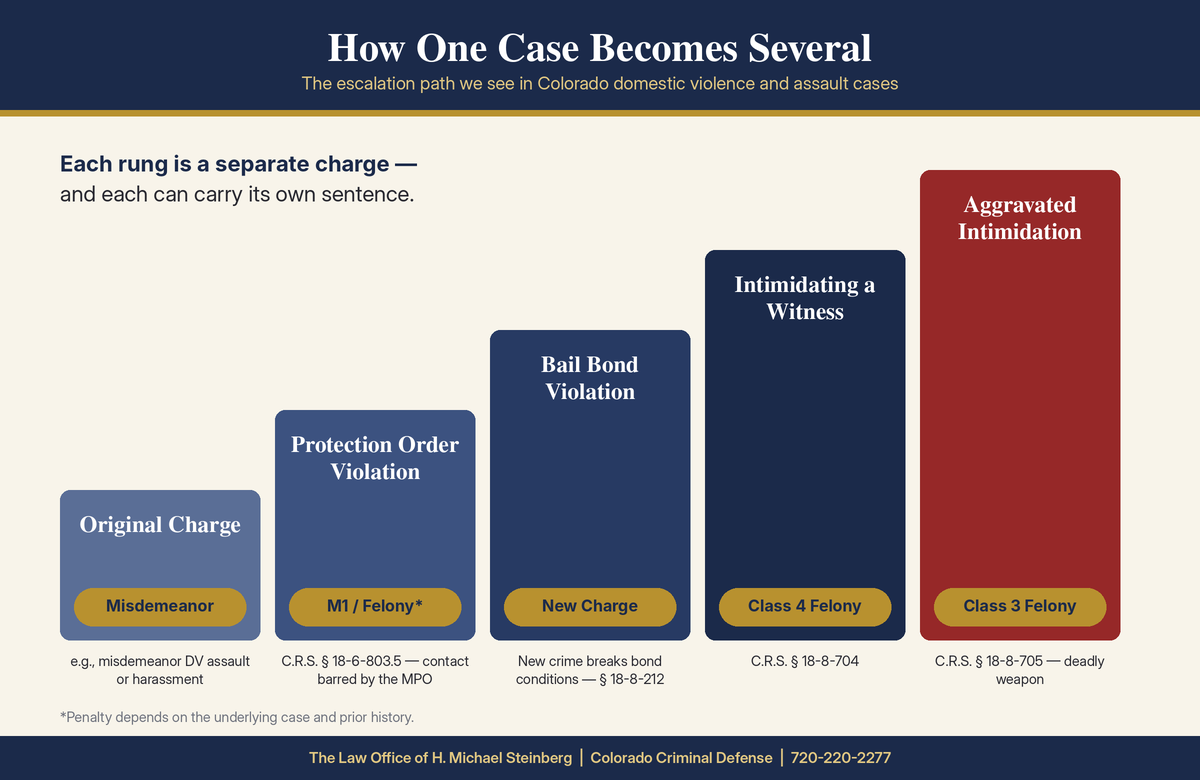 One contact with a protected witness can stack several new charges on top of the original case.
Danger #6: A Weapon Turns It Into a Class 3 Felony
Under C.R.S. § 18-8-705, intimidation becomes aggravated intimidation of a witness or victim — a class 3 felony — if, during the act, the person is armed with a deadly weapon intending to kill, maim, or wound if resisted, or knowingly wounds someone or puts them in reasonable fear of death or bodily injury using force, threats, or intimidation with a deadly weapon.
The statute treats possession of an article used or fashioned to make someone reasonably believe it is a deadly weapon — or a verbal claim to be armed — as prima facie evidence of being armed.
The same structure now applies to retaliation through C.R.S. § 18-8-706.3. In other words, saying “I have a gun” during a confrontation with a witness can raise the stakes dramatically even if no weapon is ever found.
Danger #7: Prison Exposure — and Aggravated Sentencing if You Were Already on Bond or Probation
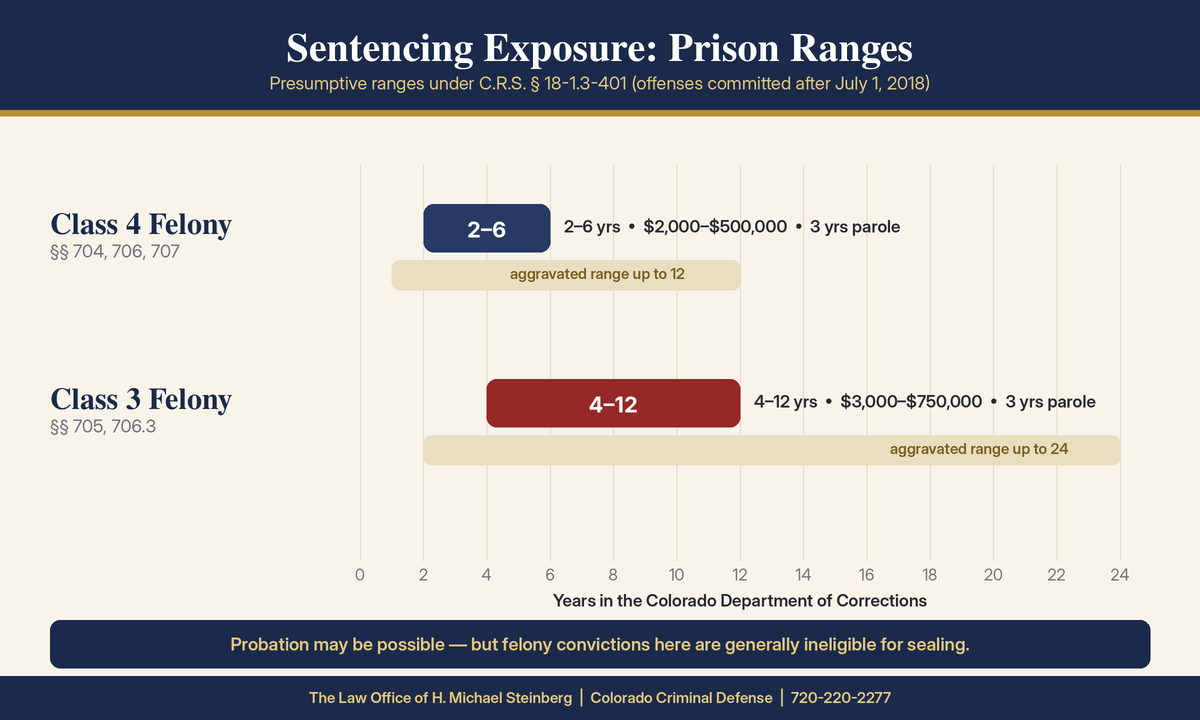
Presumptive and aggravated prison ranges for witness-related felonies.
| Felony Class | Witness Offenses | Presumptive Prison Range | Fine Range | Mandatory Parole* |
|---|---|---|---|---|
| Class 4 | §§ 18-8-703, -704, -706, -707 | 2 to 6 years | $2,000 to $500,000 | 3 years |
| Class 3 | §§ 18-8-705, -706.3 | 4 to 12 years | $3,000 to $750,000 | 3 years |
*Sentencing ranges under C.R.S. § 18-1.3-401 for felonies committed on or after July 1, 2018. Probation, community corrections, and other alternatives may be available depending on the facts and the defendant’s history.
Sentencing exposure can climb further. Colorado law requires or permits sentences in the aggravated range — up to twice the maximum of the presumptive range — in certain circumstances, including when the new felony was committed while the defendant was on parole or probation for another felony.
Because intimidation charges so often arise while a case is pending, defendants who are already on bond, probation, or supervision for a prior offense need to understand this risk immediately.
Danger #8: The Intimidation Can Sink Your Original Case
Even apart from the new charge, contacting a witness can badly damage your defense on the underlying accusation:
- Consciousness of guilt. Prosecutors commonly argue that efforts to silence a witness show the defendant knew they were guilty. Jurors find this argument persuasive.
- Forfeiture by wrongdoing. In Vasquez v. People, 173 P.3d 1099 (Colo. 2007), the Colorado Supreme Court applied the doctrine of forfeiture by wrongdoing. When a court finds by a preponderance of the evidence that a defendant wrongfully caused a witness to be unavailable with the intent to prevent testimony, the defendant can lose the right to confront that witness — and the witness’s earlier statements may come in without cross-examination.
- Lost leverage. A case that might have been negotiated to a reduced misdemeanor or a dismissal is far harder to resolve once a felony witness charge is added.
“Trying to make a witness “go away” often makes the prosecution’s case stronger, not weaker.”
Danger #9: Consequences That Last for Life
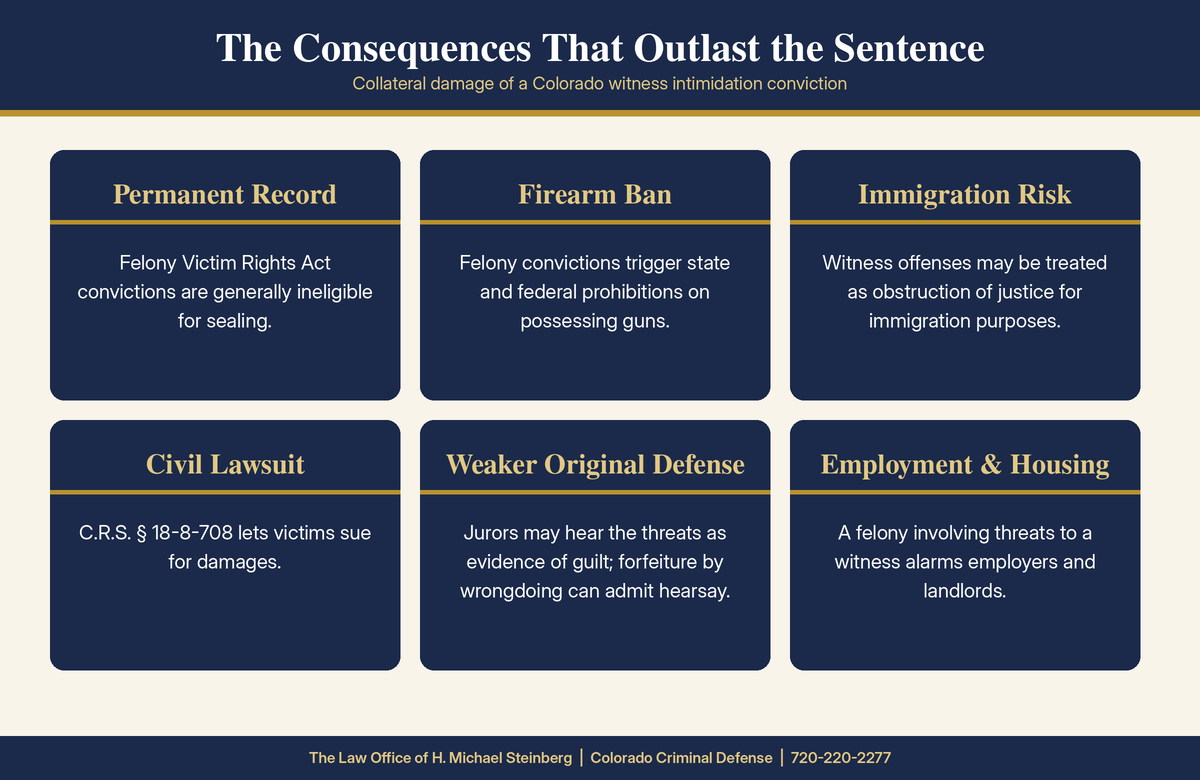
The consequences of a conviction last long after the sentence ends.
- Victim Rights Act designation. Intimidation, aggravated intimidation, retaliation, and tampering are listed crimes under Colorado’s Victim Rights Act, C.R.S. § 24-4.1-302. The alleged victim is entitled to notice and a voice at key stages of the case.
- No sealing for felony VRA convictions. Colorado’s sealing statute, C.R.S. § 24-72-706, generally excludes convictions for felony Victim Rights Act crimes. A felony witness intimidation conviction will likely remain on your record permanently.
- Firearms. Any felony conviction triggers Colorado’s prohibition on possessing weapons under C.R.S. § 18-12-108 and the federal ban under 18 U.S.C. § 922(g). See my related discussion of gun rights after a domestic violence conviction.
- Immigration. For non-citizens, witness-related offenses may be treated as “obstruction of justice” under 8 U.S.C. § 1101(a)(43)(S) when the sentence is one year or more — a potential aggravated felony. Immigration counsel should be consulted before any plea.
- Civil liability. Under C.R.S. § 18-8-708, a victim of intimidation or retaliation may sue for damages.
Intimidation, Retaliation, Tampering, and Bribery: How They Differ
These offenses overlap, but the differences can determine which charge the prosecution can actually prove:
| Offense | Key Question | Timing |
|---|---|---|
| Intimidation (§ 704) | Did the person use a threat, harassment, or harm to influence a witness’s testimony or cooperation? | Before or during the case |
| Retaliation (§ 706) | Was the threat or harm payback for the person’s role as a witness or victim in a criminal matter? | Usually after cooperation or testimony |
| Tampering (§ 707) | Did the person try to induce false testimony or absence without threats or bribes — through persuasion or pleading? | Before testimony |
| Bribery (§ 703) | Was a benefit (money, favors, dropped debt) offered to influence testimony? | Before testimony |
Tampering deserves special attention because it requires no threat at all. Begging a partner to “just not show up” or to “tell them you made it up” can be charged as a class 4 felony under § 18-8-707. The line between legitimate defense investigation and unlawful contact is one I address with every client — and it is why all contact with witnesses should go through counsel.
Free Speech Limits: When Is a Statement a “True Threat”?
Not every angry or offensive statement is a crime. The First Amendment protects a great deal of heated speech, and Colorado’s appellate courts have repeatedly policed the boundaries of these statutes:
- In People v. Hickman, 988 P.2d 628 (Colo. 1999), the Colorado Supreme Court struck the phrase “act of harassment” from the retaliation statute as it was then written as unconstitutionally overbroad, while upholding the remainder of the statute and holding that retaliation is a specific-intent offense.
- In Counterman v. Colorado, 600 U.S. 66 (2023), the U.S. Supreme Court held that the prosecution of a true threat requires proof that the speaker had some subjective understanding of the threatening nature of the statements — at least recklessness.
- In People v. Trujillo, 2025 COA 22, the Court of Appeals reversed a retaliation conviction because the jury was not properly instructed that the defendant had to act because of the victim’s relationship to a criminal proceeding, and it directed the trial court to reassess the true-threat question under Counterman.
- In People v. Johnson, 2017 COA 11, 446 P.3d 826, the court held that the retaliation statute applies to criminal, not civil, proceedings.
These decisions give defense counsel meaningful tools. The words used, the context, the relationship of the parties, and what the speaker actually intended all matter.
How Witness Intimidation Charges Are Defended
Every defense begins with a careful analysis of the evidence and the elements, and with a coherent theory of the defense. Depending on the facts, the strongest defenses often include:
- No specific intent. The prosecution must prove an intent to influence testimony or cooperation (or, for retaliation, to retaliate for the person’s role in a criminal case). Statements made about a breakup, a child-custody dispute, money, or property — without that purpose — may not qualify.
- Not a threat. Pleading, apologizing, or expressing anger is not necessarily a threat. Under Counterman, the speaker’s own mental state about the threatening nature of the words matters.
- Not a protected person. In People v. Gonzales, 602 P.2d 6 (Colo. App. 1978), rev’d on other grounds, 601 P.2d 1366 (Colo. 1979), the court recognized the intimidated person must have witnessed something about which their testimony would be probative.
- Missing statutory elements in tampering cases. In People v. Yascavage, 101 P.3d 1090 (Colo. 2004), the Colorado Supreme Court affirmed that a charge based on inducing a witness to be absent from a proceeding requires proof that the witness was legally summoned.
- Identity and authorship. Who actually sent the text, made the post, or placed the call? Shared phones, spoofed accounts, and third-party messages create real reasonable-doubt issues.
- Context and credibility. Recorded calls are often excerpted. The full recording, the history between the parties, and the motives of the complaining witness can change the picture entirely.
- Early challenges. Weak felony charges can sometimes be tested at the preliminary hearing, where the prosecution must establish probable cause on each element.
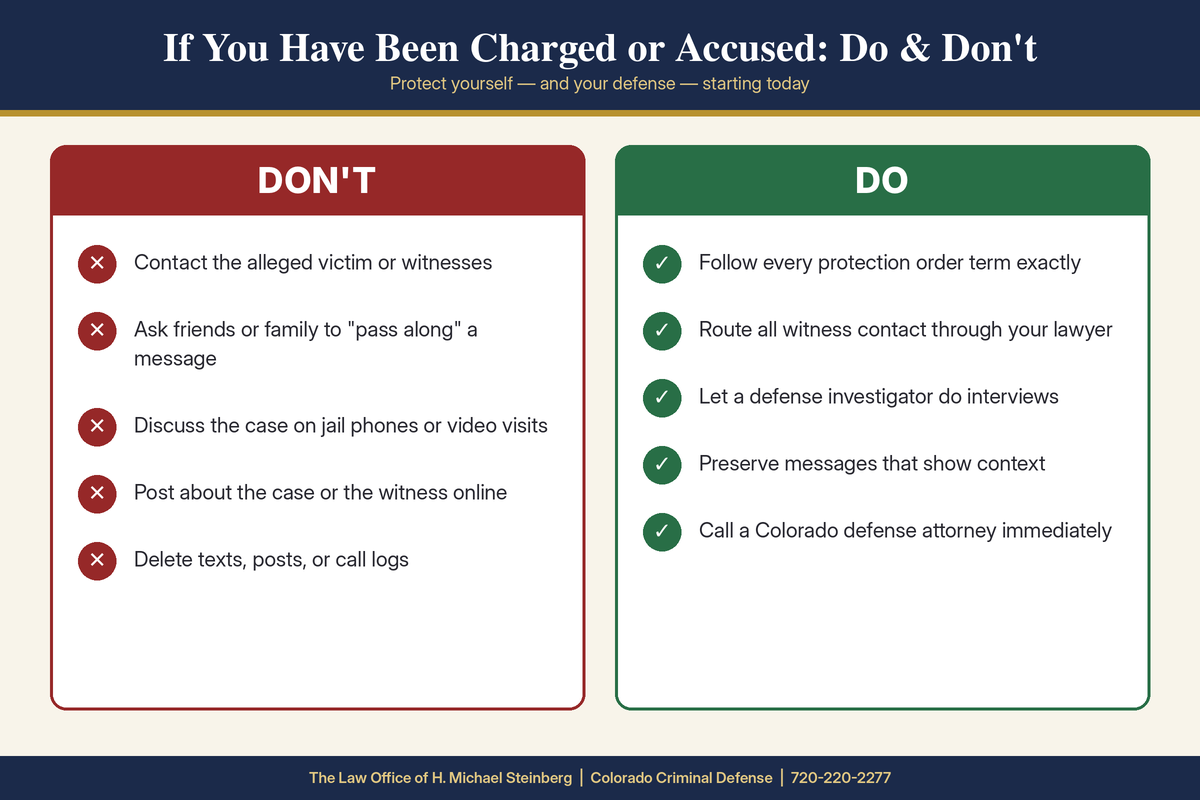
Practical rules that protect you — and your defense.
What to Do if You Have Been Charged or Accused
- Stop all contact immediately — direct, indirect, through friends or family, and online.
- Do not discuss the case on jail phones, video visits, or by text.
- Do not delete anything. Destroying messages can create additional charges and can eliminate evidence that helps you.
- Follow every term of the protection order exactly, even if the protected person reaches out to you.
- Let your lawyer handle witnesses. Defense counsel and defense investigators may lawfully interview witnesses; you should not.
- Get experienced counsel now. Early action can affect bond, protection order modifications, and how the prosecution charges the case.
Frequently Asked Questions About Witness Intimidation in Colorado
Is witness intimidation a felony in Colorado?
Yes. Intimidating a witness or victim is a class 4 felony under C.R.S. § 18-8-704, with a presumptive range of 2 to 6 years in prison. Aggravated intimidation involving a deadly weapon is a class 3 felony under § 18-8-705.
Can I be charged if the witness was never actually scared or never changed their testimony?
Yes. Colorado courts hold the crime is complete when the intentional attempt is made. Success is not required, and an attempt cannot be undone by later abandoning it.
Is it intimidation to ask the alleged victim to drop the charges?
It depends on the words and the circumstances. A threat can be intimidation under § 18-8-704. Even without a threat, urging someone to testify falsely, withhold testimony, or skip court can be charged as tampering under § 18-8-707. And contact usually violates the mandatory protection order. The safest course is no contact at all.
Can I be charged for something I posted on social media?
Yes. A threat does not have to be delivered directly to the witness to be prosecuted, and posts are easily preserved. The First Amendment protects some speech, but true threats are not protected.
Can a witness intimidation conviction be sealed in Colorado?
Generally not if it is a felony conviction. Witness intimidation, retaliation, and tampering are Victim Rights Act crimes, and Colorado’s sealing statute excludes felony VRA convictions. Dismissed charges may be eligible for sealing.
What if the alleged victim contacts me first?
The protection order restrains you, not the protected person. Responding can still be charged as a violation. Do not respond — tell your lawyer instead.
Talk to an Experienced Colorado Criminal Defense Lawyer
A witness intimidation, retaliation, or tampering accusation threatens far more than the original case. It can mean a new felony, a revoked bond, a permanent record, and a weaker defense on every other charge. These cases require an attorney who understands both the statutes and the realities of how they are prosecuted in Colorado courtrooms.
Facing a Witness Intimidation Charge? Act Now.
H. Michael Steinberg has defended clients across the Denver metro area and throughout Colorado for over 40 years. Call 720-220-2277 or contact the Law Office of H. Michael Steinberg for a confidential consultation. For more on Colorado criminal law, visit the Colorado Criminal Lawyer Blog and our domestic violence articles.
About the Author
H. Michael Steinberg is a Denver, Colorado criminal defense lawyer with over 40 years of experience defending people charged with felonies and misdemeanors throughout the Denver metro area, including at the Lindsey-Flanigan Courthouse and surrounding district and county courts. His practice focuses on domestic violence, DUI, drug crimes, sex crimes, and serious felony defense. Learn more at www.hmichaelsteinberg.com.
Disclaimer: This article is for general informational purposes only and is not legal advice. Reading it does not create an attorney-client relationship. Colorado law changes, and every case depends on its own facts. Statutory summaries are paraphrased; consult the official Colorado Revised Statutes and a licensed Colorado attorney about your situation.