 Colorado Criminal Lawyer Blog
Why Can’t I Go Right Home After a Colorado Domestic Violence Arrest?


By H. Michael Steinberg
 Introduction
The short answer clients want first, before anything else: not right away, and often not for a long time — even after you’re released from jail. Colorado treats a domestic violence arrest differently from almost any other arrest in the state, and the rules that keep you out of your own home can take effect before you’ve even spoken to a lawyer.
The Short Answer
Once police arrest someone for an alleged domestic violence offense, Colorado law requires a mandatory protection order that typically bars the arrested person from contacting the alleged victim and from returning to any home the two share — and that order goes into effect automatically, as a matter of law, when the person is advised of it at the first court appearance (C.R.S. § 18-1-1001).
You cannot simply post bond and walk back through your own front door. Going home again — to that address, at least — usually requires either the case ending or a judge formally modifying the order.
Why the Arrest Happens in the First Place
Colorado is a mandatory-arrest state for domestic violence. Under C.R.S. § 18-6-803.6, once a peace officer determines there is probable cause to believe a crime involving domestic violence occurred, the officer “shall, without undue delay, arrest” the person believed responsible — the officer does not have discretion to just write a report and leave. “Domestic violence” is defined broadly enough to reach far beyond spouses: current and former unmarried couples, people who share a child, and others who are or were in an intimate relationship are all covered, and the parties never needed to live together for the statute to apply.
If both people accuse each other, the officer must evaluate each claim separately, weighing prior complaints, the relative severity of injuries, the risk of future harm, and whether one person may have acted in self-defense — the statute does not require a dual arrest (C.R.S. § 18-6-803.6).
Why You Can’t Just Bond Out Immediately
After booking, most people arrested in Colorado can be released under a jurisdiction’s standard bond schedule without ever seeing a judge. Domestic violence cases are the exception. Colorado’s statewide administrative order on bond and release expressly states that no person may be released under an administrative bond schedule for a crime designated as domestic violence under C.R.S. § 18-6-800.3 — instead, “the bond amount, terms of a protection order and other conditions shall be set by the court on advisement.”
In practice, that means a person arrested on a domestic violence allegation typically spends at least one night in jail and waits for the first court appearance — sometimes called the “advisement” or “bond hearing” — before any release is possible
Colorado law sets an outer limit on how long that wait can last: an in-custody arrestee must be brought before a court for bond setting “as soon as practicable,” but no later than 48 hours after arriving at a jail or holding facility, a deadline that runs through weekends and holidays (C.R.S. § 16-4-102; Some local court directives build in even faster timelines for adults arrested on outstanding warrants (Colorado Judicial Branch, CJD 22-04), but 48 hours is the statewide backstop. Arrests over a weekend or holiday routinely push a person’s first court date out to the far edge of that window.
What Happens at the First Court Appearance
At that first appearance, three things happen at once:
- The judge advises you of the charges and your basic rights.
- The judge sets bond — the amount, and whether it will be cash, surety, or personal recognizance.
- The judge enters the mandatory protection order required in every domestic violence case, and you are required to acknowledge it, on the record and in writing, as a condition of any release (C. R.S. § 18-1-1001(5)
You cannot post bond without agreeing to the protection order’s terms. If the alleged victim was not present when the order was first issued, the prosecuting attorney must notify them separately (Colorado Criminal Defense Law Firm). Under Colorado’s Victim Rights Act, the alleged victim also has an independent right to be heard at bond proceedings generally and must be notified whenever there is a later request to reduce or modify bond or its conditions (C.R.S. § 24-4.1-302.5).
What the Mandatory Protection Order Actually Restricts
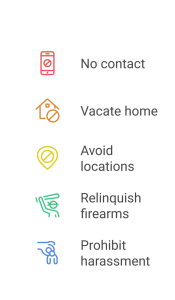
This is the order that answers the “can I go home” question, and it is far more sweeping than most people expect. Under C.R.S. § 18-1-1001, the order typically requires the arrested person to:
- Have no contact with the alleged victim — directly or indirectly, and by any method: calls, texts, email, social media, or messages relayed through a third person. Even a conciliatory “we need to talk” text can violate this term.
- Vacate and stay away from the shared home. If you live with the alleged victim, the order generally bars you from returning — even to collect personal belongings — without a court order or a law-enforcement escort
- Stay away from other locations where the alleged victim or witnesses are likely to be found, such as a workplace or school.
- Relinquish firearms and ammunition. If you are in custody when the relinquishment requirement is triggered, you generally must comply within 24 hours after release, excluding weekends and legal holidays, or risk being held in contempt of court (C.R.S. § 18-1-1001(9)).
- Do not harass, molest, intimidate, retaliate against, or tamper with the witness or victim — the baseline restraints written into the order for every Title 18 charge.
Two features of this order surprise clients the most.
First, the alleged victim cannot waive it on your behalf. Even if they call you, invite you back, or say they no longer want the case pursued, you remain bound by the order until a judge changes it — going home anyway, even at the alleged victim’s invitation, can be charged as a separate crime.
Second, this mandatory protection order is legally distinct from any separate no-contact condition attached to your bond — both can be in force simultaneously, and violating either one is its own new charge.
Quick Reference: Going Home After a Colorado DV Arrest
| Question | Answer |
| Can you bond out right after booking? | No — domestic violence cases are excluded from standard bond schedules; you wait for a judge (Colorado Judicial Branch, |
| Longest you can be held before a bond hearing | 48 hours after arriving at the jail, including weekends/holidays (C.R.S. § 16-4-102). |
| Governing protection-order statute | C.R.S. § 18-1-1001 — mandatory in every domestic violence case. |
| Can you return to a shared home once released? | Generally no, absent a court order or police escort, until the order is modified. |
| Can the alleged victim let you come back? | No — only a judge can modify or lift the order. |
| How long does the order last? | Until the case’s final disposition (dismissal, acquittal, or completed sentence), unless modified sooner. |
| Who can ask a judge to modify or dismiss it? | The defendant or the prosecuting attorney, at any time. |
This table is a general orientation only and is not a substitute for case-specific legal advice.
 Can the Order Ever Be Modified So You Can Go Home?
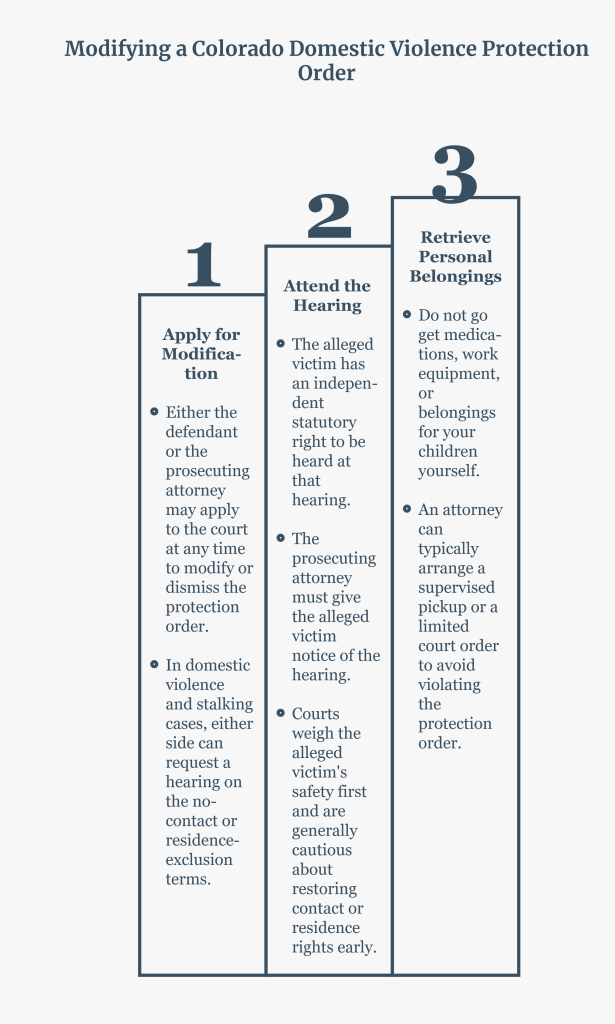
Yes — but it takes a motion and a hearing, not a phone call from the alleged victim. Either the defendant or the prosecuting attorney may apply to the court at any time to modify or dismiss the protection order, and in domestic violence and stalking cases specifically, either side can request a hearing on the no-contact or residence-exclusion terms (Colorado Criminal Defense Law Firm). The alleged victim has an independent statutory right to be heard at that hearing, and the prosecuting attorney must give them notice of it (C.R.S. § 24-4.1-302.5; Courts weigh the alleged victim’s safety first and are generally cautious about restoring contact or residence rights early in a case — modification is realistic, but it is not automatic, and it is not fast.
If you need to retrieve medications, work equipment, or belongings for your children before a hearing can be held, don’t go get them yourself. An attorney can typically arrange a supervised pickup or a limited court order rather than risk a new charge for violating the protection order.
Key Takeaways
- Colorado’s mandatory-arrest law means police generally have no discretion once they find probable cause for a domestic violence offense — an arrest follows.
- Domestic violence arrests are excluded from standard bond schedules; expect to wait for a judge, up to 48 hours, before any release is possible.
- A mandatory protection order under C.R.S. § 18-1-1001 takes effect at your first court appearance and typically bars contact with the alleged victim and return to a shared home — before you can post bond, you must acknowledge it in writing.
- The alleged victim cannot lift the order by inviting you back; only a judge can modify or dismiss it, on a motion from the defense or the prosecution.
- Firearm relinquishment deadlines and residence-exclusion terms carry real contempt and new-charge exposure — treat every term of the order as strictly enforced from the moment it’s read to you in court.
If You’re Facing This Situation in Colorado
If you or someone you love has just been arrested on a domestic violence allegation, the clock is already running on decisions that affect where you can live, whether you can see your children, and what happens to your firearms — often before you’ve had a chance to speak with a lawyer. An experienced Colorado criminal defense attorney can appear with you at the first advisement, address bond and protection-order terms on the record, and move quickly to seek a modification if the residence exclusion is unworkable.
 Contact The Steinberg Colorado Criminal Defense Law Firm for a confidential consultation. Visit colorado-criminal-lawyer-online.com to learn more
This article is provided for general informational purposes only and does not constitute legal advice. Reading this article does not create an attorney-client relationship between you and The Steinberg Colorado Criminal Defense Law Firm.
Laws change, and the application of law to specific facts varies from case to case — consult a licensed Colorado attorney about your particular situation. This is attorney advertising. Prior results do not guarantee a similar outcome.
About the Author
Mr. Steinberg writes and publishes The Colorado Criminal Lawyer Blog — a client-education resource that translates Colorado criminal statutes, rules of evidence, and appellate decisions into practical guidance for the people they affect.
The Steinberg Colorado Criminal Defense Law Firm — Denver · Statewide Colorado Criminal Defense