 Colorado Criminal Lawyer Blog
In 2026-Insurance Companies Can No Longer Collect Criminal Restitution In Colorado


By H. Michael Steinberg, A Colorado Criminal Defense Lawyer – Practicing Colorado Criminal Law in the courts of Colorado for over 40 years.
 Introduction:
For years, defendants in Colorado criminal cases faced a double financial punch at sentencing — ordered to pay restitution not just to the person they harmed, but also to that person’s insurance company for money the insurer already paid out under a policy. I felt this was an outrage when I was a prosecutor and even more so as a criminal defense lawyer.
The Colorado state legislature finally agreed.
A sweeping 2026 reform law changed the law. Colorado House Bill 26-1017, signed into law by Governor Jared Polis on April 2, 2026, fundamentally restructured how criminal restitution works when an insurer has already compensated a victim — prioritizing real people over corporate entities at the sentencing table.
Whether you are a Colorado criminal defense attorney’s client facing charges or a crime victim trying to understand your rights, this guide breaks down exactly what HB 26-1017 means for you.
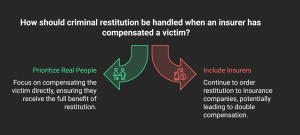
What Is HB 26-1017? The Big Picture
Colorado House Bill 26-1017, formally titled “Criminal Restitution Prohibited for Insurers,” amends two key statutes — C.R.S. § 18-1.3-601 (the legislative declaration) and C.R.S. § 18-1.3-602 (definitions) — to fundamentally change how the criminal justice system treats insurance companies in the restitution process.
✓ Key Takeaway
In plain terms: private insurers can no longer use the criminal courts to force defendants to repay them for claims they paid to policyholders.
The Colorado General Assembly’s legislative declaration accompanying HB 26-1017 states it plainly: when an insurance company pays out a claim, that company is performing a contractual business function — collecting premiums in exchange for covering losses. Criminal restitution, the legislature declared, exists to make direct victims whole, not to subsidize insurance industry recoveries.
Insurers, the bill’s sponsors argued, have entirely adequate civil remedies: lawsuits, subrogation actions, and civil judgments. The criminal courts should not be their collection agency.
Here is the legislative declaration underlying the new law:
| ★ Legislative Declaration — General Assembly Finding
“An insurance company, as part of its business operations, compensates a direct victim of a crime due to the contractual relationship between the insurance company and victim whereby the victim pays the insurance company a premium, and the insurance company compensates the victim for losses sustained. In these instances, criminal restitution to make direct victims whole must be prioritized, while insurance companies should recover their losses through remedies other than criminal restitution orders.” — Colorado House Bill 26-1017, Section 1 (adding C.R.S. § 18-1.3-601(1)(h)) |
What Changed? Old Law vs. New Law
Understanding HB 26-1017 requires a clear look at how Colorado handled insurance company restitution before the law, and exactly what the statute now says. The changes are surgical but significant.
The Old Law — How Colorado Used to Handle Insurer Restitution
Under the prior version of C.R.S. § 18-1.3-602, the term “victim” was defined broadly to include “any person who has suffered losses because of a contractual relationship.” Colorado courts had interpreted this language to sweep in insurance companies — after all, an insurer that pays a policyholder’s claim suffers a financial loss connected to the crime, and that relationship is contractual (the insurance policy).
The practical result was troubling: a defendant convicted of, say, a hit-and-run that caused $40,000 in damage could be ordered to pay restitution to the direct victim for their $2,000 deductible and also to the insurance company for the $38,000 it paid out — even though the insurer had already collected premiums designed to cover exactly that kind of risk.
This was patently unfair. In effect, defendants bore the burden of reimbursing both the victim and a corporate entity that had already been compensated through its own business model.
| The Old Problem — Double Restitution
Under prior law, defendants were routinely ordered to pay restitution to the direct victim AND their insurer for the same underlying loss — even when the insurer had already collected premiums specifically to cover that risk. Courts treated insurers as “victims” by virtue of their contractual relationship alone. |
The New Law — What HB 26-1017 Established
HB 26-1017 makes three foundational statutory changes, each carefully designed to redirect criminal restitution away from insurance companies while protecting direct victims and preserving legitimate exceptions:
Who Is Still Considered a “Victim” Under HB 26-1017?
HB 26-1017 is not a blanket immunity for defendants or a wholesale removal of all insurer rights. The statute is carefully drafted with important exceptions. Understanding who retains victim status — and who does not — is critical for both defendants and crime victims navigating the post-HB 26-1017 landscape.
Exceptions — When Insurers Remain Victims
HB 26-1017 does NOT remove victim status from insurance companies in all situations. An insurer remains a qualifying “victim” eligible for criminal restitution in two specific scenarios:
1. Direct Insurance Fraud — Schemes to Defraud the Insurer – Victim Status Retained
When the criminal conduct itself is specifically directed at the insurance company — for example, staged automobile accidents, fabricated injury claims, fraudulent billing schemes, or arson-for-profit arrangements — the insurer is the direct target of the crime, not merely a downstream contractual payer. In these cases, the insurer retains full victim status and is entitled to seek criminal restitution just like any other direct victim. The loss is not incidental to the crime; it is the crime.
If you are facing insurance fraud charges in Colorado, it is critical to understand that an insurer can seek criminal restitution against you under these circumstances. A Colorado insurance fraud defense attorney can help evaluate your exposure at sentencing.
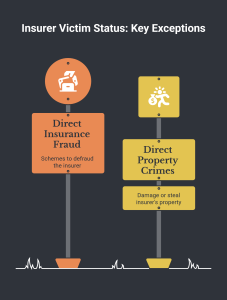 2. Direct Property Crimes Against the Insurer’s Own Property -Victim Status Retained
If a defendant’s criminal acts directly damage or steal property owned by the insurance company itself — not property belonging to one of its policyholders — the insurer qualifies as a direct victim in the traditional sense. This exception is narrow: it covers situations where the insurer’s own physical or financial assets are the subject of the crime, not situations where the insurer is simply paying a claim on behalf of a policyholder.
What HB 26-1017 Means for Defendants
In Colorado, HB 26-1017 represents one of the most meaningful sentencing reforms in years. The law directly reduces the financial exposure that criminal defendants face at the restitution stage — but it comes with important caveats that every defendant must understand before assuming their restitution burden has disappeared. Understanding criminal sentencing in Colorado has never been more important.
Reduced Restitution Exposure at Sentencing
Courts can no longer tack insurance company losses onto a defendant’s restitution obligation when those losses arose from a victim’s private insurance coverage.
In practical terms, this means:
- If a victim’s $50,000 property loss was covered entirely by their homeowner’s insurance (less a $1,000 deductible), the defendant’s criminal restitution exposure is now limited to the $1,000 deductible — not $50,000
- If a victim’s medical bills were paid in full by health insurance, the insurer cannot piggyback onto the criminal restitution order for reimbursement
- Restitution hearings may now require explicit evidence of what portions of a loss were and were not covered by private insurance
Notably, however, Colorado’s criminal defendants are still responsible for the following under the amended statute:
- The victim’s out-of-pocket deductible — courts are now expressly authorized to award this amount
- Losses not covered by any insurance policy — gaps in coverage remain fully restitution-eligible
- Worker’s compensation restitution — unchanged; employer/WC insurer restitution rights remain intact
- Government agency costs — Medicaid, Medicare, and similar agency costs remain restitution-eligible
- Direct fraud victims — if the crime targeted an insurer directly, that restitution claim survives
✓ Defendant Takeaway
HB 26-1017 narrows defendants’ criminal restitution exposure when a victim’s losses are covered by private insurance.
However, defendants must still account for deductibles, uninsured losses, and worker’s compensation. The facts of each case — including insurance coverage details — now matter significantly at the restitution hearing stage.
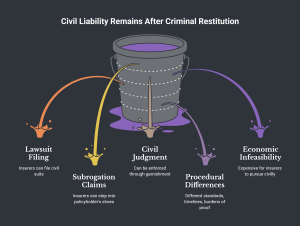 Remaining Civil Exposure — This Law Does Not Shield Defendants from Lawsuits
This is the most critical misconception to dispel: HB 26-1017 does not make defendants immune to civil liability from insurers. The statute explicitly preserves an insurance company’s right to pursue non-criminal remedies.
After paying a claim, an insurer may still:
- File a civil lawsuit against the defendant for recovery of amounts paid
- Pursue a subrogation claim in civil court — “stepping into the shoes” of the policyholder to sue the at-fault party
- Obtain a civil judgment that can be enforced through garnishment, liens, or other civil collection methods
The difference is procedural and substantial: civil litigation is governed by different standards, timelines, and burdens of proof than criminal restitution. Defendants facing significant insurer claims should consult with civil defense counsel in addition to their criminal defense attorney, but my experience is this: it is often economically infeasible for an insurance company to pursue a criminal defendant in a separate — and very expensive — civil lawsuit.
What HB 26-1017 Means for Crime Victims
A natural concern for crime victims reading about HB 26-1017 is: does this law reduce my ability to get restitution? The answer is emphatically no. In fact, the law was designed to prioritize direct victims over corporate insurance interests. Here is what HB 26-1017 means if you were harmed by a crime:
- The victim receives priority in all restitution proceedings — direct losses come before any other party’s claims
- The deductible is now expressly protected — even if the rest of the loss was covered by insurance, courts are specifically authorized to award you restitution for the out-of-pocket deductible paid by the victim.
- The victim’s right to compensation is not reduced because they carried insurance — having insurance does not diminish the victim’s status or their restitution claim for uncovered losses
- Victim compensation funds and government benefits remain fully available — Medicaid, Medicare, and state victim compensation programs are unaffected
- The criminal restitution process remains the primary remedy — the law simply redirects insurance companies to the civil courts while keeping the victim in the center of the criminal process.
✓ Victim Takeaway
HB 26-1017 Restitution is now directed to the victim first. The insurance deductible is specifically protected. Insurance companies are sent to civil court — where they have every tool they need — while criminal courts focus on making you whole
The Bottom Line on HB 26-1017
Colorado House Bill 26-1017 marks a genuine philosophical shift in how the state approaches criminal restitution.
For decades, the broad statutory definition of “victim” allowed insurance companies to insert themselves into the criminal sentencing process and extract restitution payments from defendants — on top of whatever direct victims received. The 75th General Assembly drew a clear line: the criminal courts exist to restore people, not to subsidize insurance industry loss-recovery operations.
The law is balanced, not radical. Workers’ compensation insurers keep their rights. Direct fraud victims — including insurers targeted by fraudulent schemes — keep their rights. Government health programs keep their rights.
For defendants, HB 26-1017 reduces restitution exposure in many cases — but it is not a shield. Civil liability to insurers remains. The fraud exception is real. Worker’s compensation restitution is unchanged. The details of your specific case — what was insured, how much was covered, what the charges are — determine your actual exposure under this new law.
Frequently Asked Questions About HB 26-1017
Below are the questions our clients and website visitors ask most frequently about this new Colorado law.
Can an insurance company still sue the person who caused my loss?
Yes — absolutely. HB 26-1017 explicitly preserves insurers’ right to file civil lawsuits against defendants. It removes them only from the criminal restitution process; if you caused an accident and the victim’s insurer paid out a claim, expect a civil subrogation lawsuit regardless of what happens in the criminal case.
Does this law apply to cases that were sentenced before April 2, 2026?
No. HB 26-1017 applies prospectively to sentencing proceedings occurring on or after the law’s effective date. Existing criminal restitution orders that were entered before the law changed are not automatically modified or vacated. If you have an existing order, consult with an attorney about any applicable post-conviction remedies — but do not assume this law retroactively eliminates a prior restitution obligation.
What if I was charged with a crime involving an insurance claim?
The interplay between criminal restitution, insurance claims, and civil liability under HB 26-1017 is nuanced and fact-specific. The fraud exception is real and can mean the insurer retains full restitution rights. Whether you benefit from the new law — or fall into an exception — depends entirely on the specific facts of your case. It is essential to speak with a Colorado criminal defense lawyer who understands this statute before any restitution hearing.
Does HB 26-1017 affect DUI cases where insurance paid out?
Potentially yes, and significantly so. DUI cases frequently involve property damage and bodily injury claims handled by auto insurance carriers. Under HB 26-1017, the DUI defendant’s criminal restitution obligation may now be limited to the victim’s deductible and any uninsured losses — rather than the full amount paid out by the insurer. However, expect the insurer to pursue a civil subrogation claim for the balance. Each case turns on its specific insurance coverage facts.
What happens to workers’ compensation claims under HB 26-1017?
Workers’ compensation insurers are explicitly carved out from the new restrictions. The amendment to C.R.S. § 18-1.3-602(3)(d) specifically preserves a workers’ compensation insurer’s right to seek criminal restitution for medical benefits, health benefits, and non-medical support services it provided to a victim. If a workplace crime results in a workers’ compensation claim, that insurer retains the same restitution rights it had before HB 26-1017.
How does HB 26-1017 interact with Medicaid and Medicare?
Medicaid, Medicare, and other government care programs for indigent persons are treated as governmental agencies under C.R.S. § 18-1.3-602(3)(d) — and are explicitly retained in the statute. These programs are not private insurance under the new law, so their restitution rights remain completely intact. If a crime victim received government-funded healthcare, the state or federal program retains its right to seek restitution through the criminal process.
Questions About HB 26-1017 and Your Case?
Whether you are facing a criminal charge that involves insurance, a restitution hearing, or a pending matter where an insurer may assert claims — the details of your case matter enormously under this new law.
Colorado Criminal Law – In 2026-Insurance Companies Can No Longer Collect Criminal Restitution In Colorado
The reader is alerted that Colorado criminal law, like criminal law in every state and at the Federal level, changes constantly. The article above was accurate when it was drafted, but it cannot account for changes that occurred after it was uploaded.
 ABOUT THE AUTHOR: H. Michael Steinberg – Email the Author at: hmsteinberg@hotmail.com
A Denver, Colorado Criminal Defense Lawyer – call his office at 303-627-7777 during business hours, or call his cell at 720-220-2277 if you cannot wait and need his immediate assistance.
“A good criminal defense lawyer is someone who devotes themselves to their client’s case from beginning to end, always realizing that this case is the most important thing in that client’s life.”
Putting more than 40 years of Colorado criminal defense experience to work for you.
One should be careful when selecting a Colorado criminal defense lawyer. We encourage you to “vet” our firm. Over the last 40 years – by focusing ONLY on Colorado criminal law – H. Michael has had the time to continually update himself in nearly every area of criminal law, including procedure, trial, and courtroom practice.
H. Michael works hard to deliver the best possible results for his clients, both in and out of the courtroom. He has written extensively on Colorado criminal law and continues to do so, and he hopes this article helps you in some small way.