 Colorado Criminal Lawyer Blog
How to Make a Good Impression in a Colorado Courtroom When You’re Charged With a Crime


By H. Michael Steinberg, A Colorado Criminal Defense Lawyer – Practicing Colorado Criminal Law in the courts of Colorado for over 40 years.
Introduction:
Facing a criminal charge in Colorado is stressful, and how you present yourself in court can genuinely influence outcomes — from how a judge sets bond conditions to how a prosecutor evaluates a plea offer to, in some cases, how a jury perceives your credibility.
I have been appearing in Colorado’s criminal courts for over forty years, and I can assure the reader that the judges and attorneys who’ve spent years in Colorado courtrooms consistently will say the same thing: defendants who show respect for the process, come prepared, and conduct themselves calmly tend to fare better than those who don’t — even when the underlying facts of the case are identical.
This guide walks through what “making a good impression” actually means in a Colorado courtroom, from the moment you’re advised of your charges through sentencing, and points you toward Colorado-specific resources along the way.
 Why Your Conduct in Court Matters
What “First Impression” Really Means in Court
This article is all about credibility.
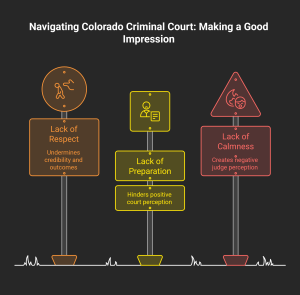
The judge, clerk, bailiff, and attorneys are doing pattern recognition all day. They see hundreds of people. Some are prepared, respectful, and organized. Some are chaotic, defensive, loud, or confused. Some are perfectly nice but clearly not listening.
When you walk in, you are basically signaling which category you are in.
And the tricky part is this. Court is one of the few places where seeming prepared can matter almost as much as being prepared. Not always, but often.
You want to do both.
It’s tempting to think a case is decided purely on the facts and the law. In reality, judges have discretion at nearly every stage — bond amount and conditions, whether to grant a continuance, how a plea is structured, and where within a sentencing range a defendant lands.
Prosecutors, too, often consider whether a defendant seems to be taking the case seriously when deciding what to offer. A defendant who is punctual, respectful, and visibly engaged with their own defense signals to everyone in the room that they understand the seriousness of the situation — and that matters, especially at advisement, bond hearings, and sentencing.
Calm, respectful conduct does not prove innocence, and nervousness does not prove guilt. Still, visible anger, interruptions, eye-rolling, whispering, or hostile reactions can distract from the legal issues that actually matter.
 Know Beforehand If Possible Which Court You Are Going To
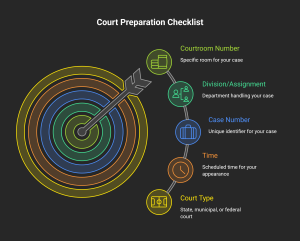
Colorado has state courts, municipal courts, and federal courts. People mix these up constantly.
Check your paperwork. The summons, notice, or docket entry should tell you the exact court name and address. If you are using online case search, confirm the courthouse location. Some counties have multiple courthouses.
Do not assume “Denver” means one building. Or that “Jefferson County” means you can just head to Golden and figure it out. Sometimes yes. Sometimes no.
Write down:
- Courthouse address.
- Courtroom number (if listed).
- Division or courtroom assignment.
- Your case number.
- The time you are supposed to be there.
- Whether it is in person or remote.
Prepare With Your Attorney Before Court
If you have a lawyer — private counsel or a public defender — use the time before your hearing date to actually prepare:
- Review what will happen at this specific hearing
- Confirm what, if anything, you’re expected to say
- Ask what the judge or prosecutor might ask you
- Clarify any conditions of bond you need to be aware of (no-contact orders, check-ins, travel
Arrive Early
If your hearing is at 9:00, showing up at 8:55 can be late. Because you still have to park. Go through security. Find the right floor. Find the courtroom. Sometimes check in.
A solid target is 30 to 45 minutes early for in-person court. More if it is a downtown courthouse and you are not familiar with parking.
If you are remote, log in 15 minutes early. Not two minutes early. Not “right on time.” Technology loves to fail at the worst moment.
Bring The Right Items With You
At a minimum:
- A government ID.
- Your paperwork, printed if possible.
- A notebook and pen.
- Any documents you plan to refer to.
- A list of key points you need to say.
- If you have an attorney, their contact info.
If you have exhibits, bring extra copies. One for you, one for the other side, one for the court. Sometimes the rules are stricter depending on the type of case. But as a first impression move, being the person who has copies is never a bad thing.
 Understand the Court Colorado Processes, Know What to Expect
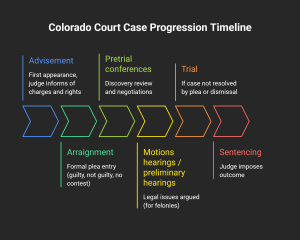
Walking into a courtroom without understanding what’s about to happen is one of the biggest reasons defendants look lost or make missteps. In Colorado, a typical misdemeanor or felony case moves through several stages:
- Advisement— Usually your first appearance, often shortly after arrest. The judge informs you of the charges, your constitutional rights, and potential penalties, and addresses bond.
- Arraignment— Where you formally enter a plea (guilty, not guilty, or occasionally no contest). Misdemeanors are typically handled in county court; felonies are handled in district court.
- Pretrial conferences— Often the longest phase, involving discovery review, negotiations between your attorney and the prosecutor, and motions.
- Motions hearings / preliminary hearings (for some felonies) — Where legal issues, like the admissibility of evidence, get argued.
- Trial — If the case isn’t resolved by plea or dismissal.
- Sentencing— Where the judge imposes the outcome, which may include a statement from you (allocution).
Knowing which hearing you’re walking into — and what’s actually expected to happen at it — prevents the kind of confused, unprepared appearance that reflects poorly on you. Your attorney can tell you exactly what to expect at each date.
Before You Ever Step Into the Courtroom
Remember: Get There Early, Every Time
Colorado courthouses require security screening, and parking or finding the right courtroom can eat up more time than you expect. Arriving even five minutes late to a criminal hearing can result in a bench warrant. Plan to arrive at least 30–45 minutes early.
Dress As If You Take This Your Case Very Seriously
You don’t need a suit, but you do need to signal respect for the proceeding. Business casual is the standard: collared shirts, slacks or modest dresses, closed-toe shoes.
Avoid:
- Clothing with profanity, drug references, or gang-associated symbols/colors.
- Hats (remove them before entering the courtroom).
- Ripped, athletic, or overly casual clothing.
Courts in Colorado, like most jurisdictions, form quick impressions based on appearance, and it’s one of the easiest things to control.
The Basics: From The Moment You Enter the Courtroom
You are being observed before you think you are being observed.
Security, the clerk’s window, even people in the hallway will see how you handle yourself. How you talk to staff. Whether you follow instructions.
Be Polite To Everyone, Especially Court Staff
This is just basic politeness. They are people.

They have complex and difficult jobs.
Court staff are like family. I know because I worked for a judge for a long time after law school — that’s me in the blue vest in 1982 in Denver District Court
Staff talk to judges. They flag issues. They can tell you where to go. They can also, if you are rude, mentally file you under “problem person.” Even if nobody says it out loud, it sticks.
This is me today:

So, the basics:
- Say hello
- Ask questions calmly
- Thank people who help you
- Follow directions the first time
If you are confused, that is fine. If you are hostile and confused, that is not fine.
Keep Your Phone Under Your Control
Put it on silent. Not vibrate. Silent.
Do not take calls in the hallway near courtrooms. Step away if you must. And never, ever pull out your phone in the courtroom unless you have permission.
Find Your Courtroom and Check In
In many Colorado courts, a docket list is posted outside the courtroom or on a screen. It may list names, case numbers, and times. Some are sheets of paper taped to the wall. Some are digital.
Find your case. Confirm you are in the right place.
Then, if there is a clerk, division clerk, or bailiff, check in politely. Sometimes they want you to sign in. Sometimes they just want to know you are present.
If you are there for jury duty, the process is different, but the same vibe applies. Be organized. Follow the directions. Don’t be the person who makes it harder for everyone.
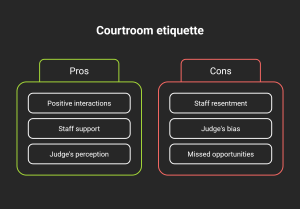 In the Courtroom: Your First 60 Seconds Matter
This is where people either settle in and look capable or unravel a bit.
When you walk in:
- Remove your hat if you have one.
- Turn off your phone.
- Sit quietly.
- Do not talk over the judge or staff.
- Do not chew gum.
- Do not eat.
- Keep your stuff tidy.
If you have an attorney, sit where they tell you. If you do not, sit on the side for your role. Typically, plaintiffs and petitioners are on one side, and defendants and respondents on the other, though this varies. If unsure, ask the bailiff quietly.
Stand When The Judge Enters The Courtroom
Most courtrooms will have the bailiff announce the judge. Stand up. Wait until you are told to sit.
Speak Clearly, But Not Loudly
A lot of people think court is about projecting confidence by being forceful. It usually backfires.
You want calm clarity.
When you speak, speak toward the judge. Not toward the other party. Not toward the audience. Not toward your own paperwork.
If you are asked a question, answer that question first. Then explain if needed. People love to give speeches. Judges love when you just answer.
How to Address the Judge in Colorado
Use “Your Honor.”
That is it. That is the safe default.
Do not call the judge “sir” or “ma’am” only. Do not use their first name. Do not guess at titles. “Your Honor” works across the board.
When you respond, you can say:
- “Yes, Your Honor.”
- “No, Your Honor.”
- “I understand, Your Honor.”
- “May I clarify, Your Honor?”
If you do not understand something, say so. Calmly. Judges would rather repeat than have you pretend and mess it up later.
Speak Only When It’s Your Turn…
- Never interrupt the judge, the prosecutor, opposing witnesses, or your own attorney.
- If you disagree with something being said, write a note to your attorney rather than speaking up — outbursts, even ones you feel are justified, damage your credibility instantly.
- If the judge asks you a direct question, answer directly and respectfully — “Yes, Your Honor” or “No, Your Honor” rather than a casual “yeah” or “nope.”
Body Language
Judges, prosecutors, and juries read body language constantly. Rolling your eyes, sighing audibly, crossing your arms defensively, or looking at your phone all communicate disengagement or hostility, even unintentionally.
Sit upright, make appropriate eye contact, and keep your expression neutral and attentive — regardless of what’s being said about you.
Support From Others Is Important, But Keep Them Composed
Having family or friends present can help demonstrate stability and community ties, which can matter for bond and sentencing. But make sure anyone who comes with you understands courtroom rules too — audible reactions, comments, or arguments from the gallery reflect on you and can result in someone being removed or held in contempt.
Never Discuss Your Case Outside the Courtroom, On The Record Or Off
Don’t talk about the facts of your case in courthouse hallways, elevators, or the parking lot — you don’t know who’s listening, and opposing witnesses or jurors are sometimes nearby. Save all case discussion for private conversations with your attorney.
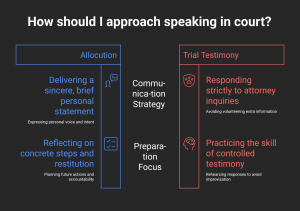 If You Have to Speak: “Allocution” and Testimony
If your case reaches sentencing, you’ll typically have the opportunity to address the judge directly — this is called allocution. This is one of the few moments in the process where your own words, delivered in your own voice, can visibly shape the outcome. Judges consistently note that they’re listening for:
- Genuine accountability, not minimization or blame-shifting
- Specific, concrete steps you’ve taken or plan to take (treatment, classes, employment, restitution)
- Brevity and sincerity over a rehearsed-sounding speech
If you testify at trial, the same principles apply, amplified: answer only the question asked, don’t volunteer extra information, don’t argue with the prosecutor on cross-examination, and always speak to the judge or jury — not combatively to the attorney questioning you. Practice this with your attorney beforehand; testifying is a skill, not something to improvise under pressure.
Common Mistakes That Undermine Defendants in Colorado Courts
- Missing a court date. Even an honest scheduling conflict can trigger a bench warrant in Colorado. If something comes up, contact your attorney or the court clerk before the date, not after.
- Violating bond conditions, even minor ones (missing a check-in, contacting a protected party). This is one of the fastest ways to lose a favorable bond and damage your credibility with the judge.
- Arguing your case on your own timeline. Judges control the proceeding; interrupting to “explain your side”outside of your designated opportunity to speak almost always backfires.
- Posting about your case on social media. Prosecutors and courts do look at public commentary — even venting —, and it can be used against you or undercut arguments your attorney is making.
- Showing up under the influence of alcohol or drugs, including in situations where impairment isn’t the charge. This will be noticed immediately by court staff and can affect bond and custody decisions on the spot.
The #1 Thing That Makes a Bad Impression Fast
Arguing with the process.
Not the case. The process.
Like when someone interrupts because “that’s not fair,” or when they keep talking while the judge is trying to move the hearing along. Or they roll their eyes. Or sigh dramatically. Or start explaining their entire life story without being asked.
Court has a structure. It is not flexible just because you are stressed. And if you show the judge you cannot follow the structure, you lose credibility.
So, make it your personal mission to:
- Wait until it is your turn.
- Stop talking when the judge speaks.
- Answer questions directly.
- Keep your tone neutral.
- Avoid sarcasm.
You can be firm. You can disagree. But you cannot be chaotic.
Emotional Control, Without Acting Like a Robot
Court involves real conflict. Sometimes it involves trauma. So yes, emotions happen.
But your goal is to show that you can manage yourself in a formal setting.
A few tricks that help more than people expect:
- Pause before answering.
- Breathe slower than you want to.
- Take notes while the other side is talking instead of reacting.
- If you feel yourself spiraling, ask for a moment to look at your notes.
- Speak in shorter sentences.
If you cry, you cry. It happens. But try to keep speaking. Or ask for a moment, then continue.
What makes a bad impression is not emotion. It is loss of control that turns into disrespect or disorder.
Sometimes you will be in a hallway with the other party, their attorney, their friends, whoever. Do not have hallway arguments.
Anything you say can come back into the courtroom in some form. Even if it is not “evidence,”it can become part of the story about your behavior.
If there is a protection order or a no-contact order in place, do not approach. Period.
If You Have an Attorney….
People sometimes think, “My lawyer will handle it, I can relax.”
Sure, your lawyer does most of the talking. But judges absolutely notice clients. Especially in family law, protection orders, and criminal matters. They watch body language. They watch reactions. They watch whether you look like you are listening.
Simple rules if you are represented:
- Let your attorney speak unless they tell you otherwise
- Don’t whisper constantly while the judge is talking
- Don’t make faces at the other side
- If you must communicate, pass a note quietly
- Follow your attorney’s lead on when to stand, when to sit, when to approach.
The Bottom Line
Making a good impression in a Colorado courtroom isn’t about performing innocence or putting on a show — judges see through that quickly. It’s about demonstrating, consistently and genuinely, that you understand the seriousness of the process and are engaging with it responsibly: showing up on time, dressing appropriately, following courtroom decorum, listening more than you speak, and working closely with your attorney rather than around them.
None of this replaces having skilled legal representation, but paired with good counsel, it can meaningfully shape how a judge, prosecutor, or jury perceives you — and that perception can carry real weight in how your case resolves.
FAQs (Frequently Asked Questions)
What should I know about the feel of Colorado courts?
Colorado courts tend to be quieter and more procedural than what people expect. They are not as dramatic as on TV, and small details, like how you present yourself, matter a lot because the environment is calm and focused on standard court procedures.
Why do first impressions matter in Colorado court?
First impressions in court are about credibility, not charm or likability. Judges, clerks, bailiffs, and attorneys quickly categorize people based on how prepared and respectful they appear. Seeming prepared can be almost as important as actually being prepared.
How early should I arrive for my court hearing in Colorado?
For in-person court hearings, aim to arrive 30 to 45 minutes early to allow time for parking, security, finding the courtroom, and checking in. For remote hearings, log in at least 15 minutes early to avoid technical issues.
What items should I bring with me to a Colorado court hearing?
Bring a government ID, all relevant paperwork (printed if possible), a notebook and pen, any documents you plan to refer to, a list of key points you want to make, your attorney’s contact info if applicable, and extra copies of exhibits for yourself, the other side, and the court.
What is appropriate attire for appearing in Colorado court?
Dress respectfully but comfortably—think business casual. Wear clean clothes without distracting graphics or slogans. Suitable options include collared shirts or plain blouses, sweaters or simple jackets, slacks or modest skirts, and closed-toe shoes. Avoid hats and sunglasses inside the courtroom.
How should I behave when entering the courthouse and interacting with staff?
Be polite and respectful to everyone you encounter, including security and clerks. Follow instructions promptly without making a fuss. Keep your phone on silent mode and avoid using it near courtrooms unless permitted. Politeness helps create a positive impression that can influence how staff and judges perceive you.
Colorado Criminal Law – How to Make a Good Impression in a Colorado Courtroom When You’re Charged With a Crime
The reader is alerted that Colorado criminal law, like criminal law in every state and at the Federal level, changes constantly. The article above was accurate when it was drafted, but it cannot account for changes that occurred after it was uploaded.
 ABOUT THE AUTHOR: H. Michael Steinberg – Email the Author at: hmsteinberg@hotmail.com
A Denver, Colorado Criminal Defense Lawyer – call his office at 303-627-7777 during business hours, or call his cell at 720-220-2277 if you cannot wait and need his immediate assistance.
“A good criminal defense lawyer is someone who devotes themselves to their client’s case from beginning to end, always realizing that this case is the most important thing in that client’s life.”
Putting more than 40 years of Colorado criminal defense experience to work for you.
One should be careful when selecting a Colorado criminal defense lawyer. We encourage you to “vet” our firm. Over the last 40 years – by focusing ONLY on Colorado criminal law – H. Michael has had the time to continually update himself in nearly every area of criminal law, including procedure, trial, and courtroom practice.
H. Michael works hard to deliver the best possible results for his clients, both in and out of the courtroom. He has written extensively on Colorado criminal law and continues to do so, and he hopes this article helps you in some small way.