 Colorado Criminal Lawyer Blog
Colorado Teen Shoplifting Defense: What Works in 2026


By H. Michael Steinberg, A Colorado Criminal Defense Lawyer – Practicing Colorado Criminal Law in the courts of Colorado for over 40 years.
 Introduction:
If you are a parent in Colorado and you just got “that call” from the school, from the mall, from a store manager, from an officer, or maybe from your own kid, crying, trying to explain it in a weird, rushed way words that do not fully make sense. “I am under arrest.”
Shoplifting charges may seem minor on paper for teens, but in reality, they can feel overwhelming. It’s not just about the stolen item—it’s about having a record. The shame. School consequences. Losing out on sports, scholarships, college applications, and future jobs. And the unspoken fear that this could be the start of something bigger.
By 2026, Colorado won’t use a one-size-fits-all approach for minor shoplifting cases. There are different paths: some are helpful; others can be pitfalls. Much depends on the county, the store, the officer, and even the exact wording in the police report.
Let’s focus on what actually makes a difference. Not wishful thinking or “just say sorry, and it’ll go away.” These are real defense strategies that can have an impact in Colorado teen shoplifting cases.
Quick note: this is for general education, not legal advice. For guidance specific to your situation, consult a Colorado criminal defense attorney specializing in juvenile cases.
 First, What Colorado Calls “Shoplifting”
In Colorado, “shoplifting” is usually charged under theft laws rather than a separate shoplifting statute in many situations. You will hear people say “shoplifting,” but the summons or petition might say Theft or sometimes Attempted Theft.
Why it matters.
Theft charges are value-based. The dollar amount of the alleged theft changes the seriousness. The way the DA frames the case can also affect whether diversion is offered, how restitution is calculated, and whether the court treats it like a one-time mistake or a pattern.
Also, some cases get charged as:
- Theft.
- Attempted theft.
- Criminal mischief (if there was damage, like ripping a security tag and damaging clothing).
- Trespass (if there is a ban notice and the teen returns).
- Robbery (rare, but can happen if force is alleged during exit, like pushing a guard).
Most teen cases aren’t in that scary category, but you still want to understand how quickly a “small thing” can be inflated if the report is sloppy or the store’s loss-prevention person exaggerates.
Applicable Laws and Classification
Shoplifting is generally prosecuted as theft under C.R.S. § 18-4-401 (or related provisions such as § 18-4-406 regarding concealment as evidence of intent).
Classification and potential penalties track the value of the merchandise:
Less than $300: Petty offense (up to 10 days jail and/or $300 fine).
$300 to less than $1,000: Class 2 misdemeanor (up to 120 days jail and/or $750 fine).
$1,000 to less than $2,000: Class 1 misdemeanor (up to 364 days jail and/or $1,000 fine).
$2,000 and above: Felony levels (Class 6 and higher), with prison ranges starting at 1–18 months and escalating.
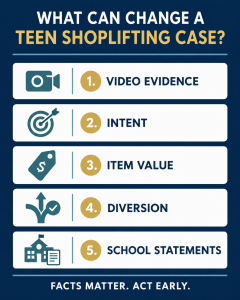 Juvenile Court vs. Adult Court
Most teenagers accused of shoplifting are handled in juvenile court. Colorado juvenile cases differ from adult cases in tone and available tools. Diversion programs are more common, confidentiality is often better, and the court is supposed to be more focused on rehabilitation.
But do not assume it is automatically juvenile court just because your child is under 18. Age, charge level, history, and other factors can matter. And if a teen is close to 18, some families get blindsided by how fast the case starts to feel “adult.”
Even in juvenile court, though, the consequences can be real. Probation. Community service. Restitution. Evaluations. Classes. Curfews. School reporting. And sometimes a record that is not as private as people think.
What Works in 2026, Step by Step
1) Stop the damage early: do not let your teen “explain” things to law enforcement without counsel
One of the most effective defensive moves is to
Teens tend to talk. They want to be honest. Or they want to impress. Or they panic and fill the silence with nonsense. Or they think that if they admit it, the officer will be nicer. Or they think the store will “drop it” if they just say sorry.
In 2026, stores and police departments are still using body cams, written statements, and sometimes store surveillance plus AI-enhanced tracking of movement in the store. A teen’s “explanation” becomes evidence, even if it is confused and half true.
If your child is contacted by police, school resource officers, or a store LP officer, the safest default is:
- Provide identifying info as required.
- Ask for a parent if appropriate.
- Politely say they will not answer questions without an attorney.
This is not being difficult. This is keeping a manageable case from becoming a confession plus extra details that the DA can use to justify harsher terms.
2) Get the footage, the reports, and the “paper trail” (police reports) fast
A surprising number of teen shoplifting cases have weak evidence. Not “no evidence,” but weak. Grainy video. A camera angle that does not show concealment. A gap in time. A receipt that does not match the store’s claim. A loss prevention report that contains assumptions presented as facts.
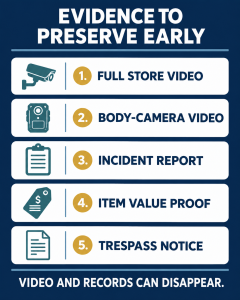
What works is pushing early for:
- The full surveillance footage, not just clips.
- Body cam footage if police were involved.
- The store’s incident report.
- Any written trespass notice.
- Inventory documentation or item value proof.
Video can disappear. Systems overwrite. Stores “lose” the longer footage. And once it is gone, it is gone.
A defense that starts with evidence preservation tends to do better than a defense that starts with “my kid is a good kid.” Good kid arguments help. But evidence wins cases.
3) Fight the “intent” element, because intent is where teen cases crack open
Theft is not just “an item left the store.” Usually, the state has to prove intent to permanently deprive (or the relevant intent standard under Colorado theft law). For teens, intent is often messy.
Examples that show up all the time:
-
- Teen had items in a bag but was still shopping, then panicked when confronted.
- Teen claims they planned to pay but got distracted, separated from friends, or had a phone call.
- Teen thought a friend scanned the item at self-checkout.
- Teen thought parent already paid, or item was theirs already.
- Teen followed a friend and did not realize what was happening.
- Teen is neurodivergent or has anxiety and froze, then made it worse.
None of these automatically “wins.” But intent is the place where a defense attorney can create reasonable doubt, negotiate a plea deal, or position the case for diversion.
Also, stores often overstate what “concealment” means. Putting something in a basket under a jacket while carrying three other items is not always clear evidence of intent. Context matters.
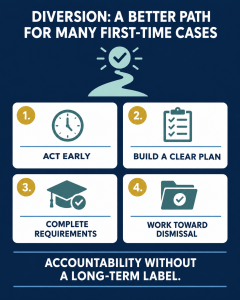 4) Seek A diversion program early, but do it the right way,
For first-time teen shoplifting cases, diversion is often the best outcome. Diversion can mean the case is paused while the teen completes requirements, then dismissed.
But the way you approach diversion matters.
What works in 2026 is a clean, structured presentation:
-
- No new admissions beyond what is necessary.
- A credible plan for restitution.
- Proof of stability: school attendance, grades, counseling if relevant, family support.
- A short statement of accountability that does not create extra legal exposure.
What does not work is the “emotional essay” style approach where a parent sends a long email to the prosecutor detailing everything the teen did, plus every other time the teen stole makeup last year, plus a full mental health history, plus screenshots of texts.
People actually do this. They think it helps. It can backfire.
A good attorney will know the diversion culture in your county. Arapahoe. Douglas,Denver, Jefferson, El Paso, Boulder, Larimer, Weld, and the mountain counties can feel very different in practice.
 5) Investigate the valuation problem because the dollar amount drives everything.
In Colorado theft cases, value can change the charge level. Stores will sometimes list the full retail price, even if the item was on sale. Or they bundle multiple items in a way that does not match what the footage actually shows. Or they claim multiple incidents.
What works:
-
- Demand proof of value.
- Separate out what can be proven vs. what is assumed.
- Challenge “aggregation” across dates unless properly supported.
- Look for store pricing tags, sale pricing, and receipts.
Even in juvenile court, valuation impacts the prosecutor’s mindset and the court’s willingness to treat it as minor. Getting the value corrected can shift the whole case.
6) Self-checkout cases: attack the assumptions, not the teen.
In 2026, many teen shoplifting allegations stem from self-checkout. And the facts are often not as clean as stores claim.
Common self-checkout issues:
-
- Mis-scans.
- Scanned, but the system did not register.
- Items moved between bags.
- Barcode did not read.
- Confusion when scanning multiples.
- A friend scanned some items,
- and the teen assumed everything was included.
What works is focusing on what can be proven:
-
- Did the video clearly show the teen skipping scans?
- Is there register data that matches the timing?
- Was there an opportunity to correct at the register?
- Was the teen stopped before leaving or after?
- Was there any statement taken improperly?
7) Trespass notices and “bans”: treat them seriously, even if the theft case resolves.
Stores often issue a trespass notice or ban letter. Teens sometimes ignore it. Parents forget about it. Then months later the teen walks into the same store with friends, and now it is a new charge… trespassing.
Even if you are accepted into diversion or deferred judgment, a trespass notice can pose a future risk.
Part of what works is making sure the family understands:
-
- What locations are covered.
- How long the ban lasts.
- Whether it is enforceable chain-wide or store-specific.
- What happens if the teen returns.
Sometimes a defense attorney can negotiate the terms or at least clarify them. Do not assume “it’s just a letter.”
8) School consequences: coordinate, because schools can accidentally worsen the legal case,
Schools can impose discipline, and sometimes an SRO is involved. A teen might be pressured to write a statement “to the school” that ends up shared with law enforcement. Or a counselor note gets referenced. Or a school discipline hearing creates admissions.
What works:
-
- Keep school discipline and criminal defense coordinated.
- Do not let your teen write detailed statements without advice.
- If the school wants an “accountability letter,” keep it general and non-incriminating, and consider having counsel review it.
You can still be cooperative with the school. You just do not want a school process to generate the prosecution’s best evidence.
9) Mental health and neurodiversity: use it carefully, not as an excuse
This is a complex area.
Anxiety, ADHD, autism spectrum issues, depression, trauma, impulse control problems. These can be relevant. They can also be misunderstood. And if raised clumsily, it can sound like “my kid is not responsible,” which tends to have the opposite effect on prosecutors and judges.
What works in 2026 is a balanced approach:
-
- If evaluation or counseling is appropriate, start it early.
- Use documentation to support mitigation or appropriate services.
- Tie it to a plan: coping skills, treatment, structure.
- Avoid presenting it as a free pass.
In some cases, mental health context helps support diversion, alternative sentencing, or tailored probation terms that actually reduce repeat behavior.
10) Restitution and civil demand letters: know the difference
Many parents receive a civil demand letter from the retailer. It might ask for money beyond the value of the item. It might feel like a fine.
Civil demand is separate from criminal restitution.
What works is not panicking and not paying blindly. You want to understand:
-
- What is legally required vs. what is requested.
- Whether paying a civil demand affects the criminal case (sometimes it can help, sometimes it is neutral, and sometimes it creates complications).
- Whether the DA will require restitution anyway.
- Whether payment is an admission (it can be framed that way).
This is one of those areas where a quick consult with a Colorado attorney can save you from an expensive mistake.
11) Sealing and expungement planning: start thinking about it now, not after the case ends
Families often wait until the case is “over” to ask about sealing records. But the outcome you negotiate now might affect what is possible later.
What works:
-
- Ask early what outcome best supports sealing later.
- Avoid pleas that create records that are harder to seal.
- Keep copies of completion certificates, dismissal orders, and diversion paperwork.
Colorado record sealing rules can be specific and depend on the exact charge and disposition. Your lawyer should be thinking about the endgame from day one.
Defense approaches that sound good but can fail
“We will just pay for it, and they will drop it”
Sometimes paying restitution helps. It does not automatically make the case go away. The store does not control prosecution once the police are involved, and even without police involvement, some stores consistently push charges.
“My kid is a straight A student”
That is great. It is mitigation, not a defense. Use it as part of a structured diversion pitch, not as the whole argument.
“The store security bullied them”
It happens. But you still need facts. If there was an illegal detention, coercion, or an improper search, that is important. If it was just uncomfortable and embarrassing, that alone does not dismiss the charge.
“It was only makeup, everyone does it”
Do not say this to anyone official. Not the store. Not the school. Not the DA. It reads as minimizing, and it can kill diversion.
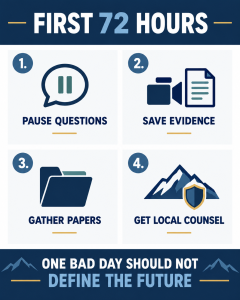 What parents can do in the first 72 hours
This is the practical checklist most families wish they had.
- Write down the timeline while it is fresh. Time, place, who was there, what was said, who stopped the teen, whether police were called.
- Preserve texts between friends about the incident. Do not edit them. Do not coach your teen to delete anything. That can become its own nightmare.
- Collect documents: citation, receipt, trespass notice, civil demand letter, school notice.
- Do not contact the store to “explain” unless advised by counsel. Parents accidentally create admissions all the time.
- Consult a juvenile defense attorney who practices in that county.
- Start proactive steps if appropriate: counseling intake, theft education class, community service. Not to perform. To show the court there is a plan.
How a good Colorado juvenile defense attorney can frame a good outcome
In 2026, the best results tend to come from a combination of:
- Evidence review (video, reports, value proof)
- Legal defense (motions, suppression issues if statements were taken improperly, intent challenges)
- Negotiation positioning (diversion request that is credible and clean)
- Mitigation without self-sabotage (school records, character letters, counseling, restitution plan)
- Future-proofing(sealing strategy, ban notice compliance, probation terms that are realistic)
Sometimes the “win” is full dismissal. Sometimes it is diversion then dismissal. Sometimes it is reducing to a lesser offense that seals more easily. Sometimes it is avoiding probation and keeping it to a class and community service.
The point is, there is usually a path that is better than what the initial citation makes it seem like.
The part nobody likes, but it matters: what the court is really worried about
Judges and prosecutors often care about two things in teen theft cases:
- Is this kid going to do it again?
- Is this kid headed toward bigger risk behaviors?
So defenses that work do not just argue facts. They tell a credible story about stability, supervision, and change. Not fake, not dramatic. Just real.
A teen who made a dumb choice with friends, has no history, has parents engaged, has already started a class, is taking it seriously. That teen is a good candidate for a lighter resolution.
A teen who is minimizing, missing court, failing school, getting cited again. The same charge suddenly gets treated way more seriously.
Civil Exposure for Parents/Guardians
Under C.R.S. § 13-21-107.5, the parents or guardian of an unemancipated minor can face civil liability for actual damages plus a statutory penalty of $100–$250, even without a criminal conviction. Stores often send civil demand letters separately from any criminal case
C.R.S. § 13‑21‑107.5 establishes a civil liability scheme in Colorado for certain theft‑related conduct in mercantile establishments, allowing owners to recover actual damages plus a statutory penalty without needing a criminal theft conviction.
Key Definitions
- Emancipated minor – Under 18, whose parents/guardian have surrendered custody and responsibilities and are no longer required to support them.
- Mercantile establishment – Any place where merchandise is displayed, held, or offered for sale (retail or wholesale).
- Merchandise – All movable items capable of manual delivery and offered for sale.
Prohibited Conduct and Liability
- Adults or emancipated minors – If they take merchandise without the owner’s consent, without paying, with intent to convert it to their own use, or alter price tags, they are civilly liable for actual damages plus a penalty of $100–$25.
- Parents/guardians of unemancipated minors – If the minor commits the same conduct, the parent/guardian is civilly liable for actual damages plus a penalty of $100–$25.
- Shopping cart theft – Taking a shopping cart without consent with intent to convert it to one’s own use (or another’s) is civilly liable for actual damages plus a $100 penalty.
Additional Provisions
- No criminal conviction required – A theft conviction under Title 18, C.R.S., is not a prerequisite for filing a civil action under this section.
- No liability caps – This civil liability is not subject to the $3,500 cap in § 13‑21‑107 or other parental liability limit.
Practical Effect
This statute provides a direct civil remedy to merchants for certain theft‑like conduct, bypassing the need for criminal prosecution. It applies to both the wrongdoer and, in some cases, the parent/guardian of a minor, and includes a fixed penalty range to deter such behavior
Wrap up
Colorado teen shoplifting cases in 2026 are not hopeless, but they are not “nothing” either. The best defenses tend to do a few simple things really well.
Protect your kid from making the case worse with statements. Get the footage and documents before they disappear. Challenge intent and valuation, as those are weak points in many cases. Push for diversion the right way. Handle school consequences carefully. And plan to seal your records early, because your future self will thank you.
If you are in the middle of this right now, you are not alone. Many good families go through it. Focus on the next right step, not the panic. The goal is not just to get through court. It is to make sure one bad day does not turn into a long-term label.
FAQs (Frequently Asked Questions)
What does ‘shoplifting’ mean under Colorado law for teens?
In Colorado, shoplifting is usually charged under theft laws rather than a separate shoplifting statute. The charges often say ‘Theft’ or ‘Attempted Theft,’ and the seriousness depends on the dollar amount of the items involved. Understanding this distinction matters because it affects how the case is handled, including diversion options, restitution, and whether it’s treated as a one-time mistake or part of a pattern.
Are teen shoplifting cases handled in juvenile court or adult court in Colorado?
Most teenagers accused of shoplifting in Colorado are handled in juvenile court, which focuses more on rehabilitation and confidentiality. However, age, charge level, history, and other factors can lead to cases being moved to adult court, especially if the teen is close to 18. It’s important not to assume automatic juvenile court processing.
What should parents do immediately after their teen is accused of shoplifting in Colorado?
A key first step is to stop further damage by advising your teen not to explain or talk about the incident without legal counsel. Teens often unintentionally provide confusing or damaging statements that can be used as evidence. The safest approach is to provide only identifying information when required and politely request an attorney before answering questions.
How important is obtaining evidence like surveillance footage and police reports in teen shoplifting cases?
Obtaining all relevant evidence early—including full surveillance footage, body cam videos if police were involved, store incident reports, trespass notices, and inventory documentation—is crucial. Many cases have weak evidence due to poor video angles or assumptions in reports. Preserving this evidence early can significantly strengthen a defense.
Why is intent a critical factor in defending teen shoplifting charges in Colorado?
The state usually must prove that the teen intended to permanently deprive the store of its property. Intent can be complicated with teens due to factors like confusion during shopping, misunderstandings about payment responsibility, or following friends without realizing wrongdoing. Challenging intent often creates opportunities for successful defense strategies.
What are potential consequences for teens charged with shoplifting in Colorado?
Even in juvenile court, consequences can include probation, community service, restitution payments, evaluations, classes, curfews, school reporting requirements, and sometimes records that are less private than expected. Shoplifting charges can also impact scholarships, college applications, future jobs, and carry emotional burdens like shame and fear of escalation.
Colorado Criminal Law – Colorado Teen Shoplifting Defense: What Works in 2026
The reader is alerted that Colorado criminal law, like criminal law in every state and at the Federal level, changes constantly. The article above was accurate when it was drafted, but it cannot account for changes that occurred after it was uploaded.
 ABOUT THE AUTHOR: H. Michael Steinberg – Email the Author at: hmsteinberg@hotmail.com
A Denver, Colorado Criminal Defense Lawyer – call his office at 303-627-7777 during business hours, or call his cell at 720-220-2277 if you cannot wait and need his immediate assistance.
“A good criminal defense lawyer is someone who devotes themselves to their client’s case from beginning to end, always realizing that this case is the most important thing in that client’s life.”
Putting more than 40 years of Colorado criminal defense experience to work for you.
One should be careful when selecting a Colorado criminal defense lawyer. We encourage you to “vet” our firm. Over the last 40 years – by focusing ONLY on Colorado criminal law – H. Michael has had the time to continually update himself in nearly every area of criminal law, including procedure, trial, and courtroom practice.
H. Michael works hard to deliver the best possible results for his clients, both in and out of the courtroom. He has written extensively on Colorado criminal law and continues to do so, and he hopes this article helps you in some small way.