 Colorado Criminal Lawyer Blog
Does Hiring A Colorado Criminal Defense Lawyer Make You Look Guilty?


 By H. Michael Steinberg, A Colorado Criminal Defense Lawyer – Practicing Colorado Criminal Law in the courts of Colorado for over 40 years.
Introduction:
No.
Hiring a criminal defense lawyer does not make you look guilty—it means you are exercising a fundamental legal right and taking an accusation, investigation, or criminal charge seriously in an attempt NOT to be the victim of a mistake in the criminal justice “system”.
“If I’m Innocent, Why Do I Need a Lawyer?”
In Colorado, a person accused of a crime has the right to defend themselves with counsel, and courts must advise defendants of that right at initial appearance. Being investigated or charged is not the same as being convicted. A criminal defense attorney’s role is to protect your rights, explain the process, evaluate the evidence, and make sure the government meets its burden of proof.
You haven’t been charged with anything. Maybe you’ve just been questioned, or you’ve heard a detective wants to “clear a few things up.” A voice in your head says: if I call a lawyer now, won’t that make me look guilty?
It’s one of the most common fears people have when they first brush up against the criminal justice system, and it stops a lot of innocent people from protecting themselves. What I tell my clients is this: the irony is that the first thing the police do when they are under investigation is to request their union lawyer, and then “lawyer up,” even if they have done nothing wrong.
The right to counsel is not reserved for people who have done something wrong. It exists because even a criminal allegation can carry serious consequences, and because navigating police interviews, court dates, evidence, deadlines, plea offers, bond conditions, and sentencing exposure can be difficult without legal guidance.
This article explains why that fear is backward, what the law actually says about your decision to get counsel, and what you should do instead of talking yourself out of it.
Even a truthful person may inadvertently create problems by trying to explain too much.
For example, a person contacted by an investigator may believe they can “clear everything up” in a voluntary interview. But once the conversation begins, the officer—not the interviewee—controls the questions, the wording, the pace, and the record of what was said.
Police and prosecutors do not begin with complete information. Witness memories can be mistaken. A statement can be taken out of context. Digital evidence can be incomplete. An accuser may have misunderstood events, made an inaccurate identification, or provided information influenced by stress, conflict, or limited knowledge.
A criminal defense lawyer can help assess whether an interview is advisable, prepare the client for interactions with law enforcement, and handle communications when appropriate. Seeking that advice is prudent. It is not a confession.
Why the Fear Exists
This fear usually comes from television, not law. On crime dramas, the character who “lawyers up” is almost always hiding something, because it’s a useful shorthand for plot tension. Real life doesn’t work that way.
The presumption of innocence is a foundational principle of the U.S. justice system: you are innocent until proven guilty, and the burden of proof rests entirely with the prosecution. Choosing to protect a right the Constitution gives you does not weaken that presumption — it’s part of how the system is designed to function.
The Fifth Amendment protects you from self-incrimination, and the Sixth Amendment guarantees your right to counsel. These aren’t loopholes for the guilty; they’re checks on a system that has enormous power to investigate, charge, and prosecute.
An innocent person is often at greater risk without a lawyer, because they assume the truth will simply speak for itself — and then unknowingly say something that gets twisted, taken out of context, or used to build a case against them.
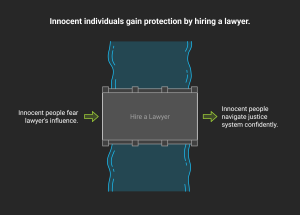 In the eyes of the law, hiring a lawyer is a right, not a signal
In the United States and many other legal systems, the right to counsel, as noted above, is fundamental. It is not a luxury. It is not a suspicious behavior. It is part of what makes a process fair.
A judge will not treat you as guilty because you hired an attorney. If anything, judges often prefer it because cases move more smoothly when someone competent handles filings, deadlines, negotiations, and court procedure.
Prosecutors also do not treat “has a lawyer” as proof of guilt. They treat it as “this person has representation.” That changes how they communicate. They cannot casually get you to say things. They have to talk through your lawyer. It is cleaner and reduces the risk of later claims that you were pressured or confused.
Police officers might personally think, “Lawyered up.” Sure. Some will. But that does not matter in the way people imagine. Police opinions are not verdicts. And police do not get to punish you for using your rights, at least not legally.
The bigger issue is this: if you do not have a lawyer, you are easier to misinterpret and easier to pressure. And that is not about guilt. That is about vulnerability.
More Common Misconceptions
- “Only guilty people need protection.“ Everyone needs protection from a process that can move fast, use pressure tactics, and misinterpret innocent behavior or answers.
- “If I explain myself, this will go away faster.“ Investigators are trained interviewers. Without legal guidance, it’s easy to unintentionally contradict yourself, guess at details, or provide information that helps build a case — even when you’ve done nothing wrong.
- “Asking for a lawyer will make them focus on me.“ Investigators already have a reason to be talking to you. Asserting your rights doesn’t add suspicion; it removes the risk that anything you say becomes the reason you’re charged.
- “I can always get a lawyer later, once things get serious.“ The earliest stages of an investigation — before charges are filed — are often when the most damage is done, because people talk freely before they understand what’s at stake.
✓ Key Takeaway
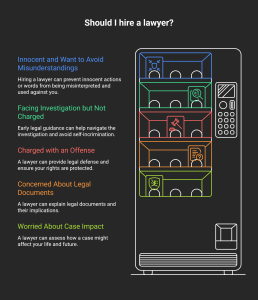
Hiring counsel is a practical and responsible decision whether you are:
Innocent and want to avoid saying something that could be misunderstood and used against you at trial.
Facing an investigation but have not been arrested or charged.
Charged with a misdemeanor, felony, traffic offense, DUI, domestic-violence-related offense, or municipal offense.
Concerned about a warrant, a summons, a protection order, or a court date.
Trying to understand whether a case could affect your job, professional license, immigration status, firearm rights, housing, or family.
What to Actually Do Instead of Worrying About The Optics
- Say the sentence that protects you. If you’re being questioned, you can simply say:“I want to speak with a lawyer before answering any questions.“ This ends the interview, and anything you say after those words cannot be used against you.
- Don’t try to “clear things up” on your own first. Even a truthful, well-intentioned explanation can be misunderstood or used selectively. Let your lawyer manage what’s communicated and when.
- Contact a criminal defense attorney immediately— before charges are filed if possible, not after. Early legal advice can sometimes prevent charges from being filed at all.
- Don’t discuss your case on social media, with acquaintances, or over recorded jail phone lines. Anything you say can resurface later, often in a much less favorable light than you intended.
- Let your lawyer handle communication with investigators, prosecutors, and even concerned family members if the case becomes public. This keeps the narrative accurate and protects your legal position.
The Truth: Those Who Know It
In practice, everyone who can afford to — corporate executives, police officers under investigation, witnesses, even prosecutors themselves when they’re on the other side of a subpoena — hires a lawyer before speaking to investigators.
That’s not a guilty person’s move. It is what informed people do.
Final Key Takeaways
- Hiring a lawyer is a constitutionally protected right, not a signal of guilt, and courts explicitly prohibit treating it as one.
- The fear of “looking guilty” is a myth reinforced by media, not by how courts or investigators actually operate.
- Innocent people are often more vulnerable without a lawyer, not less, because they underestimate how statements can be used.
The best time to get legal advice is as early as possible — ideally before any questioning or charges occur.
Some of the tasks of a criminal defense lawyer at this stage of a case …
To:
-
-
Understand the precise accusation and potential penalties
-
Communicate with law enforcement or prosecutors in an appropriate manner
-
Prevent an avoidable or damaging statement
-
Review charging documents, police reports, body-camera footage, lab results, and other evidence
-
Identify constitutional or procedural issues
-
Address bond, release conditions, no-contact orders, and court compliance
-
Negotiate where appropriate
-
Prepare a defense for hearings or trial
-
Assess collateral consequences beyond the immediate criminal case.
-
None of those steps requires guilt. They are part of a meaningful defense process.
-
Frequently Asked Questions
Can a prosecutor tell the jury that I hired a lawyer or that I stayed silent?
No. It is unconstitutional for a prosecutor to comment on your decision to remain silent or to request an attorney, and doing so can be grounds for appeal. Juries are also instructed not to draw any negative conclusions from it.
If I’m innocent, why would I need a defense lawyer at all?
Because being innocent doesn’t protect you from being investigated, misquoted, or charged based on incomplete evidence. A defense lawyer’s job includes making sure the process treats you fairly — innocence is not a shortcut around procedure.
Won’t hiring a lawyer make the police think I’m hiding something?
Police already have training and incentives that don’t change based on your choice to have counsel. What changes is your ability to avoid mistakes, so the case is judged on real evidence rather than an unguided conversation.
Is it too early to call a lawyer if I’ve only been questioned, not arrested?
It’s rarely too early. The period before formal charges are filed is often the most important window to seek advice, since decisions and statements made during this time can shape the entire case.
Colorado Criminal Law – Does Hiring A Colorado Criminal Defense Lawyer Make You Look Guilty?
The reader is alerted that Colorado criminal law, like criminal law in every state and at the Federal level, changes constantly. The article above was accurate when it was drafted, but it cannot account for changes that occurred after it was uploaded.
 ABOUT THE AUTHOR: H. Michael Steinberg – Email the Author at: hmsteinberg@hotmail.com
A Denver, Colorado Criminal Defense Lawyer – call his office at 303-627-7777 during business hours, or call his cell at 720-220-2277 if you cannot wait and need his immediate assistance.
“A good criminal defense lawyer is someone who devotes themselves to their client’s case from beginning to end, always realizing that this case is the most important thing in that client’s life.”
Putting more than 40 years of Colorado criminal defense experience to work for you.
One should be careful when selecting a Colorado criminal defense lawyer. We encourage you to “vet” our firm. Over the last 40 years – by focusing ONLY on Colorado criminal law – H. Michael has had the time to continually update himself in nearly every area of criminal law, including procedure, trial, and courtroom practice.
H. Michael works hard to deliver the best possible results for his clients, both in and out of the courtroom. He has written extensively on Colorado criminal law and continues to do so, and he hopes this article helps you in some small way.