 Colorado Criminal Lawyer Blog
Can Colorado Probation Monitor Everything on Your Phone?


SEX OFFENDER PROBATION | ELECTRONIC MONITORING | COLORADO LAW
Can Colorado Probation Monitor Everything on Your Phone? People v. Silvanic and the Limits of Electronic Surveillance in Sex Offender Probation
By H. Michael Steinberg, Colorado Criminal Defense Lawyer
For people serving Sex Offender Intensive Supervision Probation (SOISP) in Colorado, a common question comes up early: can probation make me install software that monitors everything I do on my phone and computer? It is easy to assume the answer is yes. Certainly it is well understood that probationers have reduced privacy rights, and SOISP is the most intensive form of probation Colorado can impose.
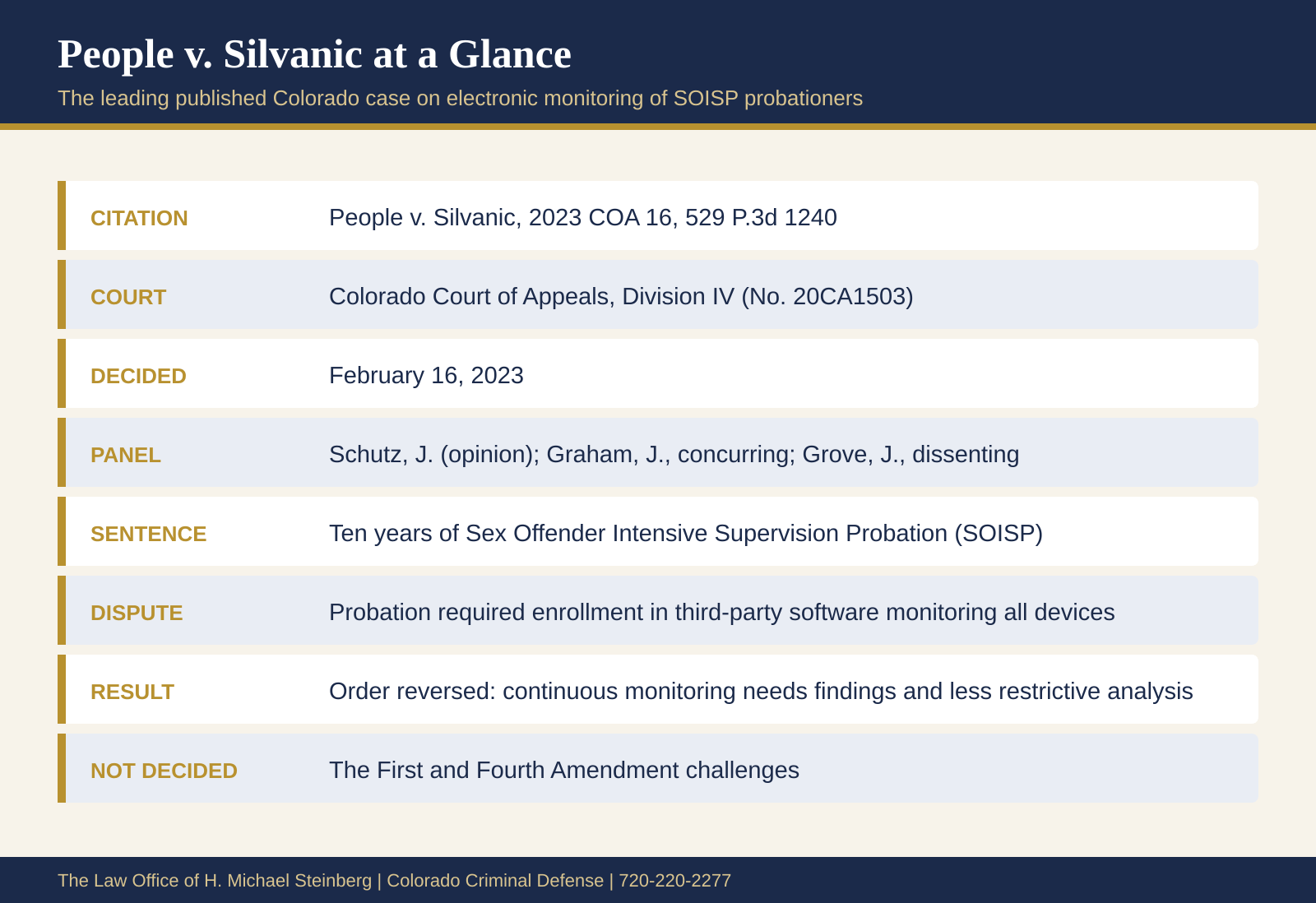
The answer to the questions has changed after the case of People v. Silvanic, 2023 COA 16. In Silvanic the Colorado Court of Appeals held that permission to search a probationer’s devices is not permission to continuously monitor them.
Before ongoing, unrestricted electronic surveillance can be imposed, the court must make individualized findings about what monitoring is actually necessary and must weigh less restrictive alternatives.
This article explains what Silvanic decided, what it did not decide, how later Colorado cases have interpreted the case, and how a defense lawyer can use the caselaw to better represent their clients.
THE SHORT ANSWER
Colorado probation does not have freestanding authority to place every person convicted of a sex offense under unlimited, continuous surveillance of every phone, computer, account, message, keystroke, GPS location, photograph and website. Individualized electronic monitoring can be lawful, but under Silvanic its scope and necessity must be justified by the court, not assumed by the probation department.
SOISP Gives Probation Broad Power, but Not Unlimited Power
Section 18-1.3-1007, C.R.S., requires that sex offenders on SOISP receive the highest level of supervision provided to probationers, in a program designed to minimize risk to the public to the greatest extent possible. That is an extraordinarily broad mandate, and Silvanic acknowledges it.
But Silvanic also holds that this mandate does not erase the judicial limits on probation conditions that burden constitutional rights. Before continuous, unfettered electronic monitoring may be imposed, the district court must:
- identify the legitimate probation and public safety interests being served;
- make factual findings about the degree of electronic monitoring actually necessary;
- examine less restrictive alternatives;
- determine that the specific monitoring condition satisfies Colorado’s probation statutes and the Brockelman factors; and
- resolve any remaining constitutional objections, rather than letting probation substitute its administrative judgment for the court’s.
What Happened in People v. Silvanic
People v. Silvanic, 2023 COA 16, 529 P.3d 1240, involved a defendant sentenced to ten years of SOISP. Electronic communications were central to the offense: Silvanic repeatedly contacted a fifteen-year-old girl electronically, including after efforts had been made to block him.
That fact makes the decision more valuable to the defense, not less. This was not a case where the offense had nothing to do with technology. The Court of Appeals still refused to approve blanket monitoring without individualized findings.
The conditions the court actually imposed
One standard condition allowed searches of Silvanic’s property, including electronic devices, when there were reasonable grounds to search. An SOISP condition allowed probation or another trained person to search his computers and devices.
The district court rejected the broader internet bans the People proposed. Instead, it required Silvanic to:
- identify his internet-capable devices;
- disclose his internet accounts;
- provide usernames, email addresses and passwords;
- disclose newly created accounts; and
- preserve, rather than delete, his internet history.
Critically, the court kept the “reasonable grounds” limitation on searches. That limitation became the heart of the appeal.
Then probation went much further
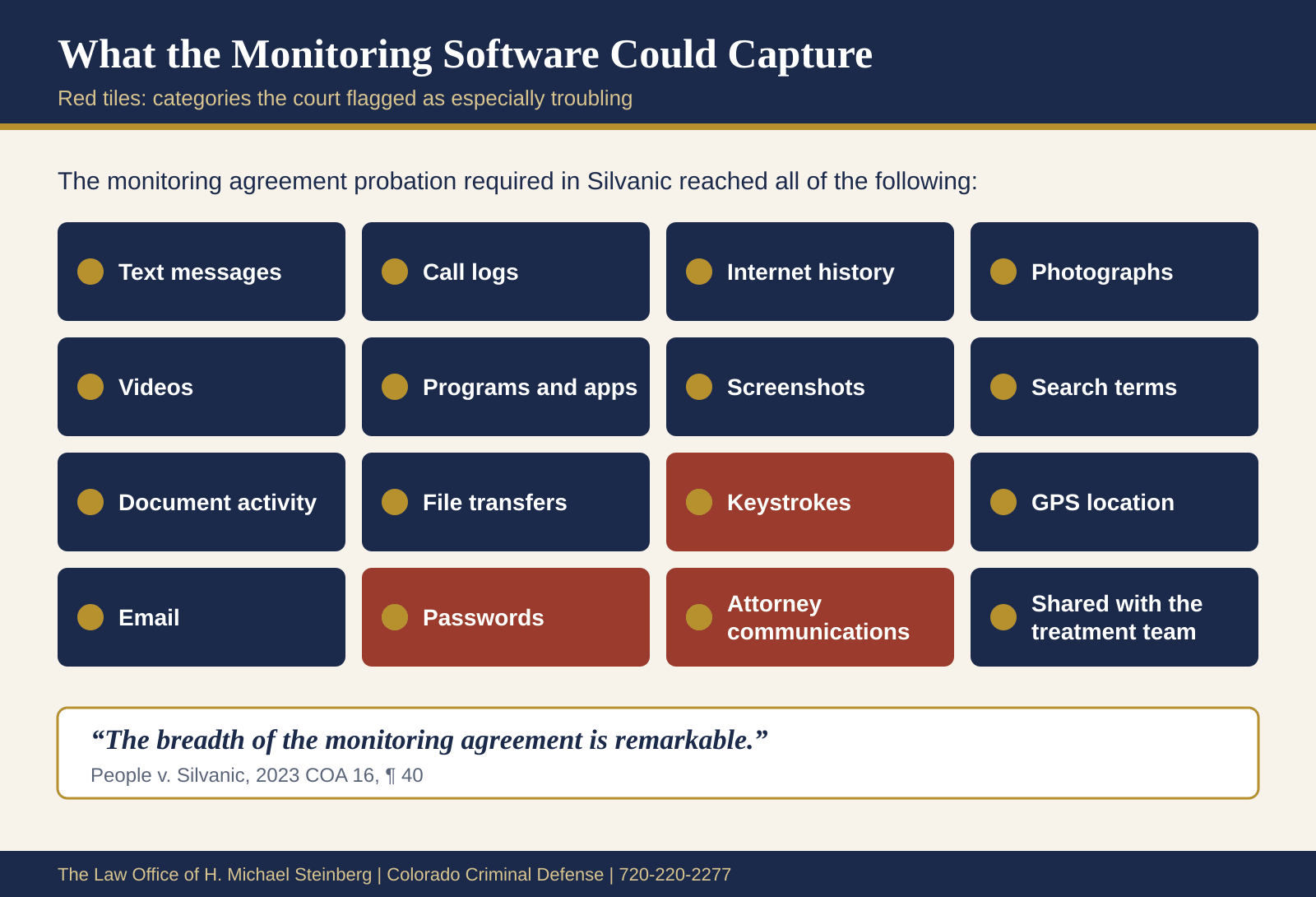
After sentencing, the probation officer directed Silvanic to enroll, at his own expense, in a third-party electronic monitoring program. The agreement covered essentially his entire digital life: messages, call logs, internet history, photographs, videos, programs, screenshots, searches, document activity, transferred files, keystrokes, GPS data and email.
It expressly contemplated capturing passwords and attorney communications, and the data could be shared with members of the supervision and treatment team.
“The breadth of the monitoring agreement is remarkable.”
— People v. Silvanic, 2023 COA 16, ¶ 40
The Key Distinction: A Search Is Not Surveillance
The district court reasoned that the existing search condition already authorized the monitoring. The Court of Appeals disagreed. Read together, the conditions authorized searches on reasonable grounds, not ongoing, unlimited monitoring.
Reasonable grounds means reasonable suspicion of a probation violation, and a search based on that suspicion must focus on property likely to hold evidence of the violation.
Continuous monitoring of all electronic communications does not fit that standard. Silvanic, ¶¶ 34–37.
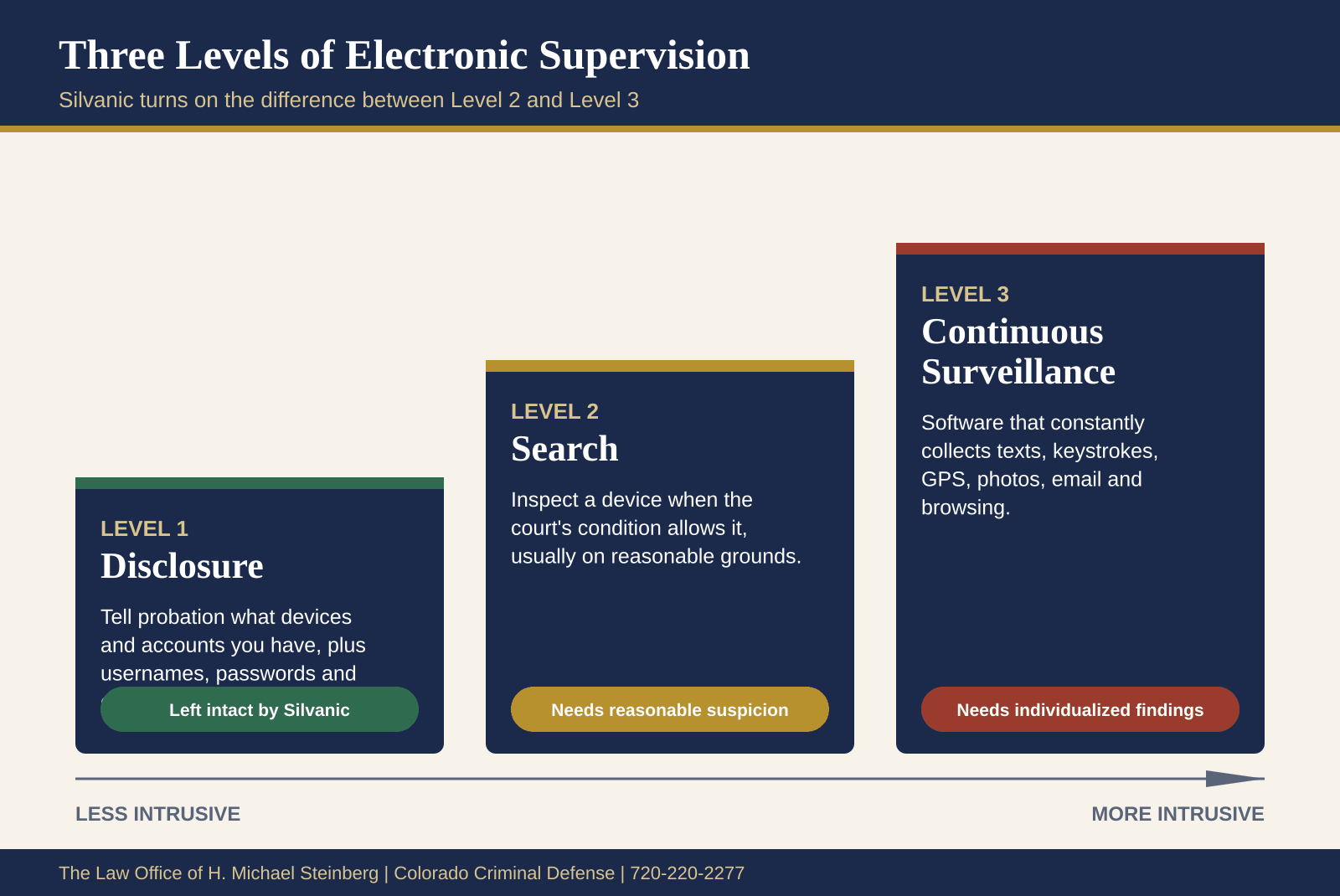
It helps to break out electronic supervision into three levels:
- Level 1, Disclosure. The probationer tells probation what devices and accounts he has, provides usernames and passwords, and reports changes. Silvanic did not disturb these requirements.
- Level 2, Search. Probation inspects a device under the court’s search condition. Where the condition requires reasonable grounds, there must be reasonable suspicion of a violation, and the search must be focused.
- Level 3, Continuous surveillance. Software constantly collects browsing, communications, keystrokes, GPS, photos, email, files, app activity, financial information and potentially privileged communications. This is qualitatively different from an occasional search.
The Governing Framework: People v. Brockelman
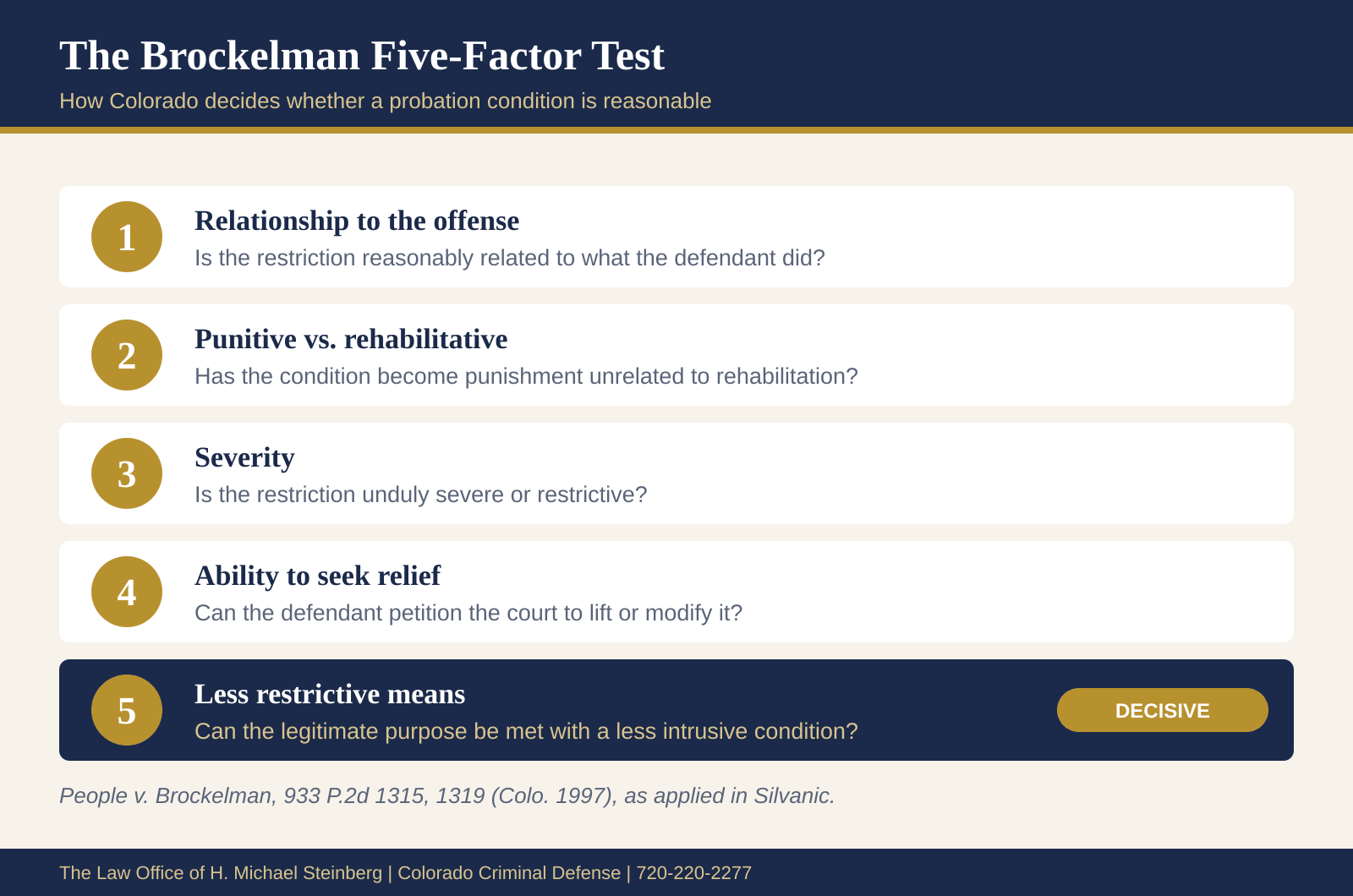
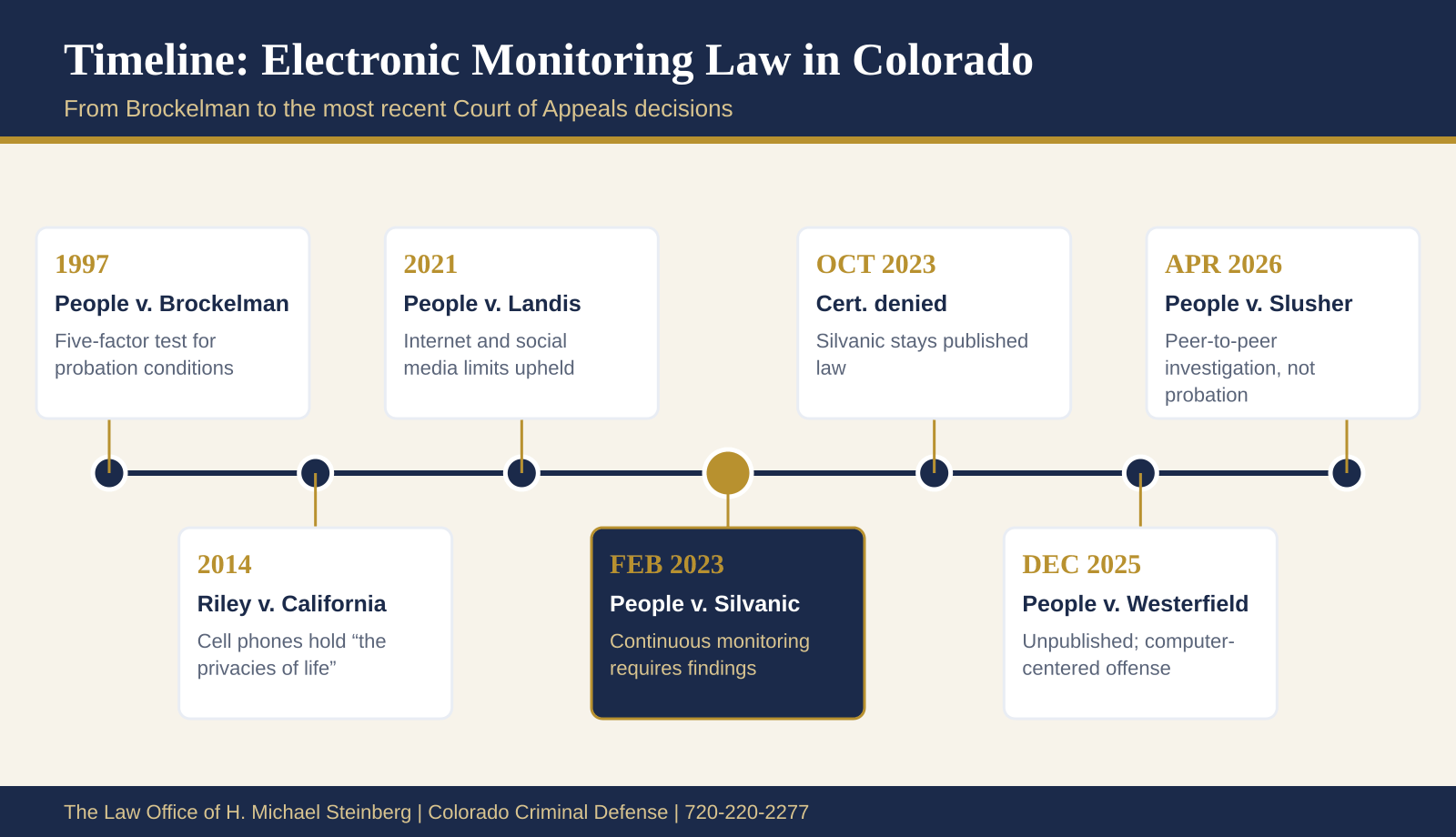
Silvanic applies People v. Brockelman, 933 P.2d 1315 (Colo. 1997). Under Brockelman, Colorado courts decide whether a probation condition is reasonably related to the statutory purposes of probation by looking at five factors:
- the relationship between the restriction and the underlying offense;
- whether the restriction is punitive to the point of being unrelated to rehabilitation;
- whether it is unduly severe or restrictive;
- whether the defendant can petition the court to lift or modify it; and
- whether less restrictive means are available.
In Silvanic, the fifth factor was decisive. The trial judge recognized the less-restrictive-means principle but never actually applied it to the monitoring program. That was not enough. A court cannot satisfy Silvanic by reciting the Brockelman test; it must apply the test to the specific technology and make factual findings.
Administrative Convenience Is Not Enough
The majority acknowledged that continuous monitoring may be easier for probation than periodic searches, but it rejected convenience as a justification:
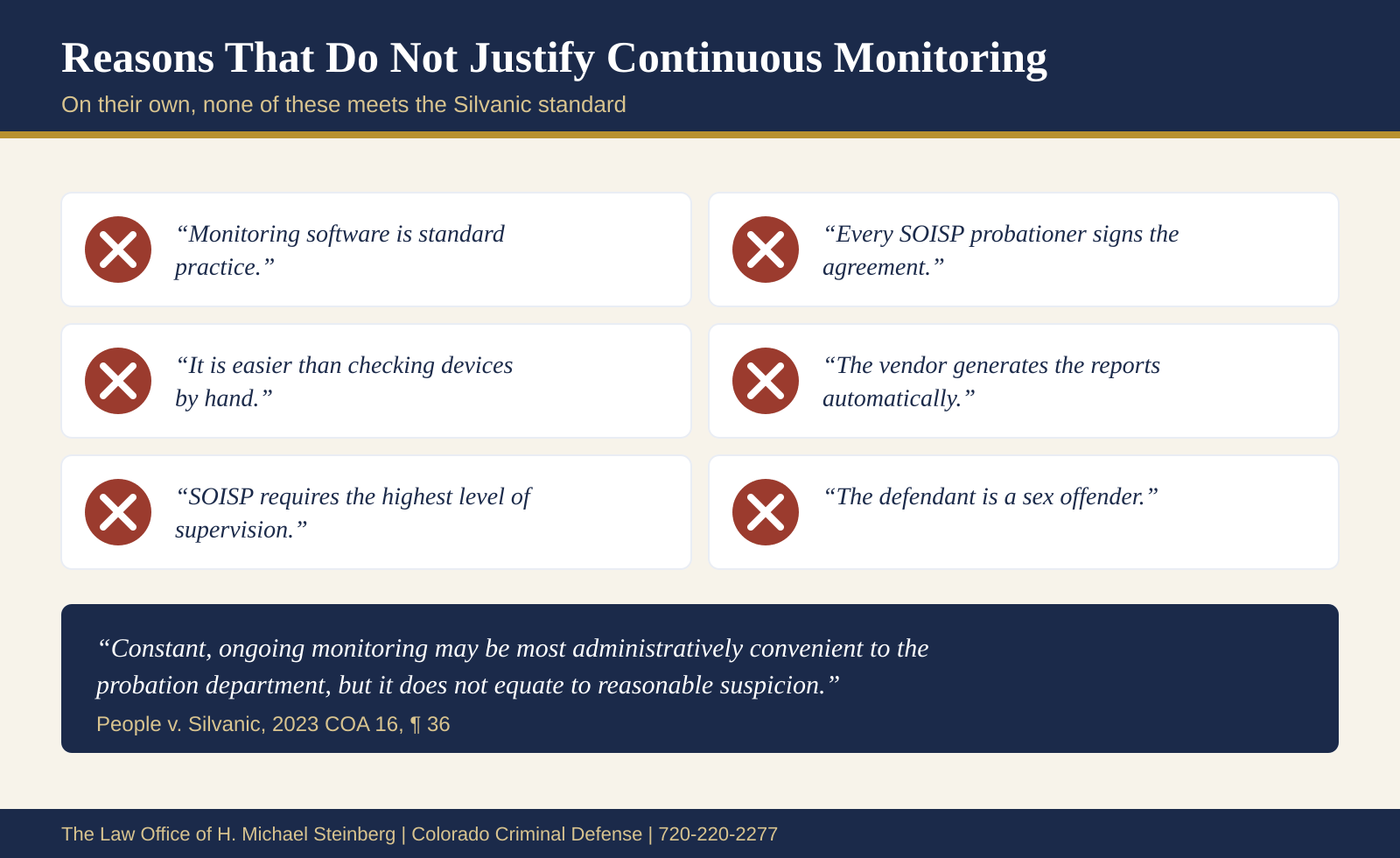
“Constant, ongoing monitoring may be most administratively convenient to the probation department, but it does not equate to reasonable suspicion.”
— People v. Silvanic, 2023 COA 16, ¶ 36
That means probation cannot establish necessity simply by pointing out that monitoring software is standard practice, that every SOISP probationer signs the agreement, that it is easier than checking devices by hand, that the vendor generates reports automatically, that SOISP requires intensive supervision, or that the defendant committed a sex offense.
When the defense raises a proper objection, the inquiry must turn to this defendant, this offense, this risk and this level of surveillance.
Being a Sex Offender Is Not Enough
The Court of Appeals was direct on this point:
“It is not sufficient to simply recite that Silvanic is a sex offender, his offense involved the use of a cell phone, and therefore continuous monitoring is permitted.”
— People v. Silvanic, 2023 COA 16, ¶ 41
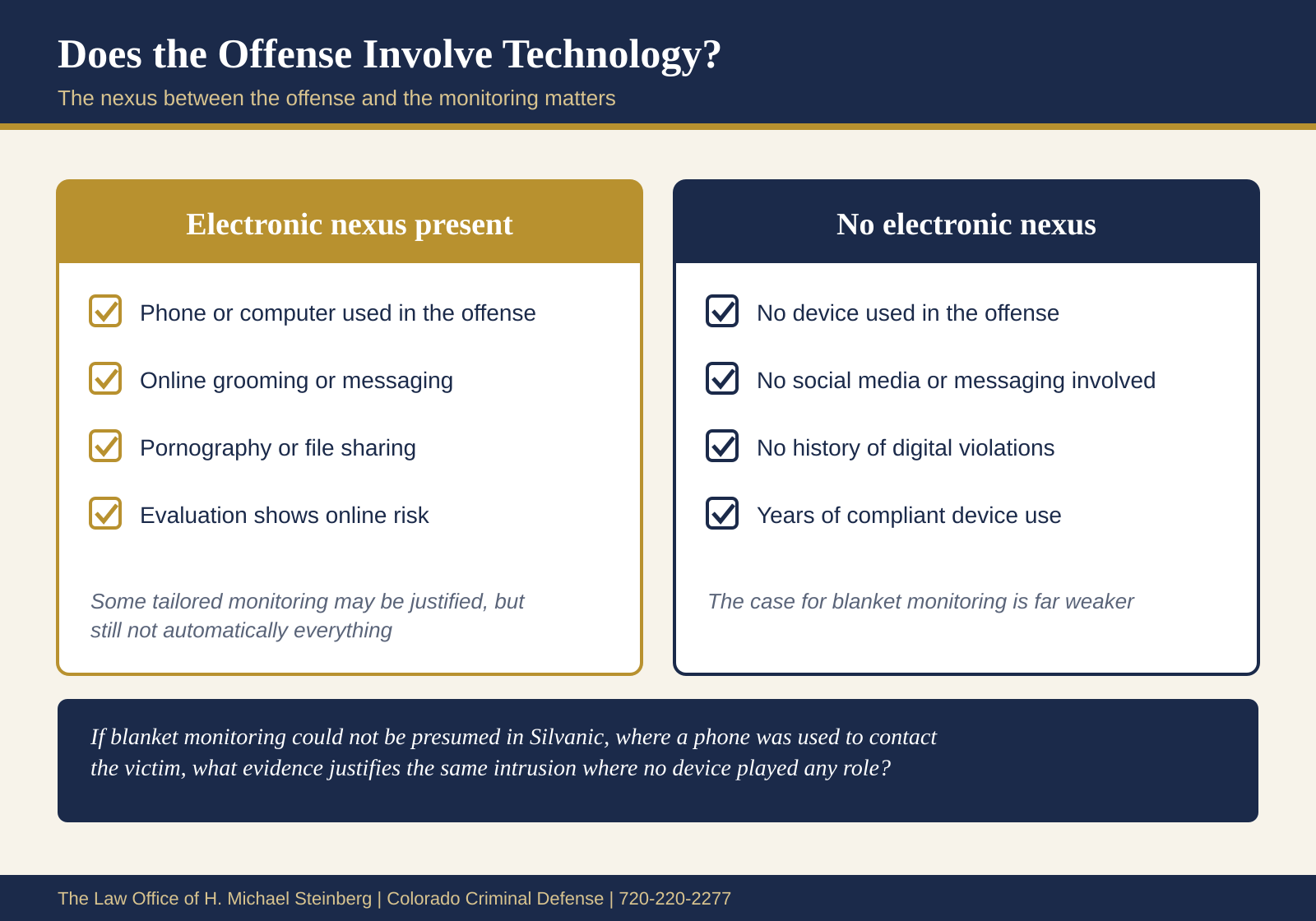
The court must identify the actual safety concerns and decide whether less intrusive monitoring or searching can address them. Because Silvanic’s own offense involved electronic communication, the argument is even stronger for a client whose case had no technological connection at all, for example where:
- no computer or cell phone was used in the offense;
- no pornography, social media or online grooming was involved;
- there is no history of prohibited digital communications; or
- the client has years of compliant device use on supervision.
If continuous surveillance required individualized justification in Silvanic, it should require serious justification where the offense has little or no technology connection. That is an application of the opinion’s reasoning, not a separate holding, but it is a powerful one.
The Burden Is on the Prosecution
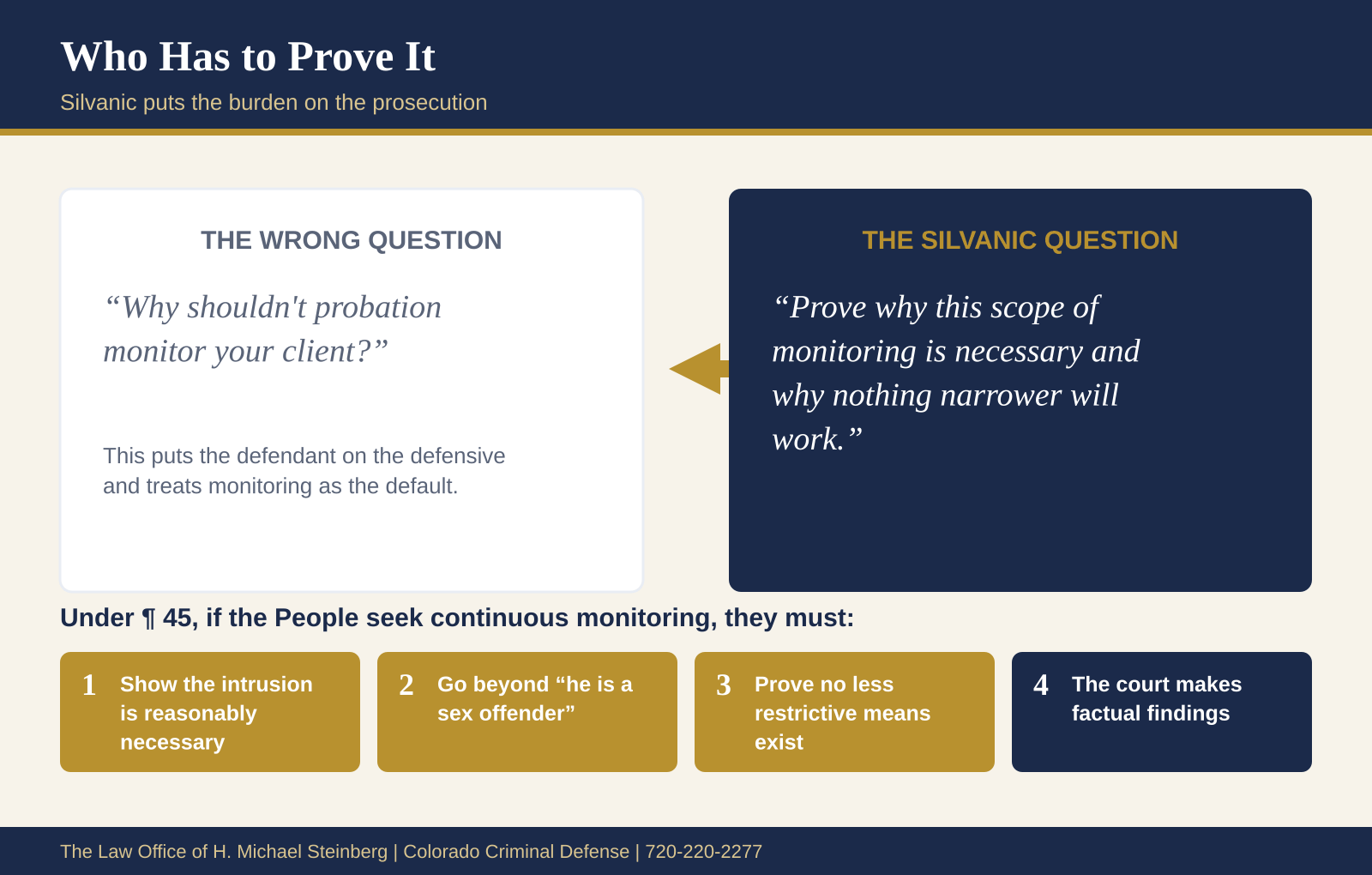
Paragraph 45 of Silvanic may be the most important paragraph for a defense motion. The court made clear it was not barring continuous monitoring on remand. But if the People seek it again, they must show the intrusion is reasonably necessary, beyond the bare fact that the defendant is a sex offender, and they must prove that no less restrictive means are available. The district court must then make findings under the correct standard.
That changes the question from “why shouldn’t probation monitor your client?” to “prove why this scope of continuous monitoring is necessary and why something narrower will not work.” That is a far better position for the defense.
What Silvanic Does Not Hold
Silvanic should not be oversold. It recognizes that probationers have diminished privacy and liberty expectations and that SOISP permits additional restrictions. It does not hold that probation may never monitor a sex offender’s computer, that computer monitoring requires a warrant, or that continuous monitoring is unconstitutional.
Silvanic also argued that suspicionless continuous surveillance violated the Fourth Amendment and that forcing him to give up the internet to avoid monitoring burdened his First Amendment rights. The court decided the case on Colorado probation law and expressly declined to reach those constitutional questions. A motion should not claim that Silvanic holds continuous monitoring unconstitutional. It does not.
THE ACCURATE RULE
Continuous, unrestricted electronic surveillance is not automatically authorized just because someone is on SOISP. Its scope and necessity must be justified by the court under Colorado probation law, including consideration of less restrictive alternatives. Silvanic sets a process, evidence and tailoring requirement, not a categorical ban.
Why Cell Phones Get Special Treatment
Silvanic relies heavily on Riley v. California, 573 U.S. 373 (2014), which recognized the enormous amount of private information a modern phone holds. Routine government access to those records looks nothing like an occasional search of a physical object.
Silvanic adds that our growing reliance on electronic communication magnifies those concerns, because blanket monitoring captures information with no legitimate probation purpose, including privileged information.
That opens the door to attacking specific categories of overbreadth: medical portals, banking information, political and religious activity, news reading, family communications, legal research and communications with counsel.
People v. Landis: The Prosecution’s Counterweight
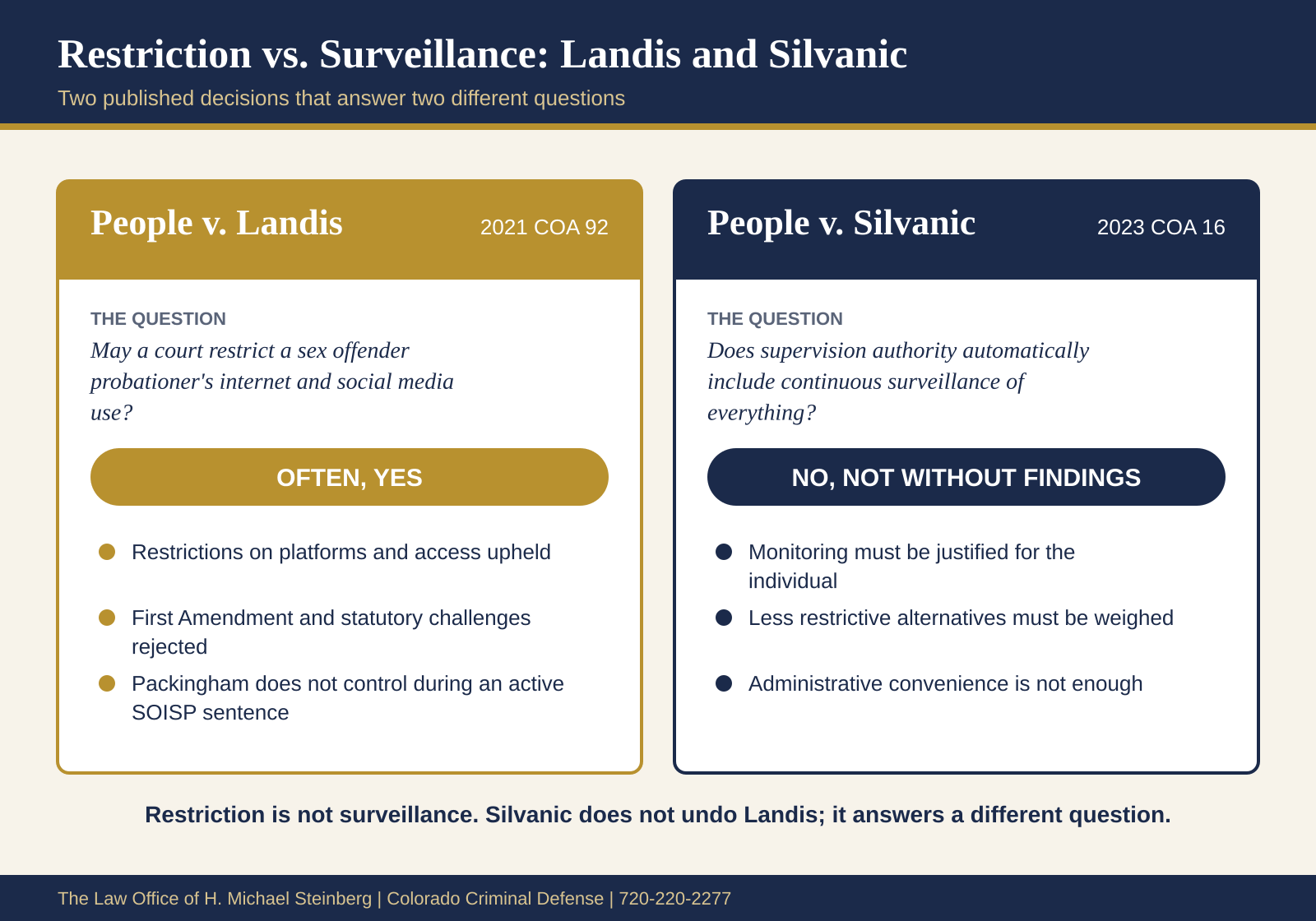
The earlier published decision in People v. Landis, 2021 COA 92, upheld SOISP conditions restricting internet and social media use and rejected statutory and First Amendment challenges. Landis also held that Packingham v. North Carolina does not control restrictions imposed as part of a still-active SOISP sentence.
Landis and Silvanic answer different questions. Landis asks whether a court may substantially restrict a probationer’s internet use. Often it may. Silvanic asks whether supervisory authority automatically includes continuous surveillance of everything. It does not, without individualized analysis. The government is strongest defending a tailored limit, such as “do not use a particular platform without permission.”It is most vulnerable when a condition amounts to “give a vendor continuous visibility into everything on every device.”
Certiorari Denied, With Two Justices Dissenting
The People sought review in the Colorado Supreme Court, and certiorari was denied on October 9, 2023, leaving the published opinion in place. Justices Hart and Berkenkotter would have granted review. They flagged two questions: whether the account-sharing requirement already authorized ongoing access, so the software merely carried out what the court had validly ordered; and whether requiring reasonable suspicion for continuous monitoring fits SOISP’s goals where electronic communication was used to groom the victim.
Those questions are not holdings, but prosecutors will attempt to use them.
The dissent previews the prosecution’s best case
Judge Grove’s dissent saw little difference between giving probation every account and password, allowing broad searches, and installing monitoring software. In his view, the software was an incremental step.
The dissent also stressed that electronic communication facilitated the offense, that Silvanic’s evaluation showed impulse-control concerns and online sexual behavior, that monitoring was preferable to banning the internet, that public protection is central to SOISP, and that courts elsewhere have upheld electronic monitoring. Those are exactly the facts a defense lawyer needs to distinguish.
Later Colorado Cases Referencing Silvanic
Our review of Colorado appellate decisions through November 2026 found no published decision overruling Silvanic or replacing its framework. Two later cases are worth knowing:
- People v. Westerfield, No. 23CA1662 (Colo. App. Dec. 4, 2025) (unpublished). The defendant’s computer held tens of thousands of images and hundreds of videos of child sexual exploitation. He agreed to a Computer Use Agreement, and monitoring software periodically reported his device use to probation. The appeal concerned revocation and resentencing, not a direct attack on the breadth of monitoring. Unpublished opinions are not precedent under C.A.R. 35(e), but Westerfield shows the other end of the spectrum: where a computer is the instrument of the offense and monitoring is built into individualized conditions, the government’s position is much stronger.
- People v. Slusher, 2026 COA 30. This case held that law enforcement’s use of peer-to-peer investigative software to download files shared on BitTorrent was not a search. It is an investigation case, not a probation case, and should not be stretched to defeat a Silvanic challenge to monitoring a probationer’s private devices.
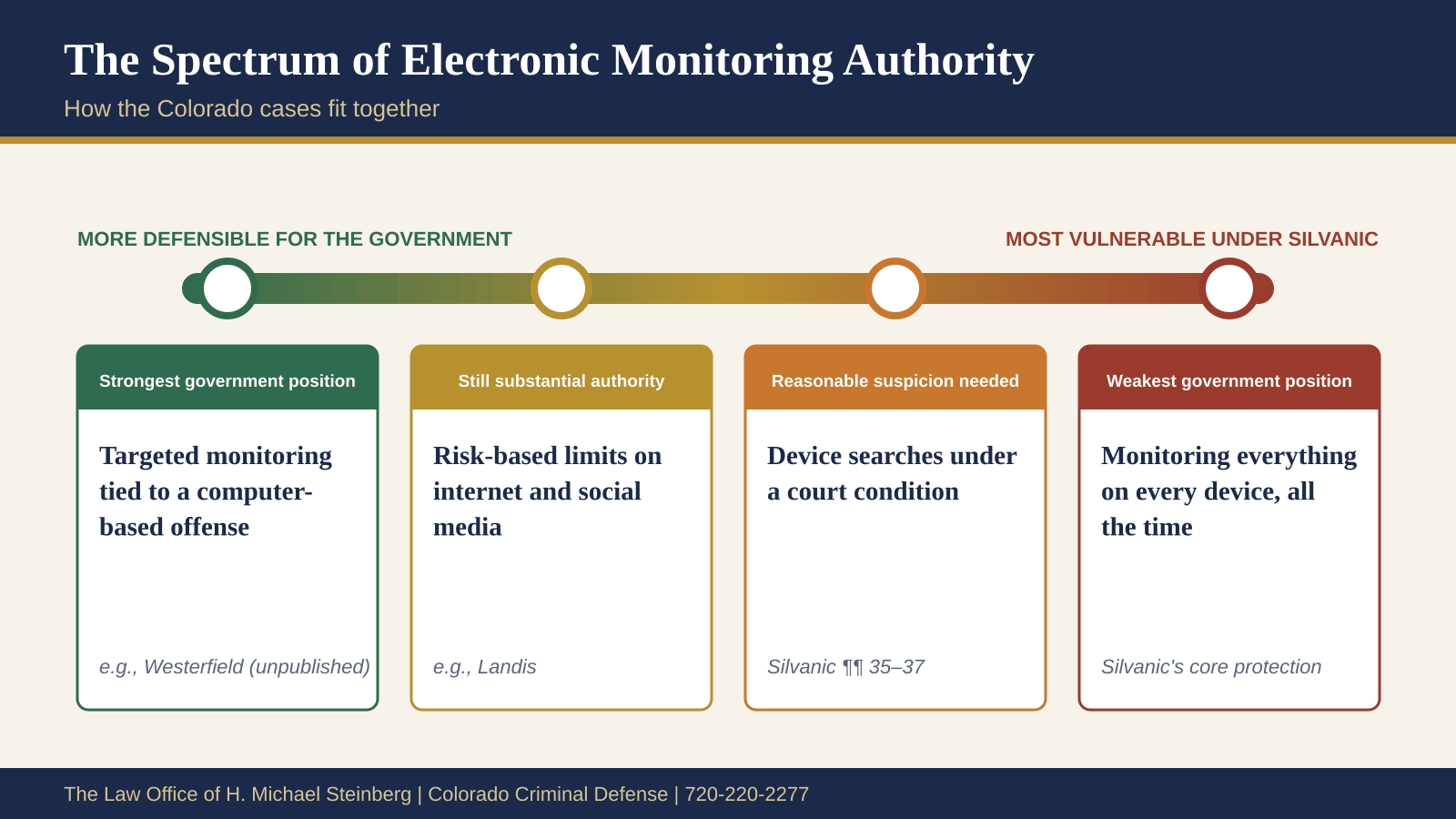
Taken together, the cases form a spectrum. The government is strongest with targeted conditions tied to a computer-based offense, still strong with risk-based limits on internet use, more constrained with device searches, and weakest with indiscriminate monitoring of everything on every device.
The further monitoring reaches into unrelated medical, financial, political, religious, family and attorney information, the bigger the Silvanic problem.
For a Current Client: Start With the Court’s Order
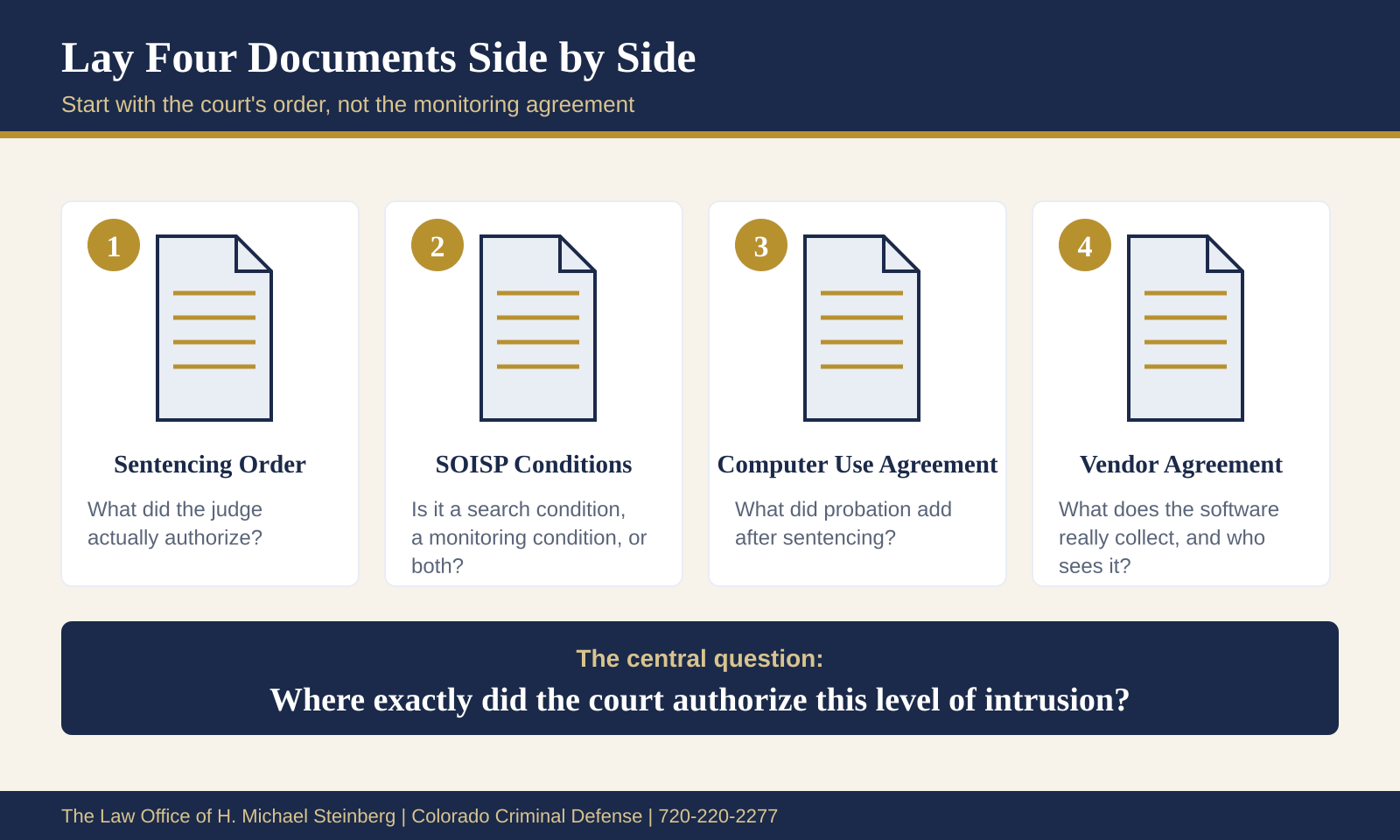
The first document to pull is not the monitoring agreement. It is the sentencing order. Then put four documents side by side: the sentencing order, the SOISP conditions, the Computer Use Agreement and the vendor’s monitoring agreement.
The central question is simple: where exactly did the court authorize this level of intrusion? Silvanic teaches that probation cannot turn judicial permission to search into permission for continuous, forward-looking surveillance. That gives the defense an argument based on authority before any constitutional question is reached.
Questions Probation Must Answer
Silvanic places great weight on the actual breadth of collection, and the dissent itself noted uncertainty about how the software worked. A contested monitoring condition calls for a record built around specific questions:
What is collected? When is it collected? Who sees it? How long is it kept? How is privileged material protected? Whose information is captured on a shared household computer or family phone? What is the proven connection to the offense? And what narrower alternative would serve the same purpose?
Possible narrower alternatives include targeted inspection, monitoring limited to specified devices, restricted applications, periodic review, review triggered by activity, exclusion of privileged accounts, or monitoring limited to the categories tied to the demonstrated risk. Silvanic does not require any particular alternative; the point is to make the government explain why something narrower will not work.
How to Frame a Motion to Modify
The strongest approach is a targeted motion to modify, not an attack on SOISP itself. Under section 18-1.3-204(1)(a), C.R.S., probation conditions must be reasonably necessary to help the defendant lead a law-abiding life. A motion that concedes legitimate supervision and asks the court to define its lawful scope gives the judge a narrow path to grant relief. A typical structure:
- Probation has only the electronic search authority the court actually gave it. Start with the language of the sentencing order.
- A search condition does not authorize permanent surveillance (Silvanic, ¶¶ 34–37).
- Continuous digital surveillance substantially burdens protected interests (Riley, as applied in Silvanic).
- The government must show an individualized connection between the monitoring and legitimate probation goals.
- The monitoring fails Brockelman because less restrictive alternatives were not considered. This is the statutory centerpiece, grounded in sections 18-1.3-202, 18-1.3-204 and 18-1.3-1007.
- Administrative convenience cannot supply the justification.
- The court must hold an evidentiary hearing and make particular findings, with probation or vendor witnesses explaining how the technology works.
- Alternatively, the court should tailor the order: devices covered, categories monitored, triggers, permitted recipients, duration, treatment of privileged communications and a way to seek reconsideration.
- Preserve the First Amendment, Fourth Amendment and Colorado Constitution, article II, sections 7 and 10, claims, along with attorney-client privilege.
SAMPLE TAILORED CONDITION
Defendant shall disclose all cellular telephones, computers, tablets and other internet-capable devices he owns or regularly uses and shall report any new device. Defendant shall comply with electronic supervision reasonably related to the conditions of probation and the risks specifically identified by the Court. Any electronic monitoring shall be limited to information reasonably related to those purposes and shall not constitute unrestricted collection or review of all electronic activity. Nothing in this condition authorizes access to the content of privileged attorney-client communications. Probation retains all lawful authority to conduct searches otherwise authorized by the conditions of probation and Colorado law. Defendant may apply for further modification based on changed circumstances, treatment progress, compliance or changes in technology.
The Bottom Line
People v. Silvanic is the leading published Colorado authority limiting automatic, blanket electronic surveillance of sex offender probationers. It does not give probationers ordinary Fourth Amendment privacy rights. What it establishes is that reduced privacy is not the same thing as unlimited government authority.
SOISP can be extremely restrictive, as Landis confirms. But probation cannot convert authority to supervise and search into carte blanche for continuous digital surveillance. When monitoring becomes pervasive, the court must decide what is actually necessary, consider less restrictive alternatives, and make findings specific to the person and the purposes of probation. The Supreme Court’s denial of certiorari left that rule standing, while the First and Fourth Amendment questions remain open for a future case.
Facing Electronic Monitoring Conditions on Sex Offender Probation?
If you or a family member has been told to sign a Computer Use Agreement or install monitoring software as part of SOISP, the scope of that monitoring may be open to challenge. H. Michael Steinberg has defended Colorado criminal cases for more than forty years. Call 720-220-2277 or visit hmichaelsteinberg.com to discuss your situation. For more analysis of Colorado criminal law, see the Colorado Criminal Lawyer Blog.
This article is for general informational purposes and is not legal advice. Reading it does not create an attorney-client relationship. Every case depends on its own facts; consult a qualified Colorado criminal defense attorney about your situation.