 Colorado Criminal Lawyer Blog
Under Colorado Law Can You Be Convicted On One Person’s Word?


By H. Michael Steinberg, A Colorado Criminal Defense Lawyer – Practicing Colorado Criminal Law in the courts of Colorado for over 40 years.
 Introduction:
Yes. In Colorado, a person can be convicted even when the case essentially comes down to one witness’s account against another’s—if the fact finder (usually a jury) believes the prosecution’s evidence proves every element beyond a reasonable doubt.
The law does not require a specific number of witnesses, physical evidence, video, DNA, or a confession in every case.
When people say “it’s just their word against mine,” they usually mean:
- One alleged victim or witness is saying you committed the crime.
- There are no other eyewitnesses.
- There is no confession.
- There is no video, no audio, and no obvious forensics.
But in court, “just one person’s word,” while believed to be the case by the person accused of the crime, is rarely the case. There is usually one or more other kinds of evidence. However, even without additional evidence, a single credible witness can be enough to convict.
Because prosecutors will try to add supporting pieces of evidence, even small ones, it can feel like more than one person’s word. None of those are necessarily proof that a crime happened. But together they can make testimony feel stronger. Juries are human. They stack together those little pieces.
“One person’s word” might still include multiple statements from that same person. A report to police, a statement to a friend, testimony in court. Consistent repetition can seem convincing even if it still comes from a single source.
 The Legal Rule: One Witness Can Be Enough
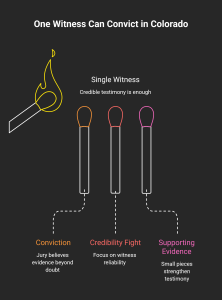
In general, courts do not require multiple witnesses.
A single credible witness in any kind of litigation can be sufficient to establish a fact. That is true in criminal cases, too. It is the jury that decides what to believe.
There are a few important exceptions and special rules depending on the type of case, but the default position is simple: if the jury believes the witness, and that belief eliminates reasonable doubt, they can and will convict.
The real fight is usually over credibility, not “is there a second witness?”
It becomes: is this witness reliable, consistent, and believable, and does the story make sense?
Why This Happens More Often Than People Think
Some crimes are naturally “one witness” crimes.
A lot of serious offenses happen in private, or without neutral observers. Examples can include:
- Sexual assault
- Domestic violence
- Child abuse
- Threats and harassment
- Simple assault with no serious injury
- Certain theft accusations where only one person claims they saw it
If the legal system required two eyewitnesses or physical evidence every time, a large portion of these cases would never be prosecutable. That is the actual reality in the background, even if nobody says it out loud in court.
 The Core Rule
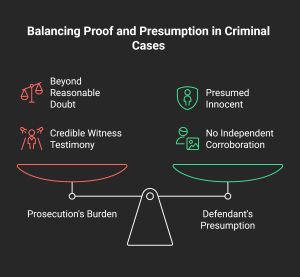
A criminal case is not decided by a headcount. The prosecution carries the burden throughout the trial, and the accused remains presumed innocent unless the jurors are convinced of guilt beyond a reasonable doubt.
Colorado’s model instructions expressly tell jurors that the “mere number of witnesses” on either side does not itself prove or disprove a fact. So, if one credible witness testifies to conduct establishing the charged offense, a jury may legally rely on that testimony—even if the defendant denies it and there is no independent corroborating evidence.
That does not mean an accusation automatically equals proof. The question is whether the testimony is credible, reliable, and persuasive enough, when considered with all the evidence and the burden of proof, to eliminate reasonable doubt.
Here is the jury instruction read to every jury in every trial in the state of Colorado on this issue:
✓ E:05 CREDIBILITY OF WITNESSES
In deciding what testimony to believe, you should carefully consider all of the testimony given and the circumstances under which each witness has testified. Consider each witness’ knowledge, motive, state of mind, demeanor, and manner while on the stand. Consider the witness’ means of knowledge, ability to observe, and strength of memory.
Consider also any relationship each witness may have to either side of the case; the manner in which each witness might be affected by the verdict; and the extent to which, if at all, each witness is either supported or contradicted by other evidence in the case.
You should consider all facts and circumstances shown by the evidence which affect the credibility of the witness’ testimony. You may believe all of the testimony of a witness, part of it, or none of it.
What Jurors Evaluate
You now have the exact jury instruction read to Colorado’s juries. Colorado jurors are the exclusive judges of witness credibility and the weight of testimony. They may accept all, some, or none of any witness’s testimony.
They are instructed to consider matters such as:
- The witness’s opportunity to see, hear, or otherwise know what happened.
- Memory, perception, and ability to describe events accurately.
- Internal consistency: whether the account changes or contains important contradictions.
- Consistency with other evidence, including texts, calls, photos, records, medical evidence, video, location data, or contemporaneous reports.
- Bias, motive, personal interest, hostility, or a reason to fabricate or exaggerate.
- Conduct, demeanor, and responsiveness while testifying.
- Whether the witness was impeached—for example, with a prior inconsistent statement or other admissible credibility evidence.
As you can see, the opposite of evidence is evidence itself. Therefore, a lack of corroboration can be a powerful defense point. It is generally an argument about whether the prosecution met its burden, rather than an automatic legal bar to conviction.
“One Word Against Another” Is Often An Incomplete Analysis
While cases are frequently described as “he said/she said,” that label can obscure important evidence. A case may still involve:
- A 911 call or prompt report.
- Text messages, social-media messages, or emails.
- Phone-location or app data.
- Surveillance footage.
- Medical findings or photographs.
- Witness testimony about events before or after the alleged crime.
- Statements by either party.
- Inconsistencies in either person’s story.
Even circumstantial evidence can matter. The jury evaluates the totality of the evidence, not just whether there was an eyewitness other than the complainant.
The Defense Perspective: Hit The Burden of Proof… Hard
When there is no neutral corroboration, the experienced criminal defense lawyers focus on the prosecution’s actual burden: proof beyond a reasonable doubt.
Effective issues pressed by defense lawyers should include:
- Whether the allegation is specific enough as to time, place, conduct, and circumstances.
- Whether the accuser’s account materially changed.
- Whether objective evidence conflicts with the account.
- Whether there was a motive to accuse, misunderstand, retaliate, or misidentify.
- Whether the investigation fairly pursued evidence that could support innocence.
- Whether the prosecution is asking jurors to fill evidentiary gaps with speculation.
A jury may hear two conflicting accounts of an encounter, but if neither account is independently corroborated, the defense need not prove the accused’s version true. It only needs the jurors to recognize a reasonable doubt about whether the prosecution’s version is true.
Corroborating Evidence in He-Said/She-Said Cases
In a “he said/she said” criminal case, the most persuasive corroboration is usually objective, time-linked evidence that independently confirms a material detail—not merely evidence that a report was made or that the parties knew each other.
The stronger the evidence is at showing what happened, when it happened, who was involved, or whether an account is reliable, the more weight it is likely to carry with a jury.
That is the exact role of Colorado jurors: to assess a witness’s opportunity to observe, memory, motives, relationships, and whether other evidence supports or contradicts the testimony.
Most Persuasive Corroboration
| Evidence type | Why it can be powerful | Important limitations |
| Video, audio, or body-camera footage |
Can show the encounter, condition of the people involved, demeanor, timing, injuries, statements, or immediate aftermath |
Footage may be incomplete, lack audio, begin after the event, or be open to more than one interpretation |
| Contemporaneous communications |
Texts, calls, emails, social-media messages, and 911 recordings can establish timing, admissions, state of mind, planning, threats, apologies, or inconsistencies |
A screenshot alone can be incomplete or altered; the party offering it must authenticate it and establish who authored it |
| Independent eyewitness testimony |
A neutral witness who personally saw or heard a significant event can strongly corroborate or undermine an account |
A witness’s vantage point, attention, relationship to the parties, and memory remain central |
|
Physical and forensic evidence
|
DNA, fingerprints, injuries, damaged property, medical findings, clothing, firearm evidence, or other scene evidence can connect an event to a person or account | Physical evidence may show that an event occurred without proving identity, intent, consent, or the precise sequence of events |
|
Reliable digital-location evidence
|
Phone data, app records, vehicle data, surveillance timestamps, access logs, or transaction records may confirm whether someone was at a location or whether a timeline is possible | Location data can be approximate; device possession does not always establish who used it |
|
Prompt report and documented condition
|
A 911 call, immediate disclosure, photos, medical record, or officer observation may preserve an account and observable condition close in time | A prompt report is not automatically proof that the accusation is true; the jury still evaluates accuracy and motive |
| Admissions or consciousness-of-guilt evidence
|
Voluntary statements, apologies, incriminating messages, efforts to hide evidence, false alibis, or attempts to influence a witness can be compelling | Context matters. An “apology” may be ambiguous, and alleged concealment or inconsistent statements can have innocent explanations |
| Prior inconsistent statements | A materially different earlier account can directly affect credibility and expose whether the story changed after the fact | Not every variation is meaningful; trauma, stress, passage of time, or poor questioning may explain some discrepancies |
| Neutral records | Work schedules, school attendance, receipts, ride-share logs, hotel records, key-card data, medical logs, or calendar entries can test an alleged timeline | Records must be properly obtained, explained, and connected to the disputed fact |
What Makes Evidence Persuasive
The best corroboration usually has four ch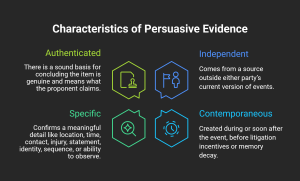 aracteristics:
- Independent: It comes from a source outside either party’s current version of events—such as a camera, service provider, neutral observer, or reliable business record.
- Contemporaneous: It was created during or soon after the event, before litigation incentives or memory decay became significant.
- Specific: It confirms a meaningful detail: location, time, contact, injury, statement, identity, sequence, or ability to observe.
- Authenticated: There is a sound basis for concluding the item is genuine and means what the proponent claims it means.
Digital evidence these days is especially common, but it is not self-proving. Under Colorado Rule of Evidence 901, the proponent must provide evidence sufficient to support a finding that the item is what it claims to be. A text or social-media post may require proof tying the relevant account, device, phone number, content, or surrounding circumstances to the claimed author.
Evidence That Tests Both Stories
In a close credibility case, corroboration is not solely evidence supporting the accusation. It can also be evidence that undermines it or makes it less likely.
For example:
- A complainant says the defendant was present at 10:30 p.m., but verified work access records and surveillance place the defendant elsewhere.
- A witness says a threatening exchange occurred, but the complete—not selectively cropped—text thread reflects a substantially different context.
- A reported injury is photographed or documented, but the timing, mechanism, or medical findings do not fit the claimed event.
- A person claims an immediate disclosure, but messages, calls, or witnesses from the relevant period show a materially different account or no contemporaneous indication of the alleged event.
The key word is material. A contradiction about an important fact—who was present, whether contact occurred, the timeline, a claimed threat, whether there was an injury, or what happened immediately afterward—usually matters far more than a minor discrepancy about clothing, exact wording, or an insignificant time estimate.
Evidence With Less Force
Certain evidence may be admissible or rhetorically useful but is often less conclusive than people assume:
- Character evidence that one person is generally “good” or another is generally “bad.”
- Evidence that a person was emotional, calm, angry, or upset after an incident.
- A delayed report, standing alone.
- A prompt report, standing alone.
- A friend or relative repeating what one party told them after the event.
- A partial screenshot, excerpted recording, or isolated message without the surrounding conversation.
- Evidence showing the parties had prior conflict, without proof that the charged conduct occurred.
These facts can provide context, but they often do not independently establish the charged act.
Colorado Trial Significance
In Colorado, jurors are told they are the sole judges of credibility. They may consider knowledge, motive, state of mind, demeanor, ability to observe, memory, relationships, and the degree to which other evidence supports or contradicts the witness
That is why the most useful corroboration is not simply “more evidence.” It is evidence that allows a jury to verify or falsify a disputed account without relying entirely on either speaker’s credibility.
For the defense, the practical inquiry is often:
- What evidence should exist if this account were accurate, and does it exist?
- For the prosecution, the corresponding question is: What independent facts make this witness’s account more reliable than a bare accusation?
Sidebar Final Focus: Colorado Domestic Violence Cases
Cases described as “word against word” often contain more than two accounts and it is felt most heavily in Colorado domestic violence cases.
Here are the main categories of commonly used evidence in domestic violence cases to bridge the gap at trial, with the Colorado rules that govern them.
| Evidence | How Colorado Treats It |
| 911 calls and statements to police
|
Under the Confrontation Clause (Crawford v. Washington, 2004; Davis v. Washington, 2006), statements made mainly to get help in an ongoing emergency are generally non-testimonial and can be admitted even if the caller does not testify. Statements that mainly describe past events for later prosecution are testimonial and are usually inadmissible unless the witness testifies or an exception applies. The Colorado Supreme Court applied this distinction in Raile v. People (Colo. 2006). Hearsay exceptions such as excited utterance (CRE 803(2)) also matter. |
| Prior inconsistent statements(recantations)
|
If the alleged victim testifies differently from an earlier statement, the earlier statement can be used as substantive evidence, not just to impeach, if the witness had a chance to explain or deny it and it concerns a matter within the witness’s own knowledge (C.R.S. § 16-10-201). |
| Photos, injuries, medical records
|
Photos of injuries or damage, medical records, and statements to medical providers for treatment (CRE 803(4)) are commonly used. For strangulation, records may show pain, voice changes, or swallowing difficulty even when marks are faint. |
|
Texts, social media, call logs, doorbell and body-camera video
|
Commonly authenticated by witnesses or records. They can support or undermine either account, including showing who initiated contact after an incident. |
| Prior acts of abuse against the same person
|
Admissible only under CRE 404(b) for a proper non-character purpose such as motive, intent, or absence of mistake, with the four-part test from People v. Spoto (Colo. 1990), including a CRE 403 balancing and a limiting instruction on request. In Rojas v. People, 2022 CO 8, the Colorado Supreme Court abolished the old “res gestae” shortcut, so courts must separate intrinsic acts from extrinsic acts and apply CRE 404(b) to the latter. Colorado’s special sex-offense statute (C.R.S. § 16-10-301) covers sexual offenses, not other domestic violence charges. |
| Expert testimony on abuse dynamics
|
Colorado courts allow generalized expert testimony about how domestic violence victims commonly behave, such as why some recant or delay reporting, if it fits the facts and clears CRE 702 and 403 (People v. Relaford, 2016 COA 99; People v. Cooper, 2021 CO 70). The expert may not say that the specific victim is truthful or that the accused is guilty. |
| The accused’s statements
|
Statements to police (after proper advisements where required), texts, apologies, and recorded jail calls can be used as admissions. Lies or shifting explanations can be used to argue consciousness of guilt. |
| Other witnesses
|
Children, neighbors, friends, and relatives who saw or heard part of an event, or who saw the parties before or after. A child witness can be crucial but can also raise impeachment issues. |
| Character for truthfulness and prior convictions
|
Reputation or opinion evidence about truthfulness, and specific instances of untruthful conduct, are limited by CRE 608. Prior felony convictions can be shown to affect credibility under C.R.S. § 13-90-101. Colorado has no CRE 609. |
Sidebar 1: When the Alleged Victim Recants or Refuses to Cooperate
This is one of the most common situations in domestic violence prosecutions and one of the most misunderstood.
The District Attorney Decides, Not the Alleged Victim
The alleged victim can tell the prosecutor they do not want to proceed, but the decision to file, continue, or dismiss the case belongs to the district attorney. Prosecutors may proceed with other evidence, such as the 911 call, body-camera video, photos, medical records, and officers’ observations, sometimes called evidence-based prosecution.
If the only evidence is the alleged victim’s initial accusation and they now say it was false, a prosecutor may weigh the case as much weaker and may dismiss. The result depends on the county, the prosecutor, and the rest of the evidence.
Sidebar 2: Can the Alleged Victim Be Made to Testify?
- Subpoenas: prosecutors can subpoena witnesses, including an alleged victim, and a witness who ignores a valid subpoena can face contempt.
- Spousal privilege does not usually block testimony: Colorado’s spousal privilege statute (C.R.S. § 13-90-107(1)(a)) has an exception for a criminal proceeding for a crime committed by one spouse against the other.
- Fifth Amendment: a witness whose testimony could expose them to criminal liability, for example, for a prior false statement, may have the right to decline to answer certain questions. They should get their own lawyer’s advice.
Legal Risks to the Alleged Victim for Changing the Story
| Situation | What Colorado law says |
| A person knowingly makes a false report to police | False reporting to authorities can be charged under C.R.S. § 18-8-111. |
| A person gives inconsistent sworn statements | Perjury or false swearing can be charged in a single count alleging one statement or the other was false and not believed, without proving which one (C.R.S. § 18-8-505). This applies to statements made under oath, not casual statements to police. |
| A prosecutor tries to prove perjury by one person’s contradiction | Falsity cannot be established solely by the uncorroborated testimony of a single witness (C.R.S. § 18-8-506), except in prosecutions based on inconsistent statements under § 18-8-505. |
| The accused pressures the alleged victim to recant | Tampering with a witness or victim can be charged separately (C.R.S. § 18-8-707), whether or not the pressure works, and it can also violate the protection order. |
| The accused causes the witness to be unavailable | Under the forfeiture-by-wrongdoing doctrine (Giles v. California, 2008), a defendant who causes a witness’s absence intending to prevent testimony forfeits confrontation objections to that witness’s earlier statements. The Supreme Court noted that in domestic violence cases, intent to silence a victim can be inferred from an ongoing pattern of abuse. A judge decides this at a hearing. |
Because of these risks, anyone considering changing their account, whether they are the accused or the alleged victim, should speak with their own lawyer first and should not act through the other person.
 Bottom line – The Core Rule: One Witness Can Be Enough
A single credible witness can be enough for a conviction in Colorado, but the prosecution still must prove guilt beyond a reasonable doubt. One person’s allegation is evidence—not a presumption of guilt—and jurors may reject it if credibility concerns, inconsistencies, missing corroboration, or contradictory evidence leave them with a reasonable doubt.
Colorado’s general criminal-law rules apply fully to domestic violence cases:
- Burden: guilt must be proved beyond a reasonable doubt (C.R.S. § 18-1-402). The accused does not have to prove innocence, testify, or explain.
- No corroboration requirement: Colorado does not require a second witness or physical evidence for domestic violence offenses. A jury may convict on the alleged victim’s testimony if it believes it. Colorado courts treat credibility as the jury’s job (for example, People v. McNeely, Colo. App. 2009).
- Sufficiency test: the Bennett standard asks whether the evidence, viewed as a whole and in the light most favorable to the prosecution, is substantial and sufficient to support a reasonable mind’s conclusion of guilt beyond a reasonable doubt (People v. Bennett, 183 Colo. 125, 515 P.2d 466 (1973)). A judge can grant a judgment of acquittal (Crim. P. 29) if it is not.
- Jury: misdemeanor trials use six jurors and felony trials use twelve, and verdicts must be unanimous (C.R.S. § 18-1-406; Crim. P. 23). One holdout can prevent a conviction.
Colorado Criminal Law – Under Colorado Law Can You Be Convicted On One Person’s Word?
The reader is alerted that Colorado criminal law, like criminal law in every state and at the Federal level, changes constantly. The article above was accurate when it was drafted, but it cannot account for changes that occurred after it was uploaded.
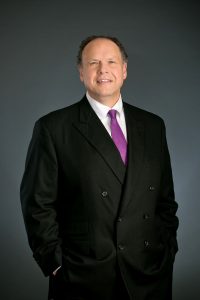 ABOUT THE AUTHOR: H. Michael Steinberg – Email the Author at: hmsteinberg@hotmail.com
A Denver, Colorado Criminal Defense Lawyer – call his office at 303-627-7777 during business hours, or call his cell at 720-220-2277 if you cannot wait and need his immediate assistance.
“A good criminal defense lawyer is someone who devotes themselves to their client’s case from beginning to end, always realizing that this case is the most important thing in that client’s life.”
Putting more than 40 years of Colorado criminal defense experience to work for you.
One should be careful when selecting a Colorado criminal defense lawyer. We encourage you to “vet” our firm. Over the last 40 years – by focusing ONLY on Colorado criminal law – H. Michael has had the time to continually update himself in nearly every area of criminal law, including procedure, trial, and courtroom practice.
H. Michael works hard to deliver the best possible results for his clients, both in and out of the courtroom. He has written extensively on Colorado criminal law and continues to do so, and he hopes this article helps you in some small way.