 Colorado Criminal Lawyer Blog
Under Colorado Law Can A Suspect’s Silence Be Used Against Them?


 Introduction
Silence is protected only when it’s properly invoked as a Fifth Amendment right; pre-arrest, pre-Miranda silence can, in some circumstances, be used as evidence, while post-arrest, post-Miranda silence generally cannot.
The U.S. Supreme Court’s rulings in Berghuis v. Thompkins and Salinas v. Texas established that silence does not automatically trigger Fifth Amendment protection — a suspect must affirmatively and clearly invoke the right to remain silent for it to count.
Colorado prosecutors cannot normally argue “they stayed silent, therefore they are guilty” if you clearly invoked your right to remain silent after you were in custody and being interrogated, meaning after Miranda stuff is in play.
But.
There are multiple situations where silence can still hurt you in practice. Sometimes legally, sometimes strategically, sometimes because the rules are narrow and you did not trigger them.
And yes, Colorado prosecutors can sometimes comment on certain kinds of silence. Or try. Or do it indirectly. And then it becomes a fight about whether it was allowed.
When Silence Is Protected
Once a person is in custody and has been given Miranda warnings (“You have the right to remain silent… anything you say can and will be used against you”), their subsequent silence in response to police questioning cannot be used against them at trial.
If someone remains silent after being Mirandized, prosecutors cannot tell a jury the person “didn’t answer any questions” or “refused to talk,” and the officer cannot testify to that silence — it stays invisible to the jury.
This protection exists because the warning itself implicitly assures the suspect that silence carries no penalty; using it against them afterward would be fundamentally unfair.
Colorado also just strengthened this area procedurally. Under HB23-1155, a custodial interrogation statement is only admissible if the suspect was properly advised beforehand of the right to remain silent and that anything said can be used against them.
When Silence Can Be Used
The protection has real limits, and this is the part clients are often surprised by:
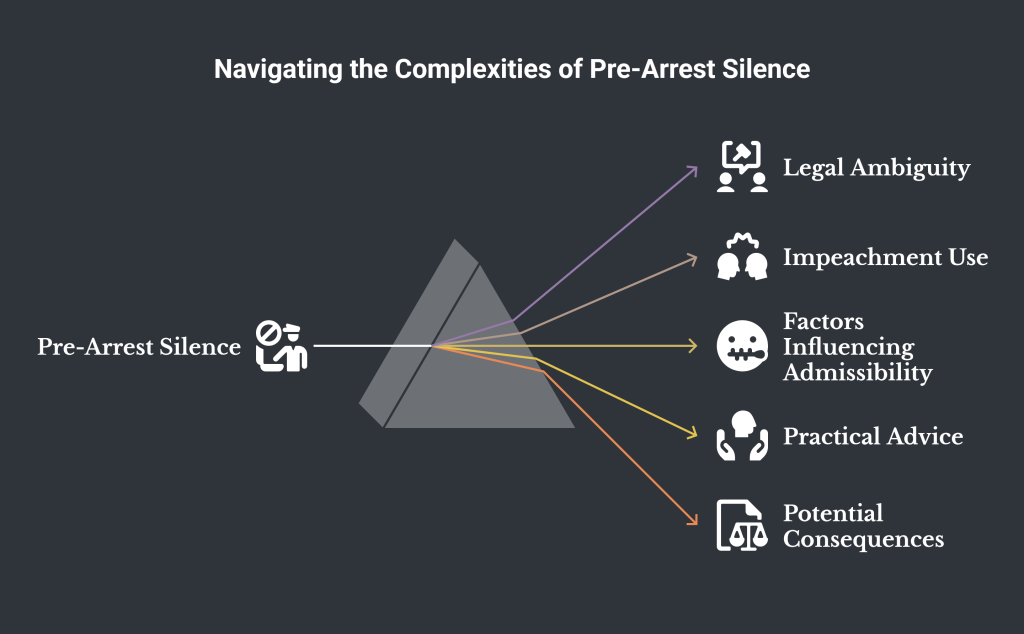 Pre-Arrest Silence: The Awkward Zone
Pre-arrest silence is the most misunderstood category.
If police come to your door and ask questions and you choose not to answer, you might assume that you are fully protected.
But depending on the exact circumstances, prosecutors sometimes try to use pre-arrest silence for impeachment, meaning if you testify later and give a story, the state argues, “If that were true, why didn’t you say it then?”
Courts have been divided nationally on how far that can go. The rules can turn on whether you were under compulsion, whether you were in custody, whether you invoked the Fifth explicitly, and whether the silence is being used substantively or just to impeach credibility.
What matters for you as a normal person is simpler:
If you think you are being investigated, do not try to “manage impressions” with selective silence and selective talking. It often makes things worse. Either you speak with counsel, or you do not speak. Half measures are where people are hurt.
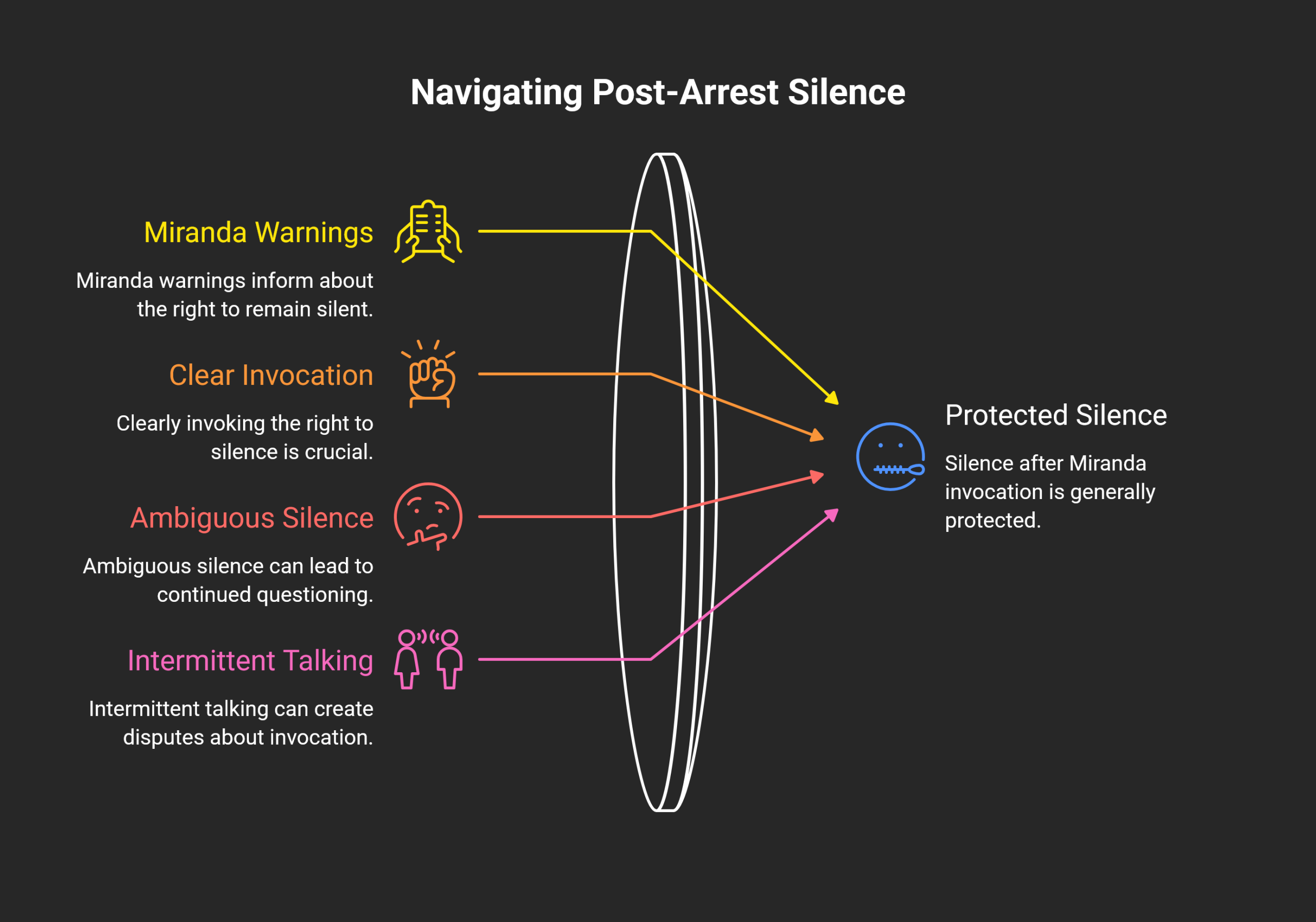 Post-Arrest, Post-Miranda Silence: Protected, If Done Correctly
Once you are in custody and being interrogated, you should be given Miranda warnings. If you then invoke your right to remain silent, the state usually cannot use that silence to argue guilt.
But.
If you never clearly invoke your rights, and you just go quiet, police may continue. They may re-ask questions. They may try different angles. And some courts treat silence without invocation differently than silence after a clear invocation.
Also, if you start talking, then stop, then talk again, you can create disputes about what was invoked, when, and whether you reinitiated the conversation.
Cleanest approach, again:
“I am invoking my right to remain silent. I want a lawyer.”
Then nothing.
Not even “What is going on?” Not even “This is crazy.” Not even “Can I call my mom?”
The call is fine. The talking about the case is the danger.
Pre-Custody, Pre-Miranda Silence
If police approach someone who isn’t yet in custody and that person stays silent instead of affirmatively invoking the Fifth Amendment, prosecutors may later use that silence as evidence of guilt.
Failure to affirmatively invoke: Under Salinas v. Texas, simply remaining silent isn’t enough — the person must clearly state that they are invoking their right to remain silent for the privilege to attach.
Un-Mirandized Voluntary Statements
If someone volunteers incriminating information before being read their rights, or makes a voluntary statement that’s later repeated after Miranda warnings, that earlier or repeated statement can still come into evidence.
Non-verbal conduct: Even body language or non-verbal responses during otherwise permissible questioning can, in some situations, be found incriminating.
Practical Colorado Rules
Colorado law lays out a few consistent principles worth highlighting for client-facing content:
No one is legally obligated to answer police questions, with narrow exceptions: providing your name under reasonable suspicion and providing your license/registration/insurance during a traffic stop.
A person cannot be punished simply for refusing to answer police questions.
Miranda warnings are only required once someone is in custody; without custody, no warning is legally required, and anything voluntarily said can be used later.
If police fail to give Miranda warnings during a custodial interrogation, the resulting statements — and any evidence derived from them under the “fruit of the poisonous tree” doctrine — are generally inadmissible.
If a suspect has previously invoked the right to silence, police may reinitiate custodial interrogation only if the original invocation was “scrupulously honored” and a significant period of time has passed.
The clearest advice is that silence alone is not a magic shield — the safest, legally recognized approach is to verbally state something like “I am invoking my right to remain silent and I want a lawyer,” rather than just going quiet, since Colorado and federal courts require an affirmative invocation for full protection.
A Deeper Dive Into This Topic
The easy lesson.
Talking to police when you’re stressed, tired, scared, or trying to be helpful can go sideways fast. People volunteer details, fix a timeline, guess at numbers, fill in gaps.
Later, the “helpful” part is what gets highlighted in court.
Because sometimes your silence is protected. Sometimes it is not. Sometimes it is protected only if you do it the “right” way, at the “right” time, with the “right” words. And if you do it wrong, Colorado can absolutely try to use the situation against you, even if they are not supposed to.
First, What Form of “Silence” Are We Even Talking About?
When people say “silence,” they might mean any of these:
- You did not answer an officer’s questions during a roadside stop.
- You refused to do field sobriety tests.
- You refused a chemical test (breath or blood) after a DUI arrest.
- You were questioned at the station, and you did not respond.
- You were arrested, and you did not explain yourself.
- You did not talk to detectives before you were arrested.
- You did not testify at trial.
- You answered some questions, then stopped answering.
- You said nothing, but you nodded, shrugged, or did something that got interpreted as a “response.”
Each one has different rules. If you remember only one thing from this article, make it this: silence is not one thing in law.
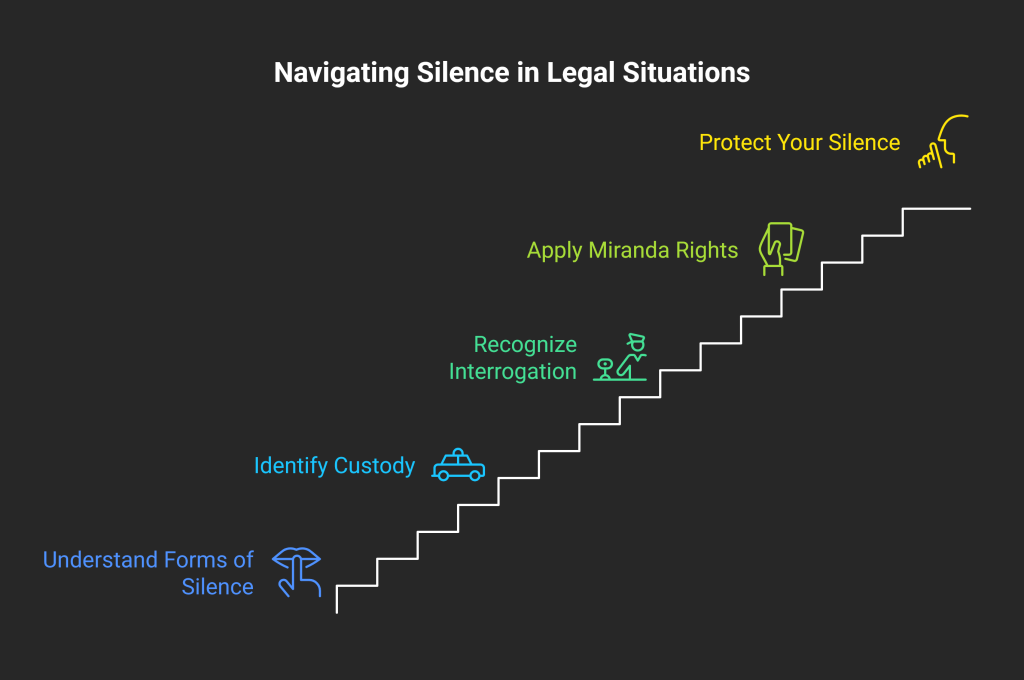 Miranda Is Not A Magic Shield
Most people understand Miranda as a script cops read. “You have the right to remain silent…” etc.
But Miranda protections primarily concern custodial interrogation.
For Miranda Rights to apply, it requires two triggers.
Custody: you are not free to leave, in the way a reasonable person would understand it.
Interrogation: questioning or its functional equivalent, meaning police actions likely to get you to incriminate yourself.
If you are not in custody, Miranda rights might not yet apply. If you are in custody but not being interrogated, same.
And if Miranda does not apply, your silence might not get the same level of protection you think you have.
This is where a lot of people are confused. They keep quiet during a voluntary encounter, thinking it is “their right.” Later the state argues that silence was suspicious, or uses it to impeach them, or frames it as consciousness of guilt.
Whether that is allowed depends on the situation, but it is not automatically forbidden.
 Colorado and the Fifth Amendment
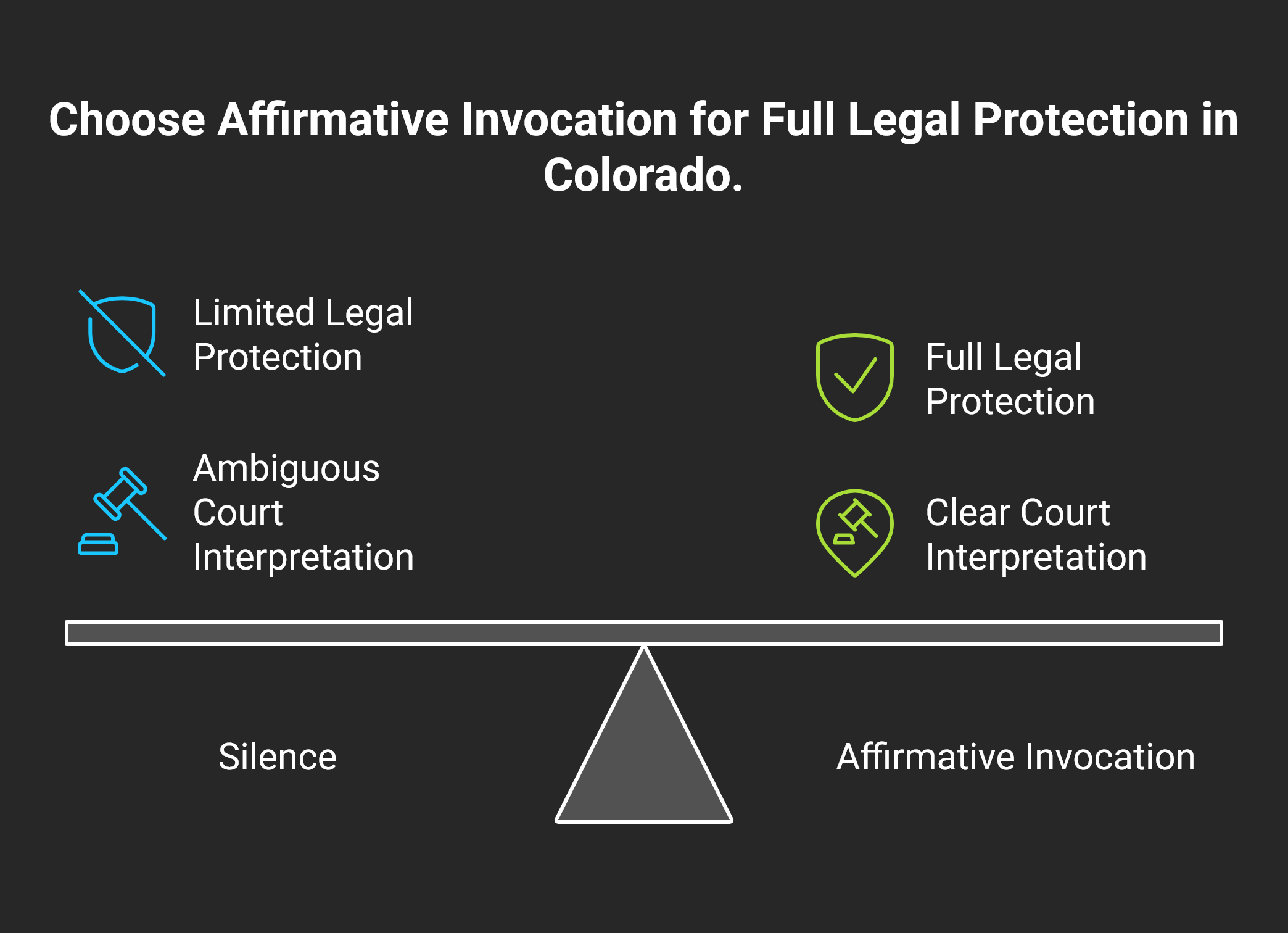
Your Fifth Amendment right exists, but you have to invoke it
In most situations, you need to clearly invoke your right to remain silent. Just sitting there, just staring, just saying “I don’t want to talk” in a vague way, or going quiet after you already talked — those can all cause legal arguments later.
The safest approach is clear and direct!
“I am invoking my right to remain silent. I want a lawyer.”
And then stop. No explaining. No “because I didn’t do anything.” No “I just want to go home.” Just stop.
Because if you say “I don’t want to talk right now,” an officer might treat that as temporary, or keep pressing. And then later it becomes a debate about whether you invoked or just hesitated.
Sidebar: Can Colorado Use Your Silence During a Traffic Stop?
A traffic stop is typically considered a temporary detention, not full custody, at least at first.
You still have to provide basic identifying information in many contexts, like your license, registration, and proof of insurance. If you refuse that, you can create a separate problem.
But as for questions like:
- “Where are you coming from?”
- “Have you had anything to drink?”
- “Do you know why I stopped you?”
- “Is there anything illegal in the car?”
You are not required to answer those. You can politely decline.
Can your refusal be used against you later?
Sometimes the state will try to frame it as suspicious behavior. Not always as direct evidence of guilt, but as part of the “totality of circumstances” supporting probable cause or reasonable suspicion. Like, “He refused to answer, avoided eye contact, appeared nervous.” That kind of narrative shows up in reports constantly.
Is that the same as saying “silence equals guilt” at trial? Not exactly. But it can still play a role early in the case, especially in suppression litigation.
So even if the jury never hears “he was silent,” your silence might still be used to justify the search, the arrest, the extended detention.
That is the practical reality.
What If You Answer Some Questions and Stay Silent on Others?
This happens constantly. People think they can “cooperate” on harmless stuff and shut down on the “real stuff.”
Sometimes that works. Sometimes it gives the police exactly what they need to box you in, and then your later silence makes it look like you are dodging.
Legally, selective answering can affect how your silence is characterized. A prosecutor may argue you were not truly invoking your rights, you were just choosing what to answer.
Even if that argument fails, it can still create a narrative problem.
If you are going to stay silent, stay silent. If you are going to talk, do it with counsel.
That advice is not dramatic. It is just realistic.
“If You Were Innocent, You Would Have Said Something”
At trial, the Fifth Amendment bars a prosecutor from commenting on a defendant’s choice not to testify. That is a core rule.
But outside of that, the state sometimes tries to sneak in similar themes.
They might not say, “He invoked his right, therefore guilty.” They say, “He never told police this story until today.” Or, “He had an opportunity to explain and he didn’t.” Or, “He wouldn’t answer basic questions.”
Whether that is allowed depends on the category of silence, the timing, whether Miranda applies, and what exactly the prosecutor is doing with it.
If the state crosses the line, defense counsel can object, ask for a mistrial, request a curative instruction, and preserve the issue for appeal. But. Even when the defense wins the legal point, the jury has still heard the insinuation.
That is why the “they can’t use it against you” line is incomplete. Sometimes the legal remedy comes after the damage.
Silence Can Be Used Against You Indirectly, Through Officer Testimony
Even if a prosecutor cannot explicitly argue guilt from silence, an officer can still testify to facts that imply it.
For example:
“I asked him where he was coming from. He stared at the ground and refused to answer.” “I asked if there were drugs in the car. He didn’t respond, just looked away.” “I confronted her with the accusation, and she said nothing.”
Now the jury is thinking what the jury thinks.
Defense counsel may fight to exclude that, or limit it, or explain it. But it is not always easy. Judges differ. Context matters.
This is another reason you want to invoke clearly and early, because “I am invoking my right to remain silent” is different than blank stares. One looks like a right. One looks like a reaction.
That is unfair of course. But it is real.
Colorado Can Use Your Silence in Jail Calls, Texts, and “Non-silence” Silence
People picture silence as an absence of words. But prosecutors care about what you actually did.
If you do not talk to police, then you call a friend from jail and say, “Don’t tell anyone anything,” the state may frame that as consciousness of guilt.
If you do not talk but delete messages, wipe a phone, or ask someone to “clean” your place, the state can use that. That is not silence. That is conduct. But it often starts with the same instinct: shut up and make it go away.
Or you stay silent in the interview, then send a long email “explaining.” Now you have created a statement anyway, and it is usually worse because it is unguarded, rambling, and written.
A lot of people lose cases not because they talked to police. They lose because they talked to everyone else.
What about Body Language, Head Nods, and “I Guess”?
This sounds made up until you see it in a report.
Officers will document things like:
“He shrugged when asked…” “He nodded affirmatively…” “He smirked…” “He didn’t deny it…”
Nonverbal responses can be treated as responses. Ambiguous words can be treated as admissions.
If you are invoking, you want it verbal, explicit, and then you want to stop participating. Do not nod along. Do not “mm-hmm” out of habit. Do not correct them. Do not try to show you are listening.
It feels rude. It is safer.
The “Right to Remain Silent” Is Not the Same as the “Right to End the Encounter”
Another area of confusion.
You might have the right to remain silent, but you might not have the right to walk away at that moment.
If you are detained, you might have to stay. You can ask, calmly:
“Am I being detained, or am I free to go?”
If free to go, leave. If detained, invoke and stop talking.
Do not argue about the detention. Do not debate law. Do not deliver a speech about your rights. That tends to extend encounters.
What to Say in Colorado, Word for Word
If you want a script you can actually use, here it is.
During a police encounter where you are being asked questions:
- “I’m going to remain silent.”
- “I want a lawyer.”
If you are asked to consent to a search:
- “I do not consent to any searches.”
If they keep pushing:
- “I’m not answering questions. I want a lawyer.”
Then stop. Repeat if needed. Do not elaborate.
And yes, be polite. Not because politeness is a legal requirement, but because being combative creates new problems.
What If Colorado Offers You a Chance to “Tell Your Side”?
This is the trap.
Detectives often sound reasonable. They will say things like:
“We already know what happened.” “This is your chance to clear it up.” “Help yourself here.” “If you lawyer up, it looks bad.”
None of that is for your benefit. Their job is to gather evidence. Even “exculpatory” details can lock you into a story that later gets attacked.
If you have a legitimate defense, it can be presented through counsel in a controlled way. Sometimes you do want to provide information. But do it strategically. Not in a surprise interview.
When Silence Is Absolutely Protected: Not Testifying at Trial
If you are the defendant in a criminal case, you have the right not to testify. The prosecution cannot comment on that decision as evidence of guilt, and the jury is typically instructed not to hold it against you.
Will jurors still wonder? Some will. They are human.
But legally, this is the strongest “silence” protection of them all.
And it is also why prosecutors sometimes try to use other types of silence instead, like pre-arrest silence, post-incident silence, selective silence, anything that sounds like, “He didn’t deny it.”
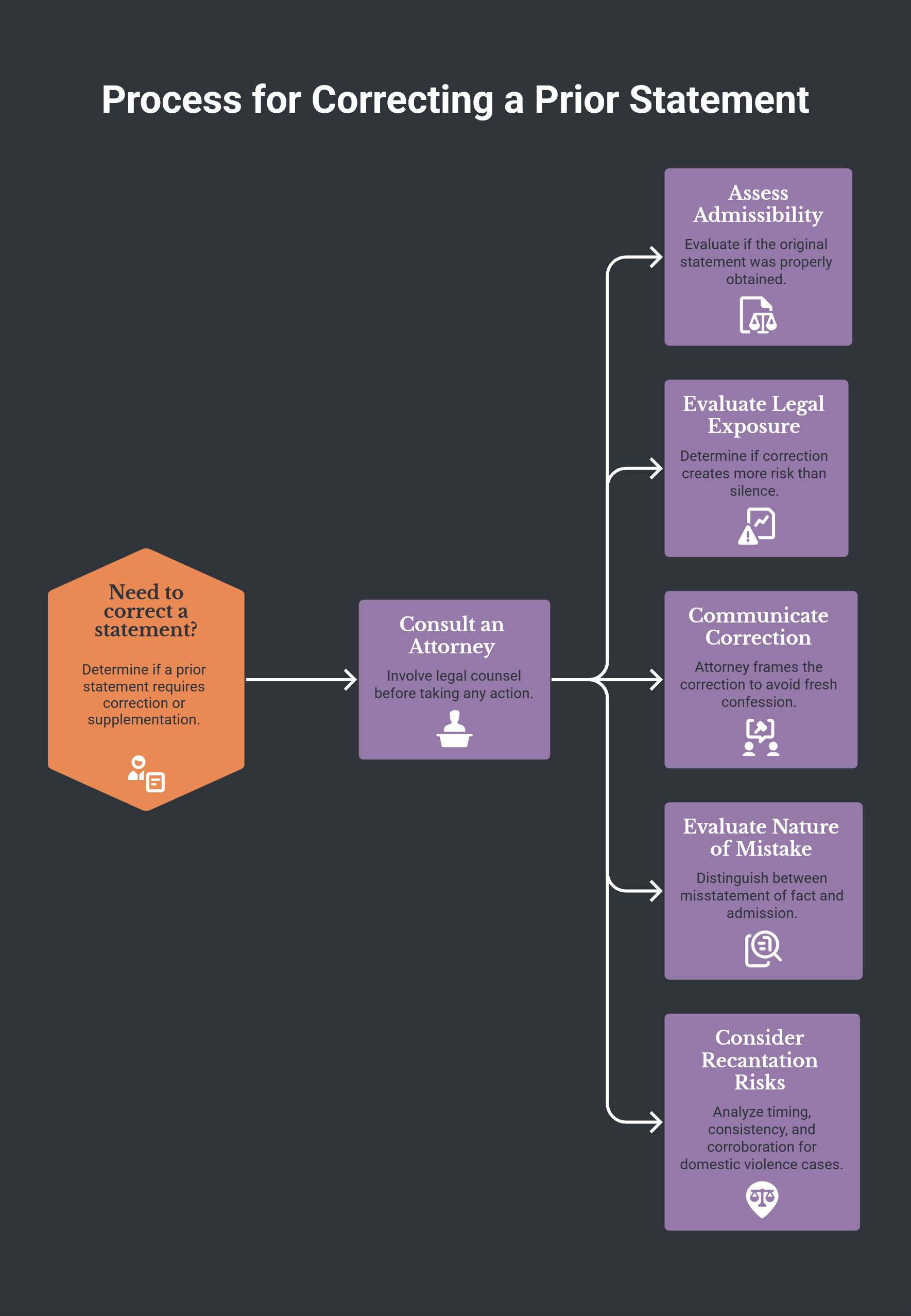 If You Already Stayed Silent “Wrong,” Is Your Case Over?
No.
A lot of cases are won on motions, on suppression, on cross-examination, on credibility, on body cam inconsistencies, on lab issues, on chain of custody, on constitutional violations, on reasonable doubt that has nothing to do with what you said.
Also, sometimes silence helps you even if it created an awkward moment. A weak “silence looks suspicious” argument is still usually better than a recorded confession or a sloppy timeline that can be disproved.
So if you are reading this after the fact, do not spiral. Stop talking now. Stop texting about it. Stop trying to fix it yourself. Get counsel.
The Takeaway
Can Colorado use your silence against you?
Sometimes they legally cannot. Sometimes they legally can. Often they will try, and the fight becomes whether it should be allowed and how much damage it did.
If you want the best odds, you do not rely on the vague idea of silence. You rely on clear invocation, and you stop feeding the case.
So. In Colorado, in 2026, if police are asking you questions and you have any reason to think you might be a suspect.
Say it clearly.
“I am invoking my right to remain silent. I want a lawyer.”
Then actually be silent.
Sidebar 2: DUI in Colorado: “Silence” Is Not the Issue, Refusals Are
DUI is its own universe in Colorado.
And this is where people get blindsided because they assume refusal is protected silence.
Colorado has an express consent law. If an officer has probable cause to believe you drove under the influence, you are typically required to choose a chemical test.
Refusing can trigger serious administrative consequences, like license revocation, and it can be used against you in certain ways.
Also, field sobriety tests are usually voluntary, but refusing them can still be used as part of the probable-cause narrative. “He refused SFSTs” (field sobriety tests). Again, not exactly “silence,” but it is the same issue.
So if your question is, “Can Colorado use my refusal against me in a DUI?” The answer is often yes, at least in some form. The law treats refusal differently from pure Fifth Amendment silence.
If you are in that situation, you want specific advice from a DUI lawyer, because the best move depends on your record, your license status, your job, and the exact facts.
Summary: When Silence Can Be Used Against You
Silence can be used against you if you do not clearly invoke your rights.
Examples:
1. Pre-Miranda silence
If you have not been Mirandized yet, your silence may be used as evidence of “inconsistent behavior” or “consciousness of guilt” in certain circumstances.
Colorado follows federal precedent here.
2. Silence during non-custodial encounters
If you are not in custody (e.g., a traffic stop, casual questioning), your silence is not protected by Miranda.
Colorado’s stop and identify law requires only your name and address — and silence is not a crime.
But prosecutors may still argue that unexplained silence shows evasiveness unless you clearly invoke your rights.
3. Ambiguous silence
If you simply stop talking without saying you’re invoking your rights, Colorado courts may treat it as non-invocation, allowing questioning to continue.
The Colorado Supreme Court recently held that ambiguous statements like “Nah” do not invoke silence.
Bottom Line
Clear invocation = silence protected.
No invocation = silence may be used against you.
FAQs (Frequently Asked Questions)
Can I remain silent during a police encounter in Colorado without it being used against me?
In Colorado, you can remain silent, but whether that silence can be used against you depends on the situation. If you’re in custody and clearly invoke your right to remain silent after Miranda warnings, your silence generally can’t be used as evidence of guilt. However, during non-custodial encounters like traffic stops, your silence might be considered suspicious and factored into probable cause or reasonable suspicion assessments.
What is the significance of Miranda rights in protecting my silence in Colorado?
Miranda rights protect your right to remain silent during custodial interrogation—meaning when you’re not free to leave and are being questioned by police. If Miranda warnings haven’t been read because you’re not in custody or not being interrogated, your silence may not have the same legal protections and could potentially be used against you.
Do I need to explicitly say I am invoking my right to remain silent in Colorado?
Yes. In many situations in Colorado, you must clearly and unambiguously invoke your right to remain silent. Simply staying quiet, giving vague statements like ‘I don’t want to talk,’ or stopping answering questions after initially talking may not be enough and could lead to legal arguments that weaken your protection.
Can refusing field sobriety or chemical tests be considered silence that harms my case?
Refusing field sobriety or chemical tests involves specific legal rules separate from simply remaining silent. While refusal isn’t silence per se, it can have legal consequences and may be interpreted negatively by law enforcement or courts. It’s important to understand these distinctions and consult a criminal defense attorney for guidance.
Is it safe to stay silent during a traffic stop in Colorado?
During a traffic stop, which is usually a temporary detention rather than full custody, you are required to provide basic identification, such as your driver’s license and registration. You are not required to answer other questions such as where you’re coming from or if you’ve been drinking. However, refusing to answer may contribute to police suspicion and influence decisions about searches or arrests.
How does pre-arrest silence affect my case in Colorado?
Silence before an arrest—such as not speaking with detectives before being taken into custody—has different legal implications than silence after arrest. Depending on circumstances, pre-arrest silence might be used by prosecutors strategically or legally against you. Because these rules are complex and situation-dependent, consulting with a Colorado criminal defense attorney is crucial.
Colorado Criminal Law – Under Colorado Law Can A Suspect’s Silence Be Used Against Them?
The reader is alerted that Colorado criminal law, like criminal law in every state and at the Federal level, changes constantly. The article above was accurate when it was drafted, but it cannot account for changes that occurred after it was uploaded.
 ABOUT THE AUTHOR: H. Michael Steinberg – Email the Author at: hmsteinberg@hotmail.com
A Denver, Colorado Criminal Defense Lawyer – call his office at 303-627-7777 during business hours, or call his cell at 720-220-2277 if you cannot wait and need his immediate assistance.
“A good criminal defense lawyer is someone who devotes themselves to their client’s case from beginning to end, always realizing that this case is the most important thing in that client’s life.”
Putting more than 40 years of Colorado criminal defense experience to work for you.
One should be careful when selecting a Colorado criminal defense lawyer. We encourage you to “vet” our firm. Over the last 40 years – by focusing ONLY on Colorado criminal law – H. Michael has had the time to continually update himself in nearly every area of criminal law, including procedure, trial, and courtroom practice.
H. Michael works hard to deliver the best possible results for his clients, both in and out of the courtroom. He has written extensively on Colorado criminal law and continues to do so, and he hopes this article helps you in some small way.