 Colorado Criminal Lawyer Blog
Colorado Law: What If You Already Talked to the Police and You Made a Mistake?


By H. Michael Steinberg, A Colorado Criminal Defense Lawyer – Practicing Colorado Criminal Law in the courts of Colorado for over 40 years.
Introduction
Most legal advice about police encounters you may receive from lawyers arrives too late. You’ve answered the phone or already sat down in the interview room and answered questions you shouldn’t have, maybe left out a critical detail or exaggerated another under pressure — and now you’re wondering whether the damage is permanent.
In Colorado, the answer to whether you have permanently damaged your case is nuanced. While you can’t erase words you’ve already spoken, you may have more options than you realize.
What you do in the next hours and days may matter enormously.
This article walks through what Colorado law actually says about statements already made to police, when and how you can still invoke your rights, the real risk of “correcting” a prior statement, and the practical steps that protect you from here forward.
Your Rights Don’t Expire During An Investigation
A common misconception is that once you start talking to police, you’ve forfeited your right to stop.
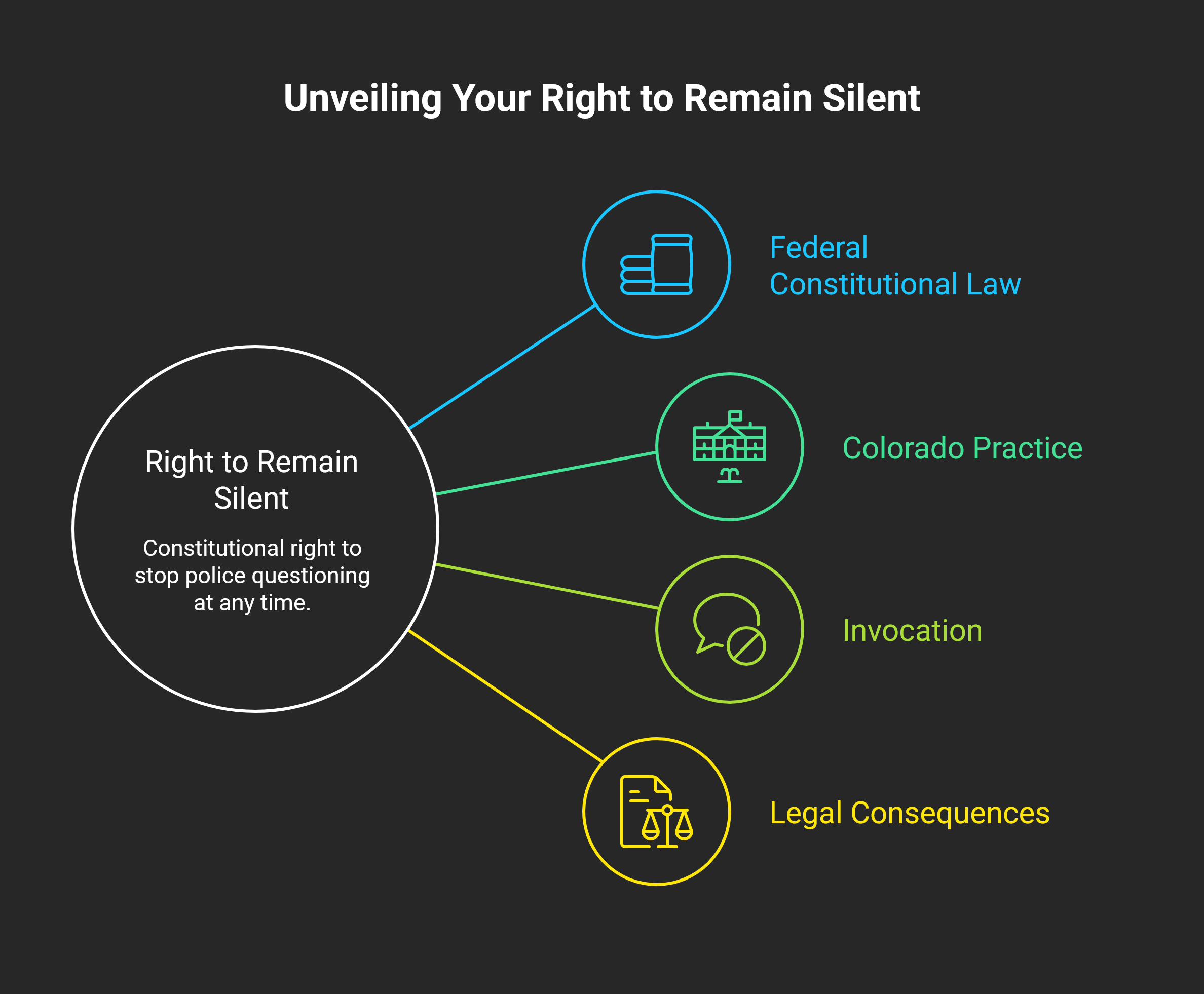
That’s false under both federal constitutional law and Colorado practice.
A large italic quote with a colored rule and an attribution line beneath. USE
Key Takeaway
The Fifth Amendment privilege against self-incrimination can be invoked at any point during an interrogation — before questioning starts, halfway through, or after you’ve already answered several questions.
If you clearly state that you’re invoking your right to remain silent or that you want an attorney, officers are constitutionally required to stop questioning you immediately.
This is not a one-time-only option you lose by talking first. Courts recognize that a suspect’s silence — and the constitutional protection that comes with it — can begin at any point during custodial interrogation.
Colorado’s own courts have taken this seriously.
In one recent case, the Colorado Supreme Court ruled that Boulder County sheriff’s detectives violated a murder suspect’s Miranda rights when they continued questioning him after he had definitively invoked his right to remain silent.
The Colorado Court of Appeals has separately reversed convictions where prosecutors improperly used a defendant’s invocation of silence against them at trial. These rulings underscore a key point: Colorado courts do enforce this right, and violations by law enforcement can result in the suppression of statements or even reversed convictions.
 How to Your Right To Remain Silent Now!
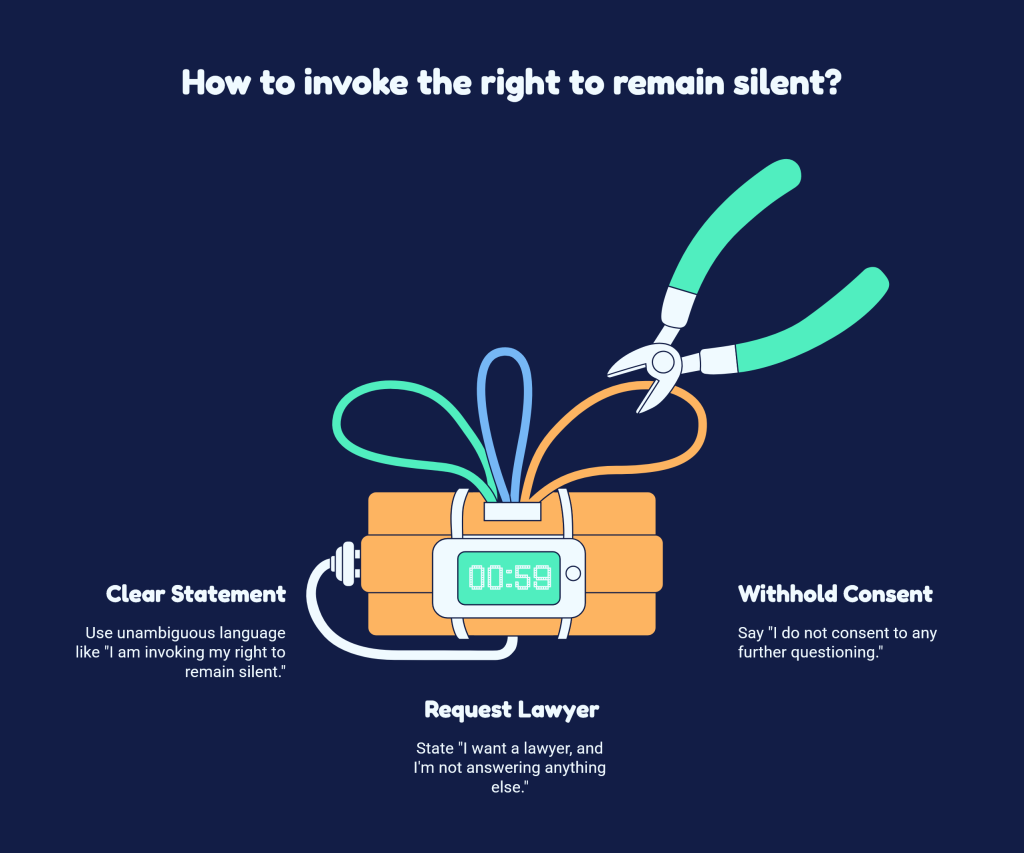
If you’ve already been talking and want to stop, the law requires only this — an unambiguous statement — simply going quiet isn’t enough to guarantee protection.
Effective, clear language includes:
- “I am invoking my right to remain silent, and I will not answer any more questions.”
- “I want a lawyer, and I’m not answering anything else until I have one.”
- “I do not consent to any further questioning.”
Once you say this clearly, stop talking entirely. Oscillating — answering a bit more after invoking, then going quiet again — can undermine the protection you just asserted.
Say it once, mean it, and hold the line even if officers keep talking at you; they are not permitted to continue substantive interrogation once you’ve clearly invoked, though they may pause and try again later in some circumstances.
What “Already Talked and Made a Mistake” Actually Means
People come to this situation in a few different ways, and the legal exposure differs depending on which one applies to you.
You told the truth but volunteered too much. This is the most common scenario. You weren’t obligated to explain your side of events, describe your whereabouts, or speculate about what happened — but you did, and now some of it looks bad out of context. This isn’t a crime. It’s a strategic problem, not a legal one, and it’s fixable primarily through how your attorney frames and contextualizes it going forward.
You said something inaccurate by mistake. Maybe you misremembered a time, a detail, or a sequence of events under stress. Honest mistakes in recollection are common and are not the same as lying. The concern here is that inconsistencies can later be used to attack your credibility.
You knowingly said something false. This is the category that carries real criminal risk under Colorado law, and it’s worth understanding precisely what the statutes cover.
The Colorado Statutes That Apply To This Situation
Colorado does not criminalize simply being wrong or vague with police. It criminalizes knowing falsehoods in specific circumstances:
| Statute | What It Covers | Penalty Level |
|---|---|---|
| C.R.S. § 18-8-111 | Knowingly making a false report of a crime, or knowingly giving false information about an incident within police’s official concern | Class 2 or Class 3 misdemeanor |
| C.R.S. § 18-8-111.5 | Knowingly providing false identifying information (name, address, birth date, SSN, license number) | Class 2 misdemeanor; Class 6 felony if it substantially impedes an investigation or arrest |
| C.R.S. § 18-8-104 | Obstruction of a peace officer | Varies by conduct |
| C.R.S. § 18-8-102 | Obstruction of justice — knowingly making false statements to law enforcement during a criminal investigation | Varies by conduct |
The critical word in every one of these statutes is “knowingly.”
Colorado law does not punish you for being mistaken, confused, traumatized, or imprecise. It punishes deliberate deception. That distinction matters enormously for how your attorney approaches correcting the record.
You are legally required to give accurate basic identifying information — your real name, address, and date of birth — if lawfully asked during a stop or detention. What most people don’t realize is that lying about your identity is treated more seriously than staying silent about substantive facts, and it’s the one area where silence isn’t an option once you’re lawfully required to identify yourself.
What If You Also Agreed to a Search?
Talking to police and consenting to a search present related but distinct legal issues. An attorney may examine whether consent was voluntary, what exactly the person authorized, whether officers exceeded the consent’s scope, and whether police had another legal basis for the search.
If a search has not yet occurred, you can clearly state:
“I do not consent to any search.”
Do not physically interfere if officers proceed. The legality of a search should be challenged through counsel and the courts—not through resistance at the scene.
Can You “Take Back” or Correct a Statement?
You can absolutely go back and try to correct or supplement a prior statement — but this is exactly the moment to involve a lawyer before you do anything, not after. Recanting or amending a statement carries real strategic risk, for a few reasons.
Key Takeaway
First, prosecutors and defense attorneys alike know that inconsistent statements are a gift to the opposing side. If you told police one version of events and later tell them something different, that inconsistency can be used to attack your credibility regardless of which version is actually true.
Second, if police believe your original statement was the deliberate lie, walking it back doesn’t erase potential exposure under the false-reporting statutes discussed above — it may simply shift the question to which version was the lie.
 That said, simply wanting to take back a statement is not itself illegal, and you’re not required to stick with an inaccurate account forever.
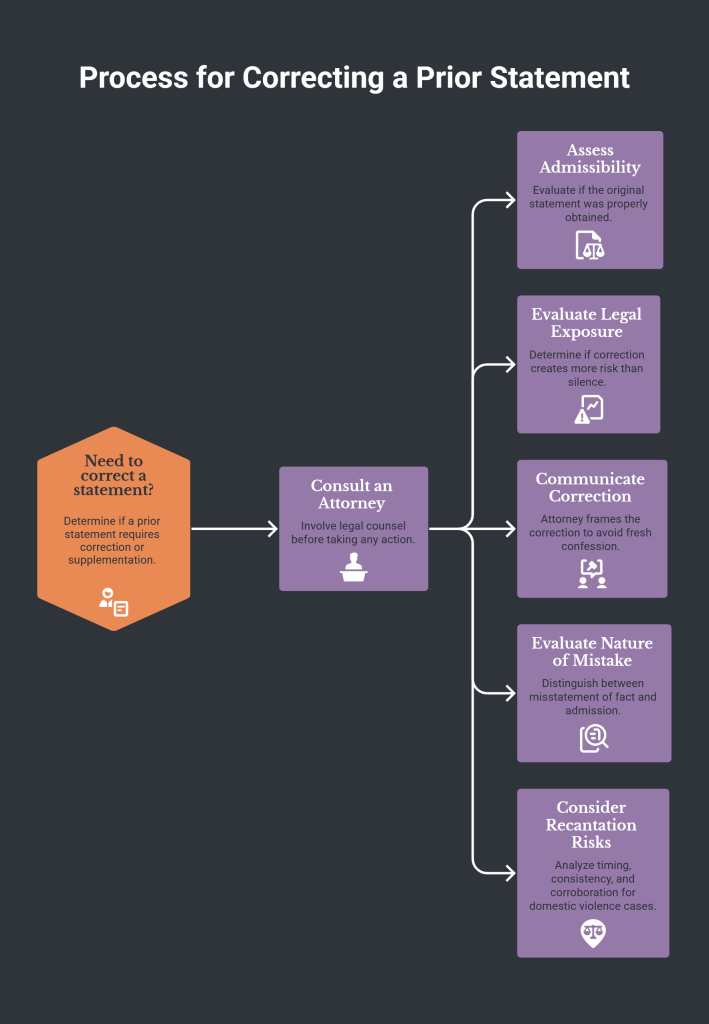
The safest and most effective way to correct the record is to do it through counsel, in a controlled way, rather than by calling the detective back yourself and volunteering a revised story.
An attorney can:
- Assess whether the original statement was even admissible or properly obtained.
- Determine whether correcting it creates more legal exposure than staying silent going forward.
- Communicate a correction to the prosecutor or investigating agency in a way that’s framed accurately and doesn’t read as a fresh confession to a new problem.
- Evaluate whether the “mistake” was a misstatement of fact versus an admission that needs a broader defense strategy.
If you’re a domestic violence complainant looking to recant a report, be aware that Colorado prosecutors can pursue a case with or without your cooperation if independent evidence exists, and recanting alone doesn’t guarantee dismissal. Prosecutors and defense counsel in these cases closely scrutinize the timing, consistency, and corroboration of a recantation.
Can You “Take Back” or Correct a Statement?
This is where people get into trouble. The instinct to fix a bad statement by talking more — calling the detective back, sending a text explaining what you “really meant,” or agreeing to a second interview to clarify — is understandable but usually a mistake for two reasons:
Every additional statement is more evidence, not less. Once you’ve spoken to police, there is no way to “unsay” it. A follow-up conversation doesn’t erase the first one; it just gives the prosecution a second (or third) statement to compare against the first, and any inconsistency can be used to argue you’re not credible.
You are not in control of how the conversation is used or characterized. Investigators may record the follow-up, and anything you say — including your explanation of the earlier statement — is fair game.
 What to Do Right Now If You Are In This Situation
If you’re sitting with the realization that you already said something you shouldn’t have, here is the practical order of operations.
- Stop talking immediately if you’re still in contact with police. Clearly invoke your right to remain silent and ask for an attorney, even mid-conversation.
- Do not contact the investigating officer yourself to “clarify” or “fix” what you said. This is the single most common way people compound an initial mistake into a second, worse one.
- Write down everything you remember while it’s fresh — what you were asked, what you said, when, where, and who else was present. Do this for your attorney’s file, not for police.
- Request or preserve any recording of your statement. If your interview was recorded, your attorney will want that exact record rather than relying on an officer’s written summary.
- Call a criminal defense attorney before you do anything else — before responding to a follow-up call, before agreeing to another interview, and before trying to submit a written correction.
Why the Attorney Step May Be Important
Colorado’s obstruction and false-reporting statutes turn entirely on intent — “knowingly” is the operative word throughout. An attorney’s job in this situation isn’t just damage control on the original statement; it’s making sure that whatever you say or do next doesn’t accidentally convert an honest mistake into evidence of knowing deception.
Given that Colorado courts have shown willingness to suppress improperly obtained statements and even reverse convictions over silence-related violations, there is real value in having someone who knows how these rules are actually applied in Colorado courtrooms — not just how they read on paper — managing your next move.
If you’ve already spoken to the police and are worried about what you said, the mistake is rarely unrecoverable, but the path to recovery runs through legal counsel, not by calling the detective back yourself.
Legal Avenues for Addressing a Problematic Statement
A Colorado criminal defense attorney may have several additional tools to address a statement that has already been made, depending on the circumstances under which it was made.
Motion to Suppress Based on a Miranda Violation
If you were in custody and interrogated without being properly advised of your Miranda rights, or if you invoked your right to remain silent or to counsel and police continued questioning anyway, your attorney can file a motion to suppress the statement. If successful, the statement — and sometimes evidence derived from it — can be excluded from trial.
Motion to Suppress Based on Involuntariness
Separate from Miranda, Colorado law requires that any statement used against you be voluntary — meaning it wasn’t the product of coercion, threats, promises, exhaustion, intoxication, deception that overbore your will, or improper police tactics.
Courts look at the “totality of the circumstances,” including:
-The length and conditions of the interrogation.
-Your age, education, and mental state.
-Whether you were denied food, sleep, or medication.
-Whether officers made threats or false promises (e.g., “if you don’t talk, we’ll charge your family too”).
-If a statement was involuntary, it can be suppressed even if Miranda warnings were properly given.
Challenging Accuracy and Context at Trial
If a statement isn’t suppressed, that doesn’t mean it controls the outcome of the case.
Your attorney can still:
-Cross-examine the officer about how the interview was conducted.
-Introduce the full context of the statement (juries often hear only fragments unless the defense insists on the complete recording or transcript).
-Present expert testimony on false or unreliable confessions where applicable (this is a recognized area of forensic psychology, particularly relevant in high-pressure or lengthy interrogations).
-Show inconsistencies between the statement and physical evidence in a way that favors your defense theory.
Negotiating With the Prosecution
Sometimes the most effective path isn’t a suppression fight at all — it’s using the full picture (including mitigating context around the statement) as leverage in plea negotiations or to persuade the DA’s office not to file certain charges in the first place.
The Bottom Line
Making a statement to police — even one you regret — is not the end of your case. Colorado law gives you and your attorney real tools to challenge how a statement was obtained, argue for its suppression, contextualize it for a jury, or use it strategically in negotiations.
What matters most now is that you stop making the situation worse by talking further, and that you get an experienced Colorado criminal defense attorney involved as soon as possible.
Colorado Criminal Law –Colorado Law: What If You Already Talked to the Police and You Made a Mistake?
The reader is alerted that Colorado criminal law, like criminal law in every state and at the Federal level, changes constantly. The article above was accurate when it was drafted, but it cannot account for changes that occurred after it was uploaded.
 ABOUT THE AUTHOR: H. Michael Steinberg – Email the Author at: hmsteinberg@hotmail.com
A Denver, Colorado Criminal Defense Lawyer – call his office at 303-627-7777 during business hours, or call his cell at 720-220-2277 if you cannot wait and need his immediate assistance.
“A good criminal defense lawyer is someone who devotes themselves to their client’s case from beginning to end, always realizing that this case is the most important thing in that client’s life.”
Putting more than 40 years of Colorado criminal defense experience to work for you.
One should be careful when selecting a Colorado criminal defense lawyer. We encourage you to “vet” our firm. Over the last 40 years – by focusing ONLY on Colorado criminal law – H. Michael has had the time to continually update himself in nearly every area of criminal law, including procedure, trial, and courtroom practice.
H. Michael works hard to deliver the best possible results for his clients, both in and out of the courtroom. He has written extensively on Colorado criminal law and continues to do so, and he hopes this article helps you in some small way.