 Colorado Criminal Lawyer Blog
People v. Burney: A Wake-Up Call on Prosecutors’ Discovery Obligations


By H. Michael Steinberg, A Colorado Criminal Defense Lawyer – Practicing Colorado Criminal Law in the courts of Colorado for over 40 years.
What a Dismissal Of Charges Can Teach Us About Rule 16 and Rule 3.8 in Colorado Criminal Cases
 Introduction:
In the summer of 2026, the Colorado Court of Appeals quietly affirmed one of the more consequential discovery rulings to come out of the Colorado Court of Appeals in many years.
In an unpublished opinion, the court upheld a Douglas County trial judge’s decision to dismiss 10 felony charges against a defendant, Dontae Lahmar Burney, after finding that prosecutors had committed 52 separate discovery violations over a six-month span.
The case did not turn on a close question of guilt or innocence. It turned on whether the District Attorney’s Office did the basic, unglamorous work every prosecutor’s office is required to do: turn over what the rules require, on time, without being chased down.
For Colorado criminal defense attorneys, People v. Burney is a useful case study because it illustrates, in stark and well-documented terms, exactly what happens when a prosecutor’s office loses track of two overlapping obligations: its procedural duty to disclose under Crim. P. 16, and its ethical duty as licensed lawyers under Colo. RPC 3.8.
This article summarizes the case and then unpacks both of those obligations in detail.
The Case: People v. Burney
Dontae Lahmar Burney was charged with 30 counts arising out of allegations of assault and child abuse. Ten of those counts were added later in the case, after the alleged victim claimed that Burney had tampered with the lug nuts on her vehicle in retaliation for his arrest.
As the case moved toward trial, defense counsel documented a pattern of missed and incomplete disclosures by the prosecution — materials that should have been produced under Colorado Procedural Rule 16 but were not — over roughly six months.
Ultimately, the trial judge found 52 separate discovery violations and, in October 2025, dismissed the ten charges connected to the later-added retaliation allegations as a sanction.
Repeated discovery failures like these erode public confidence in the fairness of the criminal process — which is precisely why Colorado courts treat them as sanctionable.
Rule 16: The Procedural Backbone of Colorado Discovery
Crim. P. 16 is the mechanical engine of criminal discovery in Colorado. It is self-executing, meaning the prosecution’s obligation to disclose does not depend on the defense filing a request — the duty exists automatically from the moment charges are filed and runs on fixed deadlines.
| What Rule 16 Requires
— whether or not the defense specifically asks for it. Disclosure must occur “as soon as practicable,” but no later than 21 days after the defendant’s first appearance for most categories of material, with certain remaining obligations due no later than 35 days before trial. The obligation is continuing. If new material comes into the prosecution’s possession after the initial disclosure deadline, Rule 16 requires it to be turned over promptly, not held until trial. |
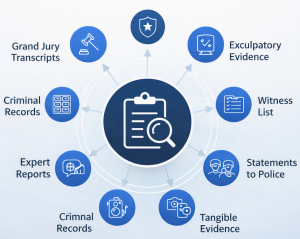 Under Crim. P. 16(I)(a)(1), the prosecution must make available to the defense the police reports, witness statements, physical and documentary evidence, expert reports, criminal records of witnesses, and any material or information within the prosecution’s possession or control that relates to the case
 The Rule 16 Doctrine of Constructive Possession
Two features of Rule 16 make it far more demanding than prosecutors sometimes appreciate.
The first is the doctrine of constructive possession: the prosecution is deemed to possess material held by any law enforcement agency that assisted in the investigation, even if that material never physically crossed the prosecutor’s desk.
A sheriff’s office body-camera file, a municipal police department’s supplemental report, or a task force officer’s notes are all fair game — and the District Attorney cannot avoid the disclosure obligation simply by not asking for them.
The second is Rule 16(I)(a)(4)’s affirmative duty to maintain a functioning flow of information between investigating agencies and the prosecutor’s office sufficient to place all relevant material within the prosecutor’s control. (In other words, Rule 16 does not just penalize prosecutors for sitting on evidence they have; it requires them to build and maintain the internal systems necessary to know what evidence exists in the first place).
Burney’s 52 documented violations over six months read like a case study in exactly this kind of systemic breakdown — not necessarily a single bad-faith decision to hide evidence, but a sustained failure of the office’s tracking and communication systems.
The P0wer Of A Colorado Judge To Sanction (Punish) A DA For Violations Of Discovery Rules
When a Rule 16 violation occurs, trial courts have broad discretion to fashion a remedy under Crim. P. 16(III).
That range runs from the mild (a continuance, an order compelling production) to the severe (exclusion of the undisclosed evidence, contempt sanctions, or, as in Burney, dismissal of the affected charges).
Colorado appellate courts review the choice of sanction for abuse of discretion, which is precisely the standard the Court of Appeals applied.
An abuse of discretion occurs when a judge’s decision is manifestly unreasonable, arbitrary, or based on a clear error of law or fact; so that no reasonable judge would have made it under the circumstances is not enough for the ruling to be wrong — it must be so unreasonable that it warrants reversal.
Rule 3.8: The Prosecutor’s Ethical Overlay
Rule 16 is a procedural rule, enforced by trial judges through the mechanics of a criminal case. Colo. RPC 3.8 is something different: a rule of professional conduct that applies to the individual lawyer, enforced not by the trial court but by the Colorado Office of Attorney Regulation Counsel through the separate disciplinary system.
| Colo. RPC 3.8(d) — Special Responsibilities of a Prosecutor
A prosecutor in a criminal case shall make timely disclosure to the defense of all evidence or information known to the prosecutor that tends to negate the guilt of the accused, mitigates the offense, or, in connection with sentencing, tends to mitigate the sentence — unless relieved of this responsibility by a protective order of a tribunal. |
Rule 3.8(d) tracks the constitutional principle from Brady v. Maryland and its progeny, but it is broader in an important respect: it is an ethical floor that exists independent of whether a Brady violation would ultimately be found prejudicial enough to warrant reversal on appeal.
A prosecutor can comply with the constitutional minimum required to avoid a reversed conviction and still violate Rule 3.8(d) by sitting on exculpatory or mitigating information the defense should have had earlier.
The ethics rule is not just about outcomes at trial — it is about the ongoing professional duty of candor and fairness that the prosecutor, as “minister of justice” rather than an ordinary advocate, owes to the system.
This is where Rule 16 and Rule 3.8 diverge most sharply, and why it is useful for defense counsel to think about them as two separate, overlapping obligations rather than one blended concept.
| Crim. P. 16 | Colo. RPC 3.8 | |
| Source of the duty | Colorado Rules of Criminal Procedure — a procedural discovery rule | Colorado Rules of Professional Conduct — a lawyer-ethics rule |
| What it requires | Disclosure of essentially all material and information in the prosecution’s possession or control, exculpatory or not | Timely disclosure of evidence or information that tends to negate guilt, mitigate the offense, or reduce punishment |
| Trigger | Automatic and self-executing — no request required; runs on fixed deadlines | Continuing personal obligation of the prosecutor as a licensed lawyer, independent of any court deadline |
| Who enforces it | The trial court, through discovery motions and sanctions | The Office of Attorney Regulation Counsel, through the disciplinary process |
| Typical remedy for violation | Continuance, exclusion of evidence, contempt, or — as in Burney — dismissal of charges | Private admonition, public censure, suspension, or disbarment of the individual prosecutor |
Where the Two Rules Meet — and Where They Don’t
It is a common misconception that a Rule 16 violation and an ethics violation are the same event viewed from two angles. They are not.
Most Rule 16 violations, including the pattern found in Burney, involve material that is discoverable under Rule 16’s broad definition — witness statements, reports, physical evidence — without necessarily being exculpatory or mitigating in the Rule 3.8(d) sense.
A missed deadline on a routine police report is a Rule 16 problem. It is only a Rule 3.8 problem if that report also contained information tending to negate guilt or mitigate the offense, and the prosecutor knew that and sat on it anyway.
- A Rule 16 violation is about timing and completeness — did the prosecution turn over everything it was required to, by the deadline the rule sets?
- A Rule 3.8 violation is about knowledge and content — did the prosecutor personally know about evidence favorable to the defense and fail to disclose it?
A single course of conduct can trigger both — dismissal or exclusion as a case sanction under Rule 16, and, separately, a disciplinary referral or grievance under Rule 3.8 — but neither one automatically proves the other.
The Strategic Use Of Rule 16 and Rule 3.8
For a Colorado criminal defense attorney litigating a discovery dispute, this distinction matters strategically.
A motion asking the court to sanction a Rule 16 violation should be built on the record of what was due, when it was due, and what actually arrived — the kind of granular, date-stamped accounting that produced the 52 separate violations in Burney.
A grievance or disciplinary complaint premised on Rule 3.8(d), by contrast, requires a further showing that specific, favorable information was known to the prosecutor and not turned over — a materiality and knowledge inquiry that Rule 16 motions do not require.
Practical Takeaways for Colorado Criminal Defendants and Counsel
- Document everything. Burney succeeded because defense counsel built a detailed record of 52 discrete violations over six months, not a vague complaint that discovery “felt slow.” Courts respond to specificity.
- Invoke constructive possession early. If an investigation involved more than one law enforcement agency, ask specifically what each agency has — body camera footage, dispatch logs, supplemental reports — rather than assuming the District Attorney’s file is complete.
- Push for enforcement, not just apologies. Structural promises of reform are not a substitute for a court order compelling production or, where the pattern is severe enough, a sanction with teeth.
- Understand that the Rule 3.8 track is separate. Even after a Rule 16 issue is resolved in the criminal case, evidence that a prosecutor knowingly withheld exculpatory or mitigating information may warrant a separate grievance to attorney regulators.
The Bottom Line
People v. Burney did not announce a new legal standard. What it did was demonstrate, with unusually granular facts, that Colorado’s existing discovery framework has real teeth when a prosecutor’s office fails to use it correctly — and that trial judges are willing to use the most severe remedy available, dismissal, when the violations are numerous enough and sustained long enough to justify it.
For defendants and defense counsel, the case is a reminder that Rule 16 and Rule 3.8 are not bureaucratic formalities. They are enforceable rights, and when the prosecution fails to honor them, the consequences can extend to the charges themselves.
| H. Michael Steinberg | Denver, Colorado Criminal Defense Attorney
For 38 years, H. Michael Steinberg has defended the rights of people charged with crimes throughout the Denver metro area and the State of Colorado. His practice includes DUI, domestic violence, drug crimes, sex offenses, and violent crimes, with deep experience litigating discovery and evidentiary disputes at the Denver County Lindsey-Flanigan Courthouse and courts throughout the Front Range. If you believe the prosecution in your case has withheld evidence or missed a discovery deadline, call the Law Office of H. Michael Steinberg at 720-220-2277 for a confidential consultation. This article is provided for general informational purposes only and does not constitute legal advice. Reading this article does not create an attorney-client relationship. Every case is different, and the outcome of any case depends on its specific facts and circumstances. Consult a qualified Colorado criminal defense attorney regarding your specific situation. Colorado Criminal Law – People v. Burney: A Wake-Up Call on Prosecutors’ Discovery ObligationsThe reader is alerted that Colorado criminal law, like criminal law in every state and at the Federal level, changes constantly. The article above was accurate when it was drafted, but it cannot account for changes that occurred after it was uploaded.
A Denver, Colorado Criminal Defense Lawyer – or call his office at 303-627-7777 during business hours – or call his cell if you cannot wait and need his immediate assistance – please call 720-220-2277.
Putting more than 40 years of Colorado criminal defense experience to work for you. You should be careful to make a responsible choice when selecting a Colorado criminal defense lawyer. We encourage you to “vet” our firm. Over the last 40 years – by focusing ONLY on Colorado criminal law – H. Michael has had the time to continually update himself in nearly every area of criminal law, including Colorado criminal law, procedure, and trial and courtroom practice. H. Michael works hard to deliver the best possible results for his clients, both in and out of the courtroom. He has written extensively on Colorado criminal law and continues to do so, and he hopes this article helps you in some small way. |
 ABOUT THE AUTHOR: H. Michael Steinberg – Email the Author at: