 Colorado Criminal Lawyer Blog
When Anger Takes the Wheel: Road Rage Charges in Colorado


When Anger Takes the Wheel: Road Rage Charges in Colorado
By H. Michael Steinberg, A Colorado criminal defense lawyer- practicing Colorado Criminal Law from both sides for over 40 years.
 Introduction:
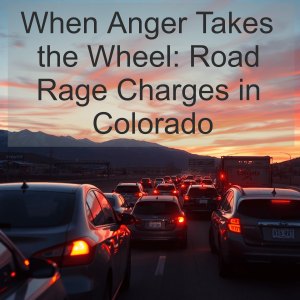
It starts small. Someone cuts you off without signaling. A driver rides your bumper for three miles on I-25. Someone flips you off at a red light. In the span of a few seconds, a minor traffic annoyance can spiral into something that changes your life forever — not because of a car accident, but because of what happens after anger takes over.
Colorado prosecutors have become much more aggressive about road rage in recent years, and they don’t need or have a special “road rage” statute to do so. Poor judgment behind the wheel — tailgating, brake-checking, gesturing, even just following someone too closely while shouting out the window — can land a driver in a Colorado District Courtroom facing felony menacing charges, reckless driving charges, or worse, depending on how the encounter unfolds.
What feels, in the moment, like an understandable reaction to someone else’s bad driving can, on a police report, appear to be a criminal act.
The problem is that road rage cases rarely stay simple. They involve competing stories, at times dash-cam and cell-phone footage, 911 calls made in the heat of the moment, and witnesses who may have only seen part of what happened. Because Colorado law lets prosecutors reach for serious charges — even in cases where no one was physically hurt — the stakes for the driver on the receiving end of a road rage accusation are often much higher than people expect.
An Increasingly Dangerous Issue For All Of Us
Colorado prosecutors, traffic engineers, and law enforcement describe aggressive driving and road rage as a problem approaching epidemic proportions on Denver-metro freeways and surface streets alike.
Data from the Colorado State Patrol shows road rage has been increasing, matching a national trend with more drivers reporting aggressive actions like tailgating and speeding. In 2022 alone, reported cases rose significantly compared with previous years, many of which resulted in serious accidents or criminal charges.
I have written about Colorado Road Rage in the past, as I am very concerned about these cases and the many mistakes law enforcement makes in investigating and the Colorado District Attorneys later charging these cases.
What most people do not understand — including the people who are arrested for the acts of road rage — is that “road rage” is not a crime you will find written anywhere in the Colorado Revised Statutes. There is no statute titled “Road Rage.” Yet the conduct we all recognize as road rage is still prosecuted aggressively in Denver, Jefferson, Arapahoe, Adams, and Douglas County courtrooms every week, often as a felony, possibly carrying years in the Colorado Department of Corrections.
This article breaks down how Colorado prosecutors actually charge road rage cases, what the potential penalties look like, what a driver facing these charges needs to know before their next court date, and the defense strategies available to people accused of these crimes.
There Is No “Road Rage” Statute — And That Is Precisely the Problem
Because the legislature never created a stand-alone road rage offense, prosecutors are free to reach into the entire criminal and traffic code to charge a single incident with one or more criminal charges. A driver who tailgates, brake-checks, pulls alongside another car, and gestures out the window may be looking at some combination of the following charges arising from the very same thirty seconds of conduct:
Reckless Driving — C.R.S. § 42-4-1401
Careless Driving — C.R.S. § 42-4-1402
Felony Menacing — C.R.S. § 18-3-206
Vehicular Assault — C.R.S. § 18-3-205
Vehicular Homicide — C.R.S. § 18-3-106
First Degree Assault— C.R.S. § 18-3-202
Second Degree Assault — C.R.S. § 18-3-203
Harassment — C.R.S. § 18-9-111
Disorderly Conduct — C.R.S. § 18-9-106
Criminal Mischief — C.R.S. § 18-4-501 (if a vehicle is struck or damaged.)
That list is exactly why road rage is “not well understood.” The public thinks of it as a single, loosely-defined bad habit. Prosecutors think of it as a rough list of possible charges.
A District Attorney reviewing dash-cam or cell-phone video of a road rage encounter will typically stack the most serious charge the facts could support — usually felony menacing is charged if a weapon was displayed — alongside one or more traffic and misdemeanor counts, giving the prosecution substantial leverage in plea negotiations.
Prosecutors charge road rage cases using whatever combination of traffic and criminal statutes the facts support. A single incident routinely generates several charges at once: a driver who cuts someone off, gets out of the car to yell, and throws a punch can walk away facing careless driving, disorderly conduct, and assault charges from one five-minute encounter.
Felony Menacing — The Charge That Turns a Traffic Dispute Into a Felony
When a weapon enters the picture of a road rage scenario — a firearm pulled from the glove box, a knife shown through the window, even an object brandished to look like a gun — the charge of choice in Colorado is almost always felony menacing under C.R.S. § 18-3-206.
C.R.S. § 18-3-206 under Felony Menacing
“A person commits the crime of menacing if, by any threat or physical action, he or she knowingly places or attempts to place another person in fear of imminent serious bodily injury.
Menacing is a class 1 misdemeanor, but it is a class 5 felony if committed by the use of a firearm, knife, or bludgeon or a simulated firearm, knife, or bludgeon.”
In March 2022, the Colorado legislature amended this statute, reclassifying misdemeanor menacing as a class 1 misdemeanor — the most serious misdemeanor category — while leaving weapon-based menacing a class 5 felony.
A class 5 felony conviction in Colorado can carry one to three years in the Department of Corrections, two years of mandatory parole, and fines of up to $100,000.
Because Colorado is an open-carry state, having a lawful firearm in the vehicle is not illegal — but using it, or even displaying it, to intimidate another driver during a dispute converts a legal weapon into the basis of a felony charge in an instant.
The prosecution’s burden in a felony menacing case is lower than most people assume.
The District Attorney does not have to prove the other driver was actually afraid — only that the defendant knowingly engaged in conduct that would place a reasonable person in fear of imminent serious bodily injury.
This distinction matters enormously in road rage cases, where video often shows a driver reaching for or displaying a weapon out of genuine fear for their own safety, only to be charged as though they were the aggressor.
Self-Defense in a Road Rage Context
Road rage cases frequently present a classic self-defense scenario: two drivers escalate a dispute, one produces a weapon first, and the other responds. Colorado’s self-defense statute, C.R.S. § 18-1-704, allows a person to use physical force — including deadly physical force in appropriate circumstances — when they reasonably believe it is necessary to defend themselves against what they reasonably believe is the use or imminent use of unlawful physical force by another.
Whether that defense applies to a given road rage shooting or menacing case depends heavily on who escalated first, whether retreat was reasonably possible, and what a jury concludes was “reasonable” under the pressure of a moving-vehicle confrontation.
These are precisely the kinds of fact-intensive questions that make experienced criminal defense trial counsel essential in a road rage prosecution involving a weapon.
Reckless and Careless Driving — The Traffic-Code Backbone of Most Road Rage Cases
Not every road rage incident involves a weapon. Far more commonly, the case begins and ends as a traffic prosecution built on the aggressive maneuvers themselves — tailgating at high speed, weaving through lanes to cut someone off, brake-checking, or forcing another vehicle toward the shoulder.
The most common road-rage charges begin at the traffic-code level.
Reckless Driving under C.R.S. § 42-4-1401
A person who drives “in such a manner as to indicate either a wanton or a willful disregard for the safety of persons or property” commits reckless driving, a class 2 misdemeanor traffic offense.
Reckless driving requires a showing of willful or wanton disregard for safety — a higher bar than ordinary negligence. Where the prosecution cannot prove that heightened mental state, Colorado law provides a fallback: careless driving under C.R.S. § 42-4-1402, which criminalizes driving “without due regard for the width, grade, curves, corners, traffic, and use of the streets and highways and all other attendant circumstances.”
A second or subsequent reckless driving conviction carries enhanced penalties — a fine of $50 to $1,000 and ten days to six months in county jail — and either offense adds points to a driving record that can trigger license suspension at twelve points within twelve months, or eighteen points within twenty-four months.
Careless Driving under C.R.S. § 42-4-1402,
Careless driving covers driving “in a careless and imprudent manner, without due regard for the width, grade, curves, corners, traffic, and use of the streets and highways and all other attendant circumstances.”
It’s a lower bar than reckless driving — negligence is the standard rather than willful disregard — and it starts as a class 2 misdemeanor traffic offense. But the statute can escalate automatically: if the careless driving proximately causes bodily injury to someone, or causes a death, it becomes a class 1 misdemeanor traffic offense regardless of intent.
Prosecutors routinely charge reckless driving and careless driving together in a single case, so that a jury unconvinced of recklessness can still convict on the lesser included careless driving count.
When a Threat Becomes a Crime Outside Of The Traffic Code: Menacing, Harassment, and Disorderly Conduct
Road rage often stops being about driving and starts being about intimidation — and Colorado’s threat-based statutes carry some of the steepest penalties in a Colorado road rage case. The first, again, is the alleged use of a deadly weapon.
Menacing under C.R.S. § 18-3-206, applies when a person “by any threat or physical action, knowingly places or attempts to place another person in fear of imminent serious bodily injury.” Standing alone, menacing is a class 1 misdemeanor. But it becomes a class 5 felony the moment a firearm, knife, or bludgeon — real or simulated — is involved.
Because Colorado is an open-carry state and it’s legal to keep a firearm in a vehicle, pointing or even brandishing a weapon during a traffic dispute is one of the most common ways a road rage incident turns into a felony case, punishable by one to three years in prison, fines up to $100,000, and two years of mandatory parole.
A closely related charge is prohibited use of weapons under C.R.S. § 18-12-106, a class 1 misdemeanor that separately criminalizes “knowingly and unlawfully aim[ing] a firearm at another person” — a charge prosecutors sometimes file with or instead of menacing.
When Road Rage Causes Injury or Death: Vehicular Assault and Vehicular Homicide
The stakes escalate dramatically the moment a road rage encounter results in physical harm. If reckless driving causes serious bodily injury to another person, the applicable charge is no longer a traffic misdemeanor — it is vehicular assault under C.R.S. § 18-3-205, a class 5 felony punishable by one to three years in prison and fines between $1,000 and $100,000.
If a person dies as a result, the charge becomes vehicular homicide under C.R.S. § 18-3-106, which can be charged as a class 3 felony where the driving was reckless, or a far more serious class 2 felony where the death resulted from driving under the influence.
Prosecutors and juries may view road-rage-related vehicular assault and homicide cases with little sympathy, because the underlying conduct — using a two-ton vehicle as an instrument of intimidation or retaliation — reads to a jury as a deliberate choice made in anger, not a momentary lapse in judgment.
When reckless driving is the primary cause of a death, it is reckless vehicular murder. It is a felony class 4. Colo. Rev. Stat. § 18-3-106.1. Prosecutors may charge extreme-indifference homicide in an appropriate extreme situation.
The Colorado Court of Appeals ruled in a double murder case that I tried a long time ago – the Jason Reynolds case – that even if a defendant was charged with road-rage homicide, the state could charge the case as extreme-indifference homicide if their actions also showed extreme disregard for human life in general. People v. Reynolds, 252 P.3d 1128 (Colo. Ct. App. 2010).
Felony Assaults, Harassment, and Disorderly Conduct
First Degree Assault under C.R.S. § 18-3-202
First-degree assault is a class 3 felony reserved for the most serious assault cases. It applies when someone causes serious bodily injury with a deadly weapon and intends to cause serious bodily injury.
Deliberately ramming another driver with a vehicle and causing severe injury can lead prosecutors to consider first-degree assault or vehicular assault, depending on proof of intent and case facts.
Second Degree Assault under C.R.S. § 18-3-202
Colorado law recognizes that an automobile itself can qualify as a “deadly weapon” for purposes of second degree assault under C.R.S. § 18-3-203, when a driver intentionally uses the vehicle to cause bodily injury to another person — for example, deliberately swerving into another car or intentionally forcing a driver off the road. Second-degree assault is typically a class 4 felony in Colorado, carrying substantially harsher penalties than reckless driving alone.
Harassment under C.R.S. § 18-9-111
When a road rage incident escalates to a physical confrontation after both vehicles have stopped — shoving, striking, or grabbing another driver — prosecutors frequently add a harassment charge under C.R.S. § 18-9-111, which covers intentionally striking, shoving, kicking, or otherwise subjecting another person to physical contact, … as well as following a person in public or engaging in conduct intended to alarm, annoy, or harass.
Disorderly Conduct under C.R.S. § 18-9-106
Fistfights, screaming matches, or brandishing that occurs after drivers exit their vehicles can also support a disorderly conduct charge under C.R.S. § 18-9-106, which covers fighting in public and displaying a deadly weapon in a manner calculated to alarm.
Misdemeanor Assault and Reckless Endangerment
If a road rage encounter escalates to a physical confrontation outside the vehicles, Colorado’s general assault statutes come into play. Third-degree assault, under C.R.S. § 18-3-204, covers knowingly, recklessly, or negligently causing bodily injury to another person and is a class 1 misdemeanor.
Even where no one is actually hurt, reckless endangerment under C.R.S. § 18-3-208 — recklessly creating a substantial risk of serious bodily injury to another person — is a class 2 misdemeanor prosecutors frequently add when a driver’s conduct puts someone in danger without quite causing an injury.
Property Damage: Criminal Mischief under C.R.S. § 18-4-501
Slamming into another car intentionally, keying a vehicle during a dispute, or smashing a window in anger can support a criminal mischief charge under C.R.S. § 18-4-501. The classification scales with the dollar amount of damage: a petty offense under $300, a class 2 misdemeanor between $300 and $1,000, a class 1 misdemeanor between $1,000 and $2,000, and increasingly serious felonies — up to a class 2 felony — above $2,000, topping out at a class 2 felony for damage exceeding $1 million.
Why Road Rage Is Prosecuted Severely in Colorado
Several converging factors explain why Denver-metro prosecutors have taken an increasingly hard line on road rage cases in recent years:
Public Safety Optics
Road rage incidents endanger everyone on the roadway, not just the two drivers involved — a fact prosecutors emphasize heavily to judges and juries.
Rising Gun Involvement
The increase in firearms carried in vehicles has turned routine traffic disputes into shooting incidents, prompting “zero tolerance” public statements from law enforcement agencies in the Denver metro area and along the Front Range.
Abundant Video Evidence
Dash cameras, doorbell cameras, traffic cameras, and bystander cell-phone footage now capture the vast majority of road rage encounters, giving prosecutors strong evidentiary cases that are difficult to contest at trial.’
Charge Stacking
Because no single road rage statute exists, prosecutors can combine felony and misdemeanor counts from a single incident, increasing both the leverage in plea negotiations and the maximum exposure if the case goes to trial.
The exposure can be greater if, for example, the crime of felony assault is separately charged and proved as a crime of violence. First- and second-degree assault are within the statute when committed using, or possessing and threatening to use, a deadly weapon, or when serious bodily injury or death is caused. Colo. Rev. Stat. § 18-1.3-406.
A crime-of-violence sentence must be to the Department of Corrections for at least the midpoint of the applicable presumptive range and up to twice the applicable maximum, without suspension, subject to the statute’s specified review mechanism. Colo. Rev. Stat. § 18-1.3-406.
The enhancement is not automatic. The charging instrument must allege the crime-of-violence count separately, and the jury or court must make the required specific finding of weapon use or injury. Colo. Rev. Stat. § 18-1.3-406.
Local Variations
How aggressively a given case is charged can depend heavily on which District Attorney’s office handles it — some Front Range jurisdictions have publicly emphasized a firm, example-making approach to weapon-involved menacing cases, while others show more willingness to consider diversion or deferred judgment, particularly for younger or first-time offenders.
 Defenses In Colorado Road Rage Case
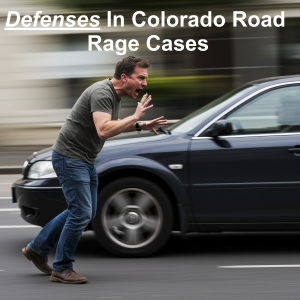
Because road rage prosecutions are built from an assortment of statutes rather than a single clearly-defined offense, the facts of each incident matter enormously, and so does the order in which events unfolded. An experienced Colorado criminal defense lawyer evaluating a road rage case will typically examine who escalated first. Video and witness accounts often show a more complicated sequence of provocation than the initial police report suggests.
Self-defense and Defense of Others – Revisited
Where a client reasonably believed they faced imminent serious bodily injury, C.R.S. § 18-1-704 may justify the use of force, including displaying or using a weapon.
Colorado’s self-defense statute, C.R.S. § 18-1-704, is often the most powerful tool available in a road rage case that escalated to physical force. A person is justified in using physical force against another to defend themselves or a third person from what they reasonably believe is the use or imminent use of unlawful force, using only the degree of force reasonably believed necessary.
Deadly force is justified only where a lesser degree of force would be inadequate and the person reasonably believes they or another are in imminent danger of death or great bodily injury.
Two features of Colorado law matter a great deal in a road rage context:
-
No duty to retreat. Colorado has never imposed a common-law duty to retreat before using force in self-defense; a defendant who did not provoke the confrontation may stand their ground, a principle Colorado courts have recognized for over a century (Idrogo v. People, 818 P.2d 752 (Colo. 1991); C.R.S. § 18-1-704 annotations).
-
The initial-aggressor exception. Self-defense is unavailable to someone who provoked the confrontation or was the “initial aggressor,” unless they withdrew and clearly communicated that intent before the other person continued the attack.
-
The Colorado Supreme Court has emphasized that this exception requires actual evidence the defendant initiated the physical conflict with unlawful force or a threat of it — not just that they were part of an escalating argument (Castillo v. People, 2018 CO 62).
-
Because road rage confrontations frequently involve mutual anger, tailgating, and provocative gestures on both sides, whether a particular defendant was the “initial aggressor” — and whether the other driver’s conduct justified a reasonable fear of imminent harm — is very often a genuine, fact-intensive jury question rather than a foregone conclusion.
For drivers with a lawfully possessed firearm in the vehicle, it is also critical to understand that Colorado’s open-carry status does not immunize a driver from a menacing charge.
Simply having a legal weapon available is not a crime; using it, brandishing it, or referencing it to intimidate another driver during a dispute is what converts lawful possession into felony exposure.
Other Strategies To Defend Against Road Rage In Colorado
Mistaken Identity
Aggressive-looking driving is sometimes misread as directed road rage when it was, in fact, unrelated erratic driving, a medical event, or a misunderstanding between two unfamiliar drivers.
Road rage incidents typically last only seconds, involve moving vehicles, and are witnessed by adrenaline-flooded participants trying to read license plates or a driver’s face through glass and mirrors.
Similar-looking vehicles, poor lighting, and the stress of the moment all increase the risk that the wrong driver is identified — and that a driver’s ordinary defensive maneuver gets misread as an aggressive one directed at a specific person.
The Gap Between Reckless and Careless Driving
Whether conduct meets the higher “wanton and willful” standard for reckless driving, or only the lesser negligence standard for careless driving, can be the difference between a felony-adjacent traffic case and a fine.
Quality and Completeness of Video Evidence
Dash-cam and bystander footage frequently fails to capture the full sequence of events, and gaps in that footage can be used to challenge the prosecution’s narrative.
Doorbell cameras, traffic cameras, and cell-phone video cut both ways in these cases, and a thorough defense review of all available footage — not just what the prosecution chooses to introduce — can reveal who actually initiated the confrontation, whether a “menacing” gesture was as described, or whether the complaining witness’s own driving provoked the response.
Challenging the Intent Element.
Because reckless driving, menacing, harassment, and disorderly conduct all require the state to prove a culpable mental state, a defense attorney can attack the prosecution’s characterization of ambiguous conduct: an aggressive lane change made to avoid a collision, a raised hand meant to signal frustration rather than threaten harm, or a raised voice that never rose to a “true threat.”
Where police reports rely on a single frightened witness’s interpretation of ambiguous body language, cross-examining that interpretation is often the case.
Defenses of Necessity and Duress.
In narrower circumstances, a driver who fled what they reasonably perceived as a genuine threat — for example, being run off the road or chased — may be able to raise necessity or duress as a defense to charges like vehicular eluding or reckless driving, arguing that the reckless conduct was a response to an emergency rather than road rage itself.
Degree-of-Harm and “Charge-Stacking” Challenges
Because a single incident can generate overlapping charges — reckless driving, menacing, harassment, and assault from one encounter — a defense strategy often includes challenging whether the state can prove every element of every charge, or whether some charges should be merged or dismissed as duplicative of the same conduct.
Quick Reference: Common Road Rage Charges in Colorado
| Charge | Statute | Classification | Range |
| Careless driving | § 42-4-1402 | Class 2 misdemeanor traffic offense (class 1 if injury or death results) | Up to 90 days / escalates with harm |
| Reckless driving | § 42-4-1401 | Class 2 misdemeanor traffic offense | $50–$1,000 fine, up to 6 months (repeat offense) |
| Reckless endangerment | § 18-3-208 | Class 2 misdemeanor | Jail/fine per misdemeanor schedule |
| Disorderly conduct (displaying firearm) | § 18-9-106 | Class 2 misdemeanor | Jail/fine per misdemeanor schedule |
| Harassment | § 18-9-111 | Class 1 or 2 misdemeanor | Jail/fine per misdemeanor schedule |
| Third-degree assault | § 18-3-204 | Class 1 misdemeanor | Up to 364 days, fines |
| Prohibited use of weapons (aiming a firearm) | § 18-12-106 | Class 1 misdemeanor | Up to 364 days, fines |
If You Are Facing Charges From a Colorado Road Rage Incident
Do not talk to the police without an attorney. Anything you say can be used against you, even if you think you are explaining yourself.
Preserve Evidence – Dash cam video, cell phone footage, surveillance video, and witness contact information can be critical. Memories fade quickly, and the other driver’s story may become more dramatic over time.
Stay Off Social Media – Posts about the incident, even ones that seem harmless, can be used by prosecutors to argue you are aggressive or unrepentant. Thorough investigators and DA’s look at social media. They will see what you posted. Was there video? Inconsistent statements?
Take The Charges Seriously. Even a misdemeanor harassment or reckless driving conviction can affect your job, your insurance, and your driving record. Felony charges can mean prison time and a permanent criminal record.
Road rage cases are not as simple as they look. What feels like a routine misunderstanding on the highway can land you in front of a judge facing a long list of traffic and criminal charges.
The difference between a misdemeanor and a felony often comes down to small facts: whether someone displayed a weapon, whether a vehicle was used to threaten or injure someone, whether anyone was actually hurt, and whether the prosecution can prove intent.
What to Do Instead Of “Raging“, Realistically, When You Feel Your Anger Rising
Not a motivational speech. Just practical ideas that actually work when you are angry and in your car:
- Create space on purpose. Let them pass. Slow down. Take the next exit. Put distance between you and the problem.
- Stop trying to teach lessons. Nobody learns on the highway. They just escalate.
- Do not engage with eye contact. It’s well established how much eye contact can ignite someone. Look forward. Be boring.
- If you feel threatened, drive to a public place. Gas station, well-lit parking lot, police station. Call 911! Don’t go home with someone behind you.
- Use your horn like a tool, not a weapon. Quick alert, not the long angry blast that basically says “let’s fight.”
- If it’s truly dangerous, call it in. Colorado State Patrol and local agencies would rather know about a driver who is actively endangering people than deal with the crash afterward.
And honestly, sometimes the best move is to narrate it to yourself like you’re watching a documentary. “That person is driving recklessly. I’m going to let them go.” It sounds silly, but it snaps you out of your ego.
The Difficult Part
You can be right and still end up ruined.
You can be the better driver. You can be the one who had the green light. You can be the one who got cut off first.
And still, if you choose to escalate, you’re choosing risk. Legal risk, physical risk, financial risk, reputation risk.
That’s the real warning nobody gives you when you first start driving. Road rage is not just an emotion. It’s a decision with consequences.
The Bottom Line
Colorado has no crime called “road rage,” but that absence is exactly what makes these cases so dangerous for the people involved. A single heated exchange behind the wheel can be charged as felony menacing, vehicular assault, second degree assault, reckless driving, careless driving, harassment, and disorderly conduct — separately or in combination — depending on how the incident unfolded and which prosecutor’s office reviews the file.
What begins as a few seconds of anger on I-25 or Colorado Boulevard can end with a felony record, years of prison exposure, loss of firearm rights, and professional licensing consequences that follow a person for the rest of their life.
If you or a family member has been arrested or charged in connection with a road rage incident anywhere in the Denver metropolitan area, the specific sequence of events, the available video evidence, and the exact charges filed will determine the defense strategy. These cases reward early, aggressive representation — before a plea offer locks in a felony record that did not need to happen.
 FAQs (Frequently Asked Questions)
What makes road rage in Colorado unique compared to other places?
Colorado’s road rage is influenced by a mix of mountain driving, sudden weather changes, tourists unfamiliar with altitude and traction, locals who are often late, and long highways where speed limits are treated like suggestions. This combination creates a distinct driving environment that can quickly escalate tensions on the road.
When does aggressive driving behavior in Colorado become a criminal offense?
In Colorado, once your driving becomes threatening or reckless—such as brake checking leading to a crash, swerving to block someone, chasing another vehicle, getting out of your car to confront someone, throwing objects, or brandishing a weapon—you may be facing criminal charges beyond just traffic tickets. The law considers cars as dangerous weapons, so using your vehicle to intimidate others can lead to serious legal consequences.
How does video recording impact road rage incidents in Colorado?
With the prevalence of dash cams, security cameras, smartphones, and other recording devices everywhere, many road rage incidents are captured on video. This footage can serve as crucial evidence in disputes or legal cases but also means that aggressive behavior is more likely to be documented and shared publicly, potentially damaging reputations and leading to legal trouble.
Can road rage incidents affect my employment or professional reputation?
Yes. If your vehicle displays company logos or if your identity is discovered through license plates or online information, employers may be contacted about your behavior. For those with commercial driver’s licenses or working in public-facing roles like healthcare or education, a road rage incident can jeopardize their job. Even during probationary periods at work, such incidents can lead to termination due to perceived poor impulse control and liability concerns.
Insurance companies do not consider personal justifications for aggressive driving. If you’re at fault in a crash caused by road rage behaviors like tailgating or reckless driving, you may face increased premiums for years, deductibles for repairs, rental car costs if coverage is limited, delays due to parts availability, and lost income from time spent handling claims and court appearances.
What legal processes might follow a road rage event even if no one is physically injured?
Even minor road rage incidents can lead to police involvement and potential legal actions such as court dates, attorney fees, probation conditions, and mandated programs. If someone feels threatened or if dangerous driving occurred, you could face charges that result in lengthy and costly legal proceedings beyond just receiving a traffic ticket.
How important is proving the details in a Colorado road rage case when planning a defense?
Very important. The prosecution must prove exactly who did what, when and where it happened, what was said or done, and if the victim felt reasonably threatened. The difference between feelings and solid proof is often where defense strategies focus.
Can mistaken identity be used as a defense in Colorado road rage cases?
Yes. Many reports come from stressed witnesses trying to identify vehicles while driving. Defenses can question wrong license plate readings, similar car models and colors, tinted windows or glare, driver changes, and whether the witness lost sight of the vehicle before later identifying it.
How can questioning the timeline and distance help defend against road rage charges in Colorado?
Road rage stories often mix up or change the timing and combine separate events. A defense can use evidence like GPS data or traffic cameras to create a clear timeline and show problems with claims about how long things lasted, how far any chase went, or what could realistically be seen or heard during the incident.
Could the other driver have been the aggressor in a road rage incident?
Yes. Even if the other driver reported the incident first, they might have been the one who cut you off, slammed on their brakes, swerved at you, started yelling or acting aggressively first, or otherwise provoked you. Showing this can change how judges and juries see the situation.
What should I know about using self-defense in Colorado road rage cases?
Self-defense applies if you honestly believed you needed to use force to protect yourself from immediate harm. You must show that your fear was reasonable and your actions were fair and aimed at getting away, not getting back at someone. Just being scared isn’t enough—you need solid facts to support your claim. It’s important to understand how self-defense in road rage cases works under Colorado’s stand-your-ground law.
Also, keep in mind the difference between misdemeanor and felony menacing. Misdemeanor menacing usually involves threats or actions that make someone fear serious injury, while felony menacing involves more serious threats, use of a weapon, or other aggravating factors. Knowing these differences is important when dealing with road rage legal issues.
Colorado Criminal Law – When Anger Takes the Wheel: Road Rage Charges in Colorado
The reader is alerted that Colorado criminal law, like criminal law in every state and at the Federal level, changes constantly. The article appearing above was accurate when it was drafted, but it cannot account for changes occurring after it was uploaded.
 ABOUT THE AUTHOR: H. Michael Steinberg – Email the Author at: hmsteinberg@hotmail.com
A Denver, Colorado Criminal Defense Lawyer – or call his office at 303-627-7777 during business hours – or call his cell if you cannot wait and need his immediate assistance – please call 720-220-2277.
“A good criminal defense lawyer is someone who devotes themselves to their client’s case from beginning to end, always realizing that this case is the most important thing in that client’s life.”
Putting more than 40 years of Colorado criminal defense experience to work for you.
You should be careful to make a responsible choice when selecting a Colorado criminal defense lawyer. We encourage you to “vet” our firm. Over the last 40 years – by focusing ONLY on Colorado criminal law – H. Michael has had the necessary time to commit to the task of constantly updating himself on nearly every area of criminal law, including Colorado criminal law and procedure and trial and courtroom practice.
H. Michael works hard to get his clients the best possible results in and out of the courtroom. He has written, and continues to write, extensively on Colorado criminal law, and he hopes this article helps you in some small way.